
- Home
- »
- Advanced Interior Materials
- »
-
Dust Control Systems Market Size Report, 2026-2033GVR Report cover
![Dust Control Systems Market (2026 - 2033)Report]()
Dust Control Systems Market (2026 - 2033)
Size, Share & Trends Analysis Report By Product (Wet, Dry), By Application (Construction, Mining, Oil & Gas, Chemical, Food & Beverage, Pharmaceutical), By Region, And Segment Forecasts
Market Size, 2025
$17.8BMarket Estimate, 2026
$18.5BMarket Forecast, 2033
$26.2BCAGR, 2026–2033
5.0%Dust Control Systems Market Summary
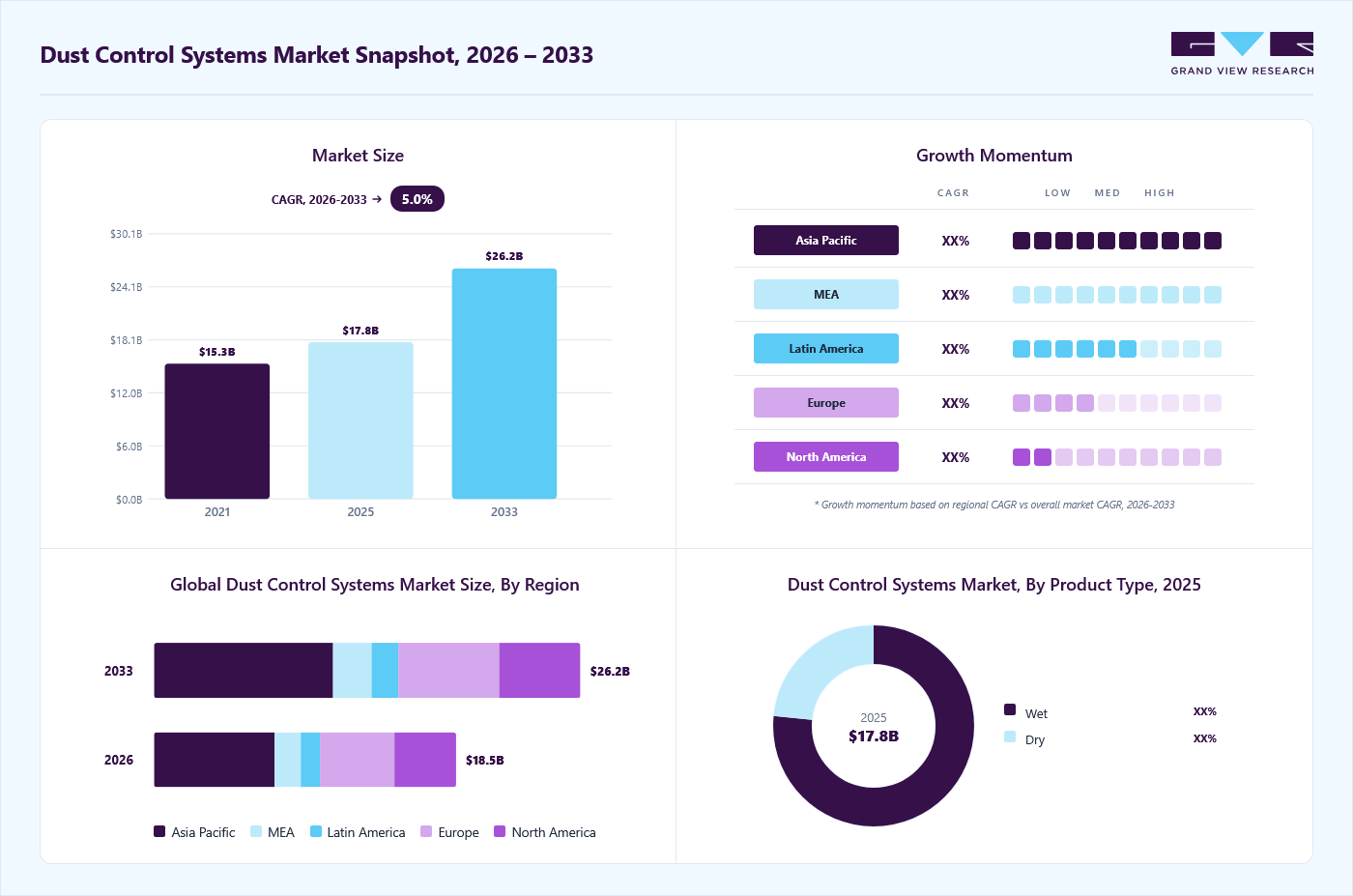
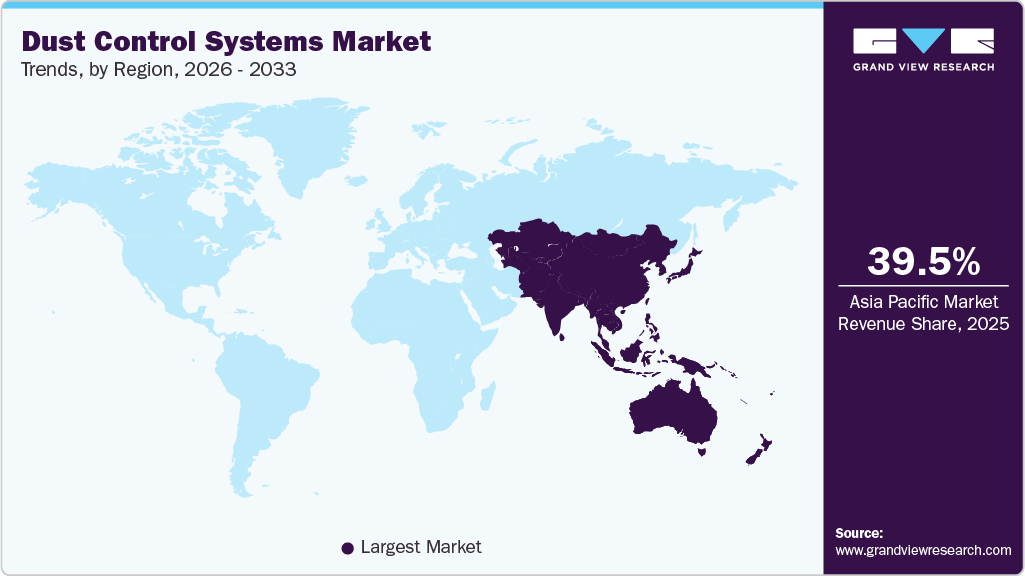
The global dust control systems market size was valued at USD 17.8 billion in 2025 and is projected to grow from USD 18.5 billion in 2026 to USD 26.2 billion by 2033, at a CAGR of 5.0% from 2026 to 2033. The market in Asia Pacific dominated with a revenue share of 39.5% in 2025. This growth can be attributed to the increasing industrial activities, especially in construction and mining, which generate significant dust emissions, necessitating effective control solutions.
Key Market Trends & Insights
- By product: Wet dust control systems segment held the largest market share of 76.5% in 2025.
- By application: Construction segment held the largest market share of 20.9% in 2025.
Regional Highlights
- Largest regional market: Asia Pacific (39.5% revenue share, 2025)
- By country: China held the largest market share in 2025
Market Size & Forecast
- Market size in 2025: USD 17.8 Billion
- Estimated market size in 2026: USD 18.5 Billion
- Projected market size by 2033: USD 26.2 Billion
- CAGR (2026-2033): 5.0%
In addition, heightened awareness of health risks associated with airborne dust particles has led industries to prioritize worker safety and compliance with stringent environmental regulations. Growing awareness of occupational health risks is further accelerating market demand. Prolonged exposure to fine dust particles is linked to respiratory and chronic health issues, prompting companies to invest in reliable dust control systems. Industries such as pharmaceuticals, food & beverage, and chemicals require cleaner production environments to protect both workers and product quality. This shift toward safer and more sustainable operations continues to support long-term market growth.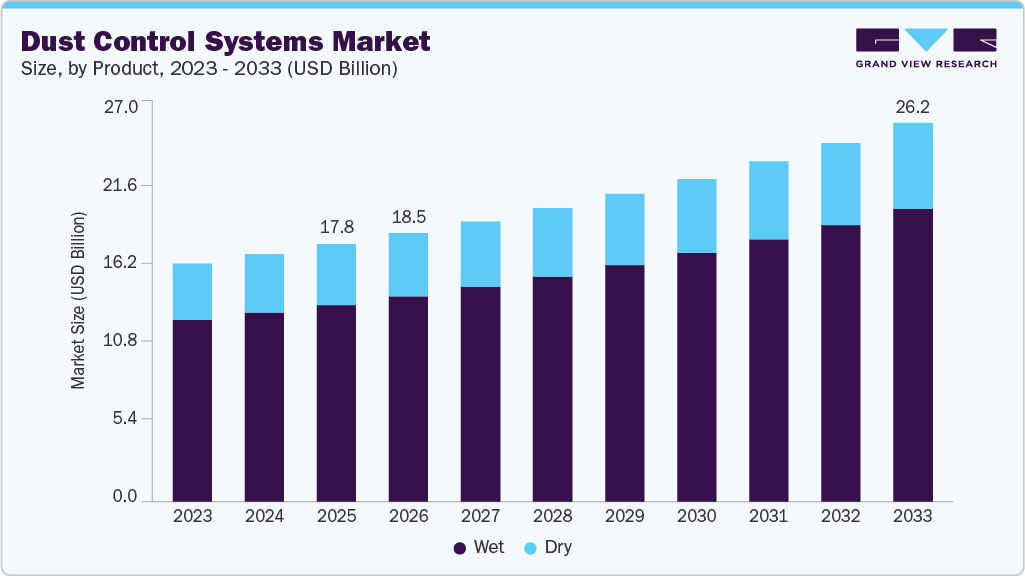
Market Concentration & Characteristics
The dust control systems industry is moderately fragmented, with the presence of both global manufacturers and a large number of regional and niche players. Large companies compete through broad product portfolios, strong distribution networks, and long-term contracts with industrial clients. At the same time, smaller firms focus on customized solutions and cost-effective systems tailored to specific applications. This mix of scale-driven leaders and specialized suppliers keeps competition active and limits high market concentration.
The need for higher efficiency and lower operating costs drives innovation in the dust control systems industry. Manufacturers are focusing on smart monitoring, automated filtration, and energy-efficient designs to improve system performance. Integration of sensors and real-time dust monitoring is helping end users optimize maintenance and reduce downtime. Continuous upgrades in filter media and hybrid systems are strengthening product differentiation.
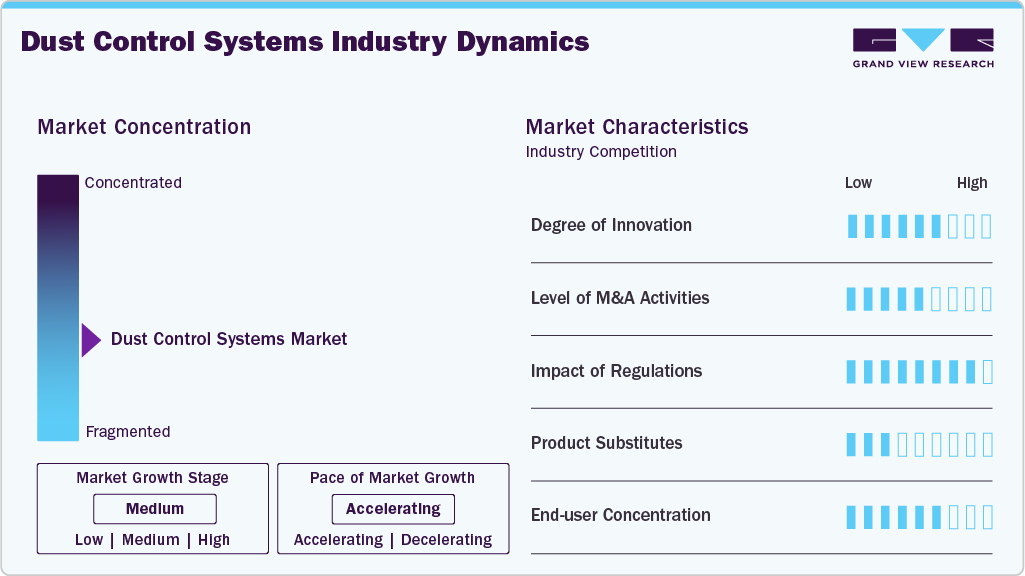
Environmental and occupational safety regulations play a major role in shaping market demand. Stricter emission limits and worker exposure standards are forcing industries to replace outdated dust control equipment. Regulatory compliance has become a key purchasing criterion, especially in construction, mining, and chemical sectors. This pressure is accelerating the adoption of certified and high-performance dust control solutions.
End-user demand is spread across multiple industries, resulting in a diversified customer base. Construction and mining account for a significant share, while pharmaceuticals, food & beverage, and chemicals contribute to steady demand. Large industrial operators often invest in centralized systems, whereas smaller facilities prefer modular or portable units. This broad end-user mix reduces reliance on any single sector and supports stable market growth.
Drivers, Opportunities & Restraints
The dust control systems industry is driven by rising industrial activity and increasing focus on workplace safety. Expanding construction, mining, and infrastructure projects generate high dust levels that require effective control solutions. Stricter environmental norms and employee health regulations are pushing industries to upgrade or install modern systems. Growing awareness of long-term health risks from dust exposure further supports demand.
Opportunities are emerging from rapid industrial growth in developing economies and large-scale infrastructure investments. Industries are increasingly adopting advanced and automated dust control solutions to improve efficiency and reduce manual intervention. Demand for customized systems in pharmaceuticals and food processing is creating new growth avenues. The shift toward sustainable and energy-efficient technologies also opens the scope for product innovation.
High initial installation costs remain a key restraint, especially for small and medium-sized enterprises. Maintenance requirements and periodic replacement of filters can add to long-term operating expenses. Limited awareness and weak regulatory enforcement in some regions’ slow adoption. In certain applications, space constraints and system integration challenges further restrict market growth.
Product Insights
Wet dust control systems dominate the market and accounted for a 76.5% share in 2025, due to their strong performance in suppressing fine and combustible dust. They are widely used in mining, construction, and heavy industrial applications where explosion risk and high dust loads are common. These systems are effective in high-temperature and high-moisture environments, making them suitable for continuous operations. Their ability to reduce airborne particles at the source supports their widespread adoption.
Dry segment is expected to grow at a moderate CAGR of 4.6% from 2026 to 2033 in terms of revenue. Dry dust control systems are witnessing significant growth driven by demand from industries requiring clean and moisture-free operations. Sectors such as pharmaceuticals, food & beverage, and chemicals prefer dry systems for their high filtration efficiency and ease of dust recovery. Advancements in filter media and compact designs are improving system reliability and lowering operating costs. This has made dry systems increasingly attractive for both large facilities and smaller industrial setups.
Application Insights
The construction sector dominated the market, accounting for a 20.9% share in 2025, due to extensive infrastructure development and urbanization. Activities such as drilling, cutting, demolition, and material handling generate high levels of airborne dust. Strict regulations related to worker safety and silica exposure are driving consistent adoption of dust control solutions at construction sites. Contractors increasingly rely on both wet suppression and portable systems to meet compliance requirements.
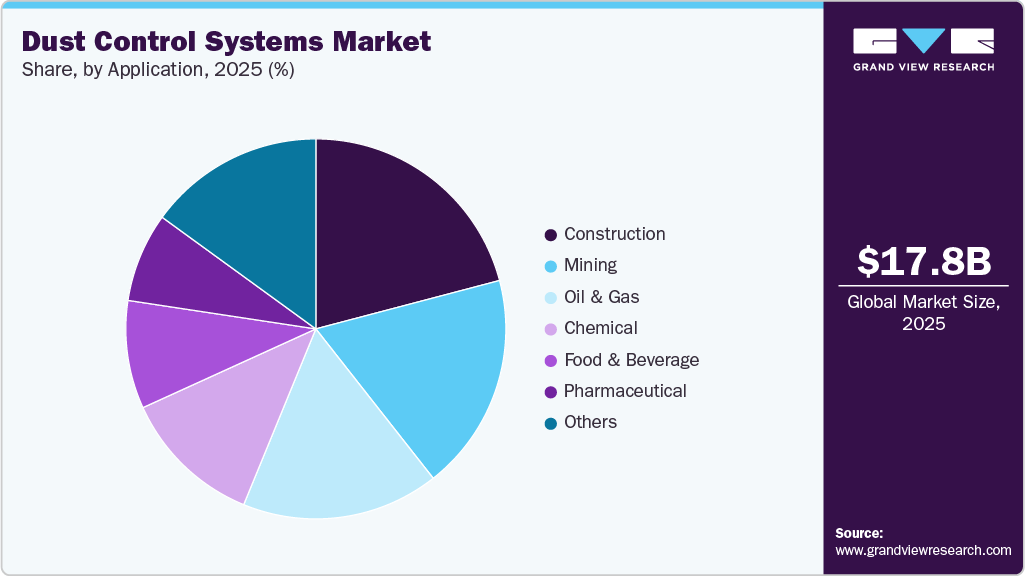
The oil & gas segment is expected to grow at a significant CAGR of 5.3% from 2026 to 2033 in terms of revenue. The oil & gas sector is experiencing significant growth in demand for dust control systems across upstream and downstream operations. Drilling, refining, and bulk material handling in dry and hazardous environments create a strong need for effective dust management. Rising investments in exploration and production, especially in arid regions, are supporting system deployment. Enhanced focus on operational safety and emission control is further accelerating adoption in this sector.
Regional Insights
North America is witnessing steady growth at a CAGR of 4.0% over the forecast period, driven by strict environmental and occupational safety regulations. The construction, oil & gas, and mining sectors are key contributors to demand. Companies are increasingly upgrading legacy systems to meet emission standards. Technological adoption and automation further support market expansion in the region.
U.S. Dust Control Systems Market Trends
The dust control systems market in the U.S. dominates North America due to strict environmental and workplace safety regulations. Strong demand from construction, mining, and oil & gas industries supports widespread system adoption. Ongoing infrastructure upgrades and shale-related activities continue to generate high dust control requirements. Advanced technologies and early adoption of automated systems further strengthen market leadership.
Mexico dust control systems market is emerging as a growing market driven by expanding manufacturing and construction activities. Industrial growth in automotive, food processing, and chemicals is increasing the need for effective dust management. Rising awareness of worker health and gradual tightening of safety regulations are supporting adoption. Cost-effective and modular dust control solutions are particularly gaining traction in the country.
Europe Dust Control Systems Market Trends
The dust control systems market in Europe is growing steadily due to strong regulatory frameworks focused on emission control and worker health. Industrial modernization and sustainability initiatives are encouraging the use of advanced dust control systems. Construction and chemical industries remain major end users. The replacement of aging equipment across industrial facilities also supports demand.
Germany dust control systems market dominates Europe due to its strong industrial base and strict environmental regulations. High demand from manufacturing, automotive, and chemical industries supports consistent system deployment. Emphasis on workplace safety and emission reduction drives the adoption of advanced filtration and dust collection technologies. Ongoing modernization of industrial facilities further reinforces market leadership.
The dust control systems market in France is experiencing steady growth driven by construction activity and industrial upgrades. Rising investments in infrastructure and energy projects are increasing the need for dust control solutions. Strong focus on employee health and compliance with EU environmental standards supports adoption. Demand is also growing for energy-efficient and low-maintenance dust control systems.
Asia Pacific Dust Control Systems Market Trends
The dust control systems market in the Asia Pacific dominated the market and accounted for a 39.5% share, due to rapid industrialization and large-scale infrastructure development. Strong growth in construction, mining, and manufacturing across China, India, and Southeast Asia is driving demand. Increasing enforcement of workplace safety and environmental norms is supporting system adoption. Cost-effective solutions and expanding industrial bases continue to strengthen the region’s lead.
China dust control systems market dominates the Asia Pacific due to its large-scale industrial and construction activities. Extensive mining operations, manufacturing hubs, and infrastructure projects generate significant dust emissions. Government-led initiatives to reduce industrial pollution are accelerating the adoption of dust control solutions. Continuous upgrades of industrial facilities further support sustained market demand.
The dust control systems market in India is emerging as a fast-growing market driven by rapid urbanization and infrastructure expansion. Rising construction, mining, and cement production are increasing the need for dust control systems. Strengthening enforcement of workplace safety and environmental regulations is improving adoption rates. Growing awareness of occupational health risks is also supporting long-term market growth.
Middle East & Africa Dust Control Systems Market Trends
The dust control systems market in the Middle East & Africa region is growing due to expansion in oil & gas, mining, and large construction projects. Harsh climatic conditions and high dust levels make dust control systems essential. Governments are placing greater emphasis on industrial safety and environmental protection. Increasing industrial investments are expected to support long-term market growth.
Saudi Arabia dust control systems market is emerging as a growing market for dust control systems due to large-scale construction and infrastructure projects. Expansion in oil & gas operations and mining activities is generating high demand for effective dust management. Harsh climatic conditions and frequent dust exposure make control systems essential for worker safety. Increasing regulatory focus on environmental protection is further supporting market growth.
Latin America Dust Control Systems Market Trends
The dust control systems market in Latin America is experiencing gradual growth supported by mining and infrastructure development. Countries rich in mineral resources are investing in dust control to improve safety and regulatory compliance. Rising awareness of occupational health risks is improving adoption rates. However, cost sensitivity still influences purchasing decisions in the region.
Brazil dust control systems market is experiencing steady growth driven by mining, construction, and industrial expansion. Large-scale infrastructure projects and mineral extraction activities generate significant dust emissions. Rising awareness of occupational health and environmental compliance is encouraging the adoption of control systems. Investments in modern industrial facilities are further supporting long-term market growth.
Key Dust Control Systems Company Insights
Some of the key players operating in the market include Donaldson Company, Inc., CDC Dust Control, and Camfil APC.
-
Donaldson Company, Inc. plays a strong role in the market through its wide range of industrial dust collectors and filtration solutions. The company focuses heavily on high-efficiency particulate removal for construction, mining, and manufacturing environments. Its systems are designed to handle fine and hazardous dust while supporting regulatory compliance. Donaldson also emphasizes durability and low lifecycle costs, which appeal to large industrial users. Continuous product upgrades and aftermarket services strengthen its competitive positioning.
-
CDC Dust Control specializes in wet dust suppression systems tailored for heavy-duty applications. The company is known for its Fogging Cannon and misting technologies used in construction, demolition, and bulk material handling. Its solutions are designed for rapid dust knockdown with minimal water usage. CDC focuses on mobile and easy-to-deploy systems, making them suitable for temporary and outdoor sites. Strong application-specific engineering supports its presence in high-dust environments.
Key Dust Control Systems Companies:
The following key companies have been profiled for this study on the dust control systems market.
- Donaldson Company, Inc.
- CDC Dust Control
- Camfil APC
- National Environmental Services, LLC
- AirPro, Inc.
- Dustcontrol Inc.
- C&W DustTech
- Dust Solutions, Inc.
- Piian Systems LLC
- New Waste Concepts Inc.
- Air Solutions, Inc.
- Sealpump Engineering Ltd.
- EnviroSystems Manufacturing, LLC
Recent Developments
-
In October 2025, Camfil APC launched the Gold Series III as an upgraded industrial dust collection solution. The system features an improved filter design to enhance dust capture while reducing energy consumption. Its modular structure allows flexible installation and easy future expansion. The design also helps lower maintenance needs and overall operating costs.
-
In April 2024, Donaldson Company, Inc. introduced the DFPRE 2 as a compact, pre-assembled dust collector designed for quick installation. The system targets space-limited industrial environments while maintaining high dust collection efficiency. It supports a range of dust types and operational needs with flexible configuration options. Built-in digital monitoring helps improve uptime and simplifies maintenance planning.
Global Dust Control Systems Market Report Scope
Report Attribute
Details
Market size in 2025
USD 17.8 billion
Estimated market size in 2026
USD 18.5 billion
Projected market size by 2033
USD 26.2 billion
Growth rate
CAGR of 5.0% from 2026 to 2033
Historical data
2021 - 2024
Forecast period
2026 - 2033
Quantitative units
Revenue in USD million/billion and CAGR from 2026 to 2033
Report coverage
Revenue forecast, company ranking, competitive landscape, growth factors, and trends
Segments covered
Product, application, region
Regional scope
North America; Europe; Asia Pacific; Latin America; MEA
Country scope
U.S.; Canada; Mexico; UK; Germany; France; Italy; China; Japan; India; Australia; Australia; Brazil; Argentina; Saudi Arabia; UAE
Key companies profiled
Donaldson Company, Inc.; CDC Dust Control.; Camfil APC; National Environmental Services, LLC; AirPro, Inc.; Dustcontrol Inc.; C&W DustTech; Dust Solutions, Inc.; Piian Systems LLC; New Waste Concepts Inc.; Air Solutions, Inc.; Sealpump Engineering Ltd.; EnviroSystems Manufacturing, LLC.
Customization scope
Free report customization (equivalent up to 8 analysts working days) with purchase. Addition or alteration to country, regional & segment scope.
Pricing and purchase options
Avail customized purchase options to meet your exact research needs. Explore purchase options
Global Dust Control Systems Market Report Segmentation
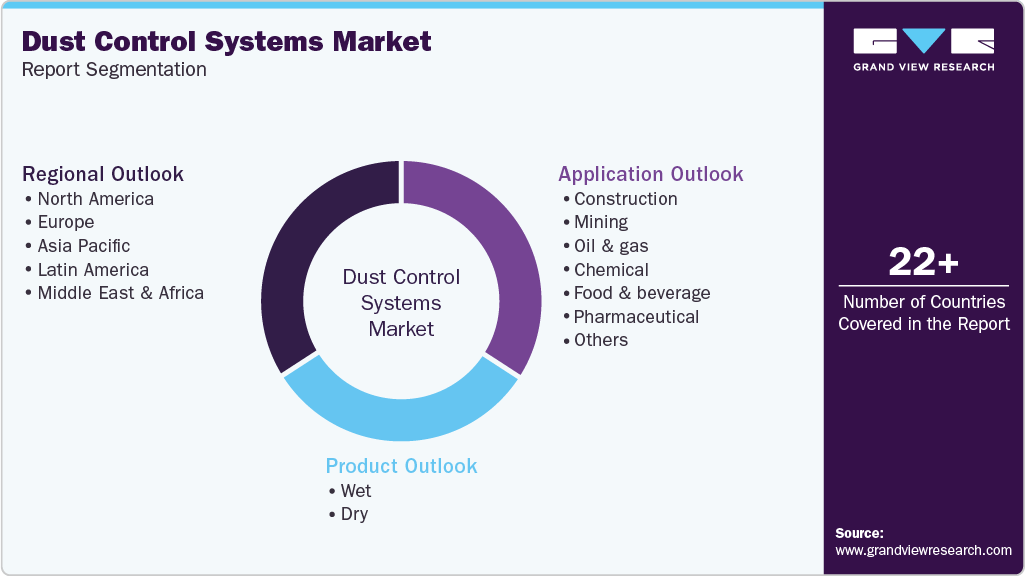
This report forecasts revenue growth at global, regional, and country levels and provides an analysis of the latest industry trends in each of the sub-segments from 2021 to 2033. For this study, Grand View Research has segmented the global dust control systems market report based on product, application, and region:
-
Product Outlook (Revenue, USD Million, 2021 - 2033)
-
Wet
-
Wet scrubbers
-
Wet electrostatic precipitators (WEPS)
-
-
Dry
-
Bag Dust Collectors
-
Cyclone Dust Collectors
-
Electrostatic Dust Collectors
-
Vacuum Dust Collectors
-
Others
-
-
-
Application Outlook (Revenue, USD Million, 2021 - 2033)
-
Construction
-
Mining
-
Oil & gas
-
Chemical
-
Food & beverage
-
Pharmaceutical
-
Others
-
-
Regional Outlook (Revenue, USD Million, 2021 - 2033)
-
North America
-
U.S.
-
Canada
-
Mexico
-
-
Europe
-
Germany
-
France
-
Italy
-
UK
-
-
Asia Pacific
-
China
-
India
-
Japan
-
Australia
-
-
Latin America
-
Brazil
-
Argentina
-
-
Middle East and Africa
-
UAE
-
Saudi Arabia
-
-
Frequently Asked Questions About This Report
The global dust control systems market size was estimated at USD 17.8 billion in 2025 and is expected to be USD 18.5 billion in 2026.
The global dust control systems market, in terms of revenue, is expected to grow at a compound annual growth rate of 5.0% from 2026 to 2033 to reach USD 26.2 billion by 2033.
Asia Pacific dominated the dust control systems market and accounting for 39.5% share, due to rapid industrialization and large-scale infrastructure development. Strong growth in construction, mining, and manufacturing across China, India, and Southeast Asia is driving demand.
Some key players operating in the dust control systems market include Nederman Holding, Illinois Tool Works, Dust Control Systems, Duztech AB, Donaldson Company, Heylo, Beltran Technologies, Spraying Systems, Dust Control Technologies, and Sly Filters.
Key factors that are driving the market growth include increasing air pollution, growing health concerns, and stringent regulations pertaining to air pollution.
The wet dust control systems segment led with a 76.5% revenue share in 2025.
The construction segment led with a 20.9% revenue share in 2025.
About the Author(s)
Advanced Interior Materials Research Team
Advanced Materials · Advanced Interior MaterialsThis report was authored by the advanced interior materials research team at Grand View Research - comprising two research analysts, one senior research analyst, and one industry expert - with specialized expertise in the advanced interior materials segment of the advanced materials industry. All findings are based on proprietary advanced materials databases, executive interviews, and regulatory analysis, subject to internal peer review prior to publication.
Last Updated:
Speak to Analyst


Customize this report to your needs — add regions, segments, or data points, with 20% free customization.
Or view our licence options:


ISO 9001:2015 & 27001:2022 Certified
We are GDPR and CCPA compliant! Your transaction & personal information is safe and secure. For more details, please read our privacy policy.


