
- Home
- »
- Next Generation Technologies
- »
-
Edutainment Market Size & Share Report, 2026-2033GVR Report cover

Edutainment Market (2026 - 2033)
Size, Share & Trends Analysis Report By Type (Interactive, Non-Interactive, Hybrid, Explorative), By Platform (Mobile Apps, Web-Based), By Age Group, By End Use, By Revenue Channel, By Region, And Segment Forecasts
Market Size, 2025
$5.6BMarket Estimate, 2026
$6.1BMarket Forecast, 2033
$12.7BCAGR, 2026–2033
11.1%Edutainment Market Summary
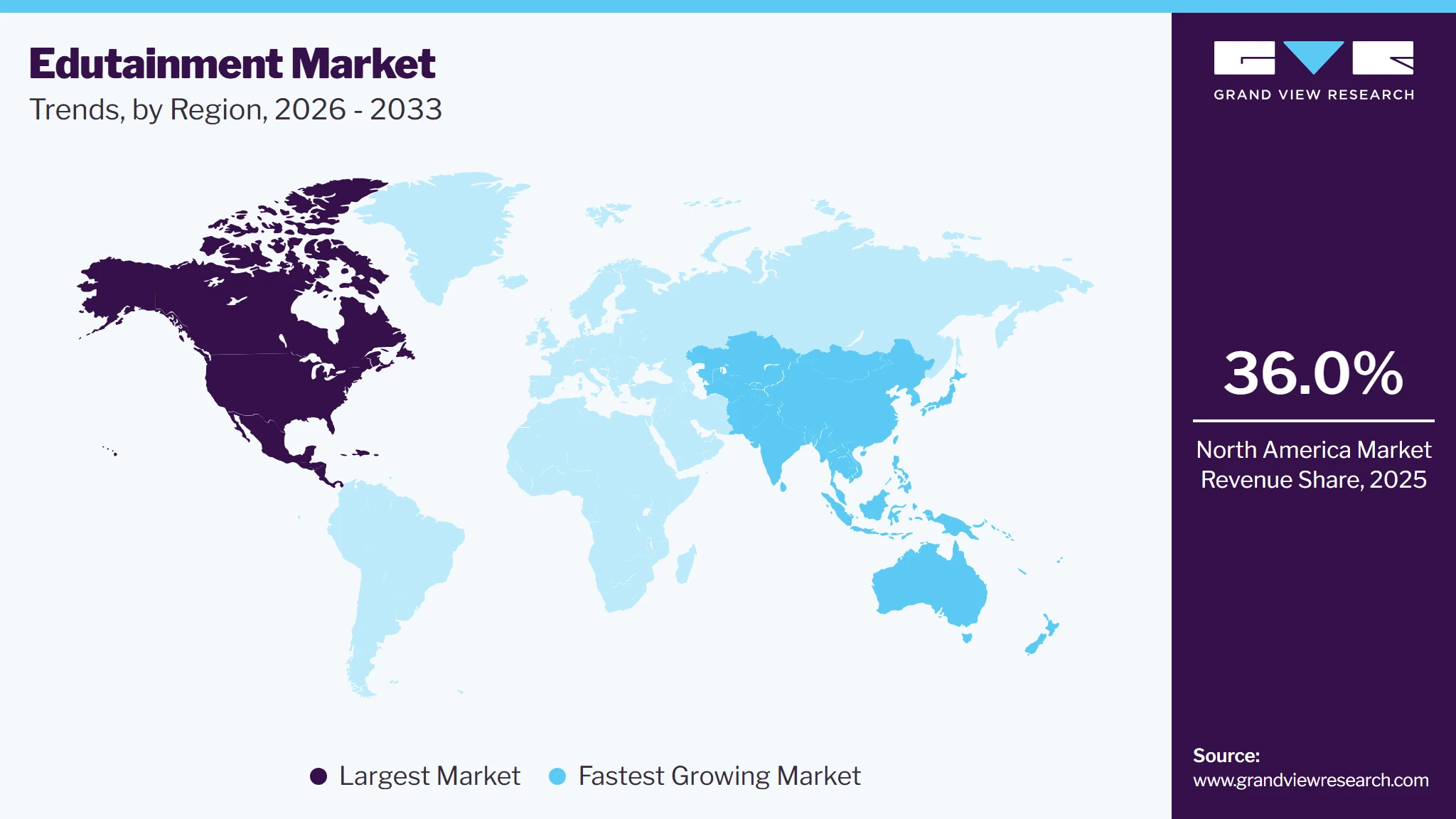
The global edutainment market size was valued at USD 5.6 billion in 2025 and is projected to grow from USD 6.1 billion in 2026 to USD 12.7 billion by 2033, at a CAGR of 11.1% from 2026 to 2033. North America dominated the market, accounting for a revenue share of over 36.0% in 2025. The market witnesses rising demand for gamified learning experiences, increasing integration of digital technologies such as AR/VR and AI, growing adoption of mobile-based educational entertainment platforms, expanding investments in interactive STEM learning and experiential education, and increasing consumer spending on educational content and family-oriented edutainment experiences
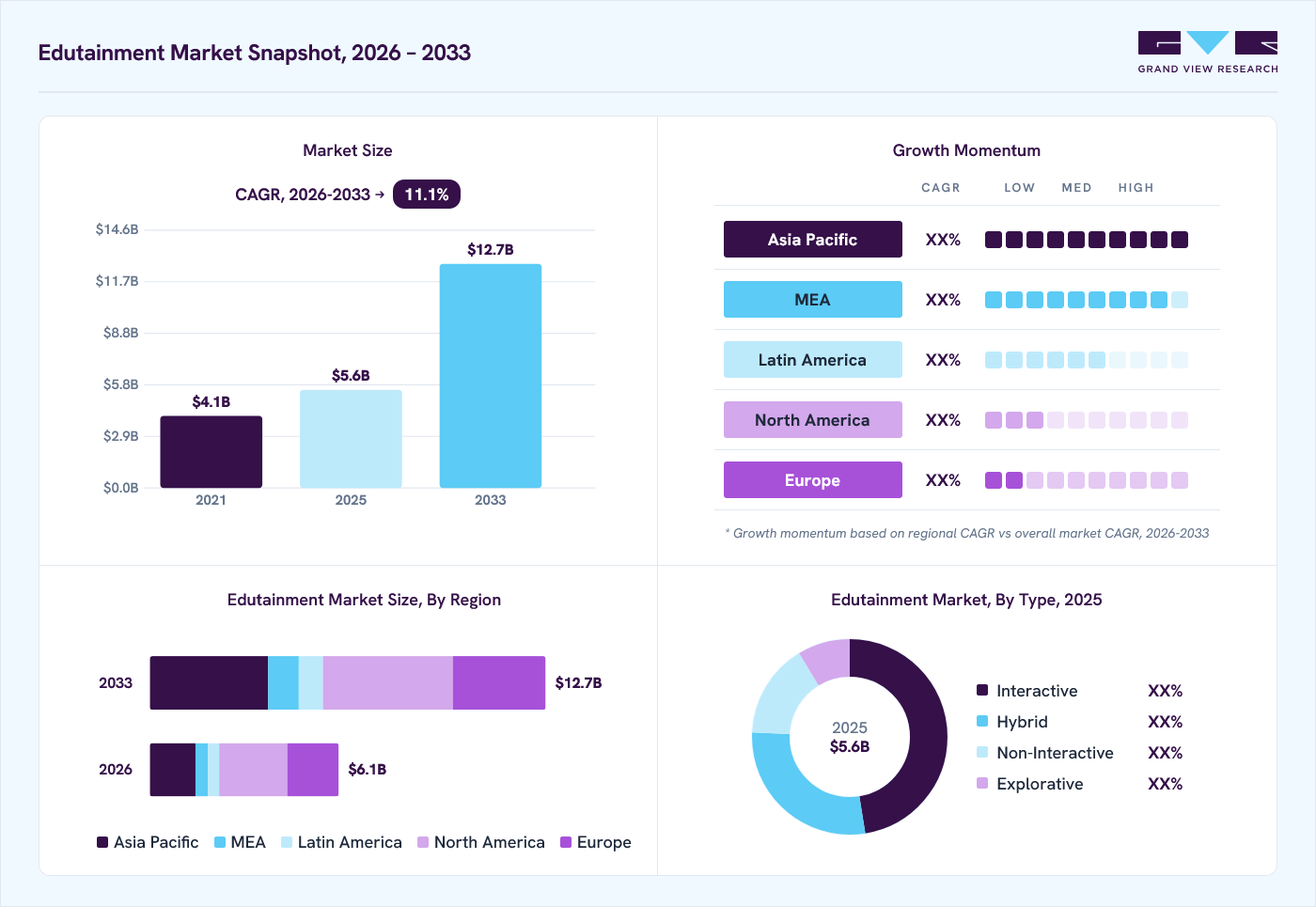 Source: Grand View Research, IR Documents, Primary Interviews, Paid DatabasesTo learn more about this report,
 Download Free Sample Report
Key Market Trends & Insights
- By type: Interactive segment held the largest market share of around 47.0% in 2025.
- By platform: Mobile apps segment held the largest market revenue share in 2025.
- By age group: Children segment led the market with the largest revenue share in 2025.
- By end use: Individual consumers segment held the largest market revenue share in 2025.
- By revenue channel: Subscription/Membership segment held the largest revenue share in 2025.
Regional Highlights
- Largest regional market: North America (36.0% revenue share, 2025)
- Fastest-growing regional market: Asia Pacific (fastest CAGR, 2026-2033)
- Leading country: U.S. held the largest share in 2025
Market Size & Forecasts
- Market size in 2025: USD 5.6 Billion
- Estimated market size in 2026: USD 6.1 Billion
- Projected market size by 2033: USD 12.7 Billion
- CAGR (2026-2033): 11.1%
Prism AI by Grand View Research Free to tryAsk a question about the edutainment marketTry asking✓Every figure cited from GVR research Prefer the report? Download free sample →
The integration of artificial intelligence is enabling edutainment providers to deliver personalized content based on individual learning speeds, preferences, and performance levels. AI-powered tutors, adaptive quizzes, and real-time feedback tools are improving learner engagement while supporting differentiated learning outcomes. Content developers are increasingly using generative AI to accelerate the creation of interactive stories, educational games, and multimedia learning modules. These capabilities are enabling providers to expand content libraries while reducing development time and production costs. Growing demand for customized digital learning experiences is expected to strengthen AI adoption across consumer and institutional edutainment platforms.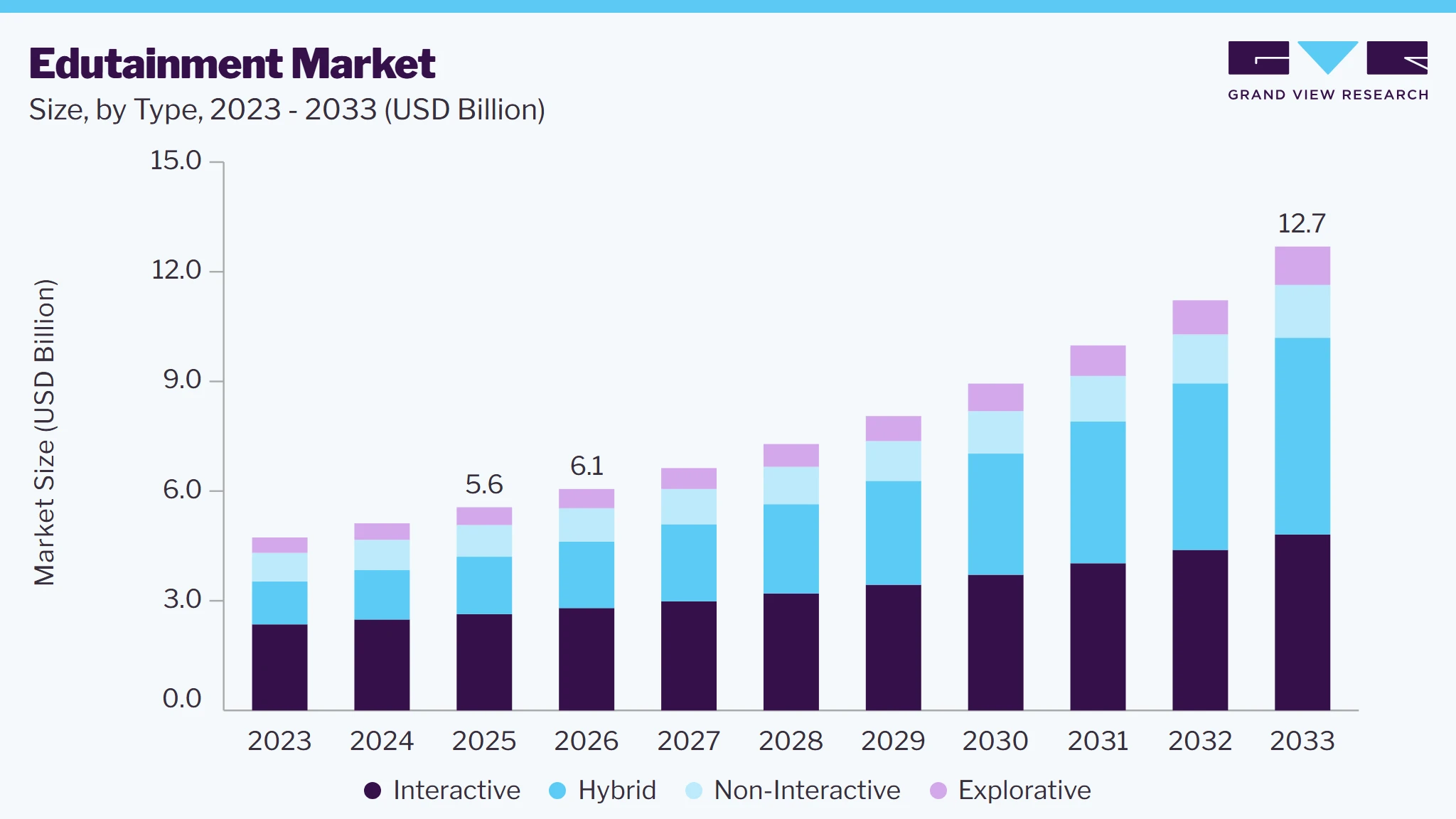 To learn more about this report, Download Free Sample Report
Edutainment providers are increasingly combining physical activities with digital content to create connected learning experiences across online and offline environments. Interactive toys, app-enabled educational kits, location-based games, and technology-enabled learning centers are strengthening participation through hands-on engagement. These hybrid formats allow companies to extend experiences beyond physical venues through companion applications, digital challenges, and ongoing content updates. The model also creates opportunities for recurring revenue through memberships, subscriptions, and complementary digital services. Growing demand for interactive and multisensory learning is encouraging providers to expand hybrid offerings across children’s education, family entertainment, and STEM learning.
The adoption of augmented reality (AR) and virtual reality (VR) is transforming edutainment by enabling learners to explore simulated environments and participate in experiential activities. Providers are integrating immersive technologies into science simulations, historical recreations, virtual laboratories, and interactive educational attractions. These experiences allow users to understand complex concepts through visualization and practical exploration rather than passive content consumption. Improvements in immersive hardware and content development tools are creating opportunities for broader deployment across schools, entertainment venues, and home-based learning. The increasing demand for experiential education is expected to spur investment in immersive edutainment solutions.
Market Dynamics
The global edutainment industry is evolving as consumers increasingly seek educational experiences that combine structured learning with entertainment and interactive engagement. The growing adoption of digital learning platforms, mobile applications, educational games, and immersive technologies is expanding the range of available edutainment offerings. Providers are diversifying their portfolios across age groups, platforms, and learning environments to address changing consumer preferences. Increasing demand for personalized content and experiential learning is encouraging the integration of artificial intelligence, augmented reality, and virtual reality into educational entertainment solutions. However, content development costs, technology accessibility, monetization challenges, and the need to maintain educational effectiveness continue to influence market expansion and competitive strategies.
Growing demand for interactive and gamified learning experiences is driving the adoption of edutainment solutions across consumer and institutional settings. Educational games, quizzes, simulations, and reward-based learning platforms are enabling providers to improve participation and sustain user engagement. Schools and educational institutions are increasingly incorporating interactive digital resources to complement conventional teaching methods and support practical learning. The expansion of smartphone usage and internet connectivity is further improving access to educational entertainment across diverse demographic groups. These factors are encouraging companies to invest in engaging content, adaptive learning features, and technology-enabled educational experiences.
High development and implementation costs are restraining the adoption of advanced edutainment solutions, particularly those incorporating augmented reality, virtual reality, and artificial intelligence. Developing high-quality educational content requires investments in instructional design, software development, multimedia production, and continuous platform maintenance. Limited access to reliable internet connectivity, compatible devices, and digital infrastructure can restrict adoption in underserved and price-sensitive markets. Providers must also balance entertainment value with educational accuracy to ensure that engaging content delivers meaningful learning outcomes. These constraints can increase operational complexity, delay market penetration, and limit the scalability of technology-intensive edutainment offerings.
The growing integration of artificial intelligence, augmented reality, and virtual reality presents opportunities for companies to develop differentiated edutainment experiences. AI-enabled platforms can personalize learning pathways, adjust content difficulty, and provide immediate feedback based on individual performance. Immersive technologies can expand applications across virtual laboratories, historical simulations, interactive museums, and experiential STEM education. Partnerships with schools, educational institutions, technology providers, and entertainment venues can accelerate product development and broaden distribution channels. The expansion of subscription-based platforms and hybrid physical-digital offerings also creates opportunities to generate recurring revenue and reach new customer segments.
Market Concentration & Characteristics
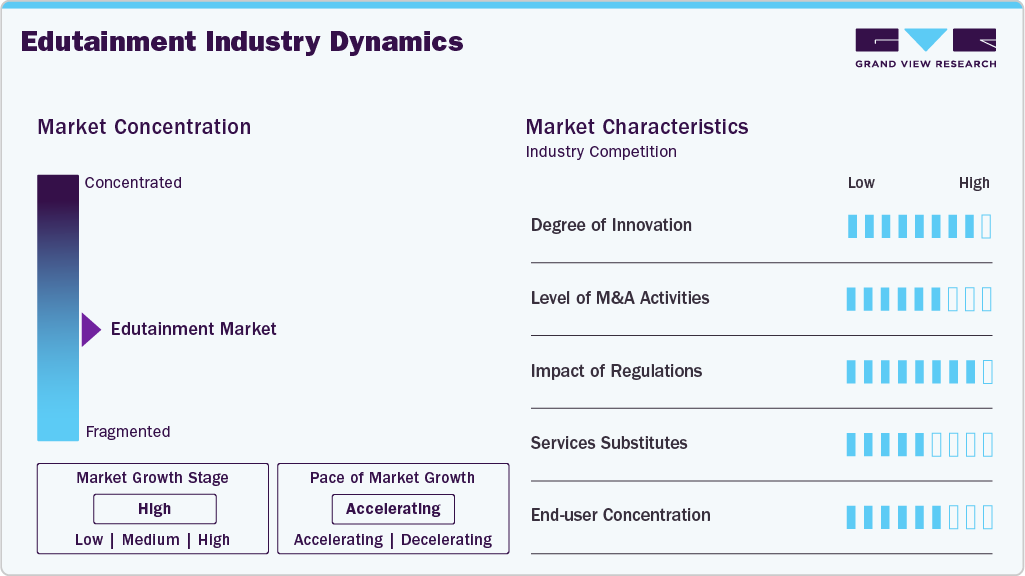
The global edutainment market is characterized by a fragmented competitive landscape, with established educational content providers, digital learning platforms, gaming companies, and experiential entertainment operators competing across diverse consumer segments. Market participants are strengthening their competitive positioning through interactive content development, gamification, subscription-based offerings, and technology-enabled learning experiences. Increasing integration of artificial intelligence, augmented reality, and virtual reality is encouraging companies to differentiate their portfolios and expand their presence across digital and physical edutainment formats. Strategic partnerships, product innovation, and geographic expansion are emerging as key approaches for improving market reach and strengthening competitive advantage.
 To learn more about this report, Download Free Sample Report
The edutainment market exhibits diverse revenue models and delivery formats, including mobile applications, web-based platforms, educational games, immersive simulations, and physical learning attractions. Market demand is supported by growing interest in personalized learning, experiential education, and entertainment-led educational content across children, teenagers, and adult learners. Competition is intensifying as providers expand their content libraries, improve user engagement, and integrate educational objectives with interactive entertainment experiences. Companies that combine effective learning outcomes, accessible technology, scalable distribution channels, and sustainable monetization strategies are positioned to strengthen their market presence and capture emerging growth opportunities.
Analyst Perspective
The edutainment market is positioned for sustained expansion as demand increases for learning experiences that combine educational value with interactive entertainment. The integration of artificial intelligence, gamification, augmented reality, and virtual reality is expected to strengthen product differentiation and improve learner engagement across digital and physical platforms. Companies that develop age-specific content, personalized learning pathways, and hybrid physical-digital experiences are likely to gain a competitive advantage. However, providers must address content development costs, digital accessibility, data privacy, and the need to demonstrate measurable educational outcomes to support long-term adoption. From an analyst's perspective, companies that balance engaging content, learning effectiveness, scalable business models, and strategic partnerships are well-positioned to capitalize on emerging opportunities in the global edutainment market.
Type Insights
The Interactive segment dominated the market, accounting for over 47.0% of global revenue in 2025, driven by increasing demand for engaging, participation-based learning experiences across digital and physical platforms. The growing popularity of gamified applications, educational quizzes, and immersive content is strengthening adoption across the online gaming edutainment market. Furthermore, the expansion of the edutainment center market is supporting demand for interactive attractions, role-playing activities, and technology-enabled experiential learning environments. Continued integration of artificial intelligence, augmented reality, and virtual reality is expected to enhance personalization, improve user engagement, and sustain demand for interactive edutainment solutions.
The hybrid segment is anticipated to grow significantly during the forecast period, driven by rising demand for learning experiences that combine digital technologies with hands-on educational activities. The integration of mobile applications, interactive toys, augmented reality, and physical learning kits enables providers to deliver more engaging and immersive edutainment experiences. Growing adoption of hybrid learning formats across educational institutions, households, and experiential entertainment venues is further supporting segment expansion. Continued advancements in connected devices and personalized content are expected to strengthen the adoption of hybrid edutainment solutions and create new revenue opportunities for market participants.
Platform Insights
The mobile apps segment dominated the edutainment industry, accounting for over 55.0% of global revenue in 2025, driven by increasing smartphone penetration, widespread internet connectivity, and growing consumer preference for convenient, on-demand learning experiences. The integration of gamification, interactive quizzes, educational videos, and personalized learning features is strengthening engagement across mobile-based edutainment platforms. Growing adoption of subscription-based applications and in-app monetization models is enabling providers to expand their content offerings and generate recurring revenue. Continued advancements in artificial intelligence, mobile gaming, and adaptive learning technologies are expected to reinforce the role of mobile applications in expanding access to educational entertainment across diverse age groups.
The AR/VR segment is expected to grow significantly during the forecast period, driven by rising demand for immersive, experiential learning across educational and entertainment settings. The integration of augmented reality and virtual reality is enabling edutainment providers to develop interactive simulations, virtual laboratories, and three-dimensional learning environments that improve concept visualization and user engagement. Growing adoption of immersive technologies in STEM education, museums, educational attractions, and digital learning applications is further expanding the segment's commercial potential. Continued advancements in affordable immersive devices, interactive content development, and AI-enabled experiences are expected to accelerate AR/VR adoption and strengthen its role in the evolution of the global market.
Age Group Insights
The children segment dominated the edutainment market, accounting for over 42.0% of global revenue in 2025, driven by increasing parental demand for engaging educational content that supports early childhood development and foundational learning. The growing adoption of interactive games, educational mobile applications, animated videos, and hands-on learning activities is strengthening edutainment consumption among children. Increasing integration of gamification, storytelling, and personalized learning features is encouraging providers to develop age-appropriate content that combines entertainment with educational outcomes. Furthermore, rising investments by educational institutions and edutainment companies in child-focused digital platforms and experiential learning solutions are expected to sustain segment growth throughout the forecast period.
The young adults segment is anticipated to witness significant growth during the forecast period, driven by increasing demand for skill-based learning, career-oriented educational content, and interactive digital experiences. Growing adoption of gamified learning applications, virtual simulations, and educational gaming platforms is enabling young adults to engage with complex subjects through flexible and immersive formats. The rising emphasis on professional development, digital skills, and continuous learning is further encouraging providers to introduce edutainment solutions tailored to young adults' academic and career objectives. Additionally, advancements in artificial intelligence, mobile technologies, and personalized content delivery are expected to strengthen user engagement and expand revenue opportunities across the young adult edutainment segment.
End Use Insights
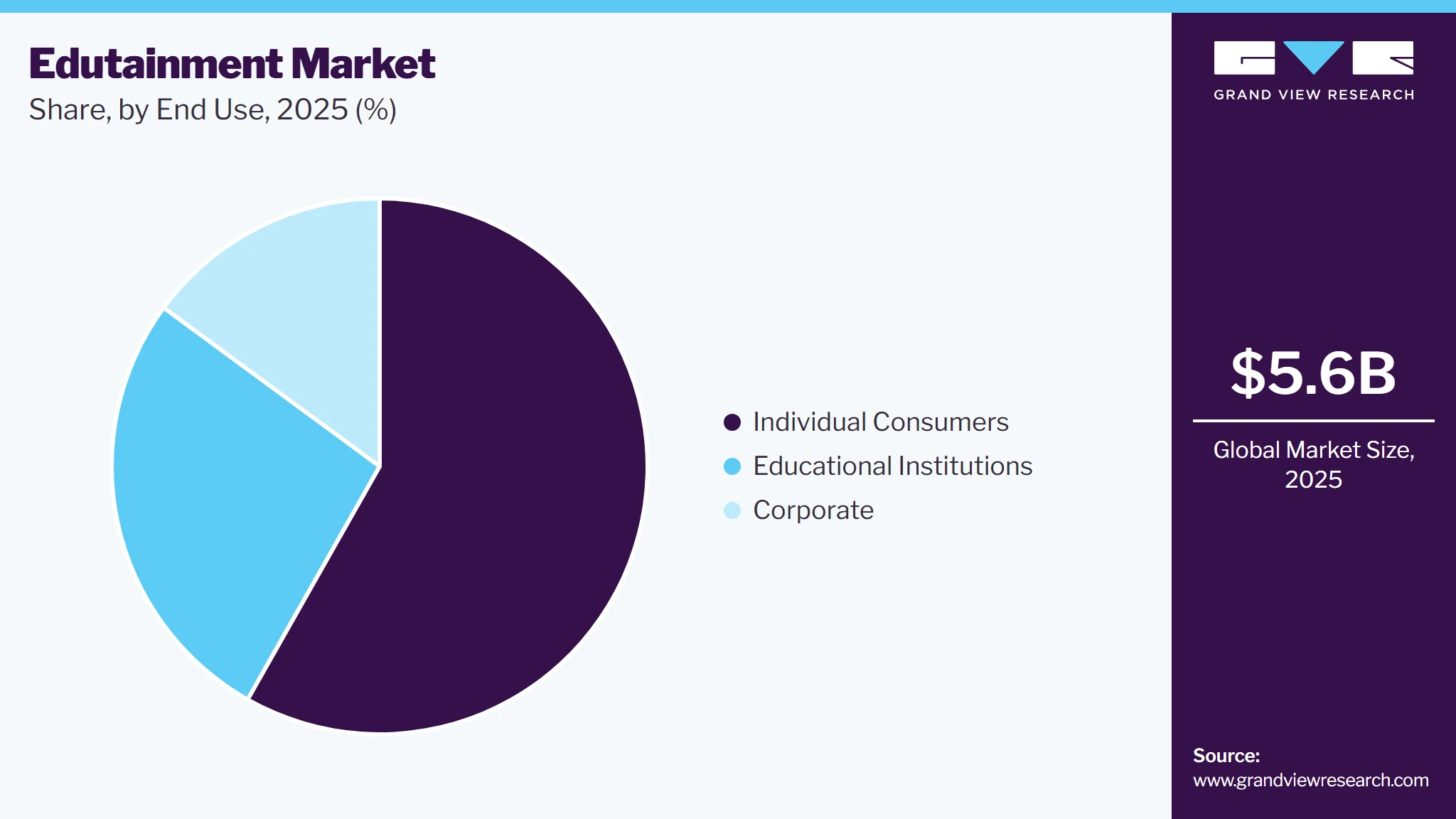
The individual consumers segment dominated the edutainment industry, accounting for over 58.0% of global revenue in 2025, driven by increasing demand for accessible, flexible, and engaging educational entertainment experiences. The growing adoption of mobile learning applications, educational games, and subscription-based digital platforms is enabling individuals and families to access interactive content across age groups. The expansion of the online gaming edutainment market is further supporting consumer participation through gamified learning, personalized content, and reward-based activities. Additionally, increasing parental investment in supplementary educational resources and rising consumer preference for self-paced learning are expected to sustain demand for individual-focused edutainment solutions.
 To learn more about this report, Download Free Sample Report
The corporate segment is expected to witness significant growth during the forecast period, driven by increasing demand for employee skill development, workplace training, and interactive professional learning solutions. Organizations are adopting simulation-based training, scenario-driven exercises, and gamified learning modules to improve knowledge retention and strengthen workforce capabilities. The growing emphasis on digital proficiency, leadership development, and continuous reskilling is encouraging businesses to incorporate engaging educational formats into their training programs. Furthermore, the need to improve training effectiveness, reduce reliance on conventional instruction methods, and support scalable employee development is expected to create new growth opportunities for corporate edutainment providers.
Revenue Channel Insights
The subscription/membership segment dominated the edutainment market, accounting for over 37.0% of global revenue in 2025, driven by increasing consumer preference for continuous access to educational content and interactive learning services. Subscription-based platforms are expanding their offerings through premium features, exclusive content libraries, and personalized learning experiences to encourage recurring engagement. The growing availability of tiered pricing models and family-oriented memberships is enabling providers to attract diverse consumer groups and strengthen revenue predictability. Furthermore, continuous content updates, progress-tracking features, and bundled educational services are expected to support subscription renewals and reinforce the segment’s contribution to the global market.
The merchandising segment is expected to witness significant growth during the forecast period, driven by increasing demand for educational toys, branded learning products, and merchandise associated with popular educational characters and franchises. Edutainment providers are expanding their product portfolios to include interactive learning kits, STEM toys, books, puzzles, and character-based educational products that extend engagement beyond digital platforms. Growing consumer interest in hands-on learning activities and educational gifts is encouraging companies to strengthen merchandise offerings across retail and e-commerce channels. Additionally, strategic licensing agreements, brand collaborations, and the integration of educational content with physical products are expected to create new revenue opportunities and support segment expansion.
Regional Insights
The North America edutainment market accounted for the largest revenue share of over 36.0% in 2025, driven by rapid adoption of digital learning technologies, high consumer spending on educational entertainment, and widespread access to advanced digital infrastructure. The region’s strong presence of edutainment providers, growing integration of gamification and immersive technologies, and increasing use of interactive educational content across schools and households are further supporting market expansion. Additionally, rising investments in AI-powered learning platforms, educational gaming, and experiential entertainment are enabling market participants to diversify offerings and strengthen regional revenue growth.
 To learn more about this report, Download Free Sample Report
U.S. Edutainment Market Trends
The U.S. edutainment industry is gaining momentum, driven by increasing adoption of gamified learning applications, educational gaming platforms, and interactive digital content across schools and households. Growing investments in artificial intelligence, augmented reality, and virtual reality are enabling providers to deliver personalized learning experiences and immersive educational entertainment. Furthermore, rising demand for STEM-focused learning tools, subscription-based educational platforms, and experiential learning solutions is encouraging companies to expand their offerings and strengthen their presence in the U.S. market.
Europe Edutainment Market Trends
The Europe edutainment industry is witnessing robust growth, driven by increasing integration of digital learning technologies, rising demand for interactive educational content, and growing emphasis on experiential learning. The adoption of gamified applications, virtual simulations, and technology-enabled educational attractions is strengthening engagement across schools, households, and cultural institutions. Furthermore, supportive digital education initiatives, expanding STEM learning programs, and continued investments in immersive learning solutions are encouraging market participants to diversify their offerings and expand their regional presence.
Asia Pacific Edutainment Market Trends
The Asia Pacific edutainment industry is expected to grow at the fastest CAGR over the forecast period, driven by rising smartphone penetration, expanding internet access, and increasing demand for digital learning solutions across emerging economies. Growing investments in educational technology, gamified applications, and interactive content are encouraging adoption among students, parents, and educational institutions. Furthermore, rising disposable incomes, expanding middle-class populations, and increasing emphasis on STEM education are creating opportunities for edutainment providers to introduce localized content and scale their presence across the region.
Key Edutainment Company Insights
Key players operating in the edutainment market include Adventure Academy (Age of Learning); Code.org; Duolingo, Inc.; Kahoot!; KidZania; Labster; Osmo (Tangible Play); Prodigy Education; Sesame Workshop; The LEGO Group / LEGO Education.
-
Duolingo, Inc. is a leading digital learning company that combines education with gamification to make language learning accessible and engaging. The company specializes in interactive language-learning lessons, personalized exercises, progress tracking, and reward-based learning experiences through its mobile application and web platform. Its strong focus on bite-sized lessons, user engagement, and adaptive learning supports its position in the digital edutainment market.
-
Kahoot! is an interactive learning platform that combines game-based activities with educational content for students, educators, businesses, and families. The company specializes in quizzes, interactive challenges, live learning games, and digital engagement tools that support knowledge retention and collaborative participation. Its flexible platform enables educational institutions and corporate users to integrate entertainment-led learning into classroom instruction, training, and group activities.
Key Edutainment Companies
The following key companies have been profiled for this study of the edutainment market.
-
Adventure Academy (Age of Learning)
-
Code.org
-
Duolingo, Inc.
-
Kahoot!
-
KidZania
-
Labster
-
Osmo (Tangible Play)
-
Prodigy Education
-
Sesame Workshop
-
The LEGO Group / LEGO Education
Competitive Benchmarking
Operating Strategies
Competitive Edge
Weaknesses
Mature Players: Duolingo, Inc., Kahoot!, Sesame Workshop, The LEGO Group / LEGO Education, KidZania
Mature players focus on expanding educational content portfolios, strengthening gamified learning experiences, developing interactive physical and digital offerings, and extending distribution through mobile applications, educational institutions, licensing agreements, and experiential entertainment venues.
Their competitive advantage lies in established brand recognition, extensive content libraries, strong consumer engagement, proprietary learning formats, established distribution channels, and the ability to combine educational outcomes with entertainment across digital platforms and physical experiences.
These companies face challenges related to high content development and maintenance costs, the need for continuous product innovation, dependence on changing consumer preferences, varying levels of technology accessibility, and the difficulty of balancing entertainment appeal with measurable educational outcomes.
Emerging Players: Adventure Academy (Age of Learning), Code.org, Labster, Osmo (Tangible Play), Prodigy Education
Emerging players focus on specialized edutainment offerings, including game-based academic learning, coding education, virtual science laboratories, interactive physical-digital learning products, and curriculum-aligned digital experiences to address specific learner groups and educational requirements.
Their strengths include focused product specialization, interactive learning formats, targeted audience engagement, innovative delivery models, and the ability to address specific subjects or learning needs through differentiated educational entertainment experiences.
Limited scale compared with diversified global brands, dependence on select product categories or age groups, challenges in expanding distribution and monetization, ongoing technology and content investment requirements, and competition for user engagement may constrain their growth.
Recent Developments
-
In September 2026, Kahoot! introduced new learning experiences to improve classroom engagement and learning outcomes, including device-free game modes, Kahootopia! Assignments, and curriculum-aligned educational content. The company also introduced a ChatGPT integration that enables educators and students to create and customize interactive quizzes from study materials, articles, and documents. These developments strengthen Kahoot!’s position in the edutainment market by expanding accessible, AI-enabled, and collaborative learning experiences for students and educators.
-
In April 2026, Kaspersky partnered with KidZania India to launch Cyber Investigation Centres in Mumbai and Delhi NCR, introducing an interactive role-play experience that teaches children about cybersecurity. The centers use simulated digital missions to help children identify phishing, identity theft, and cyberbullying while practicing safe browsing and responsible online behavior. This partnership strengthens experiential learning in the edutainment industry by combining cybersecurity education with hands-on activities, critical-thinking exercises, and immersive entertainment.
-
In January 2026, The LEGO Group and LEGO Education launched four new STEM science kits designed for children aged seven and above, expanding hands-on educational experiences beyond classrooms into home environments. Developed in collaboration with educators, the kits focus on space, animals, and nature, encouraging children to build, experiment, solve challenges, and explore scientific concepts through interactive play. This launch strengthens the company’s presence in the edutainment market by expanding its home-based learning portfolio and supporting demand for engaging, hands-on STEM education.
Edutainment Market Report Scope
Report Attribute
Details
Market size in 2025
USD 5.6 billion
Estimated market size in 2026
USD 6.1 billion
Projected market size by 2033
USD 12.7 billion
Growth rate
CAGR of 11.1% from 2026 to 2033
Actual data
2021 - 2025
Forecast period
2026 - 2033
Quantitative units
Revenue in USD billion and CAGR from 2026 to 2033
Report coverage
Revenue forecast, company share, competitive landscape, growth factors, and trends
Segments covered
Type, platform, age group, end use, revenue channel, and region
Regional scope
North America; Europe; Asia Pacific; Latin America; Middle East and Africa
Country scope
U.S.; Canada; Mexico; UK; Germany; France; China; Japan; India; South Korea; Australia; Brazil; UAE; KSA; South Africa
Key companies profiled
Adventure Academy (Age of Learning); Code.org; Duolingo, Inc.; Kahoot!; KidZania; Labster; Osmo (Tangible Play); Prodigy Education; Sesame Workshop; The LEGO Group / LEGO Education
Customization scope
Free report customization (equivalent to up to 8 analyst working days) with purchase. Addition or alteration to country, regional & segment scope.
Pricing and purchase options
Avail customized purchase options to meet your exact research needs. Explore purchase options
Global Edutainment Market Report Segmentation
This report forecasts revenue growth at the global, regional & country levels and provides an analysis of the latest industry trends in each of the sub-segments from 2021 to 2033. For this study, Grand View Research has segmented the global edutainment market report based on type, platform, age group, end use, revenue channel, and region:
-
Type Outlook (Revenue, USD Billion, 2021 - 2033)
-
Interactive
-
Non-Interactive
-
Hybrid
-
Explorative
-
-
Platform Outlook (Revenue, USD Billion, 2021 - 2033)
-
Mobile Apps
-
Web-Based
-
PC/Console
-
AR/VR
-
Others
-
-
Age Group Outlook (Revenue, USD Billion, 2021 - 2033)
-
Children
-
Teenagers
-
Young Adults
-
Adults
-
-
End Use Outlook (Revenue, USD Billion, 2021 - 2033)
-
Individual Consumers
-
Educational Institutions
-
Corporate
-
-
Revenue Channel Outlook (Revenue, USD Billion, 2021 - 2033)
-
Subscription/Membership
-
Advertising
-
Ticketing/Admission Fees
-
Merchandising
-
Others
-
-
Regional Outlook (Revenue, USD Billion, 2021 - 2033)
-
North America
-
U.S.
-
Canada
-
Mexico
-
-
Europe
-
UK
-
Germany
-
France
-
-
Asia Pacific
-
China
-
Japan
-
India
-
South Korea
-
Australia
-
-
Latin America
-
Brazil
-
-
Middle East and Africa
-
UAE
-
KSA
-
South Africa
-
-
Research Methodology
The edutainment market figures in this report are based on a proven research process that combines executive interviews with secondary research from proprietary databases, company filings, and recognized regulatory and institutional sources. Market size is built through value-chain sizing—reconciling supply-side and demand-side estimates—and triangulated with bottom-up and top-down approaches. Every estimate passes multiple levels of expert validation before publication, with each edutainment segment quantified using the revenue-capture definitions in the table below.
Segment Definition
Type
Revenue Capture Definition
Interactive
This segment includes edutainment products that require active user participation through quizzes, educational games, simulations, puzzles, and interactive learning activities. It captures revenue generated from products and services that enable users to engage directly with educational content and receive feedback or responses.
Non-Interactive
This segment includes edutainment content consumed primarily through passive viewing, listening, or reading, such as educational videos, documentaries, animated programs, and learning-oriented digital media. It captures revenue generated from the sale, licensing, subscription, or distribution of educational entertainment content that does not require continuous user interaction.
Hybrid
This segment includes edutainment offerings that combine interactive and non-interactive learning formats within a single product or experience. It captures revenue generated from integrated solutions that combine activities such as video-based instruction, educational games, guided lessons, and hands-on learning components.
Explorative
This segment includes edutainment experiences that emphasize discovery, experimentation, and self-directed exploration through educational environments, interactive exhibits, virtual worlds, and experiential attractions. It captures revenue generated from products and experiences that allow users to explore educational concepts, environments, or scenarios at their own pace.
Platform
Revenue Capture Definition
Mobile Apps
This segment includes edutainment applications accessed through smartphones and tablets, covering educational games, language-learning apps, interactive quizzes, and learning-based entertainment content. It captures revenue generated through subscriptions, in-app purchases, paid downloads, advertising, and other monetization methods associated with mobile applications.
Web-Based
This segment includes edutainment platforms accessed through internet browsers, including online learning games, interactive educational websites, web-based quizzes, and browser-based learning experiences. It captures revenue generated through subscriptions, licensing, advertising, paid access, and other commercial services delivered through web platforms.
PC/Console
This segment includes edutainment games and educational entertainment software designed for personal computers, gaming consoles, and compatible systems. It captures revenue generated through software sales, digital downloads, subscriptions, downloadable content, and in-game purchases associated with educational gaming experiences.
AR/VR
This segment includes edutainment solutions that use augmented reality and virtual reality technologies to deliver immersive educational experiences, simulations, and interactive virtual environments. It captures revenue generated through immersive applications, software licenses, virtual experiences, and related digital content designed for AR/VR-compatible devices.
Others
This segment includes edutainment delivered such as television, streaming services, and other specialized digital delivery channels. It captures revenue generated through content licensing, distribution agreements, subscriptions, advertising, and other monetization models associated with these platforms.
Age Group
Revenue Capture Definition
Children
This segment includes edutainment products and experiences designed primarily for children, generally below 13 years of age, combining foundational learning with age-appropriate entertainment. It captures revenue generated from educational games, interactive toys, animated learning content, applications, and experiential activities targeted at this age group.
Teenagers
This segment includes edutainment offerings designed for users generally aged 13–19, covering academic games, coding activities, interactive science content, educational media, and skill-building experiences. It captures revenue generated from digital platforms, educational entertainment products, and experiential learning services specifically targeting teenagers.
Young Adults
This segment includes edutainment products and experiences primarily targeting individuals generally aged 20–29, combining entertainment with higher education support, language learning, professional skill development, and subject-based learning. It captures revenue generated from relevant applications, games, simulations, and digital or physical experiences consumed by this age group.
Adults
This segment includes edutainment offerings designed for individuals aged 30 and above, including educational documentaries, interactive knowledge platforms, hobby-based learning, cultural experiences, and lifelong learning activities. It captures revenue generated from products and services that combine entertainment with personal enrichment, practical knowledge, and continuing education for adult audiences.
End Use
Revenue Capture Definition
Individual Consumers
This segment includes edutainment products and services purchased or accessed by individuals and households for personal learning, leisure, or family-oriented educational activities. It captures revenue from direct consumer payments, subscriptions, application purchases, educational games, interactive toys, and other consumer-focused edutainment offerings.
Educational Institutions
This segment includes edutainment solutions acquired or used by schools, colleges, universities, training centers, museums, and other educational organizations to support learning and student engagement. It captures revenue generated through institutional subscriptions, software licenses, educational content contracts, interactive learning tools, and related edutainment services.
Corporate
This segment includes edutainment solutions adopted by businesses to support employee training, professional development, workplace engagement, and knowledge acquisition through interactive or game-based formats. It captures revenue generated through corporate platform subscriptions, enterprise licenses, customized learning content, simulations, and related training services.
Revenue Channel
Revenue Capture Definition
Subscription/Membership
This segment includes recurring-payment models that provide users with ongoing access to edutainment applications, content libraries, digital learning games, physical attractions, or membership-based experiences. It captures revenue from monthly or annual subscriptions, premium memberships, and recurring access fees paid by individuals, households, or organizations.
Advertising
This segment includes revenue generated by displaying or integrating advertisements within edutainment applications, websites, videos, games, and other educational entertainment content. It captures payments from advertisers and sponsors for ad placements, sponsored content, and other promotional activities associated with edutainment platforms.
Ticketing/Admission Fees
This segment includes payments made by visitors to access physical edutainment venues, including interactive learning centers, educational attractions, themed experiences, and other admission-based facilities. It captures revenue from entry tickets, activity fees, timed experiences, and other access charges associated with educational entertainment venues.
Merchandising
This segment includes sales of physical products associated with edutainment brands, characters, educational content, or learning experiences, such as educational toys, books, games, puzzles, and branded merchandise. It captures revenue generated through direct product sales, retail distribution, e-commerce, licensing arrangements, and merchandise partnerships.
Others
This segment includes edutainment revenue streams not classified under subscriptions/memberships, advertising, ticketing/admission fees, or merchandising. It captures revenue from sponsorships, content licensing, royalties, commissions, food and beverage sales at edutainment venues, and other ancillary commercial activities.
Estimation Model
Layer
Key Questions
Description
Edutainment Demand Layer
Who drives demand for edutainment products and experiences?
Identify demand across individual consumers, educational institutions, and corporate users for educational games, interactive content, and experiential learning.
Edutainment Spending Layer
How much do consumers and organizations spend on edutainment?
Assess spending on digital platforms, educational games, immersive experiences, learning toys, and physical edutainment attractions.
Edutainment Adoption & Segmentation Layer
Which edutainment formats and platforms are adopted?
Evaluate adoption across type, platform, age group, end use, and revenue channel to determine market distribution.
Edutainment Revenue Realization Layer
How much revenue is generated by the edutainment market?
Estimate revenue from digital content, subscriptions, advertising, merchandise, ticketing, and other channels across regions to establish the total market size.
Delivered Customizations
This report has been delivered with the following in-depth customizations
Client Request
Customization Delivered
Value Adds
Edutainment Type & Experience Assessment
Analyzed Interactive, Non-Interactive, Hybrid, and Explorative edutainment formats across digital content, educational games, and experiential learning offerings.
Identifies high-potential edutainment formats, evolving consumer preferences, competitive differentiation, and opportunities for product development.
Platform-Specific Edutainment Adoption Analysis
Assessed adoption across Mobile Apps, Web-Based platforms, PC/Console, AR/VR, and other delivery channels.
Provides insights into platform adoption, technology integration, monetization models, and opportunities to expand digital and immersive edutainment offerings.
Age Group & End-Use Demand Assessment
Evaluated demand across Children, Teenagers, Young Adults, and Adults, covering Individual Consumers, Educational Institutions, and Corporate users.
Supports identification of high-growth customer segments, audience-specific learning requirements, purchasing patterns, and targeted market expansion strategies.
Revenue Channel & Competitive Landscape Assessment
Analyzed Subscription/Membership, Advertising, Ticketing/Admission Fees, Merchandising, and other revenue channels, alongside key edutainment providers and their strategies.
Helps identify monetization opportunities, competitive positioning, revenue diversification strategies, and potential areas for business expansion.
About the Author(s)
Next Generation Technologies Research Team
Technology · Next Generation TechnologiesThis report was authored by the next generation technologies research team at Grand View Research - comprising two research analysts, one senior research analyst, and one industry expert - with specialized expertise in the next generation technologies segment of the technology industry. All findings are based on proprietary technology databases, executive interviews, and regulatory analysis, subject to internal peer review prior to publication.
Last Updated:
Speak to Analyst

Customize this report to your needs - add regions, segments, or data points, with 20% free customization.
Or view our licence options:


ISO 9001:2015 & 27001:2022 Certified
We are GDPR and CCPA compliant! Your transaction & personal information is safe and secure. For more details, please read our privacy policy.


