
- Home
- »
- Plastics, Polymers & Resins
- »
-
Egg Boxes & Trays Market Size & Share Report, 2026-2033GVR Report cover

Egg Boxes And Trays Market (2026 - 2033)
Size, Share & Trends Analysis Report By Distribution Channel (Supermarkets & Hypermarkets, Online Retail/eGrocery, Convenience Stores, Wholesale/Bulk Suppliers), By Application, By Material, By Product Type, By Region, And Segment Forecasts
Market Size, 2025
$3.2BMarket Estimate, 2026
$3.3BMarket Forecast, 2033
$4.5BCAGR, 2026–2033
4.7%Egg Boxes And Trays Market Summary
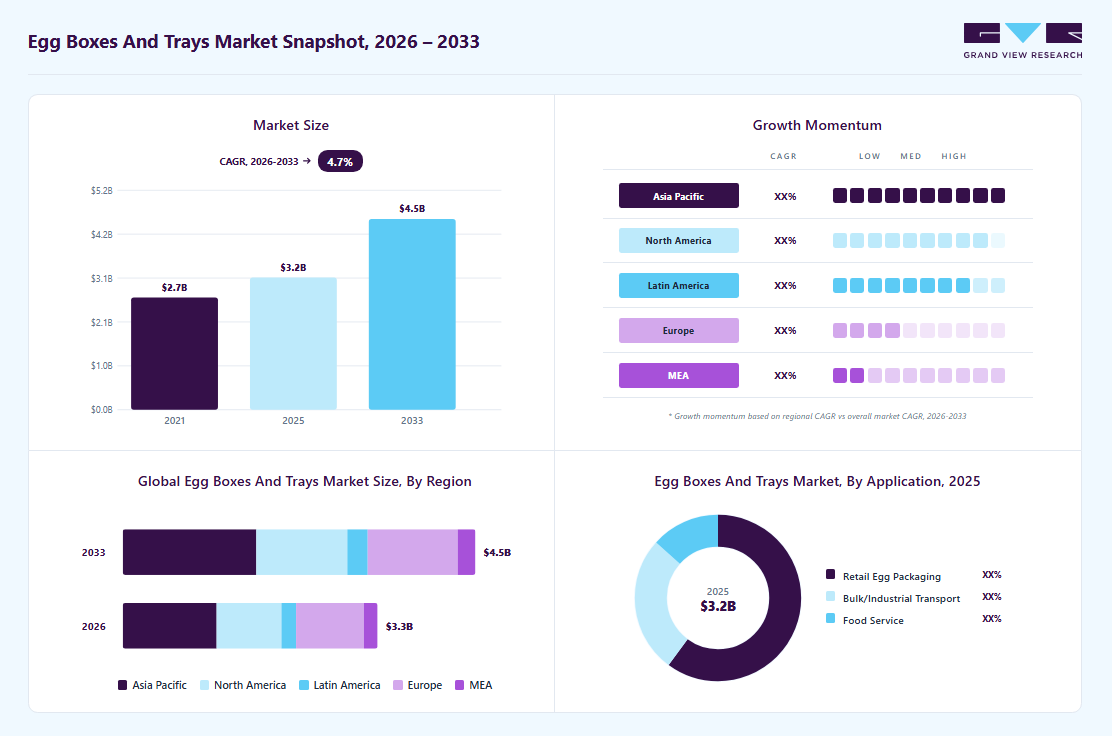
The global egg boxes and trays market was valued at USD 3.2 billion in 2025 and is expected to grow from USD 3.3 billion in 2026 to USD 4.5 billion by 2033, at a CAGR of 4.7% from 2026 to 2033. Asia Pacific dominated the egg boxes and trays market with the largest revenue share of 36.7% in 2025 and is expected to grow at the fastest CAGR of 5.2% during the forecast period. The demand for egg boxes and trays is increasing steadily due to the rising global consumption of eggs as an affordable and protein-rich food source.
 Source: Grand View Research, IR Documents, Primary Interviews, Paid DatabasesTo learn more about this report,
 Download Free Sample Report
 Key Market Trends & Insights
- By distribution channel: Online retail/e-grocery segment is expected to grow at a CAGR of 5.5% from 2026 to 2033 in terms of revenue.
- By application: Retail egg packaging segment dominated the egg boxes and trays market in 2025, accounting for 60.0% of the total market share
- By material: Biodegradable composites segment is expected to grow at a CAGR of 5.2% from 2026 to 2033 in terms of revenue.
- By product type: Egg boxes segment dominated the egg boxes and trays market in 2025, accounting for 61.1% of the total market share.
Regional Highlights
- Largest regional market: Asia Pacific (36.7% revenue share, 2025)
- By country: The China held the largest market share in 2025.
Market Size & Forecast
- Market size in 2025: USD 3.2 Billion
- Estimated market size in 2026: USD 3.3 Billion
- Projected market size by 2033: USD 4.5 Billion
- CAGR (2026-2033): 4.7%
Three ways to get this report
Buy it, customize it, or ask a question.Ask an Analyst
A direct answer, usually in 1 working day
- AccessReport author, directly
- Reply timeWithin 1 working day
- No sales callDirect answer only
- FormatEmail reply
- CostFree, no cost
Get the Full Report
What the study covers
- FormatsPDF · Excel · Dashboard
- Timeline2026–2033 annual, 2025 base
- Coverage20+ countries, 5 regions
- Companies10+ key players profiled
Customize the Report
20% free customization
- IncludeCountries, segments, points
- TailorTo your product definition
- ExtendDeeper competitor detail
- OrA fully bespoke study
- Turnaround5–10 working days
Expanding urban populations, changing dietary habits, and growing awareness regarding nutritional intake are supporting higher egg production and distribution activities worldwide. This directly drives the need for safe, durable, and lightweight packaging solutions capable of protecting fragile eggs during storage and transportation. Retail supermarkets, hypermarkets, and e-commerce grocery channels are also increasing the adoption of branded and protective egg packaging formats to minimize breakage and improve shelf presentation. Sustainable molded fiber trays are witnessing particularly strong demand as governments and consumers shift away from plastic packaging. The increasing penetration of organized retail chains in emerging economies is further supporting large-scale procurement of egg cartons and trays.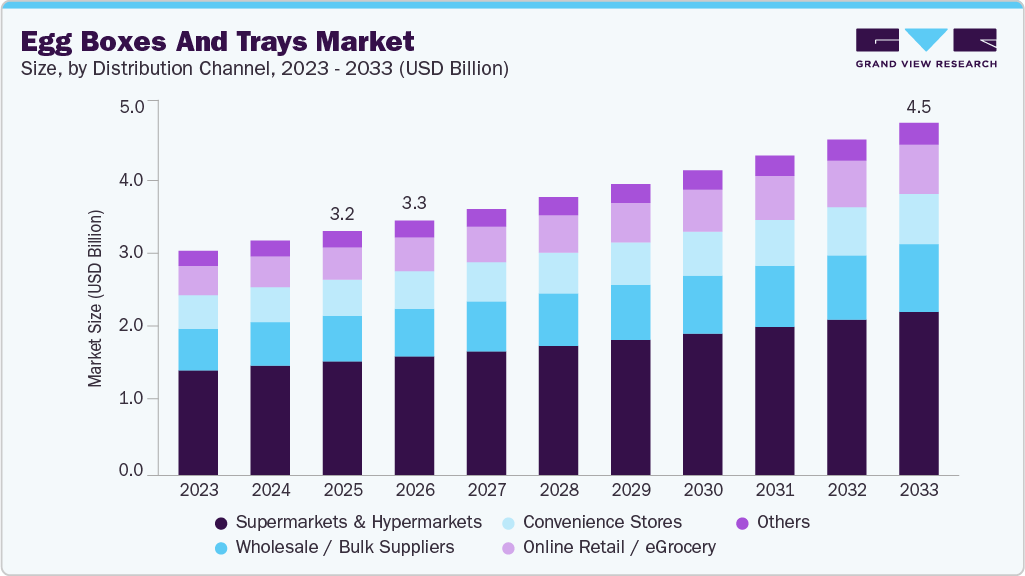 To learn more about this report, Download Free Sample Report
 The expansion of commercial poultry farming and international egg trade is also accelerating market growth. Egg producers require bulk packaging solutions that provide stacking efficiency, ventilation, cushioning, and logistics optimization across long-distance transportation networks. Increasing exports of eggs and processed egg products are encouraging the adoption of advanced pulp-based and recyclable packaging formats.
Moreover, rising concerns related to food contamination and hygiene are driving the use of tamper-resistant and food-grade packaging materials. Manufacturers are introducing customized packaging with improved moisture resistance, shock absorption, and product visibility to cater to premium and organic egg categories. Automation in egg grading and packing facilities is further supporting high-volume consumption of standardized trays and cartons globally.
Market Dynamics
One of the major drivers for the egg boxes and trays market is the global transition toward sustainable and biodegradable packaging solutions. Governments across Europe, North America, and Asia are imposing restrictions on single-use plastics and expanded polystyrene (EPS), encouraging poultry farms and retailers to adopt molded pulp and recycled paper packaging alternatives.
Molded fiber trays are gaining popularity due to their compostability, recyclability, low production cost, and ability to provide effective cushioning during transportation. Increasing environmental awareness among consumers is encouraging retailers to use eco-friendly packaging as part of their sustainability branding initiatives. The growing circular economy trend is also boosting investments in recycled paper-based tray manufacturing facilities.
One of the major restraints affecting the egg boxes and trays market is the fluctuating cost and inconsistent availability of recycled paper and pulp raw materials used in molded fiber packaging production. The market heavily depends on waste paper collection and recycling systems, making manufacturers vulnerable to supply shortages, changing recycling rates, transportation disruptions, and variations in global paper prices.
Rising energy and fuel costs further increase manufacturing and logistics expenses, particularly for small and medium-sized producers operating with limited profit margins. In several developing regions, inadequate recycling infrastructure and inconsistent raw material quality create additional operational challenges for tray manufacturers. These factors can lead to higher production costs and reduced pricing competitiveness, especially against low-cost plastic alternatives.
Market Concentration & Characteristics
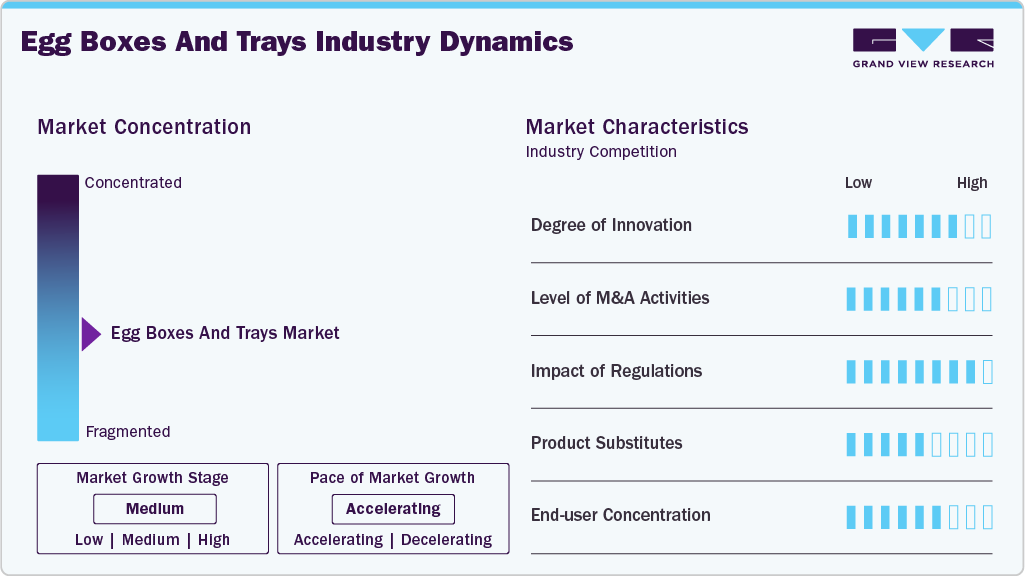
The egg boxes and trays market is moderately fragmented, with the presence of both multinational packaging companies and regional molded pulp manufacturers. Large companies dominate organized retail and export-oriented packaging segments through strong production capabilities, advanced molding technologies, and wide distribution networks. However, regional players continue to maintain a strong presence due to low entry barriers, availability of recycled paper raw materials, and proximity to poultry farming clusters. The molded fiber packaging industry is gradually moving toward consolidation as larger companies acquire smaller converters to strengthen their sustainable packaging portfolios and geographic reach.
 To learn more about this report, Download Free Sample Report
 Plastic egg cartons, reusable plastic crates, and thermoformed PET packaging act as substitutes for molded fiber egg boxes and trays. Plastic packaging offers advantages such as moisture resistance, transparency, and durability, making it suitable for premium retail packaging applications. However, increasing environmental concerns and regulatory restrictions on plastic usage are limiting long-term growth prospects for plastic-based alternatives. Reusable transport crates are gaining adoption in commercial poultry supply chains due to cost efficiency in bulk transportation, though they are less preferred in retail applications. The rising preference for biodegradable and recyclable materials is expected to reduce the threat posed by non-sustainable substitutes over time.
Distribution Channel Insights
The supermarkets & hypermarkets segment dominated the egg boxes and trays market in 2025, accounting for 46.8% of the total market share, due to the large-scale retail distribution of packaged eggs through organized retail channels. These stores require standardized, durable, and visually appealing packaging solutions that provide product protection, branding visibility, and ease of stacking during storage and transportation. Growing consumer preference for hygienically packed eggs and increasing sales of organic, cage-free, and premium egg varieties are further driving the adoption of molded fiber cartons and customized retail packaging formats in supermarkets.
The online retail and eGrocery segment is witnessing rapid growth due to increasing consumer preference for doorstep grocery delivery and digital shopping convenience. Egg packaging manufacturers are developing stronger and impact-resistant cartons capable of minimizing breakage during last-mile delivery and long-distance transportation. E-commerce grocery platforms require lightweight yet durable packaging solutions that can withstand handling across automated warehousing and logistics networks. The growing penetration of smartphone-based grocery applications and quick commerce services is additionally increasing demand for compact and transport-efficient egg packaging formats.
Application Insights
The retail egg packaging segment dominated the egg boxes and trays market in 2025, accounting for 60.0% of the total market share, owing to rising consumer demand for safe, hygienic, and branded egg packaging across supermarkets, convenience stores, and grocery chains. Retail packaging solutions, such as egg cartons and small tray formats, are widely used to enhance product presentation, reduce breakage risk, and facilitate consumer handling. Increasing demand for premium eggs, including organic, free-range, and omega-3 enriched products, is encouraging manufacturers to introduce aesthetically appealing and customized retail packaging designs. Retail-ready molded fiber cartons with printed branding, nutritional labeling, and tamper-resistant features are becoming increasingly popular among egg producers and retailers.
The bulk and industrial transport segment is growing steadily due to rising large-scale egg distribution activities across poultry farms, wholesalers, foodservice providers, and export supply chains. Bulk egg trays are designed to maximize stacking efficiency, ventilation, and cushioning during transportation and storage operations. Commercial poultry producers increasingly prefer lightweight molded pulp trays and reusable transport systems that reduce logistics costs while minimizing product damage. The expansion of international egg trade and automated handling systems is further increasing demand for standardized industrial packaging solutions compatible with high-volume transportation networks.
Material Insights
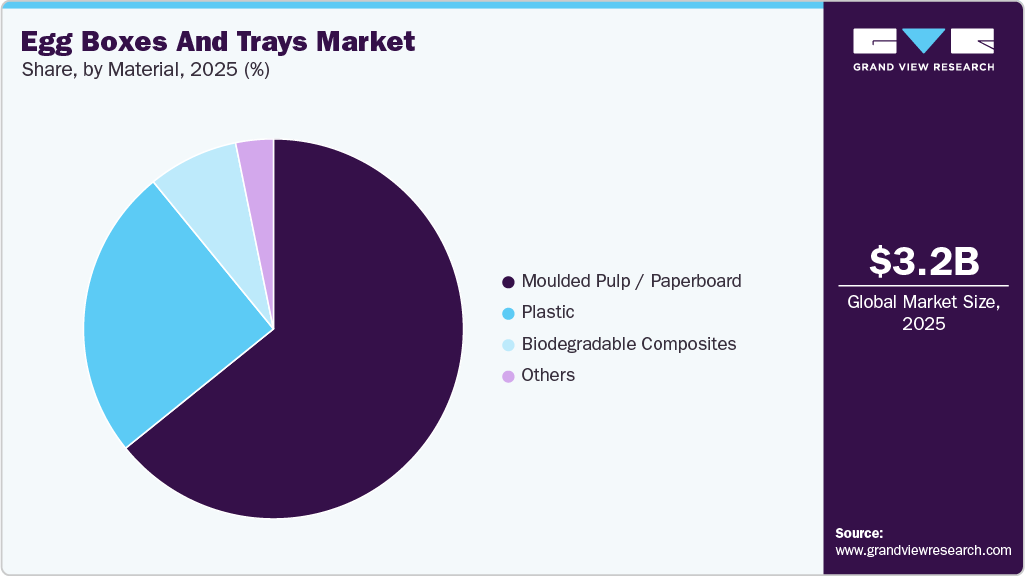
The moulded pulp/paperboard segment dominated the egg boxes and trays market in 2025, accounting for 64.2% of total demand, due to its strong sustainability advantages, low production cost, and excellent cushioning properties. Molded fiber packaging made from recycled paper materials is widely preferred because it is biodegradable, recyclable, lightweight, and capable of providing effective protection for fragile eggs during transportation. Increasing government restrictions on plastic packaging and growing consumer awareness regarding environmental sustainability are accelerating the shift toward paper-based egg packaging solutions globally. Poultry farms and retailers are increasingly adopting molded pulp trays to meet ESG commitments and reduce packaging waste.
 To learn more about this report, Download Free Sample Report
 The biodegradable composites segment is emerging as a high-growth category due to increasing innovation in sustainable packaging materials and rising demand for environmentally friendly alternatives to conventional plastic packaging. Manufacturers are exploring the use of agricultural residues, bamboo fibers, bagasse, and starch-based materials to produce compostable egg packaging solutions with improved structural performance. Biodegradable composites offer advantages such as reduced carbon footprint, renewable raw material usage, and enhanced sustainability appeal among environmentally conscious consumers. Governments and food retailers are increasingly encouraging the adoption of bio-based packaging materials to support circular economy initiatives and reduce landfill waste.
Product Type Insights
The egg boxes segment dominated the egg boxes and trays market in 2025, accounting for 61.1% of the total market share, due to its widespread usage in retail packaging applications and strong demand from supermarkets, grocery stores, and household consumers. Egg boxes provide enhanced product protection, convenient handling, improved shelf presentation, and branding opportunities for poultry producers and retailers. Molded fiber egg cartons are highly preferred because they offer effective cushioning, stackability, ventilation, and compatibility with automated packaging systems. The growing popularity of premium egg categories is also increasing demand for customized carton designs with printed labels, transparent lids, and tamper-evident features.
The egg trays segment is witnessing significant growth due to increasing demand from commercial poultry farms, wholesalers, and industrial egg transportation applications. Egg trays are primarily used for bulk handling and storage operations because they provide high stacking efficiency, lightweight structure, and cost-effective transportation benefits. Molded pulp trays remain the most commonly used format due to their shock absorption capabilities and low manufacturing cost. Rising egg exports and expansion of automated poultry logistics systems are further driving the adoption of standardized tray formats designed for machine compatibility and efficient warehouse management. Manufacturers are increasingly introducing stronger and moisture-resistant tray designs to improve performance across long-distance and cold-chain transportation environments.
Regional Insights
Asia Pacific region dominated the egg boxes and trays market due to high egg consumption, large poultry farming operations, and rapidly expanding food retail infrastructure in countries such as China and India. The region benefits from abundant recycled paper availability, low manufacturing costs, and growing investments in sustainable packaging production facilities. Rising awareness regarding biodegradable packaging and increasing government restrictions on plastic waste are further supporting molded fiber tray adoption across the region.
 To learn more about this report, Download Free Sample Report
 China represents the largest market for egg boxes and trays in Asia Pacific due to its extensive poultry farming industry and very high domestic egg consumption levels. The country is witnessing significant investments in automated egg sorting, grading, and packaging facilities to improve operational efficiency and minimize transportation losses. Chinese manufacturers are increasingly focusing on molded fiber packaging technologies made from recycled paper and agricultural residues to align with national sustainability goals and environmental regulations.
North America Egg Boxes and Trays Market Trends
North America is witnessing strong growth in the egg boxes and trays market due to rising consumer preference for eco-friendly food packaging and increasing regulatory pressure on single-use plastics. Retailers and supermarket chains across the U.S. and Canada are replacing foam-based egg cartons with recyclable molded fiber alternatives to achieve sustainability targets and improve brand image. The region’s highly organized poultry industry requires large-scale packaging solutions capable of supporting automated handling, transportation efficiency, and reduced product damage.
U.S. Egg Boxes and Trays Market Trends
U.S. market is experiencing substantial growth due to increasing adoption of recyclable and compostable food packaging solutions across the poultry and retail industries. Major grocery chains and food retailers are actively transitioning from polystyrene foam cartons to molded fiber packaging formats to comply with sustainability goals and consumer expectations. The country’s highly advanced poultry farming sector relies heavily on automated egg grading and packaging systems, creating demand for standardized and machine-compatible tray designs.
Europe Egg Boxes and Trays Market Trends
Europe is one of the most sustainability-focused markets for egg boxes and trays due to stringent environmental regulations and widespread consumer awareness regarding recyclable packaging materials. Countries across the region are aggressively reducing the use of single-use plastics, which is accelerating the transition toward molded fiber and paper-based egg packaging solutions. Retail chains and food producers are increasingly emphasizing biodegradable packaging as part of broader ESG and circular economy strategies. The region’s strong recycling infrastructure and advanced waste management systems support the availability of recycled paper raw materials used in molded pulp manufacturing.
Key Egg Boxes and Trays Company Insights
The egg boxes and trays market is characterized by a moderately fragmented and highly competitive landscape, with manufacturers competing based on product durability, sustainability performance, cost efficiency, customization capabilities, and large-scale supply reliability. Companies are increasingly focusing on biodegradable molded fiber packaging, lightweight tray structures, moisture-resistant coatings, and recyclable materials to strengthen their competitive positioning amid growing environmental concerns and regulatory pressure on plastic packaging. Investments in advanced pulp molding technologies, automated production systems, thermoformed fiber solutions, and energy-efficient manufacturing processes are becoming key strategic priorities across the industry. Market participants are also pursuing capacity expansions, regional partnerships, mergers & acquisitions, and closed-loop recycling initiatives to improve operational efficiency and expand their customer base.
-
In January 2026, Hartmann Packaging A/S announced a major expansion of its North American molded fiber egg packaging operations, including additional production lines and warehouse capacity investments planned through 2027 to meet growing demand for sustainable egg packaging solutions.
-
In April 2025, Huhtamaki Oyj completed the acquisition of Zellwin Farms in Florida, U.S., to strengthen its molded fiber egg carton and egg flat packaging business and expand manufacturing capacity in North America.
Key Egg Boxes And Trays Companies:
The following key companies have been profiled for this study on the egg boxes and trays market.
-
Huhtamaki Oyj
-
Hartmann Packaging A/S
-
Novolex
-
Packman Packaging
-
Best Plus Pulp Co.
-
Smurfit Westrock
-
DS Smith
-
Omni-Pac Group
-
Tekni-Plex
-
CKF Inc.
Competitive Benchmarking
Operating Strategies
Competitive Edge
Weakness
Mature Players: Huhtamaki Oyj, Hartmann Packaging A/S, Novolex, Smurfit Westrock
- Focus on large-scale automated molded pulp manufacturing facilities.
- Establish long-term supply agreements with poultry farms, supermarkets, and food retailers.
- Invest in sustainable packaging technologies, closed-loop recycling systems, and global expansion strategies.
- Strong global distribution networks and large production capacities.
- Advanced thermoformed fiber technologies and automated production infrastructure.
- Strong brand recognition and established relationships with major retail and foodservice companies.
- High capital investment and operational expenditure requirements.
- Slower adaptability to changing regional packaging trends and customer preferences.
- Exposure to fluctuations in recycled paper raw material prices and global logistics costs.
Emerging Players: Packman Packaging, Best Plus Pulp Co., Omni-Pac Group
- Focus on regional market penetration and localized supply capabilities.
- Offer customized and cost-effective packaging solutions for small and medium poultry producers.
- Expand through flexible production models and adoption of biodegradable packaging materials.
- Lower operational costs and faster customization capabilities.
- Greater flexibility in responding to regional customer requirements.
- Ability to adopt innovative eco-friendly materials and niche packaging designs quickly.
- Limited manufacturing capacity and smaller geographic presence.
- Lower bargaining power with suppliers and large retail customers.
- Limited investment capability for advanced automation and R&D activities.
Egg Boxes And Trays Market Report Scope
Report Attribute
Details
Market size in 2025
USD 3.2 billion
Estimated Market size in 2026
USD 3.3 billion
Projected Market size by 2033
USD 4.5 billion
Growth rate
CAGR of 4.7% from 2026 to 2033
Base year for estimation
2025
Historical data
2021 - 2024
Forecast period
2026 - 2033
Quantitative units
Revenue in USD billion and CAGR from 2026 to 2033
Report coverage
Revenue forecast, company ranking, competitive landscape, growth factors, and trends
Segments covered
Distribution channel, application, material, product type, region
Regional scope
North America; Europe; Asia Pacific; Latin America; Middle East & Africa
Country scope
U.S.; Canada; Mexico; Germany; France; UK; Italy; Spain; China; India; Japan; South Korea; Australia; Brazil; Argentina; Saudi Arabia; UAE; South Africa
Key companies profiled
Huhtamaki Oyj; Hartmann Packaging A/S; Novolex; Packman Packaging ; Best Plus Pulp Co.; Smurfit Westrock; DS Smith; Omni-Pac Group; Tekni-Plex; CKF Inc.
Customization scope
Free report customization (equivalent up to 8 analysts working days) with purchase. Addition or alteration to country, regional & segment scope.
Pricing and purchase options
Avail of customized purchase options to meet your exact research needs. Explore purchase options
Global Egg Boxes And Trays Market Report Segmentation
This report forecasts revenue growth at the regional, and country levels and provides an analysis on the latest industry trends and opportunities in each of the sub-segments from 2021 to 2033. For the purpose of this study, Grand View Research has segmented the egg boxes and trays market report on the basis of material, product type, application, distribution channel, and region:
-
Distribution Channel Outlook (Revenue, USD Billion, 2021 - 2033)
-
Supermarkets & Hypermarkets
-
Online Retail / eGrocery
-
Convenience Stores
-
Wholesale / Bulk Suppliers
-
Others
-
-
Application Outlook (Revenue, USD Billion, 2021 - 2033)
-
Retail Egg Packaging
-
Bulk/Industrial Transport
-
Food Service
-
-
Material Outlook (Revenue, USD Billion, 2021 - 2033)
-
Moulded Pulp / Paperboard
-
Plastic
-
Biodegradable Composites
-
Others
-
-
Product Type Outlook (Revenue, USD Billion, 2021 - 2033)
-
Egg Boxes
-
Egg Trays
-
-
Regional Outlook (Revenue, USD Billion, 2021 - 2033)
-
North America
-
U.S.
-
Canada
-
Mexico
-
-
Europe
-
Germany
-
France
-
UK
-
Italy
-
Spain
-
-
Asia Pacific
-
China
-
India
-
Japan
-
South Korea
-
Australia
-
-
Latin America
-
Brazil
-
Argentina
-
-
Middle East & Africa
-
Saudi Arabia
-
UAE
-
South Africa
-
-
Delivered Customizations
This report has been delivered with the following In-depth customizations
Client Request
Customization Delivered
Value Adds
Regional Segmentation Analysis
Detailed country-wise and regional demand analysis covering major regions. The study includes poultry production trends, egg consumption patterns, organized retail penetration, eGrocery growth, export-import trade analysis, and packaging consumption outlook by country. The customization also includes identification of high-growth markets, regional pricing trends, manufacturing hubs, and investment opportunities across emerging economies.
Helps clients identify high-growth regional markets, optimize expansion strategies, prioritize investments, and strengthen distribution networks based on country-level demand potential and supply chain dynamics.
Sustainability & ESG Analysis
Comprehensive assessment of sustainability trends and ESG performance within the egg boxes and trays market, including analysis of recyclable packaging adoption, molded fiber penetration, carbon footprint reduction initiatives, and plastic replacement trends. The study covers government regulations related to single-use plastics, recycling mandates, EPR policies, and food packaging sustainability standards across major regions.
Assists companies in aligning product portfolios with sustainability goals, improving ESG positioning, meeting regulatory compliance requirements, and strengthening brand image among environmentally conscious consumers and retailers.
Competitive Benchmarking
In-depth competitive benchmarking of global and regional egg packaging manufacturers based on production capacity, technology capabilities, geographic presence, pricing strategies, sustainability initiatives, product portfolio, customer base, and recent developments. The assessment further identifies competitive gaps, new entrant threats, partnership opportunities, and regional competitive intensity across various end-use sectors.
Enables clients to evaluate competitor positioning, identify strategic growth opportunities, strengthen market differentiation, support acquisition or partnership decisions, and improve long-term competitive strategy development.
Frequently Asked Questions About This Report
The global egg boxes and trays market was estimated at around USD 3.2 billion in the year 2025 and is expected to reach around USD 3.3 billion in 2026.
The supermarkets & hypermarkets segment dominated the egg boxes and trays market in 2025, accounting for 46.8% of the total market share.
The key players in the egg boxes and trays market include Huhtamaki Oyj, Hartmann Packaging A/S, Novolex, Packman Packaging, Best Plus Pulp Co., Smurfit Westrock, DS Smith, Omni-Pac Group, Tekni-Plex, and CKF Inc.
Rising global egg consumption, growing demand for sustainable and protective packaging solutions, expansion of organized retail and eGrocery channels, and increasing adoption of recyclable molded fiber packaging are key factors driving the egg boxes and trays market.
The global egg boxes and trays market is expected to grow at a compound annual growth rate of 4.7% from 2026 to 2033 to reach around USD 4.5 billion by 2033.
The Asia Pacific egg boxes and trays market dominated with a share of 37.1% in 2025.
Retail egg packaging segment dominated the egg boxes and trays market in 2025, accounting for 60.0% of the total market share.
Egg boxes segment dominated the egg boxes and trays market in 2025, accounting for 61.1% of the total market share.
About the Author(s)
Plastics, Polymers & Resins Research Team
Bulk Chemicals · Plastics, Polymers & ResinsThis report was authored by the plastics, polymers & resins research team at Grand View Research - comprising two research analysts, one senior research analyst, and one industry expert - with specialized expertise in the plastics, polymers & resins segment of the bulk chemicals industry. All findings are based on proprietary bulk chemicals databases, executive interviews, and regulatory analysis, subject to internal peer review prior to publication.
Last Updated:
Speak to Analyst

Customize this report to your needs - add regions, segments, or data points, with 20% free customization.
Or view our licence options:


ISO 9001:2015 & 27001:2022 Certified
We are GDPR and CCPA compliant! Your transaction & personal information is safe and secure. For more details, please read our privacy policy.


