
- Home
- »
- Automotive & Transportation
- »
-
Electric Three Wheeler Market Size, Share Report 2026-2033GVR Report cover

Electric Three-Wheeler Market (2026 - 2033)
Size, Share & Trends Analysis Report By Battery (Lithium-ion, Lead acid), By Power (Up to 1000W, 1000W-1500 W, Above 1500W), By End Use (Passenger Carrier, Goods Carrier), By Region, And Segment Forecasts
Market Size, 2025
$1.6BMarket Estimate, 2026
$1.7BMarket Forecast, 2033
$2.9BCAGR, 2026–2033
7.9%Electric Three-Wheeler Market Summary
The global electric three-wheeler market size was valued at USD 1.6 billion in 2025 and is projected to grow from USD 1.7 billion in 2026 to USD 2.9 billion by 2033, at a CAGR of 7.9% from 2026 to 2033. The Asia Pacific held the largest share of 65.3% of the global market in 2025. The market is witnessing accelerated growth driven by a combination of regulatory push, cost advantages, and urban mobility dynamics.
 Source: Grand View Research, IR Documents, Primary Interviews, Paid DatabasesTo learn more about this report,
 Download Free Sample Report
 Key Market Trends & Insights
- By battery: Lithium-ion segment accounted for the largest share of 46.7% in 2025.
- By power: 1000 W to 1500 W segment accounted for the largest revenue share of 42.6% in 2025.
- By end use: Passenger carrier segment held the largest market share in 2025.
Regional Highlights
- Largest regional market: Asia Pacific (65.3% revenue share, 2025)
- By country: The U.S. is expected to witness significant growth over the forecast period.
Market Size & Forecast
- Market size in 2025: USD 1.6 Billion
- Estimated market size in 2026: USD 1.7 Billion
- Projected market size by 2033: USD 2.9 Billion
- CAGR (2026-2033): 7.9%
Three ways to get this report
Buy it, customize it, or ask a question.Ask an Analyst
Analyst response in 1 business day
- AccessReport author, directly
- Reply timeWithin 1 working day
- No sales callDirect answer only
- FormatEmail reply
- CostFree, no cost
Get the Full Report
What the study covers
- FormatsPDF · Excel · Dashboard
- Timeline2026–2033 annual, 2025 base
- Coverage20+ countries, 5 regions
- Companies10+ key players profiled
Customize the Report
20% free customization
- IncludeCountries, segments, points
- TailorTo your product definition
- ExtendDeeper competitor detail
- OrA fully bespoke study
- Turnaround5–10 working days
Government-led electrification policies, including subsidies, tax benefits, and phased restrictions on internal combustion engines, are significantly lowering the adoption barrier. The market for electric three-wheelers is expected to grow significantly, driven by strong government support and increased regulatory focus on emissions reduction. The rising concentration of greenhouse gases and deteriorating urban air quality have compelled policymakers to promote cleaner mobility solutions, particularly in densely populated cities. Governments are introducing subsidies, tax exemptions, and incentive schemes such as the FAME II Scheme to reduce the upfront cost of electric three-wheelers and encourage adoption. To learn more about this report, Download Free Sample Report
 Furthermore, stricter emission norms and potential restrictions on internal combustion engine (ICE) three-wheelers are accelerating the transition toward electric alternatives. Several regional authorities are also offering benefits, such as permit relaxations and reduced registration fees, to electric vehicle owners. These regulatory and financial measures are creating a favorable ecosystem for manufacturers, fleet operators, and end users. As a result, policy-driven demand is expected to remain a key growth pillar for the electric 3-wheeler market.
The electric three-wheelers market is witnessing robust growth driven by their superior cost economics compared to conventional ICE vehicles. The rising volatility of fuel prices has significantly increased the appeal of electric alternatives, as electricity offers a more stable, lower-cost energy source. Electric three-wheelers have lower maintenance requirements due to fewer mechanical components, which reduces overall servicing and downtime costs. This results in a favorable total cost of ownership, especially for commercial operators who rely on daily income generation. Additionally, the emergence of innovative financing solutions, leasing models, and battery-as-a-service offerings is reducing the initial investment burden for buyers. Faster payback periods, typically within one to two years, are further strengthening the business case for adoption. These economic advantages are particularly critical in price-sensitive markets across Asia and Africa. Low cost of ownership is among other factors expected to drive growth in Africa electric three-wheelers industry.
The market for electric three-wheelers is expanding rapidly due to the growing demand for efficient last-mile connectivity and urban logistics solutions. Rapid urbanization and the proliferation of e-commerce, food delivery, and hyperlocal service platforms are increasing the need for cost-effective and high-utilization transport options. Electric three-wheelers are well-suited for these Power Types due to their compact design, maneuverability, and lower operating costs. Their adoption in both passenger transport and goods carriage across urban and semi-urban areas is significantly contributing to market growth. Furthermore, the integration of electric three-wheelers into fleet management systems and digital logistics platforms is enhancing operational efficiency and route optimization. The shift toward sustainable supply chains is also encouraging logistics companies to electrify their fleets. In addition, the ability of electric three-wheelers to operate in low-emission or restricted zones provides a strategic advantage in urban centers. These factors collectively position last-mile mobility demand as a key growth driver for the electric 3 wheeler market.
Market Dynamics
The rapid expansion of the e-commerce and logistics sectors is driving the growth of the electric three-wheeler market, particularly in urban and semi-urban areas. The growing volume of online shopping, food delivery, courier services, and quick-commerce operations has created strong demand for efficient, cost-effective last-mile delivery solutions. Electric three-wheelers are increasingly preferred for these applications because they offer substantially lower fuel and maintenance costs than conventional diesel- or petrol-powered vehicles. Their compact size and easy maneuverability also enable faster movement through congested city roads and narrow streets, making them highly suitable for frequent intra-city deliveries. As logistics companies focus on improving operational efficiency while reducing transportation costs, the adoption of electric cargo three-wheelers continues to grow rapidly.
In addition, businesses and fleet operators are increasingly integrating electric three-wheelers into their delivery networks to meet sustainability goals and comply with stricter emission regulations introduced by governments. Many e-commerce companies and third-party logistics providers are transitioning toward electric fleets to reduce carbon emissions and support green transportation initiatives. Advancements in battery technology, improved vehicle range, and the expansion of charging and battery-swapping infrastructure are further encouraging their deployment in commercial logistics operations.
High initial vehicle costs are restraining the growth of the electric three-wheeler market, particularly in developing and price-sensitive economies. Electric three-wheelers generally have a higher upfront purchase price compared to conventional internal combustion engine (ICE) vehicles due to the high cost of lithium-ion batteries, electric powertrain systems, and advanced electronic components. Many individual drivers and small fleet operators rely on low-cost vehicle ownership models and often face financial limitations when considering the transition to electric mobility. Limited access to affordable financing options and higher loan interest rates in certain regions further reduce the affordability of electric three-wheelers for commercial users. These cost-related challenges continue to slow the large-scale adoption of electric three-wheelers, especially among low-income consumers and independent operators.
Dependence on government subsidies and incentive programs also creates uncertainty within the electric three-wheeler market. Several countries support electric vehicle adoption through financial incentives, tax benefits, and purchase subsidies to improve affordability and encourage market penetration. However, changes in government policies, reductions in subsidy allocations, or delays in incentive disbursement can directly affect vehicle demand and consumer purchasing decisions. Manufacturers and fleet operators often face difficulties in long-term business planning due to fluctuations in policy support and evolving regulatory frameworks.
The development of battery-swapping infrastructure presents a significant opportunity for growth in the electric three-wheeler market by addressing one of the major operational challenges of electric vehicles: charging time and vehicle downtime. Commercial three-wheelers used for passenger transport and last-mile delivery operations typically require continuous daily usage, making long charging durations inefficient for drivers and fleet operators. Battery-swapping systems allow depleted batteries to be replaced with fully charged ones within a few minutes, enabling vehicles to return to operation quickly and improving overall productivity. The increasing establishment of battery-swapping networks across urban and semi-urban areas is enhancing the practicality and convenience of electric three-wheelers, particularly for high-utilization commercial applications. Growing investments from governments, energy providers, and private mobility companies in swapping infrastructure are expected to further support the large-scale adoption of electric three-wheelers.
Advancements in battery technology also create substantial growth opportunities for the electric three-wheeler market by improving vehicle performance, reliability, and affordability. Continuous innovations in lithium-ion batteries are increasing driving range, energy efficiency, charging speed, and battery lifespan, making electric three-wheelers more suitable for everyday transportation and logistics operations. Declining battery manufacturing costs are reducing the overall price of electric vehicles and lowering the total cost of ownership for individual drivers and fleet operators. Improved battery durability and enhanced vehicle efficiency are encouraging greater consumer adoption in price-sensitive markets, particularly in developing economies.
Market Concentration & Characteristics
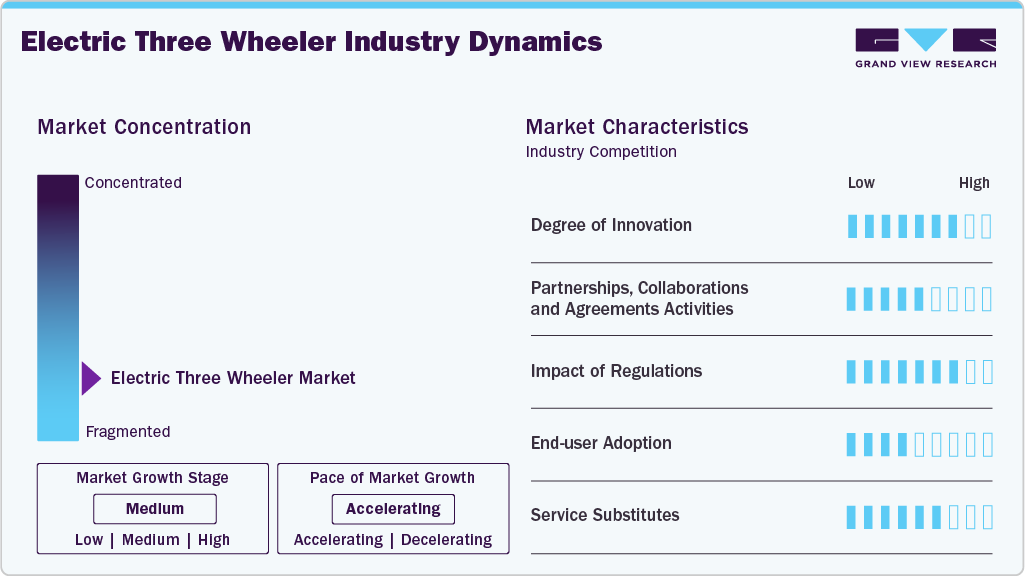
The electric three-wheeler market is fragmented in nature due to the presence of a large number of regional, domestic, and international manufacturers competing across passenger and cargo vehicle segments. The market comprises established automotive companies and several emerging electric mobility startups that offer products across different price ranges and applications. In countries such as India, China, Bangladesh, and Southeast Asian nations, numerous local manufacturers operate with strong regional distribution networks and cater primarily to price-sensitive consumers. The availability of low entry barriers, growing government support for electric mobility, and increasing demand for affordable last-mile transportation solutions have further encouraged the entry of new participants into the market.
 To learn more about this report, Download Free Sample Report
 Fragmentation is also supported by rapid technological developments, varying battery technologies, and differences in charging and battery-swapping business models adopted by market participants. Companies compete on factors such as vehicle pricing, battery range, payload capacity, financing support, aftersales services, and fleet partnerships. While established players such as Mahindra Electric Mobility, Piaggio, and Bajaj Auto hold notable market positions, emerging companies, including Euler Motors, Omega Seiki, and several regional manufacturers, continue to gain market share through innovation and targeted urban mobility solutions. The presence of unorganized and small-scale manufacturers in developing economies further contributes to the fragmented structure of the electric three-wheeler market.
Battery Insights
Based on battery, the segment is divided into lithium-ion, lead-acid, and others. Lithium-ion batteries experienced a dominant market share of 46.7% in 2025. The growth is credited to their advantages, such as increased battery life because of high energy density, compact size, shorter charging duration, and low maintenance. The increasing number of electric vehicles, hybrid electric vehicles, and plug-in hybrid electric vehicles has further propelled the demand for lithium-ion batteries. The declining prices of lithium over the year, owing to widespread use, are also contributing to a positive growth trajectory.
Lead-acid battery is likely to experience significant growth with the projected 7.6% CAGR over the forecast period. Lead-acid batteries are widely used in EVs due to their ability to deliver high-power surges, making them a reliable energy source. The lead-acid battier are cheaper than its counterparts and is recyclable. Technological developments in battery packaging and designing have led to increased storage capacity and durability. The rising sales of electric three-wheelers in countries such as India and China, coupled with the establishment of electric mobility start-ups in European, North American, and Asian region is contributing towards market growth. Furthermore, OEMs are collaborating with organizations providing battery swapping and charging solutions, thereby enabling easier replacement of batteries and supporting the market. However, lead-acid batteries are less eco-friendly than lithium-ion batteries and require longer charging times.
Power Insights
The 1000 W to 1500 W segment dominated the electric three-wheeler industry, accounting for the largest revenue share of 42.6% in 2025. The high growth of the 1000 W to 1500 W segment is due to its affordable operational cost. The segment's growth is also attributed to the market's demand for high-powered electric three-wheeler vehicles. The instant torque provided by the 1000W to 1500W motor increases vehicle efficiency with better acceleration from the start, making it a preferred choice by the OEMs. As the electric motors can reach high speeds faster than ICE, they are able to operate with a single gear and still reach their maximum speed. This results in the elimination of transmission, thus reducing the complexity and number of parts. The increasing vehicle electrification in developing countries is motivating manufacturers to invest significantly in research and development to improve the power and efficiency of electric vehicles. The technological advancement focuses on expanding the vehicles' top speed range by increasing the motor's power and the gear ratio. Therefore, these technical advantages make 1000W to 1500W motors ideal for passenger carriers.
The above 1500 W segment is also expected to witness significant growth over the forecast period, owing to rapid industrialization, which supports the formation of electric three-wheeler fleets with higher power capacity, enabling the vehicles to travel longer distances to transport cargo. The 1500 W-powered vehicles are commonly used in industries such as construction, mining, machine manufacturing, and the delivery of apparel and perishable food. Furthermore, the demand for high-speed electric three-wheelers with increased range is also boosting the market growth. Motor power enables higher acceleration and spinning while carrying a cargo load, allowing the vehicles to cover a greater distance in a trip.
End Use Insights
The passenger carrier segment accounted for the largest market revenue share in 2025. The segment growth is attributed to demand for three-wheelers as a public transport option for daily and last-mile commutes. In developing countries with a high density of middle-income populations, public transport is preferred over private commuting. Electric three-wheelers are emerging as an eco-friendly and more affordable option, propelling the market growth of electric three-wheeler passenger carriers. Moreover, governments at the central and state levels have introduced incentives to favor the development of sustainable public transport in rural and urban parts of the country, which is further expected to boost the market growth.
 To learn more about this report, Download Free Sample Report
 The electric three-wheeler goods carriers segment is anticipated to depict the fastest CAGR from 2026 to 2033, owing to increased industrial activities. Electric three-wheelers are considered an economical, eco-friendly option for lightweight commercial vehicles suitable for transporting cargo such as perishables, utilities, furniture, or couriers. The increasing reliance on e-commerce is further driving the market growth of electric three-wheeler carriers as an alternative to conventional three-wheelers for last-mile delivery.
Regional Insights
The North America electric three-wheeler industry is expected to witness robust growth, driven by increased focus on sustainable urban mobility and carbon-emission reduction targets. Rising environmental awareness and supportive federal and state-level incentives are encouraging the adoption of compact electric vehicles for short-distance travel and niche commercial Power Types. The region is also seeing growing interest from startups and innovative OEMs such as Arcimoto, which are introducing purpose-built electric three-wheelers for urban commuting and last-mile delivery.
U.S. Electric Three-Wheeler Market Trends
The electric three-wheeler industry in the U.S. is expected to grow, driven by an increasing emphasis on sustainable, low-emission mobility solutions. Rising regulatory pressure to curb greenhouse gas emissions, supported by federal and state-level incentives, is encouraging the adoption of alternative electric vehicle formats. Policies such as tax credits and clean mobility programs aligned with the Inflation Reduction Act are improving the economic feasibility of electric vehicle ownership, including emerging three-wheeler segments.
Europe Electric Three-Wheeler Market Trends
The electric three-wheeler industry in Europe is expected to experience growth driven primarily by stringent emission regulations and aggressive decarbonization targets across the transport sector. Regulatory frameworks under the European Green Deal are compelling a shift toward low- and zero-emission mobility solutions, particularly in urban environments where air quality compliance is critical. Several cities across Europe are implementing low-emission and zero-emission zones, restricting the entry of internal combustion engine vehicles and creating a direct demand pull for compact electric alternatives such as three-wheelers.
The UK electric three-wheeler market is expected to grow, primarily driven by stringent urban emission regulations and cost pressures in last-mile logistics. The expansion of clean air and ultra-low-emission zones, particularly frameworks such as the Ultra Low Emission Zone, is directly restricting the use of high-emission vehicles and creating strong demand for compact zero-emission alternatives. This regulatory environment is compelling fleet operators and small logistics providers to adopt electric three-wheelers for intra-city operations where compliance costs for conventional vehicles are rising.
The electric three-wheeler market in Germany is expected to witness targeted growth, primarily driven by stringent regulatory enforcement and structural transformation in urban freight logistics. The implementation of low-emission zones, such as the Umweltzone, is restricting the movement of high-emission vehicles in city centers, thereby creating demand for compact, zero-emission alternatives. This regulatory pressure is particularly impactful in dense urban clusters where compliance costs for conventional vehicles are increasing.
Asia Pacific Electric Three-Wheeler Market Trends
The electric three-wheeler industry in the Asia Pacific depicted a dominant market share of 65.3% in 2025. The regional market is expected to experience strong growth, fundamentally driven by its role as a primary income-generating asset in informal and semi-formal transport economies. In countries such as India, Bangladesh, and Indonesia, three-wheelers are widely used for passenger mobility and goods transport, making operating costs a critical decision factor. Electric variants offer significantly lower daily operating costs than internal combustion engine vehicles, directly improving driver earnings and accelerating adoption. This strong economic incentive, combined with high vehicle utilization rates, creates a rapid payback cycle, making electrification financially compelling at scale.
 To learn more about this report, Download Free Sample Report
 The China electric three-wheeler market is expected to grow, primarily driven by its deep integration into the country’s urban-rural logistics and light mobility ecosystem. Electric three-wheelers are widely used for short-distance goods transport, agricultural logistics, and informal delivery networks, making them a critical utility vehicle rather than a discretionary purchase. Their significantly lower operating cost compared to ICE alternatives directly enhances income generation for small businesses and individual operators, creating a strong economic adoption driver. High daily utilization rates and short route cycles further improve return on investment, enabling faster, scalable fleet electrification.
The electric three-wheeler market in India is expected to experience strong growth, fundamentally driven by its role as a primary livelihood asset in the country’s informal mobility and logistics economy. A significant proportion of three-wheelers operate as income-generating vehicles for passenger transport and goods movement, making daily operating costs a critical determinant of adoption. Electric variants offer substantially lower operating and maintenance costs than ICE vehicles, directly improving driver earnings and enabling faster payback, often within a short operating cycle. This strong unit-level economics, combined with high vehicle utilization in urban and semi-urban areas, creates a structurally high demand base for electrification.
Key Electric Three-Wheeler Company Insights
Some of the key companies in the electric three-wheeler market include Mahindra Electric Mobility Limited, Piaggio Vehicle Pvt., Atul Auto Limited, Terra Motors, and Gayam Motor Works, among others. Organizations are focusing on increasing their customer base to gain a competitive edge in the industry. Therefore, key players are taking several strategic initiatives, such as mergers and acquisitions, and partnerships with other major companies.
-
Mahindra Electric Mobility Limited is an India-based electric vehicle manufacturer and a subsidiary of the Mahindra Group, headquartered in Bengaluru, India. The company focuses on the development, manufacturing, and commercialization of electric mobility solutions, with a strong presence in electric three-wheelers and passenger vehicles. Within the three-wheeler segment, Mahindra Electric offers a range of electric autorickshaws and cargo vehicles designed for last-mile passenger transport and urban logistics. The company leverages its parent group’s automotive manufacturing capabilities, distribution network, and financing ecosystem to scale adoption across domestic and select international markets. Mahindra Electric is also engaged in advancing EV technologies, including battery systems, power electronics, and connected vehicle solutions.
-
Piaggio Vehicles Pvt. Ltd. is an India-based commercial vehicle manufacturer and a wholly owned subsidiary of the Piaggio Group, headquartered in Pune, India. The company operates primarily in the light commercial vehicle segment, with a strong presence in three-wheelers across passenger and cargo Power Types. Under its widely recognized Ape brand, Piaggio develops and manufactures a range of internal combustion engine and electric three-wheelers designed for last-mile mobility and urban logistics. In the electric segment, the company offers batteries, including the Ape Electrik lineup, targeting both passenger transport and goods movement use cases. Piaggio Vehicles leverages its global engineering expertise, localized manufacturing capabilities, and extensive dealer network to support large-scale deployment across India and export markets in Asia and Africa. The company also focuses on Battery innovation, including integrating battery technology and developing digital fleet solutions, to enhance operational efficiency and support the transition toward sustainable mobility.
Key Electric Three-Wheeler Companies:
The following key companies have been profiled for this study on the electric three-wheeler market.
- Mahindra Electric Mobility Limited (Mahindra and Mahindra)
- Piaggio Vehicle Pvt. (Piaggio & C.SpA)
- Atul Auto Limited
- Terra Motors
- Gayam Motor Works
- Omega Seiki Pvt Ltd
- Bodo Vehicle Group Co. Ltd.
- Euler Motors
- Bajaj Auto
- Jiangsu Kingbon Vehicle Co., Ltd.
- E-Tuk Factory
Competitive Benchmarking
Operating Strategies
Competitive Edge
Weaknesses
Mature Players: Piaggio Vehicle Pvt. (Piaggio & C.SpA), Atul Auto Limited, Terra Motors
- Established manufacturers are focusing on expanding their electric passenger and cargo three-wheeler portfolios across urban and semi-urban markets.
- Strong emphasis on dealership expansion, battery-swapping collaborations, financing support, and large-scale production capabilities to strengthen market presence.
- Strong brand recognition, extensive distribution channels, and well-developed aftersales service networks support higher customer trust and market penetration.
- Large manufacturing capacities and established supplier ecosystems enable economies of scale and consistent vehicle supply.
- Rising battery raw material costs and supply chain disruptions can increase manufacturing expenses and affect profitability.
- Transition from conventional ICE three-wheelers to electric platforms requires significant capital investment and infrastructure development.
Emerging Players: Gayam Motor Works, Omega Seiki Pvt Ltd
- Focus on electric-first business models, specializing in last-mile delivery, cargo mobility, and smart urban transportation solutions.
- Expansion strategies primarily target high-growth urban logistics and e-commerce transportation segments.
- Strong focus on innovation, lightweight vehicle platforms, and cost-efficient electric mobility solutions for commercial applications.
- Faster product development cycles and operational flexibility help address evolving customer requirements in emerging EV markets.
- Limited production scale and smaller dealership networks compared to those of established automotive manufacturers may limit market reach.
- Dependence on external battery suppliers and the development of charging infrastructure may create operational and supply-related challenges.
Recent Developments
-
In April 2026, Hyundai Motor Company and TVS Motor announced the Joint Development Agreement to deliver and commercialize electric three-wheelers in India and additional markets. Under the agreement, Hyundai Motor will lead the design of and co-develop the E3W by leveraging its research and development expertise, advanced mobility technologies, and human-centric design approach.
-
In April 2026, Bajaj Auto announced the launch of electric three-wheelers under the all-new WEGO brand. This Battery launch is expected to attract new customers and help the company strengthen its position in the Indian market.
Electric Three-Wheeler Market Report Scope
Report Attribute
Details
Market size in 2025
USD 1.6 billion
Estimated market size in 2026
USD 1.7 billion
Projected market size by 2033
USD 2.9 billion
Growth rate
CAGR of 7.9% from 2026 to 2033
Base year for estimation
2025
Actual estimates/Historical data
2021 - 2025
Forecast period
2026 - 2033
Quantitative Units
Revenue in USD Billion, Volume in Thousand Units, and CAGR from 2026-2033
Report coverage
Revenue forecast, company ranking, competitive landscape, growth factors, and trends
Segments covered
Battery, power, end use, region
Regional scope
North America; Europe; Asia Pacific; Latin America; Middle East and Africa
Country scope
U.S.; Canada; Mexico; UK; Germany; France; China; Japan; India; Bangladesh; Sri Lanka; Thailand; Philippines; Vietnam; Indonesia; Singapore; Brazil; KSA; UAE; South Africa
Key Company Profiled
Mahindra Electric Mobility Limited; Piaggio & C.SpA; Atul Auto Limited; Terra Motors; Gayam Motor Works; Omega Seiki Pvt Ltd; Bodo Vehicle Group Co. Ltd.; Euler Motors; Bajaj Auto; Jiangsu Kingdom Vehicle Ltd; E-Tuk Factory
Customization scope
Revenue forecast, company ranking, competitive landscape, growth factors, and trends
Pricing and purchase options
Avail customized purchase options to meet your exact research needs. Explore purchase options.
Global Electric Three-Wheeler Market Report Segmentation
This report forecasts revenue growth at global, regional, and country levels and analyzes industry trends in each of the sub-segments from 2021 to 2033. For this study, Grand View Research has segmented the global electric three-wheeler market report based on battery, power, end use, and region:
 To learn more about this report, Download Free Sample Report
 -
Battery Outlook (Volume, Thousand Unit; Revenue, USD Million, 2021 - 2033)
-
Lithium-ion
-
Lead Acid
-
Others
-
-
Power Outlook (Volume, Thousand Unit; Revenue, USD Million, 2021 - 2033)
-
Up to 1000 W
-
1000 W - 1500 W
-
Above 1500 W
-
-
End Use Outlook (Volume, Thousand Unit; Revenue, USD Million, 2021 - 2033)
-
Passenger Carrier
-
Goods Carrier
-
-
Regional Outlook (Volume, Thousand Unit; Revenue, USD Million, 2021 - 2033)
-
North America
-
U.S.
-
Canada
-
Mexico
-
-
Europe
-
UK
-
Germany
-
France
-
-
Asia Pacific
-
China
-
Japan
-
India
-
Bangladesh
-
Sri Lanka
-
Thailand
-
Philippines
-
Vietnam
-
Indonesia
-
Singapore
-
-
Latin America
-
Brazil
-
-
Middle East & Africa
-
KSA
-
UAE
-
South Africa
-
-
Delivered Customizations
This report has been delivered with the following In-depth customizations
Client Request
Customization Delivered
Value Adds
Sales Volume and Demand Analysis
- Regional and country-level sales volume analysis for electric passenger and cargo three-wheelers.
- Segment-wise demand analysis across e-commerce logistics, passenger transportation, shared mobility, and urban delivery applications.
- Historical and current adoption trend analysis across major economies.
- Supported demand forecasting and market penetration assessment across application segments.
- Enabled identification of high-demand urban mobility and last-mile logistics markets.
Technology and Battery Trend Assessment
- Comparative analysis of lithium-ion and lead-acid battery adoption trends in electric three-wheelers.
- Assessment of vehicle range improvements, charging technologies, and battery-swapping integration trends.
- Evaluation of cost trends related to batteries and electric powertrain components.
- Supported technology benchmarking and product development planning.
- Assisted in understanding cost optimization opportunities and battery technology transition trends.
Competitive Landscape and Market Share Analysis
- Benchmarking of leading electric three-wheeler manufacturers based on product portfolio, battery type, vehicle range, pricing, and regional presence.
- Analysis of strategic developments, including partnerships, dealership expansion, production capacity expansion, and battery-swapping collaborations.
- Supported competitor tracking and evaluation of strategic positioning across regional markets.
- Enabled identification of market gaps, emerging business models, and expansion opportunities.
Frequently Asked Questions About This Report
Some of the key players operating in the electric three-wheeler market include Mahindra Electric Mobility Limited, Piaggio Vehicle Pvt., Atul Auto Limited, Terra Motors, Gayam Motor Works, Omega Seiki Pvt Ltd, Bodo Vehicle Group Co. Ltd., Euler Motors, Bajaj Auto, Jiangsu Kingbon Vehicle Co., Ltd., and E-Tuk Factory.
Key factors driving the electric three-wheeler market include government-led electrification policies, subsidies and tax incentives, lower operating and maintenance costs compared to ICE vehicles, growing demand for last-mile connectivity and urban logistics solutions, rapid expansion of e-commerce and delivery services, and the development of battery-swapping infrastructure.
The 1000 W to 1500 W segment accounted for the largest revenue share of 42.6% in 2025.
The passenger carrier segment held the largest market share in 2025.
Asia Pacific dominated the global market with a 65.3% revenue share in 2025.
The global electric three-wheeler market size was valued at USD 1.6 billion in 2025 and is estimated at USD 1.7 billion for 2026.
The global electric three-wheeler market is expected to grow at a CAGR of 7.9% from 2026 to 2033, reaching USD 2.9 billion by 2033.
The lithium-ion segment led the market with a 46.7% revenue share in 2025.
About the Author(s)
Automotive & Transportation Research Team
Technology · Automotive & TransportationThis report was authored by the automotive & transportation research team at Grand View Research - comprising two research analysts, one senior research analyst, and one industry expert - with specialized expertise in the automotive & transportation segment of the technology industry. All findings are based on proprietary technology databases, executive interviews, and regulatory analysis, subject to internal peer review prior to publication.
Last Updated:
Speak to Analyst

Customize this report to your needs - add regions, segments, or data points, with 20% free customization.
Or view our licence options:


ISO 9001:2015 & 27001:2022 Certified
We are GDPR and CCPA compliant! Your transaction & personal information is safe and secure. For more details, please read our privacy policy.


