
- Home
- »
- Advanced Interior Materials
- »
-
Electric Torque Tools Market Size & Share Report, 2026-2033GVR Report cover

Electric Torque Tools Market (2026 - 2033)
Size, Share & Trends Analysis Report By End-use (Automotive & Transportation, Aerospace & Defense), By Product (Corded, Cordless), By Region, And Segment Forecasts
Market Size, 2025
$672.9MMarket Estimate, 2026
$707.9MMarket Forecast, 2033
$1,009.4MCAGR, 2026–2033
5.2%Electric Torque Tools Market Summary
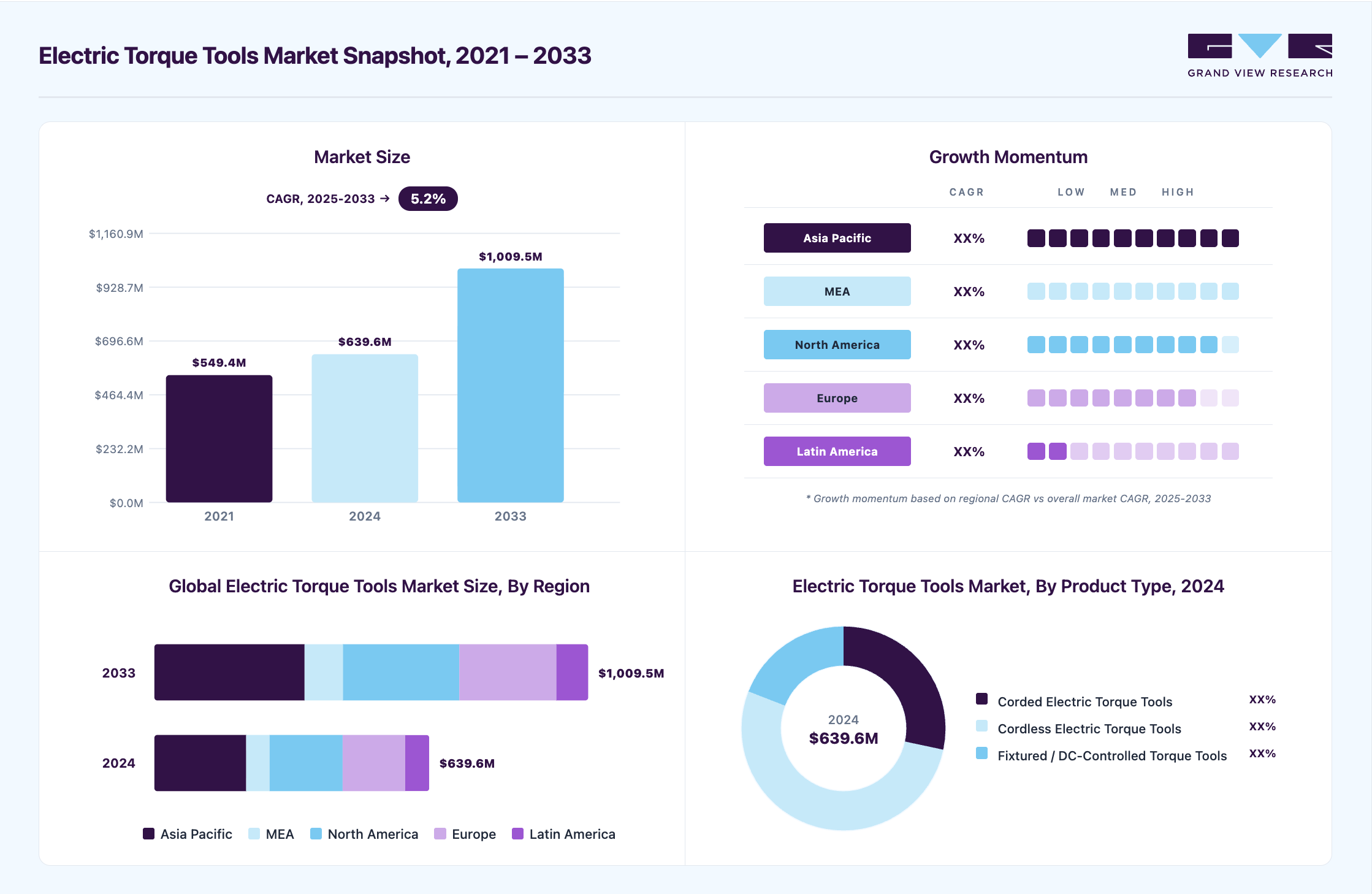
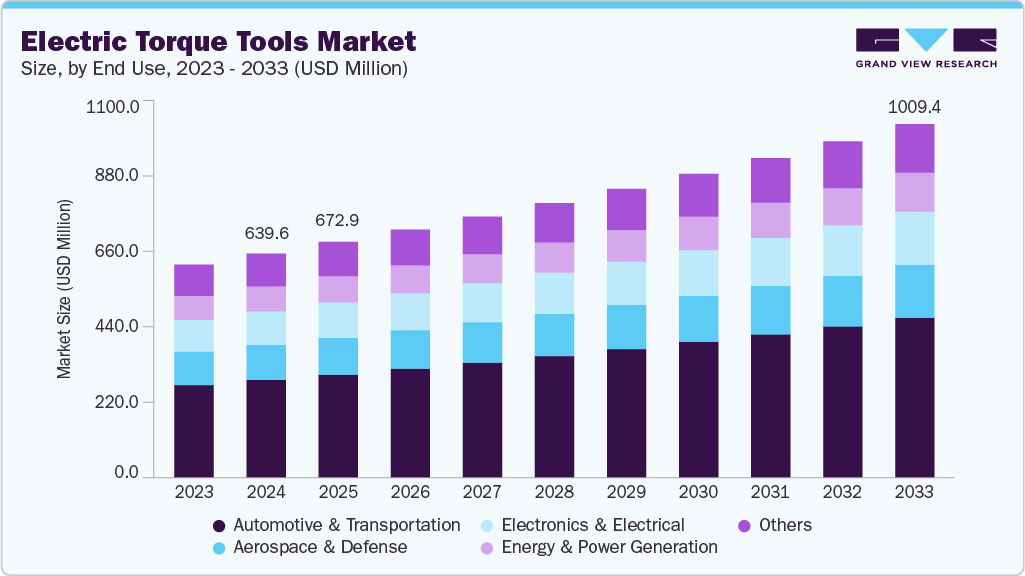
The global electric torque tools market size was valued at USD 672.9 million in 2025 and is projected to grow from USD 707.9 million in 2026 to USD 1,009.4 million by 2033, at a CAGR of 5.2% from 2026 to 2033. Asia Pacific dominated the market with the revenue share of 33.5% in 2025. Increasing industrial activities in these domains drive the demand for precise and efficient torque tools, pivotal in assembly and fastening applications.
 Source: Grand View Research, IR Documents, Primary Interviews, Paid DatabasesTo learn more about this report,
 Download Free Sample Report
 Key Market Trends & Insights
- By product type: Cordless electric torque tools segment led the market with the largest revenue share of 52.8% in 2025.
- By end use: Automotive & transportation segment led the market with the largest revenue share of 43.8% in 2025.
Regional Highlights
- Largest regional market: Asia Pacific (33.5% revenue share, 2025)
- By country: China held the largest market share in 2025.
Market Size & Forecast
- Market size in 2025: USD 672.9 Million
- Estimated market size in 2026: USD 707.9 Million
- Projected market size by 2033: USD 1,009.4 Million
- CAGR (2026-2033): 5.2%
Three ways to get this report
Buy it, customize it, or ask a question.Ask an Analyst
A direct answer, usually in 1 working day
- AccessReport author, directly
- Reply timeWithin 1 working day
- No sales callDirect answer only
- FormatEmail reply
- CostFree, no cost
Get the Full Report
What the study covers
- FormatsPDF · Excel · Dashboard
- Timeline2026–2033 annual, 2025 base
- Coverage20+ countries, 5 regions
- Companies10+ key players profiled
Customize the Report
20% free customization
- IncludeCountries, segments, points
- TailorTo your product definition
- ExtendDeeper competitor detail
- OrA fully bespoke study
- Turnaround5–10 working days
The market benefits from growing industrialization and the need for high-quality tools to maintain safety and performance standards, especially in countries with robust manufacturing bases. Technological advancements in the electric torque tools themselves also fuel market growth. Innovations include improvements in battery technology, smart features such as real-time torque monitoring, and ergonomic cordless designs that enhance user efficiency while reducing operator fatigue and errors. These advancements meet the increasing demand for precision, traceability, and safety in assembly processes across diverse industries, including aerospace and automotive.
 To learn more about this report, Download Free Sample Report
 Another significant driver is the rising adoption of global electric vehicles (EVs) and hybrid models. EVs' complex design and assembly requirements necessitate specialized torque tools for accurately tightening electric motors, battery packs, and other components. Government incentives and stricter environmental regulations have accelerated the shift toward electrification in the automotive sector, further boosting torque tool demand tailored to EV manufacturing and maintenance.
Market Dynamics
The electric torque tools market is witnessing growth due to increasing automation in manufacturing, rising demand for precision fastening, and stringent quality requirements across automotive, aerospace, electronics, and industrial sectors. Manufacturers are adopting electric torque tools to improve assembly accuracy, reduce human error, and ensure product consistency. Advancements in digital torque monitoring, data connectivity, and smart manufacturing integration are further supporting market expansion. However, high initial investment costs and the need for regular calibration continue to influence market adoption.
The increasing adoption of automated and precision assembly processes is a major driver for the electric torque tools market. Industries such as automotive, aerospace, electronics, and industrial manufacturing require accurate torque control to ensure product quality, safety, and compliance with industry standards. Electric torque tools provide consistent fastening accuracy, reduce assembly errors, and improve production efficiency. As manufacturers continue investing in automated production lines and quality control systems, demand for advanced electric torque tools is expected to increase steadily.
High initial investment and ongoing maintenance costs remain a key restraint for the electric torque tools market. Advanced electric torque tools equipped with digital controllers, sensors, and data connectivity features require higher capital expenditure than conventional fastening tools. In addition, periodic calibration, software updates, and maintenance are necessary to maintain torque accuracy and comply with quality standards. These costs can discourage adoption among small and medium-sized manufacturers with limited budgets, particularly in price-sensitive industries.
The integration of electric torque tools with Industry 4.0 and smart manufacturing technologies presents significant growth opportunities. Modern electric torque tools can be connected to manufacturing execution systems, quality management platforms, and cloud-based monitoring solutions for real-time torque data collection and process control. These capabilities improve production traceability, predictive maintenance, and quality assurance while reducing assembly errors. Growing investment in digital factories and connected production environments is expected to accelerate demand for intelligent electric torque tools.
Market Concentration & Characteristics
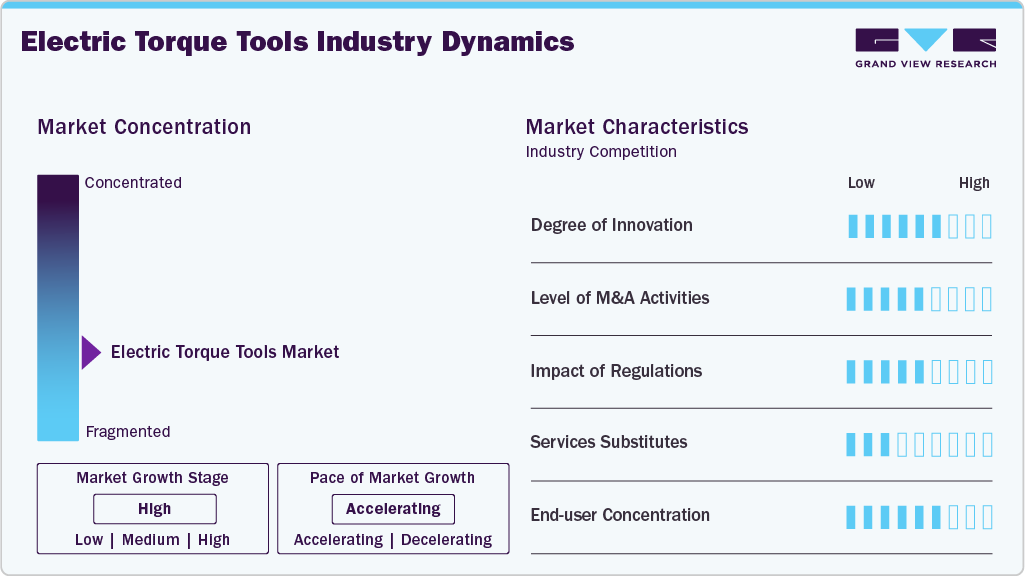
The market exhibits a moderately concentrated competitive landscape, with key players such as RAD Torque Systems, HYTORC, and Enerpac holding significant market shares, particularly in North America and Europe. The market's concentration is strongest in sectors requiring high precision, like automotive and aerospace, where tightening accuracy and automation investments are critical. Moderate merger and acquisition activity has been observed, mainly involving larger companies acquiring smaller specialized firms to bolster product portfolios and technological capabilities. The presence of numerous smaller companies ensures a dynamic market structure, maintaining a balance between dominance and competition.
 To learn more about this report, Download Free Sample Report
 Innovation in the market is characterized by advancements in battery technology for longer runtimes, faster charging, and integration of smart digital features enabling real-time torque monitoring and data logging. Ergonomic designs that reduce operator fatigue and enhance usability further drive product differentiation. Regulatory frameworks, especially in aerospace and automotive sectors, impose strict safety and quality standards, which increase demand for reliable, precise, and traceable tightening solutions. While pneumatic torque wrenches remain significant substitutes, cordless electric torque tools are gaining preference due to portability and noise reduction. End-user concentration skews toward large manufacturers and maintenance providers in automotive, aerospace, and railway segments, reflecting industry demands for high-quality torque control.
Analyst Perspective
The electric torque tools market is expected to experience steady growth, driven by increasing automation, precision assembly requirements, and stringent quality standards across automotive, aerospace, electronics, and industrial manufacturing sectors. The integration of digital torque monitoring, data traceability, and Industry 4.0 technologies is enhancing operational efficiency and process reliability. Manufacturers are focusing on product innovation, ergonomic designs, and connected fastening solutions to strengthen their market position. Rising investments in smart factories and advanced manufacturing are expected to create sustained growth opportunities for the market.
End Use Insights
Based on end use, the automotive & transportation segment led the market with the largest revenue share of 43.8% in 2025, driven by the increasing demand for precision vehicle assembly and maintenance. Electric torque tools ensure accurate fastening in engines, chassis, and suspension systems, reducing the risk of component damage. The rise of electric and hybrid vehicles has further accelerated the need for specialized torque tools. Manufacturers are adopting advanced digital torque monitoring to enhance production efficiency and quality.
The electronics & electrical segment is expected to grow at a CAGR of 5.3% over the forecast period, driven by the growing complexity and miniaturization of electronic components. Electric torque tools are essential for precisely assembling delicate devices such as smartphones, computers, and industrial electronics. Rising consumer electronics demand and repair services further fuel market growth. Innovations in insulated and ESD-safe torque tools enhance operational safety and product reliability.
Product Insights
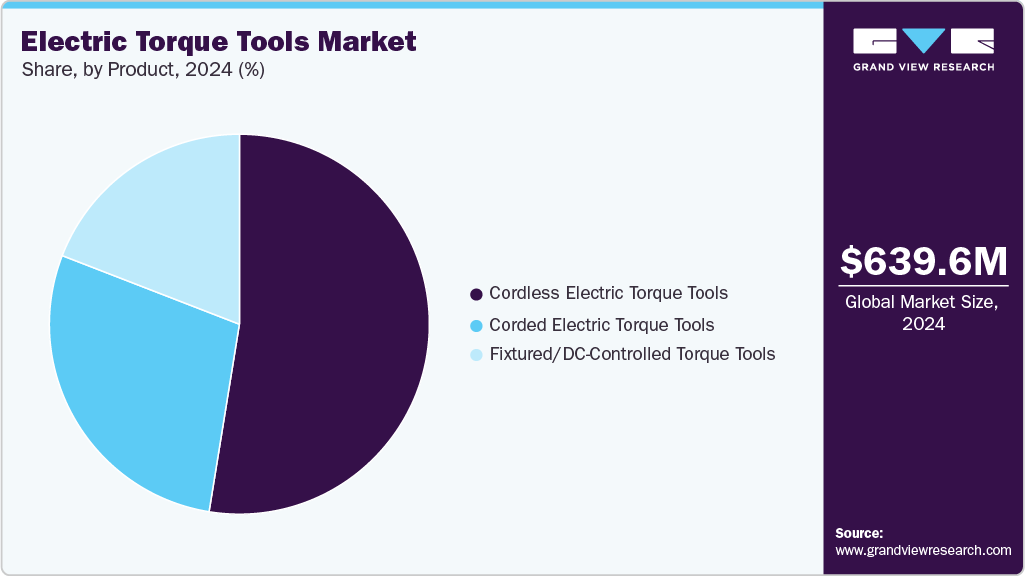
Based on product type, the cordless electric torque tools segment led the market with the largest revenue share of 52.8% in 2025, driven by the increasing need for mobility, flexibility, and ease of use in industrial and field operations. Battery-powered torque tools allow technicians to perform accurate fastening without reliance on power cords, improving productivity. Growth in maintenance, repair, and assembly services across the automotive, aerospace, and electronics industries fuels demand. Advancements in battery life, motor efficiency, and ergonomic designs enhance user experience.
 To learn more about this report, Download Free Sample Report
 The fixtured/DC-controlled torque tools segment is expected to grow significantly at a CAGR of 4.8% over the forecast period, driven by the growing adoption of automated and semi-automated production systems. These tools provide precise torque control and repeatability for automotive, aerospace, and electronics manufacturing assembly lines. Integration with digital monitoring systems allows real-time data collection and quality assurance. Manufacturers increasingly invest in DC-controlled tools to minimize errors, improve efficiency, and reduce rework.
Regional Insights
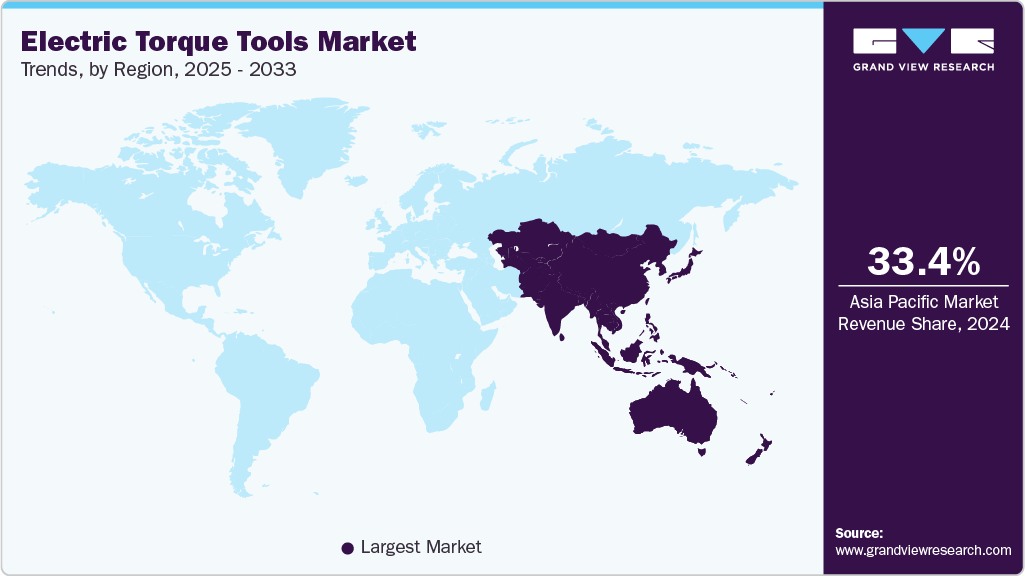
Asia Pacific dominated the electric torque tools market with the largest revenue share of 33.5% in 2025, witnessing strong growth due to industrialization, automation, and the expansion of automotive and electronics manufacturing hubs in China, Japan, and India. The region’s focus on improving manufacturing efficiency and reducing operational downtime has accelerated the use of precision torque tools in assembly lines. Rapid technological adoption and competitive pricing from local manufacturers contribute to widespread market penetration. In addition, the ongoing shift toward electric mobility and renewable energy infrastructure is creating new application areas for electric torque systems. Continuous innovation and favorable government support for industrial modernization further bolstered market development in this region.
 To learn more about this report, Download Free Sample Report
 China Electric Torque Tools Market Trends
The electric torque tools market in the China held the largest share in the Asia Pacific region in 2025. The electric torque tools market in China is driven by the country’s strong manufacturing base and its strategic focus on automation and digitalization. The government’s “Made in China 2025” initiative has significantly boosted investment in advanced production technologies, increasing demand for precision assembly tools. The rapid growth of the electric vehicle industry, along with large-scale construction and infrastructure projects, is fueling the use of electric torque solutions. Furthermore, Chinese manufacturers are enhancing product capabilities by integrating IoT features and smart torque monitoring to align with global quality standards. Competitive domestic production and export potential position China as a key growth engine in the global market.
North America Electric Torque Tools Market Trends
The electric torque tools market in North America is driven by the rapid adoption of smart manufacturing technologies and automation across the automotive, aerospace, and heavy machinery industries. Manufacturers increasingly integrate torque management systems with digital monitoring to improve assembly precision and reduce error margins. The region’s strong industrial infrastructure and investments in Industry 4.0 are fostering demand for tools that support traceable and data-driven operations. Furthermore, the rising focus on workplace safety and ergonomic efficiency encourages companies to shift from pneumatic to electric torque solutions. The presence of major players and innovation-driven R&D initiatives continues to strengthen market expansion across the U.S. and Canada.
The U.S. electric torque tools market is primarily fueled by advanced manufacturing initiatives and the growing emphasis on quality control across high-value sectors. In particular, the automotive and defense industries are deploying electric torque systems to ensure precision in assembly and maintenance. Increasing investment in electric vehicle production and renewable energy installations further amplifies the demand for high-torque, digitally enabled tools. In addition, government policies encouraging energy-efficient technologies are fostering the transition from hydraulic and pneumatic systems to electric alternatives. The growing adoption of connected tools for real-time data tracking and torque verification is a defining trend in the U.S. market.
Europe Electric Torque Tools Market Trends
The electric torque tools market in Europe benefits from a strong focus on sustainability, energy efficiency, and high manufacturing standards. Industries such as automotive, aerospace, and wind energy are increasingly adopting electric torque systems to enhance precision while minimizing energy consumption. The region’s regulatory push for eco-friendly and low-emission industrial tools accelerates the transition from pneumatic to electric torque systems. In addition, European manufacturers are at the forefront of integrating digital and sensor-based technologies for real-time torque control. Continuous innovation and high-quality engineering standards continue to drive the region’s market expansion.
Germany electric torque tools market is propelled by the country’s robust automotive and industrial manufacturing sectors, which emphasize precision, efficiency, and reliability. The integration of electric torque systems within advanced assembly lines is becoming increasingly prevalent due to the nation’s focus on Industry 4.0. German manufacturers prioritize automation, predictive maintenance, and digital connectivity, all aligning with electric torque technologies' benefits. The growing adoption of EV manufacturing and renewable energy projects also spurs demand for high-performance torque solutions. Moreover, Germany’s strong engineering expertise and export capabilities further reinforce its leadership in the European market.
Latin America Electric Torque Tools Market Trends
The electric torque tools market in Latin America is expanding due to industrial modernization and growing infrastructure and automotive manufacturing investments. Countries such as Brazil and Mexico are adopting electric torque solutions to improve production efficiency and reduce reliance on manual assembly processes. The demand for energy-efficient and low-maintenance tools is also increasing, driven by the region’s efforts to enhance sustainability. Furthermore, multinational manufacturers are entering the market through partnerships and local distribution networks to meet evolving industrial needs. Continued urbanization and industrial expansion are expected to further boost market growth in the coming years.
Middle East & Africa Electric Torque Tools Market Trends
The electric torque tools market in the Middle East & Africa is driven by expanding the construction, oil & gas, and energy sectors, which require high-precision and durable torque solutions. The growing focus on infrastructure development projects and renewable energy installations has fueled the demand for efficient, maintenance-friendly tools. Countries such as Saudi Arabia and the UAE promote industrial automation as part of their economic diversification goals, creating favorable conditions for adopting electric torque tools. In addition, the region’s increasing awareness of worker safety and energy efficiency propels the shift from traditional mechanical tools. The emergence of new industrial zones and manufacturing hubs continues to support steady market growth.
Key Electric Torque Tools Company Insights
Some key market players include Atlas Copco AB and Stanley Black & Decker, Inc.
-
Atlas Copco AB is a leading global provider of industrial productivity solutions. It offers a wide range of advanced electric torque tools designed for precision assembly and manufacturing applications. The company’s product portfolio includes cordless nutrunners, digital torque wrenches, and smart assembly systems that enable real-time torque monitoring and traceability.
-
Stanley Black & Decker, Inc., is a major manufacturer of professional-grade power tools and torque equipment for the automotive, aerospace, and construction industries. Its DeWalt and Stanley brands deliver high-performance electric torque tools with integrated electronic torque control for enhanced precision.
Hilti Corporation and Ingersoll Rand Inc. are some of the emerging market participants.
-
Hilti Corporation specializes in providing cutting-edge construction and industrial tools, including a range of electric torque-controlled fastening systems. The company’s torque tools are widely used in heavy-duty applications, offering high accuracy, durability, and ease of use. Hilti invests heavily in research and development to integrate sensor-based monitoring and calibration technologies.
-
Ingersoll Rand Inc. is a global leader in industrial equipment. It offers precision torque tools for automotive assembly, aerospace, and energy sectors. The company’s portfolio includes cordless electric torque multipliers, digital torque wrenches, and programmable fastening systems.
Key Electric Torque Tools Companies:
The following key companies have been profiled for this study on the electric torque tools market.
-
Atlas Copco AB
-
Stanley Black & Decker, Inc.
-
Hilti Corporation
-
Ingersoll Rand Inc.
-
Makita Corporation
-
Robert Bosch GmbH
-
Techtronics Industries Co., Ltd. (TTI)
-
Apex Tool Group, LLC
-
Desoutter Industrial Tools
Competitive Benchmarking
Category
Operating Strategies
Established Players (e.g. Atlas Copco AB, Stanley Black & Decker, Inc., Hilti Corporation, Ingersoll Rand Inc., Robert Bosch GmbH, Makita Corporation)
- Focus on expanding portfolios of corded, cordless, and DC-controlled electric torque tools for industrial assembly applications.
- Invest in R&D for digital torque control, Industry 4.0 connectivity, traceability, and ergonomic tool designs.
- Strengthen global distribution networks through industrial distributors, OEM partnerships, and direct sales while providing calibration, maintenance, and after-sales services.
Emerging & Regional Players (e.g Techtronic Industries Co., Ltd. (TTI), Apex Tool Group, LLC, Desoutter Industrial Tools)
- Focus on specialized electric torque tools for niche industrial applications and customized fastening solutions.
- Expand market presence through regional distributors, system integrators, and partnerships with manufacturing companies.
- Develop cost-effective products with improved ergonomics, digital controls, and application-specific torque management features.
Recent Developments
- In June 2023, RAD Torque Systems launched the highly anticipated B-RAD X, touted as the world’s most powerful battery-powered torque wrench. The tool delivers exceptional torque output, precision, and efficiency for demanding industrial and automotive applications. This launch reinforces RAD Torque’s position as a leader in innovative, high-performance torque solutions globally.
Electric Torque Tools Market Report Scope
Report Attribute
Details
Market size in 2025
USD 672.9 million
Estimated market size in 2026
USD 707.9 million
Projected market size by 2033
USD 1,009.4 million
Growth rate
CAGR of 5.2% from 2026 to 2033
Base year for estimation
2025
Historical data
2021 - 2024
Forecast period
2026 - 2033
Quantitative units
Revenue in USD million and CAGR from 2026 to 2033
Report coverage
Revenue forecast, company ranking, competitive landscape, growth factors, and trends
Segments covered
Product type, end use, region
Regional scope
North America; Europe; Asia Pacific; Latin America; Middle East & Africa
Country scope
U.S., Canada, Mexico, Germany, France, UK, Italy, Spain, China, India, Japan
Key companies profiled
Atlas Copco AB; Stanley Black & Decker, Inc.; Hilti Corporation; Ingersoll Rand Inc.; Makita Corporation; Robert Bosch GmbH; Techtronics Industries Co., Ltd. (TTI); Apex Tool Group, LLC; Desoutter Industrial Tools.
Customization scope
Free report customization (equivalent up to 8 analysts' working days) with purchase. Addition or alteration to country, regional & segment scope.
Pricing and purchase options
Avail customized purchase options to meet your exact research needs. Explore purchase options
Global Electric Torque Tools Market Report Segmentation
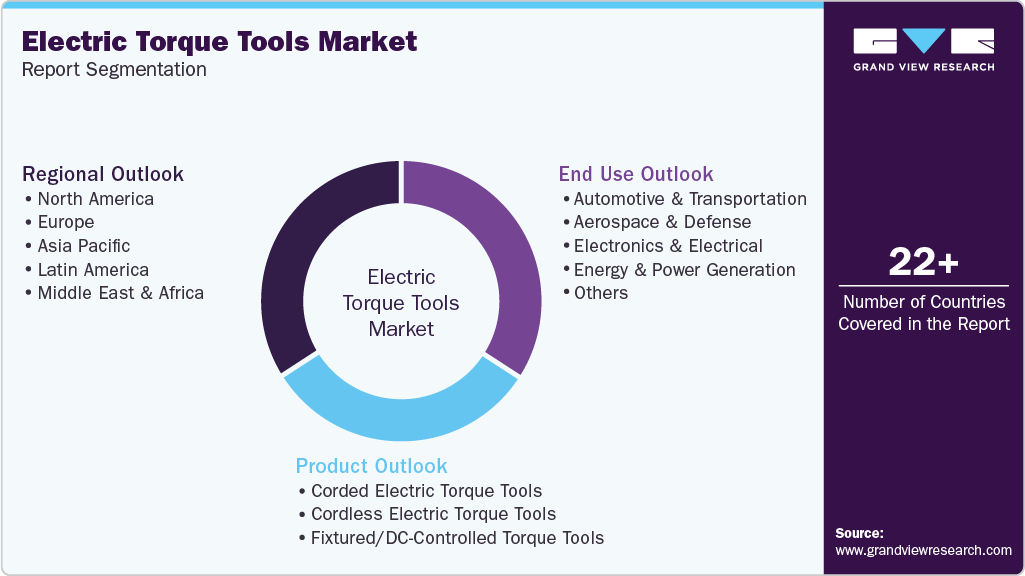
This report forecasts revenue growth at global, regional, and country levels and provides an analysis of the latest industry trends in each of the sub-segments from 2021 to 2033. For this study, Grand View Research has segmented the global electric torque tools market report based on product, end use, and region:
 To learn more about this report, Download Free Sample Report
 -
End Use Outlook (Revenue, USD Million, 2021 - 2033)
-
Automotive & Transportation
-
Aerospace & Defense
-
Electronics & Electrical
-
Energy & Power Generation
-
Others
-
-
Product Outlook (Revenue, USD Million, 2021 - 2033)
-
Corded Electric Torque Tools
-
Cordless Electric Torque Tools
-
Fixtured/DC-Controlled Torque Tools
-
-
Regional Outlook (Revenue, USD Million, 2021 - 2033)
-
North America
-
U.S.
-
Canada
-
Mexico
-
-
Europe
-
Germany
-
UK
-
France
-
Italy
-
Spain
-
-
Asia Pacific
-
China
-
Japan
-
India
-
-
Latin America
-
Middle East & Africa
-
Research Methodology
The electric torque tools market figures in this report are based on a proven research process that combines executive interviews with secondary research from proprietary databases, company filings, and recognized regulatory and institutional sources. Market size is built through value-chain sizing - reconciling supply-side and demand-side estimates - and triangulated with bottom-up and top-down approaches. Every estimate passes multiple levels of expert validation before publication, with each electric torque tools segment quantified using the revenue-capture definitions in the table below.
Segment Definition
Segment - Product Type
Revenue Capture Definition
Corded Electric Torque Tools
Revenue generated from sales of electrically powered corded torque tools providing continuous operation for industrial assembly and precision fastening applications.
Cordless Electric Torque Tools
Revenue generated from sales of battery-powered electric torque tools used for portable, flexible, and high-precision fastening across multiple industries.
Fixtured / DC-Controlled Torque Tools
Revenue generated from sales of fixtured and DC-controlled electric torque tools integrated into automated production lines for controlled fastening operations.
Segment - End Use
Revenue Capture Definition
Automotive & Transportation
Revenue generated from sales of electric torque tools used in vehicle assembly, component manufacturing, maintenance, and transportation equipment production.
Aerospace & Defense
Revenue generated from sales of electric torque tools used in aircraft manufacturing, defense equipment assembly, maintenance, and precision fastening applications.
Electronics & Electrical
Revenue generated from sales of electric torque tools used in electronics assembly, electrical equipment manufacturing, semiconductor production, and precision fastening operations.
Energy & Power Generation
Revenue generated from sales of electric torque tools used in power plants, renewable energy installations, transmission equipment, and industrial maintenance.
Others
Revenue generated from sales of electric torque tools across construction, industrial manufacturing, medical devices, machinery, and other end-use industries.
Estimation Model
Layer Name
Key Question
Description
Industrial Manufacturing and Assembly Demand Layer
Which sectors generate demand for electric torque tools?
The estimation begins by evaluating demand across automotive & transportation, aerospace & defense, electronics & electrical, energy & power generation, industrial machinery, and other manufacturing sectors.
Product Type and Technology Layer
Which product types drive market demand?
This layer refines demand by assessing the adoption of corded electric torque tools, cordless electric torque tools, and fixtured/DC-controlled torque tools. Factors including torque accuracy, digital control systems, battery performance, automation compatibility, ergonomic design, and smart connectivity influence product adoption across industrial applications.
End-user Adoption Layer
What determines electric torque tool demand?
Market demand is estimated by evaluating electric torque tool deployment across automotive & transportation, aerospace & defense, electronics & electrical, energy & power generation, and other industrial sectors.
Revenue Layer
How is total market revenue calculated?
Revenue is estimated by aggregating sales of electric torque tools across product types, end-use industries, and regional markets. Equipment pricing, manufacturing output, automation investments, replacement demand, industrial capital expenditure, distributor sales, manufacturer revenues, and regional production trends are incorporated to validate the overall market size.
Delivered Customizations
This report has been delivered with the following In-depth customizations
Client Request
Customization Delivered
Value Adds
Regional Segmentation
Detailed regional analysis of the electric torque tools market covering North America, Europe, Asia-Pacific, Latin America, and the Middle East & Africa, along with country-level demand assessment, manufacturing output, industrial automation trends, automotive production, aerospace manufacturing, electronics production, and import-export analysis.
Helped clients identify high-growth regional markets and prioritize expansion strategies based on industrial development, automation investments, and sector-specific demand.
Opportunity Assessment
Comprehensive opportunity analysis focusing on smart manufacturing adoption, Industry 4.0 integration, digital torque monitoring, connected fastening solutions, and automation investments. The customization also assessed growth opportunities across automotive & transportation, aerospace & defense, electronics & electrical, energy & power generation, and other industrial sectors while identifying emerging application areas and future revenue opportunities.
Enabled clients to develop targeted market entry, product development, and investment strategies by identifying high-growth applications and emerging customer requirements. Assisted in strategic planning, technology adoption, and long-term business expansion.
Competitive benchmarking
In-depth benchmarking of major electric torque tool manufacturers based on product portfolio, torque control technologies, digital connectivity, geographic presence, industrial customer base, distribution networks, R&D investments, and automation capabilities. The analysis also compared company positioning across automotive, aerospace, electronics, and industrial manufacturing markets.
Assisted clients in understanding competitor strengths, technological capabilities, and market positioning. Helped identify product differentiation opportunities, partnership potential, and competitive strategies to strengthen long-term market presence.
Frequently Asked Questions About This Report
The global electric torque tools market size was estimated at USD 639.6 million in 2024 and is expected to reach USD 672.9 million in 2025.
The electric torque tools market is expected to grow at a compound annual growth rate of 5.2% from 2025 to 2033 to reach USD 1,009.4 million by 2033.
Cordless electric torque tools segment dominated the market and accounted for the largest revenue share of 52.5% in 2024, driven by the increasing need for mobility, flexibility, and ease of use in industrial and field operations.
Some of key players in the electric torque tools market are Atlas Copco AB, Stanley Black & Decker, Inc., Hilti Corporation, Ingersoll Rand Inc., Makita Corporation, Robert Bosch GmbH, Techtronics Industries Co. Ltd. (TTI), Apex Tool Group, LLC, and Desoutter Industrial Tools.
The key factors driving the electric torque tools market include rising demand for precise and efficient fastening solutions in automotive, electronics, and industrial applications, increasing adoption of cordless and digital torque tools, and growing emphasis on automation, safety, and operational productivity.
About the Author(s)
Advanced Interior Materials Research Team
Advanced Materials · Advanced Interior MaterialsThis report was authored by the advanced interior materials research team at Grand View Research - comprising two research analysts, one senior research analyst, and one industry expert - with specialized expertise in the advanced interior materials segment of the advanced materials industry. All findings are based on proprietary advanced materials databases, executive interviews, and regulatory analysis, subject to internal peer review prior to publication.
Last Updated:
Speak to Analyst

Customize this report to your needs - add regions, segments, or data points, with 20% free customization.
Or view our licence options:


ISO 9001:2015 & 27001:2022 Certified
We are GDPR and CCPA compliant! Your transaction & personal information is safe and secure. For more details, please read our privacy policy.


