
- Home
- »
- Plastics, Polymers & Resins
- »
-
Electronic Shelf Label Market Size, Share Report, 2026-2033GVR Report cover

Electronic Shelf Label Market (2026 - 2033)
Size, Share & Trends Analysis Report By Component (Displays, Batteries), By Type (E-paper Displays, LCDs), By Communication Technology, By Size, By Application, By Region, And Segment Forecasts
Market Size, 2025
$2.1BMarket Estimate, 2026
$2.4BMarket Forecast, 2033
$7.3BCAGR, 2026–2033
17.4%Electronic Shelf Label Market Summary
The global electronic shelf label market size was valued at USD 2.1 billion in 2025 and is projected to grow from USD 2.4 billion in 2026 to USD 7.3 billion by 2033, at a CAGR of 17.4% from 2026 to 2033. The market in North America dominated with a revenue share of 38.0% in 2025. The market is primarily driven by the rising adoption of automation in retail to improve pricing accuracy and operational efficiency.
 Source: Grand View Research, IR Documents, Primary Interviews, Paid DatabasesTo learn more about this report,
 Download Free Sample Report
 Key Market Trends & Insights
- By component: Displays segment held the largest market share of 44.0% in 2025.
- By type: E-paper displays segment held the largest market share of 65.0% in 2025.
- By communication technology: Radio frequency (RF) segment held the largest market share of 67.0% in 2025.
- By size: ≤ 3 inches segment held the largest market share of 60.0% in 2025.
- By application: Retail segment held the largest market share of 87.0% in 2025.
Regional Highlights
- Largest regional market: North America (38.0% revenue share, 2025)
- Fastest-growing regional market: Asia Pacific (highest CAGR, 2026-2033)
- By country: Canada held the largest market share in 2025
Market Size & Forecast
- Market size in 2025: USD 2.1 Billion
- Estimated market size in 2026: USD 2.4 Billion
- Projected market size by 2033: USD 7.3 Billion
- CAGR (2026-2033): 17.4%
Three ways to get this report
Buy it, customize it, or ask a question.Ask an Analyst
Analyst response in 1 business day
- AccessReport author, directly
- Reply timeWithin 1 working day
- No sales callDirect answer only
- FormatEmail reply
- CostFree, no cost
Get the Full Report
What the study covers
- FormatsPDF · Excel · Dashboard
- Timeline2026–2033 annual, 2025 base
- Coverage20+ countries, 5 regions
- Companies10+ key players profiled
Customize the Report
20% free customization
- IncludeCountries, segments, points
- TailorTo your product definition
- ExtendDeeper competitor detail
- OrA fully bespoke study
- Turnaround5–10 working days
In addition, the growing demand for real-time product information and dynamic pricing in omnichannel retailing is accelerating market growth. The global retail sector is undergoing a transformative shift toward automation to streamline operations, reduce labor costs, and improve pricing accuracy. Electronic Shelf Labels (ESLs) play a vital role in this evolution by enabling retailers to automate price updates across thousands of products in real time. Traditional manual price tagging is not only time-consuming but also error-prone, which can result in inconsistencies and customer dissatisfaction. By adopting ESLs, retailers can ensure uniform pricing across stores and reduce dependency on human labor for routine pricing updates. For example, leading retailers like Walmart and Carrefour have piloted ESL deployments to enhance price agility, especially during promotional campaigns and flash sales. To learn more about this report, Download Free Sample Report
 With the rise of omnichannel retail, where physical and digital shopping experiences are integrated, pricing consistency across platforms has become critical. ESLs help achieve this synchronization by linking directly with central pricing systems and inventory databases. Furthermore, retailers are increasingly embracing dynamic pricing strategies-adjusting prices based on demand, competitor pricing, or inventory levels. ESLs allow such price changes to be reflected instantly on store shelves, providing a competitive advantage. For instance, in grocery chains, prices for perishable items can be reduced dynamically based on their remaining shelf life, minimizing waste and optimizing inventory turnover.
Beyond pricing, ESLs enhance the overall shopping experience by offering rich, contextual product information such as discounts, nutritional details, or product origin. Some ESLs now incorporate QR codes or NFC technology, allowing customers to access additional product data or promotional offers via their smartphones. This level of digital interactivity bridges the gap between physical and online shopping, catering to tech-savvy consumers who expect convenience and transparency. Retailers like Best Buy and MediaMarkt have adopted ESLs with color e-paper displays and interactive elements to provide a more engaging and informative in-store experience, leading to higher customer satisfaction and loyalty.
Retailers are increasingly prioritizing sustainability as part of their business strategy, and ESLs align well with these goals. By replacing paper labels, ESLs help reduce paper consumption and associated waste, contributing to a more environmentally friendly operation. Over time, ESLs also offer cost savings through reduced labor and material costs. While the initial investment in ESL infrastructure may be high, the long-term return on investment is favorable, especially for large-scale retailers managing thousands of SKUs.
Market Dynamics
The rapid expansion of hypermarkets, supermarkets, and convenience stores is a major factor driving the growth of the global electronic shelf label (ESL) market. Retailers are increasingly adopting ESL solutions to enhance customer experience, improve pricing accuracy, and streamline store operations. ESLs enable real-time price updates, dynamic promotions, and seamless integration with inventory and point-of-sale systems, helping retailers create a more efficient and digitally connected shopping environment. As competition in the retail sector intensifies, retailers are investing heavily in in-store digitization technologies to improve operational flexibility and customer engagement.
Additionally, ESLs are proving effective in influencing consumer purchasing behavior and increasing sales through visually appealing digital promotions and real-time product information. According to a study commissioned by Vestcom, 47% of grocery shoppers in the U.S. stated that digital screens improved their shopping experience, while 27% reported being encouraged to try new products or make impulse purchases due to digital displays. However, concerns regarding pricing transparency, particularly among younger consumers, highlight the need for retailers to maintain trust while implementing dynamic pricing strategies. Despite these concerns, the growing focus on smart retail infrastructure and enhanced in-store experiences continues to support the widespread adoption of ESL systems globally.
The high initial implementation cost remains a key restraint for the growth of the global electronic shelf label (ESL) market. Deploying ESL systems requires substantial investment in hardware, software infrastructure, installation, and system integration. Retailers must also ensure compatibility with existing enterprise resource planning (ERP) and point-of-sale (POS) systems, which can further increase implementation complexity and costs. For large retail chains, although ESL solutions offer long-term operational benefits such as automated pricing, improved inventory management, and reduced labor costs, the significant upfront expenditure can still delay adoption decisions.
The integration of ESL systems into existing store infrastructure poses another significant challenge. ESLs require seamless integration with inventory management systems, point-of-sale (POS) systems, and pricing strategies. Retailers must ensure that their software platforms can communicate effectively with ESLs, which often involves complex installation processes and software customization. Compatibility issues arise when ESL providers and retailers use different systems that are not optimized to work together. For example, when a retail chain shifts from one POS system to another, ESL systems might require significant reconfiguration or even hardware replacements, adding additional costs and time to the transition. Retailers may also need to train their staff on how to use these new technologies effectively.
Market Concentration & Characteristics
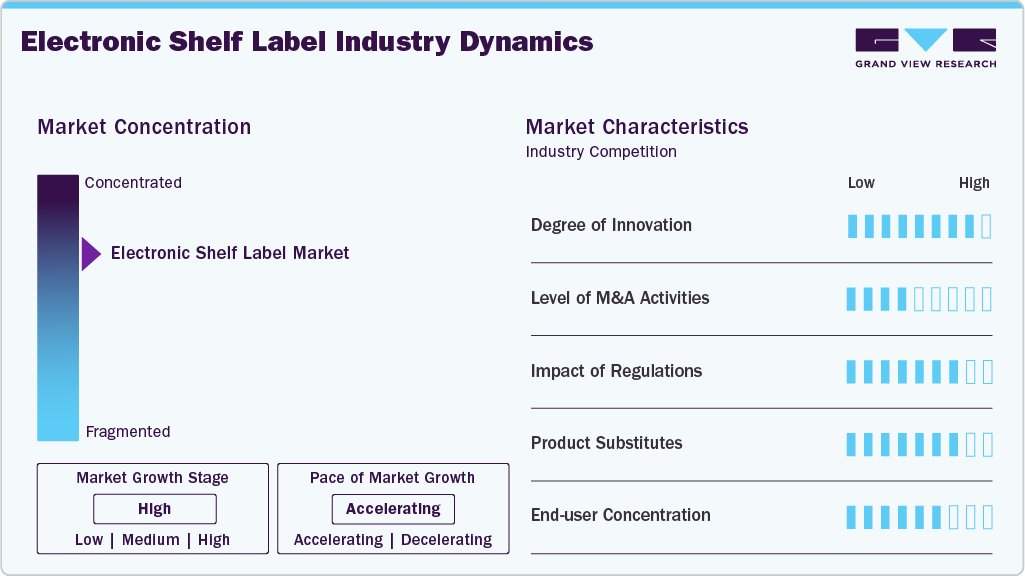
The ESL industry is heavily driven by technological advancements, particularly in display technology (e.g., e-paper and LCD), wireless communication (e.g., RF, NFC, BLE, and Wi-Fi), and IoT integration. As retailers seek real-time pricing, dynamic promotions, and greater efficiency, innovation remains at the core of this industry. Continuous R&D investments are focused on improving battery life, display clarity, energy efficiency, and integration with AI-powered pricing engines. The industry is also evolving to support smart retail solutions, such as shelf monitoring and real-time inventory management through sensor integration.
 To learn more about this report, Download Free Sample Report
 While ESL systems can offer substantial cost savings over time, the industry is characterized by a relatively high initial cost of deployment, especially for large retailers. Expenses include ESL units, communication infrastructure (gateways, software, servers), and integration with existing retail systems (ERP, POS, etc.). However, the long-term return on investment (ROI) is significant due to reduced labor costs, fewer pricing errors, and better promotional efficiency. This cost-benefit equation makes ESLs more appealing to medium- to large-scale retailers and gradually affordable for smaller stores as the technology matures and prices decline.
Component Insights
The displays segment recorded the largest market revenue share of over 44.0% in 2025 and is expected to grow at the fastest CAGR of 17.9% during the forecast period. Displays are the visual interface of ESLs, responsible for presenting product information such as price, promotions, and QR codes. They are typically made using e-paper (electrophoretic) or LCD technologies, with e-paper being the most common due to its low power consumption and excellent readability under ambient lighting. Displays are a critical component because they directly interact with consumers and influence retail communication and engagement.
Batteries power ESLs and are essential for their wireless functionality. Most ESLs use coin cell lithium batteries, which can last 5-10 years depending on the update frequency and display technology. Long battery life reduces maintenance costs and downtime, especially in large-scale retail operations with thousands of tags.
Type Insights
The e-paper displays segment recorded the largest market revenue share of over 65.0% in 2025 and is expected to grow at the fastest CAGR of 18.1% during the forecast period. E-paper (electronic paper) displays are the most used ESLs, known for their low power consumption, wide viewing angles, and readability under various lighting conditions, including direct sunlight. These displays mimic the appearance of ink on paper and can retain images without a constant power supply. The primary driver for E-paper displays is their exceptional energy efficiency, which allows for months or even years of operation on a single battery.
Graphic e-paper displays are an advanced version of standard E-paper screens that can display high-resolution graphical content such as logos, barcodes, QR codes, and product images. They offer a more dynamic and branded shopping experience compared to traditional segment-based e-paper labels. Retailers are increasingly investing in enhanced customer engagement and product differentiation, making graphic e-paper displays attractive due to their ability to display detailed branding elements.
Communication Technology Insights
The radio frequency (RF) segment recorded the largest market share of over 67.0% in 2025. RF is the most widely adopted communication technology in ESL systems. It enables wireless data transfer between the central server and ESLs using radio waves, typically in the 2.4 GHz ISM band. RF technology allows retailers to update thousands of labels simultaneously across a large store area, supporting long-range and low-power communication. Retailers favor RF for its cost-effectiveness, ability to cover wide areas, and fast synchronization speeds. Moreover, the increasing adoption of smart retail practices and the need for centralized pricing control further boost RF ESL deployment.
The infrared segment is projected to grow at the fastest CAGR of 18.1% during the forecast period. Infrared communication in ESLs relies on light signals to transmit data between a transmitter (often mounted on the ceiling) and the labels. While IR offers secure and interference-free communication, it requires line-of-sight between the transmitter and the ESL, limiting flexibility and making it more suitable for small-scale or specialized environments such as pharmacies or electronics stores.
Size Insights
The ≤ 3 inches segment recorded the largest market revenue share of over 60.0% in 2025 and is expected to grow at the fastest CAGR of 17.7% during the forecast period. This segment includes compact ESLs that are primarily used for price tags on smaller retail items such as cosmetics, pharmaceuticals, packaged foods, and convenience store goods. These labels are most commonly used in high-density product shelving where space is limited. The primary driver for this size category is high product density in retail environments, especially in supermarkets, drugstores, and convenience stores.
The 3 to 7 inches segment represents mid-sized ESLs widely used in grocery chains, hypermarkets, department stores, and specialty retail for general merchandise. They provide a balanced display area for prices, promotions, QR codes, and product information. Multifunctionality and versatility are major drivers here. These ESLs strike a balance between size and information capacity, allowing retailers to display dynamic content without occupying excessive shelf space. This size range is increasingly favored for stores undergoing digital transformation and omnichannel alignment.
Application Insights
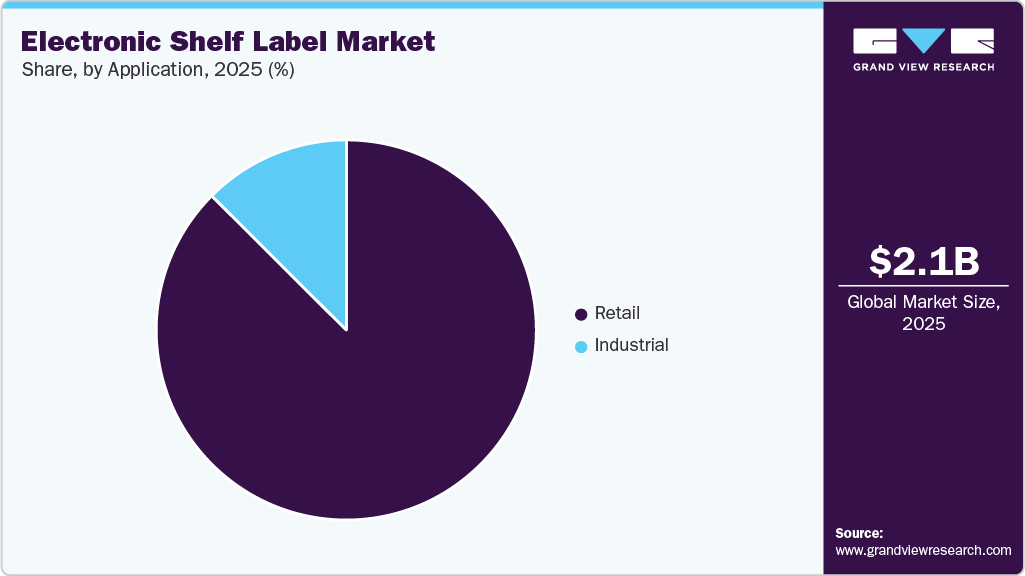
The retail segment recorded the largest market revenue share of over 87.0% in 2025 and is expected to grow at the fastest CAGR of 17.7% during the forecast period. ESLs are extensively used across various retail formats such as supermarkets, hypermarkets, department stores, and convenience stores to automate pricing, enhance customer experience, and improve operational efficiency. Retailers are increasingly seeking to bridge their online and offline channels through unified pricing and promotions, where ESLs offer a seamless solution. In addition, the pressure to improve store efficiency, minimize human errors in price labeling, and enhance customer experience through interactive features like QR codes and NFC is contributing significantly to adoption.
 To learn more about this report, Download Free Sample Report
 In the industrial sector, ESLs are being adopted for use in warehousing, logistics, and manufacturing facilities. While still an emerging segment compared to retail, industrial applications utilize ESLs for inventory management, bin labeling, equipment tracking, and supply chain visibility. These labels can be integrated with warehouse management systems (WMS) and ERP platforms to display real-time data such as stock levels, part numbers, or storage instructions. ESLs enhance accuracy and speed in picking and packing operations and reduce the need for manual interventions in dynamic environments. The industrial uptake of ESLs is primarily driven by the increasing need for automation and digital transformation in warehousing and logistics.
Region Insights
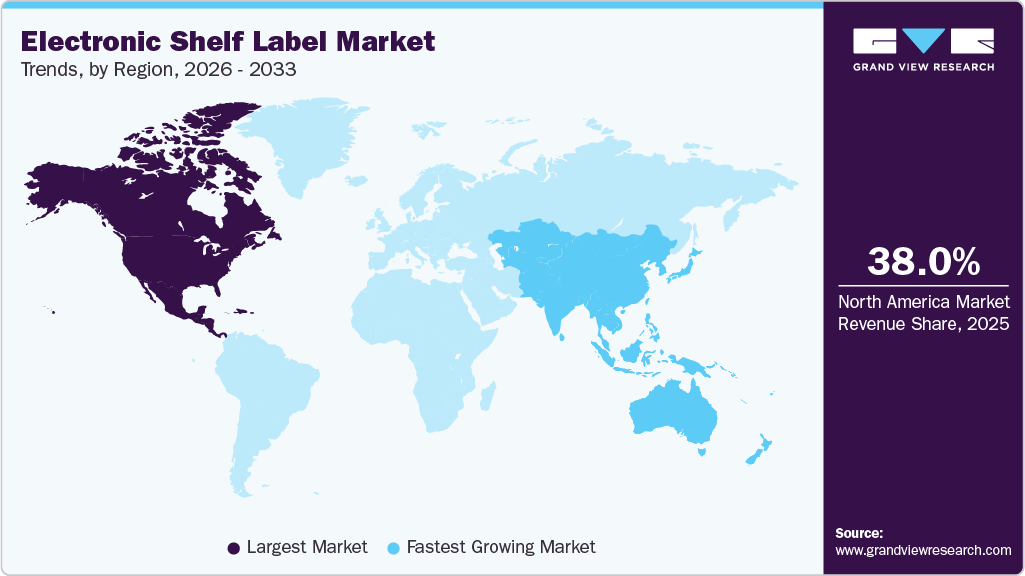
North America electronic shelf label market dominated the global industry and accounted for the largest revenue share of over 38.0% in 2025. This positive outlook is due to the region’s advanced retail ecosystem, high digital adoption rates, and strong investment in automation. With major retail chains like Walmart, Kroger, and Costco constantly seeking ways to optimize pricing strategies and enhance operational efficiency, ESL adoption is growing rapidly. The region's well-developed logistics and supply chain infrastructure, coupled with the increasing demand for omnichannel retailing, further propel market growth. Retailers are leveraging ESL solutions to synchronize online and offline pricing in real time, improving pricing accuracy and customer experience.
 To learn more about this report, Download Free Sample Report
 U.S. Electronic Shelf Label Market Trends
The electronic shelf label market in the U.S. stands as a leader in ESL adoption due to its position as a global technology hub, home to major software and hardware innovators. Silicon Valley’s ecosystem of startups and tech giants, such as Apple, Intel, and NVIDIA, is driving the development of next-generation ESLs with AI and machine learning capabilities, leading to increasing implementation of ESLs in the country. For instance, in June 2024, Walmart announced the rollout of ESLs to improve pricing and inventory management in its stores. This initiative, which began testing at Store 266 in Grapevine, Texas, is planned to expand to 2,300 stores by 2026.
Europe Electronic Shelf Label Market Trends
The electronic shelf label market in Europe is growing rapidly due to the region’s strong emphasis on sustainability and evolving regulatory requirements. Governments across the European Union are enforcing strict policies on reducing paper waste, improving energy efficiency, and adopting smart retail technologies, which are accelerating ESL adoption. For instance, the EU’s Green Deal and Circular Economy Action Plan encourage retailers to digitize operations and minimize environmental impact. Major retail chains like Carrefour, Tesco, and Aldi are implementing ESLs to support dynamic pricing strategies while reducing paper waste associated with traditional price tags.
Asia Pacific Electronic Shelf Label Market Trends
The electronic shelf label market in the Asia Pacific is expected to grow at the fastest CAGR of 17.7% over the forecast period. This positive outlook is due to the region's strong economic growth, rising digitalization, and increasing retail modernization. Countries across the region are witnessing a shift towards smart retail solutions driven by urbanization, increasing disposable incomes, and government initiatives promoting digital transformation. The high penetration of e-commerce in countries such as China and India is pushing traditional brick-and-mortar retailers to adopt ESLs to ensure dynamic pricing and better inventory management.
China electronic shelf label marketis a key driver of the ESL market in the Asia Pacific, benefiting from its low manufacturing costs and rapid technological advancements. In June 2024, the Chinese government announced that in the first four months of 2024, China's electronics manufacturing industry experienced significant growth, with profits from major companies increasing by 75.8% YoY to approximately CNY 144.2 billion (about USD 20.3 billion). As the world’s leading electronics manufacturing hub, China is home to major ESL producers that leverage cost-effective production and advanced R&D to develop next-generation digital labeling solutions. Retailers such as Alibaba’s Freshippo and JD.com’s supermarkets are integrating ESLs to streamline pricing, enable dynamic promotions, and enhance supply chain efficiency.
Key Electronic Shelf Label Company Insights
The competitive environment of the ESL market is characterized by intense rivalry among key players driven by rapid technological advancements, increasing adoption of automation in retail, and rising demand for real-time pricing solutions. Major companies such as Pricer, Panasonic Connect Co., Ltd., SOLUM, VusionGroup, Displaydata Ltd, and Delfi Technologies A/S dominate the market with strong global footprints and continuous innovations in e-paper displays, wireless technologies, and cloud-based solutions. The market also sees the emergence of regional players, especially in the Asia-Pacific region, offering cost-effective alternatives, thereby intensifying price competition. Strategic partnerships with retailers, investments in R&D, and product customization remain core strategies to gain a competitive advantage in this evolving landscape.
-
In January 2025, Sexton Group Ltd partnered with JRTech Solutions to introduce advanced Electronic Shelf Label (ESL) technology to its members, which includes over 450 independent building materials dealers across North America. This collaboration aims to enhance operational efficiency and improve customer experience at retail locations by leveraging cutting-edge ESL technology.
-
In August 2024, VusionGroup announced a partnership with SPAR Austria to enhance the retail experience through the deployment of multicolor smart electronic shelf labels (ESLs) and VusionCloud technology across 200 store locations by the end of the year. This initiative aims to digitalize SPAR's shelves, providing real-time products and pricing data.
-
In January 2024, Opticon and Epishine showcased their innovative solar-powered electronic shelf labels (ESLs) at NRF 2024, highlighting significant advancements in retail technology. This collaboration introduces a centralized light-powered ESL system that utilizes Epishine's printed organic solar cells. These cells efficiently capture indoor light to power the labels, eliminating the need for individual batteries.
Key Electronic Shelf Label Companies:
The following are the leading companies in the electronic shelf label market. These companies collectively hold the largest market share and dictate industry trends.
- Pricer
- Panasonic Connect Co., Ltd.
- SOLUM
- VusionGroup
- Hangzhou Zkong Networks Co., Ltd.
- Teraoka (Pty) Ltd
- Displaydata Ltd
- M2COMM
- Opticon
- Shanghai SUNMI Technology Co., Ltd.
- ComQi
- Hanshow Technology
- SUNLUX IOT TECHNOLOGY(GUANGDONG) INC
- Minewtag
- YalaTech
- Ynvisible Interactive Inc.
- Delfi Technologies A/S
- SEN SECURITY SOLUTIONS
- Infotek Software & Systems (P) Ltd
- Guangzhou Mengbian Information Technology Co., Ltd.
Competitive Benchmarking
Operating Strategies
Competitive Edge
Weaknesses
Mature Players: Pricer; VusionGroup; SOLUM; Panasonic Connect; Hanshow Technology; Hangzhou Zkong Networks Co., Ltd.
- Mature players secure multi-year contracts with major retailers like Walmart, Carrefour, Tesco, and Auchan to standardize ESL adoption.
- Energy-efficient solutions such as solar ESLs are being explored to enhance sustainability and lower operational costs.
- Established ESL providers have a strong brand presence and deep market penetration across retail segments such as supermarkets, hypermarkets, and consumer electronics stores.
- Strategic Partnerships and Long-Term Contracts
- Established ESL companies often rely on long-term contracts with major global retailers. While these partnerships provide stability, they also create dependency, making companies vulnerable to contract renewals, shifting retailer priorities, and aggressive price negotiations.
Emerging Players: M2COMM; Ynvisible Interactive Inc.; SEN SECURITY SOLUTIONS; Delfi Technologies A/S; Displaydata Ltd
- Expanding aggressively in Southeast Asia, Latin America, and Africa, where ESL penetration is still low.
- To compete effectively, emerging players incorporate cutting-edge technologies such as e-paper displays, NFC, RFID, IoT, AI-driven analytics, and cloud integration.
- Offering lower-cost solutions with flexible pricing models such as subscription-based ESL services (ESL-as-a-service).
- Emerging players provide more customized integrations for specific industries such as pharmacies, DIY stores, and boutique retail chains.
- Large retailers require pilot testing, after-sales support, and service-level agreements (SLAs), which emerging players may struggle to meet due to limited financial and operational resources, making it hard to compete with established end-to-end solution providers.
Electronic Shelf Label Market Report Scope
Report Attribute
Details
Market size in 2025
USD 2.1 billion
Estimated market size in 2026
USD 2.4 billion
Projected market size by 2033
USD 7.3 billion
Growth rate
CAGR of 17.4% from 2026 to 2033
Historical data
2021 - 2024
Forecast period
2026 - 2033
Quantitative units
Revenue in USD million/billion, and CAGR from 2026 to 2033
Report coverage
Revenue forecast, competitive landscape, growth factors, and trends
Segments covered
Component, type, communication technology, size, application, region
States scope
North America; Europe; Asia Pacific; Latin America; MEA
Key companies profiled
Pricer; Panasonic Connect Co., Ltd.; SOLUM; VusionGroup; Hangzhou Zkong Networks Co., Ltd.; Teraoka (Pty) Ltd; Displaydata Ltd; M2COMM; Opticon; Shanghai SUNMI Technology Co., Ltd.; ComQi; Hanshow Technology; SUNLUX IOT TECHNOLOGY (GUANGDONG) INC; Minewtag; YalaTech; Ynvisible Interactive Inc.; Delfi Technologies A/S; SEN SECURITY SOLUTIONS; Infotek Software & Systems (P) Ltd; Guangzhou Mengbian Information Technology Co., Ltd.
Customization scope
Free report customization (equivalent up to 8 analyst’s working days) with purchase. Addition or alteration to country, regional, and segment scope.
Pricing and purchase options
Avail customized purchase options to meet your exact research needs. Explore purchase options
Global Electronic Shelf Labels Market Report Segmentation
This report forecasts revenue growth at a global level and provides an analysis of the latest industry trends in each of the sub-segments from 2021 to 2033. For this study, Grand View Research has segmented the global electronic shelf label market report based on component, type, communication technology, size, application, and region:
-
Component Outlook (Revenue, USD Million, 2021 - 2033)
-
Displays
-
Batteries
-
Transceivers
-
Microprocessors
-
Others
-
-
Type Outlook (Revenue, USD Million, 2021 - 2033)
-
E-paper Displays
-
Graphic E-paper Displays
-
LCDs
-
-
Communication Technology Outlook (Revenue, USD Million, 2021 - 2033)
-
Radio Frequency
-
Infrared
-
Near-field Communications
-
Others
-
-
Size Outlook (Revenue, USD Million, 2021 - 2033)
-
≤ 3 inches
-
3 to 7 inches
-
7 to 10 inches
-
≥ 10 inches
-
-
Application Outlook (Revenue, USD Million, 2021 - 2033)
-
Retail
-
Industrial
-
-
Region Outlook (Revenue, USD Million, 2021 - 2033)
-
North America
-
U.S.
-
Canada
-
Mexico
-
-
Europe
-
Germany
-
France
-
UK
-
Italy
-
Spain
-
Albania
-
Croatia
-
Greece
-
-
Asia Pacific
-
China
-
India
-
Japan
-
Australia
-
South Korea
-
-
Latin America
-
Brazil
-
-
Middle East & Africa
-
South Africa
-
Saudi Arabia
-
UAE
-
-
Delivered Customizations
This report has been delivered with the following In-depth customizations
Client Request
Customization Delivered
Value Adds
Regional Segmentation
Detailed analysis of the global Electronic Shelf Label market across North America, Europe, Asia Pacific, Latin America, and Middle East & Africa, including country-level demand assessment, retail digitalization trends, smart store adoption, regulatory environment, and regional growth outlook.
Identify high-growth regional markets and investment hotspots. Support region-specific expansion strategies and sales prioritization. Enable understanding of regional adoption patterns and competitive intensity.
Competitive Benchmarking
Comparative assessment of key ESL manufacturers and solution providers based on product portfolio, technology capabilities, pricing strategies, regional presence, partnerships, innovation focus, and strategic initiatives.
Support competitor tracking and positioning analysis. Identify market leaders, emerging players, and differentiation opportunities. Enable informed partnership and competitive strategy development.
Pricing Analysis
Assessment of electronic shelf label (ESL) pricing trends across hardware components, display technologies, communication protocols, and deployment models, including analysis of software integration costs, installation expenses, regional pricing variations, subscription-based service models, and competitor benchmarking.
Identify key pricing drivers and cost optimization opportunities. Support competitive pricing strategy development and procurement planning. Enable benchmarking against regional and global ESL solution providers.
Frequently Asked Questions About This Report
Key players include Pricer; Panasonic Connect Co., Ltd.; SOLUM; VusionGroup; Hangzhou Zkong Networks Co., Ltd.; Teraoka (Pty) Ltd; Displaydata Ltd; M2COMM; Opticon; Shanghai SUNMI Technology Co., Ltd.; ComQi; Hanshow Technology; SUNLUX IOT TECHNOLOGY (GUANGDONG) INC; Minewtag; YalaTech; Ynvisible Interactive Inc.; Delfi Technologies A/S; SEN SECURITY SOLUTIONS; Infotek Software & Systems (P) Ltd; Guangzhou Mengbian Information Technology Co., Ltd.
The growing demand for real-time product information and dynamic pricing in omnichannel retailing is accelerating the ESL market growth.
The displays segment led with a 44.0% revenue share in 2025, while the batteries power ESLs segment is the fastest-growing.
The e-paper displays segment led with a 65.0% revenue share in 2025, while the graphic e-paper displays segment is the fastest-growing.
The radio frequency (RF) segment led with a 67.0% revenue share in 2025, while the infrared segment is the fastest-growing.
The ≤ 3 inches segment led with a 60.0% revenue share in 2025.
The global electronic shelf label market size was valued at USD 2.1 billion in 2025 and is estimated at USD 2.4 billion for 2026.
The global electronic shelf label market is expected to grow at a CAGR of 17.4% from 2026 to 2033, reaching USD 7.3 billion by 2033.
North America dominated with a 38.0% revenue share in 2025.
Asia Pacific is the fastest-growing region over the forecast period.
About the Author(s)
Plastics, Polymers & Resins Research Team
Bulk Chemicals · Plastics, Polymers & ResinsThis report was authored by the plastics, polymers & resins research team at Grand View Research - comprising two research analysts, one senior research analyst, and one industry expert - with specialized expertise in the plastics, polymers & resins segment of the bulk chemicals industry. All findings are based on proprietary bulk chemicals databases, executive interviews, and regulatory analysis, subject to internal peer review prior to publication.
Last Updated:
Speak to Analyst

Customize this report to your needs - add regions, segments, or data points, with 20% free customization.
Or view our licence options:


ISO 9001:2015 & 27001:2022 Certified
We are GDPR and CCPA compliant! Your transaction & personal information is safe and secure. For more details, please read our privacy policy.


