
- Home
- »
- Advanced Interior Materials
- »
-
Elemental Sulfur Market Size & Share Report, 2026-2033GVR Report cover

Elemental Sulfur Market (2026 - 2033)
Size, Share & Trends Analysis Report By Source (Refineries, Gas Processing Plants), By End-use (Agriculture, Chemical, Rubber, Metallurgy), By Region (North America, Europe, Asia Pacific, Central & South America, MEA), And Segment Forecasts
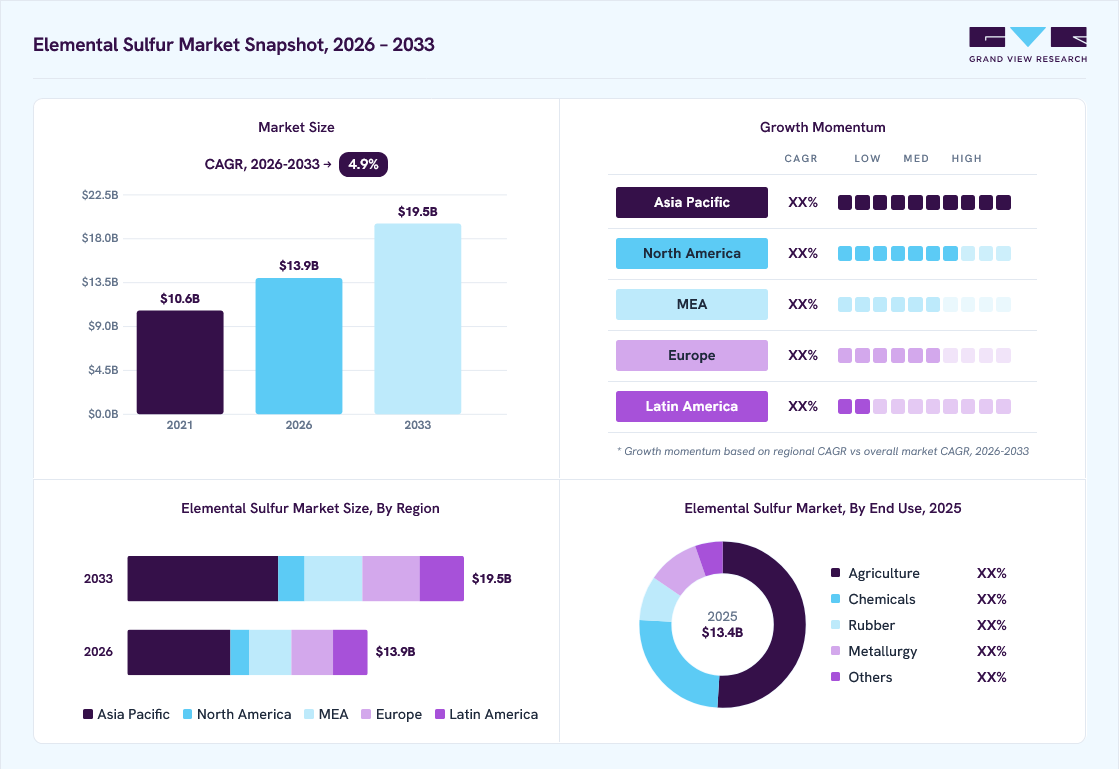
Market Size, 2025
$13.4BMarket Estimate, 2026
$13.9BMarket Forecast, 2033
$19.5BCAGR, 2026–2033
4.9%Elemental Sulfur Market Summary
The global elemental sulfur market size was valued at USD 13.4 billion in 2025 and is projected to grow from USD 13.9 billion in 2026 to USD 19.5 billion by 2033, at a CAGR of 4.9% from 2026 to 2033. Asia Pacific dominated the market, accounting for a revenue share of 42.6% in 2025. The market growth is driven by increasing demand from the agricultural sector.
 Source: Grand View Research, IR Documents, Primary Interviews, Paid DatabasesTo learn more about this report,
 Download Free Sample Report
 Key Market Trends & Insights
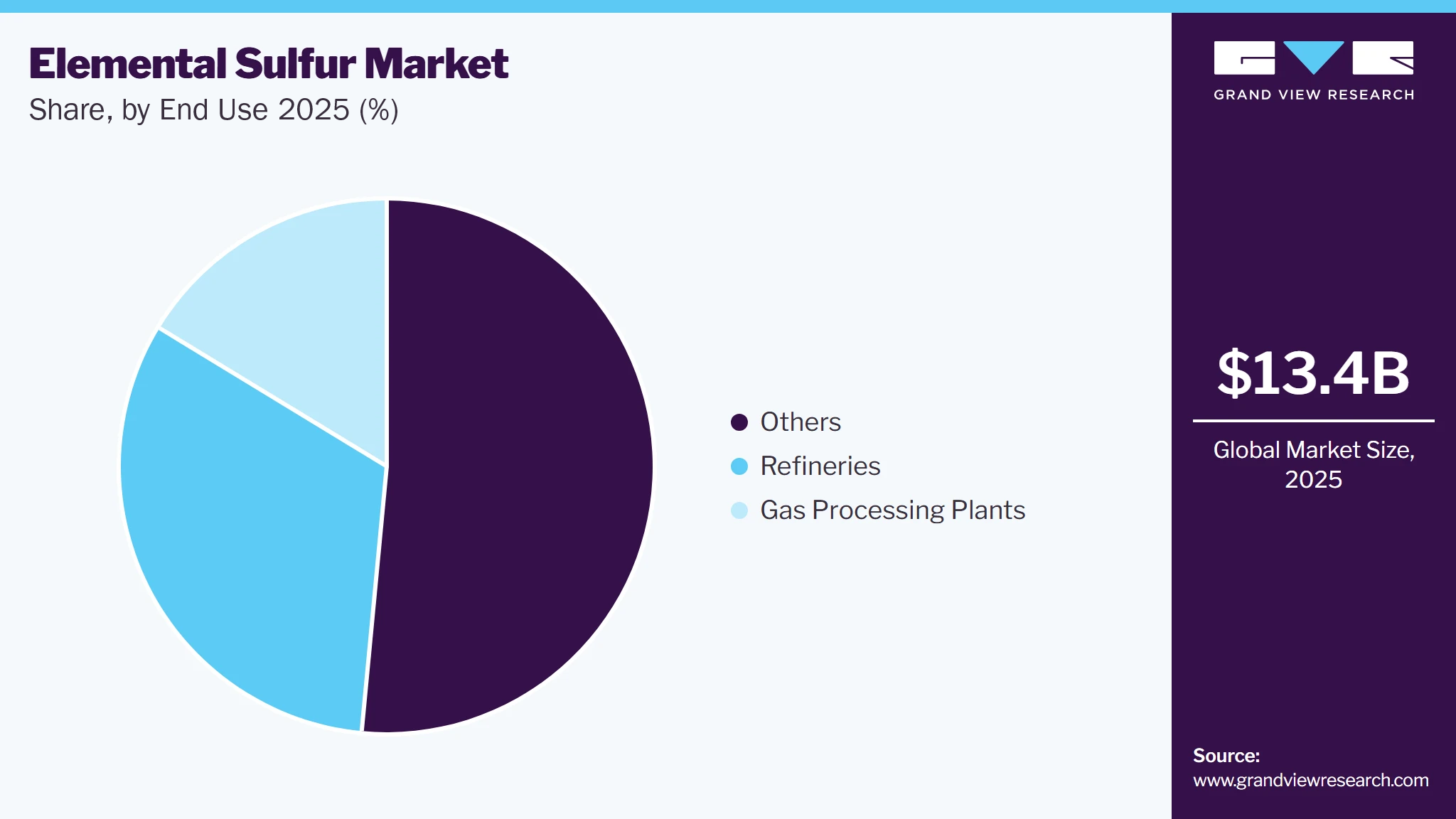
- By source: Others segment led the market with the largest revenue share of 51.5% in 2025.
- By end-use: Agriculture segment led the market with the largest revenue share of 50.9% in 2025.
Regional Highlights
- Largest regional market: Asia Pacific (42.6% revenue share, 2025)
- By country: The elemental sulfur market in the China held the largest share in the Asia Pacific region in 2025.
Market Size & Forecast
- Market size in 2025: USD 13.4 Billion
- Estimated market size in 2026: USD 13.9 Billion
- Projected market size by 2033: USD 19.5 Billion
- CAGR (2026–2033): 4.9%
Three ways to get this report
Buy it, customize it, or ask a question.Ask an Analyst
A direct answer, usually in 1 working day
- AccessReport author, directly
- Reply timeWithin 1 working day
- No sales callDirect answer only
- FormatEmail reply
- CostFree, no cost
Get the Full Report
What the study covers
- FormatsPDF · Excel · Dashboard
- Timeline2026–2033 annual, 2025 base
- Coverage20+ countries, 5 regions
- Companies10+ key players profiled
Customize the Report
20% free customization
- IncludeCountries, segments, points
- TailorTo your product definition
- ExtendDeeper competitor detail
- OrA fully bespoke study
- Turnaround5–10 working days
Sulfur is a key component in the production of fertilizers, specifically ammonium sulfate and phosphates, which are essential for crop growth and soil health. With the rising global population, the demand for food production has surged, necessitating higher agricultural output and subsequently boosting the demand for sulfur-based fertilizers. Additionally, the growing adoption of advanced agricultural techniques in developing countries further fuels market growth, as these methods often require higher-quality fertilizers to ensure productivity. To learn more about this report, Download Free Sample Report
 Regulatory pressures to minimize emissions of sulfur dioxide during refining and gas processing have led to advancements in sulfur recovery technologies, resulting in a steady supply of high-purity elemental sulfur. The shift towards cleaner energy sources and stricter environmental regulations has further highlighted the importance of sulfur recovery as part of sustainable industrial practices.
 To learn more about this report, Download Free Sample Report
 Market Dynamics
The elemental sulfur market is primarily driven by rising demand for sulfur-based fertilizers and sulfuric acid across agriculture, mining, chemical processing, and industrial applications. Elemental sulfur is widely used to improve soil fertility, enhance crop productivity, and serve as a key feedstock for sulfuric acid production. Growing global food demand, expanding agricultural activities, increasing industrialization, and the continued expansion of petroleum refining and natural gas processing operations are driving market growth. In addition, advancements in sulfur recovery technologies and a growing focus on resource efficiency are further contributing to long-term market growth.
The increasing demand for elemental sulfur from the fertilizer and agricultural industries remains a key growth driver for the market. Elemental sulfur is widely used in sulfur-containing fertilizers and soil amendment products to improve nutrient availability, enhance crop yields, and address sulfur deficiencies in agricultural soils. Rising global food demand, increasing adoption of precision farming practices, and growing awareness regarding balanced crop nutrition are accelerating sulfur consumption across major agricultural regions.
Furthermore, expanding commercial farming activities and the growing need to improve soil health are supporting the use of elemental sulfur in modern agricultural practices. Governments and agricultural organizations are increasingly promoting balanced nutrient management to improve crop productivity and sustainability, which continues to drive sulfur demand across cereals, oilseeds, fruits, vegetables, and other high-value crops worldwide.
Despite favorable growth prospects, fluctuations in refinery utilization rates, natural gas processing activities, and global energy market conditions can significantly affect sulfur supply availability and pricing. Since most elemental sulfur is recovered as a by-product of oil and gas operations, fluctuations in energy sector activity can create supply uncertainties and affect market stability. Additionally, transportation, storage, and environmental compliance requirements can increase operational costs and create challenges for sulfur producers and end users.
The increasing demand for sulfuric acid and sulfur-based chemicals across fertilizer manufacturing, mining, metal processing, and industrial production presents significant growth opportunities for the elemental sulfur market. Industries are increasingly seeking reliable sulfur feedstock to support expanding production capacities and industrial operations. Furthermore, growing investments in mining projects, chemical processing facilities, and sustainable resource recovery technologies are creating new avenues for elemental sulfur consumption and market expansion over the forecast period.
Analyst Perspective
The elemental sulfur market is witnessing steady growth driven by rising demand from the agriculture, chemical, mining, and industrial manufacturing sectors. Increasing consumption of sulfur-based fertilizers to enhance crop productivity, coupled with growing sulfuric acid production for chemical processing and metal extraction, is driving market expansion. The continued growth of petroleum refining and natural gas processing, which serve as the primary sources of elemental sulfur, is further driving market development. While fluctuations in sulfur supply, price volatility, and evolving environmental regulations remain key challenges, advancements in sulfur recovery technologies and improvements in resource utilization are enhancing production efficiency and supply reliability. Growing investments in agricultural productivity, mining operations, chemical manufacturing, and industrial infrastructure are creating new opportunities across end-use industries. In the coming years, companies that can strengthen supply chain capabilities, optimize sulfur recovery processes, and expand their presence in high-growth agricultural and industrial markets are expected to reinforce their competitive position in the industry.
Source Insights
As global energy consumption continues to increase, particularly in emerging economies, refineries are expanding their capacities to meet the growing need. It is a by-product of refining processes for crude oil and natural gas, sees increased production as a result of heightened refining activities. This makes refineries a significant contributor to the overall sulfur supply chain. In December 2022, AccuStandard introduced a comprehensive new range of Certified Reference Materials to support the precise analysis of sulfur content in renewable diesel fuel. This launch represents a significant advancement in fuel analysis, aligning with the industry's transition toward more sustainable energy sources.
Based on source, the others segment led the market with the largest revenue share of 51.5% in 2025. The market is significantly driven by its role as a byproduct in gas processing activities, primarily due to the growing global demand for cleaner energy sources. Natural gas, considered a cleaner-burning alternative to coal and oil, often contains hydrogen sulfide as an impurity. Removing H2S through gas processing yields elemental sulfur as a valuable byproduct. With increased global energy demands and stricter environmental regulations to curb harmful emissions, gas processing facilities have been scaling up operations, thus enhancing sulfur recovery. This creates a robust supply of elemental sulfur, further fueling its market growth.
End Use Insights
Sulfur, an essential macronutrient, is a key component of amino acids and proteins that are vital for plant development. The increasing awareness among farmers about the importance of sulfur in mitigating nutrient deficiencies in crops has significantly bolstered the demand for elemental sulfur. Additionally, the rise in intensive farming practices and the depletion of natural sulfur levels in soils due to prolonged cultivation have further escalated the need for sulfur-based fertilizers.
 To learn more about this report, Download Free Sample Report
 Based on end-use, the agriculture segment led the market with the largest revenue share of 50.9% in 2025. It is extensively used in the production of sulfuric acid, a vital reagent for extracting metals such as copper, nickel, and zinc through leaching processes. With the increasing global demand for these metals, particularly in industries like electronics, automotive, and renewable energy, the consumption of sulfuric acid and by extension, elemental sulfur has risen significantly.
The transition to greener energy sources, including electric vehicles and wind power, has fueled the demand for metals required in batteries and infrastructure, further supporting the growth of the metallurgy segment.
Regional Insights
Asia Pacific dominated the elemental sulfur market with the largest revenue share of 42.6% in 2025. The Asia Pacific elemental sulfur industry is experiencing robust growth, driven by the region's expanding industrial base and increasing demand for sulfur in key end use sectors. One of the primary drivers is the growing utilization of elemental sulfur in the production of sulfuric acid, which is a critical raw material for the fertilizers industry. With agriculture being a major economic sector in countries such as India, China, and Southeast Asian economies, the demand for fertilizers, particularly phosphate fertilizers, is on the rise. This trend significantly boosts the consumption of elemental sulfur, as sulfuric acid is essential for processing phosphate rock into fertilizers.
 To learn more about this report, Download Free Sample Report
 The elemental sulfur market in the China held the largest share in the Asia Pacific region in 2025. The metallurgical industry in China is another critical driver of sulfur demand. China, being a global leader in steel production, relies heavily on sulfur compounds, including sulfuric acid, for metal extraction and refining processes. It is used in processes such as copper, zinc, and nickel extraction, which are essential for producing high-quality metals. As China’s industrial output continues to grow, especially with the strategic focus on infrastructure and renewable energy projects, the need for sulfur in metallurgy is expected to rise.
North America Elemental Sulfur Market Trends
North America's petrochemical and agricultural sectors, along with a strong focus on environmental regulations, drive regional growth. The petrochemical industry relies on sulfur as a key raw material for sulfuric acid production, essential for petroleum refining and fertilizer manufacturing. Rising demand for petroleum products further boosts elemental sulfur consumption, as sulfuric acid plays a critical role in refining crude oil and extracting valuable by-products.
U.S. Elemental Sulfur Market Trends
The U.S. elemental sulfur industry is driven by its industrial applications in chemicals, rubber, and pharmaceuticals. It is essential for producing detergents, pesticides, and vulcanized rubber, with demand rising alongside manufacturing and infrastructure growth. The automotive and construction sectors also rely on sulfur compounds for high-performance materials that meet strict quality standards.
Europe Elemental Sulfur Market Trends
Environmental regulations and initiatives aimed at reducing sulfur emissions have played a significant role in driving growth of the Europe sulfur industry. Europe has stringent environmental standards and emission reduction targets, particularly regarding sulfur dioxide emissions from industrial sources, power plants, and transportation. These regulations have encouraged the adoption of sulfur recovery technologies and processes, such as flue gas desulfurization, to comply with emissions standards. This regulatory pressure, combined with the European Union's commitment to reducing air pollution and achieving climate goals, has led to increased demand for sulfur and sulfur-based technologies.
Central & South America Elemental Sulfur Market Trends
The oil & gas sector in Central and South America is experiencing growth, particularly in countries such as Brazil, Argentina, and Colombia, which are investing heavily in oil exploration and production. As sulfur is a byproduct of crude oil refining, the increasing production of oil and natural gas directly correlates with a greater demand for sulfur recovery technologies. The continued growth of the oil & gas industry, including offshore and shale oil projects, ensures a steady supply of sulfur for various industrial applications, including in sulfuric acid production and desulfurization processes.
Middle East & Africa Elemental Sulfur Market Trends
The mining and metallurgy industries in the Middle East & Africa are also substantial contributors to the elemental sulfur industry. The region is home to significant mineral resources, including metals such as gold, copper, and iron ore, particularly in countries like South Africa, Morocco, and Zambia. It is used extensively in metal extraction and refining processes, particularly in hydrometallurgical techniques, such as sulfuric acid leaching, where sulfur plays a crucial role in extracting valuable metals from ores. As mining activities continue to increase to meet global demand for metals, sulfur remains integral to the metallurgical and extraction processes.
Key Elemental Sulfur Company Insights
Some of the key players operating in the market include ADNOC Group and China Petrochemical Corporation
-
ADNOC Group is a key player in the industry, producing sulfur as a byproduct of its natural gas and crude oil refining processes. The company’s sulfur production is integral to its refining operations, with sulfur being primarily used for sulfuric acid manufacturing, fertilizers, and various chemical applications.
-
China Petrochemical Corporation (Sinopec) offers elemental sulfur, sulfuric acid, and other sulfur-based chemicals that are used in a variety of industries, such as agriculture, petrochemicals as a raw material for various chemical processes, and metallurgy for ore processing.
Key Elemental Sulfur Companies
The following key companies have been profiled for this study on the elemental sulfur market.
- ADNOC Group
- China Petrochemical Corporation
- Georgia Gulf Sulfur Corporation
- Intrepid Potash
- JOHN H. CARTER COMPANY
- Motiva Enterprises LLC
- Saudi Arabian Oil Co.
- Shell plc
- Suncor Energy Inc.
- Valero
- Grupa Azoty
Competitive Benchmarking
Category
Operating Strategies
Competitive Edge
Weakness
Established Players (e.g., ADNOC Group, China Petrochemical Corporation, Saudi Arabian Oil Co., Shell plc, Suncor Energy Inc., Valero, Motiva Enterprises LLC)
- Focus on large-scale elemental sulfur recovery through petroleum refining and natural gas processing operations supported by integrated energy infrastructure.
- Emphasize supply reliability, operational efficiency, sulfur recovery optimization, and long-term supply agreements with fertilizer, chemical, and industrial customers.
- Benefit from extensive refining and gas processing assets, strong production capacities, integrated supply chains, and global distribution networks.
- Large-scale operations support consistent sulfur availability, cost efficiencies, and strong market presence across major consuming regions.
- Face exposure to fluctuations in crude oil and natural gas processing activities that directly impact sulfur production volumes.
- High capital requirements, environmental compliance costs, and volatility in energy markets can affect profitability and operational flexibility.
Emerging & Specialized Players (e.g., Georgia Gulf Sulfur Corporation, Intrepid Potash, JOHN H. CARTER COMPANY, Grupa Azoty)
- Focus on sulfur distribution, specialty sulfur products, fertilizer integration, and customer-specific supply solutions for regional and industrial markets.
- Emphasize operational flexibility, value-added sulfur applications, strategic partnerships, and expansion within targeted end-use sectors.
- Benefit from specialized market expertise, strong customer relationships, and the ability to address niche application requirements across agriculture, chemicals, and industrial processing industries.
- Agile business models support faster response to changing customer demand and regional market opportunities.
- Limited production capacity and geographic reach compared to integrated oil and gas companies.
- Dependence on third-party sulfur supply, exposure to sulfur price volatility, and expansion challenges related to infrastructure and distribution investments may constrain growth.
Recent Developments
-
In December 2023, LANXESS expanded its plant for sustainable sulfur carriers, marking a significant development in the market. The plant, located in the U.S., is now capable of producing more sulfur carriers, which are essential in converting elemental sulfur into a usable form for various industries, including agriculture and energy.
-
In July 2024, NASA's Curiosity rover uncovered a surprising sulfur-based discovery in a Martian rock, which could have implications for future space exploration and resource utilization. This finding opens new avenues for understanding Martian geology and the potential for in-situ resource utilization, particularly sulfur. While this discovery is not immediately tied to the terrestrial sulfur market, it may spur future developments in space mining and resource extraction technologies, potentially influencing industries involved in sulfur processing and supply in the longer term.
-
In November 2024, Abu Dhabi National Oil Company strengthened its position in the global sulfur market by fully integrating its sulfur operations. The company engages in sulfur mining while also producing elemental sulfur and sulfuric acid, reinforcing its role as a key player in the sulfur supply chain.
Elemental Sulfur Market Report Scope
Report Attribute
Details
Market definition
The global Elemental Sulfur Market refers to the revenue generated from the sales of elemental sulfur products used in fertilizer manufacturing, chemical processing, petroleum refining, mining, rubber vulcanization, and various industrial applications worldwide.
Market size value in 2025
USD 13.4 billion
Market size value in 2026
USD 13.9 billion
Revenue forecast in 2033
USD 19.5 billion
Growth rate
CAGR of 4.9% from 2026 to 2033
Base year for estimation
2025
Historical data
2021 - 2024
Forecast period
2026 - 2033
Quantitative units
Revenue in USD million and CAGR from 2026 to 2033
Report coverage
Revenue forecast, company ranking, competitive landscape, growth factors, and trends
Segments covered
Source, end-use, region.
Regional scope
North America; Europe; Asia Pacific; Latin America; Middle East & Africa
Country scope
U.S., Canada, Mexico, Germany, UK, France, Spain, Poland, China, Japan, India, Singapore, Indonesia, Brazil, UAE, South Africa
Key companies profiled
ADNOC Group, China Petrochemical Corporation, Georgia Gulf Sulfur Corporation, Intrepid Potash, JOHN H. CARTER COMPANY, Motiva Enterprises LLC, Saudi Arabian Oil Co., Shell plc, Suncor Energy Inc., Valero, Grupa Azoty
Customization scope
Free report customization (equivalent up to 8 analysts' working days) with purchase. Addition or alteration to country, regional & segment scope.
Pricing and purchase options
Avail customized purchase options to meet your exact research needs. Explore purchase options
Global Elemental Sulfur Market Report Segmentation
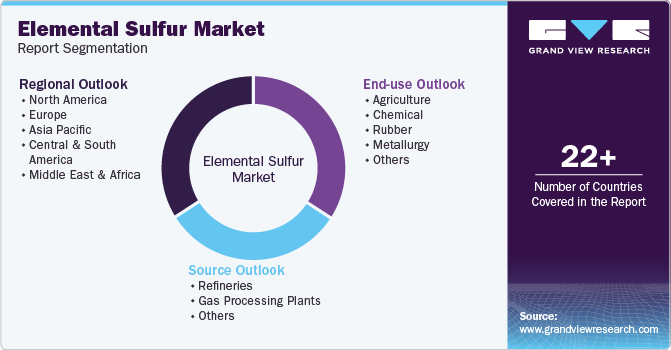
This report forecasts volume & revenue growth at global, regional, and country levels and provides an analysis of latest industry trends in each of the sub-segments from 2021 to 2033. For this study, Grand View Research has segmented the global elemental sulfur market report based on source, end use, and region:
 To learn more about this report, Download Free Sample Report
 -
Source Outlook (Volume, Kil0tons; Revenue, USD Million, 2021 - 2033)
-
Refineries
-
Gas Processing Plants
-
Other
-
-
End Use Outlook (Volume, Kil0tons; Revenue, USD Million, 2021 - 2033)
-
Agriculture
-
Chemical
-
Rubber
-
Metallurgy
-
Others
-
-
Regional Outlook (Volume, Kil0tons; Revenue, USD Million, 2021 - 2033)
-
North America
-
U.S.
-
Canada
-
Mexico
-
-
Europe
-
Germany
-
UK
-
France
-
Spain
-
Poland
-
-
Asia Pacific
-
China
-
Japan
-
India
-
Singapore
-
Indonesia
-
-
Central & South America
-
Brazil
-
-
Middle East & Africa
-
UAE
-
South Africa
-
-
Research Methodology
The elemental sulfur market figures in this report are based on a proven research process that combines executive interviews with secondary research from proprietary databases, company filings, and recognized regulatory and institutional sources. Market size is built through value-chain sizing - reconciling supply-side and demand-side estimates - and triangulated with bottom-up and top-down approaches. Every estimate passes multiple levels of expert validation before publication, with each elemental sulfur segment quantified using the revenue-capture definitions in the table below.
Segment Definition
Source
Revenue Capture Definition
Refineries
Refineries represent the primary source of elemental sulfur recovered during crude oil refining and fuel desulfurization processes. Market revenue is attributed to the recovery, processing, storage, and sale of elemental sulfur generated from refinery operations, including sulfur handling and supply activities to downstream industries.
Gas Processing Plants
Gas processing plants recover elemental sulfur through the removal of hydrogen sulfide and other sulfur compounds from natural gas streams. Revenue is generated through sulfur recovery operations, sulfur processing, distribution, and sales to fertilizer, chemical, and industrial end-use sectors.
Others
This segment includes elemental sulfur produced from sulfur mining, industrial recovery processes, and other non-conventional sulfur sources. Revenue is derived from sulfur extraction, purification, supply, storage, transportation, and commercial sales across various industrial applications.
End Use
Revenue Capture Definition
Agriculture
The agriculture segment utilizes elemental sulfur in fertilizers and soil amendment products to improve soil fertility, nutrient availability, and crop productivity. Revenue capture includes sulfur sales for fertilizer manufacturing, direct agricultural applications, soil treatment solutions, and related agronomic uses.
Chemicals
Elemental sulfur serves as a key feedstock for sulfuric acid and other sulfur-based chemical production processes. Revenue is generated through sulfur consumption in chemical manufacturing, industrial processing, specialty chemicals, and downstream sulfur-derived product applications.
Rubber
In the rubber industry, elemental sulfur is widely used as a vulcanizing agent to enhance the strength, elasticity, and durability of rubber products. Revenue includes sulfur sales for tire manufacturing, industrial rubber goods, automotive components, and various rubber processing applications.
Metallurgy
The metallurgy segment uses sulfur-derived products primarily in metal extraction, ore leaching, and mineral processing operations. Revenue is generated through sulfur utilization in mining activities, metallurgical processing, metal recovery operations, and associated industrial treatment applications.
Others
This category includes applications across water treatment, pharmaceuticals, pulp & paper, petroleum refining, explosives, and other industrial sectors. Associated revenues are linked to sulfur sales, industrial processing activities, specialty applications, and various downstream end-use operations.
Estimation Model
Layer Name
Key Question
Description
Sulfur Demand Base Layer
What forms the demand base?
Identify global demand for elemental sulfur across fertilizer production, chemical manufacturing, mining, metallurgy, rubber processing, and other industrial applications. Assess activity levels in agriculture, industrial production, and sulfur-consuming sectors to establish the addressable market opportunity.
Sulfur Production & Supply Layer
Where is elemental sulfur produced and supplied?
Estimate elemental sulfur production from petroleum refineries, natural gas processing plants, and other recovery sources across key regions. Analyze sulfur recovery capacities, feedstock availability, refining infrastructure, processing facilities, trade flows, and distribution networks to assess market accessibility and supply dynamics.
End-use Consumption Layer
How extensively is elemental sulfur utilized?
Analyze the consumption of elemental sulfur across agriculture, chemical manufacturing, rubber production, metallurgy, and other industrial applications. Evaluate sulfur application rates, sulfuric acid production requirements, industrial processing needs, and downstream consumption patterns influencing sulfur demand.
Revenue Layer
How is market revenue generated?
Expenditures on elemental sulfur used in fertilizer manufacturing, chemical processing, mining operations, rubber vulcanization, and other industrial applications quantify market revenue. Sulfur production volumes, consumption patterns, trade activities, product pricing, and end-use industry demand drive the overall market value.
Delivered Customizations
This report has been delivered with the following In-depth customizations
Client Request
Customization Delivered
Value Adds
Elemental Sulfur Competitive Landscape Assessment
Detailed competitive landscape analysis covering elemental sulfur producers, refiners, gas processing companies, distributors, and integrated chemical manufacturers. The study profiled key market participants based on geographic presence, organizational structure, sulfur production capacity, source integration (refineries and gas processing plants), distribution networks, customer base, strategic initiatives, trade activities, and investments in sulfur recovery and processing technologies.
Enabled evaluation of competitive positioning, production capabilities, supply chain strengths, customer engagement strategies, and market participation across the elemental sulfur value chain.
End-use Industry & Demand Assessment
Evaluation of global elemental sulfur demand across agriculture, chemicals, rubber, metallurgy, and other industrial applications. Included assessment of sulfur consumption patterns, sulfuric acid production requirements, fertilizer demand trends, downstream industry developments, regulatory considerations, and regional consumption dynamics across major markets.
Highlighted end-use demand trends, consumption patterns, and regional growth opportunities. Supported strategic planning, market entry evaluation, customer targeting, and investment prioritization decisions across key demand sectors.
Opportunity Assessment
Identification of high-growth opportunities associated with expanding sulfur-based fertilizer consumption, increasing sulfuric acid demand, mining sector growth, and industrial manufacturing expansion. Assessed emerging opportunities arising from agricultural intensification, investments in chemical production facilities, advancements in sulfur recovery technologies, and growing industrialization across developing economies.
Enabled prioritization of high-value growth opportunities and emerging application segments. Supported long-term business planning, capacity expansion strategies, supply chain optimization initiatives, and investment decisions aligned with evolving sulfur demand fundamentals.
Frequently Asked Questions About This Report
The key driver of the global elemental sulfur market is the growing demand for sulfur-based fertilizers and sulfuric acid across agriculture, chemical processing, mining, and industrial manufacturing sectors. Rising global food demand, increasing adoption of balanced crop nutrition practices, and expanding fertilizer production are driving sulfur consumption worldwide.
Asia Pacific dominated the market with revenue share of 42.6% in 2025.
The key players operating in the elemental sulfur market include ADNOC Group, China Petrochemical Corporation, Georgia Gulf Sulfur Corporation, Intrepid Potash, JOHN H. CARTER COMPANY, Motiva Enterprises LLC, Saudi Arabian Oil Co., Shell plc, Suncor Energy Inc., Valero, and Grupa Azoty
Based on source, Others segment led the market with the largest revenue share of 51.5% in 2025.
The elemental sulfur market size was estimated at USD 13.4 billion in 2025 and is expected to reach USD 13.9 billion in 2026.
The elemental sulfur market is expected to grow at a compound annual growth rate of 4.9% from 2026 to 2033 to reach USD 19.5 billion by 2033.
Agriculture accounted for largest revenue share of 50.9% in 2025.
About the Author(s)
Advanced Interior Materials Research Team
Advanced Materials · Advanced Interior MaterialsThis report was authored by the advanced interior materials research team at Grand View Research - comprising two research analysts, one senior research analyst, and one industry expert - with specialized expertise in the advanced interior materials segment of the advanced materials industry. All findings are based on proprietary advanced materials databases, executive interviews, and regulatory analysis, subject to internal peer review prior to publication.
Last Updated:
Speak to Analyst

Customize this report to your needs - add regions, segments, or data points, with 20% free customization.
Or view our licence options:


ISO 9001:2015 & 27001:2022 Certified
We are GDPR and CCPA compliant! Your transaction & personal information is safe and secure. For more details, please read our privacy policy.


