
- Home
- »
- Network Security
- »
-
Encryption Software Market Size & Share Report, 2026-2033GVR Report cover
![Encryption Software Market (2026 - 2033)Report]()
Encryption Software Market (2026 - 2033)
Size, Share & Trends Analysis Report By Deployment (On-premise, Cloud-based), By Application (Disk Encryption, Database Encryption, File/Folder Encryption, Web Communication Encryption), By End Use, By Region, And Segment Forecasts
Market Size, 2025
$17.0BMarket Estimate, 2026
$19.5BMarket Forecast, 2033
$48.7BCAGR, 2026–2033
13.9%Encryption Software Market Summary
The global encryption software market size was valued at USD 17.0 billion in 2025 and is projected to grow from USD 19.5 billion in 2026 to USD 48.7 billion by 2033, growing at a CAGR of 13.9% from 2026 to 2033. The market in North America dominated with a revenue share of 38.0% in 2025. Data security concerns are rising as the Internet of Things (IoT) and Bring Your Own Device (BYOD) trends grow among enterprises. It has further led to increased instances of cyberattacks, commercial espionage, data breaches, and theft & losses in companies, thereby escalating the need to protect sensitive data and ensure compliance.
Key Market Trends & Insights
- By deployment: The on-premises segment accounted for more than 66.0% of overall revenue in 2025.
- By end use: The BFSI segment accounted for a dominant share above 32.0% in the market in 2025.
- By application: The disk encryption segment accounted for the highest revenue, approximately 36.7% in 2025.
Regional Highlights
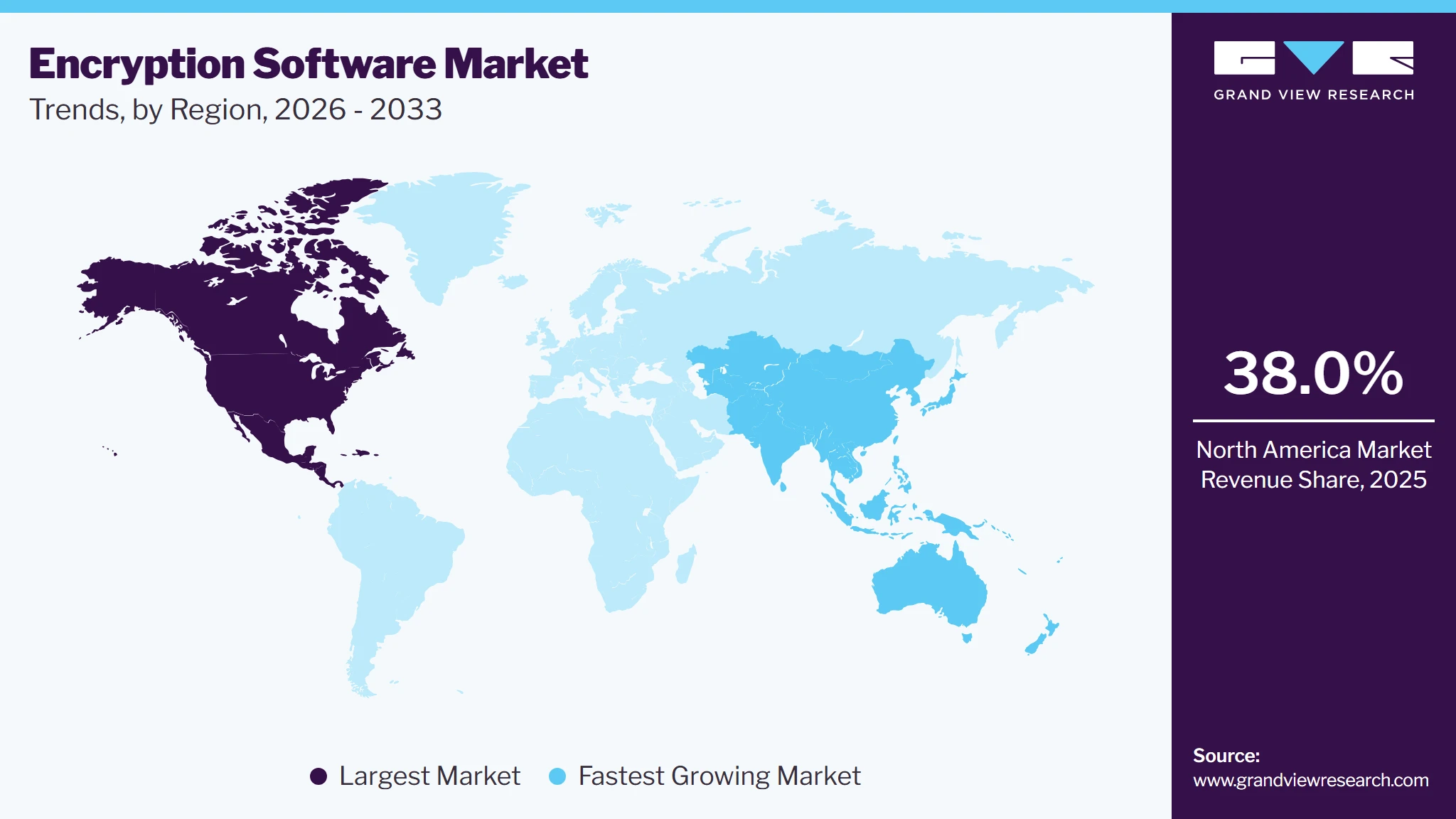
- Largest regional market: North America (38.0% revenue share, 2025)
- Fastest-growing regional market: Asia Pacific (highest CAGR, 2026-2033)
Market Size & Forecast
- Market size in 2025: USD 17.0 Billion
- Estimated market size in 2026: USD 19.5 Billion
- Projected market size by 2033: USD 48.7 Billion
- CAGR (2026-2033): 13.9%
Mobile technology advancements in hardware and software, their dissemination among businesses, and the growing penetration of smartphones are likely to catapult the demand for encryption software in the coming years. The growing penetration of mobile devices across organizations has increased the risk of data loss, making it imperative to implement encryption software for secure data transmission. Furthermore, as enterprises increasingly move to cloud computing, the need to safeguard sensitive data is growing, thereby driving greater adoption of this technology.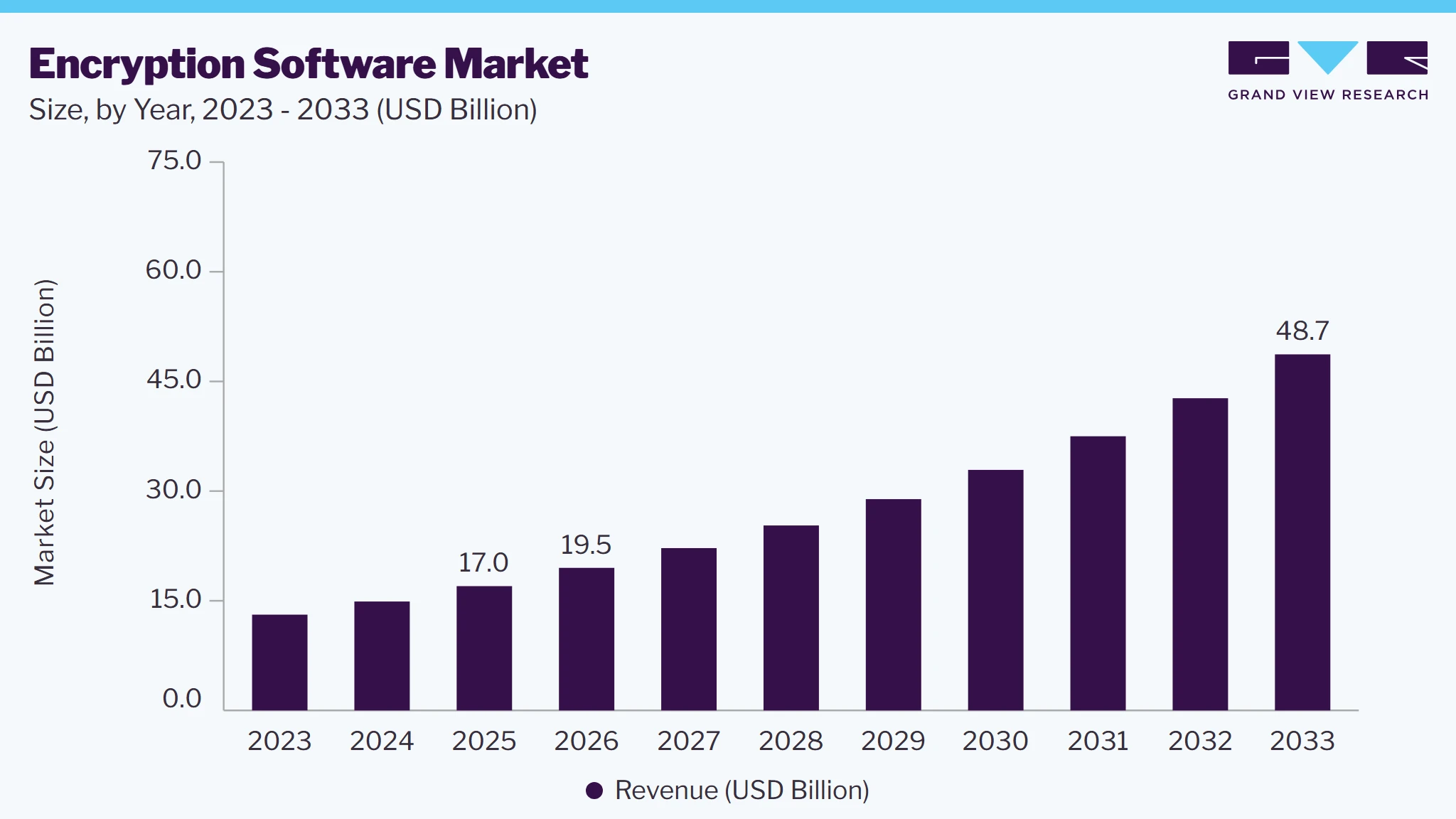
Several industry verticals, such as BFSI and healthcare, must comply with stringent regulations, including PCI DSS and HIPAA, which require data security solutions. It translates to greater demand for encryption software globally. Furthermore, with rapid digitization and growing internet usage, enterprise and user intellectual property has become susceptible to theft and infringement. Owing to these risks, companies are required to protect the data. Encryption software enables organizations to safeguard their intellectual property and sensitive data, which is expected to boost its demand over the forecast period.
Market Dynamics
The continuously growing incidence of cyberattacks, ransomware, and data breaches is a major driver of the cybersecurity market, including encryption software. The modern digital network is highly vulnerable to cyberattacks due to the use of multiple mobile devices, including smartphones, laptops, and other internet-connected peripherals. According to the 2025 X-Force Threat Intelligence Index published by IBM, an 84% increase in emails delivering infostealers in 2024 was observed compared to 2023. Such attacks are a preferred means for cybercriminals to commit identity theft. Sectors including BFSI, healthcare, education, and government departments, for public and individual records, are adopting encryption software solutions to protect sensitive personal data. In addition, manufacturing companies faced the highest number of ransomware attacks in 2024. Companies often get high returns on investment in encryption software by safeguarding their data against ransomware attacks.
Companies, including IBM, Palo Alto, Thales, and Microsoft, among others, are continuously pursuing the development of highly secure encryption solutions. These solutions incorporate technologies such as AI and ML to learn cyberattack patterns and counter them through encryption. This has significantly boosted the demand for sophisticated encryption software among organizations.
Deployment of encryption software can be a complex process for an organization, particularly in terms of network management and performance impacts in the initial stages. An organization might need to encrypt data across multiple domains, including the cloud, databases, and endpoint devices. This can lead to challenges such as resource optimization and longer latency for simple processes. Besides, improper data encryption can result in critical data loss, compliance issues, and compromised encryption keys, leading to data theft.
In addition to complexity, small and medium-sized enterprises might be intimidated by high upfront costs. Small and medium-scale companies often run on shoestring budgets and cannot afford comprehensive encryption. The company also lacks technical expertise to ensure thorough implementation. Such factors can delay an organization’s plan to implement an encryption solution, thereby restraining market growth.
Software companies are adopting post-quantum cryptography (PQC) within their encryption software at a brisk pace. With the advancement of quantum computing, conventional encryption algorithms, including RSA and ECC, often seem vulnerable to quantum-enabled attacks. Such developments are expected to help governments, financial institutions, healthcare providers, education institutions, and cloud service providers begin transitioning from traditional encryption software to post-quantum cryptography (PQC).
IT and technology companies, including IBM and Microsoft, are introducing multiple products powered by post-quantum cryptography (PQC). For instance, Microsoft introduced its Post-Quantum Cryptography (PQC) algorithms for Windows Server 2025 and Windows 11. PQC also helps secure data for a longer period. Organizations are adopting philosophies such as ‘Harvest Now, Decrypt Later (HNDL)’ to encrypt and store data, then wait for future quantum computers to break the encryption. Organizations that handle long-term data, such as healthcare and intellectual property, use these techniques to secure their data.
Deployment Insights
The on-premises segment accounted for more than 66.0% of overall revenue in 2025. The widespread adoption of social media, the Internet of Things (IoT), and the Internet of Everything (IoE) has enhanced business operations and increased the volume of data generated and retrieved via mobile devices. These factors are expected to drive demand for on-premises and cloud-based deployments in the coming years.
The cloud-based segment is expected to register the fastest CAGR of above 16% over the forecast period. The spiraling adoption of cloud storage solutions by companies and the expansion of cloud infrastructure drive the cloud segment's growth. Moreover, developments in the IT & telecom sector, such as Choose Your Own Device (CYOD) and BYOD, are projected to significantly impact overall market growth during the forecast period. The establishment of new businesses in emerging economies is poised to further bolster demand for cloud-based solutions.
End Use Insights
The BFSI segment accounted for a dominant 32.0% share of the market in 2025. The dynamic nature of the security industry and the rising number of cyberattacks result in an increased need to protect sensitive financial data from breaches with maximum returns and minimum risk. As banking institutions increasingly adopt cloud solutions, the segment is anticipated to have greater potential for deploying these security solutions.
Banking institutions generally use traditional methods such as email and portable devices to transfer data, which pose a high risk of data breaches, thereby increasing the growth opportunities for encryption software in the banking and financial industry. Furthermore, the high reliance on online transactions and the need to protect them will further boost demand for encryption software in the BFSI sector in the coming years. The retail segment is projected to register a significant CAGR over the forecast period. The growing need for data storage and the increasing number of retail companies transitioning to cloud infrastructure are driving this segment's growth.
Application Insights
The disk encryption segment dominated the market, accounting for over 36.7% of revenue in 2025. Encrypted disks are safe, as even if they get stolen or misplaced, access to their contents remains limited to authorized users. With the emergence and growing prominence of the BYOD trend, critical data can now be exchanged on employee devices. This has further augmented the need for strong encryption techniques.
The cloud encryption segment is expected to grow with the highest CAGR of above 36.0% during the forecast period. Data storage is a key resource across industries such as BFSI, retail, and others. The demand for cloud encryption solutions is expected to increase as more organizations move to the cloud, driven by scalability and flexible usage policies. Furthermore, the proliferation of big data analytics has led to increased usage of these solutions by internet services to ensure user data privacy. Burgeoning cyber-attacks and mobile theft are prompting regulatory bodies to mandate data transfer and security standards.
Regional Insights
North America dominated the market, accounting for the largest revenue share of 38.0% in 2025, owing to increased internet penetration in the region. In addition, the presence of a well-established and renowned IT & telecom sector is also driving market growth in the region.
Asia Pacific Encryption Software Market Trends
The encryption software market in the Asia Pacific is expected to grow at the fastest CAGR of over 21.0% during the forecast period. The region is expected to be very promising for companies, owing to a lack of storage infrastructure, prompting organizations to store data in the cloud. It increases the risk of theft and data loss, thereby stoking demand for encryption software. In addition, the rising adoption of IoT, cloud services, and BYOD has spurred growth in the regional market. Rapid advancements in manufacturing across countries, including India and China, coupled with the flourishing retail and IT & telecom sectors, are poised to drive demand for encryption software over the forecast period.
Key Encryption Software Company Insights
Some of the major players in the market include Microsoft Corporation, Symantec, Intel Security, Sophos, Check Point Software Technologies, Trend Micro, and IBM Corporation. These companies offer data protection solutions to small & medium-sized businesses (SBMs) and enterprises. Companies operating in the market focus on developing innovative techniques related to advanced cryptography to provide robust data security solutions.
Key Encryption Software Companies
The following key companies have been profiled for this study on the encryption software market.
-
Bloombase
-
Cisco Systems, Inc.
-
Check Point Software Technologies Ltd.
-
Dell Inc.
-
IBM Corporation
-
McAfee, LLC
-
Microsoft
-
Oracle
-
Sophos Ltd.
-
Broadcom
-
Trend Micro Incorporated
-
WinMagic
Recent Developments
-
In November 2025, Microsoft introduced its Post-Quantum Cryptography (PQC) algorithms for Windows Server 2025 and Windows 11. The encryption solution offers various benefits, including enhanced security, seamless integration, and enterprise-readiness.
-
In October 2025, IBM launched Guardium Cryptography Manager, an AI-powered cryptographic data protection solution. The new solution is expected to help organizations incorporate crypto-agility. The solution is expected to deliver visibility, centralized lifecycle management, and encryption.
-
In October 2025, Palo Alto Networks offered its AI-enabled cybersecurity offerings. The solution was designed to identify vulnerabilities and protect sensitive data used by AI models. The solution can also secure interactions between AI agents and enterprise systems.
Encryption Software Market Report Scope
Report Attribute
Details
Market size value in 2025
USD 17.0 billion
Estimated market size in 2026
USD 19.5 billion
Projected market size by 2033
USD 48.7 billion
Growth rate
CAGR of 13.9% from 2026 to 2033
Historical data
2021 - 2025
Forecast period
2026 - 2033
Quantitative units
Revenue in USD billion, and CAGR from 2026 to 2033
Report coverage
Revenue forecast, company ranking, competitive landscape, growth factors, and trends
Segments covered
Deployment, application, end use, region
Regional Scope
North America; Europe; Asia Pacific; Latin America; MEA
Country scope
U.S.; Canada; UK; Germany; France; China; India; Japan; Brazil; Mexico; Saudi Arabia; South Africa; UAE
Key companies profiled
Bloombase; Cisco Systems, Inc.; Check Point Software Technologies Ltd.; Dell Inc.; IBM Corporation; McAfee, LLC; Microsoft; Oracle; Sophos Ltd.; Broadcom; Trend Micro Incorporated; WinMagic
Customization scope
Free report customization (equivalent up to 8 analysts working days) with purchase. Addition or alteration to country, regional & segment scope.
Pricing and purchase options
Avail of customized purchase options to meet your exact research needs. Explore purchase options
Global Encryption Software Market Report Segmentation
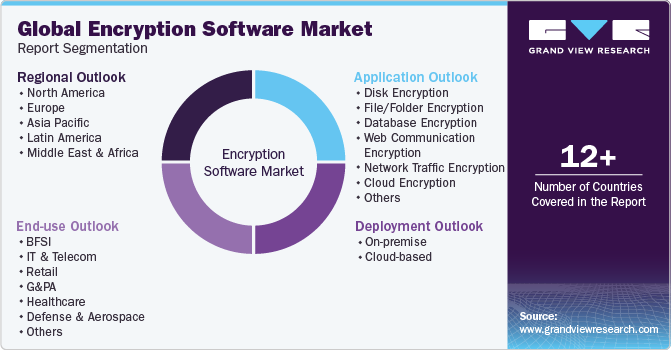
This report forecasts revenue growth at the global, regional, and country levels and analyzes the latest industry trends in each sub-segments from 2021 to 2033. For this study, Grand View Research has segmented the global encryption software market based on deployment, application, end use, and region:
-
Deployment Outlook (Revenue, USD Million, 2021 - 2033)
-
On-premise
-
Cloud-based
-
-
Application Outlook (Revenue, USD Million, 2021 - 2033)
-
Disk encryption
-
File/Folder Encryption
-
Database Encryption
-
Web Communication Encryption
-
Network Traffic Encryption
-
Cloud Encryption
-
Others
-
-
End-use Outlook (Revenue, USD Million, 2021 - 2033)
-
BFSI
-
IT & Telecom
-
Retail
-
G&PA
-
Healthcare
-
Defense & Aerospace
-
Education
-
Manufacturing
-
-
Regional Outlook (Revenue, USD Million, 2021 - 2033)
-
North America
-
U.S.
-
Canada
-
-
Europe
-
UK
-
Germany
-
France
-
-
Asia Pacific
-
China
-
India
-
Japan
-
-
Latin America
-
Brazil
-
Mexico
-
-
Middle East and Africa
-
United Arab Emirates (UAE)
-
Saudi Arabia
-
South Africa
-
-
Frequently Asked Questions About This Report
The global encryption software market size was estimated at USD 13.46 billion in 2022 and is expected to reach USD 15.57 billion by 2023.
The global encryption software market is expected to grow at a compound annual growth rate of 16.2% from 2023 to 2030 to reach USD 44.55 billion by 2030.
North America dominated the encryption software market with a share of 37.2% in 2022. This is attributable to the proliferation of cloud services, the presence of well-established market players, significant internet penetration, and the renowned IT & telecom sector.
Key players operating in the encryption software market include Microsoft Corporation, Oracle Corporation, Bloombase, McAfee, LLC, Braodcom, Inc., Dell Inc., Sophos Ltd., WinMagic, Check Point Software Technologies Ltd., Cisco Systems, Inc., Trend Micro Incorporated, and International Business Machines Corporation.
Key factors that are driving the market growth include rising concerns over data security,growing popularity of Bring Your Own Devices (BYOD) arrangement across enterprises, and growing penetration of mobile devices across organizations.
About the Author(s)
Network Security Research Team
Technology · Network SecurityThis report was authored by the network security research team at Grand View Research - comprising two research analysts, one senior research analyst, and one industry expert - with specialized expertise in the network security segment of the technology industry. All findings are based on proprietary technology databases, executive interviews, and regulatory analysis, subject to internal peer review prior to publication.
Last Updated:
Speak to Analyst

Need a Tailored Report?
Customize this report to your needs — add regions, segments, or data points, with 20% free customization.
Or view our licence options:


ISO 9001:2015 & 27001:2022 Certified
We are GDPR and CCPA compliant! Your transaction & personal information is safe and secure. For more details, please read our privacy policy.












