
- Home
- »
- Next Generation Technologies
- »
-
Enterprise Knowledge Graph Market Size Report, 2026-2033GVR Report cover

Enterprise Knowledge Graph Market (2026 - 2033)
Size, Share & Trends Analysis Report By Offering (Software, Services), By Type (Property graphs, Triple stores (RDF)), By Application, By Deployment Mode (Cloud, On-Premises), By Organization Size, By End Use, By Region, And Segment Forecasts
Market Size, 2025
$2.9BMarket Estimate, 2026
$3.5BMarket Forecast, 2033
$13.4BCAGR, 2026–2033
21.3%Enterprise Knowledge Graph Market Summary
The global enterprise knowledge graph market size was valued at USD 2.9 billion in 2025 and is projected to grow from USD 3.5 billion in 2026 to USD 13.4 billion by 2033, at a CAGR of 21.3% from 2026 to 2033. The market in North America dominated with a revenue share of 35.3% in 2025. The market is growing due to the increasing need for organizations to integrate and connect large volumes of structured and unstructured data across multiple enterprise systems.
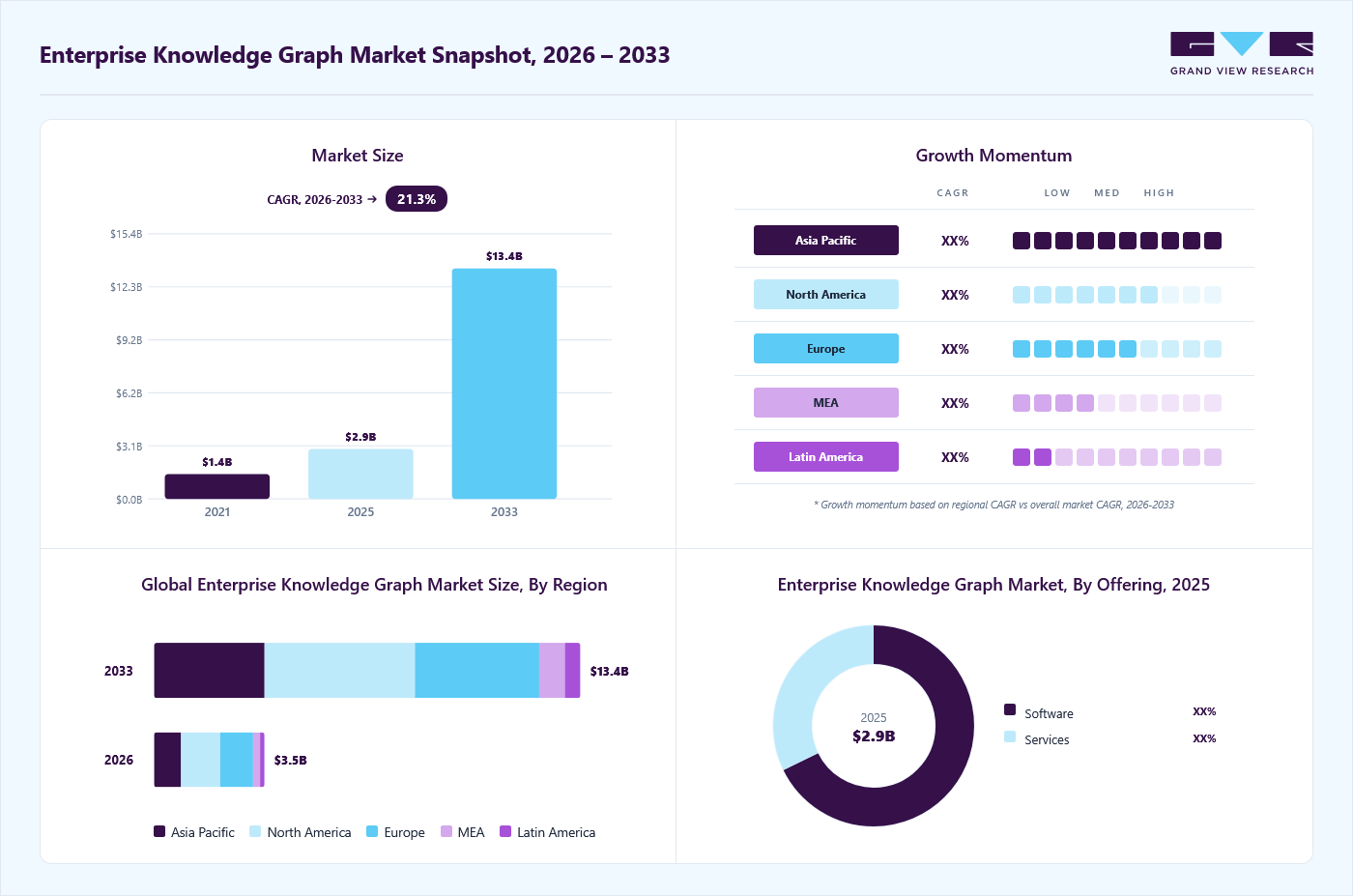 Source: Grand View Research, IR Documents, Primary Interviews, Paid DatabasesTo learn more about this report,
 Download Free Sample Report
 Key Market Trends & Insights
- By offering: Software segment held the largest market share of 67.7% in 2025.
- By type: Property graphs segment held the largest market share of 65.3% in 2025.
- By application: Semantic search & enterprise knowledge management segment held the largest market share of 47.8% in 2025.
- By deployment mode: Cloud segment held the largest market share of 56.6% in 2025.
Regional Highlights
- Largest regional market: North America (35.3% revenue share, 2025)
- Fastest-growing regional market: Asia Pacific (highest CAGR, 2026-2033)
- By country: The U.S. held the largest market share in 2025
Market Size & Forecast
- Market size in 2025: USD 2.9 Billion
- Estimated market size in 2026: USD 3.5 Billion
- Projected market size by 2033: USD 13.4 Billion
- CAGR (2026-2033): 21.3%
Three ways to get this report
Buy it, customize it, or ask a question.Ask an Analyst
A direct answer, usually in 1 working day
- AccessReport author, directly
- Reply timeWithin 1 working day
- No sales callDirect answer only
- FormatEmail reply
- CostFree, no cost
Get the Full Report
What the study covers
- FormatsPDF · Excel · Dashboard
- Timeline2026–2033 annual, 2025 base
- Coverage20+ countries, 5 regions
- Companies10+ key players profiled
Customize the Report
20% free customization
- IncludeCountries, segments, points
- TailorTo your product definition
- ExtendDeeper competitor detail
- OrA fully bespoke study
- Turnaround5–10 working days
As businesses adopt advanced technologies such as artificial intelligence, machine learning, and generative AI, knowledge graphs are becoming essential for providing contextual relationships between data, which improves AI accuracy and decision-making.The demand for enterprise knowledge graph solutions is increasing as organizations aim to unify fragmented data across multiple enterprise systems and extract meaningful insights from complex datasets. Enterprises are increasingly adopting knowledge graphs to enable advanced analytics, semantic search, and AI-driven decision-making, which require structured relationships between data entities. Additionally, the rapid adoption of generative AI and machine learning applications is driving the need for context-rich data frameworks that improve model accuracy and reasoning capabilities. Knowledge graphs also help organizations enhance data governance, improve operational efficiency, and support intelligent automation, making them a critical component of modern enterprise data architectures.
 To learn more about this report, Download Free Sample Report
 Enterprises are increasingly prioritizing data interoperability and real-time knowledge discovery, which is accelerating the adoption of enterprise knowledge graph platforms. These solutions enable organizations to map complex relationships between data assets, enabling businesses uncover hidden insights that traditional relational databases cannot easily identify. The growing importance of 360-degree customer views and personalized services is also encouraging companies to implement knowledge graphs for better data connectivity. In addition, industries such as BFSI, healthcare, and retail are leveraging knowledge graphs to strengthen fraud detection, clinical research, and recommendation systems. The rising investments in digital transformation and data fabric architectures further support the integration of knowledge graphs into enterprise data ecosystems. Moreover, organizations are adopting knowledge graphs to improve metadata management, knowledge management, and enterprise search capabilities, enabling faster and more informed business decisions.
The increasing need for effective data governance and regulatory compliance is emerging as another significant growth driver for the enterprise knowledge graph market. Organizations across industries are required to manage large volumes of sensitive and regulated data while maintaining transparency and traceability. By providing a structured and interconnected view of enterprise data, knowledge graphs support organizations in improving data quality, reducing compliance risks, and strengthening overall data governance frameworks.
Offering Insights
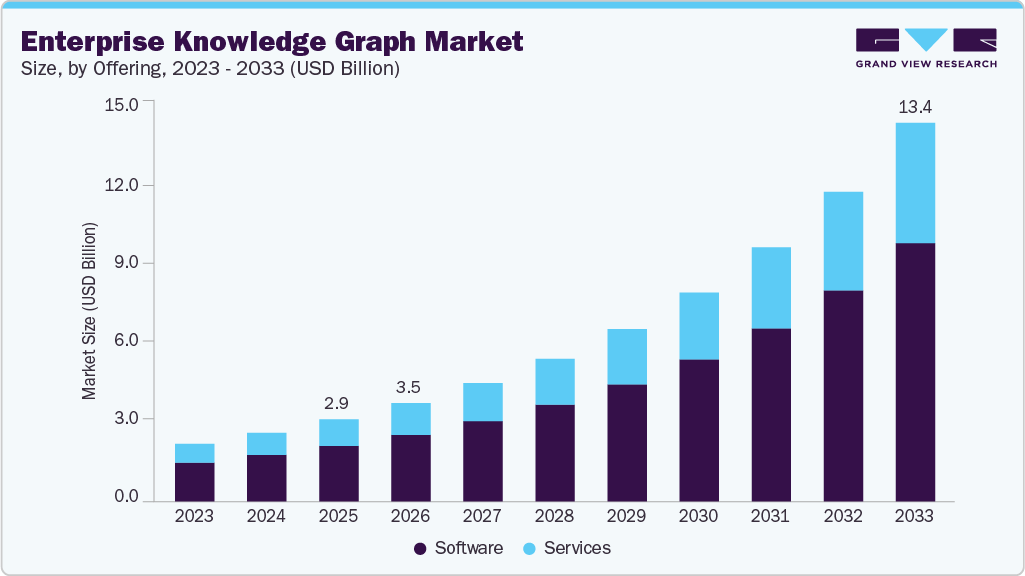
The software segment dominated the enterprise knowledge graph Market with a share of 67.7% in 2025, driven by the growing demand for advanced knowledge graph platforms that enable organizations to integrate, manage, and analyze large volumes of enterprise data across multiple systems. These software solutions provide essential capabilities such as graph databases, ontology management, semantic data integration, and relationship mapping, which form the foundation of enterprise knowledge graph implementations. The rising adoption of AI, ML, and advanced analytics is further accelerating the demand for knowledge graph software, as these technologies require structured and interconnected data to generate meaningful insights. In addition, enterprises are increasingly deploying cloud-based knowledge graph platforms to improve scalability, real-time data processing, and cross-system interoperability. The ability of software solutions to seamlessly integrate with enterprise applications such as CRM, ERP, and data management platforms further contributes to the segment’s dominance in the market.
The services segment in the enterprise knowledge graph market is growing due to the increasing need for expert support in deploying and managing complex knowledge graph solutions. Enterprises often require consulting, data modeling, ontology design, and system integration services to effectively deploy knowledge graphs across existing IT infrastructures. Additionally, the lack of in-house expertise in semantic technologies and graph databases is driving demand for specialized service providers. Organizations are also seeking ongoing support, maintenance, and optimization services to ensure scalability and performance of their knowledge graph platforms.
Type Insights
The Property Graphs segment dominated the enterprise knowledge graph market with a share of 65.3% in 2025, driven by the increasing adoption of graph-based data models that enable organizations to efficiently represent complex relationships between enterprise data entities. Property graph models allow nodes and relationships to store multiple attributes, making them highly suitable for enterprise applications such as fraud detection, recommendation systems, and customer intelligence. Their flexibility and ease of use compared to traditional semantic models have encouraged widespread adoption across industries seeking faster data modeling and analytics capabilities. Furthermore, the growing deployment of graph databases and real-time analytics platforms is further accelerating the use of property graph models in enterprise knowledge graph implementations.
The RDF triple stores segment is witnessing steady growth in the enterprise knowledge graph market due to its strong foundation in semantic web standards and interoperability. RDF-based models enable organizations to define clear relationships and meaning between data using standardized frameworks such as RDF, OWL, and SPARQL, making them highly suitable for data integration across heterogeneous systems. These capabilities are particularly valuable in industries such as healthcare, life sciences, and government, where structured knowledge representation and data consistency are critical. Moreover, RDF triple stores support advanced reasoning and ontology-driven data modeling, which enhances semantic search and knowledge discovery.
Application Insights
The semantic search & enterprise knowledge management segment dominated the Enterprise Knowledge Graph Market with a share of 47.8% in 2025, driven by the increasing need for organizations to efficiently access and utilize large volumes of enterprise information. Enterprises are adopting knowledge graph technologies to enhance semantic search capabilities, enabling systems to understand the context and relationships between data entities rather than relying on simple keyword-based searches. This approach significantly improves information discovery across internal documents, databases, and enterprise applications.
The Recommendation Systems segment is growing notably in the Enterprise Knowledge Graph Market due to the increasing demand for personalized user experiences across digital platforms. Enterprises are leveraging knowledge graphs to analyze relationships between users, products, and behaviors, enabling more accurate and context-aware recommendations. This is particularly evident in industries such as e-commerce, media, and retail, where companies aim to enhance customer engagement and conversion rates. Additionally, knowledge graphs improve recommendation engines by incorporating contextual data and real-time insights, leading to better prediction accuracy.
Deployment Mode Insights
The cloud segment dominated the enterprise knowledge graph Market with a share of 56.6% in 2025, driven by the growing adoption of scalable and flexible cloud-based data infrastructure across enterprises. Cloud deployment enables organizations to store, process, and analyze large volumes of interconnected data without the need for significant on-premises infrastructure investments. It also allows enterprises to easily integrate knowledge graph platforms with cloud-based AI, analytics, and data management solutions, enhancing operational efficiency and data accessibility. Additionally, cloud platforms support real-time data processing, scalability, and faster deployment, making them highly suitable for enterprise knowledge graph applications.
The on-premises segment is witnessing steady growth in the Enterprise Knowledge Graph Market due to the increasing need for data security, privacy, and regulatory compliance among organizations handling sensitive information. Industries such as BFSI, healthcare, and government prefer on-premises deployments to maintain full control over their data and ensure compliance with strict data protection regulations. Additionally, on-premises solutions enable organizations to customize knowledge graph architectures and integrate them deeply with legacy systems, which is often critical for large enterprises.
Organization size Insights
The large enterprises segment dominated the enterprise knowledge graph market with a share of 57.6% in 2025, driven by the growing need among large organizations to manage and integrate vast volumes of structured and unstructured data generated across multiple business units. Large enterprises typically operate complex IT ecosystems involving systems such as ERP, CRM, supply chain platforms, and data lakes, which require advanced technologies such as knowledge graphs to establish meaningful relationships between data assets. Additionally, large organizations possess the financial and technical resources required to implement enterprise-scale knowledge graph platforms that support advanced analytics, AI-driven insights, and enterprise search capabilities. The increasing focus on data-driven decision-making, customer intelligence, and operational optimization further contributes to the strong adoption of enterprise knowledge graph solutions among large enterprises.
The small and medium enterprises (SMEs) segment is growing steadily in the Enterprise Knowledge Graph Market due to the increasing availability of cost-effective and cloud-based knowledge graph solutions that reduce the need for large upfront investments. SMEs are adopting these technologies to improve data integration, enhance customer insights, and support data-driven decision-making without requiring extensive IT infrastructure. Furthermore, the rise of SaaS-based graph platforms and managed services is making it easier for smaller organizations to deploy and scale knowledge graph applications. The growing focus of SMEs on digital transformation and AI adoption is further driving the demand for enterprise knowledge graph solutions in this segment.
End Use Insights
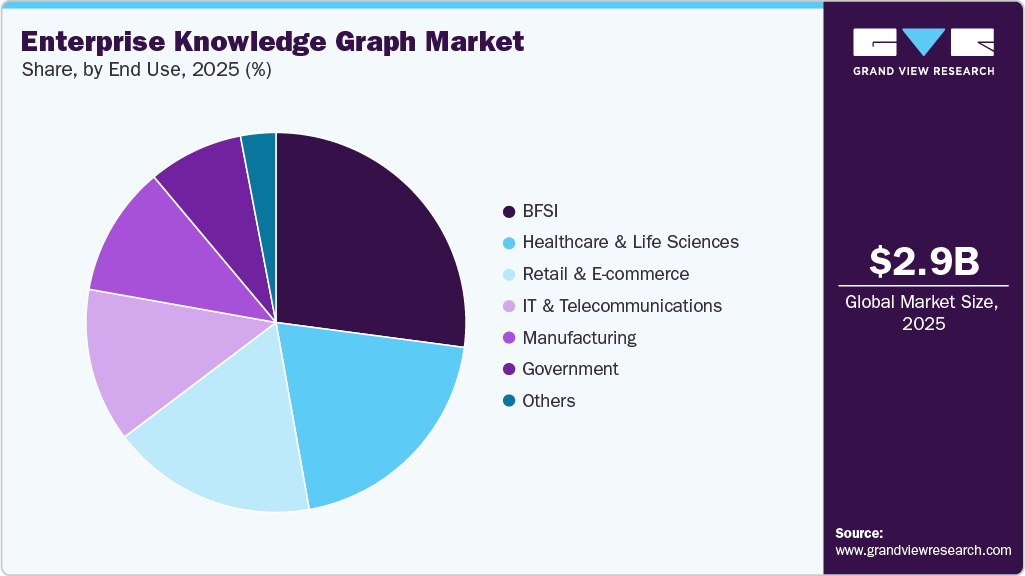
The BFSI segment dominated the enterprise knowledge graph market with a share of 27.1% in 2025, driven by the increasing need for financial institutions to manage complex data relationships and detect fraudulent activities across large transaction networks. Banks and financial organizations generate massive volumes of transactional and customer data, which require advanced technologies such as knowledge graphs to uncover hidden patterns and connections. Enterprise knowledge graphs assist BFSI institutions enhance fraud detection, risk management, regulatory compliance, and customer intelligence by linking data from multiple sources.
 To learn more about this report, Download Free Sample Report
 The Healthcare & Life Sciences segment is growing significantly in the Enterprise Knowledge Graph Market due to the increasing need to integrate and analyze complex, heterogeneous data such as patient records, clinical data, research findings, and genomic information. Knowledge graphs enable organizations to connect these diverse datasets, supporting clinical decision-making, drug discovery, and personalized medicine. The rising adoption of artificial intelligence (AI) and advanced analytics in healthcare is driving the use of knowledge graphs to improve diagnosis accuracy and treatment outcomes. Regulatory requirements and the need for data interoperability and standardization across healthcare systems are further encouraging the adoption of knowledge graph solutions in healthcare sector.
Regional Insights
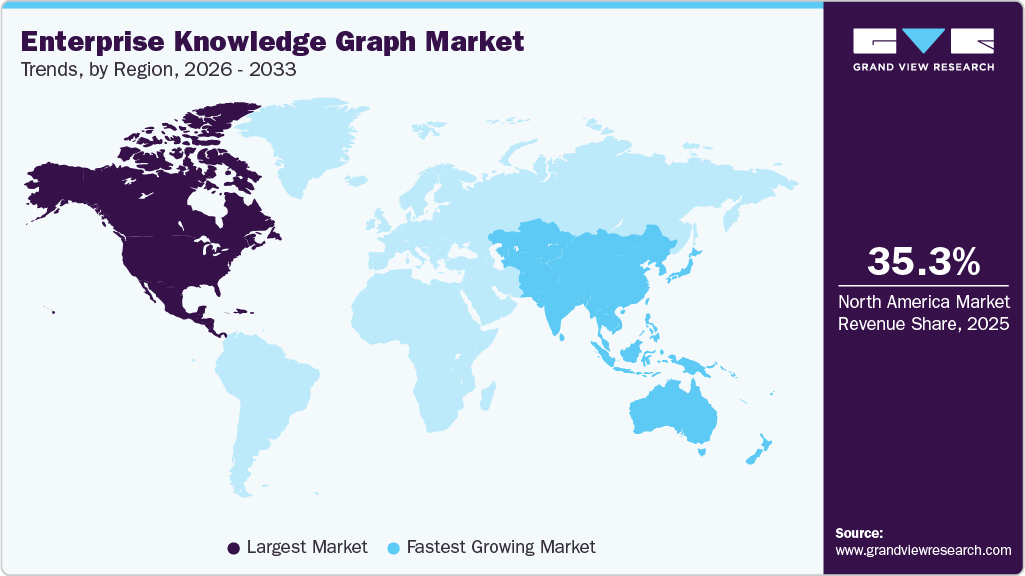
The North America enterprise knowledge graph market dominated the respective global industry with a share of 35.3% in 2025, driven by the strong presence of leading technology companies and graph database providers in the region. Organizations across the United States and Canada are increasingly investing in advanced data management, artificial intelligence, and knowledge graph technologies to enhance enterprise analytics and decision-making capabilities. Additionally, the region has a well-established digital infrastructure and a high level of enterprise adoption of cloud computing, big data platforms, and AI-driven solutions, which supports the deployment of enterprise knowledge graph systems. Hence the growing demand for fraud detection, customer intelligence, and enterprise search solutions across industries such as BFSI, healthcare, and retail further contributes to the region’s dominant position in the market.
 To learn more about this report, Download Free Sample Report
 U.S. Enterprise Knowledge Graph Market Trends
The U.S dominates the enterprise knowledge graph market in North America due to its strong ecosystem of leading technology companies, AI innovators, and graph database providers. The country is home to major players such as Microsoft, Amazon Web Services, IBM, Oracle, and Neo4j, which actively develop and deploy knowledge graph technologies across enterprise platforms. Additionally, U.S. organizations are early adopters of artificial intelligence, big data analytics, and advanced data management solutions, which has accelerated the integration of knowledge graphs into enterprise IT architectures.
Another key factor supporting market dominance is the high level of investment in AI research, cloud infrastructure, and data-driven technologies across industries such as BFSI, healthcare, retail, and technology. U.S. enterprises increasingly rely on knowledge graphs to improve fraud detection, customer intelligence, and enterprise search capabilities, driving strong demand for these solutions.
Europe Enterprise Knowledge Graph Market Trends
The Europe region is witnessing steady growth in the enterprise knowledge graph market, driven by the increasing adoption of advanced data management and AI technologies across industries. Organizations in countries such as Germany, the UK, and France are increasingly investing in knowledge graph solutions to improve data integration, enterprise search, and decision-making capabilities. Additionally, the strong focus on data governance, regulatory compliance, and data transparency in Europe encourages enterprises to adopt knowledge graph platforms that provide better data lineage and relationship mapping. Furthermore, the region’s expanding digital transformation initiatives and investments in artificial intelligence research are accelerating the deployment of knowledge graph technologies across sectors such as BFSI, healthcare, manufacturing, and retail.
Asia-Pacific Enterprise Knowledge Graph Market Trends
The Asia Pacific region is experiencing rapid growth in the enterprise knowledge graph market, driven by the increasing adoption of artificial intelligence, big data analytics, and advanced data management technologies across emerging economies. Countries such as China, India, Japan, and South Korea are investing heavily in digital transformation initiatives, which is accelerating the deployment of knowledge graph solutions across enterprises. Additionally, the growing expansion of industries such as BFSI, e-commerce, telecommunications, and healthcare is generating large volumes of data, creating a strong demand for technologies that can efficiently integrate and analyze complex data relationships. Apart from these factors, the rising adoption of cloud computing platforms and AI-driven enterprise applications in the region is encouraging organizations to implement knowledge graph technologies to enhance decision-making and operational efficiency.
Key Enterprise Knowledge Graph Company Insights
The enterprise knowledge graph market features several key players that significantly shape its global landscape through advanced graph database platforms, semantic technologies, and scalable enterprise data integration solutions. IBM Corporation is a prominent provider of enterprise knowledge graph capabilities, widely recognized for its Watson AI platform, Cloud Pak for Data, and data integration solutions, which enable organizations to connect complex enterprise data and generate contextual insights. The company’s strong presence in artificial intelligence, hybrid cloud infrastructure, and enterprise analytics allows organizations to develop knowledge-driven applications that enhance decision-making, automate data relationships, and improve enterprise search capabilities across industries such as banking, healthcare, telecommunications, and government.
-
IBM Corporation is a global technology leader delivering advanced enterprise knowledge graph capabilities through its AI-driven data platforms and hybrid cloud infrastructure. The company supports a wide range of industries including BFSI, healthcare, government, and telecommunications by enabling intelligent data integration, knowledge discovery, and advanced analytics through its Watson AI and Cloud Pak for Data platforms. IBM’s strong capabilities in artificial intelligence, semantic data management, and enterprise consulting enable organizations to build scalable knowledge graph architectures that improve decision-making, strengthen data governance, and enhance enterprise intelligence across complex data ecosystems.
-
Neo4j Inc. is a major provider of graph database technologies that power enterprise knowledge graph implementations across industries. The company enables organizations to model and analyze complex data relationships through its Neo4j Graph Database and AuraDB cloud platform, supporting use cases such as fraud detection, recommendation engines, network analysis, and enterprise search. Neo4j’s scalable graph data architecture, advanced analytics capabilities, and strong developer ecosystem allow enterprises to efficiently integrate diverse datasets and extract meaningful insights. The company’s continuous innovation in graph technologies and strong adoption across industries position as a key player driving the growth of the global Enterprise Knowledge Graph Market.
Key Enterprise Knowledge Graph Companies:
The following key companies have been profiled for this study on the enterprise knowledge graph market.
- Microsoft Corporation
- IBM Corporation
- Neo4j Inc.
- Amazon Web Services (AWS)
- Oracle Corporation
- TigerGraph
- Stardog
- Progress Software (MarkLogic)
- Franz Inc.
- Ontotext
- OpenLink Software
- RelationalAI
- ArangoDB
- Bitnine
- Altair
Recent Development
-
In May 2025, Neo4j announced the launch of Neo4j Aura Graph Analytics, the industry’s first graph analytics offering designed to work with any data platform without requiring data movement (Zero ETL). The serverless solution provides more than 65 ready-to-use graph algorithms and enables organizations to analyze complex relationships across large datasets, helping enterprises build advanced knowledge graph applications for fraud detection, recommendation systems, and AI-driven analytics. The platform is designed to deliver deeper insights and improved model accuracy while making graph analytics accessible to a broader range of enterprise users.
-
In February 2024, Oracle announced new generative AI capabilities in its Autonomous Database, including conversational AI tools, large language model (LLM) integration, and new analytics features for knowledge graphs. These capabilities enable enterprises to generate insights through natural language queries and analyze complex relationships across datasets without needing to manually locate or structure data. This development strengthens Oracle’s position in the Enterprise Knowledge Graph Market by integrating generative AI, graph analytics, and data management within a unified platform, enabling organizations to build intelligent knowledge-driven applications and improve enterprise decision-making.
Enterprise Knowledge Graph Market Report Scope
Report Attribute
Details
Market size in 2025
USD 2.9 billion
Estimated Market size in 2026
USD 3.5 billion
Projected Market size by 2033
USD 13.4 billion
Growth rate
CAGR of 21.3% from 2026 to 2033
Actual data
2021 - 2025
Forecast period
2026 - 2033
Quantitative units
Revenue in USD Million/Million and CAGR from 2026 to 2033
Report coverage
Revenue forecast, company ranking, competitive landscape, growth factors, and trends
Segments covered
Offering, type, deployment, enterprise size, end use, region
Regional scope
North America; Europe; Asia Pacific; Latin America; MEA
Country scope
U.S., Canada, Mexico, Germany, UK, France, China, India, Japan, Australia, South Korea, Brazil, UAE, South Africa, KSA
Key companies profiled
IBM Corporation; Neo4j Inc.; Microsoft Corporation; Amazon Web Services (AWS); Oracle Corporation; TigerGraph; Stardog; Progress Software (MarkLogic); Franz Inc.; Ontotext; OpenLink Software; RelationalAI; ArangoDB; Bitnine; Altair.
Customization scope
Free report customization (equivalent up to 8 analysts working days) with purchase. Addition or alteration to country, regional & segment scope.
Pricing and purchase options
Avail customized purchase options to meet your exact research needs. Explore purchase options
Global Enterprise Knowledge Graph Market Report Segmentation
This report forecasts revenue growth at global, regional, and country levels and provides an analysis of the latest industry trends in each of the sub-segments from 2021 to 2033. For this study, Grand View Research has segmented the global Enterprise Knowledge Graph Market report based on offering, deployment type, Type, organization size, end use, and region.
-
Offering Outlook (Revenue, USD Million, 2021 - 2033)
-
Software
-
Services
-
-
Type Outlook (Revenue, USD Million, 2021 - 2033)
-
Property graphs
-
Triple stores (RDF)
-
-
Application Outlook (Revenue, USD Million, 2021 - 2033)
-
Semantic Search & Enterprise Knowledge Management
-
Recommendation Systems
-
Fraud Detection & Risk Analytics
-
Customer 360 & Personalization
-
Supply Chain & Operational Intelligence
-
Others
-
-
Deployment Mode Outlook (Revenue, USD Million, 2021 - 2033)
-
Cloud
-
On-Premises
-
-
Organization size Outlook (Revenue, USD Million, 2021 - 2033)
-
Small & Medium Enterprise
-
Large Enterprise
-
-
End Use Outlook (Revenue, USD Million, 2021 - 2033)
-
BFSI
-
Healthcare & Life Sciences
-
Retail & E-commerce
-
IT & Telecommunications
-
Manufacturing
-
Government
-
Others
-
-
Regional Outlook (Revenue, USD Million, 2021 - 2033)
-
North America
-
U.S.
-
Canada
-
Mexico
-
-
Europe
-
UK
-
Germany
-
France
-
-
Asia Pacific
-
China
-
Japan
-
India
-
Australia
-
South Korea
-
-
Latin America
-
Brazil
-
-
Middle East and Africa (MEA)
-
KSA
-
UAE
-
South Africa
-
-
Frequently Asked Questions About This Report
The software segment led with a 67.7% revenue share in 2025.
Property graphs held the largest revenue share 65.3% in 2025.
Semantic search & enterprise knowledge management held the largest share (over 47.8%) in 2025.
Asia Pacific is the fastest-growing region over the forecast period.
The global enterprise knowledge graph market size was estimated at USD 2.9 billion in 2025 and is expected to reach USD 3.5 billion in 2026.
The global enterprise knowledge graph market is expected to grow at a compound annual growth rate of 21.3% from 2026 to 2033 to reach USD 13.4 billion by 2033.
North America dominated the market with a share of 35.3% in 2025.
Some key players operating in the enterprise knowledge graph market include IBM Corporation; Oracle Corporation; Microsoft Corporation; Google LLC; Amazon.com, Inc.; Neo4j, Inc.; TigerGraph, Inc.; Stardog Union, Inc.; Ontotext USA Inc.; MarkLogic Corporation; Palantir Technologies Inc.; Altair Engineering Inc.; data.world; Franz Inc.; and ArangoDB Inc.
Key factors that are driving the enterprise knowledge graph market growth include the increasing need for unified data integration across disparate enterprise systems, rising adoption of artificial intelligence and machine learning for advanced analytics and decision-making, and continuous technological advancements in semantic technologies, graph databases, and cloud-based data platforms across industries.
About the Author(s)
Next Generation Technologies Research Team
Technology · Next Generation TechnologiesThis report was authored by the next generation technologies research team at Grand View Research - comprising two research analysts, one senior research analyst, and one industry expert - with specialized expertise in the next generation technologies segment of the technology industry. All findings are based on proprietary technology databases, executive interviews, and regulatory analysis, subject to internal peer review prior to publication.
Last Updated:
Speak to Analyst

Customize this report to your needs - add regions, segments, or data points, with 20% free customization.
Or view our licence options:


ISO 9001:2015 & 27001:2022 Certified
We are GDPR and CCPA compliant! Your transaction & personal information is safe and secure. For more details, please read our privacy policy.


