
- Home
- »
- Next Generation Technologies
- »
-
Enterprise Labeling Software Market, Industry Report, 2033GVR Report cover

Enterprise Labeling Software Market (2026 - 2033) Size, Share & Trends Analysis Report By Component (Software, Services), By Label (Barcode Labeling, RFID Labeling), By Application (Inventory Management, Asset Tracking), By End Use, By Region, And Segment Forecasts
Market Size, 2025
$1.1BMarket Estimate, 2026
$1.2BMarket Forecast, 2033
$2.3BCAGR, 2026–2033
8.8%Enterprise Labeling Software Market Summary
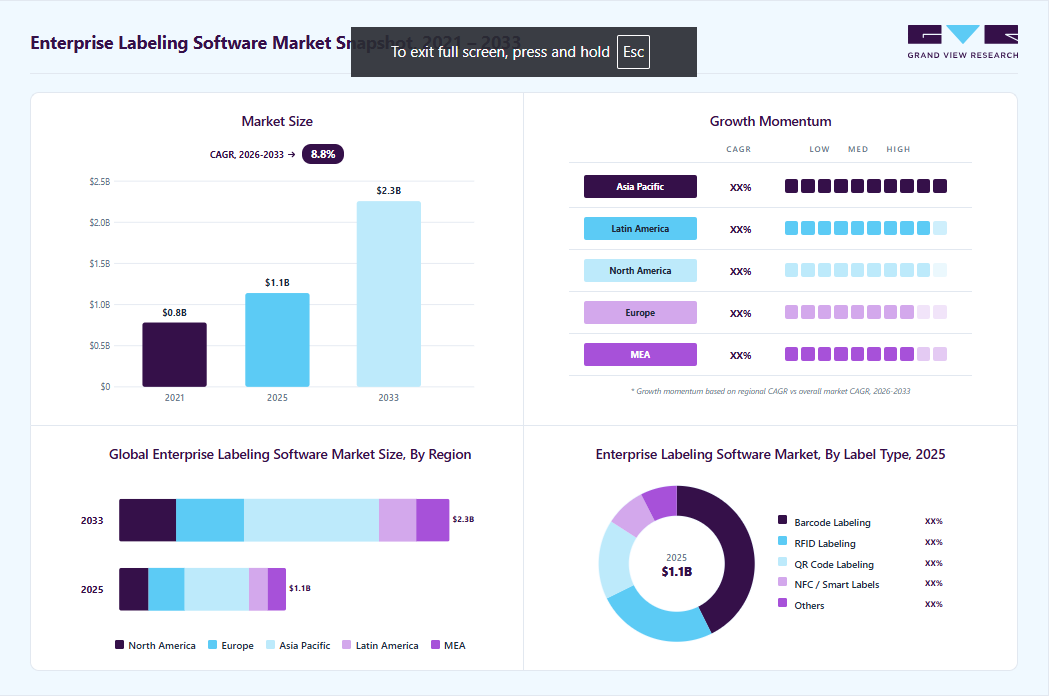
The global enterprise labeling software market size was valued at USD 1.1 billion in 2025 and is projected to grow from USD 1.2 billion in 2026 to USD 2.3 billion by 2033, at a CAGR of 8.8% from 2026 to 2033. Asia Pacific dominated the global enterprise labeling software market with the largest revenue share of 38.5% in 2025. The market growth is driven by the increasing adoption of cloud-based labeling solutions, the rising need for regulatory compliance and end-to-end traceability, the growing integration of labeling platforms with ERP and supply chain systems, the accelerating deployment of RFID and smart labeling technologies, and the rapid expansion of e-commerce and global logistics operations.
 Source: Grand View Research, IR Documents, Primary Interviews, Paid DatabasesTo learn more about this report,
 Download Free Sample Report
 Key Market Trends & Insights
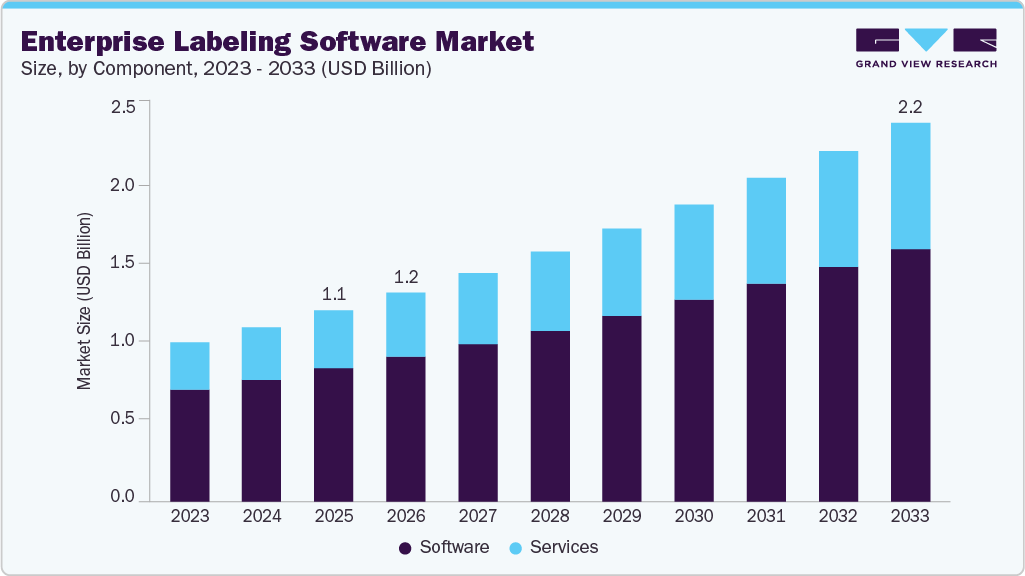
- By component: Software segment led the market and held the largest revenue share of over 69.7% in 2025.
- By application: Inventory management segment led the market and held the largest revenue share of over 34.4% in 2025.
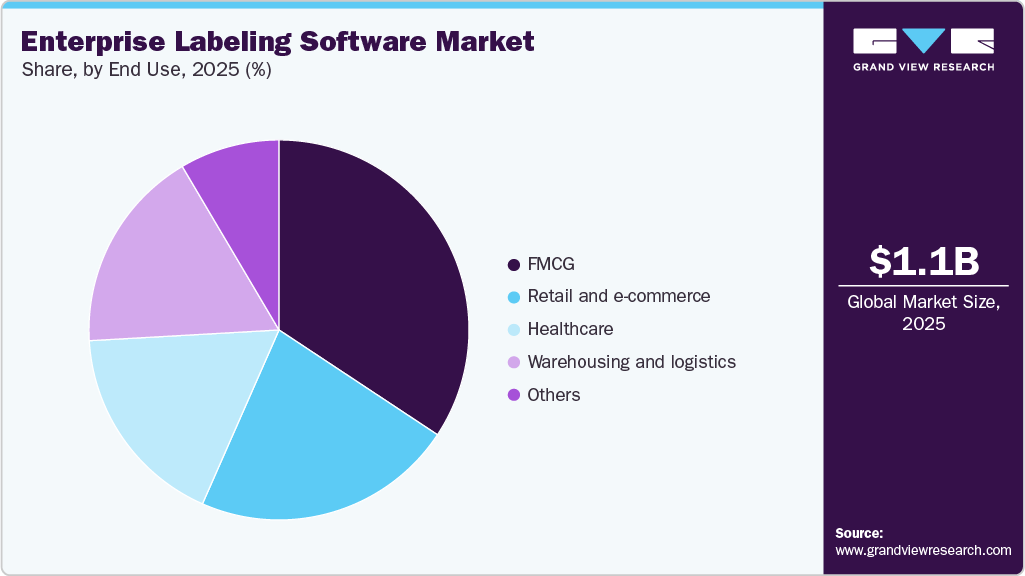
- By end use: Healthcare segment is expected to grow at the fastest CAGR of over 10.8% from 2026 to 2033.
Regional Highlights
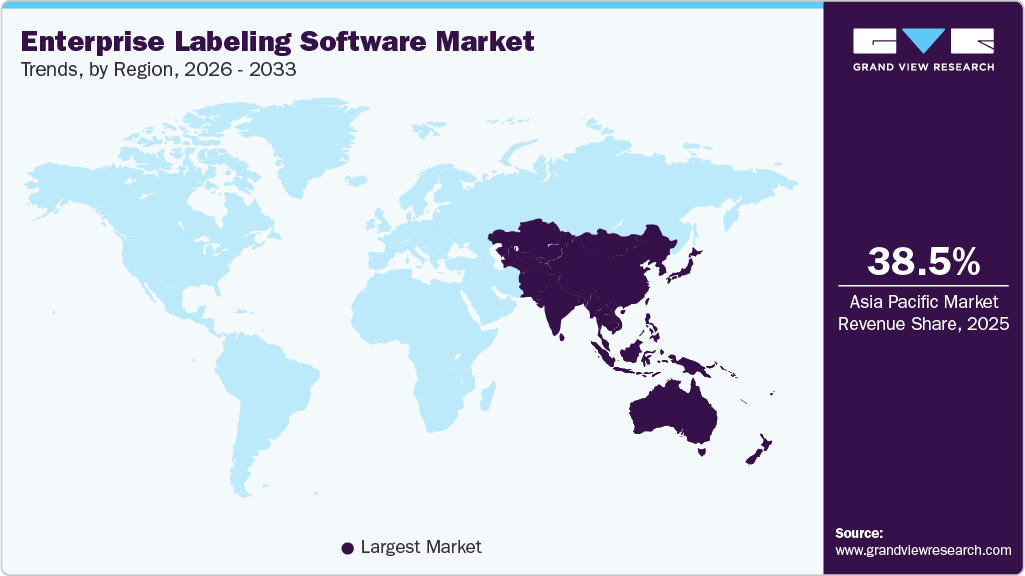
- Largest regional market: Asia Pacific (38.5% revenue share, 2025)
- Fastest-growing regional market: Asia Pacific (highest CAGR, 2026-2033)
- By country: The China held the largest market share in 2025.
Market Size & Forecast
- Market size in 2025: USD 1.1 Billion
- Estimated market size in 2026: USD 1.2 Billion
- Projected market size by 2033: USD 2.3 Billion
- CAGR (2026-2033): 8.8%
Three ways to get this report
Buy it, customize it, or ask a question.Ask an Analyst
Analyst response in 1 business day
- AccessReport author, directly
- Reply timeWithin 1 working day
- No sales callDirect answer only
- FormatEmail reply
- CostFree, no cost
Get the Full Report
What the study covers
- FormatsPDF · Excel · Dashboard
- Timeline2026–2033 annual, 2025 base
- Coverage20+ countries, 5 regions
- Companies10+ key players profiled
Customize the Report
20% free customization
- IncludeCountries, segments, points
- TailorTo your product definition
- ExtendDeeper competitor detail
- OrA fully bespoke study
- Turnaround5–10 working days
The enterprise labeling software industry is gaining momentum due to the shift toward cloud-based and SaaS deployment models. These enable scalability and centralized label management across global operations. Increasing emphasis on regulatory compliance and product traceability, especially in healthcare, food & beverage, and chemicals, is boosting demand for advanced labeling solutions. Organizations are integrating labeling software with ERP, WMS, and supply chain systems to improve operational efficiency and ensure data consistency across business functions. The adoption of RFID, QR codes, and smart labeling technologies is turning traditional labeling into a more connected, data-driven ecosystem. The rapid growth of e-commerce and omnichannel distribution networks is also driving the need for dynamic, high-volume, accurate labeling across complex logistics environments.
 To learn more about this report, Download Free Sample Report
 Enterprises are increasingly integrating labeling software with ERP, WMS, and supply chain management systems to streamline and standardize operations across complex environments. This integration ensures data accuracy, consistency, and governance while eliminating manual errors from siloed systems. Automating labeling workflows helps organizations increase productivity, reduce bottlenecks, and improve throughput. Real-time data synchronization across interconnected systems supports faster decision-making and greater end-to-end supply chain visibility. As organizations prioritize digital transformation and connected ecosystems, demand for fully integrated labeling solutions continues to grow.
The rapid expansion of e-commerce and omnichannel retail is driving demand for enterprise labeling software across global markets. Businesses need dynamic, high-volume labeling capabilities to manage increasing order volumes and complex logistics networks efficiently. Accurate, real-time labeling is critical for seamless order fulfillment, reducing errors, and enhancing customer satisfaction. The growing need for standardized labeling across diverse distribution channels reinforces the importance of scalable solutions. As global e-commerce and last-mile delivery ecosystems evolve, demand for automated, flexible, and high-performance labeling platforms is expected to rise steadily.
Component Insights
The software segment led the market in 2025, accounting for over 69% of global revenue, driven by the increasing adoption of cloud-based and SaaS labeling platforms that enable centralized management and scalability. Enterprises are prioritizing software solutions to streamline labeling workflows, ensure regulatory compliance, and enhance data accuracy across operations. The growing integration of labeling software with ERP, WMS, and supply chain systems is further strengthening its adoption across industries. In addition, continuous advancements in automation, real-time data processing, and smart labeling capabilities are enhancing the value proposition of software solutions. As organizations accelerate digital transformation initiatives, the software segment is expected to maintain its dominant position over the forecast period.
The services segment is expected to witness strong growth over the forecast period, driven by the increasing adoption of AI-driven and automation-enabled labeling solutions across enterprise environments. Organizations are actively leveraging advanced technologies to automate the implementation, optimization, and management of labeling workflows. This trend is enabling improved operational efficiency, reduced manual intervention, and enhanced accuracy in complex labeling processes. In addition, the rising demand for analytics-driven insights and performance optimization is strengthening the need for specialized service offerings. As enterprises continue to advance their digital transformation strategies, the demand for AI-enabled and value-added labeling services is expected to grow significantly.
Label Insights
The barcode labeling segment held the largest market share in 2025, driven by the rapid adoption of cost-effective and standardized labeling solutions across multiple industries. Organizations are increasingly relying on barcode technology due to its proven reliability, ease of deployment, and strong compatibility with existing enterprise systems. The widespread use of barcode labeling in retail, FMCG, healthcare, and logistics is further accelerating demand across high-volume operational environments. In addition, continuous advancements in barcode printing and integration capabilities are enhancing accuracy, efficiency, and workflow automation. As enterprises prioritize operational scalability and compliance, barcode labeling continues to strengthen its position as a foundational technology in the labeling ecosystem.
The RFID labeling segment is expected to record strong growth over the forecast period, primarily driven by the increasing adoption of real-time tracking and advanced supply chain visibility solutions across industries. Organizations are actively deploying RFID technology to enhance inventory accuracy, reduce shrinkage, and improve asset tracking capabilities. The ability of RFID to enable automated data capture without line-of-sight is significantly improving operational efficiency in complex logistics and retail environments. In addition, growing investments in IoT-enabled infrastructure and smart warehouses are accelerating the integration of RFID labeling systems. As enterprises prioritize automation, traceability, and data-driven decision-making, the demand for RFID-based labeling solutions is expected to expand rapidly.
Application Insights
The inventory management segment accounted for the largest market revenue share in 2025, driven by the consistent need for real-time inventory visibility and efficient stock control across complex supply chains. Organizations are increasingly adopting advanced labeling solutions to streamline inventory tracking, reduce discrepancies, and optimize warehouse operations. The integration of labeling software with warehouse management systems (WMS) and enterprise resource planning (ERP) platforms is further enhancing accuracy and operational efficiency. In addition, the growing adoption of automation technologies, including barcode and RFID-based tracking, is strengthening inventory management capabilities. As enterprises focus on minimizing operational costs and improving fulfillment efficiency, demand for labeling solutions in inventory management continues to rise steadily.
The product labeling segment is expected to witness significant growth over the forecast period, driven by increasing demand for regulatory compliance and accurate product identification across industries. Organizations are prioritizing advanced labeling solutions to meet stringent global standards, particularly in sectors such as healthcare, food & beverage, and chemicals. The growing complexity of supply chains and product portfolios is further driving the need for dynamic and scalable labeling capabilities. In addition, the integration of labeling software with enterprise systems is enabling real-time updates and improved data accuracy in labeling processes. As businesses focus on brand consistency, traceability, and compliance, demand for product labeling solutions is expected to rise substantially.
End Use Insights
The FMCG segment accounted for the largest market revenue share in 2025, owing to increasing demand for high-volume, accurate, and compliant labeling across fast-moving consumer goods supply chains. Companies in this sector are actively adopting advanced labeling solutions to manage large SKU volumes and ensure consistency across diverse product lines. The need for regulatory compliance, including ingredient disclosure and packaging standards, is further driving the adoption of enterprise labeling software. In addition, the expansion of global distribution networks and retail channels is increasing the complexity of labeling requirements. As FMCG companies continue to focus on operational efficiency, traceability, and brand integrity, demand for scalable labeling solutions is expected to remain strong.
 To learn more about this report, Download Free Sample Report
 The healthcare segment is expected to witness strong growth in the coming years, driven by rising preference for advanced labeling solutions that ensure patient safety, regulatory compliance, and product traceability. Healthcare organizations and pharmaceutical companies are increasingly adopting enterprise labeling software to meet stringent requirements such as UDI and serialization standards. The growing complexity of medical supply chains and the need for accurate labeling of drugs, devices, and specimens are further accelerating adoption. In addition, the integration of labeling systems with hospital information systems and supply chain platforms is enhancing operational efficiency and data accuracy. As the industry continues to prioritize compliance, safety, and traceability, demand for labeling solutions in healthcare is expected to increase significantly.
Regional Insights
North America Enterprise Labeling Software Market Trends
The North America enterprise labeling software industry holds a significant revenue share in 2025, driven by strong demand across highly regulated industries. Organizations are increasingly adopting advanced labeling solutions to ensure compliance and improve supply chain visibility. The presence of key market players and early adoption of cloud-based technologies are further supporting growth. In addition, the expansion of e-commerce and logistics networks continues to drive demand for scalable labeling systems.
Europe Enterprise Labeling Software Market Trends
The Europe enterprise labeling software industry is expected to witness significant growth, driven by increasing regulatory compliance and standardized labeling requirements. Organizations are adopting advanced solutions to enhance traceability, safety, and operational efficiency. The growing focus on digital transformation and supply chain automation is further accelerating adoption. In addition, expanding cross-border trade and logistics complexity are driving demand for scalable labeling systems.
Asia Pacific Enterprise Labeling Software Market Trends
Asia Pacific is expected to hold a significant share of the global enterprise labeling software industry, with a revenue share of over 38.5% by 2025. The Asia Pacific enterprise labeling software industry is witnessing strong growth, driven by the rapid adoption of digital technologies across key industries. Organizations are increasingly implementing advanced labeling solutions to improve operational efficiency and meet evolving regulatory requirements. The expansion of e-commerce and cross-border trade is further accelerating demand for scalable labeling systems. In addition, rising investments in automation and supply chain modernization continue to drive market growth across the region.
 To learn more about this report, Download Free Sample Report
 China’s enterprise labeling software industry is expected to experience significant growth in 2025, driven by the rapid expansion of manufacturing, e-commerce, and logistics sectors across the country. Enterprises are increasingly adopting advanced labeling solutions to enhance operational efficiency, ensure regulatory compliance, and support large-scale production environments. The growing emphasis on supply chain digitization and smart manufacturing initiatives is further accelerating the adoption of integrated labeling platforms. In addition, rising investments in automation and real-time tracking technologies are strengthening demand for scalable and intelligent labeling solutions.
Key Enterprise Labeling Software Company Insights
Some key players in the Enterprise labeling software industry are Loftware, Inc., Zebra Technologies, Seagull Scientific, TEKLYNX International, Honeywell International Inc., SATO Holdings Corporation, and others.
-
Loftware, Inc. is a provider of enterprise labeling and artwork management solutions, offering cloud-based platforms that enable centralized label management across global operations. The company specializes in delivering compliance-driven labeling solutions integrated with ERP and supply chain systems. Its strong focus on SaaS innovation and regulatory capabilities positions it as a key player in highly regulated industries such as healthcare and manufacturing. By continuously enhancing its digital labeling ecosystem, Loftware drives operational efficiency and scalability for enterprise customers.
-
Zebra Technologies is the automatic identification and data capture solutions, offering a comprehensive portfolio of labeling software, printers, and tracking technologies. The company plays a critical role in enabling end-to-end visibility across supply chains through integrated labeling and tracking solutions. Its strong hardware-software ecosystem and global presence support large-scale enterprise deployments. By focusing on innovation in RFID, barcode, and real-time data solutions, Zebra continues to strengthen its leadership in the labeling market.
Key Enterprise Labeling Software Companies:
The following key companies have been profiled for this study on the enterprise labeling software market.
- Loftware, Inc.
- Zebra Technologies
- Seagull Scientific
- TEKLYNX International
- Honeywell International Inc.
- SATO Holdings Corporation
- Avery Dennison Corporation
- TSC Auto ID Technology Co., Ltd.
- Cognex Corporation
- Esko Graphics BV
- CYBRA Corporation
- Tharo Systems, Inc.
Recent Developments
-
In March 2026, Seagull Software launched BarTender 12, an advanced enterprise labeling platform designed for complex and multi-site operations. The solution features a hybrid architecture combining cloud-based design with on-premises printing for greater flexibility and scalability. It enables centralized label management, real-time collaboration, and seamless integration with enterprise systems. This launch highlights the growing importance of connected and scalable labeling solutions in modern supply chains.
-
In February 2026, GMP Labeling Inc. partnered with Loftware to deliver integrated digital labeling solutions by leveraging Loftware’s cloud-based enterprise labeling software. The collaboration enables seamless integration with enterprise systems such as ERP, MES, and quality management platforms. It aims to enhance labeling accuracy, ensure regulatory compliance, and improve end-to-end traceability across operations. In addition, the partnership supports centralized label management and standardization of labeling processes in highly regulated industries.
Enterprise Labeling Software Market Report Scope
Report Attribute
Details
Market size in 2025
USD 1.1 billion
Estimated market size in 2026
USD 1.2 billion
Projected market size by 2033
USD 2.3 billion
Growth Rate
CAGR of 8.8% from 2026 to 2033
Base Year
2025
Actual data
2021 - 2025
Forecast period
2026 - 2033
Quantitative units
Revenue in USD billion/million and CAGR from 2026 to 2033
Report coverage
Revenue forecast, company ranking, competitive landscape, growth factors, and trends
Segments covered
Component, label, application, end use, region
Regional scope
North America; Europe; Asia Pacific; Latin America; MEA
Country scope
U.S.; Canada; Mexico; Germany; UK; France; China; India; Japan; Australia; South Korea; Brazil; UAE; South Africa; KSA
Key companies profiled
Loftware, Inc.; Zebra Technologies; Seagull Scientific; TEKLYNX International; Honeywell International Inc.; SATO Holdings Corporation; Avery Dennison Corporation; TSC Auto ID Technology Co., Ltd.; Cognex Corporation; Esko Graphics BV; CYBRA Corporation; Tharo Systems, Inc.
Customization scope
Free report customization (equivalent up to 8 analysts working days) with purchase. Addition or alteration to country, regional & segment scope.
Pricing and purchase options
Avail customized purchase options to meet your exact research needs. Explore purchase options
Global Enterprise Labeling Software Market Report Segmentation
This report forecasts revenue growth at global, regional, and country levels and provides an analysis of the latest industry trends in each of the sub-segments from 2021 to 2033. For this study, Grand View Research has segmented the global enterprise labeling software market report based on component, label, application, end use, and region:
-
Component Outlook (Revenue, USD Billion, 2021 - 2033)
-
Software
-
Services
-
-
Label Outlook (Revenue, USD Billion, 2021 - 2033)
-
Barcode Labeling
-
RFID Labeling
-
QR Code Labeling
-
NFC / Smart Labels
-
Others
-
-
Application Outlook (Revenue, USD Billion, 2021 - 2033)
-
Inventory Management
-
Asset Tracking
-
Product Labeling
-
Shipping and Logistics
-
Others
-
-
End Use Outlook (Revenue, USD Billion, 2021 - 2033)
-
FMCG
-
Retail and E-commerce
-
Healthcare
-
Warehousing and logistics
-
Others
-
-
Regional Outlook (Revenue, USD Billion, 2021 - 2033)
-
North America
-
U.S.
-
Canada
-
Mexico
-
-
Europe
-
UK
-
Germany
-
France
-
-
Asia Pacific
-
China
-
India
-
Japan
-
Australia
-
South Korea
-
-
Latin America
-
Brazil
-
-
MEA
-
UAE
-
South Africa
-
KSA
-
-
Frequently Asked Questions About This Report
The barcode labeling segment largest revenue share in 2025.
The global enterprise labeling software market size was estimated at USD 1.1 billion in 2025 and is expected to reach USD 1.2 billion in 2026.
The global enterprise labeling software market is expected to grow at a compound annual growth rate of 8.8% from 2026 to 2033, reaching USD 2.3 billion by 2033
Asia Pacific dominated the enterprise labeling software market, accounting for over 38.5% in 2025.
Some key players operating in the enterprise labeling software market include Loftware, Inc., Zebra Technologies, Seagull Scientific, TEKLYNX International, Honeywell International Inc., SATO Holdings Corporation, Avery Dennison Corporation, TSC Auto ID Technology Co., Ltd., Cognex Corporation, Esko Graphics BV, CYBRA Corporation, Tharo Systems, Inc.
Key factors that are driving the market growth include driven by the increasing adoption of cloud-based labeling solutions, the rising need for regulatory compliance and end-to-end traceability, and the growing integration of labeling platforms with ERP and supply chain systems
Inventory management held the largest revenue share in 2025.
FMCG held the largest share in 2025.
The software segment held the highest market share in 2025.
About the Author(s)
Next Generation Technologies Research Team
Technology · Next Generation TechnologiesThis report was authored by the next generation technologies research team at Grand View Research - comprising two research analysts, one senior research analyst, and one industry expert - with specialized expertise in the next generation technologies segment of the technology industry. All findings are based on proprietary technology databases, executive interviews, and regulatory analysis, subject to internal peer review prior to publication.
Last Updated:
Speak to Analyst

Customize this report to your needs - add regions, segments, or data points, with 20% free customization.
Or view our licence options:


ISO 9001:2015 & 27001:2022 Certified
We are GDPR and CCPA compliant! Your transaction & personal information is safe and secure. For more details, please read our privacy policy.


