
- Home
- »
- Organic Chemicals
- »
-
Ethanolamines Market Size And Share Report, 2026-2033GVR Report cover

Ethanolamines Market (2026 - 2033)
Size, Share & Trends Analysis Report By Product (Monoethanolamine (MEA), Diethanolamine (DEA), Triethanolamine (TEA)), By Application (Surfactants & Detergents), By Region, And Segment Forecasts
Market Size, 2025
$4.2BMarket Estimate, 2026
$4.3BMarket Forecast, 2033
$5.7BCAGR, 2026–2033
4.1%Ethanolamines Market Summary
The global ethanolamines market size was valued at USD 4.2 billion in 2025 and is projected to grow from USD 4.3 billion in 2026 to USD 5.7 billion by 2033, at a CAGR of 4.1% from 2026 to 2033. Asia Pacific dominated the market, accounting for the largest revenue share of 39.5% in 2025. Market expansion is supported by increasing use of ethanolamines in gas treatment, surfactants and detergents, cement and construction chemicals, personal care formulations, and agrochemical applications, along with growing demand for efficient acid gas removal, high-performance formulation ingredients, and chemical intermediates across industrial and consumer sectors.
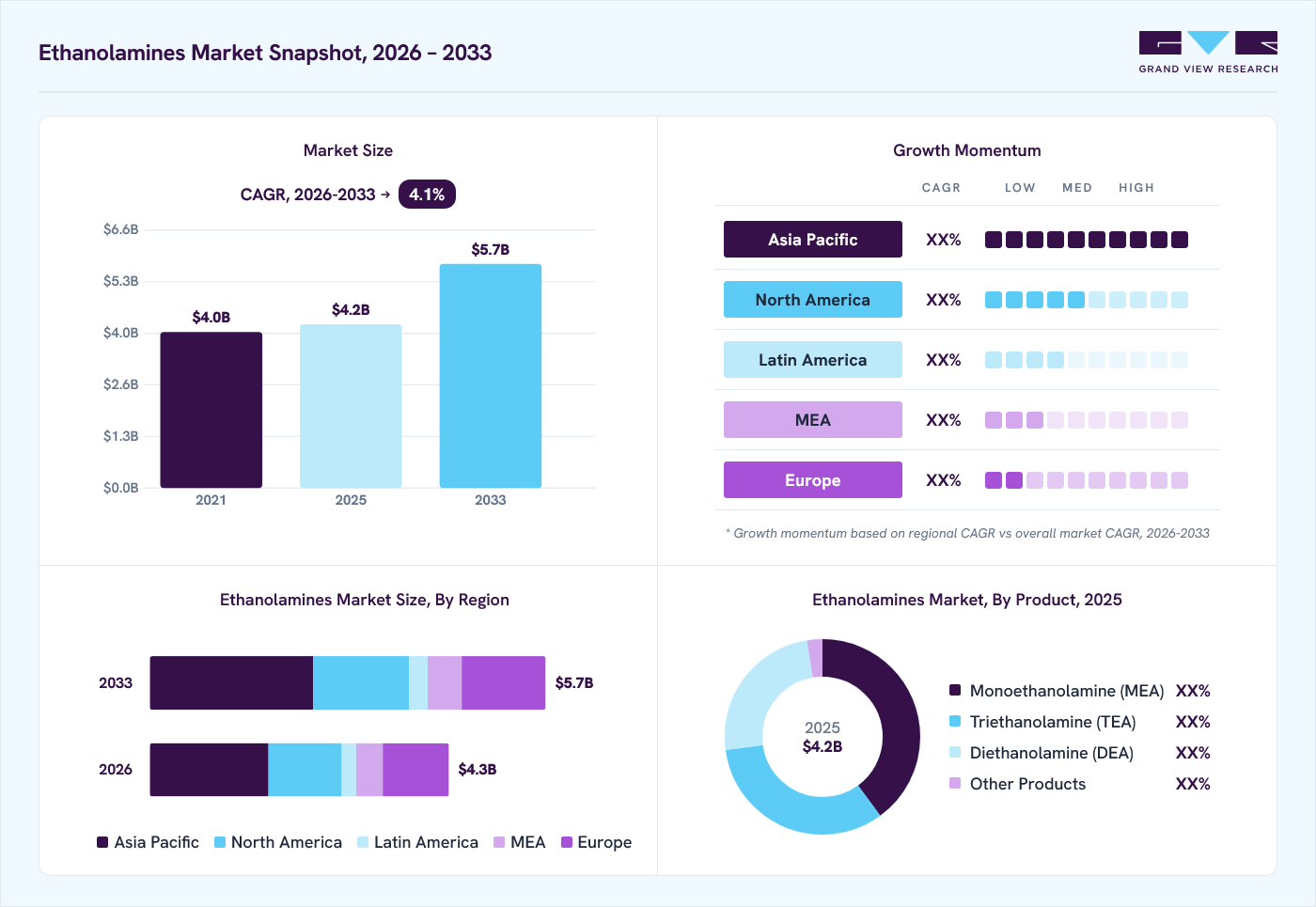 Source: Grand View Research, IR Documents, Primary Interviews, Paid DatabasesTo learn more about this report,
 Download Free Sample Report
Key Market Trends & Insights
- By product: Monoethanolamine (MEA) emerged as the leading product segment, accounting for a revenue share of 39.9% in 2025.
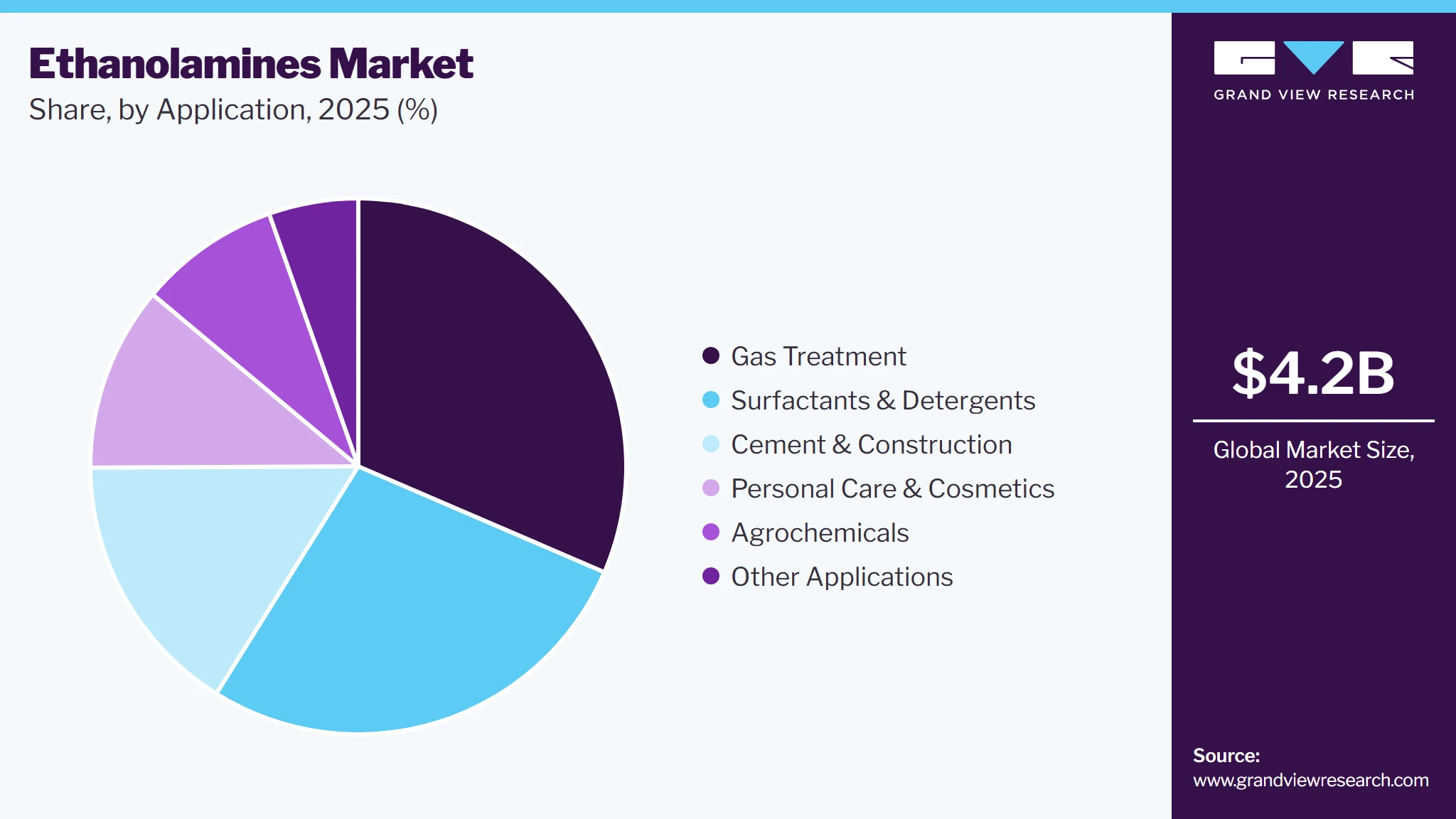
- By application: Gas treatment represented the largest application segment, capturing a revenue share of 31.5% in 2025.
Regional Highlights
- Largest regional market: Asia Pacific (39.5% revenue share, 2025)
- By country: China held the largest market share in 2025.
Market Size & Forecast
- Market size in 2025: USD 4.2 Billion
- Estimated market size in 2026: USD 4.3 Billion
- Projected market size by 2033: USD 5.7 Billion
- CAGR (2026-2033): 4.1%
Prism AI by Grand View Research Free to tryAsk a question about the ethanolamines marketTry asking✓Every figure cited from GVR research Prefer the report? Download free sample →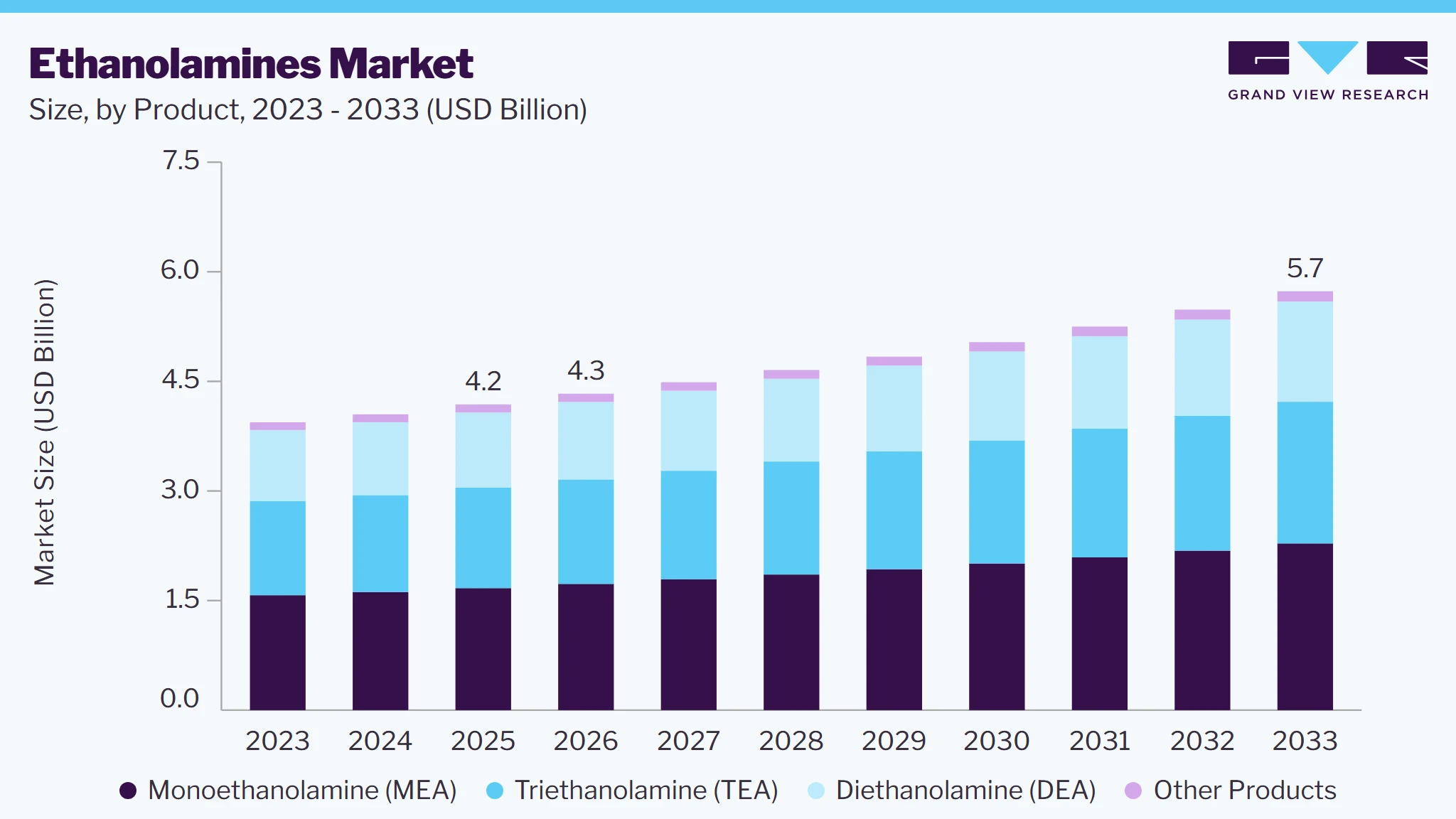 To learn more about this report, Download Free Sample Report
Rising demand for efficient gas treatment solutions and expanding use of ethanolamines in downstream formulations are supporting market growth across industrial and consumer sectors. Applications in gas treatment, surfactants and detergents, cement and construction, personal care and cosmetics, agrochemicals, and other areas are gaining momentum as manufacturers seek effective chemical intermediates, formulation aids, neutralizing agents, and performance-enhancing ingredients for diverse processing and end-use requirements.Market Dynamics
The global ethanolamines market is being influenced by rising consumption across gas treatment, surfactants and detergents, cement and construction, personal care and cosmetics, and agrochemical applications. Increasing demand for efficient acid gas removal, formulation ingredients, chemical intermediates, and neutralizing agents is encouraging broader use of ethanolamines across industrial and consumer value chains. Developments in product formulations, process efficiency, application performance, and downstream chemical manufacturing are supporting wider adoption across diverse operating environments.
The growing requirement for efficient gas purification, chemical intermediates, formulation ingredients, and processing aids is a key factor supporting the global ethanolamines market. Industries are increasingly using ethanolamines in acid gas treatment, surfactant and detergent production, cement additives, personal care formulations, and agrochemical applications to improve process efficiency and product performance. Rising natural gas processing activities, expanding chemical manufacturing capacity, and increasing consumption of formulated cleaning and personal care products are further strengthening demand across downstream industries.
In response to evolving application requirements, manufacturers are investing in production capacity, product development, formulation technologies, and process improvements to address diverse end-use needs. Companies are developing ethanolamine grades and formulations that provide effective gas absorption, neutralization, emulsification, and chemical intermediate functionality, enabling users to improve processing performance and product quality. Continued expansion of downstream chemical applications, together with increasing demand for efficient gas treatment and specialized formulation ingredients, is expected to support sustained market growth and broaden the use of ethanolamines across industrial and consumer sector.
Volatility in raw material prices and the technical requirements associated with ethanolamine production represent key constraints for the global market. Ethanolamines are primarily manufactured using ethylene oxide and ammonia, making production economics sensitive to feedstock availability, energy costs, and fluctuations across petrochemical supply chains. Changes in raw material prices can influence manufacturing costs and product pricing, while maintaining consistent product quality requires controlled reaction conditions, process optimization, and stringent quality management across production facilities.
The production and handling requirements associated with different ethanolamine grades also require manufacturers to maintain specialized process capabilities, storage systems, safety measures, and technical expertise. Companies may need to invest in process optimization, plant maintenance, quality testing, environmental controls, and efficient feedstock management to maintain reliable output and meet application-specific specifications. These operational and cost considerations may place greater pressure on smaller producers and cost-sensitive end users, potentially limiting margin flexibility and influencing purchasing decisions across certain downstream applications.
The expanding need for efficient gas purification, high-performance chemical intermediates, and specialized formulation ingredients presents significant opportunities for companies operating in the global ethanolamines market. Increasing investments in natural gas processing, chemical manufacturing, cleaning products, construction materials, personal care products, and agricultural inputs are broadening the consumption base for ethanolamines. Growing use of these compounds in acid gas removal, surfactant production, cement additives, and agrochemical formulations is enabling manufacturers to address a wider range of downstream requirements and strengthen their presence across diverse application areas.
At the same time, advancements in product formulation, production processes, gas treatment technologies, and application-specific solutions are creating opportunities for differentiated ethanolamine grades and performance characteristics. Manufacturers are developing products suited to specific requirements in gas purification, detergents, personal care formulations, cement processing, and agricultural chemicals. As demand for efficient processing aids, neutralizing agents, and versatile chemical intermediates continues to expand, investments in capacity expansion, formulation development, process optimization, and downstream partnerships could create additional growth opportunities across global markets.
Market Concentration & Characteristics
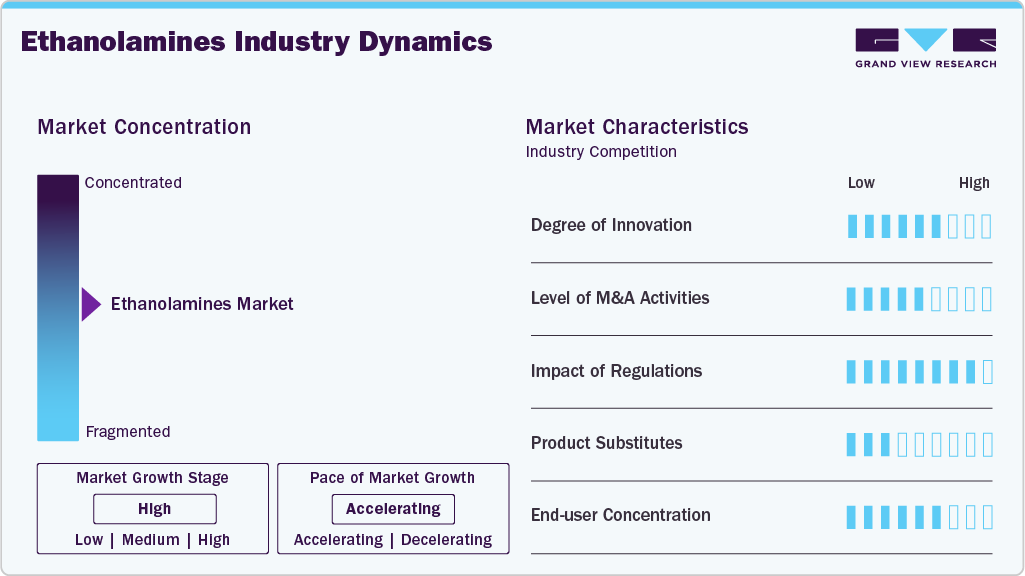
The global ethanolamines market is moderately consolidated, with competition shaped by production capacity, product quality, application versatility, feedstock efficiency, technological capabilities, geographic reach, and relationships with downstream customers. Leading manufacturers are strengthening their ethanolamine portfolios to address demand across gas treatment, surfactants and detergents, cement and construction, personal care and cosmetics, agrochemicals, and other applications. Investments in capacity expansion, process optimization, product development, supply chain capabilities, application support, and technical services remain important competitive factors, while established distribution networks and consistent product availability influence supplier selection across major end-use industries.
 To learn more about this report, Download Free Sample Report
Market participants are also strengthening their market positions through capacity expansions, strategic partnerships, product development, process optimization, and broader regional distribution networks. Companies are increasingly working with downstream users to develop ethanolamine grades and formulations tailored to gas treatment, detergent production, cement processing, personal care products, agrochemical applications, and other specialized requirements.
Analyst Perspective
The global ethanolamines market is supported by expanding demand across gas treatment, surfactants and detergents, cement and construction, personal care and cosmetics, and agrochemical applications. Rising requirements for efficient acid gas removal, versatile chemical intermediates, formulation performance, and process efficiency are encouraging broader utilization across industrial and consumer sectors. Advances in production processes, product formulations, application technologies, and capacity development are improving the functional versatility of ethanolamines and supporting their adoption across an expanding range of downstream applications.
Product Insights
The Monoethanolamine (MEA) segment accounted for the largest revenue share of 39.9% in 2025. Its extensive use in gas treatment, surfactant and detergent manufacturing, agrochemical formulations, and other chemical applications continues to support strong demand. The product's effectiveness as a neutralizing agent, chemical intermediate, and acid gas treating component, combined with its broad compatibility across industrial processes, reinforces its leading position within the global ethanolamines market.
Triethanolamine (TEA) is projected to register the fastest growth at a CAGR of 4.5% from 2026 to 2033. Expansion is supported by increasing utilization in cement and construction chemicals, personal care formulations, surfactants, and other downstream applications requiring effective neutralization and formulation performance. Growing demand for high-quality construction additives and specialty formulations, together with continued product development for application-specific requirements, is expected to further support TEA consumption across diverse end-use industries.
Application Insights
The gas treatment segment accounted for the largest revenue share of 31.5% of the total market in 2025, supported by increasing use of ethanolamines for acid gas removal, natural gas purification, and industrial gas processing. Growing demand for efficient treatment of carbon dioxide and hydrogen sulfide in gas processing facilities is strengthening consumption across the industry. Expanding natural gas infrastructure, increasing processing capacity, and the need for reliable gas purification solutions are further supporting the application of ethanolamines in gas treatment operations.
 To learn more about this report, Download Free Sample Report
Cement & Construction is among the fastest-growing application segments, with a CAGR of 4.4% from 2026 to 2033. Rising utilization of ethanolamines in cement grinding aids, concrete additives, and construction chemical formulations is supporting segment expansion. Increasing construction activity, growing emphasis on cement processing efficiency, and continued development of performance-enhancing construction materials are creating additional opportunities for ethanolamine manufacturers to serve evolving requirements across the building and infrastructure sector.
Regional Insights
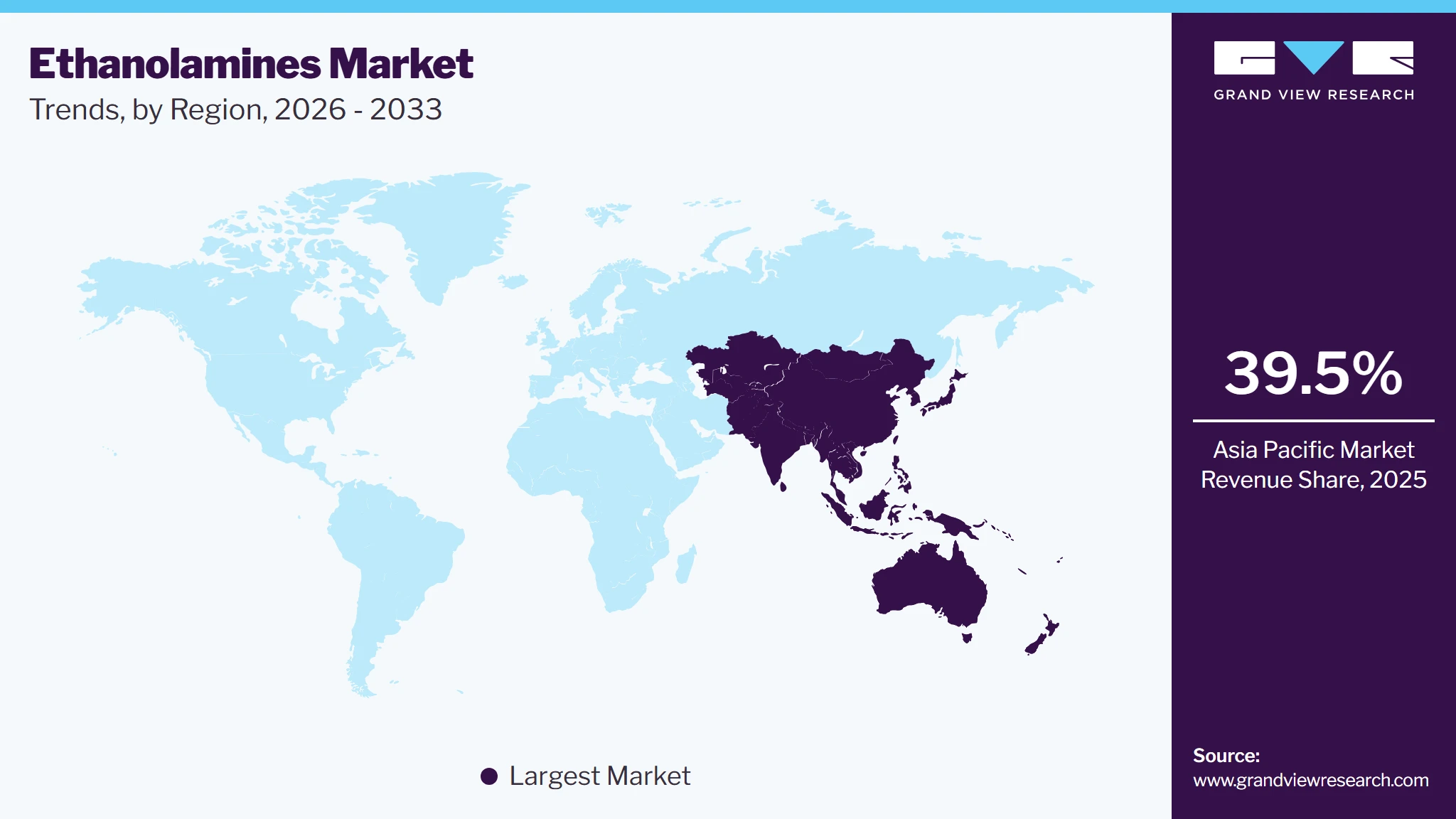
The Asia Pacific ethanolamines market accounted for the largest revenue share of 39.5% in 2025, driven by its extensive chemical manufacturing base, expanding energy infrastructure, and strong consumption across downstream industries. China, India, Japan, and South Korea contribute substantially to regional demand through applications in gas treatment, surfactants and detergents, cement and construction, personal care, and agrochemicals. Growing chemical production capacity and increasing utilization of ethanolamines in industrial formulations are supporting continued market development across the region.
 To learn more about this report, Download Free Sample Report
China Ethanolamines Market Trends
China represents the largest individual market within Asia Pacific, supported by its substantial chemical production capacity and broad downstream manufacturing base. Demand for ethanolamines is reinforced by applications in gas purification, detergents, construction chemicals, personal care products, and agricultural formulations. Expansion of natural gas processing, infrastructure development, and consumer product manufacturing is further increasing consumption across key application industries.
North America Ethanolamines Market Trends
The North America ethanolamines market accounted for a revenue share of 24.5% in 2025, supported by established chemical manufacturing, extensive natural gas processing infrastructure, and mature downstream industries. The U.S. remains the principal contributor, with demand spanning gas treatment, detergents, construction materials, personal care products, and agrochemical formulations. Ongoing investments in energy infrastructure, industrial processing facilities, and specialty chemical production are sustaining ethanolamine consumption across the region.
The U.S. represents the dominant market in North America, supported by its large-scale natural gas processing industry and well-developed chemical manufacturing infrastructure. Gas treatment represents an important consumption area, while ethanolamines are also utilized in surfactants and detergents, cement additives, personal care formulations, and agrochemicals. Continued development of domestic energy infrastructure and demand for performance-oriented chemical ingredients are contributing to steady market expansion.
Europe Ethanolamines Market Trends
The Europe ethanolamines market accounted for 22.2% of global revenue in 2025, with consumption supported by established chemical industries and diversified downstream manufacturing. Germany, the UK, France, Italy, Spain, and Russia represent key markets across the region. Demand is distributed across gas treatment, cleaning formulations, construction chemicals, personal care, and agricultural applications. Regulatory requirements, process efficiency initiatives, and increasing emphasis on product performance are also influencing formulation and sourcing decisions among European manufacturers.
Latin America Ethanolamines Market Trends
The Latin America ethanolamines market accounted for 4.8% of global revenue in 2025, with Brazil and Argentina as major consumption centers. Regional demand is linked to agricultural production, detergents and cleaning products, construction activity, and industrial chemical processing. Expanding agrochemical consumption and infrastructure development are supporting applications across multiple downstream sectors, while growth in manufacturing and energy-related activities is creating additional demand for ethanolamine-based products.
Middle East & Africa Ethanolamines Market Trends
Demand in the Middle East & Africa is supported by oil and gas processing, construction activity, chemical manufacturing, and the expansion of industrial infrastructure across the region. Saudi Arabia represents an important market, benefiting from its large energy and petrochemical base, while South Africa contributes through industrial and consumer applications. Investments in downstream processing capacity and economic diversification initiatives are expected to broaden ethanolamine consumption across the region.
Key Ethanolamines Company Insights
Companies operating in the global ethanolamines market are focusing on capacity expansion, product development, process optimization, strategic collaborations, and geographic expansion to strengthen their market presence. Major producers are serving diverse downstream requirements through portfolios covering monoethanolamine (MEA), diethanolamine (DEA), triethanolamine (TEA), and related products used in gas treatment, surfactants and detergents, cement and construction, personal care, agrochemicals, and other applications.
-
Dow maintains a broad chemicals portfolio with ethanolamines serving applications across gas treatment, surfactants, detergents, and industrial formulations. The company benefits from its integrated manufacturing capabilities, established customer network, and extensive presence across major chemical-consuming markets. Its focus on process efficiency, product quality, and downstream application support enables it to serve varied requirements across industrial and commercial end uses.
-
BASF SE offers ethanolamine products for applications spanning gas treatment, cleaning formulations, chemical intermediates, personal care, and other industrial uses. The company's global production and distribution infrastructure supports supply to customers across multiple regions, while its broad chemicals portfolio provides opportunities to serve interconnected downstream markets.
Key Ethanolamines Companies
The following key companies have been profiled for the study on the ethanolamines market.
-
Dow Chemical
-
BASF SE
-
INEOS Group
-
Huntsman Corporation
-
SABIC
-
Nouryon
-
LyondellBasell Industries
-
Nippon Shokubai Co., Ltd.
-
Sinopec
-
Thai Ethanolamines Co., Ltd.
Competitive Benchmarking
Operating Strategies
Competitive Edge
Weaknesses
Mature Players: Dow; BASF SE; INEOS Group; Huntsman Corporation; SABIC; LyondellBasell Industries; Nippon Shokubai Co., Ltd.; Sinopec
- Expand ethanolamine production capacity and optimize manufacturing processes to support consistent supply across major regional markets.
- Broaden product portfolios covering MEA, DEA, TEA, and related grades for gas treatment, surfactants, detergents, construction, personal care, and agrochemical applications.
- Strengthen downstream relationships, distribution networks, and technical support capabilities to address application-specific requirements and improve customer retention.
- Large-scale manufacturing infrastructure and established petrochemical integration support reliable feedstock access and production economics.
- Diversified product portfolios and extensive downstream relationships provide exposure to multiple end-use industries and regional demand centers.
- Strong distribution networks, established brands, technical resources, and financial capabilities support broad market coverage.
- Large production structures can reduce flexibility when responding to niche or highly customized customer requirements.
- Exposure to ethylene oxide, ammonia, energy, and broader petrochemical cost fluctuations can influence production economics.
- Mature portfolios and extensive operating networks can require substantial investment in process upgrades, environmental compliance, and capacity modernization.
Emerging Players: Nouryon, Thai Ethanolamines Co., Ltd.
- Target specific application segments and regional markets where demand for ethanolamines is increasing.
- Develop application-focused grades and strengthen technical collaboration with customers in gas treatment, personal care, construction, and other downstream industries.
- Expand through regional partnerships, distribution agreements, capacity additions, and improvements in production efficiency.
- Greater operational flexibility can support faster responses to regional demand and customer-specific requirements.
- Focused product portfolios allow specialized producers to concentrate resources on selected applications and market niches.
- Regional proximity to customers can support shorter supply chains, responsive technical service, and closer commercial relationships.
- Smaller production capacities may limit the ability to serve large-volume contracts consistently across multiple regions.
- More limited geographic reach and distribution infrastructure can constrain access to international customers.
- Lower scale may create greater sensitivity to feedstock prices, capital requirements, quality compliance, and production-cost fluctuations.
Recent Developments
-
In September 2024, BASF inaugurated a new world-scale alkyl ethanolamines plant at its Antwerp, Belgium site, increasing its global production capacity by nearly 30% to more than 140,000 tons per year. The expansion strengthens BASF’s supply capabilities across Europe and other key markets while supporting growing demand for alkyl ethanolamines. Such capacity additions improve product availability and reinforce the production base, supporting overall growth in the global ethanolamines market.
Ethanolamines Market Report Scope
Report Attribute
Details
Market size in 2025
USD 4.2 billion
Estimated market size in 2026
USD 4.3 billion
Projected market size by 2033
USD 5.7 billion
Growth rate
CAGR of 4.1% from 2026 to 2033
Base year for estimation
2025
Historical data
2021 - 2024
Forecast period
2026 - 2033
Quantitative units
Revenue in USD million, Volume in Kilotons and CAGR from 2026 to 2033
Report coverage
Revenue forecast, volume forecast, company ranking, competitive landscape, growth factors, and trends
Segments covered
Product, application, region
Country scope
U.S.; Canada; Mexico; Germany; UK; France; Italy; Spain; China; India; Japan; South Korea; Brazil; Argentina; Saudi Arabia; South Africa
Key companies profiled
Dow Chemical; BASF SE; INEOS Group; Huntsman Corporation; SABIC; Nouryon; LyondellBasell Industries; Nippon Shokubai Co., Ltd.; Sinopec; Thai Ethanolamines Co., Ltd.
Customization scope
Free report customization (equivalent up to 8 analysts’ working days) with purchase. Addition or alteration to country, regional & segment scope.
Pricing and purchase options
Avail customized purchase options to meet your exact research needs. Explore purchase options
Global Ethanolamines Market Report Segmentation
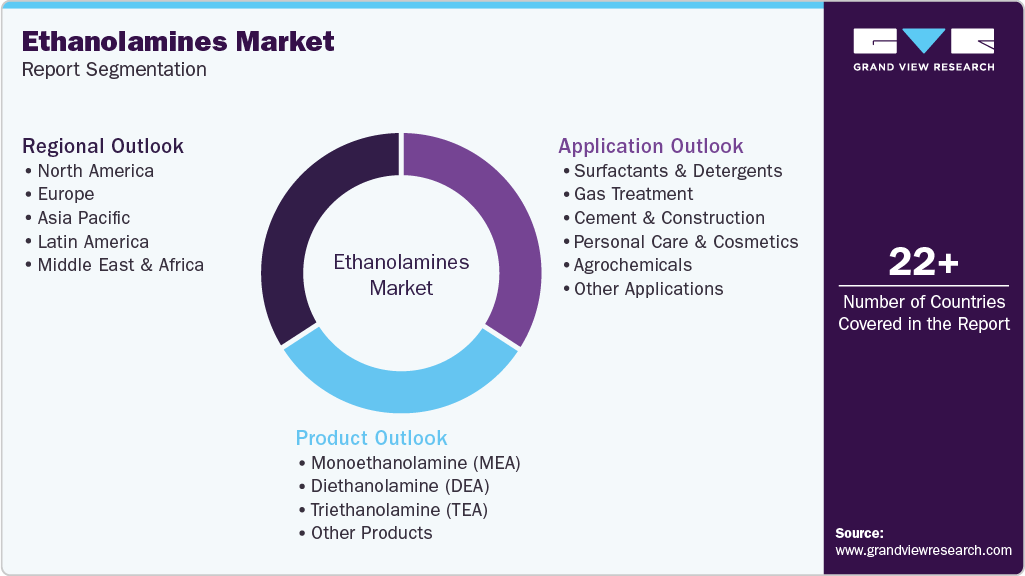
This report forecasts volume & revenue growth at regional, and country levels and provides an analysis of the latest industry trends in each of the sub-segments from 2021 to 2033. For this study, Grand View Research has segmented the global graphene-enhanced anti-corrosion coatings market report based on product, application, and region:
 To learn more about this report, Download Free Sample Report
-
Product Outlook (Revenue, USD Million; Volume, Kilotons; 2021 - 2033)
-
Monoethanolamine (MEA)
-
Diethanolamine (DEA)
-
Triethanolamine (TEA)
-
Other Products
-
-
Application Outlook (Revenue, USD Million; Volume, Kilotons; 2021 - 2033)
-
Surfactants & Detergents
-
Gas Treatment
-
Cement & Construction
-
Personal Care & Cosmetics
-
Agrochemicals
-
Other Applications
-
-
Region Outlook (Revenue, USD Million; Volume, Kilotons; 2021 - 2033)
-
North America
-
U.S.
-
Canada
-
Mexico
-
-
Europe
-
Germany
-
UK
-
France
-
Italy
-
Spain
-
-
Asia Pacific
-
China
-
India
-
Japan
-
South Korea
-
-
Latin America
-
Brazil
-
Argentina
-
-
Middle East & Africa
-
Saudi Arabia
-
South Africa
-
-
Research Methodology
The ethanolamines market figures in this report are based on a proven research process that combines executive interviews with secondary research from proprietary databases, company filings, and recognized regulatory and institutional sources. Market size is built through value-chain sizing - reconciling supply-side and demand-side estimates - and triangulated with bottom-up and top-down approaches. Every estimate passes multiple levels of expert validation before publication, with each ethanolamines segment quantified using the revenue-capture definitions in the table below.
Segment Definition
Segment - Product
Revenue capture definition
Monoethanolamine (MEA)
Market value is generated through the consumption of MEA in gas treatment, surfactant and detergent production, agrochemical formulations, and other industrial processes. Its ability to absorb acidic gases and function as a versatile chemical intermediate supports demand across energy, chemical manufacturing, and formulated product applications.
Diethanolamine (DEA)
Revenue is generated through DEA utilization in surfactants, gas treatment chemicals, agrochemical products, and specialty formulations. Its properties as a chemical intermediate, neutralizing agent, and formulation component support consumption across industrial and downstream chemical applications.
Triethanolamine (TEA)
Market value is created through TEA consumption in cement and construction chemicals, surfactants and detergents, personal care formulations, and other applications. Its neutralizing, emulsifying, and formulation-supporting properties contribute to demand across construction, consumer products, and industrial chemical markets.
Other Products
Revenue is generated through ethanolamine products outside MEA, DEA, and TEA that serve specialized chemical processing and formulation requirements. These products are used across selected industrial, chemical, and downstream applications where specific functional properties or performance characteristics are required.
Segment - Application
Revenue capture definition
Surfactants & Detergents
Market value is generated through ethanolamine consumption in surfactant production, household and industrial detergents, cleaning formulations, and related products. Their neutralizing and formulation-supporting properties contribute to product performance and enable their use across a range of cleaning and surface-active formulations.
Gas Treatment
Revenue is generated through the use of ethanolamines for removing acidic gases such as carbon dioxide and hydrogen sulfide from natural gas and industrial gas streams. Their gas absorption capabilities support purification processes across natural gas processing, refining, chemical manufacturing, and other industrial facilities.
Cement & Construction
Market value is created through ethanolamine utilization in cement grinding aids, concrete additives, and construction chemical formulations. Their ability to improve grinding efficiency and support formulation performance is contributing to consumption across cement manufacturing and infrastructure-related activities.
Personal Care & Cosmetics
Revenue is generated through ethanolamine utilization in personal care and cosmetic formulations, where these compounds serve functions such as pH adjustment, emulsification, and formulation stabilization. Demand is associated with products including creams, lotions, shampoos, and other formulated consumer products.
Agrochemicals
Market value is generated through the incorporation of ethanolamines into herbicide, pesticide, and other agricultural chemical formulations. Their role in neutralization, formulation, and salt formation supports the development and application of agrochemical products across crop protection markets.
Other Applications
Revenue is generated through ethanolamine consumption in applications outside surfactants and detergents, gas treatment, cement and construction, personal care and cosmetics, and agrochemicals. These uses span selected industrial and specialty chemical processes where ethanolamines provide neutralization, absorption, formulation, or intermediate functionality.
Estimation Model
Layer No.
Layer Name
Key Question
Description
01
Product Layer
What ethanolamine products are consumed?
Identify the production, commercial availability, and consumption of Monoethanolamine (MEA), Diethanolamine (DEA), Triethanolamine (TEA), and other ethanolamine products across global markets. The assessment considers product characteristics, manufacturing capacity, supply availability, trade flows, pricing, and suitability for different downstream applications.
02
Application Demand Layer
Where are ethanolamines utilized?
Assess ethanolamine consumption across surfactants and detergents, gas treatment, cement and construction, personal care and cosmetics, agrochemicals, and other applications. The analysis considers application intensity, downstream production volumes, formulation requirements, industrial activity, and demand trends to determine ethanolamine utilization across major markets.
03
Country & Regional Consumption Layer
How does demand vary across markets?
Evaluate ethanolamine consumption across major countries and regions based on industrial production, natural gas processing, construction activity, consumer product manufacturing, agricultural chemical demand, and other relevant economic indicators. Country-level consumption patterns, production capacity, imports, exports, and application penetration are assessed to develop regional market estimates.
04
Revenue Layer
How is market revenue generated?
Market revenue is calculated from the commercial sale and consumption of ethanolamine products across identified applications and geographic markets. The estimation incorporates product-specific pricing, consumption volumes, regional price variations, supply conditions, and downstream demand to determine annual market value and forecast revenue through the study period.
Delivered Customizations
This report has been delivered with the following In-depth customizations
Client Request
Customization Delivered
Value Adds
Regional segmentation
The assessment includes country-level market size and forecasts, product demand patterns across MEA, DEA, TEA, and other products, and application-level analysis covering surfactants and detergents, gas treatment, cement and construction, personal care and cosmetics, agrochemicals, and other applications. The analysis also evaluates regional production capacity, downstream consumption, trade patterns, industrial activity, and application trends shaping ethanolamine demand across individual countries.
Provides visibility into country-specific demand conditions, application concentration, market maturity, and growth patterns. Supports market entry planning, geographic expansion, resource allocation, distributor selection, and identification of markets with attractive downstream demand and development potential.
Opportunity Assessment
Detailed evaluation of growth opportunities across MEA, DEA, TEA, and other ethanolamine products, along with major application areas including gas treatment, surfactants and detergents, cement and construction, personal care and cosmetics, and agrochemicals. The assessment considers expanding natural gas processing, chemical manufacturing, construction activity, consumer product production, agricultural chemical consumption, and other demand drivers influencing future ethanolamine requirements.
Helps identify product and application segments with expanding consumption potential and supports prioritization of capacity expansion, product development, market entry, customer targeting, and downstream partnerships. Insights into evolving application requirements also support investment and commercialization planning.
Competitive Benchmarking
Comparative assessment of leading global ethanolamine manufacturers based on product portfolio, production capacity, geographic presence, application coverage, manufacturing footprint, supply chain capabilities, technical support, strategic partnerships, research and development activities, and expansion strategies. The benchmarking evaluates capabilities across MEA, DEA, TEA, and other products, as well as key application segments and major regional markets.
Enables comparison of competitive capabilities while identifying gaps in product coverage, manufacturing scale, geographic reach, application exposure, and customer support. Supports decisions related to capacity investments, partnerships, product development, geographic expansion, customer acquisition, and broader competitive strategy within the global ethanolamines market.
Frequently Asked Questions About This Report
The global ethanolamines market size was estimated at USD 4.2 billion in 2025 and is expected to reach USD 4.3 billion in 2026.
The ethanolamines market is expected to grow at a CAGR of 4.1% from 2026 to 2033, reaching USD 5.7 billion by 2033.
Some of the key players operating in the ethanolamines market include Dow, BASF SE, INEOS Group, Huntsman Corporation, SABIC, Nouryon, LyondellBasell Industries, Nippon Shokubai Co., Ltd., Sinopec, and Thai Ethanolamines Co., Ltd.
Asia Pacific dominated the ethanolamines market, accounting for 39.5% of total revenue in 2025. The region's leading position is supported by expanding chemical manufacturing, natural gas processing, construction activity, consumer product production, and growing consumption across industrial and downstream applications.
The ethanolamines market is driven by increasing demand for gas treatment, surfactants and detergents, cement and construction chemicals, personal care formulations, and agrochemicals. Expanding natural gas processing, chemical manufacturing, infrastructure development, and consumption of formulated products are further supporting ethanolamine demand across global markets.
Triethanolamine (TEA) is expected to be the fastest growing product segment, registering a CAGR of 4.5% from 2026 to 2033. Increasing use in cement and construction chemicals, surfactants, personal care formulations, and other applications is supporting demand for TEA across diverse downstream industries.
Asia Pacific is expected to be the fastest growing regional market, expanding at a CAGR of 4.7% from 2026 to 2033. Increasing chemical production, natural gas processing, construction activity, and downstream manufacturing across China, India, Japan, South Korea, and other regional markets are supporting continued ethanolamine consumption.
Monoethanolamine (MEA) accounted for the largest share of the market, representing 39.9% of total revenue in 2025. Its leading position is supported by broad use in gas treatment, surfactants and detergents, agrochemical formulations, and other industrial applications requiring effective neutralization, gas absorption, and chemical intermediate functionality.
Cement & construction is expected to be the fastest growing application segment, registering a CAGR of 4.4% from 2026 to 2033. Increasing utilization of ethanolamines in cement grinding aids, concrete additives, and construction chemical formulations is supporting segment expansion alongside continued infrastructure development.
About the Author(s)
Organic Chemicals Research Team
Bulk Chemicals · Organic ChemicalsThis report was authored by the organic chemicals research team at Grand View Research - comprising two research analysts, one senior research analyst, and one industry expert - with specialized expertise in the organic chemicals segment of the bulk chemicals industry. All findings are based on proprietary bulk chemicals databases, executive interviews, and regulatory analysis, subject to internal peer review prior to publication.
Last Updated:
Speak to Analyst

Customize this report to your needs - add regions, segments, or data points, with 20% free customization.
Or view our licence options:


ISO 9001:2015 & 27001:2022 Certified
We are GDPR and CCPA compliant! Your transaction & personal information is safe and secure. For more details, please read our privacy policy.


