
- Home
- »
- Next Generation Technologies
- »
-
EtherCAT Market Size And Share, Industry Report, 2033GVR Report cover

EtherCAT Market (2025 - 2033) Size, Share & Trends Analysis Report By Component (Hardware, Software, Services), By Device Type (Master Controllers, Slave Controllers) , By End Use, By Region, And Segment Forecasts
Market Size, 2024
$2,445.6MMarket Estimate, 2026
$2,676.5MMarket Forecast, 2033
$5,647.9MCAGR, 2025–2033
9.8%EtherCAT Market Summary
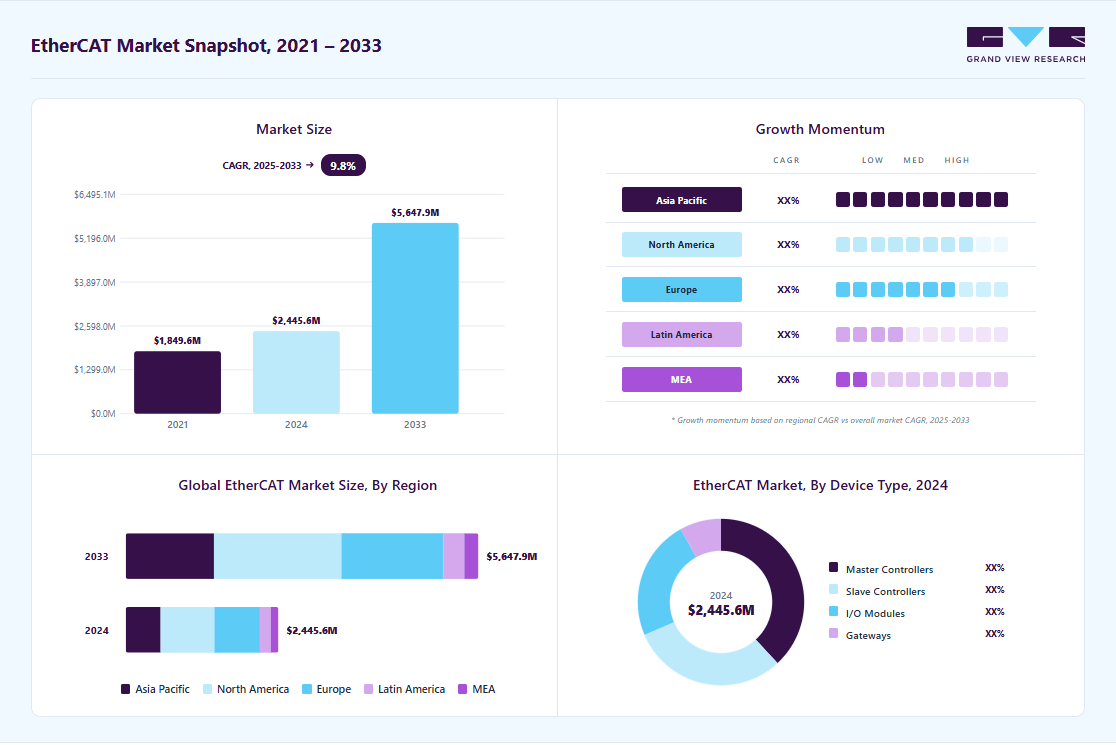
The global EtherCAT market size was estimated at USD 2,445.6 million in 2024 and is projected to reach USD 5,647.9 million by 2033, growing at a CAGR of 9.8% from 2025 to 2033. The global EtherCAT industry is witnessing steady growth, driven by increasing automation across industries.
 Source: Grand View Research, IR Documents, Primary Interviews, Paid DatabasesTo learn more about this report,
 Download Free Sample Report
 Key Market Trends & Insights
- The North America EtherCAT market dominated with the largest global revenue share of 35.4% in 2024.
- The EtherCAT industry in the U.S. led North America with the largest revenue share in 2024.
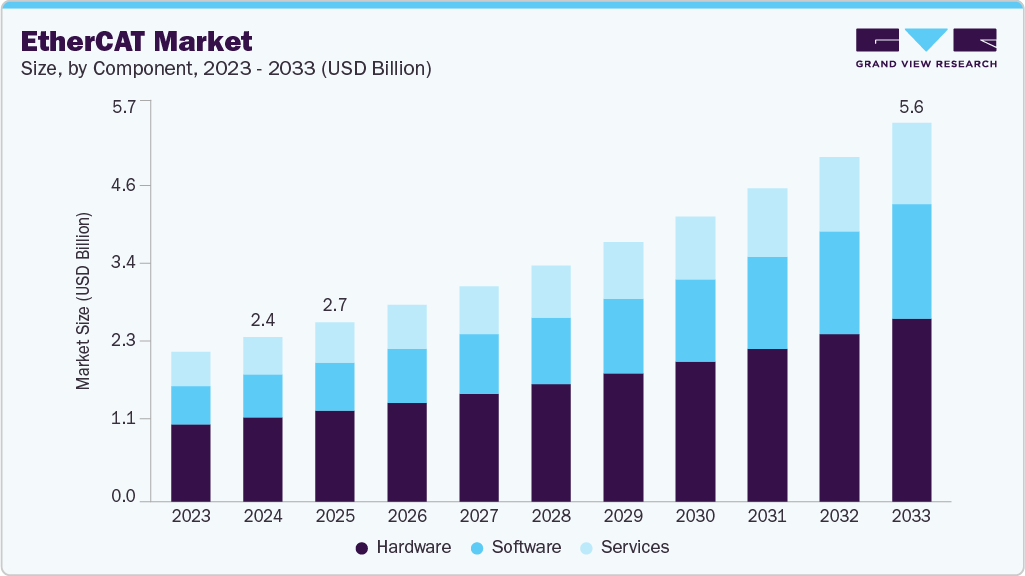
- By component, the hardware segment held the largest revenue share of 51.2% in 2024.
- By device type, the master controllers segment held the dominant market position with the largest revenue share of 38.1% in 2024.
- By end use, the electrical & electronics segment is expected to grow at the fastest CAGR of 11.6% from 2025 to 2033.
Market Size & Forecast
- 2024 Market Size: USD 2,445.6 Million
- 2033 Projected Market Size: USD 5,647.9 Million
- CAGR (2025-2033): 9.8%
- North America: Largest market in 2024
- Asia Pacific: Fastest growing market
Three ways to get this report
Buy it, customize it, or ask a question.Ask an Analyst
Analyst response in 1 business day
- AccessReport author, directly
- Reply timeWithin 1 working day
- No sales callDirect answer only
- FormatEmail reply
- CostFree, no cost
Get the Full Report
What the study covers
- FormatsPDF · Excel · Dashboard
- Timeline2025–2033 annual, 2024 base
- Coverage20+ countries, 5 regions
- Companies10+ key players profiled
Customize the Report
20% free customization
- IncludeCountries, segments, points
- TailorTo your product definition
- ExtendDeeper competitor detail
- OrA fully bespoke study
- Turnaround5–10 working days
It is widely adopted in automotive, electronics, aerospace, and energy sectors for real-time, high-speed communication. The market’s expansion is supported by rising demand for precision, reliability, and efficient industrial control systems. The EtherCAT market is witnessing growing demand for high-performance controllers. Industries are increasingly seeking faster and more capable devices to manage complex automation tasks efficiently. These controllers enable real-time data processing and ensure low-latency communication across networks. Their advanced capabilities support precise control, synchronization, and scalable industrial operations. As automation systems become more sophisticated, the reliance on robust, high-speed controllers continues to rise. Several companies are actively driving the trend toward high-performance EtherCAT controllers through advanced MCUs and integrated solutions. For instance, in November 2024, GigaDevice Semiconductor Inc., a fabless supplier in China, launched its GD32H75E series with an integrated EtherCAT SubDevice Controller, targeting industrial automation applications. The high-performance MCU series supports servo control, PLCs, and communication modules, combining speed, flexibility, and real-time capabilities.EtherCAT adoption is expanding across advanced manufacturing sectors. Industries are increasingly seeking high-precision and reliable automation solutions. There is growing demand for real-time, deterministic communication networks. Integrated control of multiple devices is becoming essential for operational efficiency. This trend shows the shift toward smarter, more precise industrial automation systems. For instance, in November 2024, NSK Ltd., a machinery manufacturing company in Japan, launched an EtherCAT-compatible driver for its Megatorque Motor, enabling integrated control and high-speed synchronous operation of multiple motors. This product enhances angular resolution and precision, boosting production efficiency across applications such as semiconductor manufacturing and industrial machinery..
 To learn more about this report, Download Free Sample Report
 The demand for scalable and flexible network solutions is rising across industries due to rapid technological advancements. Companies require networks that can grow alongside their operations without significant infrastructure changes. Flexible networks allow easy integration of new devices and systems, reducing downtime and operational disruptions. Scalability ensures that networks can handle increased data traffic and connected devices efficiently. Industries such as manufacturing, healthcare, and logistics increasingly rely on adaptable networks to support automation and digitalization. The rise of IoT and Industry 4.0 initiatives has intensified the need for networks that can evolve with changing requirements. Scalable solutions also optimize resource utilization and reduce long-term operational costs. Flexibility in network design enables organizations to respond quickly to market demands and technological shifts. Cloud integration and hybrid network models further enhance scalability and flexibility.
Component Insights
The hardware segment dominated the EtherCAT industry in 2024, accounting for a 51.2% share, due to its essential role in enabling industrial automation and real-time communication. Devices such as controllers, sensors, and motion control equipment drive the adoption of EtherCAT networks. The demand for high-performance, reliable hardware solutions remains strong across manufacturing, robotics, and semiconductor sectors. Hardware solutions ensure low latency, high-speed data transfer, and precision control, which are critical for modern industrial applications. Companies continue to invest in upgrading and expanding hardware infrastructure to support growing automation needs.
Software adoption in the market is expanding as industries increasingly rely on advanced control, monitoring, and diagnostic tools. Platforms for network management, configuration, and simulation are gaining traction to enhance system efficiency. The growth of software solutions supports predictive maintenance, real-time analytics, and seamless integration with other digital systems. Software flexibility allows for customization and scalability without significant hardware changes. Companies are investing in software to optimize operations and improve productivity across automation networks.
Device Type Insights
Master controllers holds the largest share in the EtherCAT industry in 2024, due to their central role in managing and coordinating EtherCAT networks. They are responsible for data exchange, synchronization, and controlling multiple slave devices efficiently. High reliability and real-time processing capabilities make master controllers critical for industrial automation applications. Industries such as manufacturing, robotics, and semiconductor production heavily rely on these devices for operational precision. Continuous upgrades in processing power and communication protocols maintain their dominance. The strong adoption of master controllers shows their foundational importance in building robust and efficient networks.
Slave controllers are experiencing growth as the demand for scalable and distributed EtherCAT networks increases. These devices extend network capabilities by handling specific tasks and local data processing. Growth in automation, IoT integration, and precision manufacturing drives the adoption of slave controllers. They enable flexible system expansion without overloading the master controller. Improved performance and compatibility with diverse industrial equipment enhance their market potential. The increasing complexity of automation systems ensures continued growth for slave controllers in the market.
End Use Insights
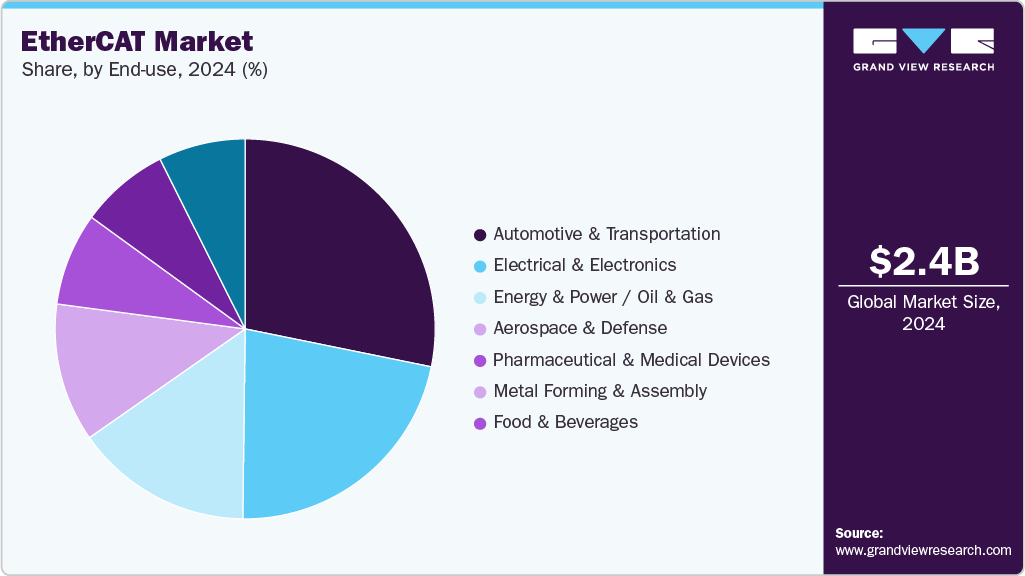
The automotive & transportation sector accounted for the largest share of the EtherCAT market in 2024. Its dominance is driven by the need for high-speed, real-time communication in advanced vehicle systems. Increasing adoption of electric vehicles and autonomous driving technologies has accelerated demand. EtherCAT enables precise control of in-vehicle networks, improving safety and efficiency. Manufacturers are integrating these networks to support complex sensors and actuators. The sector’s investment in connected and intelligent transportation continues to fuel market growth. Strong collaboration between automotive OEMs and EtherCAT solution providers is enhancing system integration. Future advancements in vehicle automation are expected to further strengthen EtherCAT adoption.
 To learn more about this report, Download Free Sample Report
 The electrical & electronics sector showed significant growth in the EtherCAT market in 2024. Rising automation and industrial digitalization are key contributors to this trend. EtherCAT provides fast, reliable data exchange essential for manufacturing and inspection systems. Adoption in robotics and smart devices is increasing steadily. Companies are leveraging EtherCAT to enhance operational efficiency and reduce latency. This growth shows the sector’s broader focus on smart, interconnected electronic solutions. Expansion into advanced testing and measurement equipment is creating new opportunities. Continuous innovation in industrial electronics is such asly to drive further EtherCAT integration.
Regional Insights
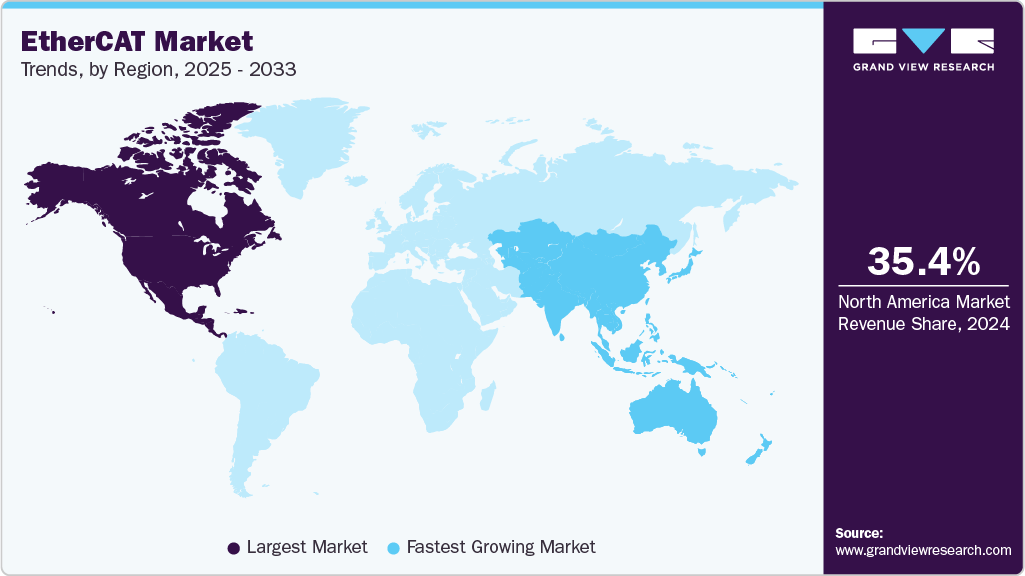
North America held the largest share of the EtherCAT market with 35.4% revenue share in 2024.Strong industrial automation adoption across manufacturing and transportation sectors drives this dominance. The region benefits from advanced infrastructure and early implementation of Industry 4.0 technologies. Major manufacturers and technology providers are investing heavily in EtherCAT solutions. This leadership is expected to continue as demand for high-speed, real-time communication networks grows.
 To learn more about this report, Download Free Sample Report
 U.S. EtherCAT Market Trends
The United States holds a significant share in the EtherCAT industry due to its advanced manufacturing and automotive industries. Adoption of Industry 4.0 technologies is accelerating demand for real-time communication networks. EtherCAT is widely used in automation, robotics, and smart factory applications. Leading technology providers and system integrators are expanding their solutions in the country.
Europe EtherCAT Market Trends
Europe is a key region in the EtherCAT industry, driven by industrial automation and precision manufacturing. Countries such as Germany and France are investing heavily in smart factories and connected manufacturing systems. EtherCAT’s reliability and low latency make it ideal for automotive and electronics applications. The region has a strong ecosystem of manufacturers and technology providers supporting EtherCAT deployment. Regulatory standards promoting efficiency and safety in industrial operations encourage adoption.
Asia Pacific EtherCAT Market Trends
Asia Pacific is the fastest-growing market for EtherCAT. Countries such as China, Japan, and South Korea are integrating EtherCAT in automotive, robotics, and electronics sectors. High demand for automation and smart production systems is driving adoption. Local manufacturers and international technology providers are investing in advanced EtherCAT solutions. Government policies supporting Industry 4.0 and smart factories are boosting market penetration. The region is expected to continue growing as industries focus on efficiency and real-time communication networks.
Key EtherCAT Company Insights
Some of the key companies in the EtherCAT industry include Bosch Rexroth AG, KEB Automation KG, Omron Corporation, Siemens, Schneider Electric, WAGO, and Yaskawa Electric Corporation. Organizations are focusing on increasing customer base to gain a competitive edge in the industry. Therefore, key players are taking several strategic initiatives, such as mergers and acquisitions, and partnerships with other major companies.
-
Siemens has actively contributed to the development and adoption of EtherCAT in industrial automation. Their controllers and drives are designed to integrate seamlessly with EtherCAT networks. Siemens emphasizes high-speed and deterministic communication for complex manufacturing processes. They provide engineering tools that simplify EtherCAT configuration and diagnostics. The company continuously updates its EtherCAT-enabled devices to meet evolving industry standards.
-
Schneider Electric has incorporated EtherCAT support across its automation products, including PLCs and motion controllers. Their solutions focus on enhancing real-time communication and process efficiency. Schneider Electric promotes interoperability with third-party EtherCAT devices to broaden system compatibility. They offer software platforms that facilitate seamless EtherCAT network management. Continuous innovation ensures their EtherCAT offerings address modern industrial challenges.
Key EtherCAT Companies:
The following are the leading companies in the EtherCAT market. These companies collectively hold the largest market share and dictate industry trends.
- Acontis Technologies GmbH
- Beckhoff Automation
- Bosch Rexroth AG
- KEB Automation KG
- Omron Corporation
- Phoenix Contact
- Siemens
- Schneider Electric
- WAGO
- Yaskawa Electric Corporation
Recent Developments
-
In February 2024, Acontis Technologies GmbH collaborated with Delta Computer Systems, Inc., a U.S.-based high-performance motion control company, to enhance industrial automation solutions. This partnership enabled the integration of EtherCAT MainDevice capability into the RMC200 Motion Controller, significantly improving system flexibility, real-time communication, and overall connectivity in complex motion control applications.
-
In April 2024, Omron expanded its NXR Series to include EtherCAT support, simplifying remote I/O maintenance and IIoT adoption. This expansion enhances the interoperability of Omron's automation solutions.
-
In February 2024, Phoenix Contact launched two new compact safety I/O modules designed for Safety over EtherCAT (FSoE), aimed at strengthening industrial network safety. These modules provide advanced protection features, ensuring reliable operation and fault detection across EtherCAT networks, while supporting streamlined integration and efficient system architecture in complex automation environments.
EtherCAT Market Report Scope
Report Attribute
Details
Market size value in 2025
USD 2,676.5 million
Revenue forecast in 2033
USD 5,647.9 million
Growth rate
CAGR of 9.8% from 2025 to 2033
Base year for estimation
2024
Historical data
2021 - 2023
Forecast period
2025 - 2033
Quantitative units
Revenue in USD million and CAGR from 2025 to 2033
Report coverage
Revenue forecast, company ranking, competitive sector, growth factors, and trends
Segment scope
Component, device type, end use, region
Region scope
North America; Europe; Asia Pacific; Latin America; Middle East & Africa
Country scope
U.S.; Canada; Mexico; Germany; UK; France; China; Japan; India; Australia, South Korea, Brazil, KSA, UAE, South Africa
Key companies profiled
Acontis Technologies GmbH, Beckhoff Automation, Bosch Rexroth AG, KEB Automation KG, Omron Corporation, Phoenix Contact, Siemens, Schneider Electric, WAGO, Yaskawa Electric Corporation
Customization scope
Free report customization (equivalent up to 8 analysts’ working days) with purchase. Addition or alteration to country, regional & segment scope
Pricing and purchase options
Avail customized purchase options to meet your exact research needs. Explore purchase options
Global EtherCAT Market Report Segmentation
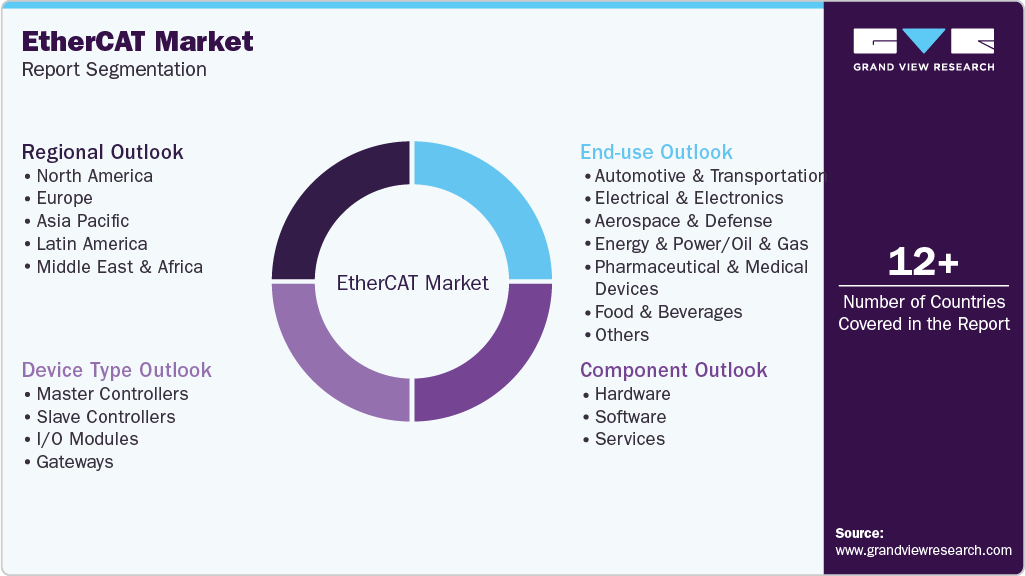
This report forecasts revenue growth at the global, regional, and country levels and provides an analysis of the latest industry trends and opportunities in each of the sub-segments from 2021 to 2033. For this study, Grand View Research has segmented the global EtherCAT market report based on component, device type, end use, and region:
 To learn more about this report, Download Free Sample Report
 -
Component Outlook (Revenue, USD Million, 2021 - 2033)
-
Hardware
-
Software
-
Services
-
-
Device Type Outlook (Revenue, USD Million, 2021 - 2033)
-
Master Controllers
-
Slave Controllers
-
I/O Modules
-
Gateways
-
-
End Use Outlook (Revenue, USD Million, 2021 - 2033)
-
Automotive & Transportation
-
Electrical & Electronics
-
Aerospace & Defense
-
Energy & Power / Oil & Gas
-
Pharmaceutical & Medical Devices
-
Food & Beverages
-
Metal Forming & Assembly
-
-
Regional Outlook (Revenue, USD Million, 2021 - 2033)
-
North America
-
U.S.
-
Canada
-
Mexico
-
-
Europe
-
UK
-
Germany
-
France
-
-
Asia Pacific
-
China
-
Japan
-
India
-
Australia
-
South Korea
-
-
Latin America
-
Brazil
-
-
Middle East & Africa (MEA)
-
KSA
-
UAE
-
South Africa
-
-
Frequently Asked Questions About This Report
The global EtherCAT market size was estimated at USD 2,445.6 million in 2024 and is expected to reach USD 2,676.5 million in 2025.
The global EtherCAT market is expected to grow at a compound annual growth rate of 9.8% from 2025 to 2033 to reach USD 5,647.9 million by 2033.
North America dominated the EtherCAT market with a share of 35.4% in 2024. This is attributable to the strong presence of industrial automation companies, widespread adoption of advanced manufacturing technologies, and increasing demand for high-speed communication solutions in the region.
Some key players operating in the EtherCAT market include Acontis Technologies GmbH, Beckhoff Automation, Bosch Rexroth AG, KEB Automation KG, Omron Corporation, Phoenix Contact, Siemens, Schneider Electric, WAGO, and Yaskawa Electric Corporation.
Key factors that are driving the market growth include the rising adoption of industrial automation, growing demand for real-time communication in manufacturing, increasing integration of IoT and smart factory solutions, and advancements in motion control systems.
About the Author(s)
Next Generation Technologies Research Team
Technology · Next Generation TechnologiesThis report was authored by the next generation technologies research team at Grand View Research - comprising two research analysts, one senior research analyst, and one industry expert - with specialized expertise in the next generation technologies segment of the technology industry. All findings are based on proprietary technology databases, executive interviews, and regulatory analysis, subject to internal peer review prior to publication.
Last Updated:
Speak to Analyst

Customize this report to your needs - add regions, segments, or data points, with 20% free customization.
Or view our licence options:


ISO 9001:2015 & 27001:2022 Certified
We are GDPR and CCPA compliant! Your transaction & personal information is safe and secure. For more details, please read our privacy policy.


