
- Home
- »
- Animal Health
- »
-
Europe Veterinary Vitamin Manufacturing Market Report, 2033GVR Report cover

Europe Veterinary Vitamin Manufacturing Market (2026 - 2033)
Size, Share & Trends Analysis Report By Animal (Production Animals, Companion Animals), By Product, By Type, By Dosage Form, By Value Chain, By Country, And Segment Forecasts
Market Size, 2025
$310.3MMarket Estimate, 2026
$324.5MMarket Forecast, 2033
$568.4MCAGR, 2026–2033
8.3%Europe Veterinary Vitamin Manufacturing Market Summary
The Europe veterinary vitamin manufacturing market size was valued at USD 310.3 million in 2025 and is projected to grow from USD 324.5 million in 2026 to USD 568.4 million by 2033, at a CAGR of 8.3% from 2026 to 2033. The market growth is driven by the region’s well-established livestock and poultry industries, increasing focus on preventive animal healthcare, rising companion animal ownership, and growing demand for high-quality feed-grade vitamins and premixes.
Key Market Trends & Insights
- By animal: Production animals segment held the largest market share of 58.0% in 2025.
- By product: Vitamin B-complex segment held the largest market share of 27.0% in 2025.
- By type: Finished drug products segment held the largest market share of 54.2% in 2025.
- By dosage form: Oral forms segment held the largest market share of 76.5% in 2025.
Market Size & Forecast
- Market size in 2025: USD 310.3 Million
- Estimated market size in 2026: USD 324.5 Million
- Projected market size by 2033: USD 568.4 Million
- CAGR (2026-2033): 8.3%
Prism AI by Grand View Research Free to tryAsk a question about the europe veterinary vitamin manufacturing marketTry asking✓Every figure cited from GVR research Prefer the report? Download free sample →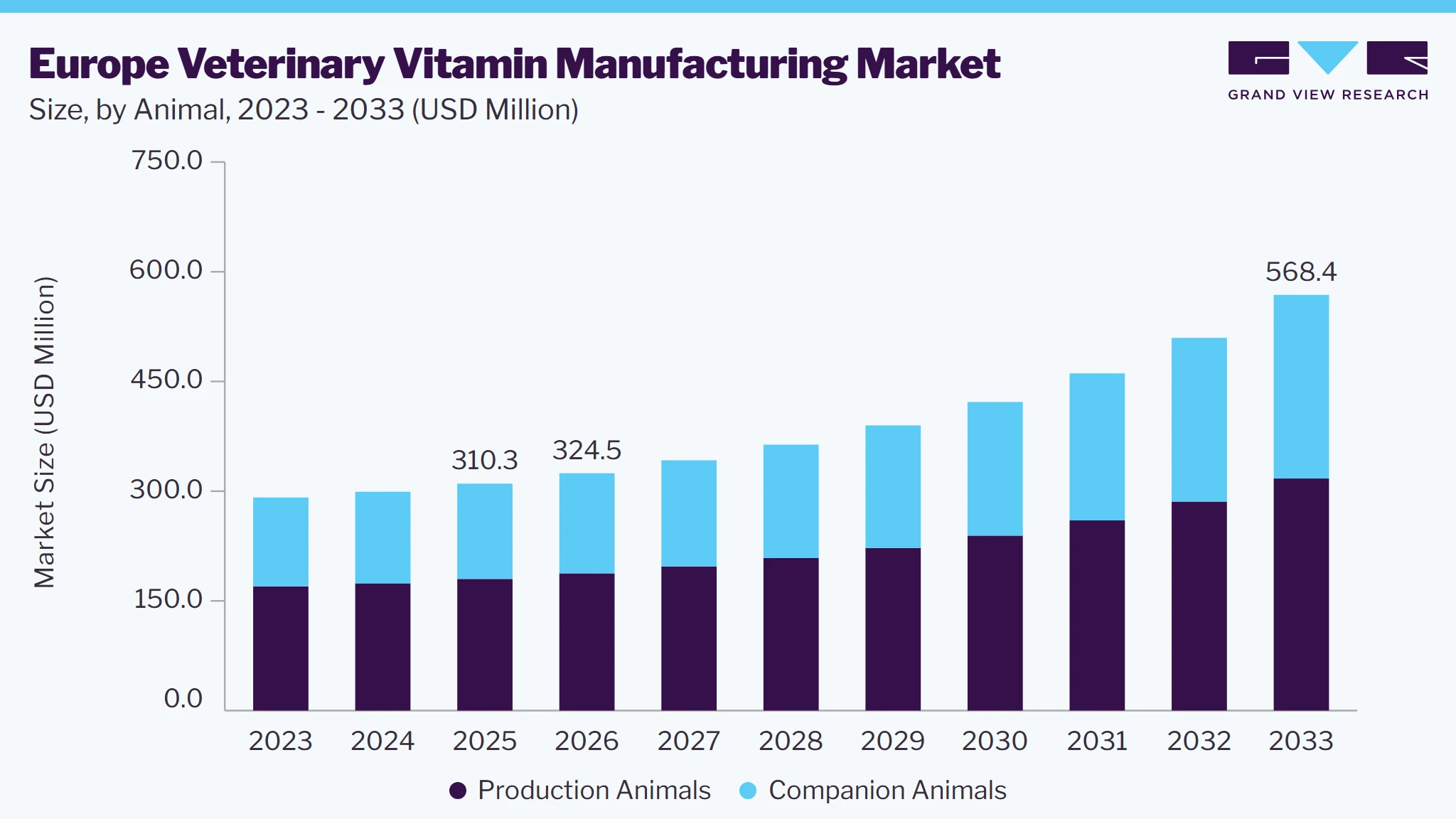 Source: Grand View Research, IR Documents, Primary Interviews, Paid DatabasesTo learn more about this report,
 Download Free Sample Report
Some of the other factors contributing to the market growth include advanced animal feed manufacturing infrastructure, stringent EU regulations concerning animal nutrition, welfare, and food safety, increasing antimicrobial stewardship efforts, higher spending on companion animal health and nutrition, and the strong presence of established animal nutrition, veterinary health, and specialty feed ingredient manufacturers. Such factors are expected to support the growth of the veterinary vitamin manufacturing market across Europe.
Market Dynamics
The Europe veterinary vitamin manufacturing market is focusing on better formulas and ways to keep vitamins stable. Manufacturers now use microencapsulation, controlled-release methods, improved mixing, precise blending, and automated dosing to keep vitamins effective, maintain batch consistency, and ensure they work well in animal feed. Digital batch tracking, quality checks during production, and traceability systems are becoming more important due to strict European feed safety and quality rules. Pet products are shifting toward tastier options such as chews, liquids, powders, and special blends. For farm animals, vitamins need to withstand heat, dissolve in water, and mix well with feed to ensure they survive processing, storage, transport, and use on farms.
The market faces challenges such as fluctuating raw material prices, reliance on imports, maintaining formula stability, complex regulations, and tight profit margins. Many vitamin ingredients come from global supply chains, which expose European makers to shipping delays, a few suppliers, and price changes. Losing stability during heat processing, exposure to air, storage, and mixing with feed is still a major technical problem, especially for sensitive vitamins. European buyers want detailed paperwork, tracking, and steady batch quality, which adds to the compliance workload. Buyers of feed and premixes are very price-conscious, which puts pressure on profits. Smaller manufacturers may find it hard to handle supplier checks, strict quality systems, rules, and advanced formula skills.
Preventive animal healthcare is becoming more important across Europe as livestock producers work to keep animals healthy, productive, and performing well. Vitamins help with immunity, growth, reproduction, bone health, and metabolism, leading to steady demand for feed and premixes with added vitamins. The move toward balanced nutrition is also pushing feed makers to use specific vitamin mixes for poultry, pigs, cattle, and fish farming. This increases the need for dependable veterinary vitamins that have steady strength, last well, and mix easily with feed. In addition, efforts to reduce unnecessary antibiotic use in European animal production are increasing attention toward nutrition-based health management. This creates opportunities for vitamin manufacturers to develop formulations supporting immunity, resilience, and overall animal performance.
Pet owners across Europe are paying more attention to nutrition, preventive care, and long-term health. This is driving demand for vitamin supplements and enhanced nutritional products made to support immunity, joint health, skin and coat condition, digestion, and overall wellness. Manufacturers are responding by creating easy-to-use and tasty forms such as chews, powders, liquids, and mixed blends. The rising demand for high-quality pet nutrition is opening up chances for special vitamin recipes and outsourced production across Europe. The growing trend of treating pets like family is also affecting buying choices, with owners looking for products made for their pet's age, breed, lifestyle, and unique nutritional needs. This pushes manufacturers to offer a wider range of distinct and focused vitamin products.
Europe relies on overseas suppliers for several vitamins, intermediates, and other inputs used in animal nutrition products. This leaves manufacturers exposed to changing raw material prices, longer lead times, and occasional supply shortages. Any disruption in international supply chains can quickly raise manufacturing costs and make production planning difficult. Smaller producers are particularly affected, as they often have less purchasing power and fewer alternative suppliers. Building alternative supply networks within Europe requires time and investment and may come at a higher cost. As feed and premix customers remain price-sensitive, manufacturers cannot always pass these additional costs on, putting pressure on margins and limiting market growth.
Opportunity - Private-Label Veterinary Vitamin Manufacturing for Pet and Farm Brands
The growing demand for more focused animal nutrition gives European manufacturers a chance to go beyond basic vitamin products. Farmers and pet owners are increasingly looking for products tailored toa specific life stages, production goals, and nutritional needs. Manufacturers can offer custom premixes, stable vitamin mixes, water-soluble products, and formulas made for poultry, cattle, pigs, fish farming, and pets. This lets suppliers serve more specific needs instead of just competing on quantity and price. Also, products with better stability, absorption, and ease of use can help manufacturers stand out. Companies with strong skills in making these products can use this change to build better customer relationships and find higher-value opportunities across Europe.
Cost & Pricing Dimensions
Dimension
Europe characteristics
Pricing visibility
Quotation-led, country-specific - less e-commerce transparency
Dosage format
Injectables & specialty products carry higher distributor/compliance cost
Manufacturing cost
Higher labor, energy, compliance, multilingual packaging
Packaging cost
Multilingual labeling, VAT, recycling rules, country-specific formats.
Quality/batch release
Higher documentation burden (EU + national compliance)
Regulatory bodies
EFSA, European Commission, FEDIAF, EMA, national regulators
Channel margin
Country-level distributor/wholesaler layers raise final price.
Customer pricing
Feed/livestock buyers price-sensitive; premium pet nutrition supports stronger pricing
Volume contracts
Common in feed/premix supply, but smaller country volumes limit scale benefits
Private-label pricing
More complex - multilingual labels, country claims, VAT, local distribution
Premium pet supplements
Pricing varies by country, VAT, specialty retail, brand, e-commerce channel
Margin pressure
Driven mainly by energy, labor, and compliance cost
Market Concentration & Characteristics
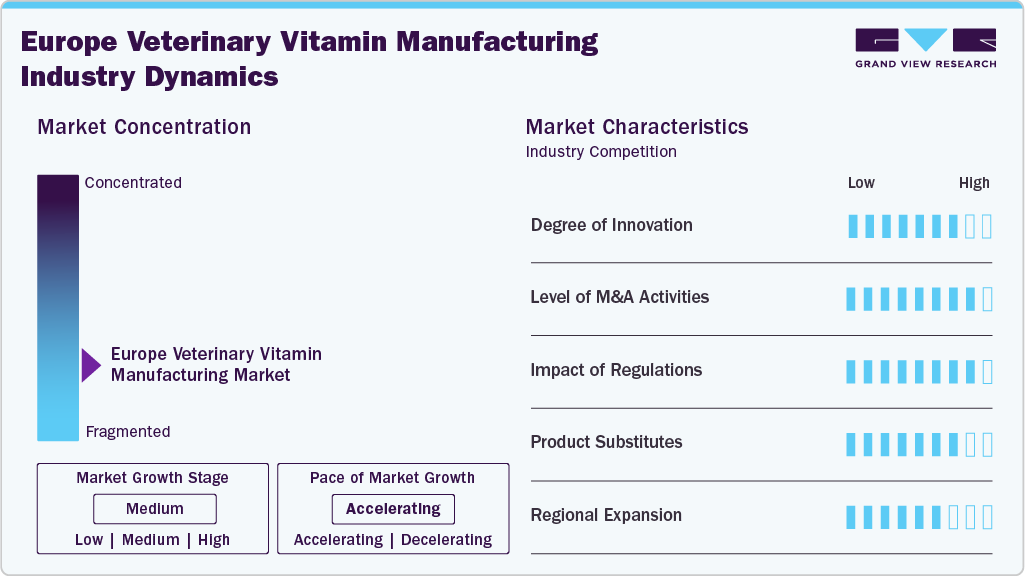
The industry is moderately fragmented, due to the presence of animal health companies, feed additive suppliers, premix manufacturers, nutraceutical producers, veterinary supplement brands, and contract manufacturers across Europe. This wide range of local and international players serving various animals, such as livestock, poultry, fish farming, and pets, creates a competitive market where suppliers compete by offering expert formulas, high-quality products, large-scale production, and tailored solutions for customers.
The industry shows a high degree of innovation, helped by improvements in keeping vitamins stable, tiny coating techniques, protective layers, precise mixing, and formulas that animals can absorb well. Manufacturers are making more custom premixes, vitamins that resist heat, water-friendly formulas, and nutrition plans tailored to specific animal types to keep nutrients stable, last longer, work better in processing, and be absorbed well while meeting the changing needs of different animals.
 To learn more about this report, Download Free Sample Report
The industry is witnessing high merger and acquisition activity as companies look to broaden their animal nutrition portfolios, gain formulation capabilities, and strengthen their presence across European markets. Acquisitions involving premix producers, specialty nutrition businesses, and feed ingredient companies allow manufacturers to expand technical expertise, improve access to customers, strengthen distribution networks, and add production capabilities without relying entirely on organic expansion.
The industry operates under strict European regulations that cover feed additives, manufacturing practices, ingredient safety, authorization, labeling, hygiene, and traceability. The European Commission and European Food Safety Authority play important roles in the regulatory framework for feed additives, including vitamins used in animal nutrition. Meeting EU feed hygiene, safety, quality, and documentation requirements is therefore a key consideration for manufacturers placing veterinary vitamin products and nutritional additives on the European market.
The threat of product substitutes is moderate, as veterinary vitamin manufacturers offer standardized, scientifically formulated products with consistent quality and efficacy. Although natural feed ingredients and fortified commercial feeds provide baseline nutritional support, they generally cannot replace targeted vitamin formulations developed to address specific nutritional deficiencies, production performance, or therapeutic supplementation requirements.
Manufacturers are expanding their production footprint across Europe through investments in manufacturing capacity, automation, contract manufacturing partnerships, and advanced quality control infrastructure. Increasing demand for premium animal nutrition products, growing livestock production, and rising companion animal health expenditure continue to encourage manufacturers to strengthen domestic production capabilities and optimize regional supply chains.
Analyst Perspective
The European veterinary vitamin manufacturing market is experiencing steady growth, driven by demand for specialized nutritional products for both companion and production animals. Manufacturers are expanding beyond standard vitamins to offer customized blends, species-specific formulations, premixes, and value-added services to address evolving needs in animal nutrition, feed production, veterinary care, and pet health. Advances in formulation and stabilization, combined with strict European standards for safety, quality, and traceability, are influencing manufacturing practices throughout the region.
Animal Insights
The production animals segment dominated the market with a share of 58.0% in 2025, owing to the region’s established livestock, poultry, and dairy industries and the growing focus on preventive nutrition across commercial farming systems. In addition, manufacturers serving European livestock producers are focusing on improving animal health, productivity, feed efficiency, and reproductive performance, which is expected to support demand for vitamin-enriched feed supplements and premixes. Vitamins such as A, D3, E, K, and B-complex are commonly used in animal feed and nutritional products to support immunity, bone development, reproduction, growth, and overall production performance. For instance, Vilofoss offers Premium 40 Y, a premix for lactating cows which contains vitamin A, vitamin D3, vitamin E, and biotin. These are formulated to support hoof health, fertility, udder health, and milk production. Such formulations highlight the importance of vitamin premixes in supporting herd health and maintaining productive performance across Europe.
The companion animals segment is expected to grow at the fastest CAGR from 2026 to 2033, driven by rising pet ownership, higher spending on pet health and wellness, and increasing use of preventive nutrition products through veterinary clinics, online platforms, specialty pet retailers, and pet supplement brands. This large pet-owning base is supporting demand for daily vitamin and nutritional products used for deficiency management, skin and coat health, immunity, digestion, mobility, healthy aging, recovery, and overall wellness.
Product Insights
The vitamin B-complex segment dominated the Europe market with a revenue share of 27.0% in 2025, as vitamin B plays an important role in helping animals use energy, grow, and perform well. These water-soluble vitamins help convert carbohydrates, fats, and proteins into energy, improving feed use, growth, productivity, and recovery during stress. Europe’s well-established livestock and poultry industries add vitamin B-complex products to feed, premixes, and supplements to support metabolism, feed efficiency, and animal performance during growth, milk production, transport, recovery, and periods of high production. B-complex vitamins also help the nervous system, red blood cell production, immune system, and reproductive health, making these products useful for dairy cattle, poultry, pigs, sheep, goats, fish farming, and other farm animals across Europe.
The vitamin D3 segment is expected to grow at the fastest CAGR over the forecast period. Increasing focus on animal nutrition, development of advanced vitamin D formulations, and demand for effective supplementation across Europe’s established livestock and companion animal sectors are primarily driving the segment growth. Vitamin D3 plays an important role in calcium and phosphorus utilization, making adequate supplementation relevant for maintaining skeletal development, bone strength, and overall animal health. In addition, manufacturers are developing advanced forms of vitamin D, including 25-hydroxycholecalciferol, to broaden nutritional solutions for different animal species. Across poultry, swine, ruminants, aquaculture species, and companion animals, vitamin D3 formulations are used to support mineral metabolism, skeletal health, growth, and overall nutritional performance.
Type Insights
The finished drug products segment led the Europe veterinary vitamin manufacturing market with a 54.2% share in 2025 and is expected to grow the fastest over the forecast period because of increasing demand for ready-to-use and precisely measured animal nutrition products that are easy to give and provide consistent supplements for farm and pet animals. Veterinarians, livestock producers, pet owners, animal nutrition companies, and pet supplement brands are using finished vitamin products more often because they add value through how they are made, measured, packaged, labeled, and stored. Products such as injectables, oral liquids, pastes, boluses, powders, chews, and premixes are used across Europe to meet nutritional needs, manage deficiencies, help recovery, boost immunity, and improve overall animal health. For instance, Netherlands-based Beaphar offers Multi Vitamin Paste for dogs, a ready-to-use product containing vitamins A, B2, B6, B12, E, folic acid, and biotin, plus other nutrients. The paste can be given directly or mixed with food, showing the availability of easy-to-use finished vitamin options for pets in the European market.
The API segment is expected to grow at a significant CAGR over the forecast period, driven by demand from European veterinary pharmaceutical companies, animal nutrition manufacturers, feed premix producers, and contract manufacturers for high-quality vitamin active ingredients used in large-scale formulation and production. Vitamins such as A, D3, E, K, B-complex, B12, and other specialty vitamins are supplied as active ingredients before being incorporated into finished veterinary products, feed supplements, and premixes. As several vitamins are sensitive to heat, light, moisture, oxygen, and feed processing conditions, manufacturers must closely manage potency, stability, formulation quality, packaging, and storage to maintain product performance. For instance, Germany-based BASF supplies Lutavit A 1000 NXT, a vitamin A acetate powder used in premixes and feeds for livestock and companion animals. Vitamin A is incorporated into a protective matrix and stabilized with antioxidants to improve stability, while the product is designed to maintain performance across premixes, mash, and pellets. BASF also operates a major animal nutrition production site in Ludwigshafen, Germany, strengthening the relevance of its vitamin manufacturing activities to the European market.
Dosage Form Insights
Oral forms segment held a share of 76.5% in 2025. Oral vitamins, such as feed mixes, water-soluble powders, boluses, and liquid supplements, are commonly used for cattle, poultry, pigs, and other farm animals in Europe. These forms let vitamins be added to feed or water, making it easy and consistent to give vitamins to large groups without treating each animal separately. This makes oral vitamins especially good for Europe’s well-established livestock and poultry systems, where vitamins are regularly used to help animal health, growth, feed use, reproduction, and nutrition during times of higher need.
The injectable is the second fastest growing segment in the market. Injectable vitamins help animals get quick and targeted nutritional support, especially when they are deficient, recovering, stressed, or have higher nutritional needs. These products are often used for cattle, calves, horses, sheep, goats, and other animals under veterinary care. Because injectable vitamins go directly into the animal’s system, they do not rely on the animal eating or drinking enough. This is helpful for animals that are sick, weak, stressed, or recovering and may not take in enough oral supplements. Injectable vitamins also let veterinarians give a precise dose based on the animal’s condition and needs. In Europe, there is a growing focus on animal health, preventive care, and efficient nutrition, which supports the use of injectable vitamin products. Their targeted approach makes them a valuable option alongside oral vitamins in livestock and veterinary care.
Value Chain Insights
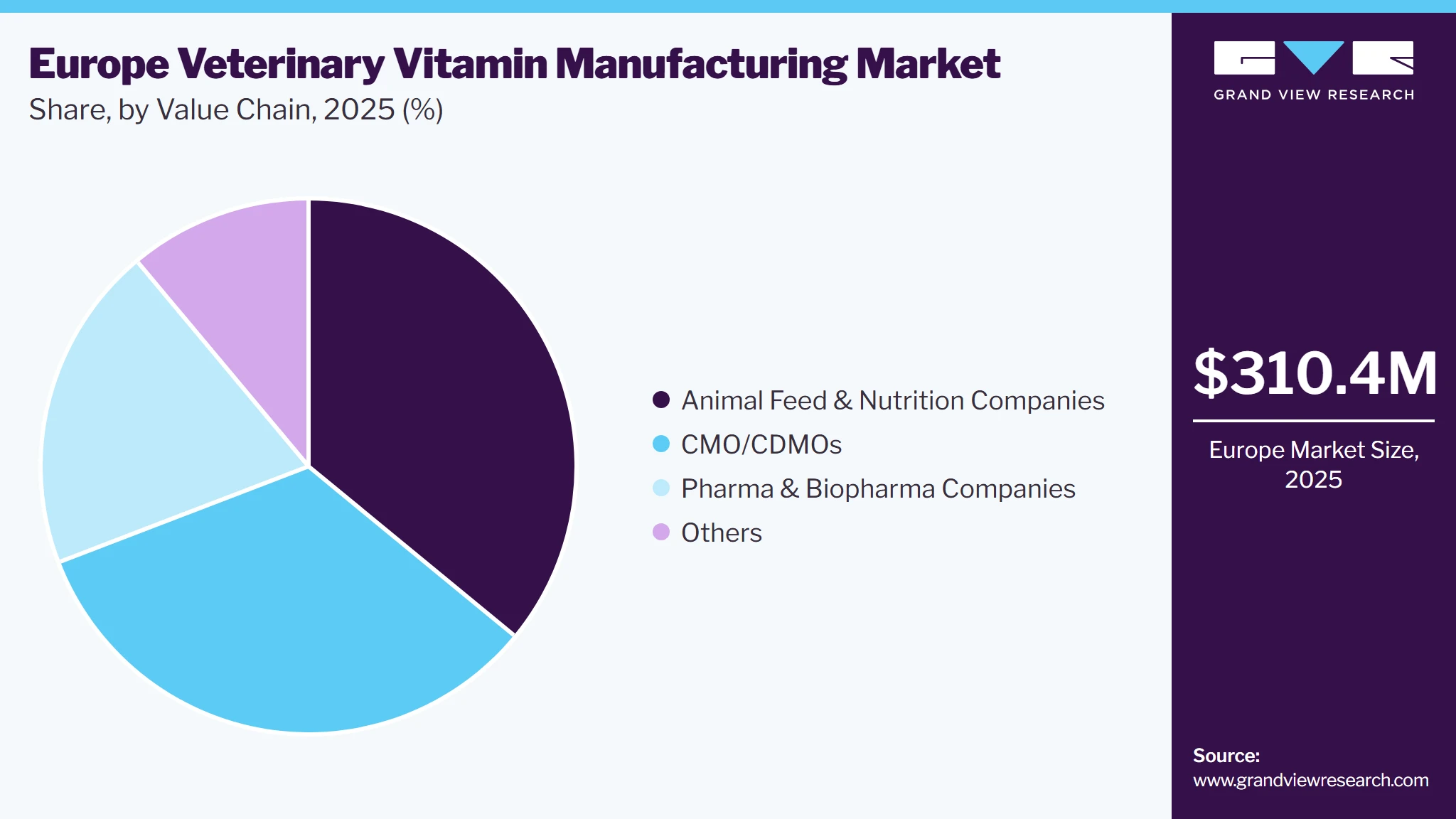
The animal feed & nutrition companies segment accounted for the largest revenue share of 36.0% in 2025. This is due to the continuous demand in Europe for bulk vitamins, premixes, and fortified feed products among the well-established livestock, poultry, and dairy industries. Feed manufacturers add vitamins to their products in order to ensure balanced animal nutrition and to promote growth, improve feed utilization, support reproductive health, boost immunity, and enhance overall production performance. The various animal feed and nutrition companies in Europe include vitamins such as A, D, E, K, the B-complex, and other micronutrients in the feed and premix formulations they produce for cattle, poultry, pigs, dairy animals, and other production animals. Since vitamin needs differ according to species, age, production stage, and feeding conditions, there is a demand for formulations tailored to specific nutritional requirements. The strong representation of compound feed and premix producers in Europe also supports this segment, as these companies need a steady supply of vitamin ingredients in order to produce feed on a commercial scale while at the same time keeping the nutrient quality and consistency between batches. As a result, there is consistent demand for veterinary vitamin manufacturers who serve the European animal nutrition industry.
 To learn more about this report, Download Free Sample Report
The CMO/CDMOs segment is estimated to grow at the fastest CAGR from 2026 to 2033, as animal health companies, feed additive suppliers, and pet nutrition brands increasingly outsource vitamin formulation and production to specialized manufacturing partners. This approach enable companies reduce investment in dedicated production facilities while gaining access to formulation expertise, established manufacturing capacity, quality systems, and regulatory knowledge. Contract manufacturers also provide support across blending, filling, packaging, testing, and other production activities, allowing companies to focus more on product development, branding, sales, and distribution while responding efficiently to changing customer needs across European markets.
Country Insights
Germany Veterinary Vitamin Manufacturing Market Trends
The Germany veterinary vitamin manufacturing market is supported by a well-established animal health and nutrition industry, along with strong capabilities in feed additives, premixes, and specialty nutritional ingredients. The country is home to companies such as BASF and Boehringer Ingelheim, while a wider network of feed manufacturers, premix suppliers, veterinary product companies, and contract manufacturers serves both production and companion animals. For instance, in October 2025, BASF launched a major animal nutrition production site in Ludwigshafen, Germany, and started a new world-scale vitamin A formulation plant at the site, strengthening Germany’s position in vitamin production for animal nutrition.
Germany also has a large livestock base that creates steady demand for vitamins used in animal feed and nutritional products. According to the German Federal Statistical Office (Destatis), Germany had around 10.4 million cattle in November 2025, including nearly 3.6 million dairy cows. The country also had approximately 21.5 million pigs in November 2025. This established livestock base supports demand for vitamins A, D3, E, B-complex, and other micronutrients supplied through premixes, feed formulations, water-soluble products, and other nutritional formats used to support animal health, growth, reproduction, and overall production performance.
Key Europe Veterinary Vitamin Manufacturing Company Insights
The Europe veterinary vitamin manufacturing market is characterized by moderate to high competition and remains moderately fragmented, with the presence of established animal nutrition companies, veterinary pharmaceutical manufacturers, feed additive suppliers, premix producers, and specialty nutrition companies. Key participants such as Zoetis Services LLC, BASF SE, Trouw Nutrition International B.V., Vilofoss A/S, MIAVIT GmbH compete through product portfolio expansion, species-specific nutritional formulations, manufacturing capabilities, and advanced formulation technologies. Companies are also focusing on product quality, regulatory compliance, supply reliability, and tailored nutritional solutions to meet the growing demand for veterinary vitamin products across livestock and companion animal applications in Europe.
Key Europe Veterinary Vitamin Manufacturing Companies
-
Zoetis Services LLC
-
BASF SE
-
Trouw Nutrition International B.V.
-
Vilofoss A/S
-
MIAVIT GmbH
-
Kaesler Nutrition GmbH
-
Biochem Zusatzstoffe Handels- und Produktionsgesellschaft mbH
-
Suanfarma, S.A
-
Orffa Additives B.V
-
Denkavit Internationaal B.V
-
VetAgro S.p.A.
-
Virbac S.A
-
Vetoquinol S.A
-
Intervet International B.V
-
Merck & Co., Inc
-
Elanco Animal Health Incorporated
-
Phibro Animal Health Corporation
-
ADM
Competitive Benchmarking
Operating Strategies
Competitive Edge
Weaknesses
Established Players (Zoetis Services LLC, BASF SE, Trouw Nutrition International B.V., Vilofoss A/S, Virbac S.A, Vetoquinol S.A, Intervet International B.V./Merck & Co., Inc., Elanco Animal Health Incorporated, Phibro Animal Health Corporation, ADM)
- Established manufacturers focus on expanding veterinary vitamin portfolios through advanced formulation capabilities, species-specific products, and investments in manufacturing capacity. They emphasize GMP-compliant production, high-quality raw material sourcing, customized premixes, and value-added nutritional solutions for companion animals and livestock. Strategic partnerships with veterinary distributors, feed manufacturers, and private-label brands, along with continuous investments in R&D, regulatory compliance, and manufacturing automation, strengthen their market presence and production capabilities.
- These companies benefit from strong global brands, extensive manufacturing infrastructure, integrated supply chains, diversified product portfolios, and long-standing relationships with veterinary clinics, feed companies, and animal health distributors. Their technical expertise, regulatory experience, and ability to manufacture at commercial scale enable consistent product quality, reliable supply, and sustained market leadership.
- Established players often face high manufacturing, quality assurance, and regulatory compliance costs associated with maintaining GMP-certified facilities and multi-country operations. Longer product development timelines, complex supply chains, and dependence on global raw material sourcing can increase operational costs. Large organizational structures may also reduce flexibility in responding quickly to evolving customer requirements and niche formulation opportunities.
Emerging Players (MIAVIT GmbH, Kaesler Nutrition GmbH, Biochem Zusatzstoffe Handels- und Produktionsgesellschaft mbH, Suanfarma, S.A, Orffa Additives B.V, Denkavit Internationaal B.V, VetAgro S.p.A.)
- Emerging manufacturers focus on customized veterinary vitamin formulations, private-label manufacturing, contract manufacturing services, and niche nutritional products for specific animal species and life stages. They emphasize flexible production, faster product development, competitive pricing, and close collaboration with veterinary brands, distributors, and regional animal nutrition companies. Their strategies prioritize customer-specific formulations, shorter commercialization timelines, and expansion through regional partnerships and specialized manufacturing services.
- Emerging companies compete through manufacturing flexibility, customized product development, responsive customer support, and specialized formulation expertise. Their ability to deliver smaller production batches, private-label solutions, and tailored nutritional products enables them to serve niche markets efficiently while responding rapidly to changing customer demands.
- Emerging manufacturers generally operate with limited production capacity, smaller distribution networks, and lower financial resources than multinational competitors. Limited brand recognition, narrower product portfolios, and fewer regulatory and technical resources may restrict expansion into larger markets. They may also face challenges in securing long-term supply contracts and competing against companies with integrated manufacturing capabilities and established customer relationships.
Recent Developments
-
In June 2026, Denkavit Ingredients entered into a strategic agreement with Zhejiang Garden Biopharmaceutical, becoming the exclusive European distributor of Garden’s feed additive vitamins. The agreement expands Denkavit’s vitamin offering in Europe and strengthens access to vitamin ingredients for feed and animal nutrition manufacturers across the region.
-
In March 2026, Adisseo launched Sanion Tetra 50 and Sanion Tetra 70, two protected sodium butyrate feed additives containing 50% and 70% active content, respectively. The products are manufactured at Adisseo’s own facilities and expand its specialty feed additive portfolio, supporting demand for advanced nutritional solutions in animal production.
-
In October 2025, BASF launched Lutavit A/D3 1000/200 NXT, combining vitamins A and D3 in a single microencapsulated formulation for animal nutrition. The product, manufactured at BASF’s vitamin A formulation facility in Ludwigshafen, Germany, is suitable for all animal species and designed for stability in applications such as premixes and pellets.
-
In June 2025, Virbac announced the revamp of its Veterinary HPM physiological nutrition range for dogs and cats. The updated portfolio began its progressive rollout in Europe in May 2025, with the company positioning the range around science-based nutrition and changing veterinarian and pet-owner requirements.
Europe Veterinary Vitamin Manufacturing Market Report Scope
Report Attribute
Details
Market size in 2025
USD 310.3 million
Estimated market size in 2026
USD 324.5 million
Projected market size by 2033
USD 568.4 million
Growth rate
CAGR of 8.3% from 2026 to 2033
Historical data
2021 - 2025
Forecast period
2026 - 2033
Quantitative units
Revenue in USD million and CAGR from 2026 to 2033
Report coverage
Revenue forecast, company ranking, competitive landscape, growth factors, and trends
Segments covered
Animal, product, type, dosage form, value chain, country
Country scope
Germany; UK; France; Italy; Spain; Norway; Denmark; Sweden
Key companies profiled
Zoetis Services LLC; BASF SE; Trouw Nutrition International B.V.; Vilofoss A/S; MIAVIT GmbH; Kaesler Nutrition GmbH; Biochem Zusatzstoffe Handels- und Produktionsgesellschaft mbH; Suanfarma, S.A; Orffa Additives B.V; Denkavit Internationaal B.V; VetAgro S.p.A.; Virbac S.A; Vetoquinol S.A; Intervet International B.V; Merck & Co., Inc; Elanco Animal Health Incorporated; Phibro Animal Health Corporation; ADM
Customization scope
Free report customization (equivalent up to 8 analysts working days) with purchase. Addition or alteration to country, regional & segment scope.
Pricing and purchase options
Avail customized purchase options to meet your exact research needs. Explore purchase options
Europe Veterinary Vitamin Manufacturing Market Report Segmentation
This report forecasts revenue growth at country levels and provides an analysis of the latest industry trends in each of the sub-segments from 2021 to 2033. For this study, Grand View Research has segmented the Europe veterinary vitamin manufacturing market report based on animal, product, type, dosage form, value chain, and country.
-
Animal Outlook (Revenue, USD Million, 2021 - 2033)
-
Companion Animals
-
Production Animals
-
-
Product Outlook (Revenue, USD Million, 2021 - 2033)
-
Vitamin B-Complex
-
Vitamin B12
-
Vitamin K
-
Vitamin D3
-
Other Vitamins
-
-
Type Outlook (Revenue, USD Million, 2021 - 2033)
-
API
-
Finished Drug Products
-
-
Dosage Form Outlook (Revenue, USD Million, 2021 - 2033)
-
Oral
-
Injectables
-
-
Value Chain Outlook (Revenue, USD Million, 2021 - 2033)
-
Pharmaceutical & Biopharmaceutical Companies
-
Animal Feed & Nutrition Companies
-
CMO/CDMOs
-
Others
-
-
Country Outlook (Revenue, USD Million, 2021 - 2033)
-
Germany
-
UK
-
France
-
Italy
-
Spain
-
Norway
-
Denmark
-
Sweden
-
Research Methodology
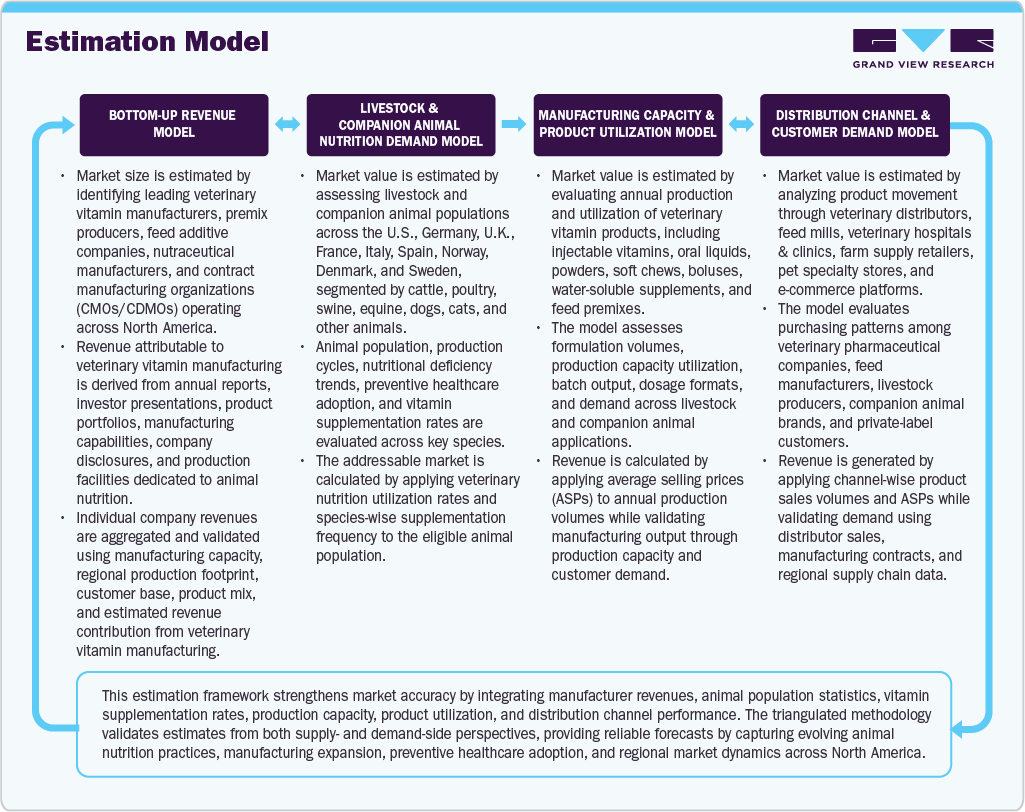
The Europe veterinary vitamin manufacturing market figures in this report are based on a proven research process that combines executive interviews with secondary research from proprietary databases, company filings, and recognized regulatory and institutional sources. Market size is built through value-chain sizing-reconciling supply-side and demand-side estimates-and triangulated with bottom-up and top-down approaches. Every estimate passes multiple levels of expert validation before publication, with each Europe veterinary vitamin manufacturing segment quantified using the revenue-capture definitions in the table below.
Segment Definition
Segment - Animal
Revenue capture definition
Companion Animals
This segment captures revenue generated from the manufacturing of veterinary vitamins formulated for pets and nonproduction animals kept primarily for companionship, including dogs, cats, horses, and small/exotic pets across Europe
Production Animals
This segment captures revenue generated from the manufacturing of veterinary vitamins intended for livestock, poultry, aquaculture, and other food-producing species where vitamin supplementation directly impacts growth performance, reproductive efficiency, and product yield across Europe
Segment - Product
Revenue capture definition
Vitamin B-Complex
This segment captures revenue generated from the manufacturing of multi-B vitamin formulations combining two or more Bgroup vitamins (e.g., B1, B2, B3, B5, B6, B7, B9) for veterinary use in energy metabolism, neurological function, and reproductive support across companion and production animals
Vitamin B12
This segment captures revenue generated from the manufacturing of cyanocobalamin and hydroxocobalamin based veterinary formulations used to support red blood cell production, neurological health, and metabolic function in companion and production animals across Europe
Vitamin K
This segment captures revenue generated from the manufacturing of Vitamin K1 (phytonadione) and Vitamin K3 (menadione) veterinary formulations used to support blood coagulation, bone metabolism, and treatment of anticoagulant toxicosis in companion and production animals
Vitamin D3
This segment captures revenue generated from the manufacturing of cholecalciferol-based veterinary formulations used to regulate calcium-phosphorus homeostasis, support bone development, and maintain immune function in companion and production animals
Other Vitamins
This segment captures revenue generated from the manufacturing of all remaining veterinary vitamin formulations not classified under B-Complex, B12, Vitamin K, or Vitamin D3, including fat-soluble vitamins (A, E) and standalone water-soluble vitamins used across companion and production animals in Europe
Segment - Type
Revenue capture definition
API (Active Pharmaceutical Ingredient)
This segment captures revenue generated from the manufacturing and supply of bulk veterinary vitamin active pharmaceutical ingredients in their pure, unformulated form, sold to downstream formulators, finished drug product manufacturers, feed premix producers, and CMO/CDMOs
Finished Drug Products
This segment captures revenue generated from the manufacturing of fully formulated, market-ready veterinary vitamin products in their final dosage form (oral, injectable), packaged and labeled for direct administration to animals or for distribution through veterinary and retail channels
Segment - Dosage Form
Revenue capture definition
Oral
This segment captures revenue generated from the manufacturing of veterinary vitamin finished drug products designed for oral administration, including tablets, capsules, powders, liquids, pastes, gels, chewables, and feed-additive premix formats for companion and production animals
Injectables
This segment captures revenue generated from the manufacturing of sterile veterinary vitamin formulations designed for parenteral administration via intramuscular, intravenous, or subcutaneous routes, used where rapid systemic availability or bypass of gastrointestinal absorption is required across companion and production animals
Segment - Value Chain
Revenue capture definition
Pharmaceutical & Biopharmaceutical Companies
This segment captures revenue generated from the in-house manufacturing of veterinary vitamin active ingredients (APIs), formulations, and finished dosage forms by animal health pharmaceutical and biopharmaceutical companies
Animal Feed & Nutrition Companies
This segment captures revenue generated from the manufacturing of vitamin premixes, fortified feed additives, nutritional supplements, and feed-grade vitamin formulations by animal feed and nutrition companies
CMO/CDMOs
This segment captures revenue generated from contract development and manufacturing activities performed by Contract Manufacturing Organizations (CMOs) and Contract Development & Manufacturing Organizations (CDMOs)
Others
This segment captures revenue generated from veterinary vitamin manufacturing activities undertaken by organizations such as veterinary nutraceutical manufacturers, private-label manufacturers, research-focused production facilities, cooperatives, and specialized manufacturing service providers across Europe
Estimation Model
 To learn more about this report, Download Free Sample Report
Delivered Customizations
This report has been delivered with the following In-depth customizations
Client Request
Customization Delivered
Value Adds
Value Chain, Manufacturing Ecosystem & Business Model Assessment
Conducted a comprehensive assessment of the Europe veterinary vitamin manufacturing ecosystem, covering raw material suppliers, vitamin API manufacturers, premix producers, contract manufacturers (CMOs/CDMOs), veterinary nutrition companies, distributors, feed manufacturers, veterinary clinics, and retail channels. Evaluated manufacturing models, sourcing strategies, production technologies, quality standards, and value creation opportunities across the supply chain.
Provides a holistic understanding of the manufacturing value chain, operational dependencies, sourcing dynamics, and revenue opportunities, enabling stakeholders to strengthen strategic positioning, identify partnership opportunities, and optimize manufacturing investments.
Pricing, Cost Structure & Manufacturing Economics Analysis
Performed a detailed evaluation of pricing trends across injectable vitamins, oral supplements, feed premixes, boluses, water-soluble formulations, and soft chews. Assessed raw material costs, production economics, packaging expenses, contract manufacturing costs, distribution margins, and pricing strategies across companion animal and livestock applications.
Supports informed pricing decisions, margin optimization, sourcing strategies, and cost management while helping manufacturers evaluate commercial viability across different product categories and customer segments.
Competitive Landscape & Manufacturing Benchmarking
Benchmarked leading veterinary vitamin manufacturers based on manufacturing capacity, formulation capabilities, product portfolio, regulatory compliance, private-label manufacturing services, geographic presence, distribution network, strategic partnerships, R&D investments, and production technologies. Compared multinational manufacturers with regional and specialty producers to identify competitive differentiation and market positioning.
Enables identification of competitive strengths, manufacturing capabilities, expansion opportunities, and strategic gaps while supporting investment planning, partnership evaluation, and long-term competitive growth strategies.
Frequently Asked Questions About This Report
Germany dominated with a 23.9% revenue share in 2025.
Spain is the fastest-growing region over the forecast period.
Key factors include the region’s well-established livestock and poultry industries, increasing focus on preventive animal healthcare, rising companion animal ownership, and growing demand for high-quality feed-grade vitamins and premixes.
The production animals segment dominated the market with a share of 58.0% in 2025, owing to the region’s established livestock, poultry, and dairy industries and the growing focus on preventive nutrition across commercial farming systems.
The finished drug products segment led the Europe veterinary vitamin manufacturing market with a 54.2% share in 2025 and is expected to grow the fastest over the forecast period.
The animal feed & nutrition companies segment accounted for the largest revenue share of 36.0% in 2025, while the CMO/CDMOs segment is estimated to grow at the fastest CAGR over the forecast period
The Europe veterinary vitamin manufacturing market size was valued at USD 310.3 million in 2025 and is estimated at USD 324.5 million for 2026.
The Europe veterinary vitamin manufacturing market is expected to grow at a CAGR of 8.3% from 2026 to 2033, reaching USD 568.4 million in 2033.
Key players include Key companies profiled Zoetis Services LLC; BASF SE; Trouw Nutrition International B.V.; Vilofoss A/S; MIAVIT GmbH; Kaesler Nutrition GmbH; Biochem Zusatzstoffe Handels- und Produktionsgesellschaft mbH; Suanfarma, S.A; Orffa Additives B.V; Denkavit Internationaal B.V; VetAgro S.p.A.; Virbac S.A; Vetoquinol S.A; Intervet International B.V; Merck & Co., Inc; Elanco Animal Health Incorporated; Phibro Animal Health Corporation; and ADM.
About the Author(s)
Animal Health Research Team
Healthcare · Animal HealthThis report was authored by the animal health research team at Grand View Research - comprising two research analysts, one senior research analyst, and one industry expert - with specialized expertise in the animal health segment of the healthcare industry. All findings are based on proprietary healthcare databases, executive interviews, and regulatory analysis, subject to internal peer review prior to publication.
Last Updated:
Speak to Analyst

Customize this report to your needs - add regions, segments, or data points, with 20% free customization.
Or view our licence options:


ISO 9001:2015 & 27001:2022 Certified
We are GDPR and CCPA compliant! Your transaction & personal information is safe and secure. For more details, please read our privacy policy.


