
- Home
- »
- Specialty Glass, Ceramic & Fiber
- »
-
Ferro Manganese Market Size & Share Report, 2026-2033GVR Report cover

Ferro Manganese Market (2026 - 2033)
Size, Share & Trends Analysis Report By Grade (High Carbon, Refined), By Application (Carbon Steel, Stainless Steel, Alloy Steel, Cast Iron, Carbon & Low Alloy Steel), By Region (North America, Europe), And Segment Forecasts
Market Size, 2025
$17.3BMarket Estimate, 2026
$18.3BMarket Forecast, 2033
$25.8BCAGR, 2026–2033
5.0%Ferro Manganese Market Summary
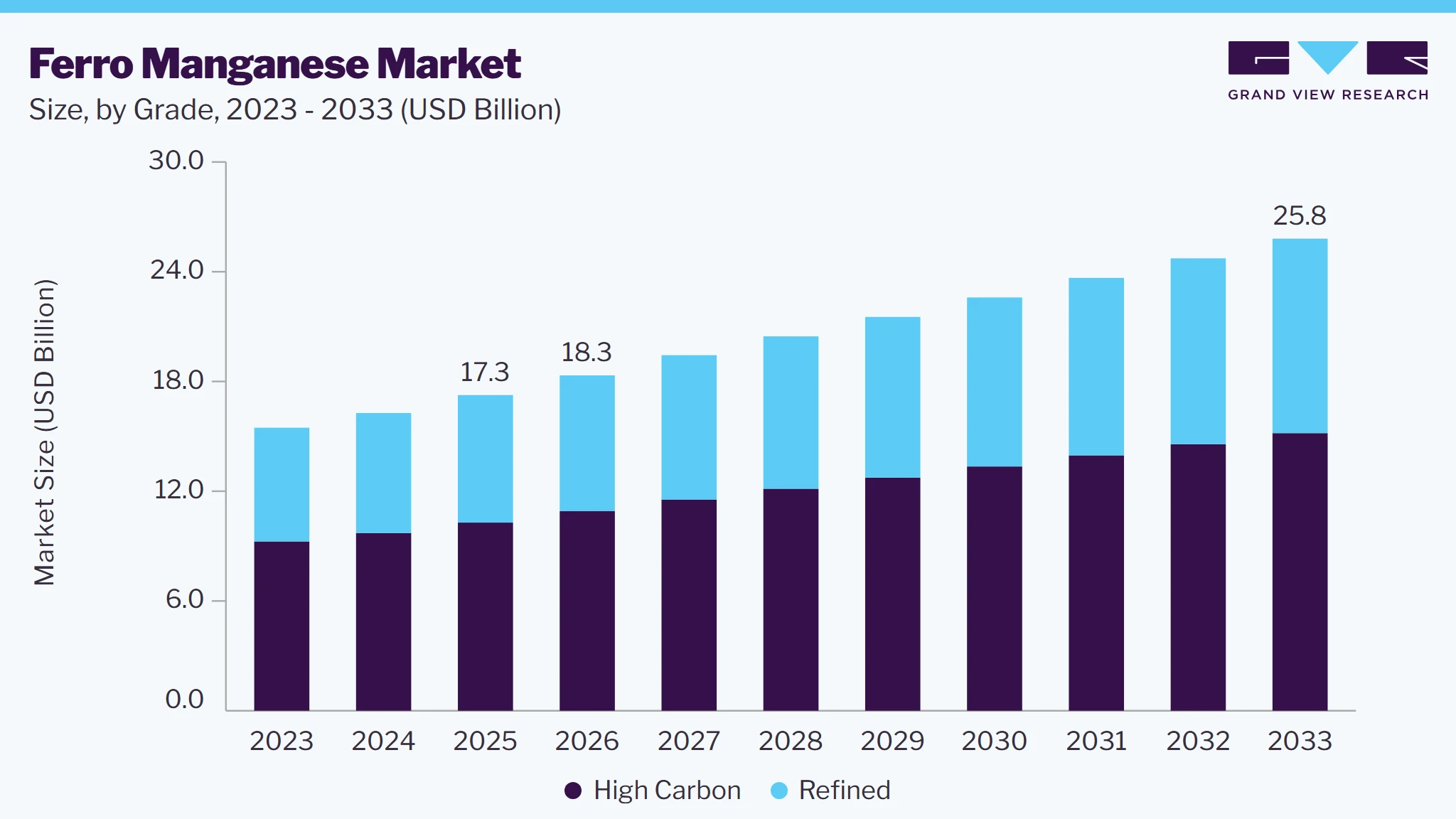
The global ferro manganese market size was valued at USD 17.3 billion in 2025 and is projected to grow from USD 18.3 billion in 2026 to USD 25.8 billion by 2033, at a CAGR of 5.0% from 2026 to 2033. The market in Asia Pacific dominated with a revenue share of 50.4% in 2025. This growth can be attributed to the rising demand for steel, particularly in construction and automotive industries, which significantly boosts ferro manganese consumption as an essential alloying element.
 Source: Grand View Research, IR Documents, Primary Interviews, Paid DatabasesTo learn more about this report,
 Download Free Sample Report
Key Market Trends & Insights
- By grade: High carbon segment held the largest market share of 59.6% in 2025.
- By application: Carbon & low alloy steel segment held the largest market share of 46.1% in 2025.
Regional Highlights
- Largest regional market: Asia Pacific (50.4% revenue share, 2025)
- Fastest-growing regional market: Latin America (highest CAGR, 2026-2033)
- By country: China held the largest market share in 2025.
Market Size & Forecast
- Market size in 2025: USD 17.3 Billion
- Estimated market size in 2026: USD 18.3 Billion
- Projected market size by 2033: USD 25.8 Billion
- CAGR (2026-2033): 5.0%
Prism AI by Grand View Research Free to tryAsk a question about the ferro manganese marketTry asking✓Every figure cited from GVR research Prefer the report? Download free sample →
In addition, industrialization and urbanization in emerging markets further enhance this demand, alongside increased infrastructure investments. Furthermore, technological advancements in production methods and a shift towards sustainable practices contribute to market growth.Ferro manganese is a ferroalloy composed primarily of manganese and iron, widely utilized in steelmaking to enhance strength and corrosion resistance. The increasing demand for stainless steel in the construction sector is significantly influencing market growth. Stainless steel is favored for its exceptional durability, corrosion resistance, and aesthetic qualities, making it ideal for various applications such as architectural cladding, handrails, and structural components such as beams and columns. Compared to concrete, its lightweight nature allows for less extensive foundations, reducing environmental impact.
 To learn more about this report, Download Free Sample Report
In addition, as urbanization accelerates globally, the construction industry increasingly relies on stainless steel for bridges and other infrastructure projects. This trend is further supported by the automotive industry's rising demand for high-strength steel, which also utilizes ferro manganese as a key ingredient. Furthermore, the automotive sector's focus on safety and performance standards drives the need for durable materials, enhancing the overall demand for ferro manganese.
Moreover, advancements in production technologies and a growing emphasis on sustainability are propelling the use of stainless steel. Stainless steel's versatility in both structural integrity and design appeal makes it a preferred choice among architects and engineers. As these industries continue to expand, the reliance on ferro manganese in producing high-quality stainless steel will likely increase, further stimulating market growth.
Market Dynamics
The primary growth driver of the ferro manganese market is the steady expansion of global steel production, as ferro manganese is an essential alloying and deoxidizing agent used in manufacturing carbon steel, alloy steel, and stainless steel. It enhances the strength, hardness, wear resistance, and toughness of steel while improving its resistance to impurities during the steelmaking process. Since nearly 85% to 90% of global manganese consumption is linked to steel production, rising demand for steel from construction, automotive, railways, shipbuilding, and heavy engineering industries continues to fuel ferro manganese consumption. Rapid industrialization and urban infrastructure development across emerging economies further strengthen the market outlook.
Rapid infrastructure and construction development is a major growth driver for the ferro manganese market, as steel remains the primary material used in buildings, bridges, highways, railways, airports, ports, and industrial facilities. Ferro manganese is an essential alloying material in steel production because it improves tensile strength, hardness, wear resistance, and deoxidation efficiency, making steel suitable for demanding structural applications. As governments continue to invest in urbanization, smart cities, affordable housing, and transportation networks, the demand for construction-grade and structural steel continues to rise, directly supporting ferro manganese consumption.
Developing economies across the Asia Pacific, the Middle East, Africa, and Latin America are witnessing significant infrastructure investments to support industrial growth and population expansion. Large-scale projects involving metro rail systems, renewable energy installations, industrial parks, and commercial real estate require substantial volumes of high-strength steel, increasing the need for ferromanganese during steel manufacturing. In addition, the modernization of aging infrastructure in developed economies is generating consistent demand for steel products, ensuring stable long-term growth opportunities for the ferro manganese market across both developed and emerging regions.
Volatility in manganese ore prices is a significant restraint for the ferro manganese market because manganese ore is the primary raw material used in ferro alloy production. Price fluctuations driven by mining disruptions, export policies, geopolitical tensions, transportation constraints, and shifts in global demand can substantially increase manufacturers' production costs. Since ferro manganese producers often operate on competitive margins, sudden increases in raw material prices are difficult to pass on to steelmakers, particularly under long-term supply contracts. This uncertainty affects profitability, complicates production planning, and may discourage capacity expansion, especially for small- and medium-sized producers that have limited ability to absorb rising input costs.
The increasing demand for advanced high-strength steel presents a significant opportunity for the ferro manganese market, as manganese is a critical alloying element that enhances steel's strength, toughness, wear resistance, and formability. Automotive manufacturers are increasingly adopting advanced high-strength steel to produce lighter vehicles that meet stringent fuel-efficiency and emissions regulations while maintaining high safety standards. Similarly, sectors such as construction, heavy machinery, railways, and renewable energy are utilizing high-performance steel grades to improve structural reliability and operational durability. As the production of advanced high-strength steel continues to expand globally, the demand for ferro manganese is expected to grow steadily, creating new opportunities for alloy producers to supply premium-grade materials to steel manufacturers.
Analyst Perspective
The ferro manganese market is expected to maintain steady growth, supported by the continued expansion of global steel production and rising demand for high-performance steel across the construction, automotive, railways, energy, and heavy engineering industries. Ferro manganese remains an indispensable alloying and deoxidizing material, enhancing the strength, toughness, and wear resistance of carbon, alloy, and stainless steels. Growing investments in infrastructure development, urbanization, and advanced high-strength steel are driving sustained demand, particularly across the Asia-Pacific and other emerging economies.
Grade Insights
Based on grade, high carbon segment led the market with the largest revenue share of 59.6% in 2025. This growth can be attributed to its extensive application in steel manufacturing. High carbon ferro manganese is crucial for producing flat carbon steel products in high demand across various industries, including construction and automotive. In addition, the increasing need for high-strength steel, particularly with the rise of electric vehicles and infrastructure projects, further propels its consumption. Furthermore, technological advancements in production methods enhance manganese recovery, making high-carbon ferro manganese more efficient and cost-effective.
The refined ferro manganese is expected to grow at the fastest CAGR of 5.3% over the forecast period. As industries focus on sustainability and reducing environmental impact, refined ferro manganese offers lower carbon content, making it suitable for high-performance steel applications. In addition, the growing demand for lightweight and corrosion-resistant materials in sectors such as automotive and construction drives the need for refined ferro manganese. Furthermore, advancements in metallurgical processes that improve the quality and consistency of refined ferromanganese contribute to its increasing adoption in various applications.
Application Insights
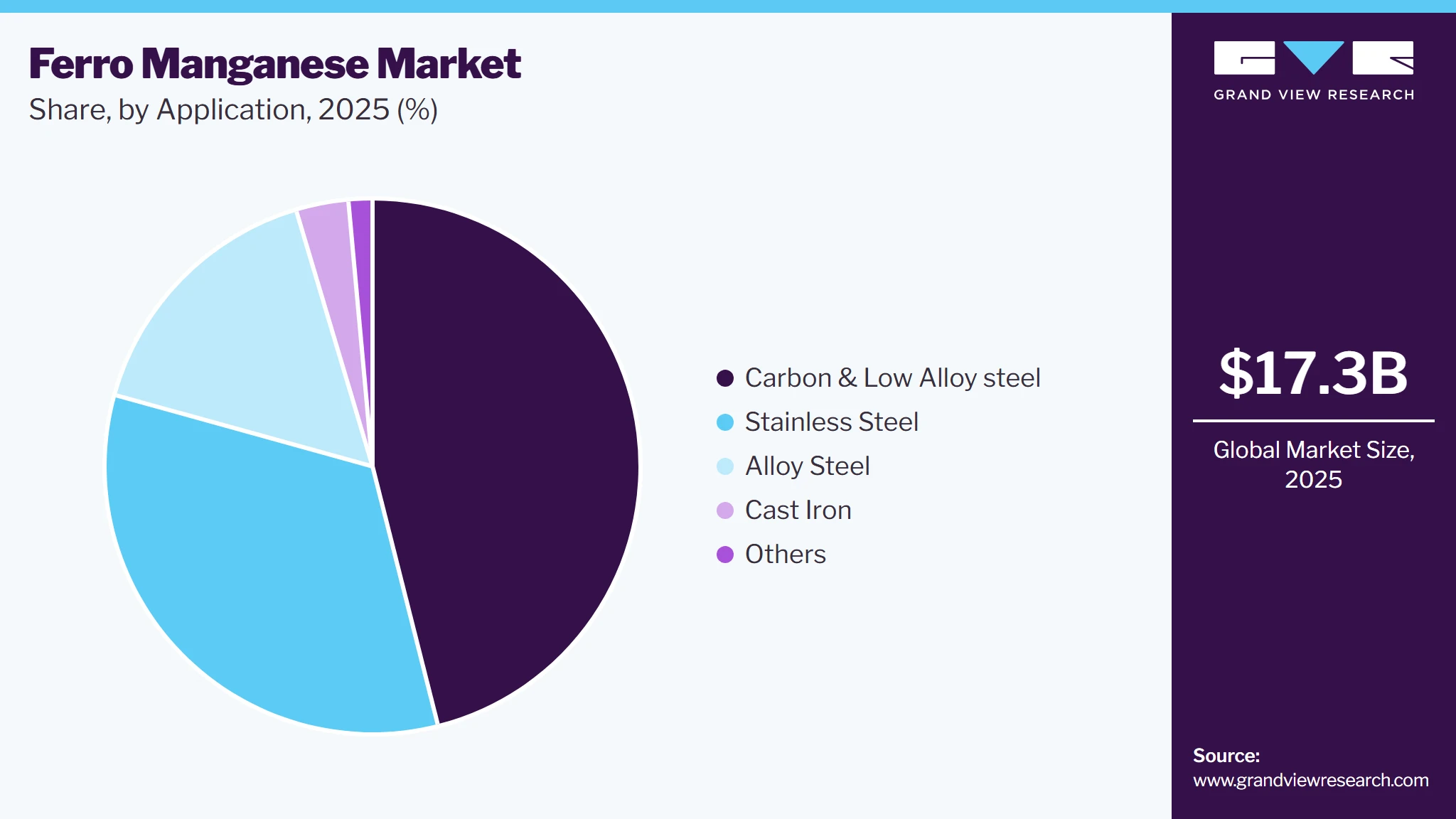
Based on application, carbon & low alloy steel segment led the market with the largest revenue share of 46.1% in 2025, primarily driven by the increasing demand for high-strength materials in various industries. In addition, carbon steel, known for its versatility and strength, is essential for the construction, automotive, and manufacturing sectors. Furthermore, as infrastructure projects expand and urbanization continues, the need for robust carbon steel products rises, directly boosting the consumption of ferro manganese as a critical alloying agent.
 To learn more about this report, Download Free Sample Report
The cast iron is expected to grow at the fastest CAGR of 5.8% from 2026 to 2033, owing to its applications in automotive components, machinery, and construction materials. Its durability and excellent casting properties make it a preferred choice in manufacturing heavy-duty products. In addition, the growing automotive industry, particularly with the shift towards electric vehicles, further enhances the need for cast iron components. Moreover, this increasing reliance on cast iron applications contributes to the overall growth of the ferro manganese market as it remains a vital ingredient in producing high-quality cast iron alloys.
Regional Insights
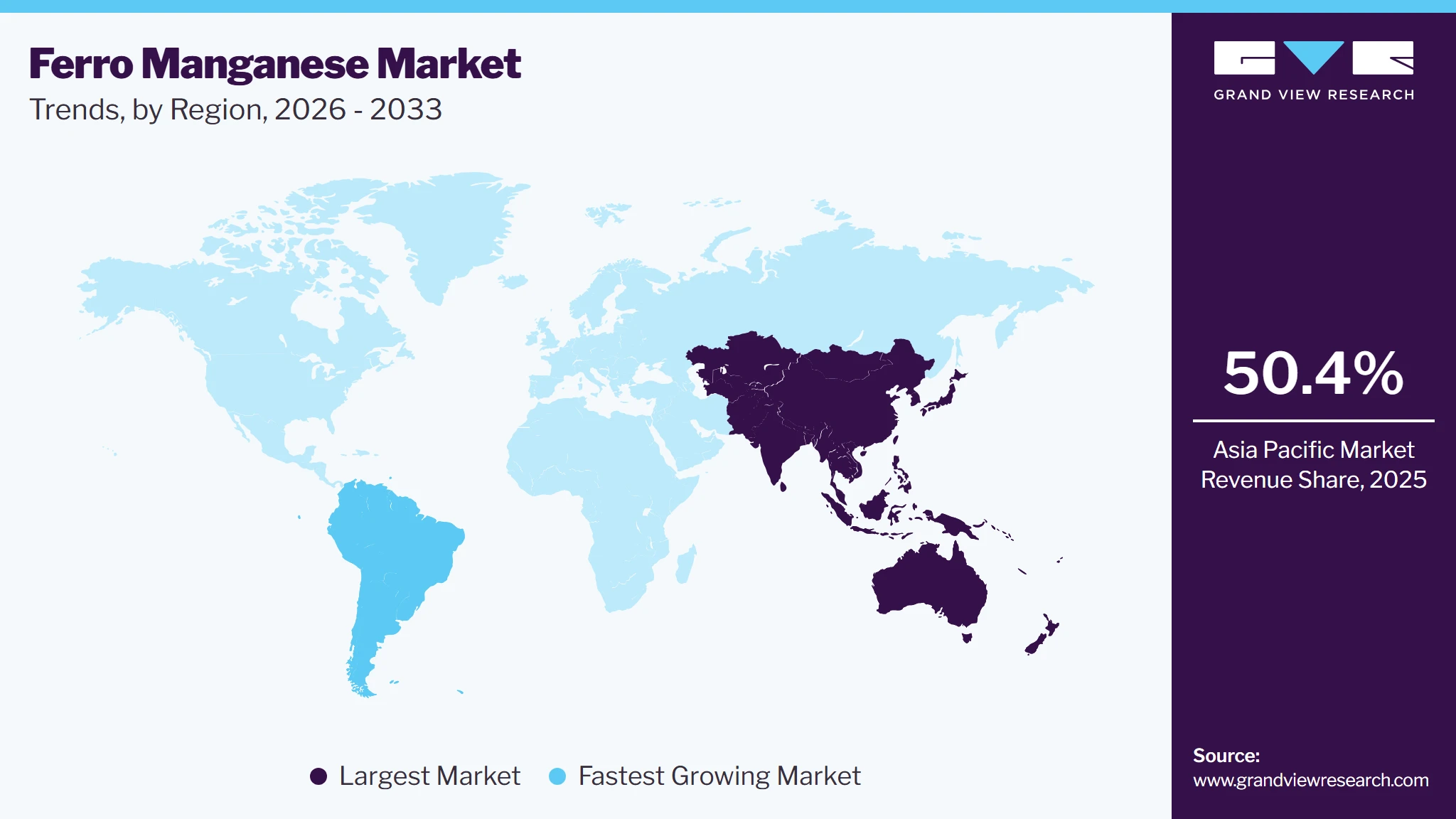
Asia Pacific dominated the ferro manganese market with the largest revenue share of 50.4% in 2025. This growth can be attributed to rapid industrialization and urbanization. In addition, the region is the largest producer of steel, with increasing investments in infrastructure and construction projects. Furthermore, emerging economies such as India, Indonesia, and Vietnam are expanding their manufacturing capabilities, leading to higher demand for ferro manganese as a crucial alloying agent in steel production. This trend is expected to continue, further enhancing market growth.
 To learn more about this report, Download Free Sample Report
China Ferro Manganese Market Trends
The ferro manganese market in the China held the largest share in the Asia Pacific region in 2025, owing to its status as the world's largest steel producer and consumer. In addition, the country's ongoing infrastructure development and urbanization drive substantial demand for steel products, which directly increases the need for ferro manganese. Furthermore, government initiatives aimed at boosting domestic manufacturing capabilities further support this growth.
North America Ferro Manganese Market Trends
North America ferro manganese market growth is expected to be driven by robust demand from the construction and automotive industries. In addition, the ongoing recovery of infrastructure projects post-pandemic has increased the requirement for high-quality steel products. Furthermore, advancements in manufacturing technologies have enhanced the efficiency of ferro manganese production, making it more accessible to domestic industries. Moreover, as electric vehicle production ramps up, the need for high-strength alloys will further stimulate market growth in this region.
U.S. ferro manganese market dominated North America and accounted for the largest revenue share in 2025, which can be attributed to the expanding steel industry, which relies on ferro manganese as a crucial alloying element to enhance steel's strength and durability. In addition, increasing urbanization and infrastructure development projects are fueling demand for steel products. Furthermore, the automotive sector's growth, particularly in electric vehicles, also boosts ferro manganese consumption. Moreover, rising investments in renewable energy infrastructure are creating new opportunities for ferro manganese applications in specialized steel alloys used in wind turbine manufacturing.
Latin America Ferro Manganese Market Trends
The Latin America ferro manganese market is expected to grow at the fastest CAGR of 6.5% over the forecast period, driven by increasing investments in mining and metallurgy. Countries such as Brazil are enhancing their steel production capabilities, driven by both domestic consumption and export opportunities. In addition, the region's rich mineral resources provide a solid foundation for ferro manganese production while growing construction and automotive sectors contribute to rising demand. Furthermore, as infrastructure projects expand across Latin America, the need for ferro manganese as an essential alloying element will continue to grow.
Europe Ferro Manganese Market Trends
The ferro manganese market in Europe is expected to grow significantly over the forecast period, primarily due to the rising demand for high-strength steel in various industries, including automotive and construction. In addition, the shift towards electric vehicles has intensified the need for lightweight materials, making ferro manganese increasingly important in steel production. Furthermore, European countries are investing in sustainable manufacturing practices, which further drives the demand for refined ferro manganese as industries aim to reduce their carbon footprints.
Germany ferro manganese market dominated the European market and accounted for the largest revenue share in 2025. The country's focus on innovation and sustainability has led to increased demand for high-performance steel products that require ferro manganese as a vital component. Furthermore, as Germany transitions towards more environmentally friendly technologies, the need for advanced materials will likely boost the consumption of ferro manganese in various applications.
Key Ferro Manganese Company Insights
Key players in the global ferro manganese industry include Monet Group, Tata Steel, Vale, and others. These players are adopting various strategies to enhance their competitive edge. These include investing in advanced production technologies to improve efficiency and reduce costs. In addition, companies are focusing on expanding their product portfolios to include specialty alloys that cater to specific industry needs. Furthermore, strengthening supply chain integration and forming strategic partnerships are crucial tactics employed to ensure a consistent supply of raw materials and effectively penetrate emerging markets.
-
Monnet Group manufactures essential alloys such as ferromanganese, silico-manganese, and ferrochrome, which are critical for steelmaking processes. The company operates within the ferroalloys segment, focusing on providing high-quality materials that serve as deoxidizing agents and alloying elements in steel production. Their diverse product portfolio caters to the demands of different industries, ensuring a robust presence in the global market.
-
Eramet Group produces high-quality ferro manganese and other alloys essential for steel manufacturing. The company operates primarily in the mining and metallurgical segments, leveraging its extensive expertise to supply critical materials used in various applications, including stainless steel and specialty alloys.
Key Ferro Manganese Companies:
The following key companies have been profiled for this study on the ferro manganese market.
-
Monet Group
-
Tata Steel
-
Gulf Manganese Corporation Limited
-
Vale
-
Eurasian Resources Group
-
Ferroglobe
-
China Minmetals Group Co., Ltd.
-
Eramet Group
-
South32
-
OM Holdings Ltd.
Competitive Benchmarking
Category
Operating Strategies
Competitive Edge
Weakness
Established Players (e.g. Tata Steel, Vale, Eurasian Resources Group)
- Mature participants in the ferromanganese market primarily focus on vertically integrated operations that encompass manganese ore sourcing, ferroalloy production, and long term supply agreements with carbon steel, stainless steel, and alloy steel manufacturers.
- These companies emphasize securing reliable raw material supplies through captive mining operations or strategic procurement contracts while optimizing smelting efficiency using modern submerged arc furnaces.
- Established players possess significant competitive advantages through their integrated manganese ore supply chains, large scale ferroalloy production facilities, and extensive metallurgical expertise.
- Their ability to manufacture ferromanganese consistently at high volumes enables lower production costs, stable product quality, and reliable supply for major steel producers.
- Despite their strong market positions, mature players face challenges related to high energy consumption and fluctuations in manganese ore and electricity prices.
- Ferromanganese production is highly energy intensive, making profitability sensitive to rising electricity tariffs and fuel costs.
Emerging & Regional Players (e.g., Monet Group, Gulf Manganese Corporation Limited)
- Emerging participants in the ferromanganese market generally focus on regional production expansion, operational efficiency, and specialized ferroalloy products.
- Rather than competing directly with established producers on production scale, these companies target growing regional steel industries through localized manufacturing and flexible supply capabilities.
- Emerging companies benefit from operational flexibility and the ability to establish production facilities using modern smelting technologies without the limitations of legacy infrastructure.
- Their newer plants often incorporate energy efficient furnaces, digital process monitoring, and automated quality control systems, improving productivity and reducing operating costs.
- Emerging participants face significant challenges related to limited production capacity, restricted access to manganese ore resources, and lower economies of scale.
- Competing against established ferroalloy manufacturers with integrated mining operations and extensive global distribution networks can be difficult, particularly during periods of raw material price volatility.
Recent Developments
-
In December 2024, Eramet updated its 2024 targets for manganese activities in Gabon, focusing on increasing the production of ferromanganese. The company aims to enhance its operational efficiency and expand its market presence amid rising demand for manganese products. Furthermore, Eramet is adjusting its nickel activities in Indonesia to align with strategic goals. These revisions reflect the company's commitment to optimizing resource management while responding to evolving market conditions in the ferro manganese sector.
-
In October 2024, OM Holdings announced a collaboration with South32 to initiate a ferroalloy slag repurposing project. This initiative aimed to enhance sustainability in the ferro manganese industry by recycling waste materials from ferroalloy production. The partnership seeks to develop innovative methods for repurposing slag, thereby reducing environmental impact and promoting resource efficiency. This project highlights the commitment of both companies to advance sustainable practices within the ferro manganese sector while contributing to a circular economy.
Ferro Manganese Market Report Scope
Report Attribute
Details
Market definition
The market size represents the annual value of the apparent consumption of ferro manganese across various applications during a particular year.
Market size in 2025
USD 17.3 billion
Estimated market size in 2026
USD 18.3 billion
Projected market size by 2033
USD 25.8 billion
Growth rate
CAGR of 5.0% from 2026 to 2033
Base year for estimation
2025
Historical data
2021 - 2024
Forecast period
2026 - 2033
Quantitative units
Revenue in USD million, volume in kilotons, and CAGR from 2026 to 2033
Report coverage
Revenue forecast, volume forecast, company ranking, competitive landscape, growth factors, and trends
Segments covered
Grade, application, and region.
Regional scope
North America; Europe; Asia Pacific; Latin America; Middle East & Africa
Country scope
U.S., Canada, Mexico, Germany, France, India, China, Japan, South Korea, Brazil
Key companies profiled
Monet Group; Tata Steel; Gulf Manganese Corporation Limited; Vale; Eurasian Resources Group; Ferroglobe; China Minmetals Group Co., Ltd.; Eramet Group; South32; OM Holdings Ltd.
Customization scope
Free report customization (equivalent up to 8 analysts' working days) with purchase. Addition or alteration to country, regional & segment scope.
Pricing and purchase options
Avail customized purchase options to meet your exact research needs. Explore purchase options
Global Ferro Manganese Market Report Segmentation
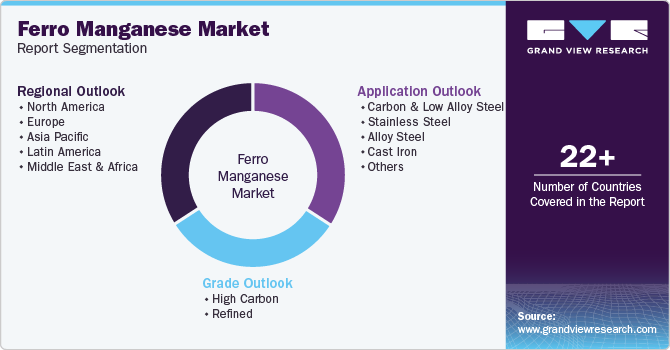
This report forecasts revenue growth at global, regional, and country levels and analyzes the latest industry trends in each sub-segment from 2021 to 2033. For this study, Grand View Research has segmented the global ferro manganese market report based on grade, application, and region.
 To learn more about this report, Download Free Sample Report
-
Grade Outlook (Volume, Kilotons; Revenue, USD Million, 2021 - 2033)
-
High Carbon
-
Refined
-
-
Application Outlook (Volume, Kilotons; Revenue, USD Million, 2021 - 2033)
-
Carbon & Low Alloy steel
-
Stainless Steel
-
Alloy Steel
-
Cast Iron
-
Others
-
-
Regional Outlook (Volume, Kilotons; Revenue, USD Million, 2021 - 2033)
-
North America
-
U.S.
-
-
Europe
-
Germany
-
UK
-
France
-
-
Asia Pacific
-
China
-
India
-
Japan
-
-
Latin America
-
Brazil
-
-
Middle East and Africa
-
Research Methodology
The ferro manganese market figures in this report are based on a proven research process that combines executive interviews with secondary research from proprietary databases, company filings, and recognized regulatory and institutional sources. Market size is built through value-chain sizing - reconciling supply-side and demand-side estimates - and triangulated with bottom-up and top-down approaches. Every estimate passes multiple levels of expert validation before publication, with each ferro manganese segment quantified using the revenue-capture definitions in the table below.
Segment Definition
Grade
Revenue Capture Definition
High Carbon
Revenue in the high carbon ferro manganese segment is generated through the sale of alloys containing high manganese and carbon content, primarily used as deoxidizers and alloying agents in carbon steel and alloy steel production.
Refined
Revenue in the refined ferro manganese segment is derived from low carbon and medium carbon ferro manganese products used in specialty steels, stainless steel, and high quality engineering applications.
Application
Revenue Capture Definition
Carbon & Low Alloy steel
Revenue in this segment is generated from the use of ferro manganese as an essential alloying and deoxidizing material in the production of carbon and low alloy steels.
Stainless Steel
Revenue is derived from the consumption of refined ferro manganese in stainless steel manufacturing, where it enhances strength, toughness, and corrosion resistance while supporting precise alloy composition.
Alloy Steel
Revenue in the alloy steel segment is generated through the use of ferro manganese to improve hardness, wear resistance, tensile strength, and machinability in specialty steel grades.
Cast Iron
Revenue is captured from the use of ferro manganese in cast iron production to control sulfur content, improve casting quality, and enhance mechanical properties.
Others
This segment includes applications such as welding consumables, foundry products, and specialized metallurgical processes where ferro manganese is used as an alloying or deoxidizing agent.
Estimation Model
Layer Name
Key Question
Description
Steel Production Demand Base Layer
What forms the demand base?
Identify global crude steel production across carbon steel, alloy steel, stainless steel, and cast iron manufacturing. Assess demand from major steel consuming industries including construction, automotive, machinery, shipbuilding, energy, and infrastructure. This layer establishes the total addressable demand for ferromanganese used as a deoxidizer and alloying agent in steel production.
Ferromanganese Application Penetration Layer
Where is ferromanganese utilized?
Estimate the penetration of ferromanganese across key steelmaking applications including carbon steel, low alloy steel, stainless steel, cast iron, and specialty steel production. Analyze the adoption of high carbon ferromanganese, medium carbon ferromanganese, and refined ferromanganese across steel plants and foundries in different regions.
Ferromanganese Consumption Intensity Layer
How much ferromanganese is consumed?
Analyze ferromanganese consumption intensity based on steel production volumes, alloy composition requirements, manganese addition rates, and metallurgical processes. Evaluate consumption across blast furnace, basic oxygen furnace, electric arc furnace, and foundry operations. Consumption intensity varies according to steel grade, product specifications, and manufacturing technology.
Revenue Layer
How is market revenue generated?
Market revenue is quantified through the sale of high carbon, medium carbon, and refined ferromanganese supplied to steel manufacturers and foundries. Revenue generation is driven by global steel production, manganese ore prices, alloy grade premiums, production costs, and demand from construction, automotive, industrial manufacturing, and infrastructure sectors. Market value is influenced by raw material availability, steelmaking activity, and regional supply demand dynamics.
Delivered Customizations
This report has been delivered with the following In-depth customizations
Client Request
Customization Delivered
Value Adds
Regional Segmentation
Detailed regional analysis of the ferromanganese market across North America, Europe, Asia Pacific, Latin America, and Middle East & Africa. Included evaluation of crude steel production, manganese ore availability, ferroalloy production capacities, stainless steel manufacturing, alloy steel demand, infrastructure investments, and government policies affecting ferroalloy production and consumption.
Identified high growth steel manufacturing hubs and emerging ferroalloy demand centers. Enabled strategic expansion planning based on steel production growth, industrialization, and infrastructure development. Supported regional demand forecasting and supply chain optimization.
Cross Segmentation
Comprehensive cross segmentation analysis by grade, application, and region, including high carbon ferromanganese and refined ferromanganese consumption across carbon & low alloy steel, stainless steel, alloy steel, cast iron, and other metallurgical applications. Evaluated regional consumption trends, alloying requirements, steel production technologies, and demand patterns across key end use industries.
Enabled identification of the most attractive grade application combinations and high growth demand segments. Supported product portfolio optimization, customer targeting, and investment prioritization strategies.
Opportunity Assessment
Identification of high growth opportunities across carbon steel production, stainless steel manufacturing, alloy steel development, infrastructure construction, automotive manufacturing, railway expansion, renewable energy infrastructure, and green steel production. Assessed future demand potential driven by increasing steel consumption, urbanization, industrialization, investments in electric arc furnace steelmaking, and modernization of ferroalloy production technologies.
Enabled prioritization of high return growth segments and emerging regional opportunities. Supported long term investment planning, production capacity expansion, technology upgrades, and strategic business development initiatives aligned with evolving global steel industry requi
Frequently Asked Questions About This Report
Asia Pacific dominated the market with revenue share of 50.4% in 2025.
Latin America is anticipated to register the fastest CAGR over the forecast period.
Based on grade, high carbon accounted for largest revenue share of 59.6% in 2025.
Based on application, carbon & low alloy steel accounted for largest revenue share of 46.1% in 2025.
Some of the key vendors in the global ferro manganese market are Monet Group; Tata Steel; Gulf Manganese Corporation Limited; Vale; Eurasian Resources Group; Ferroglobe; China Minmetals Group Co., Ltd.; Eramet Group; South32; OM Holdings Ltd.
The global ferro manganese market size was valued at USD 17.3 billion in 2025 and is estimated at USD 18.3 billion for 2026.
The growth of the ferro manganese market is primarily driven by increasing steel production, rising demand for high strength and alloy steels, expanding infrastructure and construction activities, growing automotive manufacturing, and continuous investments in industrial and metallurgical development across emerging economies.
China dominated the Asia Pacific market with revenue share of 62.9% in 2025.
The global ferro manganese market is expected to grow at a CAGR of 5.0% from 2026 to 2033, reaching USD 25.8 billion by 2033.
About the Author(s)
Specialty Glass, Ceramic & Fiber Research Team
Advanced Materials · Specialty Glass, Ceramic & FiberThis report was authored by the specialty glass, ceramic & fiber research team at Grand View Research - comprising two research analysts, one senior research analyst, and one industry expert - with specialized expertise in the specialty glass, ceramic & fiber segment of the advanced materials industry. All findings are based on proprietary advanced materials databases, executive interviews, and regulatory analysis, subject to internal peer review prior to publication.
Last Updated:
Speak to Analyst

Customize this report to your needs - add regions, segments, or data points, with 20% free customization.
Or view our licence options:


ISO 9001:2015 & 27001:2022 Certified
We are GDPR and CCPA compliant! Your transaction & personal information is safe and secure. For more details, please read our privacy policy.


