
- Home
- »
- Agrochemicals & Fertilizers
- »
-
Fertilizer Additives Market Size & Share Report, 2026-2033GVR Report cover

Fertilizer Additives Market (2026 - 2033)
Size, Share & Trends Analysis Report By Function (Corrosion Inhibitors, Hydrophobic Agents), By End-product (Urea, Ammonium Nitrate, Ammonium Phosphate, Ammonium Sulfate), By Region, And Segment Forecasts
Market Size, 2025
$4.0BMarket Estimate, 2026
$4.1BMarket Forecast, 2033
$5.0BCAGR, 2026–2033
2.8%Fertilizer Additives Market Summary
The global fertilizer additives market size was valued at USD 4.0 billion in 2025 and is projected to grow from USD 4.1 billion in 2026 to USD 5.0 billion in 2033, at a CAGR of 2.8% from 2026 to 2033. Asia Pacific dominated the market, accounting for a revenue share of 60.0% in 2025. The market is driven by the growing demand for fertilizers. Shrinking arable land, coupled with a rising global population, has facilitated the adoption of practices that minimize waste and enhance agricultural productivity.
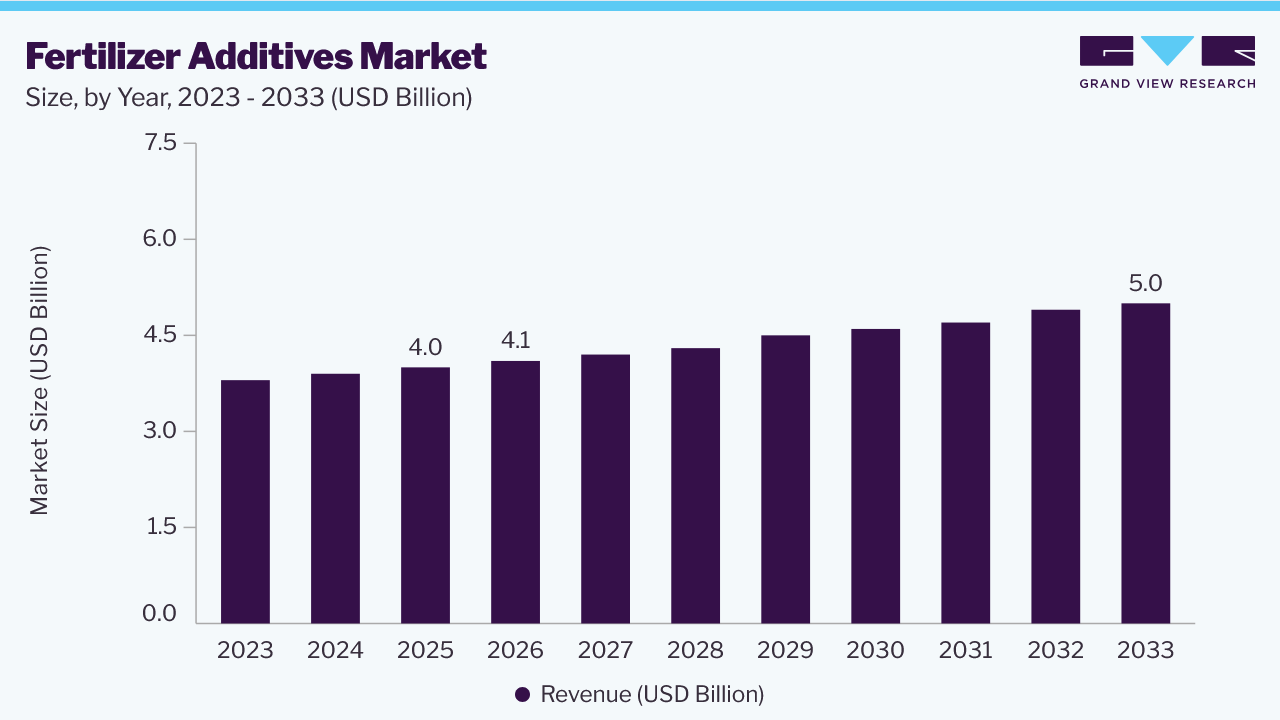 Source: Grand View Research, IR Documents, Primary Interviews, Paid DatabasesTo learn more about this report,
 Download Free Sample Report
Key Market Trends & Insights
- By function: The anti-caking segment led the market in revenue share in 2025.
- By end-product: The urea segment led the market in terms of revenue share in 2025.
Regional Highlights
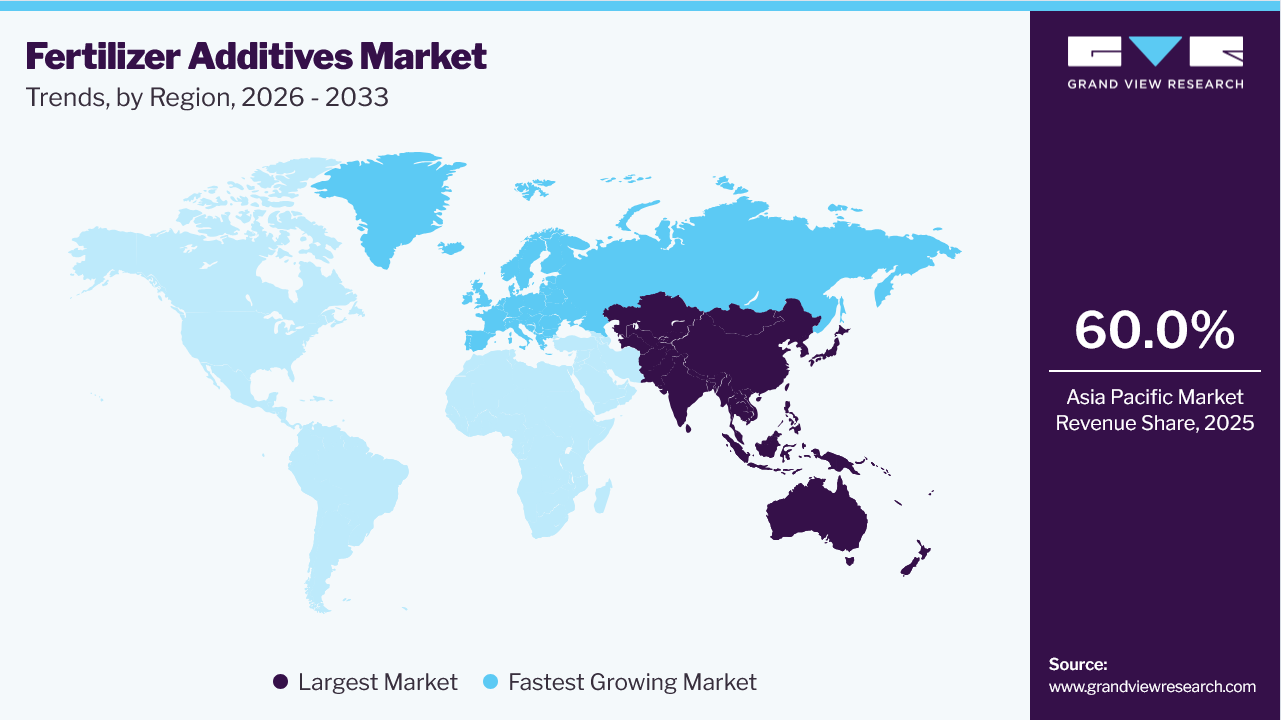
- Largest regional market: Asia Pacific (60.0% revenue share, 2025)
- Fastest-growing regional market: Europe (highest CAGR, 2026-2033)
Market Size & Forecast
- Market size in 2025: USD 4.0 Billion
- Estimated market size in 2026: USD 4.1 Billion
- Projected market size by 2033: USD 5.0 Billion
- CAGR (2026-2033): 2.8%
Three ways to get this report
Buy it, customize it, or ask a question.Ask an Analyst
Analyst response in 1 business day
- AccessReport author, directly
- Reply timeWithin 1 working day
- No sales callDirect answer only
- FormatEmail reply
- CostFree, no cost
Get the Full Report
What the study covers
- FormatsPDF · Excel · Dashboard
- Timeline2026–2033 annual, 2025 base
- Coverage20+ countries, 5 regions
- Companies10+ key players profiled
Customize the Report
20% free customization
- IncludeCountries, segments, points
- TailorTo your product definition
- ExtendDeeper competitor detail
- OrA fully bespoke study
- Turnaround5–10 working days
Fertilizer additives are chemicals added to fertilizers to improve their performance or make structural modifications. Changing agricultural practices and awareness of the quality & quantity of fertilizers are likely to drive the use of additives in the coming years.
Fertilizer additives are experiencing high global demand due to the adoption of sustainable agricultural practices in emerging economies and efforts to increase per-hectare crop yields. Companies operating in the ecosystem are investing heavily in research and development activities to enhance the quality of feed additives and make them suitable for changing agricultural practices. For instance, in February 2026, BASF and Yunnan Yuntianhua extended their partnership on urease inhibitor-based fertilizer additives to improve nitrogen efficiency and reduce environmental emissions, supporting large-scale adoption of stabilized fertilizers in emerging agricultural markets.
The major distribution channels present in the market are direct supply agreements and third-party distribution channels. Direct supply agreements are gaining importance as end-users enter into purchase agreements with manufacturers to ensure uninterrupted supply. Bulk quantity discounts, as well as some offsets in logistics costs, have led end-users to prefer the direct route.
Fertilizers improve soil yield. They can be classified into two types: organic and inorganic. Manure, fish meal, granite meal, and seaweed are organic fertilizers, while nitrogen, phosphorus, and potassium are inorganic fertilizers. The ability of inorganic fertilizers to act faster than organic fertilizers is likely to fuel their growth.
Analyst Perspective
The fertilizer additives market is a structurally stable yet innovation-driven segment within the broader agrochemicals value chain, supported by rising fertilizer consumption, shrinking arable land, and increasing pressure to improve nutrient use efficiency. The market is growing at a moderate CAGR, with demand increasingly driven by sustainability regulations, enhanced-efficiency fertilizers, and the adoption of precision agriculture. Key segments such as anti-caking agents, corrosion inhibitors, coating agents, and slow-release additives are gaining traction due to their ability to improve storage stability, reduce nutrient loss, and enhance fertilizer performance, particularly in nitrogen-based fertilizers. Overall, the market is shifting from commodity chemical use to performance-driven, sustainable fertilizer solutions, reinforcing the market's long-term importance in global agriculture.
Function Insights
By function, the anti-caking segment led the market in revenue share in 2025. Anti-caking, anti-dusting, corrosion inhibitors, and anti-coating are the primary functions of fertilizer additives, with anti-caking accounting for the largest share. The segment’s growth is primarily driven by rising global fertilizer consumption and increasing demand for efficient fertilizer handling and storage solutions. This dominance is attributed to the critical role of anti-caking additives in preventing caking and agglomeration during storage, particularly in high-humidity and monsoon conditions. These additives are essential for maintaining fertilizer quality and ensuring efficient storage, handling, and transportation. In addition, anti-dusting additives play an important role in minimizing material loss and improving operational safety during fertilizer handling and distribution.
The hydrophobic agents segment, also referred to as water repellents, plays a crucial role in protecting fertilizers from atmospheric moisture and preserving product quality. The segment is driven by increasing demand for moisture-resistant fertilizers to improve storage stability and nutrient efficiency. Excess moisture can reduce the availability of essential nutrients, such as nitrogen, phosphorus, and potassium, by accelerating their degradation and loss. Hydrophobic additives help maintain fertilizer integrity, improve shelf life, and enhance performance during storage and transportation. For instance, in August 2025, ICL’s announced that its eqo.x biodegradable controlled-release fertilizer coating technology became the first biodegradable CRF coating officially certified under the EU Fertilizing Products Regulation. The technology supports controlled nutrient release, improves nutrient use efficiency, and reduces nutrient losses, while enhancing fertilizer stability and performance under varying environmental conditions.
End-Product Insights
By end product, the urea segment accounted for the largest revenue share in 2025. Urea, a nitrogen-based fertilizer, is widely used due to its high nitrogen content, cost-effectiveness, and broad availability, making it a preferred choice among farmers globally. The segment’s growth is driven by rising agricultural demand and increasing fertilizer consumption in emerging economies such as India and Brazil. For instance, in March 2026, Brazil reported rising fertilizer prices due to global supply constraints, increasing pressure on agricultural input costs. This reinforced the importance of urea as a key nitrogen fertilizer in the country’s agricultural sector. Urea is extensively used, particularly in the Asia Pacific region, owing to its affordability and effectiveness in improving crop productivity. Its widespread adoption continues to drive demand for fertilizer additives that enhance storage stability, reduce caking, and improve handling efficiency.
The ammonium nitrate segment represents a significant source of nitrogen, containing both nitrate and ammonia. It is widely used due to its high nitrogen content, cost-effectiveness, and fast nutrient availability, making it a preferred choice among farmers. The segment’s growth is supported by rising fertilizer demand in price-sensitive markets across Asia Pacific and Latin America. As the second most widely used nitrogenous fertilizer after urea, ammonium nitrate continues to witness steady demand due to its affordability and efficiency in improving crop productivity.
Ammonium phosphate is a phosphorus-rich fertilizer that provides one of the essential macronutrients required for plant growth. However, it is highly susceptible to moisture absorption during storage and handling. This drives demand for hydrophobic and anti-caking additives to improve product stability and prevent moisture-related degradation. The two major grades of ammonium phosphate fertilizers available in the market are ammonium polyphosphate (APP) and diammonium phosphate (DAP), which are used based on specific crop and application requirements.
Regional Insights
Asia Pacific fertilizer additives industry dominated the global market, accounting for approximately 60.0% of revenue in 2025. The demand for additives is expected to increase in emerging economies such as China and India due to growth in their agricultural sectors. Agriculture is a crucial sector that significantly contributes to the GDP of these economies, including Bangladesh, India, China, and Sri Lanka.
 To learn more about this report, Download Free Sample Report
The fertilizer additives industry in China is projected to grow at the fastest CAGR during the forecast period. This growth is primarily driven by rising demand for efficient nutrient management solutions, improving crop productivity, and increasing focus on sustainable agricultural practices. For instance, in March 2026, Clariant introduced advanced agricultural formulation technologies at CAC 2026, focused on improving stability, biological compatibility, and dispersion performance in crop protection and fertilizer applications, highlighting growing innovation-driven demand for efficient and sustainable agricultural inputs in the Asia-Pacific region. Innovative market-based nutrient sources are used under specific soil and plant conditions to trigger specific responses that improve plant growth and productivity. Due to repeated cropping without sufficient time for the soil to regain its fertility, soils in the Asia-Pacific are becoming unsuitable for cultivation. The market is expected to be driven by the need to provide timely nutrition with a low environmental impact.
Europe Fertilizer Additives Market Trends
The fertilizer additives industry in Europe is projected to grow at a significant CAGR during the forecast period. The market growth in Europe is primarily driven by factors such as the rising focus on sustainability, preference for organic and bio-based agricultural produce, the presence of key chemical manufacturers, and high emphasis on maintaining soil health in countries such as Germany, France, and the UK, which will lead to the market growth during the forecast period. Stringent environmental regulations and increasing adoption of sustainable farming practices are further supporting demand for performance-enhancing fertilizer additives. For instance, in June 2026, the European Parliament introduced regulatory measures to simplify and strengthen chemical- and fertilizer-related rules, reinforcing the region’s focus on sustainable agricultural inputs, environmental protection, and improved product safety standards across the fertilizer value chain.
The Germany fertilizer additives industry is anticipated to grow at a substantial CAGR during the forecast period. Repeated cropping without allowing the soil to regain fertility makes European soils unsuitable for cultivation. However, the product can provide timely nutrition to the soil while having a lower environmental impact. These factors are expected to drive market growth, thereby increasing demand for the product.
North America Fertilizer Additives Market Trends
The fertilizer additives market in North America is projected to grow at a significant CAGR during the forecast period. Urea and ammonium nitrate were the most popular fertilizers in this region in 2025. Crop management planning has become a crucial part of the governments of countries across the region, which is likely to positively impact market growth during the forecast period.
U.S. Fertilizer Additives Market Trends
The fertilizer additives industry in the U.S. is projected to grow at the fastest CAGR during the forecast period. The need for fertilizer additives may increase with the adoption of precision technologies in farming, as recommended fertilizer rates are applied more precisely. For instance, in August 2025, Koch Agronomic Services expanded the application of its OPTRIENT nutrient management solutions across additional U.S. row and specialty crops to improve nitrogen utilization and overall crop performance. The company also strengthened its portfolio of enhanced-efficiency fertilizers, reflecting growing adoption of advanced nutrient management solutions in North America. Controlled-release fertilizers (CRF) and slow-release fertilizers (SRF) are key product categories supporting this trend by improving nutrient delivery efficiency and reducing environmental impact.
Central & South America Fertilizer Additives Market Trends
The fertilizer additives industry in Central & South America is projected to grow at a significant CAGR during the forecast period. This growth is attributed to the expanding agricultural sector’s production in countries such as Brazil and Argentina. As the agricultural sector grows in this country, demand for fertilizer additives to improve crop yields and quality also increases.
The Brazil fertilizer additives industry is projected to grow at a significant CAGR during the forecast period. For instance, in February 2026, the continued expansion of soybean and corn cultivation in Brazil, with increasing agricultural land dedicated to export-oriented crop production, is driving greater demand for fertilizer technologies that enhance nutrient use efficiency and crop productivity. Brazil's agricultural industry is rapidly expanding, and it is a significant exporter of commodities such as rice, maize, soybeans, coffee, and more to global markets. The market demand in the area is expected to rise due to the increasing land area under cultivation and the growing agricultural risks posed by changing climatic conditions, such as droughts and heatwaves.
Middle East & Africa Fertilizer Additives Market Trends
The fertilizer additives industry in the Middle East & Africa is projected to grow at a significant CAGR during the forecast period. This growth is attributed to the increasing demand for sustainable agricultural practices; the need to increase crop yield and quality has led to rising demand for fertilizer additives in the region.
The Saudi Arabia fertilizer additives industry is projected to grow at the fastest CAGR during the forecast period. Saudi Arabia's demand for high yields in the agriculture sector is met by increased demand for higher-quality fertilizers and micronutrients, which in turn has had a positive influence on market growth in the region. For instance, in June 2026, Saudi Arabia continued to strengthen its agricultural sector through investments in sustainable farming and food security initiatives to enhance domestic crop production and resource efficiency. The country's increasing emphasis on advanced agricultural practices is driving demand for high-quality fertilizers and nutrient management solutions, creating favorable opportunities for fertilizer additives that improve fertilizer performance and crop productivity.
Key Fertilizer Additives Market Company Insights
Some of the key players operating in the market include Clariant AG and KAO Corporation, among others.
- Clariant is a Switzerland-based specialty chemical manufacturing company. It operates through four major business segments, namely care chemicals, catalysis, natural resources, and plastics & coatings. These segments cover various product categories such as additives, catalysts, functional minerals, industrial & consumer specialties, masterbatch, oil & mining services, and pigments, and cater to over 21 end-use industries worldwide.
- Kao Corporation is a Japan-based manufacturer and distributor of consumer goods and industrial products. It operates through five major business segments: chemicals, fabric & home care, cosmetics, skin & hair care, and human health care.
Arkema and CHEMIPOL, S.A., among others, are emerging market participants in the global market.
- Arkema is a specialty materials company offering advanced chemical solutions across multiple industries, including agriculture, coatings, adhesives, and industrial applications. The company provides specialty additives and performance materials that support fertilizer processing, coating, and efficiency enhancement applications globally. It operates through an extensive international footprint across Europe, North America, Asia-Pacific, and other regions.
- CHEMIPOL, S.A. is a manufacturer and supplier of biocides, additives, and process chemicals. The company offers its products to various end-use industries, including agrochemicals, emulsions & adhesives, fuel, household products, metalworking fluids, paints & coatings, paper, personal care, and water treatment.
Key Fertilizer Additives Companies
The following key companies have been profiled for this study on the fertilizer additives market .
-
Clariant
-
KAO Corporation
-
Dorf Ketal
-
Solvay
-
Arkema
-
CHEMIPOL, S.A.
-
Cameron Chemicals
-
Michelman, Inc.
-
Tolsa, S.A.
-
ChemSol, LLC
Recent Developments
- In March 2026, OCI Global completed the handover of its Beaumont New Ammonia (BNA) facility in Texas to Woodside following successful performance testing and operational readiness activities. The world-scale ammonia plant, with a capacity of up to 1.1 million metric tons per year, marks a significant milestone in expanding global ammonia production and supporting the transition toward lower-carbon ammonia solutions.
Fertilizer Additives Market Report Scope
Report Attribute
Details
Market size in 2025
USD 4.0 billion
Estimated market size in 2026
USD 4.1 billion
Projected market size by 2033
USD 5.0 billion
Growth rate
CAGR of 2.8% from 2026 to 2033
Base year for estimation
2025
Actual data
2021 – 2024
Forecast period
2026 – 2033
Quantitative units
Revenue in USD million/billion, volume in kilo tons, and CAGR from 2026 to 2033
Report coverage
Revenue forecast, company ranking, competitive landscape, growth factors, and trends
Segments covered
Function, end-product, region
Regional Scope
North America; Europe; Asia Pacific; Central & South America; Middle East & Africa
Country Scope
U.S.; Canada; Mexico; Germany; UK; France; Italy; Spain; China; India; Japan; South Korea; Brazil; Argentina; South Africa; Saudi Arabia
Key companies profiled
Clariant; KAO Corporation; Dorf Ketal; Solvay; Arkema; CHEMIPOL, S.A.; Cameron Chemicals; Michelman, Inc.; Tolsa, S.A.; ChemSol, LLC.
Customization scope
Free report customization (equivalent up to 8 analysts working days) with purchase. Addition or alteration to country, regional & segment scope.
Pricing and purchase options
Avail of customized purchase options to meet your exact research needs. Explore purchase options
Fertilizer Additives Market Report Segmentation
This report forecasts revenue growth at global, regional, and country levels and provides an analysis of the latest industry trends and opportunities in each of the sub-segments from 2021 to 2033. For this study, Grand View Research has segmented the global fertilizer additives market report based on function, end-product, and region:
-
Function Outlook (Volume, Kilotons; Revenue, USD Billion, 2021 - 2033)
-
Corrosion Inhibitors
-
Hydrophobic Agents
-
Anti-dusting Agents
-
Anti-caking Agent
-
Slow-Release Coatings
-
Urea
-
Ammonium Nitrate
-
Ammonium Phosphate
-
Others
-
-
Others
-
-
End-Product Outlook (Volume, Kilotons; Revenue, USD Billion, 2021 - 2033)
-
Urea
-
Ammonium Nitrate
-
Ammonium Phosphate
-
Ammonium Sulfate
-
Others
-
-
Regional Outlook (Volume, Kilotons; Revenue, USD Billion, 2021 - 2033)
-
North America
-
U.S.
-
Canada
-
Mexico
-
-
Europe
-
Germany
-
UK
-
France
-
Italy
-
Spain
-
-
Asia Pacific
-
China
-
India
-
Japan
-
South Korea
-
-
Central & South America
-
Brazil
-
Argentina
-
-
Middle East and Africa
-
Saudi Arabia
-
South Africa
-
-
Frequently Asked Questions About This Report
The global fertilizer additives market size was valued at USD 4.0 billion in 2025 and is estimated at USD 4.1 billion for 2026.
Key players in the market are Clariant; KAO Corporation; Dorf Ketal; Solvay; Arkema; CHEMIPOL, S.A.; Cameron Chemicals; Michelman, Inc.; Tolsa, S.A.; ChemSol, LLC., and others.
The anti-caking segment accounted for the largest revenue share in 2025.
Asia Pacific dominated with an approximately 60.0% revenue share in 2025.
The global fertilizer additives market is expected to grow at a CAGR of 2.8% from 2026 to 2033, reaching USD 5.0 billion.
About the Author(s)
Agrochemicals & Fertilizers Research Team
Bulk Chemicals · Agrochemicals & FertilizersThis report was authored by the agrochemicals & fertilizers research team at Grand View Research - comprising two research analysts, one senior research analyst, and one industry expert - with specialized expertise in the agrochemicals & fertilizers segment of the bulk chemicals industry. All findings are based on proprietary bulk chemicals databases, executive interviews, and regulatory analysis, subject to internal peer review prior to publication.
Last Updated:
Speak to Analyst

Customize this report to your needs - add regions, segments, or data points, with 20% free customization.
Or view our licence options:


ISO 9001:2015 & 27001:2022 Certified
We are GDPR and CCPA compliant! Your transaction & personal information is safe and secure. For more details, please read our privacy policy.


