
- Home
- »
- Sensors & Controls
- »
-
Fingerprint Sensor Market Size & Share Report, 2026-2033GVR Report cover

Fingerprint Sensor Market (2026 - 2033)
Size, Share & Trends Analysis Report By Type (Area & Touch Sensors, Swipe Sensors), By Technology (Capacitive, Ultrasonic, Optical, Thermal), By End-use (BFSI & Payments, Consumer Electronics), By Region, And Segment Forecasts
Market Size, 2025
$4.7BMarket Estimate, 2026
$4.9BMarket Forecast, 2033
$7.4BCAGR, 2026–2033
6.2%Fingerprint Sensor Market Summary
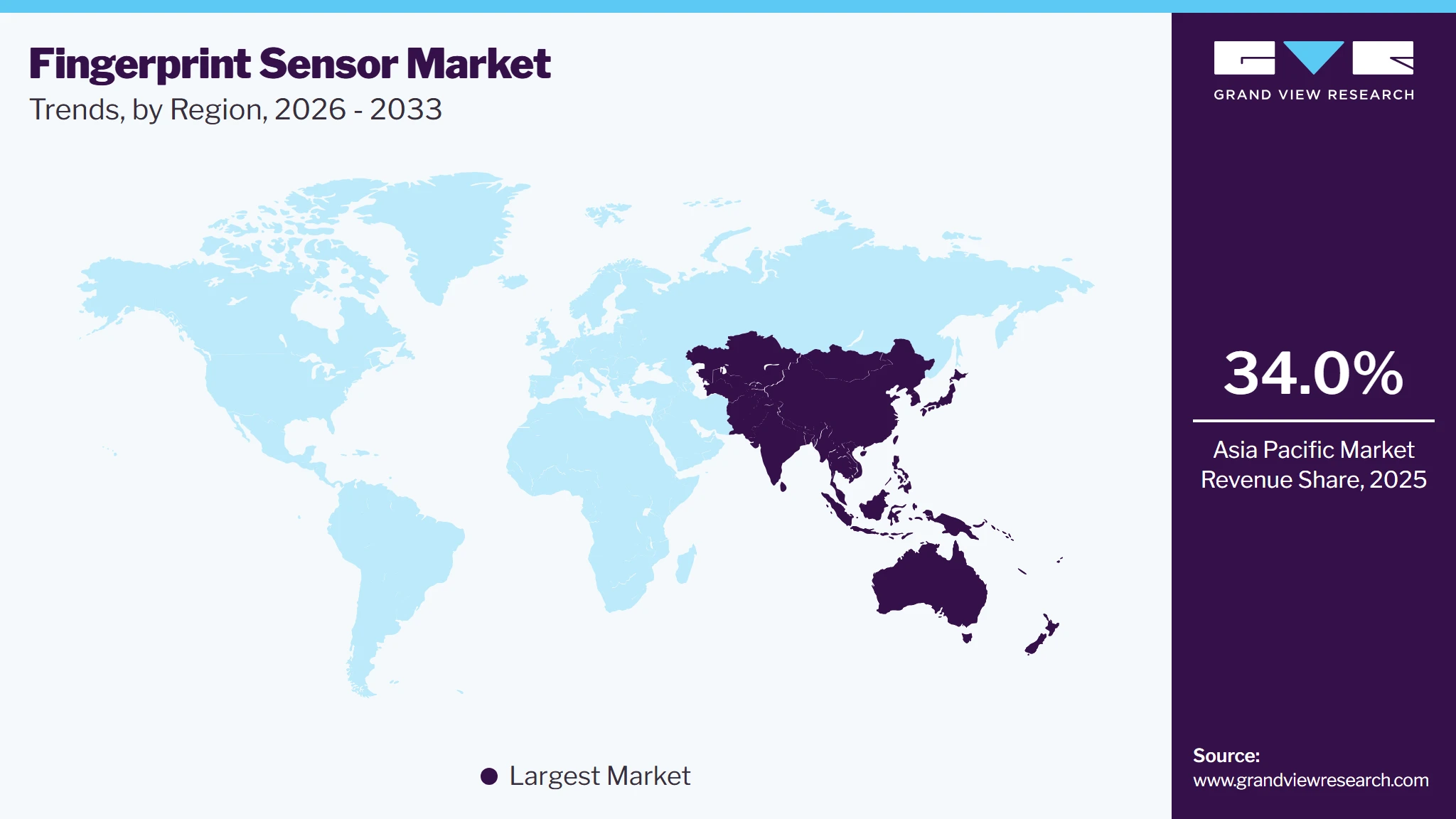
The global fingerprint sensor market size was valued at USD 4.7 billion in 2025 and is projected to grow from USD 4.9 billion in 2026 to USD 7.4 billion by 2033, at a CAGR of 6.2% from 2026 to 2033. Asia Pacific dominated the market, accounting for the largest revenue share of 34.0% in 2025. The market is driving the market due to the increasing deployment of fingerprint-based access control across offices, residential buildings, educational institutions, and industrial facilities, supporting demand for fingerprint sensors.
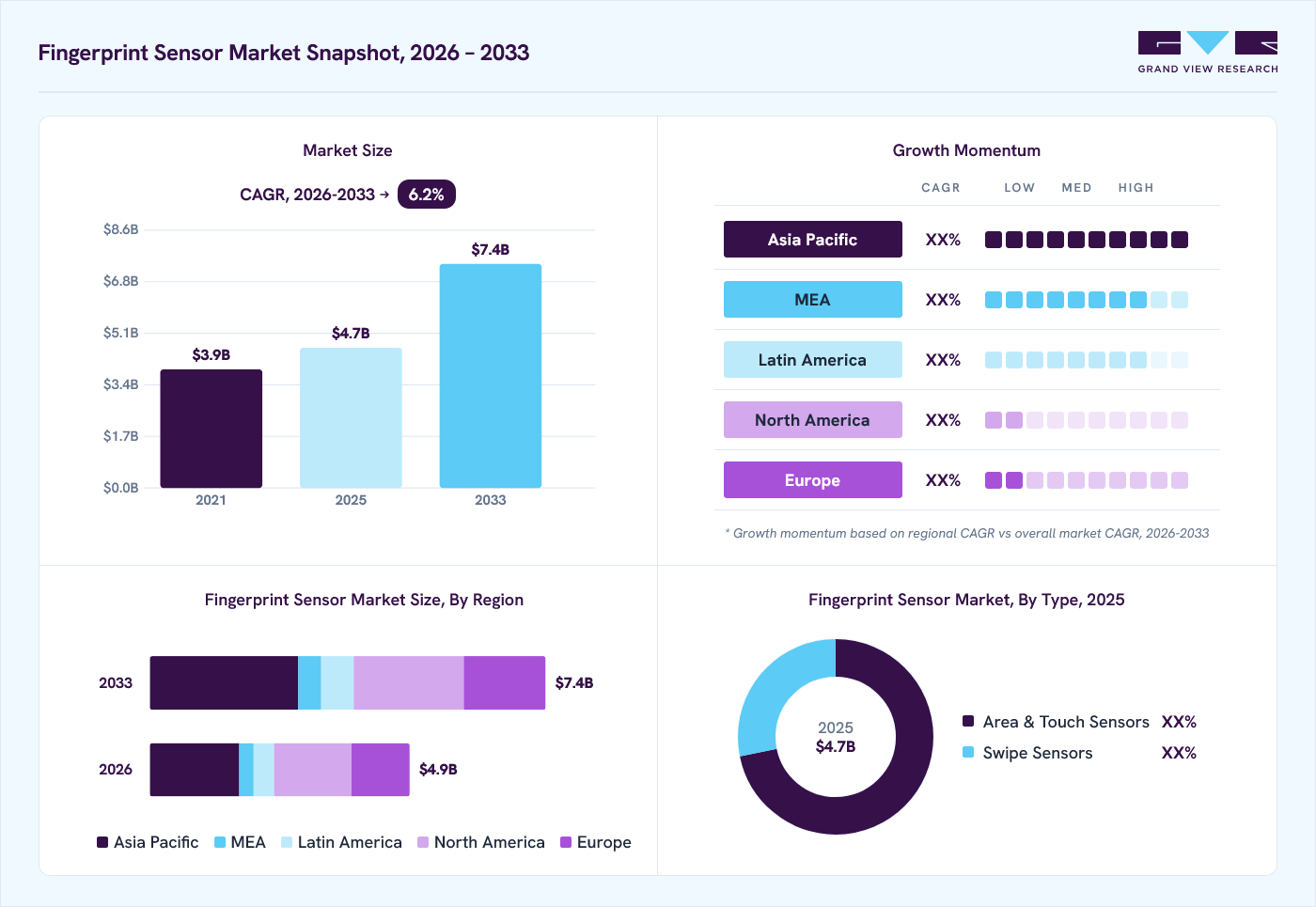 Source: Grand View Research, IR Documents, Primary Interviews, Paid DatabasesTo learn more about this report,
 Download Free Sample Report
Key Market Trends & Insights
- By type: Area & touch sensors segment dominated the market, with a revenue share of 71.8% in 2025.
- By technology: Capacitive segment held the largest market share of 48.9% in 2025.
- By end use: Consumer electronics segment held the largest market share of 49.5% in 2025.
Regional Highlights
- Largest regional market: Asia Pacific (34.0% revenue share, 2025)
- By country: China held the largest market share in 2025
Market Size & Forecast
- Market size in 2025: USD 4.7 Billion
- Estimated market size in 2026: USD 4.9 Billion
- Projected market size by 2033: USD 7.4 Billion
- CAGR (2026-2033): 6.2%
Prism AI by Grand View Research Free to tryAsk a question about the fingerprint sensor marketTry asking✓Every figure cited from GVR research Prefer the report? Download free sample →
The increasing need for secure identity verification is driving the adoption of fingerprint sensors across consumer and enterprise applications. Fingerprint authentication provides a convenient method for verifying users without requiring passwords or PINs. Smartphone manufacturers continue to integrate fingerprint sensors into devices to support secure unlocking and application authentication. Financial institutions are also adopting biometric verification for digital banking and payment authentication. Government agencies use fingerprint-based identification for citizen registration, border management, and law enforcement. Enterprises are incorporating fingerprint authentication into access control and employee attendance systems.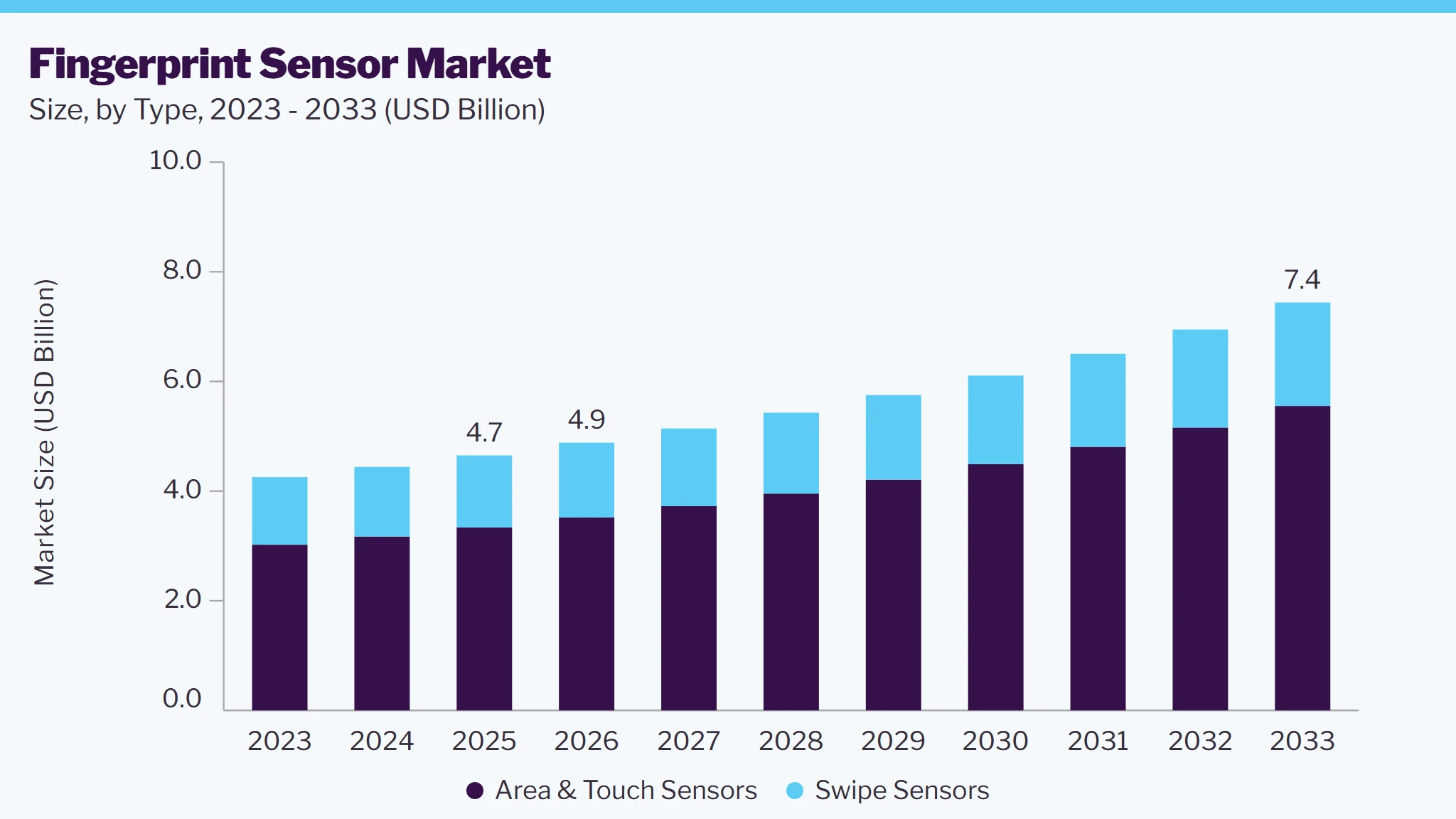 To learn more about this report, Download Free Sample Report
The other market driving factor is the expansion of digital identity initiatives, creating additional demand for fingerprint-based identification technologies. Governments are developing biometric-enabled identity systems to improve the accuracy and security of citizen verification. National identification programs increasingly incorporate fingerprints as part of enrollment and authentication processes. Border-control agencies are also deploying biometric systems to automate identity checks and improve passenger processing. Law enforcement agencies use fingerprint databases for criminal identification and forensic investigations. Growing digital government services require reliable identity verification across online and physical service channels.
Furthermore, the growth of digital banking and electronic payment services is increasing the need for secure user authentication. Financial institutions are integrating biometric verification into mobile banking, payment applications, and customer onboarding processes. Fingerprint authentication provides a rapid verification method for accessing financial accounts and authorizing transactions. The expansion of mobile wallets and fintech platforms is creating additional applications for biometric sensors. Banks and payment providers are also adopting multi-factor authentication to reduce risks associated with stolen credentials and unauthorized account access. Increasing smartphone-based financial activity supports the integration of fingerprint authentication into consumer devices.
Market Dynamics
The increasing adoption of connected and smart devices is expanding the use of fingerprint sensors beyond traditional smartphones and laptops. Wearables, smart locks, connected access systems, and other IoT-enabled devices are incorporating biometric authentication to provide secure and convenient user verification. The growing number of connected devices also increases the need for authentication methods that can operate without relying solely on passwords or PINs. This trend is further supported by the expansion of smart homes, connected workplaces, and personalized digital ecosystems. Fingerprint sensors enable device-level identity verification and can support personalized access, user settings, and transaction authorization. As manufacturers integrate biometric functionality into a broader range of connected devices, demand for compact, low-power, and easily integrated fingerprint sensors is increasing.
The collection and storage of biometric data create privacy and data-security concerns for organizations and users. Unlike passwords, fingerprints cannot be changed if biometric information is compromised. Regulatory requirements surrounding the collection, processing, storage, and sharing of biometric data can increase compliance costs for technology providers and end users. Concerns regarding unauthorized access, identity theft, and misuse of biometric information can also limit adoption in privacy-sensitive applications. These factors can make organizations more cautious when deploying fingerprint-based authentication systems, particularly in regions with strict data-protection requirements.
The integration of fingerprint authentication into vehicles is creating new opportunities for biometric sensor adoption in the automotive sector. Automakers are exploring fingerprint-based systems for keyless vehicle access and driver identification, reducing reliance on conventional keys and passwords. Biometric authentication can also support personalized vehicle functions by linking verified users with stored settings. This includes seat positions, infotainment preferences, climate controls, and other driver-specific configurations. The increasing adoption of connected and software-defined vehicles is creating additional use cases for biometric authentication. Fingerprint sensors can support secure vehicle access, user authorization, and protection of digital vehicle services. As automotive manufacturers incorporate advanced security and personalization features, demand for compact and reliable fingerprint sensors can expand across new vehicle models.
Market Concentration & Characteristics
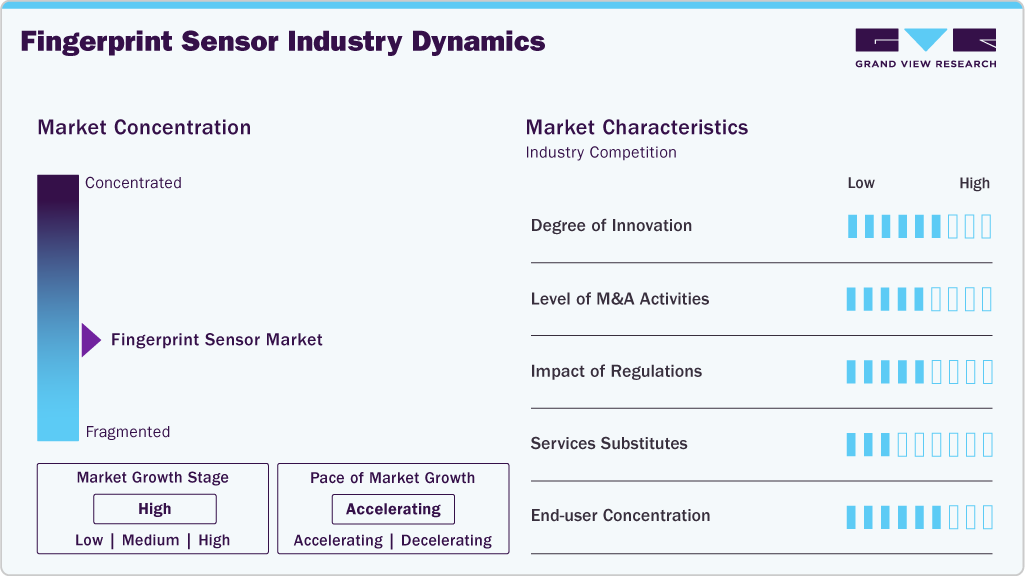
The market has a high degree of innovation, supported by continuous development in optical, capacitive, ultrasonic, and other sensing technologies. Companies are improving sensor resolution, authentication speed, power efficiency, anti-spoofing capabilities, and under-display integration. Innovation is also expanding fingerprint authentication beyond smartphones into automotive, access control, payment cards, and enterprise security applications.
 To learn more about this report, Download Free Sample Report
Regulations have a moderate to high impact on the fingerprint sensor industry because biometric data is subject to privacy, security, consent, and data-handling requirements across different jurisdictions. Regulations encourage manufacturers and solution providers to adopt secure data storage, on-device processing, and stronger protection of biometric templates. These requirements can also increase compliance and integration requirements for companies supplying government, financial, healthcare, and enterprise applications.
Analyst Perspective
The market is evolving beyond traditional consumer electronics toward higher-value applications driven by digital identity, payments, and automotive systems. While smartphones and personal devices remain the primary demand base, growth is increasingly supported by under-display ultrasonic sensors, biometric payment cards, and vehicle access technologies. The competitive focus is shifting toward compact, secure, low-power solutions with faster authentication, spoof detection, and seamless integration. As OEMs adopt bezel-free designs and biometric applications expand, companies offering advanced sensor technologies and broad application capabilities are well positioned to capture emerging opportunities.
Type Insights
The area & touch sensors segment led the market in 2025, accounting for 71.8% of global revenue, driven by the increasing adoption of fingerprint authentication across smartphones, laptops, tablets, smart cards, access-control systems, and other connected devices. These sensors capture a larger portion of the fingerprint through a single touch, supporting faster and more consistent user authentication. Their compact form factors also support integration into side-mounted, rear-mounted, and under-display configurations, giving device manufacturers greater design flexibility. Rising demand for secure device access, digital payments, and passwordless authentication further supports adoption across consumer and commercial applications.
The swipe sensors segment is the fastest-growing segment during the forecast period, driven by demand for compact and space-efficient biometric solutions in applications where the available sensing area is limited. These sensors capture fingerprint patterns as users move their fingers across a narrow sensing surface, supporting integration into selected portable security devices, enterprise authentication systems, and specialized equipment. Their smaller sensing footprint can support lower component requirements in cost-sensitive applications. However, greater user dependence on consistent finger movement limits their adoption compared with single-touch sensing formats.
Technology Insights
The capacitive segment led the market with the largest revenue share of 48.9% in 2025, due to its established adoption across smartphones and other consumer devices. Their relatively low cost, compact form factor, fast authentication, and mature manufacturing ecosystem support continued deployment in mass-market devices. The growing use of biometric authentication for device unlocking, mobile payments, and application access further supports demand. Improvements in ultra-thin capacitive sensors also support integration into side-mounted and compact device designs.
The ultrasonic segment is expected to grow at the fastest CAGR during the forecast period, due to its ability to support secure biometric authentication through smartphone displays and other surfaces. The technology uses sound waves to create detailed three-dimensional fingerprint profiles, supporting accurate recognition under conditions such as wet or contaminated fingers. Increasing demand for bezel-free smartphones and under-display authentication is supporting ultrasonic sensor deployment in premium devices. Advancements in larger sensing areas, thinner sensor designs, anti-spoofing capabilities, and multi-fingerprint recognition are further expanding their application potential.
End Use Insights
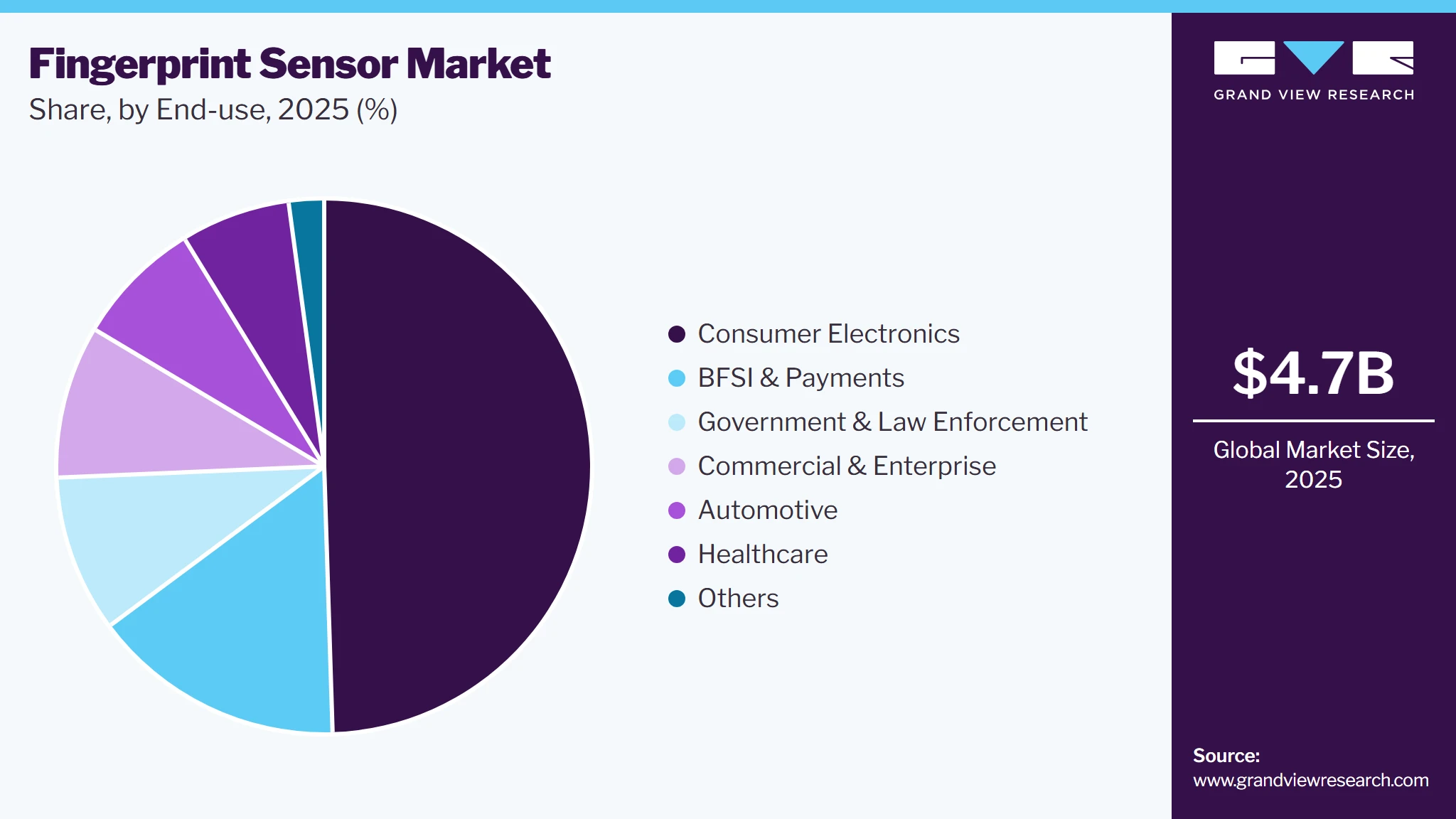
The consumer electronics segment led the market with the largest revenue share of 49.5% in 2025, driven by the increasing integration of fingerprint authentication into smartphones, laptops, tablets, and wearable devices for secure and convenient user access. Rising use of mobile banking, digital wallets, and e-commerce further increases the need for biometric verification on personal devices. Advancements in under-display, compact, and low-power fingerprint sensors support integration without significantly affecting device design. Growing concerns around unauthorized access, identity theft, and the protection of personal data also encourage manufacturers to include biometric security features.
 To learn more about this report, Download Free Sample Report
The automotive segment is anticipated to exhibit the fastest CAGR over the forecast period. This segment is driven by the growing adoption of biometric authentication for vehicle access, driver identification, and personalized in-vehicle functions. Fingerprint sensors can support functions such as vehicle starting, profile unlocking, infotainment access, and personalized settings, reducing reliance on conventional passwords and keys. The increasing development of connected and software-defined vehicles is creating additional use cases for fingerprint-based authentication and in-vehicle payments. Automotive-grade sensor development, including solutions designed for temperature and durability requirements, is also supporting integration into vehicle systems.
Regional Insights
Asia Pacific dominated the fingerprint sensor market with the largest revenue share of 34.0% in 2025, driven by the region’s large electronics manufacturing ecosystem and expanding production of connected devices. High-volume manufacturing of smartphones, tablets, laptops, wearables, and other electronic products creates substantial opportunities for fingerprint sensor integration. Device manufacturers increasingly require compact sensors with lower power consumption, higher resolution, and smaller form factors to accommodate evolving product designs. Advances in sensor miniaturization also support biometric authentication across a broader range of portable and connected devices. These manufacturing capabilities and expanding device categories support sustained fingerprint sensor demand across the region.
 To learn more about this report, Download Free Sample Report
China Fingerprint Sensor Market Trends
China’s fingerprint sensor market is expected to witness steady growth, supported by the widespread adoption of biometric authentication across smartphones, consumer electronics, smart locks, and payment applications. The expansion of smart home ecosystems is encouraging greater use of fingerprint-enabled access and security solutions. Growing emphasis on digital identity, secure authentication, and contactless user verification is further supporting demand. In addition, strong domestic electronics manufacturing capabilities and continued integration of biometric technologies into connected devices are strengthening the market’s growth prospects.
North America Fingerprint Sensor Market Trends
The fingerprint sensor market in North America is driven by the increasing modernization of physical and logical access-control systems across enterprises and commercial facilities. Organizations are moving toward authentication systems that provide stronger identity verification while reducing dependence on conventional access credentials. Growing cybersecurity requirements are also encouraging integration between physical access infrastructure and enterprise IT security systems. Fingerprint authentication supports controlled access to workplaces, data centers, industrial facilities, and other restricted environments.
The U.S. fingerprint sensor market is driven by the growing transition toward passwordless and phishing-resistant authentication across digital platforms. Adoption of passkeys and WebAuthn-based authentication is expanding as technology providers and online services seek alternatives to password-dependent security. Fingerprint sensors integrated into smartphones, laptops, and other personal devices can provide local biometric verification for accessing these credentials. Growing concerns regarding account compromise and unauthorized digital access further support the use of device-based biometric authentication. Expansion of passwordless authentication ecosystems, therefore, creates additional applications for fingerprint sensors in personal and enterprise computing devices.
Europe Fingerprint Sensor Market Trends
The fingerprint sensor market in Europe is driven by the expansion of biometric border and immigration management infrastructure. The EU Entry/Exit System incorporates fingerprint and facial biometric collection for non-EU travelers entering participating European countries. Deployment across airports and other border checkpoints increases requirements for fingerprint scanners and associated biometric identification infrastructure. The transition from manual passport processing toward automated identity verification further expands the role of biometric sensing technologies.
Key Fingerprint Sensor Company Insights
Some key players in the market, such as NEXT Biometrics, Shenzhen Goodix Technology Co., Ltd., IDEMIA, and others.
-
IDEMIA provides biometric and identity technologies covering fingerprint, facial, and iris recognition for physical and digital identity applications. Its fingerprint portfolio includes biometric enrollment, authentication, access control, identity verification, and government identification solutions. The company offers fingerprint readers and OEM modules for applications such as ATMs, kiosks, point-of-sale terminals, voting systems, and time-and-attendance systems. Its solutions incorporate fingerprint algorithms, anti-spoofing capabilities, and match-on-device or match-on-card functions. IDEMIA also develops AI-based biometric technologies for identification and authentication across government and enterprise environments.
-
NEXT Biometrics develops fingerprint sensing technologies based on its Active Thermal® technology for secure identification and authentication. Its portfolio includes fingerprint sensors and readers designed for government ID, banking and finance, laptops, smartphones, physical access control, and logical access management. The company offers sensor products such as Granite, Basalt, Access 200, and Access 100, with different sensing areas and security specifications. Its solutions support applications requiring compact form factors, low biometric error rates, and integration flexibility. NEXT Biometrics also provides biometric IP licensing to support integration into third-party product portfolios.
Key Fingerprint Sensor Companies
The following key companies have been profiled for this study on the fingerprint sensor market:
-
Shenzhen Goodix Technology Co., Ltd.
-
Fingerprint Cards AB
-
Qualcomm Technologies, Inc.
-
Synaptics Incorporated
-
Egis Technology Inc.
-
IDEMIA
-
IDEX Biometrics ASA
-
NEXT Biometrics Group ASA
-
Apple Inc.
-
Suprema Inc.
Competitive Benchmarking
Category
Operating Strategies
Competitive Edge
Weakness
Established Players (Shenzhen Goodix Technology Co., Ltd.; Fingerprint Cards AB; Qualcomm Technologies, Inc.; Synaptics Incorporated; Egis Technology Inc.; Suprema Inc.)
- Mature players generally pursue broad product portfolios, OEM partnerships, technology development, and expansion across multiple application areas to maintain market coverage.
- Their advantages include established customer relationships, extensive technology portfolios, intellectual property, manufacturing capabilities, and proven integration experience.
- Large established players face pricing pressure, dependence on major device cycles, and competition from specialized suppliers offering application-specific or lower-cost solutions.
Emerging Players (IDEX Biometrics ASA; NEXT Biometrics Group ASA)
- Emerging players generally focus on specialized technologies, targeted applications, strategic partnerships, and niche market expansion rather than broad market coverage.
- Their advantages include focused R&D, differentiated sensing technologies, flexible product development, and the ability to address emerging applications such as biometric payment cards and full-screen authentication.
- They generally have smaller customer bases, limited scale, lower brand recognition, and greater dependence on successful adoption within specific application segments.
Recent Developments
-
In March 2026, Fingerprint Cards AB reported that its fingerprint biometric system had completed EMVCo’s new assessment for biometric payment cards. The evaluation covered the company’s fingerprint sensor, supporting hardware, and biometric algorithm against the updated performance and security requirements. The assessment provides independent validation of the company’s technology for secure biometric payment applications.
-
In January 2026, NEXT Biometrics selected Giantplus Technology as its display partner to co-develop a full-screen biometric authentication solution based on its Active Thermal technology. The collaboration focuses on integrating fingerprint authentication across the display area of smartphones.
-
In December 2025, Goodix introduced its ultra-slim side-mounted capacitive fingerprint sensor in Samsung’s Galaxy Z TriFold, alongside its foldable touch technology. Measuring 1.65 mm in width, the sensor supports biometric authentication when the device is used in both folded and unfolded modes.
-
In November 2025, Synaptics and Qualcomm announced a strategic collaboration focused on advancing fingerprint and touch sensing solutions for mobile and computing devices. The initiative integrates Synaptics’ sensing technologies with Qualcomm’s 3D Sonic fingerprint technology, supporting biometric authentication across smartphones, tablets, AI-enabled PCs, and other connected devices.
Fingerprint Sensor Market Report Scope
Report Attribute
Details
Market size in 2025
USD 4.7 billion
Estimated market size in 2026
USD 4.9 billion
Projected market size by 2033
USD 7.4 billion
Growth rate
CAGR of 6.2% from 2026 to 2033
Actual data
2021 - 2025
Forecast period
2026 - 2033
Quantitative units
Revenue in USD billion and CAGR from 2026 to 2033
Report coverage
Revenue forecast, company ranking, competitive landscape, growth factors, and trends
Segments covered
Type, technology, end use, region
Regional scope
North America; Europe; Asia Pacific; Latin America; MEA
Country scope
U.S.; Canada; Mexico; UK; Germany; France; China; India; Japan; South Korea; Australia; Brazil; Saudi Arabia; South Africa; UAE
Key companies profiled
Shenzhen Goodix Technology Co., Ltd.; Fingerprint Cards AB; Qualcomm Technologies, Inc.; Synaptics Incorporated; Egis Technology Inc.; IDEMIA; IDEX Biometrics ASA; NEXT Biometrics Group ASA; Apple Inc.; Suprema Inc.
Customization scope
Free report customization (equivalent up to 8 analysts working days) with purchase. Addition or alteration to country, regional & segment scope.
Pricing and purchase options
Avail customized purchase options to meet your exact research needs. Explore purchase options
Global Fingerprint Sensor Market Report Segmentation
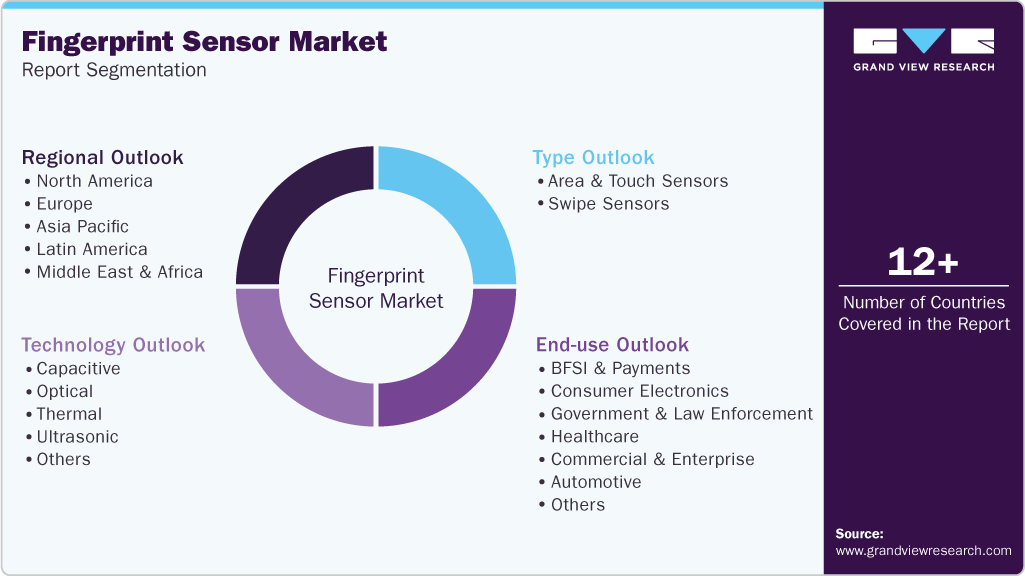
This report forecasts revenue growth at global, regional, and country levels and provides an analysis of the latest industry trends in each of the sub-segments from 2021 to 2033. For this study, Grand View Research has segmented the global fingerprint sensor market report based on type, technology, end use, and region:
 To learn more about this report, Download Free Sample Report
-
Type Outlook (Revenue, USD Billion, 2021 - 2033)
-
Area & Touch Sensors
-
Swipe Sensors
-
-
Technology Outlook (Revenue, USD Billion, 2021 - 2033)
-
Capacitive
-
Optical
-
Thermal
-
Ultrasonic
-
Others
-
-
End Use Outlook (Revenue, USD Billion, 2021 - 2033)
-
BFSI & Payments
-
Consumer Electronics
-
Government & Law Enforcement
-
Healthcare
-
Commercial & Enterprise
-
Automotive
-
Others
-
-
Regional Outlook (Revenue, USD Billion, 2021 - 2033)
-
North America
-
U.S.
-
Canada
-
Mexico
-
-
Europe
-
UK
-
Germany
-
France
-
-
Asia Pacific
-
China
-
India
-
Japan
-
Australia
-
South Korea
-
-
Latin America
-
Brazil
-
-
MEA
-
UAE
-
South Africa
-
KSA
-
-
Research Methodology
The fingerprint sensor market figures in this report are based on a proven research process that combines executive interviews with secondary research from proprietary databases, company filings, and recognized regulatory and institutional sources. Market size is built through value-chain sizing-reconciling supply-side and demand-side estimates-and triangulated with bottom-up and top-down approaches. Every estimate passes multiple levels of expert validation before publication, with each fingerprint sensor segment quantified using the revenue-capture definitions in the table below.
Segment Definition
Segment - Type
Revenue capture definition
Area & Touch Sensors
Revenue captured from fingerprint sensors that identify users through direct placement of a finger on a defined sensing surface, including integrated and standalone touch-based modules. This segment covers sensors used across smartphones, tablets, laptops, access-control systems, and other biometric devices.
Swipe Sensors
Revenue generated from fingerprint sensors that capture fingerprint patterns as the user moves a finger across the sensing surface. These sensors are primarily applied in portable and compact biometric devices where swipe-based fingerprint scanning is suitable.
Segment - Technology
Revenue capture definition
Capacitive
Revenue captured from fingerprint sensors that use electrical capacitance to map fingerprint ridge and valley patterns for biometric authentication. The segment includes capacitive sensors supplied for smartphones, laptops, access-control devices, and other electronic applications.
Optical
Revenue generated from fingerprint sensors that use light-based imaging to capture and analyze fingerprint patterns. This segment covers optical sensing solutions incorporated into consumer electronics, identification systems, and security applications.
Thermal
This segment captures revenue from fingerprint sensors that identify fingerprint patterns through temperature differences between ridges and valleys. It includes thermal sensing solutions used in biometric identification, payment, access control, and other authentication systems.
Ultrasonic
Revenue includes fingerprint sensors that use ultrasonic waves to capture detailed fingerprint characteristics for authentication. The segment covers solutions used in applications requiring enhanced security, accurate biometric recognition, and operation under challenging finger or surface conditions.
Others
This category captures revenue from alternative fingerprint sensing technologies, including radio frequency (RF) and piezoresistive sensing. It covers specialized sensor components and solutions used in applications requiring distinct sensing methods or integration requirements.
Segment - End Use
Revenue capture definition
Commercial & Enterprise
Revenue is generated through fingerprint sensors incorporated into employee access systems, attendance terminals, enterprise devices, and facility security solutions. The segment covers biometric authentication hardware used across offices and commercial facilities.
BFSI & Payments
This segment captures revenue from fingerprint sensors used in banking terminals, payment cards, ATMs, and financial authentication systems. Demand is associated with biometric verification for secure transactions and customer identity validation.
Healthcare
This segment includes revenue from fingerprint sensors used for patient identification, healthcare workforce authentication, medical devices, and secure access systems. Adoption supports accurate identity verification and controlled access to healthcare services and information.
Government & Law Enforcements
Revenue includes fingerprint sensors deployed in national identification, border control, criminal identification, and public security systems. It covers biometric enrollment and verification equipment used by government and law enforcement agencies.
Consumer Electronics
Revenue is captured from fingerprint sensors integrated into smartphones, tablets, laptops, wearables, and other personal electronic devices. It covers sensor components supplied for device authentication and secure user access.
Automotive
Revenue covers fingerprint sensors integrated into vehicles for driver identification, keyless entry, ignition authorization, and personalized in-car settings. The segment includes biometric components supplied for connected and digitally enabled vehicle systems.
Others
Revenue comprises fingerprint sensors used across travel, hospitality, education, and defense applications for identity verification and controlled access. It includes biometric readers and modules deployed in facilities, checkpoints, campuses, and secured environments.
Estimation Model
Layer Name
Key Questions
Description
Device Ownership Layer
Which devices and systems use fingerprint sensors?
Identify the installed base of smartphones, laptops, tablets, payment devices, access-control systems, vehicles, and other equipment that incorporate fingerprint sensors. Apply the fingerprint-sensor adoption rate across these device categories to estimate the addressable population of sensor-enabled devices.
Sensor Deployment Layer
How many fingerprint sensors are deployed?
Apply sensor attachment rates and replacement cycles to the addressable device base to estimate annual fingerprint sensor shipments. This layer accounts for new-device production, sensor replacement, and multiple fingerprint-enabled systems across consumer, commercial, government, and automotive applications.
Application & Channel Layer
Where are fingerprint sensors deployed and supplied?
Measure the distribution of fingerprint sensor demand across consumer electronics, government & law enforcement, BFSI & payments, commercial & enterprise, healthcare, automotive, and other applications. The model also considers OEM integration, biometric-system manufacturers, security integrators, and other supply channels.
Monetization Layer
How much revenue is generated from fingerprint sensors?
Apply the average selling price per fingerprint sensor or module to estimated annual sensor shipments across technologies, types, and applications. Aggregate revenues from capacitive, optical, ultrasonic, thermal, and other sensor technologies to derive the total addressable market value.
Delivered Customizations
This report has been delivered with the following In-depth customizations
Client Request
Customization Delivered
Value Adds
Market Entry & Expansion Assessment
Regional demand sizing and forecasting
Customer segmentation and buying behavior analysis
Competitive landscape benchmarking
Regulatory and distribution channel assessment
Identified high-growth market opportunities
Supported go-to-market strategy development
Highlighted investment priorities and risks
Enabled data-driven expansion planning
Technology & Innovation Assessment
Emerging technology trend analysis
Innovation pipeline
Technology adoption readiness assessment
Ecosystem and partnership mapping
Identified future growth areas
Supported innovation roadmap planning
Evaluated commercialization potential
Strengthened strategic partnership decisions
Customer & End-User Insights Study
Consumer awareness and adoption analysis
Purchase decision journey mapping
Satisfaction and loyalty assessment
Usage pattern and pain-point evaluation
Revealed key adoption drivers and barriers
Supported customer-centric product development
Improved targeting and engagement strategy
Identified opportunities for retention and upselling
Frequently Asked Questions About This Report
The global fingerprint sensor market size was estimated at USD 4.7 billion in 2025 and is expected to reach USD 4.9 billion in 2026.
The global fingerprint sensor market is expected to grow at a compound annual growth rate of 6.2% from 2026 to 2033 to reach USD 7.4 billion by 2033.
Key factors that are driving the market growth include the universal shift toward passwordless biometric security and the proliferation of connected consumer devices.
Some key players operating in the fingerprint sensor market include Shenzhen Goodix Technology Co., Ltd., Fingerprint Cards AB, Qualcomm Technologies, Inc., Synaptics Incorporated, Egis Technology Inc., IDEMIA, IDEX Biometrics ASA, NEXT Biometrics Group ASA, Apple Inc., Suprema Inc.
Capacitive is accounted to hold 48.9% of revenue share by technology in fingerprint sensor market.
Asia Pacific dominated the fingerprint sensor market with the largest revenue share of 34.0% in 2025.
About the Author(s)
Sensors & Controls Research Team
Semiconductors & Electronics · Sensors & ControlsThis report was authored by the sensors & controls research team at Grand View Research - comprising two research analysts, one senior research analyst, and one industry expert - with specialized expertise in the sensors & controls segment of the semiconductors & electronics industry. All findings are based on proprietary semiconductors & electronics databases, executive interviews, and regulatory analysis, subject to internal peer review prior to publication.
Last Updated:
Speak to Analyst

Customize this report to your needs - add regions, segments, or data points, with 20% free customization.
Or view our licence options:


ISO 9001:2015 & 27001:2022 Certified
We are GDPR and CCPA compliant! Your transaction & personal information is safe and secure. For more details, please read our privacy policy.


