
- Home
- »
- Agrochemicals & Fertilizers
- »
-
Fipronil Pyrazole Market Size & Share Report, 2026-2033GVR Report cover

Fipronil Pyrazole Market (2026 - 2033)
Size, Share & Trends Analysis Report By Form (Gel, Particle, Liquid), By End-use (Chemical Synthesis, Agriculture, Others), By Region (North America, Europe, Asia Pacific, Latin America, MEA), And Segment Forecasts
Market Size, 2025
$306.7MMarket Estimate, 2026
$316.0MMarket Forecast, 2033
$405.2MCAGR, 2026–2033
3.6%Fipronil Pyrazole Market Summary
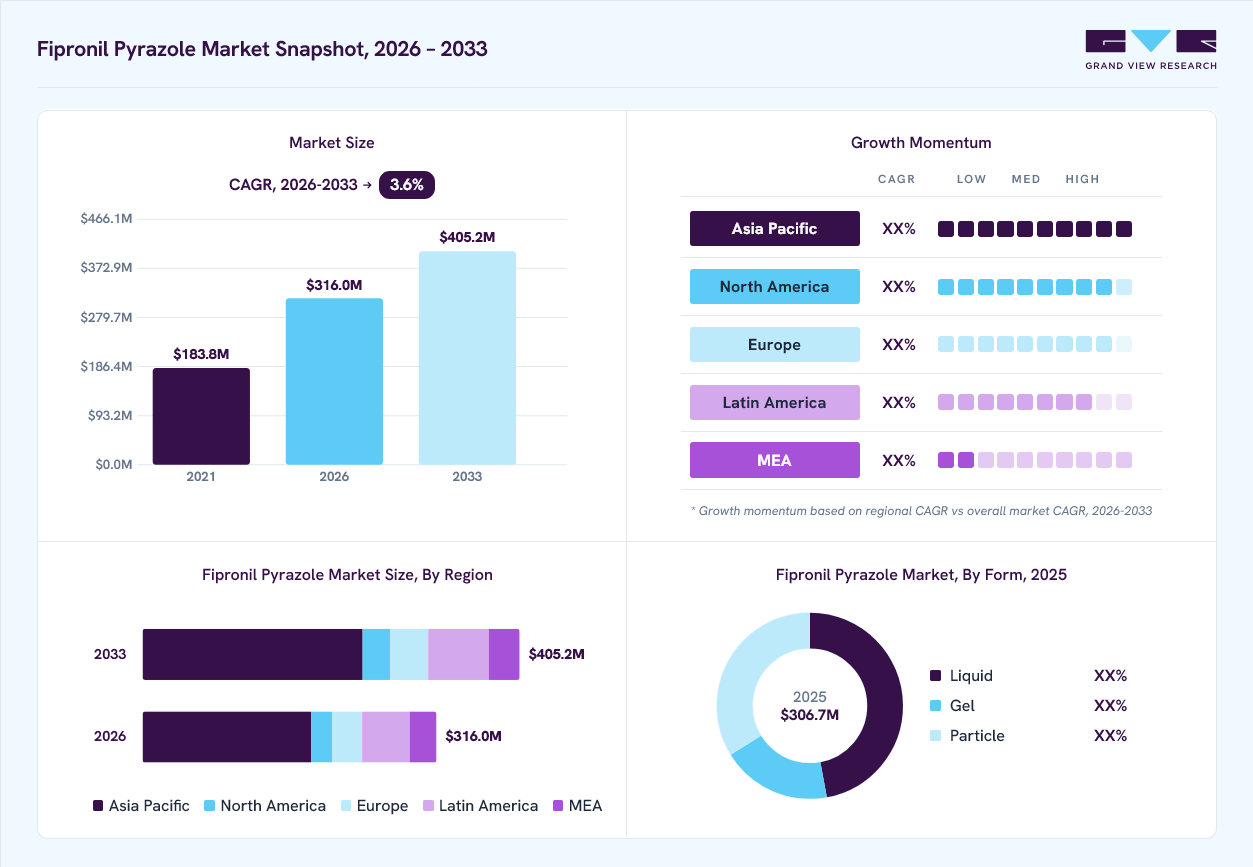
The global fipronil pyrazole market size was valued at USD 306.7 million in 2025 and is projected to grow from USD 316.0 million in 2026 to USD 405.2 million by 2033, at a CAGR of 3.6% from 2026 to 2033. Asia Pacific dominated the market, accounting for a revenue share of 57.2% in 2025. Increasing agricultural production owing to rising global demand for food is expected to drive the growth of the market during the forecast period.
 Source: Grand View Research, IR Documents, Primary Interviews, Paid DatabasesTo learn more about this report,
 Download Free Sample Report
 Key Market Trends & Insights
- By form: Liquid segment accounted for the highest market share, representing 47.0% of total revenue in 2025.
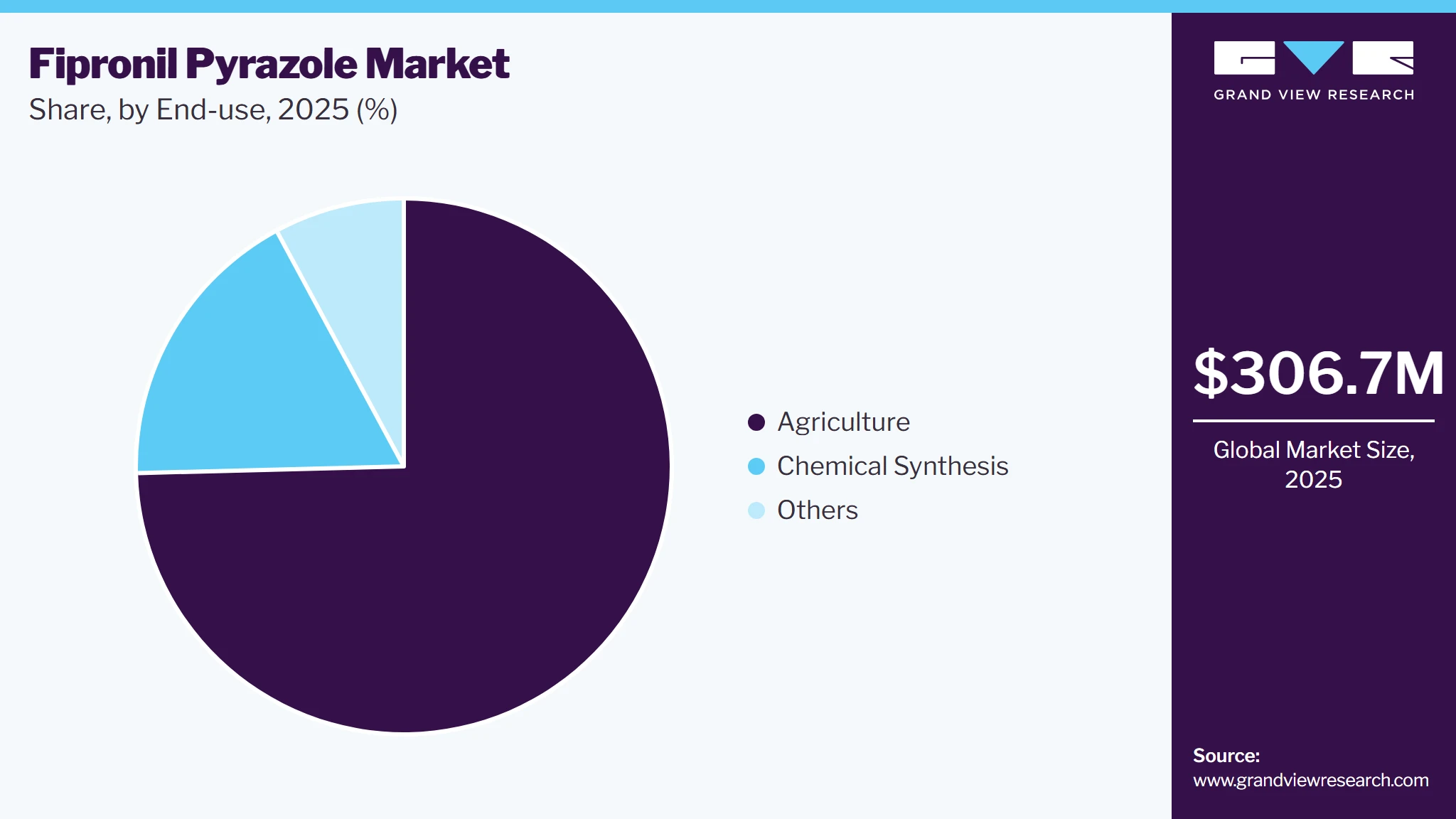
- By end use: Agriculture held a dominant position, contributing 74.6% of total revenue in 2025.
Regional Highlights
- Largest regional market: Asia Pacific (57.2% revenue share, 2025)
- By country: The China held the largest market share in 2025.
Market Size & Forecast
- Market size in 2025: USD 306.7 Million
- Estimated market size in 2026: USD 316.0 Million
- Projected market size by 2033: USD 405.2 Million
- CAGR (2026-2033): 3.6%
Three ways to get this report
Buy it, customize it, or ask a question.Ask an Analyst
A direct answer, usually in 1 working day
- AccessReport author, directly
- Reply timeWithin 1 working day
- No sales callDirect answer only
- FormatEmail reply
- CostFree, no cost
Get the Full Report
What the study covers
- FormatsPDF · Excel · Dashboard
- Timeline2026–2033 annual, 2025 base
- Coverage20+ countries, 5 regions
- Companies10+ key players profiled
Customize the Report
20% free customization
- IncludeCountries, segments, points
- TailorTo your product definition
- ExtendDeeper competitor detail
- OrA fully bespoke study
- Turnaround5–10 working days
The growth of the global market is primarily driven by rising demand for crop protection chemicals across the globe. Moreover, due to the rising demand for food across the globe had led to rise in demand for crop protection to get high yields. This helps to meet the demand for world demand for food.
Fipronil pyrazole is a type of insecticide that belongs to the phenyl pyrazole group. It has a broad-spectrum effect and is useful against ants, beetles, fleas, termites, etc. It works through both contact and stomach action and is moderately systemic. Fipronil is available in different formulations, including wettable granules, suspension concentrates, baits, ready-to-use products, and ultra-low volume sprays. It can be used alone or combined with other insecticides. The addition of piperonal butoxide can enhance the toxicity of fipronil. It is a white powder with a moldy odor.
 To learn more about this report, Download Free Sample Report
 The most used method for producing fipronil pyrazole is oxidation. The oxidation reaction is conventionally carried out using organic solvents, particularly halogenated aliphatic and trifluoroacetic acid. Trifluoro acetic acid is a suitable medium for effective oxidation, with good conversion and selectivity to the sulphonyl derivative at minimum levels of sulphonyl derivative formation. Oxidants such as peracids, peroxides, and persulfates have been widely used for such oxidation reactions. However, due to its high melting point, trichloroacetic acid has not been reported as a medium for oxidation.
The unique properties of fipronil pyrazole, including emulsification, foaming, and conditioning, position it as a valuable functional ingredient across diverse industries. Ongoing technological advancements in fipronil pyrazole, such as the use of nanotechnology, are expected to fuel the growth of the market worldwide in the coming years.
Market Dynamics
The fipronil pyrazole market is influenced by evolving agricultural practices, increasing emphasis on crop protection, and the growing need for effective pest management solutions across diverse farming systems. Rising demand for higher agricultural productivity, coupled with the expansion of commercial farming, continues to support product adoption in insect control applications. At the same time, advancements in formulation technologies are improving product stability, application efficiency, and compatibility with integrated pest management strategies. However, the market faces challenges from stringent environmental regulations, growing concerns over the ecological impact of certain insecticides, and increasing scrutiny regarding residue limits and pollinator safety. These factors are encouraging manufacturers to invest in sustainable production processes and responsible product stewardship. Emerging opportunities are linked to expanding agricultural activities in developing economies, increased adoption of precision farming, and continued investment in research to develop improved formulations with enhanced efficacy and reduced environmental impact.
The increasing need to maximize agricultural productivity is a primary driver of the Fipronil Pyrazole market. Growing global food demand, shrinking arable land, and the need to minimize crop losses caused by insect pests have encouraged farmers to adopt high-performance crop protection products. Fipronil pyrazole-based formulations are valued for their broad-spectrum insecticidal activity, long-lasting residual effect, and effectiveness against both soil- and foliage-dwelling pests. These characteristics enable growers to improve crop quality and achieve higher yields, supporting consistent demand across commercial agriculture.
The expansion of high-value crops, rising investments in modern farming practices, and increasing awareness of integrated pest management are reinforcing market growth. Agricultural producers are seeking products that provide reliable pest control while optimizing input costs and reducing the frequency of applications.
Environmental regulations governing volatile organic compound (VOC) emissions and aerosol packaging present a restraint for the fipronil pyrazole market. Regulatory authorities across several countries are enforcing stricter standards on solvent-based formulations, chemical propellants, and packaging waste to reduce environmental pollution and improve air quality. Compliance with these regulations requires manufacturers to invest in research and development, reformulate products using lower-emission ingredients, adopt environmentally compliant propellants, and implement sustainable packaging solutions. These transitions often increase production costs and extend product development timelines. Companies operating across multiple regions must comply with varying regulatory frameworks, adding complexity to manufacturing, certification, and distribution processes. While sustainable innovations are creating long-term opportunities, the immediate financial burden associated with regulatory compliance and technological upgrades remains a challenge, particularly for small and medium-sized manufacturers with limited investment capacity.
The growing adoption of precision agriculture presents a significant opportunity for the Fipronil Pyrazole market. Farmers are increasingly utilizing data-driven technologies, GPS-guided equipment, sensors, and digital monitoring systems to optimize pesticide application and improve resource efficiency. These technologies enable more targeted use of crop protection products, enhancing pest control performance while reducing unnecessary chemical usage. As precision farming practices become more widespread, demand for high-efficacy insecticides that integrate effectively with advanced application systems is expected to increase. Strategic collaborations between agrochemical companies, technology providers, and agricultural research institutions are also accelerating innovation, enabling market participants to strengthen their competitive position and expand into high-growth agricultural regions.
Market Concentration & Characteristics
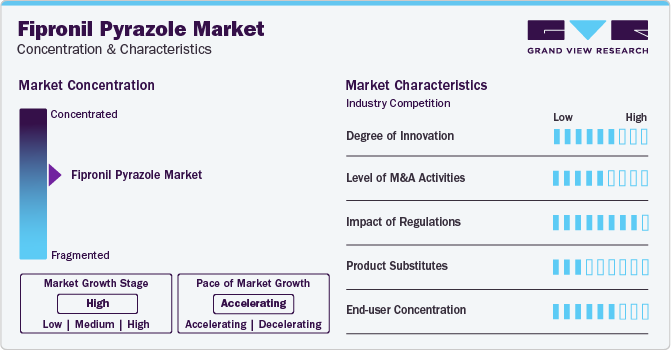
The market is fragmented with the presence of many manufacturers. Fipronil pyrazole comes in various form, such as gel, particle, and liquid forms.
Manufacturers must adopt the right sales channel to ensure their products are distributed effectively to end consumers. To ensure a smooth supply of goods, manufacturers must establish a good working relationship with their distributing partners. Selection of an ideal sales channel is essential for the secure distribution of the product to end-users.
 To learn more about this report, Download Free Sample Report
 The preferred distribution channels include third-party distributors, wholesalers, and e-commerce platforms. This ensures a seamless supply of goods to end consumers. Manufacturers often cater to clients/companies across the globe, regardless of their location to establish strong partnerships with product exporters. This leads to a better distribution network amongst the manufacturers and distributors across different geographical areas.
Analyst Perspective
The fipronil pyrazole market is supported by the increasing need for effective pest control solutions in modern agriculture and public health applications. Demand is being driven by the focus on improving crop productivity while minimizing losses from insect infestations. At the same time, manufacturers are investing in advanced formulations that enhance efficacy and align with evolving regulatory standards. Although environmental concerns and regulatory scrutiny remain key challenges, ongoing innovation and expansion into emerging agricultural markets are creating new growth opportunities. Companies that balance product performance with sustainability and regulatory compliance are likely to strengthen their competitive position over the long term.
Form Insights
Based on form, the liquid segment accounted for the highest market share, representing 47.0% of total revenue in 2025. The growth of this segment can be attributed to the ability of liquids to distribute and disperse active ingredients over the treated surfaces evenly for effective performance. The liquid carrier helps distribute and disperse the active ingredient evenly over the treated surfaces. It is easier to apply to large areas than particle formulations, providing a quick knockdown effect on pests.
The particle form of fipronil pyrazole is an active ingredient present in a solid particle form, such as powder or granule. This formulation is easier to handle, store, and apply. It also allows a more targeted application to the specific area, reducing non-target exposure risks and minimizing waste. Particle formulations demonstrate better coverage and adherence to surfaces than liquid forms. Apart from agriculture, this form is used in forestry, public health, and household applications to effectively control pests, such as insects, rodents, and flies.
End-use Insights
By end-use, agriculture held a dominant position, contributing 74.6% of total revenue in 2025. The effectiveness of fipronil pyrazole against various insect pests makes it a valuable tool for crop protection. It is used in the form of liquid sprays and granules in agricultural applications. Fipronil pyrazole is also used for seed treatment.
In agriculture, fipronil pyrazole can be applied in several forms, such as liquid sprays, granules, or seed treatments. The choice of formulation depends on the target pest, crop, and the desired application method. When used as a foliar spray, fipronil pyrazole is diluted in water and applied directly to the plants, targeting the insects that come into contact with the sprayed solution.
 To learn more about this report, Download Free Sample Report
 Fipronil pyrazole serves as an intermediate in the synthesis of various organic compounds. It can be utilized to build more complex molecules through organic reactions such as substitution, addition, or condensation reactions. Additionally, fipronil pyrazole’s chemical properties make it suitable for incorporating into molecular frameworks to develop new pharmaceuticals, agrochemicals, or materials with specific properties. Its use in chemical synthesis can vary depending on the desired end product and specific reactions and transformations involved in the synthesis process.
Regional Insights
The North America region is significantly expected to grow during the forecast period due to a rise in the demand for crop protection chemicals and the increase in agricultural production. According to the U.S. Agricultural, Economic, and Foreign Trade outlook, the total wheat production area is projected at 49.5 million acres, the total production area went up by 3.8 million acres from previous year 2022 and the highest wheat producing area since 2016/17.
U.S. Fipronil Pyrazole Market Trends
The U.S. fipronil pyrazole market is expected to grow over the forecast period due to the rising agricultural sector and rising demand for crop protection chemicals, in order to increase the production and to protect the crops has led to a rising demand for pesticides and insecticides such as fipronil pyrazole.
Asia Pacific Fipronil Pyrazole Market Trends
Asia Pacific dominated the fipronil pyrazole market with the highest revenue share of 57.2% in 2025. This is attributable to the growing population and decreasing arable land, which has created pressure to increase the overall crop yield.
China Aerosol Paints Market Trends
China dominated the Asia Pacific fipronil pyrazole market in 2025.
Chinafipronil pyrazole market is expected to grow over the forecast period due to increased crop production in the country. Fipronil pyrazole is used to ensure better crop yield and increase production, crop protection, and crop yield. China is increasing the production of crops such as wheat, rice, corn, and rose. In 2022, China’s cereal production was 633.7 million tons with the major cereal crops being wheat, rice, and coarse grains.
 To learn more about this report, Download Free Sample Report
 Europe Fipronil Pyrazole Market Trends
Europe fipronil pyrazole market is expected to grow, attributable to rising food consumption by 1.3% per annum to 2032, indicating an increase in the share of agricultural commodities used as food, according to the Organization for Economic Co-operation and Development (OECD). The rising food consumption is expected to lead to a rise in crop production, resulting in growth in demand for pesticides and insecticides.
The fipronil pyrazole market in Germany is witnessing significant growth due to the rising agriculture production across the country. This leads to a rise in demand for pesticides and insecticides in order to achieve the highest crop production. The country is also promoting agricultural trade and investing to improve the trade in the least developed countries.
Central & South America Fipronil Pyrazole Market Trends
Central & South America fipronil pyrazole market is expected to grow in the region during the forecast period, attributable to the increased production of crops. The increasing crop production leads to the demand for pesticides and insecticides, such as fipronil pyrazole.
The fipronil pyrazole market in Brazil is growing, due to the rising demand for agriculture to meet the increasing demand for food consumption in the country. This has led to a rise in demand for crop protection chemicals, such as pesticides and insecticides used in crop development.
Middle East & Africa Fipronil Pyrazole Market Trends
Middle East & Africa fipronil pyrazole market is witnessing the growth of crops owing to rising crop production, further leading to rise in demand for fipronil pyrazole to manufacture pesticides and insecticides. This has enabled market players to invest in the region to establish a strong foothold in the Middle East and Africa region.
The fipronil pyrazole market in Saudi Arabia is receiving government support which is aiming to increase the crop production in the region by launching new government initiatives to increase the crop production. This has led to a rise in demand for insecticides and pesticides to increase the crop production. Thus, leading to a rise in the demand for the fipronil pyrazole market.
Key Fipronil Pyrazole Company Insights
Some of the key players operating in the market include BASF SE, Bayer AG among others.
BASF SE is a chemical manufacturer and supplier with a presence across Europe, North America, Asia Pacific, South America, Africa, and the Middle East. The company is involved in the manufacturing of a wide range of products such as solvents, fipronil pyrazole, amines, resins, glues, petrochemicals, thermoplastics, foams, and polymers.
-
The company is a global enterprise with core competencies in the fields of healthcare and agriculture. It is a significant player in the agriculture and chemical industries. Crop Science division of the company provides innovative solutions to farmers worldwide, thereby helping them produce healthy and abundant crops while protecting the environment. Agricultural products of Bayer AG include seeds, and crop protection chemicals that help farmers optimize their yields and enhance the quality of their produce. The company has a global presence with operations in more than 90 countries across the world.
-
BASF SE is a chemical manufacturer and supplier with a presence across Europe, North America, Asia Pacific, South America, Africa, and the Middle East. The company is involved in the manufacturing of a wide range of products such as solvents, fipronil pyrazole, amines, resins, glues, petrochemicals, thermoplastics, foams, and polymers.
HPM Chemicals, Gharda Chemicals Limited, and GSP, among others, are some of the emerging market participants in the Fipronil Pyrazole market.
-
The company is a manufacturer and supplier of high-quality chemicals that cater to various industries. With 26 branches across India, it distributes products through 45,000 retail outlets. It has a global presence, with operations spanning three continents and ten countries worldwide.
-
The company is a leading agricultural company, which specializes in developing, manufacturing, and distributing crop protection products, fertilizers, and seeds. With a commitment to sustainable agriculture, it provides farmers with the best possible services, support, and advice to help them succeed in the agriculture.
Key Fipronil Pyrazole Companies:
The following key companies have been profiled for this study on the fipronil pyrazole market.
- Abcam Limited
- BASF SE
- Bayer AG
- Gharda Chemicals Limited
- GSP
- HPM Chemicals
- Peptech Biosciences Ltd.
- Parijat Industries (India) Pvt. Ltd.
- Albaugh LLC
Competitive Benchmarking
Category
Operating Strategies
Competitive Edge
Weakness
Established Players (BASF SE, Bayer AG, Albaugh LLC, Gharda Chemicals Limited, HPM Chemicals)
- Invest in continuous R&D to enhance formulation performance and regulatory compliance.
- Strengthen global distribution networks through strategic partnerships and regional subsidiaries.
- Expand manufacturing capabilities to ensure consistent supply and cost optimization.
- Focus on portfolio diversification by offering integrated crop protection solutions.
- Strong brand recognition and established customer relationships across global markets.
- Extensive regulatory expertise and proven ability to secure product registrations in multiple countries.
- Advanced manufacturing infrastructure supported by robust quality management systems.
- Significant financial resources enabling acquisitions, innovation, and geographic expansion.
- High compliance and operational costs associated with global regulatory requirements.
- Slower response to niche market opportunities due to complex organizational structures.
- Dependence on mature agricultural markets with relatively stable growth rates.
- Greater exposure to product restrictions and regulatory changes affecting established product portfolios.
Emerging Players (Abcam Limited, GSP, Peptech Biosciences Ltd., Parijat Industries (India) Pvt. Ltd.)
- Focus on cost-efficient manufacturing to strengthen competitiveness in price-sensitive markets.
- Expand presence through regional distribution partnerships and local market penetration.
- Invest selectively in formulation development tailored to local agricultural requirements.
- Target underserved and emerging agricultural markets with customized product offerings
- Greater operational flexibility to respond quickly to changing customer requirements.
- Competitive pricing supported by efficient production and lower overhead costs.
- Strong understanding of regional farming practices and local distribution channels.
- Ability to develop specialized formulations addressing specific crop and pest challenges.
- Limited international market presence and brand recognition compared to established competitors.
- Lower investment capacity for large-scale research, product development, and regulatory approvals.
- Dependence on third-party distributors for expansion into new geographic markets.
- Smaller production capacities may limit the ability to meet large-volume demand consistently.
Recent Developments
-
In February 2023, Parijat Industries partnered with African countries in agriculture, such as Parijat Mali, West Africa's pioneering integrated Pesticide Formulation Plant. Parijat Industries offer international quality products that are ethically produced and sourced, contributing to the agricultural sectors of both regions. India, a leading producer of agricultural inputs, collaborates with African countries to improve agricultural productivity and help farmers adapt to the changing climate. Parijat Industries supplies quality, cost-effective crop protection chemicals serving West African farmers.
-
In January 2023, BASF SE started the global registration of its new range of environment-friendly insecticides and active ingredients under the brand name Axalion. This development is anticipated to help the company in strengthening its insecticides portfolio globally by carrying out sustainable agricultural innovations.
Fipronil Pyrazole Market Report Scope
Report Attribute
Details
Market size in 2025
USD 306.7 million
Estimated market size in 2026
USD 316.0 million
Projected market size by 2033
USD 405.2 million
Growth rate
CAGR of 3.6% from 2026 to 2033
Base year for estimation
2025
Historical data
2021 - 2024
Forecast period
2026 - 2033
Quantitative units
Revenue in USD billion/million, Volume in Kilotons and CAGR from 2026 to 2033
Report coverage
Revenue forecast, company ranking, competitive landscape, growth factors, and trends
Segments covered
Form, end-use, region
Regional scope
North America; Europe; Asia Pacific; Latin America; Middle East & Africa
Country scope
U.S.; Canada; Mexico; Germany; UK; France; Italy; Spain; China; India; Japan; South Korea; Brazil; Argentina; South Africa; Saudi Arabia
Key companies profiled
Abcam Limited; BASF SE; Bayer AG; Gharda Chemicals Limited; GSP; HPM Chemicals; Peptech Biosciences Ltd.; Parijat Industries (India) Pvt. Ltd.; Albaugh LLC.
Customization scope
Free report customization (equivalent up to 8 analysts' working days) with purchase. Addition or alteration to country, regional & segment scope.
Pricing and purchase options
Avail customized purchase options to meet your exact research needs. Explore purchase options
Global Fipronil Pyrazole Market Report Segmentation
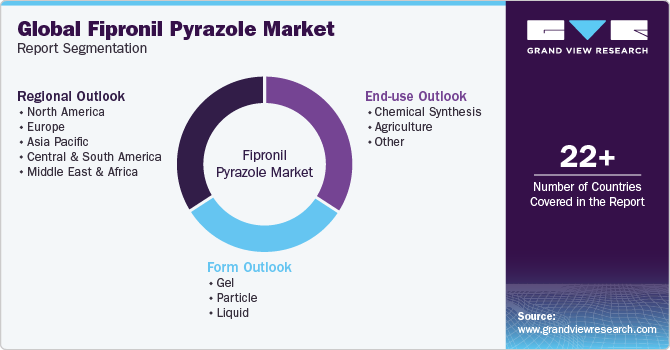
This report forecasts revenue growth at global, regional, and country levels and provides an analysis of the latest industry trends in each of the sub-segments from 2021 to 2033. For this study, Grand View Research has segmented the global fipronil pyrazole market report based on form, end-use, and region.
 To learn more about this report, Download Free Sample Report
 -
Form Outlook (Volume, Kilotons; Revenue, USD Million; 2021 - 2033)
-
Gel
-
Particle
-
Liquid
-
-
End-use Outlook (Volume, Kilotons; Revenue, USD Million; 2021 - 2033)
-
Chemical Synthesis
-
Agriculture
-
Other
-
-
Regional Outlook (Volume, Kilotons; Revenue, USD Million; 2021 - 2033)
-
North America
-
U.S.
-
Canada
-
Mexico
-
-
Europe
-
Germany
-
UK
-
France
-
Italy
-
Spain
-
-
Asia Pacific
-
China
-
India
-
Japan
-
South Korea
-
-
Central & South America
-
Brazil
-
Argentina
-
-
Middle East and Africa
-
Saudi Arabia
-
South Africa
-
-
Research Methodology
The fipronil pyrazole market figures in this report are based on a proven research process that combines executive interviews with secondary research from proprietary databases, company filings, and recognized regulatory and institutional sources. Market size is built through value-chain sizing - reconciling supply-side and demand-side estimates - and triangulated with bottom-up and top-down approaches. Every estimate passes multiple levels of expert validation before publication, with each fipronil pyrazole segment quantified using the revenue-capture definitions in the table below.
Segment Definition
Segment - Form
Revenue capture definition
Gel
Business expansion is supported by increasing utilization of gel-based fipronil formulations for household pest control, veterinary applications, and targeted insect management where controlled placement and prolonged effectiveness are essential.
Particle
Market value is driven by the adoption of granular and particulate formulations in agricultural pest management, enabling efficient soil treatment, seed protection, and long-lasting control of subterranean insects across diverse crop systems.
Liquid
Commercial growth is fueled by extensive use of liquid formulations in foliar spraying, seed treatment, and professional pest control services, offering broad coverage, operational flexibility, and effective insect management across agricultural and non-agricultural environments.
Segment - Application
Revenue capture definition
Chemical Synthesis
Sales momentum is strengthened by the incorporation of fipronil pyrazole as an intermediate in chemical manufacturing and research activities focused on developing advanced agrochemical formulations and specialty compounds.
Agriculture
Industry expansion is reinforced by widespread application in crop protection programs to control a broad range of economically significant insect pests, helping improve crop quality, yield stability, and farm productivity.
Other End-uses
Demand is sustained through utilization in veterinary products, public health pest management, structural termite control, and other specialized insect control applications requiring effective and long-lasting pest suppression.
Estimation Model
Layer Name
Key Question
Description
Raw Material & Production Layer
What forms the supply base?
Assess global fipronil pyrazole production based on the availability of key chemical intermediates, pyrazole derivatives, active ingredients, solvents, formulation additives, and packaging materials. Evaluate synthesis, formulation, quality control, and packaging processes while analyzing raw material sourcing, production costs, manufacturing technologies, capacity utilization, and major production centers influencing global supply.
Application Adoption Layer
Where is fipronil pyrazole consumed?
Examine the adoption of fipronil pyrazole across major end-use sectors, including agriculture, chemical synthesis, veterinary products, public health pest control, and termite management. Demand is influenced by the need for effective broad-spectrum insect control, improved crop protection, long-lasting residual activity, and reliable pest management across agricultural and non-agricultural applications.
Consumption Intensity Layer
How much fipronil pyrazole is utilized?
Analyze consumption patterns by evaluating usage volumes across crop protection programs, seed treatment, soil treatment, chemical manufacturing, and specialized pest control applications. The assessment considers seasonal demand, cultivated area, pest infestation levels, application frequency, regional agricultural practices, and industry-specific utilization trends to estimate overall market consumption.
Revenue Layer
How is market revenue generated?
Market value is generated through the commercialization of fipronil pyrazole formulations supplied to agrochemical manufacturers, distributors, farming enterprises, chemical producers, and professional pest management providers. Business expansion is supported by increasing agricultural intensification, rising demand for high-performance insecticides, product innovation, broader distribution networks, regulatory compliance initiatives, and investments in advanced formulations that strengthen long-term market competitiveness.
Delivered Customizations
This report has been delivered with the following In-depth customizations
Client Request
Customization Delivered
Value Adds
Regional Segmentation
The study delivers detailed country-level analysis across major fipronil pyrazole production and consumption markets. It evaluates raw material availability, manufacturing capacity, supply chain dynamics, import-export trends, regulatory frameworks, pricing outlook, agricultural demand, and adoption across chemical synthesis, agriculture, and other end-use applications.
Enables stakeholders to identify high-growth regional markets, assess production competitiveness, understand regulatory landscapes, optimize sourcing strategies, and prioritize expansion opportunities based on evolving agricultural and industrial demand.
Competitive Benchmarking
The report provides a comprehensive benchmarking assessment of leading fipronil pyrazole manufacturers, covering product portfolios, production capabilities, geographic footprint, distribution networks, research and development initiatives, regulatory compliance strategies, operational strengths, and recent strategic developments.
Helps businesses evaluate competitive positioning, identify portfolio gaps, benchmark innovation capabilities, support strategic collaborations, and strengthen long-term market expansion and differentiation strategies.
Opportunity Assessment
The study evaluates emerging growth opportunities across advanced insecticide formulations, precision agriculture, integrated pest management, seed treatment technologies, expanding agricultural activities, and specialty pest control applications. It also examines opportunities arising from formulation innovation, digital farming adoption, and increasing investments in sustainable crop protection solutions.
Assists companies in identifying high-potential application areas, aligning innovation with evolving customer requirements, optimizing investment decisions, accelerating market penetration, and enhancing long-term business growth potential.
Frequently Asked Questions About This Report
The global fipronil pyrazole market is expected to grow at a CAGR of 3.6% from 2026 to 2033, reaching USD 405.2 million by 2033.
Based on form, the liquid segment accounted for the highest market share, representing 47.0% of total revenue in 2025, driven by its ease of application, superior formulation stability, and widespread adoption across agricultural pest control and professional insect management applications.
By end-use, agriculture held a dominant position, contributing 74.6% of total revenue in 2025, due to the widespread use of fipronil pyrazole insecticides for protecting high-value crops against a broad spectrum of insect pests, thereby improving yield and crop quality.
Asia Pacific is the fastest growing region with a CAGR of 3.9% in the forecast period, due to increasing demand for crop protection solutions, rising adoption of modern farming practices, and the strong presence of agrochemical manufacturing across countries such as China and India.
Particle is the fastest growing form segment with a CAGR of 3.9% in the forecast period. Its superior suitability for soil application, seed treatment, and long-lasting insect control is driving increased adoption across modern agricultural practices, supporting its rapid market expansion.
The market is primarily driven by the rising demand for effective crop protection solutions to improve agricultural productivity and minimize pest-related yield losses. Increasing adoption of integrated pest management practices, expansion of commercial farming, and continuous advancements in insecticide formulations are further supporting market growth.
The global fipronil pyrazole market size was valued at USD 306.7 million in 2025 and is estimated at USD 316.0 million in 2026.
Asia Pacific dominated the fipronil pyrazole market with the highest revenue share of 57.2% in 2025. Increasing agricultural production, expanding crop protection activities, and the strong presence of agrochemical manufacturers across China, India, and Southeast Asia continue to reinforce the region's market leadership.
Some key players operating in the fipronil pyrazole market include Abcam Limited; BASF SE; Bayer AG; Gharda Chemicals Limited; GSP; HPM Chemicals; Peptech Biosciences Ltd.; Parijat Industries (India) Pvt. Ltd.; Albaugh LLC.
About the Author(s)
Agrochemicals & Fertilizers Research Team
Bulk Chemicals · Agrochemicals & FertilizersThis report was authored by the agrochemicals & fertilizers research team at Grand View Research - comprising two research analysts, one senior research analyst, and one industry expert - with specialized expertise in the agrochemicals & fertilizers segment of the bulk chemicals industry. All findings are based on proprietary bulk chemicals databases, executive interviews, and regulatory analysis, subject to internal peer review prior to publication.
Last Updated:
Speak to Analyst

Customize this report to your needs - add regions, segments, or data points, with 20% free customization.
Or view our licence options:


ISO 9001:2015 & 27001:2022 Certified
We are GDPR and CCPA compliant! Your transaction & personal information is safe and secure. For more details, please read our privacy policy.


