
- Home
- »
- Advanced Interior Materials
- »
-
Fire-Resistant Building Materials Market Size Report, 2033GVR Report cover

Fire-Resistant Building Materials Market (2026 - 2033)
Size, Share & Trends Analysis Report By End Use (Commercial, Industrial), By Application (Interior Building Systems, Structural Fire Protection), By Product, By Region, And Segment Forecasts
Market Size, 2025
$58.6BMarket Estimate, 2026
$62.2BMarket Forecast, NULL
$94.5BCAGR, 2026–NULL
6.2%Fire-Resistant Building Materials Market Summary
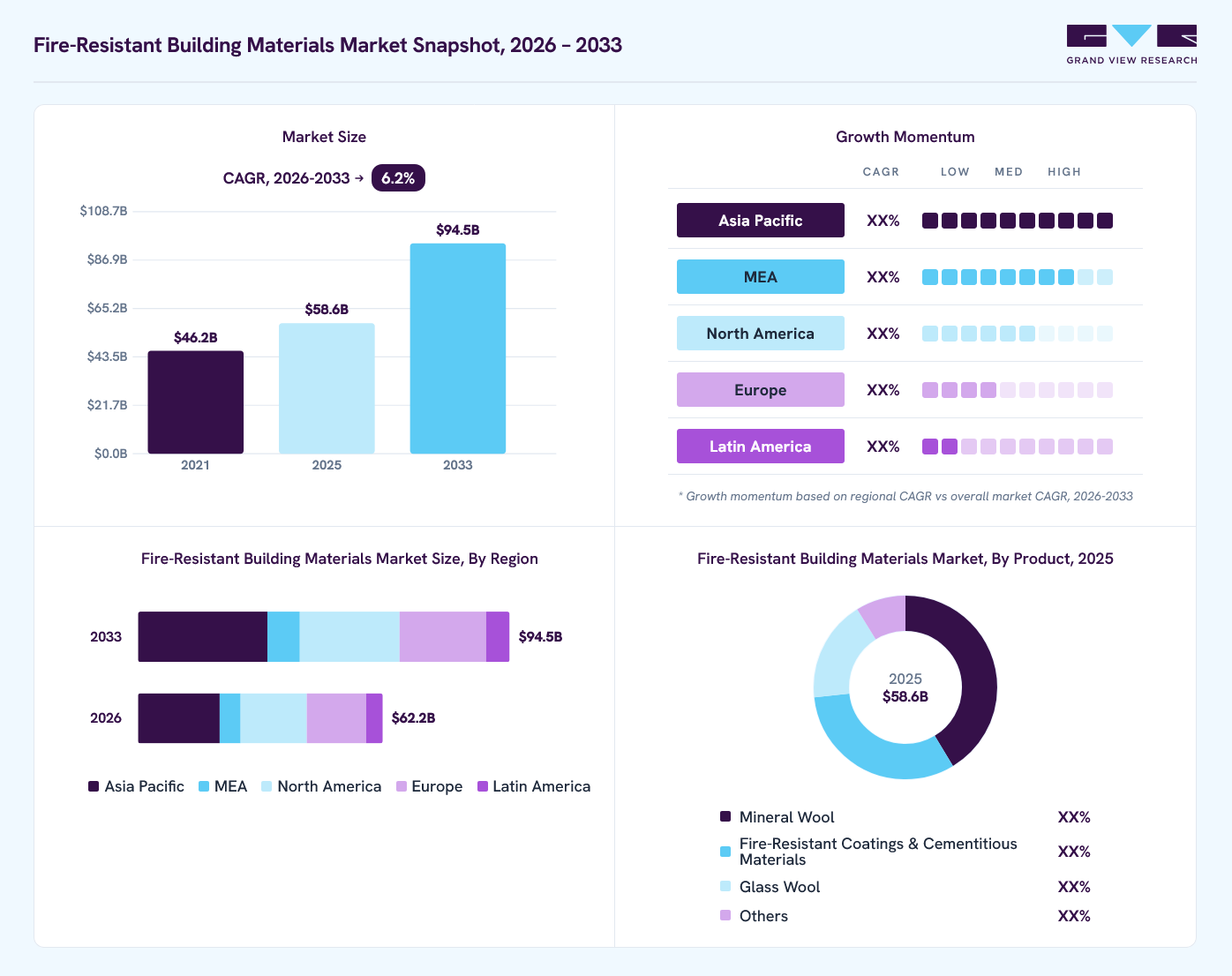
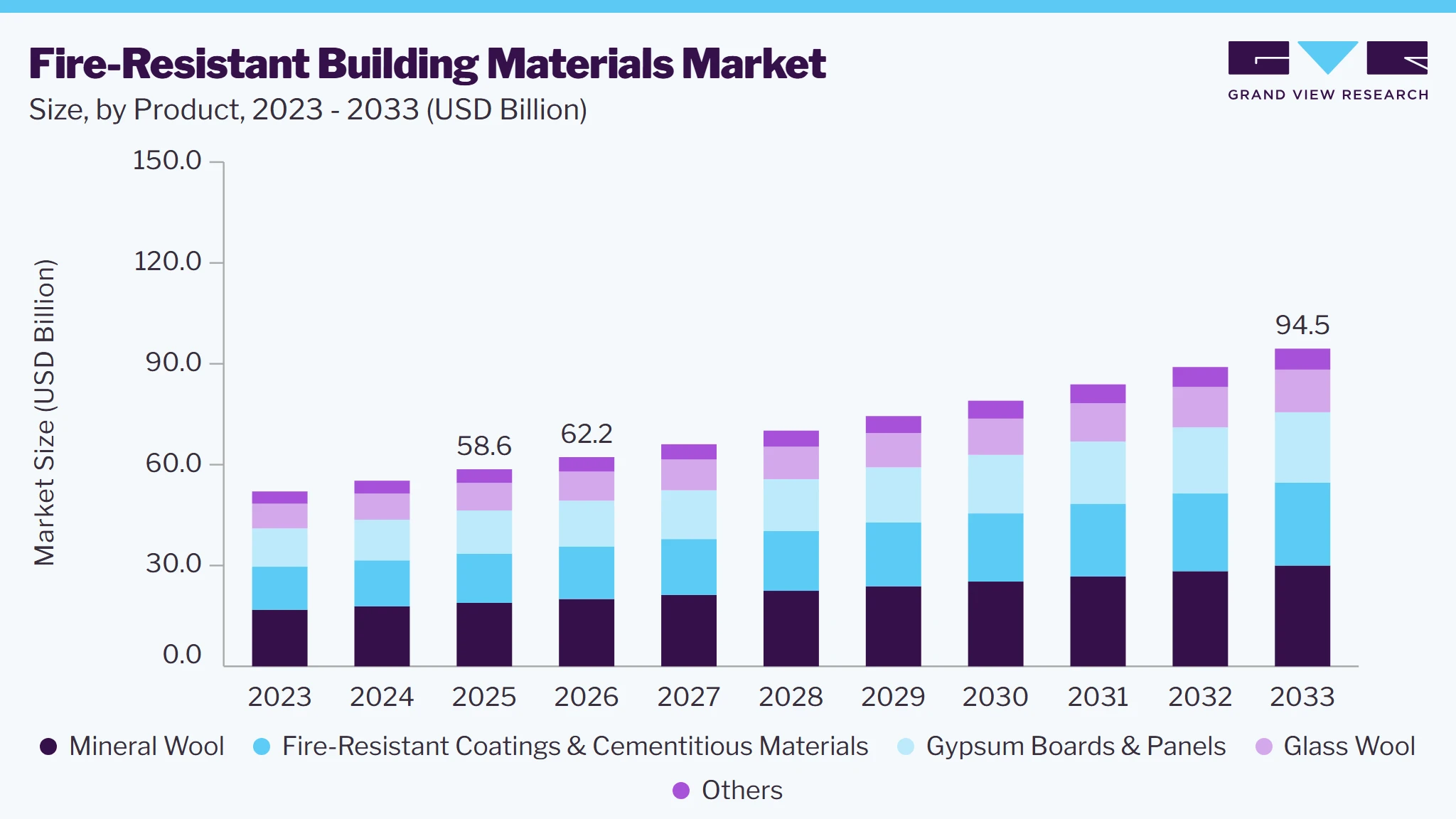
The global fire-resistant building materials market size was valued at USD 58.6 billion in 2025 and is projected to grow from USD 62.2 billion in 2026 to USD 94.5 billion by 2033, at a CAGR of 6.2% from 2026 to 2033. Asia Pacific dominated the market, accounting for a revenue share of 33.2% in 2025. The market is gaining prominence as construction projects increasingly incorporate materials and systems designed to slow the spread of fire, protect structural elements, and maintain building compartmentation.
 Source: Grand View Research, IR Documents, Primary Interviews, Paid DatabasesTo learn more about this report,
 Download Free Sample Report
 Key Market Trends & Insights
- By product: The fire-resistant coatings & cementitious materials segment is expected to grow at a CAGR of 6.8% over the forecast period.
- By application: The interior building systems segment dominated the market, accounting for 30.1% of revenue in 2025.
- By end use: The commercial segment is projected to register a CAGR of 6.7% from 2026 to 2033.
Regional Highlights
- Largest regional market: Asia Pacific (33.2% revenue share, 2025)
- By country: China held the largest market share in 2025
Market Size & Forecast
- Market size in 2025: USD 58.6 Billion
- Estimated market size in 2026: USD 62.2 Billion
- Projected market size by 2033: USD 94.5 Billion
- CAGR (2026-2033): 6.2%
Three ways to get this report
Buy it, customize it, or ask a question.Ask an Analyst
A direct answer, usually in 1 working day
- AccessReport author, directly
- Reply timeWithin 1 working day
- No sales callDirect answer only
- FormatEmail reply
- CostFree, no cost
Get the Full Report
What the study covers
- FormatsPDF · Excel · Dashboard
- TimelineAnnual series with forecast
- Coverage20+ countries, 5 regions
- Companies10+ key players profiled
Customize the Report
20% free customization
- IncludeCountries, segments, points
- TailorTo your product definition
- ExtendDeeper competitor detail
- OrA fully bespoke study
- Turnaround5–10 working days
Demand is supported by the expansion of residential, commercial, industrial, institutional, and infrastructure construction, particularly in high-rise and densely populated areas where fire safety requirements are becoming more prominent. Fire-resistant boards, mineral wool, fire-rated glass, cementitious products, intumescent coatings, firestop sealants, and other passive protection solutions are being integrated into walls, floors, ceilings, façades, structural steel, doors, and service penetrations. The market is also benefiting from greater attention to building safety during material selection and project design.
 To learn more about this report, Download Free Sample Report
 Increasing construction activity and the replacement or renovation of older buildings are creating demand for materials that provide fire protection without significantly affecting structural performance, aesthetics, or installation efficiency. The growing use of steel structures, engineered wood, composite panels, lightweight construction systems, and glazed façades has further increased the need for specialized fire-resistant solutions. Fire-resistant materials are also being incorporated into commercial facilities, warehouses, manufacturing plants, data centers, transportation infrastructure, and energy-related facilities where fire protection is closely linked with asset protection and operational continuity.
Product development is increasingly focused on combining fire resistance with lightweight construction, durability, sustainability, and ease of installation. Intumescent coatings are receiving particular attention because they can expand when exposed to high temperatures and form an insulating char layer that protects the underlying substrate. Recent research is also examining inorganic, silicone-, phosphate-, alkali-silicate-, and geopolymer-based intumescent systems as alternatives to conventional formulations.
Market Dynamics
The market is shaped by the interplay of stricter fire-safety requirements, rising construction activity, evolving building systems, material performance expectations, and technological development. Demand is shifting from conventional fireproofing to integrated passive fire protection systems that combine fire resistance with thermal insulation, acoustic performance, structural protection, durability, and installation efficiency. At the same time, manufacturers face challenges related to material costs, certification, skilled installation, compatibility with different substrates, and environmental requirements.
The increasing use of passive fire protection systems is a major factor supporting demand for fire-resistant building materials. Passive systems such as fire-rated boards, mineral wool, firestop sealants, fire-resistant glass, intumescent coatings, and cementitious protection help contain fire and protect structural components without requiring active intervention. Their application is expanding across walls, floors, façades, structural steel, service penetrations, doors, ceilings, and building envelopes. The growing adoption of lightweight construction, steel structures, engineered wood, composite systems, and high-rise buildings is driving demand for materials that deliver reliable fire performance while meeting the functional and aesthetic requirements of modern buildings.
The focus on whole-building fire safety is also increasing demand for compatible systems rather than individual fire-resistant products. Contractors and designers increasingly consider the interaction between insulation, boards, sealants, coatings, glazing, structural elements, and penetration systems when developing fire-rated assemblies. This creates opportunities for manufacturers to provide tested and certified systems for multiple construction applications. The development of fire-resistant solutions for steel, timber, composite panels, and other substrates is further broadening the addressable market.
The higher cost of specialized fire-resistant materials, testing, certification, and professional installation can limit adoption, particularly in price-sensitive construction projects. Advanced coatings, fire-rated glazing, specialized boards, and certified firestop systems may require higher upfront costs than conventional construction materials. Installation quality can also influence actual fire performance, necessitating trained contractors and proper application procedures. These factors can encourage project developers to balance fire-performance requirements with construction budgets and may slow adoption in jurisdictions with less stringent regulatory requirements.
The shift toward sustainable and multifunctional construction materials creates opportunities for new fire-resistant products that combine fire protection with insulation, acoustic performance, durability, low emissions, and improved environmental characteristics. Manufacturers are exploring halogen-free flame retardants, inorganic intumescent systems, bio-based additives, expandable graphite, geopolymer-based materials, and advanced composite formulations. Recent research has demonstrated the development of halogen-free, silane-based flame-retardant systems for wood, as well as the use of biochar and expandable graphite coatings to improve the fire performance of engineered wood products.
Market Concentration & Characteristics
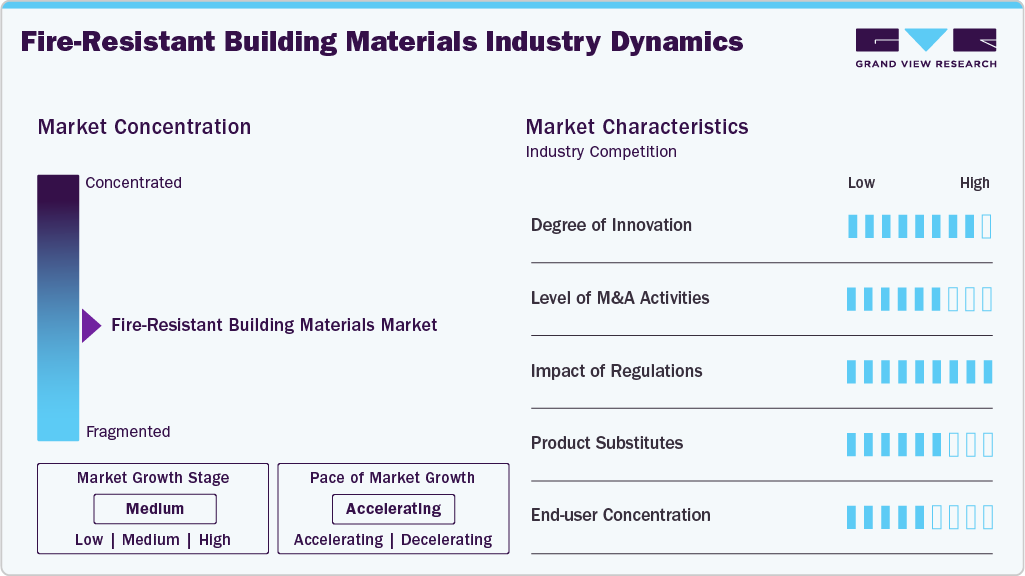
The fire-resistant building materials industry has a diverse competitive landscape, encompassing manufacturers specializing in insulation, boards, coatings, sealants, glass, cementitious products, and integrated passive fire protection systems. Competition is influenced by product certification, technical performance, installation support, distribution reach, application expertise, and the ability to provide complete, tested systems. Established manufacturers benefit from established product portfolios, certification capabilities, contractor relationships, and project specifications, while smaller and emerging participants compete through specialized formulations, local manufacturing, application-specific products, and customized solutions.
 To learn more about this report, Download Free Sample Report
 The threat of substitutes is moderate because fire-resistnt building materials can be replaced or supplemented with alternative protection approaches, depending on the construction system and the required fire rating. Concrete, gypsum-based systems, mineral wool, cementitious coatings, intumescent coatings, fire-resistant glass, fire-rated composite assemblies, and structural design modifications can provide different forms of fire protection. For example, intumescent coatings can protect steel while maintaining its visible profile, whereas fire-resistant boards can provide a physical protective layer around structural components. Research comparing passive protection approaches indicates that different systems can offer different advantages in thermal protection, cost, and environmental performance.
Analyst Perspective
The market is supported by an increasing emphasis on building safety, stricter fire-performance requirements, the renovation of existing structures, and the wider adoption of passive fire protection systems. Demand is shifting toward integrated solutions that provide fire resistance alongside thermal insulation, acoustic performance, durability, and installation efficiency. Product development is also focused on lightweight, sustainable, low-emission, and high-performance materials. Growth opportunities are expected across new construction and renovation projects, particularly in commercial, industrial, high-rise, and infrastructure applications where fire protection is a critical design consideration.
Product Insights
The mineral wool segment held the highest revenue share of 32.2% in 2025, supported by its strong fire resistance, thermal insulation, acoustic performance, and broad use across walls, roofs, façades, ceilings, and other building systems. Its non-combustible characteristics and suitability for meeting stringent fire-safety requirements make it widely adopted across residential, commercial, industrial, and infrastructure projects. Growing demand for energy-efficient and fire-safe buildings further supports the use of mineral wool in both new construction and renovation applications.
The fire-resistant coatings & cementitious materials segment is expected to grow at a CAGR of 6.8% over the forecast period, as construction projects increasingly require effective protection for structural steel, concrete, timber, and other load-bearing components. Intumescent coatings and cementitious fireproofing protect while supporting flexible application across complex structural geometries. Increasing adoption of steel-frame construction, infrastructure development, industrial facilities, and high-performance passive fire protection systems is expected to support segment expansion.
End Use Insights
The commercial segment accounted for the highest revenue share of 42.7% in 2025, driven by the extensive use of fire-resistant materials in offices, hotels, hospitals, retail facilities, educational buildings, data centers, and other commercial structures. These buildings often require fire-rated walls, ceilings, façades, insulation, doors, glazing, and compartmentation systems to meet stringent safety requirements. Continued commercial construction, redevelopment, and renovation activity are supporting demand for certified fire-resistant building materials.
The industrial segment is expected to grow at a CAGR of 6.3% over the forecast period, as manufacturing facilities, warehouses, processing plants, energy facilities, and other industrial structures increasingly incorporate fire-resistant materials to protect buildings, assets, and critical operating areas. The use of steel structures, insulated panels, specialized coatings, and fire-rated compartmentation systems creates consistent demand for passive fire protection. The expansion of industrial infrastructure and the modernization of existing facilities are further supporting the adoption of fire-resistant building materials.
Application Insights
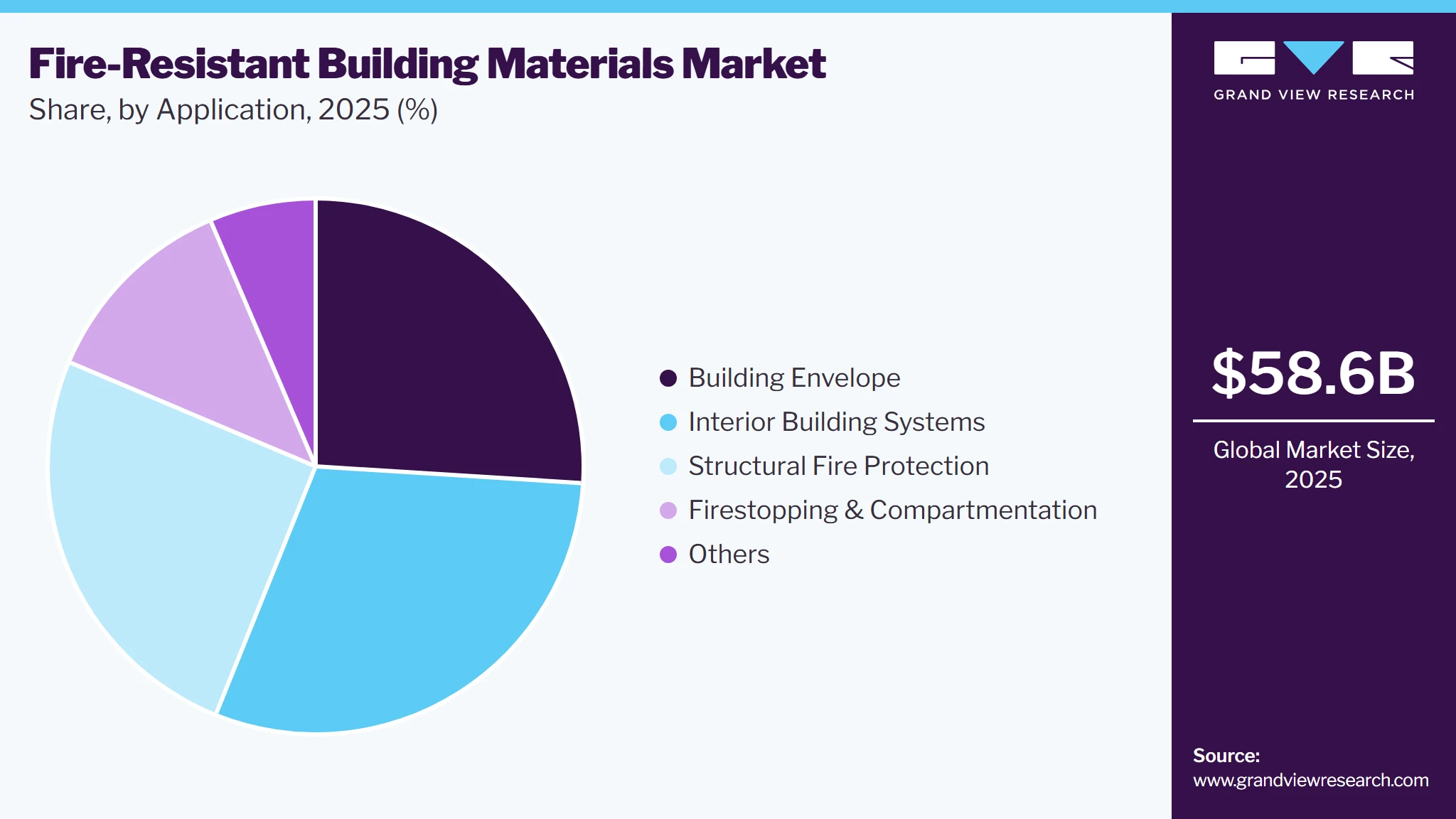
The interior building systems segment held the highest revenue market share of 30.1% in 2025, driven by the widespread use of fire-resistant materials in internal walls, partitions, ceilings, floors, shafts, doors, and other interior components. Gypsum boards, mineral wool, fire-rated panels, and firestop materials are commonly incorporated into interior assemblies to control fire and smoke movement between building spaces. Increasing emphasis on compartmentation and compliance with fire-safety requirements continues to support demand within this application.
 To learn more about this report, Download Free Sample Report
 The structural fire protection segment is expected to grow at a CAGR of 6.8% over the forecast period, with increasing use of steel, concrete, engineered timber, and other structural systems in modern construction. Fire-resistant coatings, cementitious materials, boards, and protective systems help maintain the performance of structural components during fire exposure. The growing construction of high-rise buildings, industrial facilities, infrastructure, and large commercial structures is increasing the need for reliable structural fire protection solutions.
Regional Insights
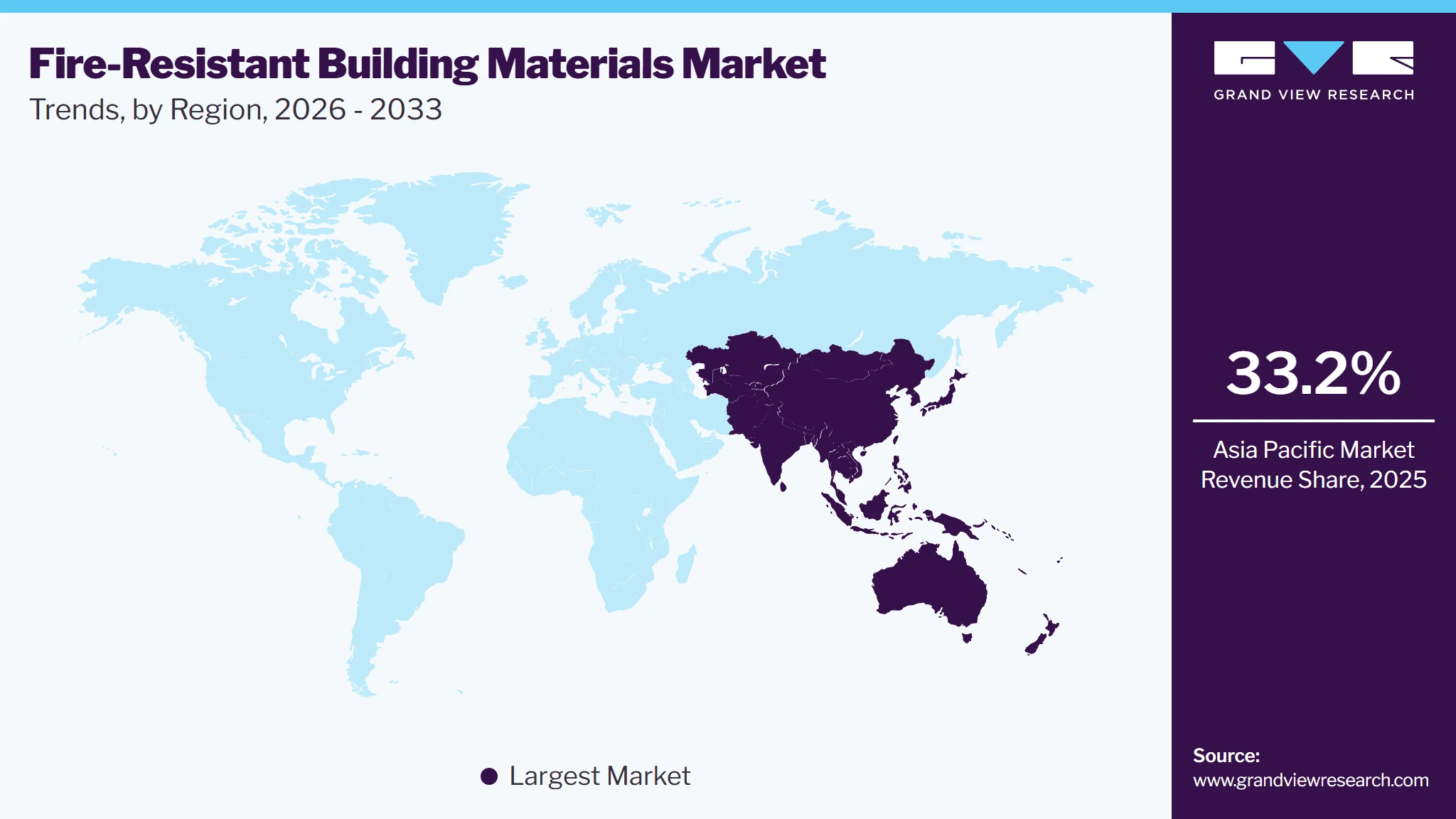
Asia Pacific dominated the global fire-resistant building materials market and accounted for the largest revenue share of 33.2% in 2025, supported by rapid urbanization, expanding construction activity, industrial development, and increasing awareness of building fire safety. Large-scale residential, commercial, industrial, transportation, and infrastructure projects are creating demand for fire-resistant insulation, boards, coatings, sealants, glass, and structural protection materials. High-rise construction and dense urban development are particularly important demand areas because fire compartmentation and structural protection are critical in these buildings.
 To learn more about this report, Download Free Sample Report
 China Fire-Resistant Building Materials Market Trends
The fire-resistant building materials market in China is supported by extensive residential and commercial construction, industrial facilities, infrastructure development, and the modernization of existing buildings. Demand is increasingly focused on fire-rated insulation, boards, coatings, sealants, fire-resistant glass, and façade protection systems. Industrial facilities, warehouses, high-rise buildings, and large public infrastructure projects represent important application areas. Local manufacturers are developing more specialized formulations and integrated systems, while increasing fire-safety awareness is encouraging the use of certified materials.
North America Fire-Resistant Building Materials Market Trends
The fire-resistant building materials market in North America is technologically advanced, supported by established fire safety codes, certification practices, and the widespread adoption of passive fire protection systems. Demand is supported by commercial buildings, high-rise construction, industrial facilities, healthcare infrastructure, data centers, and renovation activity. The region has strong adoption of fire-rated insulation, gypsum boards, firestop systems, intumescent coatings, fire-resistant glazing, and structural fire protection. Increasing attention to building resilience and the protection of critical infrastructure is also encouraging the use of certified fire-resistant systems.
The U.S. fire-resistant building materials market benefits from established building-code requirements and a mature ecosystem of manufacturers, testing laboratories, architects, contractors, and fire-protection specialists. Demand is spread across residential, commercial, institutional, industrial, and infrastructure projects, with particularly strong requirements in high-rise buildings, healthcare facilities, warehouses, manufacturing plants, and other facilities where fire protection is critical. Fire-rated assemblies and penetration protection are increasingly integrated into building design rather than treated as standalone products.
Europe Fire-Resistant Building Materials Market Trends
The fire-resistant building materials market in Europe has a strong focus on building fire safety, product performance, environmental performance, and harmonized construction standards. The market is supported by renovation programs, commercial construction, industrial facilities, and growing requirements for improved building-envelope performance. Fire-resistant insulation, boards, glazing, coatings, sealants, and façade protection systems are widely used. Environmental considerations are increasingly influencing product development, encouraging manufacturers to reduce hazardous substances and to develop lower-emission, more sustainable formulations.
Germany fire-resistant building materials market represents a technically advanced market where fire safety is closely integrated into building design, material selection, and construction standards. Demand is supported by commercial and residential construction, industrial facilities, infrastructure projects, and renovation of existing buildings. Mineral-based insulation, fire-resistant boards, structural protection coatings, firestop products, and fire-rated glazing are important areas of application. The country's emphasis on energy-efficient and sustainable buildings is also encouraging the development of materials that combine thermal insulation and fire resistance.
Central and South America Fire-Resistant Building Materials Market Trends
The fire-resistant building materials market in CSA is experiencing demand from commercial construction, industrial development, residential projects, and infrastructure investment. National building regulations, urbanization, construction modernization, and awareness of fire risks influence adoption. Fire-resistant coatings, boards, insulation, sealants, and glazing systems are increasingly used where higher fire-performance requirements apply. Market development varies across countries due to differences in construction standards, enforcement, local manufacturing capabilities, and the availability of certified products.
Middle East & Africa Fire-Resistant Building Materials Market Trends
The fire-resistant building materials market in MEA is supported by commercial construction, high-rise developments, hospitality projects, industrial facilities, transportation infrastructure, and large-scale urban development. Fire safety is particularly important in dense buildings and major infrastructure projects, creating demand for fire-rated boards, insulation, coatings, sealants, glazing, and structural protection systems. The region's use of steel structures, façade systems, composite panels, and large glazed surfaces creates additional requirements for specialized fire-resistant solutions.
Key Fire-Resistant Building Materials Company Insights
Some of the key players operating in the market include 3M and Saint-Gobain.
-
3M is a diversified technology and manufacturing company offering fire protection solutions such as firestop sealants, firestop mortars, putties, sleeves, and penetration-sealing systems for commercial, industrial, and infrastructure applications.
-
Saint-Gobain is a global building-materials company providing fire-resistant solutions, including gypsum boards, insulation, glazing, and related building systems designed to improve fire safety and building performance.
Knauf Insulation and Sherwin-Williams are some of the emerging market participants.
-
Knauf Insulation is a global insulation manufacturer offering glass mineral wool and rock mineral wool solutions that provide fire resistance, thermal insulation, and acoustic performance across residential, commercial, and industrial buildings.
-
Sherwin-Williams is a global coatings manufacturer offering fire-resistant and intumescent coating solutions for protecting structural steel and other building components against fire exposure.
Key Fire-Resistant Building Materials Companies
The following key companies have been profiled for this study on the fire-resistant building materials market.
-
3M
-
Saint-Gobain
-
Sika AG
-
PPG Industries
-
AkzoNobel
-
Carboline
-
Sherwin-Williams
-
Knauf Insulation
-
ROCKWOOL
-
Promat
Competitive Benchmarking
Category
Operating Strategies
Competitive Edge
Weakness
Established Players: 3M, Saint-Gobain, Sika AG, PPG Industries, AkzoNobel, ROCKWOOL
Invest in advanced fire-resistant materials, coatings, insulation, boards, and firestop systems.
Expand portfolios and manufacturing across insulation, gypsum, coatings, sealants, and structural protection.
Strengthen partnerships with architects, contractors, developers, and distributors.
Established manufacturing and expertise support large-scale commercialization.
Diversified portfolios cover multiple fire-protection applications.
Strong R&D, certification capabilities, technical support, and global distribution.
High capital requirements for R&D, testing, certification, and manufacturing.
Complex qualification and approval processes can extend commercialization timelines.
Raw material, energy, and construction-cycle fluctuations can affect costs.
Emerging Players: Carboline, Sherwin-Williams, Knauf Insulation, Promat
Focus on specialized coatings, mineral wool, fire-resistant boards, cementitious protection, and firestopping.
Expand through partnerships with contractors, architects, applicators, and distributors.
Prioritize fire performance, sustainability, installation efficiency, and customized solutions.
Specialized portfolios address targeted fire-protection requirements.
Technical expertise supports differentiation in fire rating, durability, and application flexibility.
Greater specialization enables customized, application-specific solutions.
Narrower portfolios compared with diversified building-material manufacturers.
Concentration in specific fire-protection categories limits diversification.
Testing, certification, and technical support costs can constrain price competitiveness.
Recent Developments
-
In March 2026, 3M announced an agreement to acquire Madison Fire & Rescue and establish a new fire-and-safety joint venture with Bain Capital, combining Madison’s fire-suppression portfolio with 3M’s Scott Safety business.
-
In April 2025, Carboline launched Thermo-Sorb HB, a two-component high-build elastomeric intumescent coating for shop and field application, offering up to 3.5 hours of fire resistance and incorporating Optifire traceability technology.
Fire-Resistant Building Materials Market Report Scope
Report Attribute
Details
Market size in 2025
USD 58.6 billion
Estimated market size in 2026
USD 62.2 billion
Projected market size by 2033
USD 94.5 billion
Growth rate
CAGR of 6.2% from 2026 to 2033
Actual data
2021 - 2025
Forecast period
2026 - 2033
Quantitative units
Revenue in USD billion and CAGR from 2026 to 2033
Report coverage
Revenue forecast, company ranking, competitive landscape, growth factors, and trends
Segments covered
Product, end use, application, region
Regional scope
North America; Europe; Asia Pacific; CSA; MEA
Country scope
U.S.; Canada; Mexico; Germany; UK; France; Italy; Spain; China; Japan; India; South Korea; Brazil; Saudi Arabia
Key companies profiled
3M; Saint-Gobain; Sika AG; PPG Industries; AkzoNobel; Carboline; Sherwin-Williams; Knauf Insulation; ROCKWOOL; Promat
Customization scope
Free report customization (equivalent up to 8 analysts working days) with purchase. Addition or alteration to country, regional & segment scope.
Pricing and purchase options
Avail customized purchase options to meet your exact research needs. Explore purchase options
Global Fire-Resistant Building Materials Market Report Segmentation
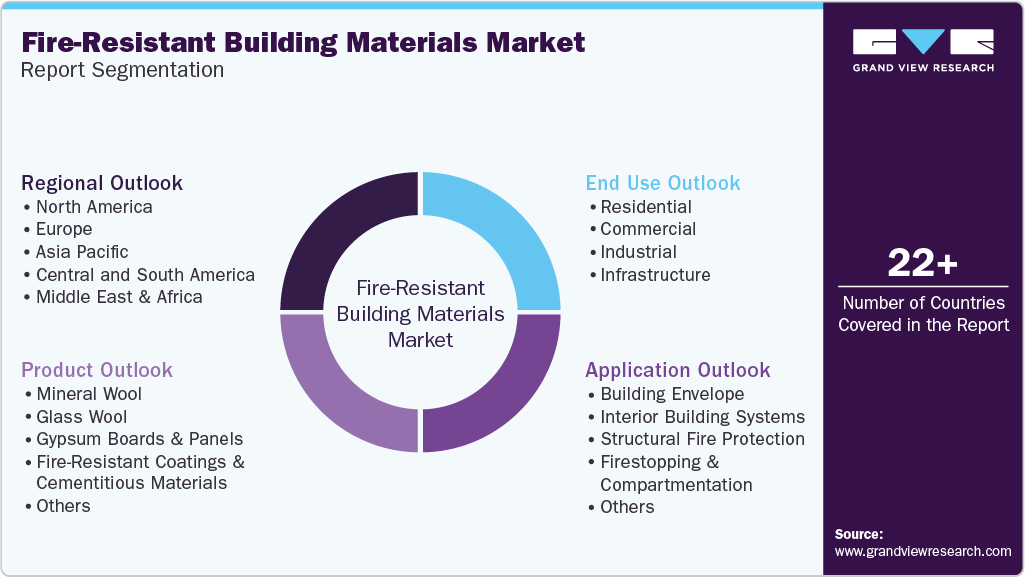
This report forecasts revenue growth at regional & country levels and provides an analysis of the industry trends in each of the sub-segments from 2021 to 2033. For this study, Grand View Research has segmented the global fire-resistant building materials market report based on product, end use, application, and region:
 To learn more about this report, Download Free Sample Report
 -
Product Outlook (Revenue, USD Billion, 2021 - 2033)
-
Mineral Wool
-
Glass Wool
-
Gypsum Boards & Panels
-
Fire-Resistant Coatings & Cementitious Materials
-
Others
-
-
End Use Outlook (Revenue, USD Billion, 2021 - 2033)
-
Residential
-
Commercial
-
Industrial
-
Infrastructure
-
-
Application Outlook (Revenue, USD Billion, 2021 - 2033)
-
Building Envelope
-
Interior Building Systems
-
Structural Fire Protection
-
Firestopping & Compartmentation
-
Others
-
-
Regional Outlook (Revenue, USD Billion, 2021 - 2033)
-
North America
-
U.S.
-
Canada
-
Mexico
-
-
Europe
-
UK
-
Germany
-
France
-
Italy
-
Spain
-
-
Asia Pacific
-
China
-
Japan
-
India
-
South Korea
-
-
Central and South America
-
Brazil
-
-
Middle East and Africa
-
Saudi Arabia
-
-
Research Methodology
The fire-resistant building materials market figures in this report are based on a proven research process that combines executive interviews with secondary research from proprietary databases, company filings, and recognized regulatory and institutional sources. Market size is built through value-chain sizing-reconciling supply-side and demand-side estimates-and triangulated with bottom-up and top-down approaches. Every estimate passes multiple levels of expert validation before publication, with each fire-resistant building materials segment quantified using the revenue-capture definitions in the table below.
Segment Definition
Segment - Product
Revenue Capture Definition
Mineral Wool
Revenue generated from the sale of mineral wool products, including rock wool and slag wool, designed to provide fire resistance, thermal insulation, acoustic insulation, and fire protection in walls, ceilings, façades, roofs, and other building applications.
Glass Wool
Revenue generated from the sale of glass wool products manufactured from glass fibers and used for fire-resistant thermal and acoustic insulation in walls, roofs, ceilings, façades, HVAC systems, and other building applications requiring improved fire performance.
Gypsum Boards & Panels
Revenue generated from the sale of fire-resistant gypsum boards and panels designed to provide fire-rated protection for walls, ceilings, partitions, shafts, and other interior building systems where controlled fire resistance and compartmentation are required.
Fire-Resistant Coatings & Cementitious Materials
Revenue generated from the sale of fire-resistant coatings, intumescent coatings, cementitious fireproofing materials, and related products used to protect structural steel, concrete, wood, and other building components from heat and fire exposure.
Others
Revenue generated from the sale of other fire-resistant building materials, including fire-resistant glass, boards, insulation products, sealants, membranes, doors, and specialized materials used for passive fire protection across construction applications.
Segment - End Use
Revenue Capture Definition
Residential
Revenue generated from the sale of fire-resistant building materials used in houses, apartments, residential complexes, and other residential buildings to improve fire safety across walls, ceilings, façades, insulation systems, structural elements, and internal compartments.
Commercial
Revenue generated from the sale of fire-resistant building materials used in offices, retail facilities, hotels, hospitals, educational buildings, data centers, and other commercial properties requiring fire-rated construction systems and passive fire protection.
Industrial
Revenue generated from the sale of fire-resistant building materials used in factories, warehouses, manufacturing facilities, energy facilities, processing plants, and other industrial buildings where protection of structures, equipment areas, and building compartments from fire is required.
Infrastructure
Revenue generated from the sale of fire-resistant building materials used in infrastructure projects such as transportation facilities, airports, tunnels, stations, public facilities, utilities, and other large-scale infrastructure requiring fire-resistant construction and passive fire protection systems.
Segment - Application
Revenue Capture Definition
Building Envelope
Revenue generated from the sale of fire-resistant building materials used in external walls, façades, roofs, insulation systems, curtain walls, and other building-envelope components to limit fire spread and improve the fire performance of the external structure.
Interior Building Systems
Revenue generated from the sale of fire-resistant materials used in interior walls, partitions, ceilings, floors, doors, shafts, and other internal building systems to provide fire-rated protection and support safe compartmentation within buildings.
Structural Fire Protection
Revenue generated from the sale of fire-resistant materials and protective systems used to protect structural steel, concrete, timber, columns, beams, and other load-bearing components from heat and fire exposure and maintain structural stability during a fire.
Firestopping & Compartmentation
Revenue generated from the sale of firestop sealants, collars, wraps, mortars, boards, barriers, and other materials used to seal service penetrations, joints, openings, and construction interfaces and maintain fire-rated compartments within buildings.
Others
Revenue generated from the sale of fire-resistant materials used in specialized construction applications outside building-envelope, interior, structural, and firestopping systems, including specialized industrial and building-service applications.
Estimation Model
Layer Name
Key Question
Description
Parent Market Analysis
What is the overall size and growth outlook of the broader construction and building-materials markets?
The estimation begins with the broader construction materials, insulation, gypsum, coatings, cementitious, glass, and specialty building-materials markets to establish the addressable market.
Fire-Resistant Material Penetration Analysis
What proportion of building materials is represented by fire-resistant products?
This layer assesses penetration across mineral wool, glass wool, gypsum boards & panels, fire-resistant coatings & cementitious materials, and others, based on fire-safety requirements, certification, and construction-system adoption.
Regional & End-use Demand Assessment
Which regions and end-use sectors generate the highest demand?
Demand is assessed across regions and building envelope, interior systems, structural fire protection, firestopping & compartmentation, and residential, commercial, industrial, and infrastructure applications.
Company Revenue Validation & Market Forecasting
How is the final market size validated and forecast?
Estimates are validated using company revenues, capacities, product portfolios, developments, investments, and project deployments, with bottom-up and top-down approaches triangulated across market segments.
Delivered Customizations
We have successfully delivered the following deep-dive customizations
Client Request
Customization Delivered
Value Adds
Product & Fire-Performance Assessment
Evaluate mineral wool, glass wool, gypsum boards & panels, fire-resistant coatings & cementitious materials, and other fire-resistant building materials based on fire resistance, thermal stability, insulation performance, durability, certification, installation requirements, and application suitability.
Helps identify the performance characteristics, positioning, and application potential of different fire-resistant building materials while highlighting opportunities for higher-performance formulations and integrated passive fire protection solutions.
Application & End-use Demand Assessment
Assess demand across building envelopes, interior building systems, structural fire protection, firestopping & compartmentation, and other applications based on construction activity, fire-safety requirements, building codes, material performance, adoption levels, and renovation activity. Demand is further evaluated across residential, commercial, industrial, and infrastructure end uses.
Provides visibility into high-demand application areas and helps identify end-use sectors offering opportunities for market expansion, product development, and application-specific fire-resistant material solutions.
Competitive Landscape & Capacity Benchmarking
Benchmark key fire-resistant building-material manufacturers based on production capacity, product portfolio, manufacturing footprint, fire-protection technologies, application coverage, geographic presence, partnerships, investments, product launches, acquisitions, and capacity expansion plans.
Provides a clear view of competitive positioning, market concentration, production capabilities, leading participants, strategic strengths, technology differentiation, and potential gaps for new investments, partnerships, or market entry.
Frequently Asked Questions About This Report
The fire-resistant building materials market size was estimated at USD 58.6 billion in 2025 and is expected to reach USD 62.2 billion in 2026.
The fire-resistant building materials market is expected to grow at a compound annual growth rate of 6.2% from 2026 to 2033 to reach USD 94.5 billion by 2033.
The commercial segment is projected to register a CAGR of 6.7% from 2026 to 2033.
Asia Pacific held the highest revenue market share of 33.2% in 2025, driven by rapid construction activity, urbanization, infrastructure development, and increasing adoption of fire-safety standards.
Key factors driving the fire-resistant building materials market include stringent fire-safety regulations, increasing construction activity, growing adoption of passive fire protection systems, and rising demand for safer and high-performance building materials.
Some key players in the fire-resistant building materials market include 3M, Saint-Gobain, Sika AG, PPG Industries, AkzoNobel, Carboline, Sherwin-Williams, Knauf Insulation, Promat, and ROCKWOOL
The interior building systems segment dominated the market, accounting for 30.1% of revenue in 2025.
Which product type segment accounted for the largest fire-resistant building materials market share?The fire-resistant coatings & cementitious materials segment is expected to grow at a CAGR of 6.8% over the forecast period.
About the Author(s)
Advanced Interior Materials Research Team
Advanced Materials · Advanced Interior MaterialsThis report was authored by the advanced interior materials research team at Grand View Research - comprising two research analysts, one senior research analyst, and one industry expert - with specialized expertise in the advanced interior materials segment of the advanced materials industry. All findings are based on proprietary advanced materials databases, executive interviews, and regulatory analysis, subject to internal peer review prior to publication.
Last Updated:
Speak to Analyst

Customize this report to your needs - add regions, segments, or data points, with 20% free customization.
Or view our licence options:


ISO 9001:2015 & 27001:2022 Certified
We are GDPR and CCPA compliant! Your transaction & personal information is safe and secure. For more details, please read our privacy policy.


