
- Home
- »
- Advanced Interior Materials
- »
-
Flat Steel Market Size, Share & Trends Report, 2026-2033GVR Report cover
![Flat Steel Market (2026 - 2033)Report]()
Flat Steel Market (2026 - 2033)
Size, Share & Trends Analysis Report By Product (Sheets & Coils, Plates), By End-use (Buildings & Construction, Railways & Highways), By Region (North America, Europe, APAC, Central & South America, MEA), And Segment Forecasts
Market Size, 2025
$768.6BMarket Estimate, 2026
$777.2BMarket Forecast, 2033
$1,083.4BCAGR, 2026–2033
4.9%Flat Steel Market Summary
The global flat steel market size was valued at USD 768.6 billion in 2025 and is projected to grow from USD 777.2 billion in 2026 to USD 1,083.4 billion by 2033, at a CAGR of 4.9% from 2026 to 2033. The market in Asia Pacific dominated with a revenue share of 62.4% in 2025. Innovations in steel production, such as advanced manufacturing techniques and improved rolling processes, have enhanced the efficiency, quality, and variety of flat steel products.

Key Market Trends & Insights
- By product: Plates segment led the market with the largest revenue share of 66.2% in 2025.
- By end use: Building & construction segment led the market with the largest revenue share of 79.0% in 2025.
Regional Highlights
- Largest regional market: Asia Pacific (62.4% revenue share, 2025)
- By country: The China held the largest market share in 2025.
Market Size & Forecast
- Market size in 2025: USD 768.6 Billion
- Estimated market size in 2026: USD 777.2 Billion
- Projected market size by 2033: USD 1,083.4 Billion
- CAGR (2026-2033): 4.9%
Additionally, shifts in consumer preferences for lighter, stronger, and more aesthetically pleasing materials-especially in sectors like automotive, construction, and appliances-drive the flat steel market. Consumers seek durable, visually appealing, lightweight products, prompting industries to prioritize flat steel's performance and design features.
Moreover, the rising emphasis on infrastructure development and increased demand from key industries, such as construction, automotive, and manufacturing, is expected to propel the market size significantly. Infrastructure projects, including bridges, roads, and buildings, require high-quality steel, boosting demand for flat steel products. In addition, the automotive industry's shift toward lightweight and fuel-efficient vehicles further fuels the demand for flat steel. As these industries expand globally, the need for flat steel, with its versatility and strength, will continue to rise, contributing to the market's growth.
Market Dynamics
The flat steel market is primarily driven by expanding construction and infrastructure activities across both developed and emerging economies. Governments continue to invest in residential housing, commercial buildings, transportation networks, bridges, railways, airports, and renewable energy infrastructure, all of which require significant volumes of hot-rolled coils, cold-rolled coils, plates, and galvanized steel products. Rapid urbanization, industrialization, and smart city developments in countries such as China, India, and Southeast Asian nations are further accelerating demand for flat steel. In parallel, ongoing infrastructure modernization programs in North America and Europe are supporting the replacement and expansion of aging public assets, creating sustained demand for high-strength, corrosion-resistant flat steel products.
Growth in construction and infrastructure development is a primary driver of the flat steel market, as flat steel products are widely used in residential buildings, commercial complexes, industrial facilities, bridges, railways, airports, ports, and highways. Products such as hot-rolled coils, cold-rolled coils, galvanized steel, and steel plates are widely preferred for their high strength, durability, and ease of fabrication. Rapid urbanization and population growth across emerging economies are increasing the need for new housing and public infrastructure, resulting in sustained demand for flat steel.
Government-backed infrastructure investment programs and private-sector construction activities are further supporting market growth. Large-scale projects involving transportation networks, renewable energy installations, logistics hubs, and industrial parks require significant volumes of flat steel for structural and fabrication applications. At the same time, the renovation and modernization of aging infrastructure in developed economies are driving additional demand, while stricter building standards are encouraging the use of high-quality, corrosion-resistant flat steel products for long-term construction projects.
Volatility in raw material prices is a major restraint for the flat steel market, as key inputs such as iron ore, coking coal, scrap steel, and ferroalloys experience frequent price fluctuations due to supply disruptions, geopolitical tensions, mining constraints, and changing global demand. These cost variations increase production expenses for steel manufacturers, reduce profit margins, and make long term pricing contracts more difficult. As a result, manufacturers often face challenges in maintaining stable product prices, while end users in construction, automotive, and manufacturing sectors may delay purchases or seek alternative materials during periods of elevated steel prices.
The rising demand for green and low carbon steel presents a significant growth opportunity for the flat steel market as governments, automakers, construction companies, and industrial manufacturers increasingly prioritize decarbonization and sustainable sourcing. Investments in electric arc furnaces, hydrogen based steelmaking, renewable energy integration, and carbon capture technologies are enabling steel producers to lower greenhouse gas emissions while meeting evolving environmental regulations. As industries seek materials with a reduced carbon footprint to achieve their sustainability targets, demand for low emission flat steel products is expected to grow, creating new revenue opportunities for manufacturers that invest in cleaner production technologies and certified green steel offerings.
Analyst Perspective
The flat steel market is expected to maintain steady long-term growth, supported by rising investments in infrastructure, construction, automotive manufacturing, renewable energy, and industrial development. Flat steel remains an essential material due to its strength, versatility, and ease of fabrication, making it indispensable for products ranging from building structures and bridges to vehicle body panels, appliances, and heavy machinery. While fluctuations in raw material prices and increasing environmental regulations continue to challenge manufacturers, the industry's transition toward green and low-carbon steel is creating significant opportunities for product differentiation and long-term value creation.
Product Insights
Based on product, plates segment led the market with the largest revenue share of 66.2% in 2025, propelled by their widespread use in heavy industries such as construction, shipbuilding, and energy. Steel plates are essential for producing large structures like bridges, tanks, and machinery, where strength and durability are critical. Their versatility and ability to withstand extreme conditions have driven high demand in sectors requiring heavy-duty materials. Furthermore, the growing need for infrastructure development and industrial expansion continues to bolster the prominence of the plates segment in the flat steel market.
Moreover, the sheets & coils segment is projected to emerge as the fastest-growing segment and grow at a CAGR of 5.0% over the forecast period, attributed to their widespread applications across various industries, including automotive, construction, and appliances. These products are crucial for manufacturing lightweight, high-strength components that meet evolving consumer and industry demands. The automotive sector’s focus on reducing vehicle weight for fuel efficiency and emissions standards drives increased demand for steel sheets and coils. Besides, their adaptability in producing consumer goods and infrastructure components positions this segment for significant growth in the coming years.
End-use Insights
Based on end use, building & construction segment led the market with the largest revenue share of 79.0% in 2025, owing to its widespread use in structural applications such as bridges, buildings, and infrastructure projects. Flat steel offers high strength, durability, and versatility, making it ideal for constructing frameworks, roofing, cladding, and reinforced structures. With rapid urbanization, rising infrastructure investments, and an increasing focus on sustainable building materials, demand for flat steel in the construction sector continues to increase. Its supporting modern, large-scale projects solidify its foothold in the market.

The automotive and aerospace segment is expected to emerge as the fastest growing segment and is poised to capture a CAGR of 5.2% over the forecast period, fueled by escalating demand for lightweight, high-strength materials. In the automotive industry, flat steel is crucial for producing vehicle bodies, where innovations in material design aim to reduce weight for improved fuel efficiency and performance. Moreover, in aerospace, flat steel plays a vital role in manufacturing structural components for aircraft. As both industries prioritize sustainability, safety, and advanced engineering, flat steel's versatility and performance characteristics are set to drive substantial growth in these sectors.
Regional Insights
Asia Pacific Flat Steel Market Trends
Asia Pacific dominated the flat steel market with the largest revenue share of 62.4% in 2025, attributed to the region’s robust industrial base, rapid economic growth, and surging demand from various sectors. Countries such as China, India, and Japan are major consumers and producers of flat steel due to their expanding infrastructure projects and rising automotive industries. In addition, the region's competitive pricing, large-scale production capabilities, and government initiatives promoting industrial growth further contribute to its dominance. The availability of raw materials and a well-established steel manufacturing base solidify Asia Pacific’s leading position in the global market.

Asia Pacific is projected to grow at a notable CAGR from 2025 to 2033, spurred by fast-paced industrialization, strong demand from key sectors, and the region’s substantial steel production capacity. Countries such as China, Japan, and India are major contributors, with China being the world's largest steel producer. The region's growing infrastructure projects and expanding automotive industry fuel the demand for high-quality flat steel. Moreover, the availability of affordable labor and robust supply chains make Asia Pacific a pivotal contributor to the global market.
The flat steel market in the China held the largest share in the Asia Pacific region in 2025 due to its rapid industrialization, massive infrastructure projects, and booming automotive sector. As the world's largest steel producer and consumer, China's demand for flat steel is fueled by its continued growth in construction, manufacturing, and transportation. The government's focus on expanding infrastructure and upgrading manufacturing capabilities further accelerates steel consumption. With investments in advanced steel production technologies and sustainable practices, China’s prominence in the flat steel market is set to strengthen shortly.
India flat steel market is anticipated to grow at a noteworthy CAGR over the forecast period,driven by a surge in industrial growth and extensive infrastructure development. The demand for flat steel products like sheets and coils is escalating as the country focuses on urbanization, smart cities, and transportation networks. The automotive sector’s shift towards lightweight and fuel-efficient vehicles further boosts the need for high-quality steel. Moreover, government initiatives such as "Make in India" and increased foreign investment in manufacturing are set to propel the growth of the market in the forecast period.
North America Flat Steel Market Trends
North America flat steel market is anticipated to emerge as the fastest growing region and expand at a CAGR of 4.5% over the forecast period, driven by strong demand from key industries such as automotive, construction, and manufacturing. The region's ongoing infrastructure development projects and the increasing adoption of advanced manufacturing technologies will fuel the need for high-quality flat steel products. Moreover, the automotive industry's shift toward lightweight, fuel-efficient vehicles is poised to boost the demand for steel sheets and coils. Besides, North America's focus on reshoring manufacturing activities further enhances the market growth prospects for flat steel in the region.
U.S. Flat Steel Market Trends
The U.S. flat steel market held a considerable position in the flat steel market in 2024, spurred bysurging demand across various industries, such as automotive, construction, and energy. The growing shift toward electric vehicles and infrastructure development drives the need for high-strength, lightweight steel solutions. Furthermore, the U.S. government’s focus on boosting domestic manufacturing and reducing steel imports is likely to strengthen the local steel industry. With technological breakthroughs and an emphasis on sustainable practices, the U.S. is well-positioned for significant growth in the flat steel market.
Mexico is projected to achieve a substantial CAGR over the forecast period, owing to its burgeoning manufacturing sector, particularly in the automotive and construction industries. As major automotive manufacturers expand operations in the country, the demand for high-quality flat steel is expected to surge. Mexico’s strategic location, trade agreements like the USMCA, and favorable labor costs further enhance its appeal as a manufacturing hub. Besides, increasing infrastructure development and government initiatives to boost industrial output are anticipated to drive ample growth in Mexico flat steel market in the years ahead.
Europe Flat Steel Market Trends
Europe flat steel market achieved sizable share in 2024, attributed to the region’s well-established industrial base, strong manufacturing sectors, and advanced technological capabilities. The region's automotive, construction, and machinery industries are major consumers of flat steel products, driving consistent demand. Additionally, Europe's focus on innovation, sustainability, and high-quality steel production further supports its presence. The presence of key steel-producing countries like Germany, Italy, and France, coupled with the European Union's trade policies and economic integration, has solidified Europe’s position as a leading contributor to the global market.
Germany is anticipated to accumulate remarkable gains by 2030, propelled by the country’s strong industrial base, particularly in the automotive, machinery, and construction sectors. As Europe's largest steel producer, Germany benefits from advanced manufacturing technologies and a robust demand for high-quality steel products. The push toward sustainable production, green steel technologies, and Germany’s focus on infrastructure and innovation will further fuel market growth. The country’s strategic position within the European Union also enhances its trade opportunities, reinforcing Germany's key role in the flat steel market expansion.
France is poised to establish a considerable foothold during the forecast period, fueled by its strong industrial base and escalating demand from sectors like automotive, construction, and energy. France automotive industry’s focus on producing lightweight, fuel-efficient vehicles is driving the demand for high-quality flat steel products such as sheets and coils. Furthermore, ongoing infrastructure projects and the push for renewable energy infrastructure are anticipated to boost steel consumption further.
Key Flat Steel Company Insights
Some of the key companies in the flat steel market include ArcelorMittal, Baosteel Group, Ezz Steel, HBIS Group, JFE Steel Corporation, Nippon Steel Corporation, Nucor, Outokumpu, POSCO, Tata Steel Limited, ThyssenKrupp AG, United States Steel Corporation, Voestalpine Group, and others.
-
ArcelorMittal provides a comprehensive range of steel products, including flat and long steel and advanced materials for the automotive, construction, and energy sectors. The company also offers mining services, supplying essential raw materials like iron ore and coal, focusing on sustainability and innovation.
-
Tata Steel Limited provides high-quality steel solutions for various sectors, such as automotive, construction, and engineering. Its product offerings focus on sustainability and innovation.
Key Flat Steel Companies:
The following key companies have been profiled for this study on the flat steel market.
-
ArcelorMittal
-
Baosteel Group
-
Ezz Steel
-
HBIS Group
-
JFE Steel Corporation
-
Nippon Steel Corporation
-
Nucor
-
Outokumpu
-
POSCO
-
Tata Steel Limited
-
ThyssenKrupp AG
-
United States Steel Corporation
-
Voestalpine Group
Competitive Benchmarking
Category
Operating Strategies
Competitive Edge
Weakness
Established Players (e.g. ArcelorMittal, Baosteel Group)
- Mature participants in the flat steel market primarily focus on integrated steel production, large scale manufacturing, and long term supply agreements with customers across automotive, construction, shipbuilding, machinery, energy, and appliance industries.
- These companies operate comprehensive production facilities that include ironmaking, steelmaking, hot rolling, cold rolling, galvanizing, and coating operations, enabling them to manufacture a wide range of flat steel products with consistent quality.
- Established players possess significant competitive advantages through their integrated manufacturing infrastructure, extensive production capacities, and secure raw material supply chains.
- Their ability to manufacture flat steel products at large scale enables lower production costs, consistent quality, and reliable delivery for high volume industrial customers.
- Despite their strong market positions, mature players face challenges related to high capital intensity, energy consumption, and environmental compliance costs.
- Flat steel manufacturing requires substantial investments in blast furnaces, rolling mills, galvanizing lines, and emissions control systems.
Emerging & Regional Players (e.g., Ezz Steel)
- Emerging participants in the flat steel market generally focus on regional production, specialized flat steel grades, and flexible manufacturing capabilities.
- Rather than competing directly with established integrated steel producers on production scale, these companies target niche opportunities involving coated steel, high strength steel, electrical steel, and customized products for growing industrial applications.
- Emerging companies benefit from operational flexibility and the ability to adopt modern steelmaking technologies without extensive legacy infrastructure constraints.
- Their facilities often incorporate advanced automation, intelligent process monitoring, and energy efficient production systems, enabling higher productivity and improved operational performance.
- Emerging participants face significant challenges related to limited production capacity, lower economies of scale, and restricted financial resources.
- Competing against established steel manufacturers with integrated operations, extensive distribution networks, and strong customer relationships can be difficult, particularly in commodity flat steel segments where pricing remains highly competitive.
Recent Developments
-
In January 2025, India initiated a safeguard investigation into non-alloy and alloy steel flat products to assess potential harm from increased imports.
-
In January 2024, Fastmarkets introduced a new pricing index for European flat steel, reflecting products with reduced carbon emissions to promote sustainability.
Flat Steel Market Report Scope
Report Attribute
Details
Market definition
The market size represents the annual value of apparent consumption of flat steel-in various applications.
Market size in 2025
USD 768.6 billion
Estimated market size in 2026
USD 777.2 billion
Projected market size by 2033
USD 1,083.4 billion
Growth rate
CAGR of 4.9% from 2026 to 2033
Base year for estimation
2025
Historical data
2021 - 2024
Forecast period
2026 - 2033
Quantitative units
Revenue in USD million, volume in kilotons, and CAGR from 2026 to 2033
Report coverage
Revenue forecast, volume forecast, company ranking, competitive landscape, growth factors, and trends
Segments covered
Product, end use, and region.
Regional scope
North America; Europe; Asia Pacific; Latin America; Middle East & Africa
Country scope
U.S., Canada, Mexico, Germany, Italy, Russia, France, China, India, Japan, Indonesia, Philippines, Singapore, Thailand, Malaysia, Brazil, Bahrain, Kuwait, Oman, Qatar, Saudi Arabia, UAE
Key companies profiled
ArcelorMittal, Baosteel Group, Ezz Steel, HBIS Group, JFE Steel Corporation, Nippon Steel Corporation, Nucor, Outokumpu, POSCO, Tata Steel Limited, ThyssenKrupp AG, United States Steel Corporation, Voestalpine Group
Customization scope
Free report customization (equivalent up to 8 analysts' working days) with purchase. Addition or alteration to country, regional & segment scope.
Pricing and purchase options
Avail customized purchase options to meet your exact research needs. Explore purchase options
Global Flat Steel Market Report Segmentation
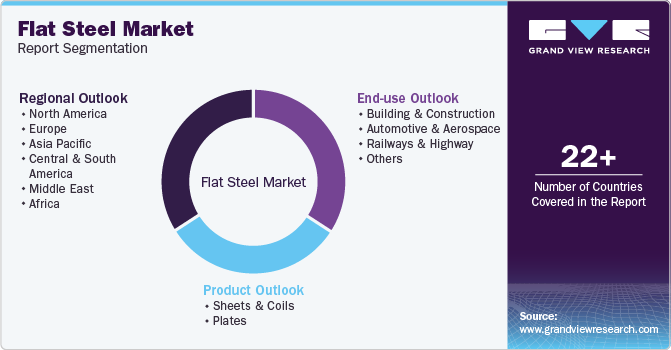
This report forecasts revenue and volume growth at global, regional, and country levels and provides an analysis of the latest industry trends in each of the sub-segments from 2021 to 2033. For the purpose of this study, Grand View Research has segmented the global flat steel market report on the basis of product, end-use, and region:
-
Product Outlook (Revenue, Kilotons, USD Million, 2021 - 2033)
-
Sheets & Coils
-
Plates
-
-
End-use Outlook (Revenue, Kilotons, USD Million, 2021 - 2033)
-
Building & Construction
-
Automotive & Aerospace
-
Railways & Highway
-
Others
-
-
Regional Outlook (Revenue, Kilotons, USD Million, 2021 - 2033)
-
North America
-
U.S.
-
Mexico
-
Canada
-
-
Europe
-
Germany
-
France
-
Italy
-
Russia
-
-
Asia Pacific
-
China
-
India
-
Japan
-
Indonesia
-
Philippines
-
Singapore
-
Thailand
-
Malaysia
-
-
Central and South America
-
Brazil
-
-
Middle East
-
Bahrain
-
Kuwait
-
Oman
-
Qatar
-
Saudi Arabia
-
UAE
-
-
Africa
-
Ethiopia
-
Tanzania
-
Mozambique
-
Rwanda
-
Zimbabwe
-
Kenya
-
-
Research Methodology
The flat steel market figures in this report are based on a proven research process that combines executive interviews with secondary research from proprietary databases, company filings, and recognized regulatory and institutional sources. Market size is built through value-chain sizing - reconciling supply-side and demand-side estimates - and triangulated with bottom-up and top-down approaches. Every estimate passes multiple levels of expert validation before publication, with each flat steel segment quantified using the revenue-capture definitions in the table below.
Segment Definition
Product
Revenue Capture Definition
Sheets & Coils
This segment includes flat rolled steel products in sheet and coil form, including hot rolled, cold rolled, galvanized, and coated steel. Revenue is generated from the sale of these products for applications across automotive, construction, appliances, packaging, and industrial manufacturing.
Plates
This segment includes thick flat steel products manufactured as steel plates for structural and heavy industrial applications. Revenue is generated from the sale of steel plates used in construction, shipbuilding, energy, heavy machinery, bridges, and pressure vessel manufacturing.
End Use
Revenue Capture Definition
Building & Construction
This segment includes flat steel used in residential, commercial, industrial, and infrastructure construction projects. Revenue is generated from the sale of flat steel for roofing, cladding, structural components, bridges, and other construction applications.
Automotive & Aerospace
This segment includes flat steel used in the manufacturing of passenger vehicles, commercial vehicles, electric vehicles, and aerospace components. Revenue is generated from the sale of flat steel for body panels, chassis, structural parts, and other transportation applications.
Railways & Highways
This segment includes flat steel used in railway infrastructure, road construction, bridges, tunnels, guardrails, and transportation facilities. Revenue is generated from the sale of flat steel for rail transport and highway development projects.
Others
This segment includes flat steel used in shipbuilding, energy, industrial machinery, appliances, packaging, and other industrial applications. Revenue is generated from the sale of flat steel across these diverse end use industries.
Estimation Model
Layer Name
Key Question
Description
Steel Consuming Industry Demand Base Layer
What forms the demand base?
Identify global demand from major steel consuming industries including building & construction, automotive, machinery, shipbuilding, appliances, energy, packaging, and infrastructure. Assess industrial production, manufacturing output, and construction activity to establish the total addressable demand for flat steel products.
Flat Steel Application Penetration Layer
Where is flat steel utilized?
Estimate the penetration of flat steel across key applications including structural components, automotive body panels, machinery, pipelines, pressure vessels, appliances, storage tanks, shipbuilding, and packaging. Analyze the adoption of hot rolled, cold rolled, coated, electrical, and plate products across end use industries and regions.
Flat Steel Consumption Intensity Layer
How much flat steel is consumed?
Analyze flat steel consumption intensity based on construction activity, vehicle production, industrial manufacturing, energy infrastructure, and capital investments. Evaluate the utilization of sheets, coils, and plates across different applications. Consumption intensity varies according to product specifications, end use requirements, manufacturing technologies, and regional industrial development.
Revenue Layer
How is market revenue generated?
Market revenue is quantified through the sale of flat steel products including hot rolled coils, cold rolled coils, plates, coated steel, electrical steel, and other flat rolled products. Revenue generation is driven by demand from construction, automotive, industrial manufacturing, energy, packaging, and infrastructure sectors. Market value is influenced by steel prices, raw material costs, product grades, value added processing, and regional supply demand dynamics.
Delivered Customizations
This report has been delivered with the following In-depth customizations
Client Request
Customization Delivered
Value Adds
Regional Segmentation
Detailed regional analysis of the flat steel market across North America, Europe, Asia Pacific, Latin America, and Middle East & Africa. Included evaluation of crude steel production, flat steel manufacturing capacities, construction activity, automotive production, appliance manufacturing, shipbuilding, industrial equipment demand, infrastructure investments, and government policies influencing flat steel consumption.
Identified high growth manufacturing hubs and emerging flat steel demand centers. Enabled strategic expansion planning based on industrialization, infrastructure development, and automotive manufacturing growth. Supported regional demand forecasting and supply chain optimization.
Cross Segmentation
Comprehensive cross segmentation analysis by product, process, end use industry, and region, including hot rolled coils, cold rolled coils, galvanized steel, coated flat steel, plates, and sheets across building & construction, automotive, machinery, energy, shipbuilding, appliances, and packaging industries. Evaluated regional consumption trends, product preferences, processing technologies, and end use demand patterns.
Enabled identification of the most profitable product end use combinations and high growth application segments. Supported product portfolio optimization, customer targeting, and investment prioritization strategies.
Opportunity Assessment
Identification of high growth opportunities across electric vehicles, renewable energy infrastructure, green buildings, advanced manufacturing, appliance production, shipbuilding, industrial machinery, and low carbon steel production.
Enabled prioritization of high return growth segments and emerging regional opportunities. Supported long term investment planning, capacity expansion decisions, product innovation, and strategic business development initiatives aligned with the evolving global steel industry.
Frequently Asked Questions About This Report
The flat steel market size was valued at USD 768.6 billion in 2025 and is expected to reach USD 777.2 billion in 2026.
The flat steel market is expected to grow at a compound annual growth rate of 4.9% from 2026 to 2033 to reach USD 1,083.4 billion by 2033.
Asia Pacific dominated the market with revenue share of 62.4% in 2025.
China dominated the Asia Pacific market with revenue share of 73.0% in 2025
Asia Pacific is anticipated to register the fastest CAGR over the forecast period.
Building & construction accounted for largest revenue share of 79.0% in 2025.
Based on product, plates segment accounted for a market revenue share of 66.2% in 2025.
The key players operating in the flat steel market are ArcelorMittal, Baosteel Group, Ezz Steel, HBIS Group, JFE Steel Corporation, Nippon Steel Corporation, Nucor, Outokumpu, POSCO, Tata Steel Limited, ThyssenKrupp AG, United States Steel Corporation, Voestalpine Group.
The key factor that is driving the growth of the global flat steel market is the growing demand for high strength, lightweight, and durable steel products across the construction, automotive, infrastructure, and industrial manufacturing sectors.
About the Author(s)
Advanced Interior Materials Research Team
Advanced Materials · Advanced Interior MaterialsThis report was authored by the advanced interior materials research team at Grand View Research - comprising two research analysts, one senior research analyst, and one industry expert - with specialized expertise in the advanced interior materials segment of the advanced materials industry. All findings are based on proprietary advanced materials databases, executive interviews, and regulatory analysis, subject to internal peer review prior to publication.
Last Updated:
Speak to Analyst

Need a Tailored Report?
Customize this report to your needs — add regions, segments, or data points, with 20% free customization.
Or view our licence options:


ISO 9001:2015 & 27001:2022 Certified
We are GDPR and CCPA compliant! Your transaction & personal information is safe and secure. For more details, please read our privacy policy.












