
- Home
- »
- Advanced Interior Materials
- »
-
Flow Wrap Machines Market Size Report, 2026-2033GVR Report cover

Flow Wrap Machines Market (2026 - 2033)
Size, Share & Trends Analysis Report By Motion (Continuous, Intermittent), By Feeding (Automatic Feeding, Semi-Automatic / Manual Feeding), By End Use, By Region, And Segment Forecasts
Market Size, 2025
$3.3BMarket Estimate, 2026
$3.5BMarket Forecast, 2030
$5.4BCAGR, 2026–2030
6.5%Flow Wrap Machines Market Summary
The global flow wrap machines market size was valued at USD 3.3 billion in 2025 and is projected to grow from USD 3.5 billion in 2026 to USD 5.4 billion by 2033, at a CAGR of 6.5% from 2026 to 2033. Asia Pacific dominated the market, accounting for a revenue share of 37.7% in 2025. Rising demand for packaged and convenience foods and increasing automation in packaging operations is driving the market globally.
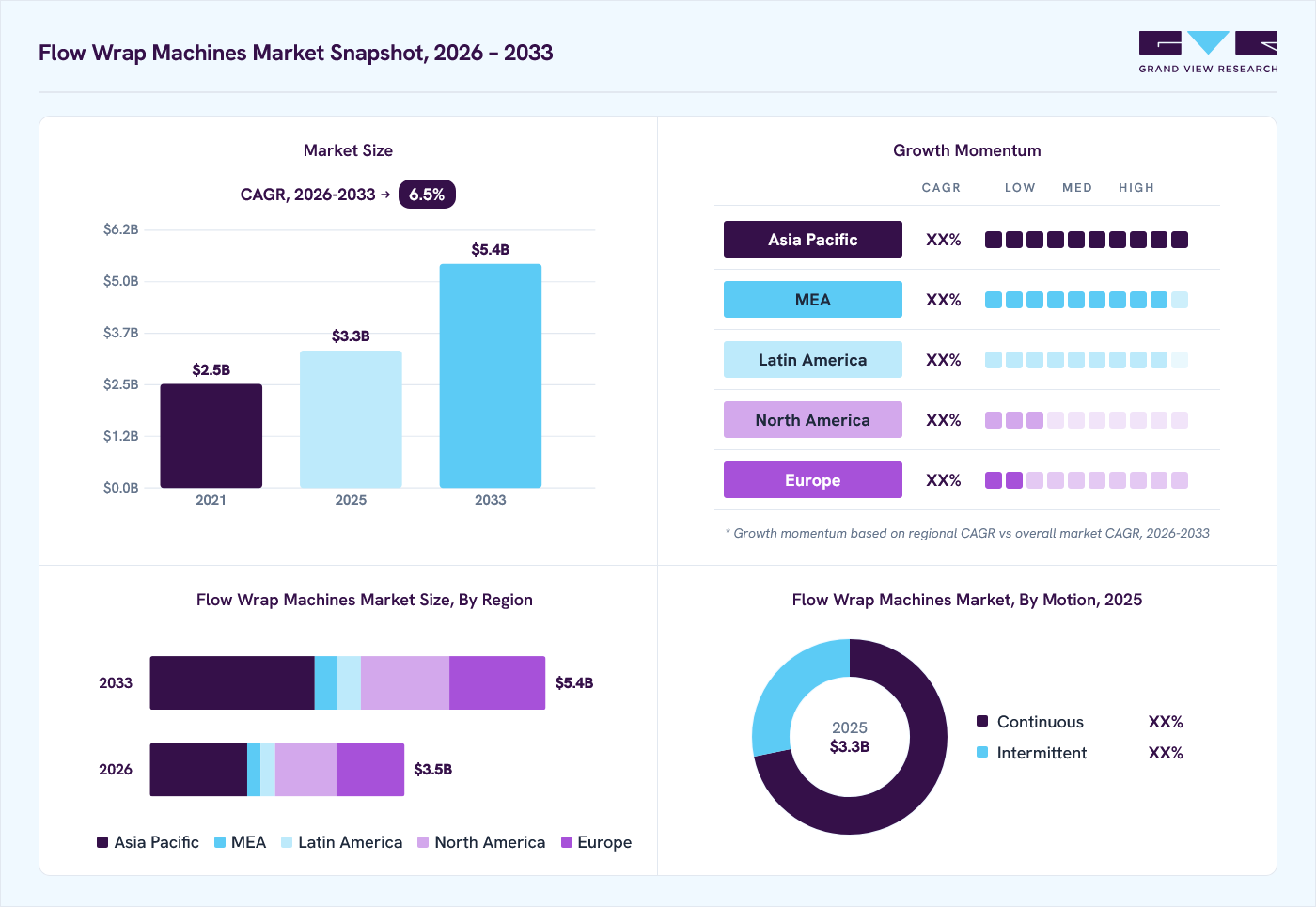 Source: Grand View Research, IR Documents, Primary Interviews, Paid DatabasesTo learn more about this report,
 Download Free Sample Report
 Key Market Trends & Insights
- By motion: The continuous segment accounted for the largest revenue share of 71.7% in 2025.
- By feeding: The semi-automatic/manual feeding segment is expected to grow at the fastest CAGR of 4.0% from 2026 to 2033.
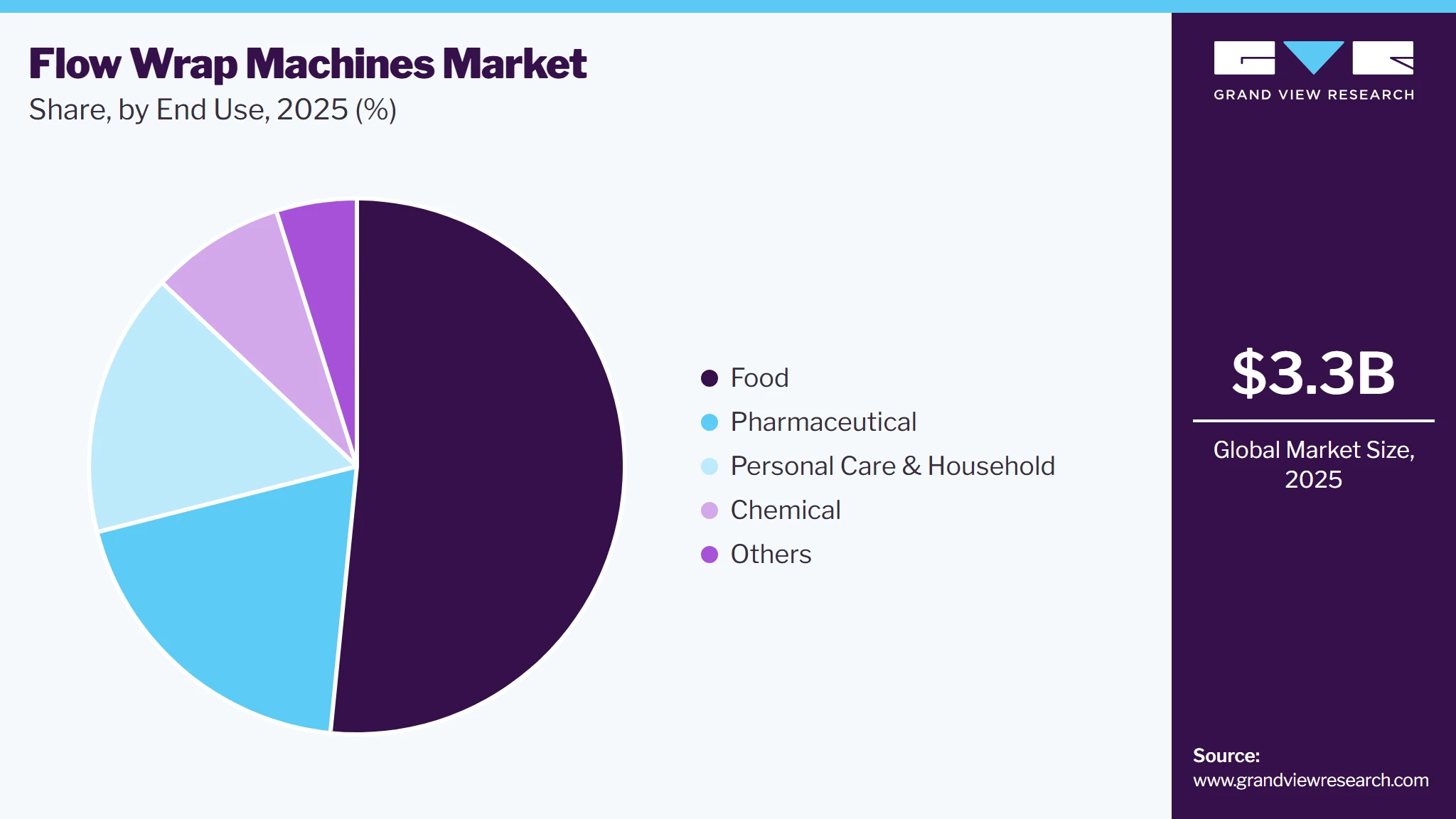
- By end use: The food segment dominated the market in 2025, accounting for 51.6% market share.
Regional Highlights
- Largest regional market: Asia Pacific (37.7% revenue share, 2025)
- By country: China held the largest share in the Asia Pacific region in 2025.
Market Size & Forecast
- Market Size in 2025: USD 3.3 Billion
- Estimated Market Size in 2026: USD 3.5 Billion
- Projected Market Size by 2033: USD 5.4 Billion
- CAGR (2026-2033): 6.5%
Three ways to get this report
Buy it, customize it, or ask a question.Ask an Analyst
A direct answer, usually in 1 working day
- AccessReport author, directly
- Reply timeWithin 1 working day
- No sales callDirect answer only
- FormatEmail reply
- CostFree, no cost
Get the Full Report
What the study covers
- FormatsPDF · Excel · Dashboard
- Timeline2026–2030 annual, 2025 base
- Coverage20+ countries, 5 regions
- Companies10+ key players profiled
Customize the Report
20% free customization
- IncludeCountries, segments, points
- TailorTo your product definition
- ExtendDeeper competitor detail
- OrA fully bespoke study
- Turnaround5–10 working days
Growing consumption of snacks, bakery products, confectionery, ready-to-eat meals, and other packaged foods is increasing the need for efficient wrapping equipment capable of handling high production volumes. Flow wrap machines provide continuous packaging operations, consistent sealing, and flexible packaging formats, making them suitable for food manufacturers with increasing output requirements.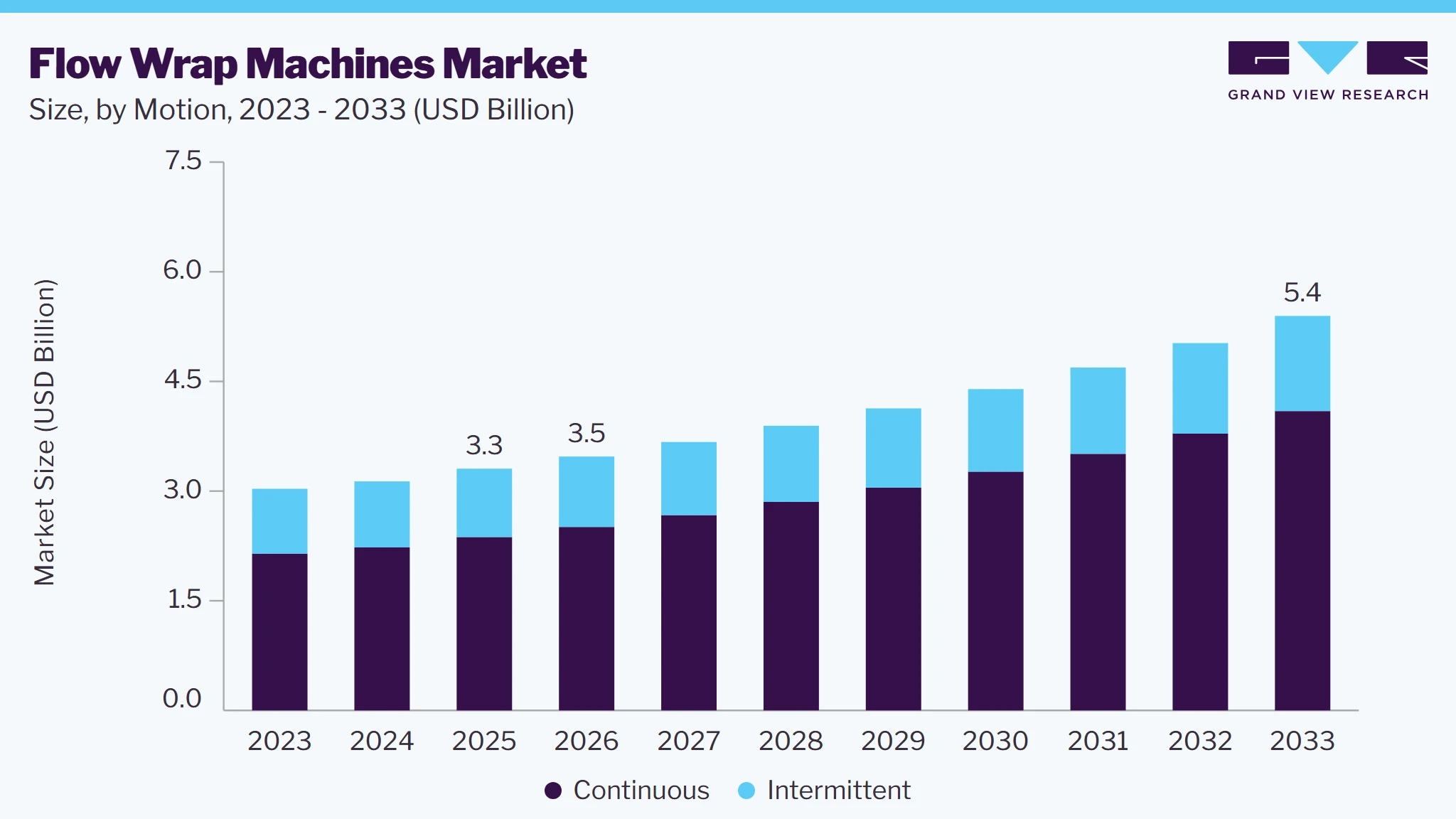 To learn more about this report, Download Free Sample Report
 Manufacturers are increasingly adopting automated packaging equipment to improve production efficiency, reduce manual intervention, and handle higher output volumes. Demand for flexible packaging formats, extended product shelf life, and improved material utilization is further supporting market development.
Market Dynamics
The global flow wrap machines industry is advancing with increased investment in factory automation, machine tool modernization, and high-precision manufacturing. Flow wrap machines are incorporating faster processing architectures, multi-axis interpolation, industrial networking, real-time monitoring, and integrated automation functions to improve machining accuracy, throughput, and production flexibility. The replacement of legacy control systems and integration of CNC equipment with connected manufacturing environments are also shaping technology development and procurement decisions.
Snacks, bakery products, confectionery, ready-to-eat foods, and other products commonly require individual or multipack wrapping. Flow wrap machines provide continuous packaging and consistent sealing for high-volume production. Expansion of packaged food production and changing consumer preferences toward convenient products are therefore increasing requirements for automated wrapping equipment across food-processing facilities.
High initial investment can restrain adoption of flow wrap machines, particularly among small and medium-sized manufacturers. Costs may include the machine, feeding systems, sealing equipment, control systems, installation, and integration with existing production lines. Additional expenses for maintenance, operator training, packaging material changes, and replacement components can increase the overall cost of ownership. Manufacturers with lower production volumes may therefore delay equipment purchases or continue using simpler packaging methods.
Automated feeding, product positioning, sealing, cutting, inspection, and process monitoring can improve production consistency while reducing manual intervention. Integration with broader packaging lines can support higher throughput and more efficient operations. Food, pharmaceutical, personal care, and consumer goods manufacturers investing in automated production systems are therefore creating opportunities for flow wrap machines with automated controls and production-line integration capabilities.
Market Concentration & Characteristics
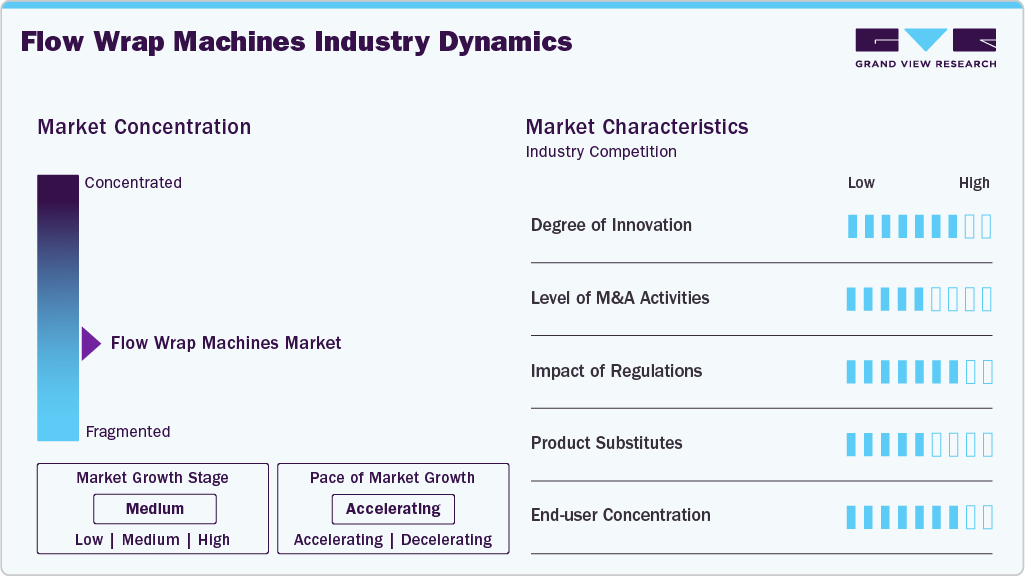
The market for flow wrap machines is moderately fragmented, with global packaging equipment manufacturers, regional suppliers, and specialized machinery companies competing across food, pharmaceuticals, personal care, and consumer goods applications. Companies differentiate through machine speed, packaging flexibility, automation, sealing performance, equipment configuration, and pricing. Regional suppliers compete through customization and service, while established manufacturers benefit from broader product portfolios and distribution networks.
The market is characterized by high technology intensity and substantial development requirements, particularly for high-speed processing, multi-axis control, precision machining, real-time monitoring, and seamless integration with drives and automation systems. Manufacturers are increasingly enhancing controller architecture, software capabilities, connectivity, and user interfaces to address the evolving requirements of digitally connected manufacturing environments.
 To learn more about this report, Download Free Sample Report
 Regulatory standards, cybersecurity requirements, and machine safety provisions influence product development and commercialization across regional markets. High integration requirements between controllers, servo systems, motors, machine tools, and production software create technical and switching barriers for new entrants. Strategic partnerships, technology investments, regional expansion, and acquisitions remain important approaches for strengthening market presence and expanding application coverage.
Analyst Perspective
The market is expected to maintain steady growth as manufacturers prioritize automated, high-throughput, and flexible packaging operations. Demand is shifting toward equipment capable of handling multiple product formats, minimizing changeover time, and maintaining consistent wrapping and sealing performance. Technological advancement is centered on servo-driven motion, automated feeding, digital monitoring, and compatibility with recyclable packaging materials. Manufacturers that combine operational efficiency, machine flexibility, reliable sealing, and integration with modern packaging lines are likely to remain well-positioned as end users continue to modernize their packaging infrastructure.
Motion Insights
Based on motion, the continuous segment accounted for the largest revenue share of 71.7% in 2025. Manufacturers are seeking high-speed packaging solutions for large-volume production. Continuous flow wrap machines enable uninterrupted product feeding, wrapping, sealing, and cutting, supporting higher throughput and consistent packaging. Increasing production of snacks, bakery products, confectionery, and other packaged foods is expected to support demand for continuous machines across automated packaging operations.
The intermittent segment is projected to register the fastest CAGR during the forecast period, as manufacturers require flexible packaging equipment for products with varying sizes, shapes, and packaging requirements. Intermittent flow wrap machines allow controlled product movement and precise sealing, making them suitable for smaller production batches and diverse product formats. Demand from food, pharmaceutical, personal care, and consumer goods applications is expected to support adoption.
Feeding Insights
Based on feeding, the automatic feeding segment accounted for the largest revenue share of 64.9% in 2025. Manufacturers are increasingly adopting automated packaging lines to achieve higher throughput and consistent product handling. Automatic feeding systems reduce manual intervention, improve product positioning, and support continuous flow wrapping. Rising production volumes across food, pharmaceutical, personal care, and consumer goods applications are expected to increase demand for automated feeding systems.
The semi-automatic/manual feeding segment is expected to grow steadily among small and medium-sized manufacturers and operations handling varied products. These systems require lower investment and provide greater flexibility for different product sizes and production volumes. Demand from smaller food processors, specialty manufacturers, and applications with frequent product changes is expected to support adoption of semi-automatic and manual feeding systems.
End Use Insights
The food segment accounted for the largest revenue share in 2025. Manufacturers are increasing production of packaged and convenience foods requiring efficient wrapping solutions. Flow wrap machines are widely used for snacks, bakery products, confectionery, processed foods, and other products. Rising packaged food consumption, higher production volumes, and demand for consistent sealing and product protection are expected to support adoption across food manufacturing facilities.
 To learn more about this report, Download Free Sample Report
 The pharmaceuticals segment is projected to register the fastest CAGR of 7.7% during the forecast period driven by increasing pharmaceutical production and demand for efficient packaging of tablets, medical products, and other packaged items. Flow wrap machines provide controlled wrapping, sealing, and product handling for individual and multipack formats. Growth in pharmaceutical manufacturing, packaging automation, and requirements for consistent and hygienic packaging are expected to support segment expansion.
Regional Insights
Asia Pacific Flow Wrap Machines Market Trends
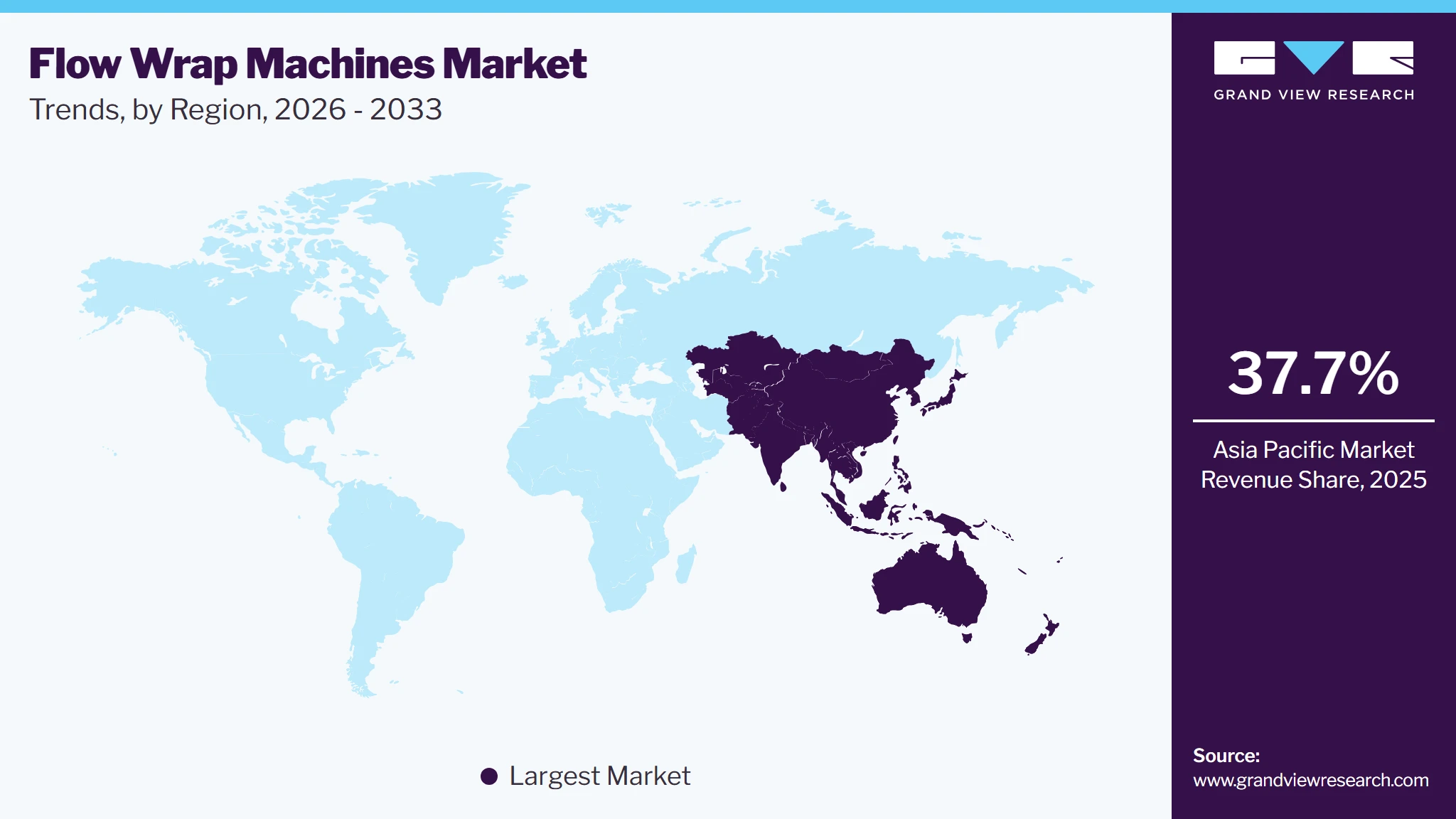
The flow wrap machines industry in Asia Pacific dominated the global market in 2025 and it is also expected to grow at the fastest CAGR over the forecast period, due to expanding packaged food production in China, India, Japan, South Korea, and Southeast Asia. Increasing consumption of individually packaged snacks, bakery products, confectionery, and convenience foods is raising demand for high-speed wrapping equipment. Growth in pharmaceutical manufacturing is providing additional applications. Expansion of organized food manufacturing and investment in automated packaging lines are supporting equipment adoption across the region.
 To learn more about this report, Download Free Sample Report
 China flow wrap machines industry represents a significant market within Asia Pacific, due to its large-scale production of packaged snacks, bakery products, confectionery, instant foods, and other convenience products. Expansion of food-processing facilities is increasing requirements for automated high-speed wrapping. Pharmaceutical manufacturing also provides demand for individual product and multipack packaging. Chinese manufacturers are increasingly upgrading packaging lines to increase throughput and reduce manual operations, supporting replacement and new installations of flow wrap machines.
The flow wrap machines industry in India is expected to grow as packaged snack, biscuit, bakery, confectionery, and ready-to-eat food production expands. Increasing organized food processing is shifting packaging activities toward automated machinery capable of handling larger production volumes. India’s expanding pharmaceutical manufacturing industry provides another application area. Growth in packaged food consumption, development of processing facilities, and investments in automated packaging lines are expected to increase demand for flow wrap machines.
North America Flow Wrap Machines Market Trends
The flow wrap machines industry in North America is driven by the established snack food, bakery, confectionery, and frozen food production in North America. The U.S. and Canada have extensive automated food-processing facilities, creating demand for high-speed wrapping equipment. Growth in pharmaceutical manufacturing and private-label packaged foods is also supporting adoption. Replacement of older packaging machinery and upgrades toward automated feeding, sealing, and inspection systems are further contributing to regional demand.
U.S. Flow Wrap Machines Market Trends
The flow wrap machines industry in the U.S. is expected to remain a major market, supported by high production of snack foods, bakery products, confectionery, frozen foods, and prepared meals. The country’s large pharmaceutical manufacturing base creates additional demand for automated product wrapping. Growth in private-label food production and investments in domestic manufacturing capacity are encouraging packaging-line automation. Demand is also supported by replacement of older machinery with equipment offering higher throughput and automated product handling.
Europe Flow Wrap Machines Market Trends
The flow wrap machines industry in Europe is driven by the high production of bakery products, confectionery, snacks, prepared foods, and pharmaceutical products. Germany, the UK, Italy, and France contribute substantially to regional packaging equipment demand. European manufacturers are also adapting packaging lines to recyclable and lightweight flexible materials. Modernization of production facilities and investments in automated packaging equipment are supporting flow wrap machine adoption across food and pharmaceutical manufacturing.
Germany represents one of the prominent European markets, supported by its large bakery, confectionery, meat-processing, and packaged food industries. The country also has a substantial pharmaceutical manufacturing base, creating demand beyond food applications. German manufacturers are investing in automated production and packaging lines to improve throughput and reduce manual handling. The transition toward recyclable packaging materials is additionally encouraging upgrades to machinery capable of handling changing flexible packaging formats.
The UK flow wrap machines industry is expected to grow over the forecast period, particularly through its bakery, confectionery, snack, prepared food, and pharmaceutical industries. High consumption of individually packaged foods supports continuous wrapping applications. The expansion of convenience and ready-to-eat food production is creating additional equipment requirements. UK manufacturers are also modifying packaging operations to accommodate recyclable materials and improve material efficiency, supporting replacement and upgrading of existing flow wrapping machinery.
Middle East & Africa Flow Wrap Machines Market Trends
The flow wrap machines industry in the Middle East and Africa present an emerging market expected to grow at a CAGR of 7.6% during the forecast period. The growth is attributed to the increase in food manufacturing capacity, particularly in packaged bakery products, snacks, confectionery, and prepared foods which are fueling the demand for flow wrap machines. Gulf countries are expanding domestic food production and processing capabilities, while African markets are increasing packaged food manufacturing. Pharmaceutical production in selected countries provides additional demand. Development of local processing facilities is encouraging investments in automated wrapping and packaging equipment.
Saudi Arabia flow wrap machines industry is expected to grow in the market as domestic food manufacturing expands, particularly in bakery products, snacks, confectionery, frozen foods, and prepared meals. Investments in food-processing capacity is increasing requirements for automated packaging equipment. The country’s efforts to expand local food production and processing are supporting new packaging-line installations. Pharmaceutical and consumer goods manufacturing also provide additional applications for flow wrapping equipment.
Latin America Flow Wrap Machines Market Trends
The flow wrap machines industry in Latin America is driven by its established food-processing industries, particularly bakery, confectionery, snacks, processed foods, and meat products. Brazil, Mexico, Argentina, and Colombia account for important food manufacturing activity. Increasing packaged food consumption is supporting automated wrapping equipment. Expansion of food-processing facilities and modernization of packaging lines are encouraging manufacturers to replace manual or older equipment with higher-throughput flow wrapping systems.
The flow wrap machine industry in Brazil is driven by the large food-processing industry, particularly in bakery products, confectionery, snacks, processed foods, and meat products. The country’s sizeable domestic food market supports high-volume packaging requirements. Expansion of processed food production and modernization of manufacturing facilities are increasing demand for automated wrapping equipment. Pharmaceutical manufacturing provides an additional application area for flow wrap machines.
Key Flow Wrap Machines Company Insights
Some of the key players operating in the market include Syntegon Technology GmbH and IMA Group, among others.
-
Syntegon Technology GmbH is a Germany-based global technology company specializing in processing and packaging solutions for the pharmaceutical, biotech, and food industries. The company offers packaging machinery and integrated systems, including horizontal flow wrapping machines, serving a wide range of industrial packaging requirements. Its capabilities span automated packaging equipment, processing technologies, digital solutions, and lifecycle services. Syntegon serves customers across international markets through its global manufacturing, sales, and service network, with a focus on automation, production efficiency, flexibility, and packaging performance.
-
IMA Group is an Italy-based global manufacturer of automatic processing and packaging machinery serving industries such as pharmaceuticals, medical devices, food, cosmetics, tea, coffee, and consumer goods. The company provides flow wrapping machines and integrated horizontal form-fill-seal packaging solutions for diverse product and packaging requirements. Its portfolio encompasses primary and secondary packaging equipment, processing systems, automation technologies, and complete production lines. IMA Group combines machine engineering, customization, automation, and international service capabilities to address packaging requirements across multiple industrial sectors.
Key Flow Wrap Machines Companies:
The following key companies have been profiled for this study on the flow wrap machines market.
-
Syntegon Technology GmbH
-
IMA Group
-
ULMA Packaging
-
FUJI MACHINERY CO., LTD.
-
Omori Machinery Co., Ltd.
-
PFM Packaging Machinery S.p.A.
-
BW Flexible Systems
-
Theegarten-Pactec GmbH & Co. KG
-
PAC Machinery
-
Paxiom Group
-
Mespack
-
Cavanna Packaging Group S.p.A.
-
Reepack S.r.l.
-
Campbell Wrapper Corporation
-
JOIEPACK Industrial Co., Ltd.
Competitive Benchmarking
Category
Operating Strategies
Competitive Edge
Weakness
Established Players (e.g., Syntegon Technology GmbH; IMA Group; ULMA Packaging; FUJI MACHINERY CO., LTD.; Omori Machinery Co., Ltd.; PFM Packaging Machinery S.p.A.; BW Flexible Systems)
- Develop high-speed flow wrapping systems with automated feeding, servo-driven mechanisms, precise film handling, and integrated controls.
- Expand machine portfolios across product formats, packaging materials, throughput levels, and automated packaging-line configurations.
- Strong brands, broad product portfolios, global service networks, and established customer relationships.
Advanced automation, high throughput, machine reliability, and digital monitoring capabilities strengthen differentiation.
- Higher equipment and R&D costs can constrain competitiveness in price-sensitive applications.
- Sophisticated systems may require greater integration expertise, maintenance capabilities, and technical support.
Emerging & Regional Players (e.g., Theegarten-Pactec GmbH & Co. KG; PAC Machinery; Paxiom Group; Mespack; Reepack S.r.l.; Cavanna Packaging Group S.p.A.; Campbell Wrapper Corporation; JOIEPACK Industrial Co., Ltd.)
- Focus on flexible, modular, and application-specific flow wrapping machines with customized configurations.
Target varied product dimensions, feeding arrangements, production volumes, and packaging requirements through adaptable equipment designs.
- Competitive pricing, customization flexibility, specialized solutions, and responsive regional support.
- Ability to tailor machines to specific packaging requirements strengthens their position in niche and mid-scale installations.
- Smaller geographic coverage and service networks can limit access to international markets.
- Relatively lower R&D resources and product breadth may constrain competition for complex, high-capacity installations.
Recent Developments:
-
On April 8, 2025, ULMA Packaging launched the FM 400 horizontal flow wrapper, developed for high-speed Modified Atmosphere Packaging (MAP) of fresh food products. The machine delivers speeds of up to 150 packs per minute and incorporates a Long-Dwell sealing head for reliable hermetic sealing. It offers top-reel, bottom-reel, and side-seal configurations and supports various barrier films. The FM 400 also features touchscreen controls, MES, ERP, and SCADA connectivity, along with remote service and OEE monitoring capabilities.
-
On April 2, 2025, Syntegon announced the upgraded Pack 103 horizontal flow wrapper, designed for small and medium-sized businesses seeking flexible packaging automation. The machine delivers speeds of up to 175 packs per minute and accommodates various product sizes and packaging formats. Its compact design, simplified operation, and quick changeovers support efficient production and greater operational flexibility. The Pack 103 replaces the Pack 102 and expands Syntegon’s flow-wrapping portfolio for food, non-food, and medical products.
Flow Wrap Machines Market Report Scope
Report Attribute
Details
Market size in 2025
USD 3.3 billion
Estimated market size in 2026
USD 3.5 billion
Revenue forecast in 2033
USD 5.4 billion
Growth rate
CAGR of 6.5% from 2026 to 2033
Base year for estimation
2025
Historical data
2021-2024
Forecast period
2026 - 2033
Quantitative units
Revenue in USD billion and CAGR from 2026 to 2033
Report coverage
Revenue forecast, company market position analysis, competitive landscape, growth factors, and trends
Segments covered
Motion, feeding, end use, and region
Regional scope
North America; Europe; Asia Pacific; Latin America; Middle East & Africa
Country Scope
U.S.; Canada; Mexico; Germany; UK; Italy; Spain; France; China; Japan; India; Australia; South Korea; Brazil; Argentina; Saudi Arabia; UAE; South Africa
Key companies profiled
Syntegon Technology GmbH; IMA Group; ULMA Packaging; FUJI MACHINERY CO., LTD.; Omori Machinery Co., Ltd.; PFM Packaging Machinery S.p.A.; BW Flexible Systems; Theegarten-Pactec GmbH & Co. KG; PAC Machinery; Paxiom Group; Mespack; Reepack S.r.l.; Cavanna Packaging Group S.p.A.; Campbell Wrapper Corporation; JOIEPACK Industrial Co., Ltd.
Customization scope
Free report customization (equivalent up to 8 analysts working days) with purchase. Addition or alteration to country, regional & segment scope.
Pricing and purchase options
Avail customized purchase options to meet your exact research needs. Explore purchase options
Global Flow Wrap Machines Market Report Segmentation
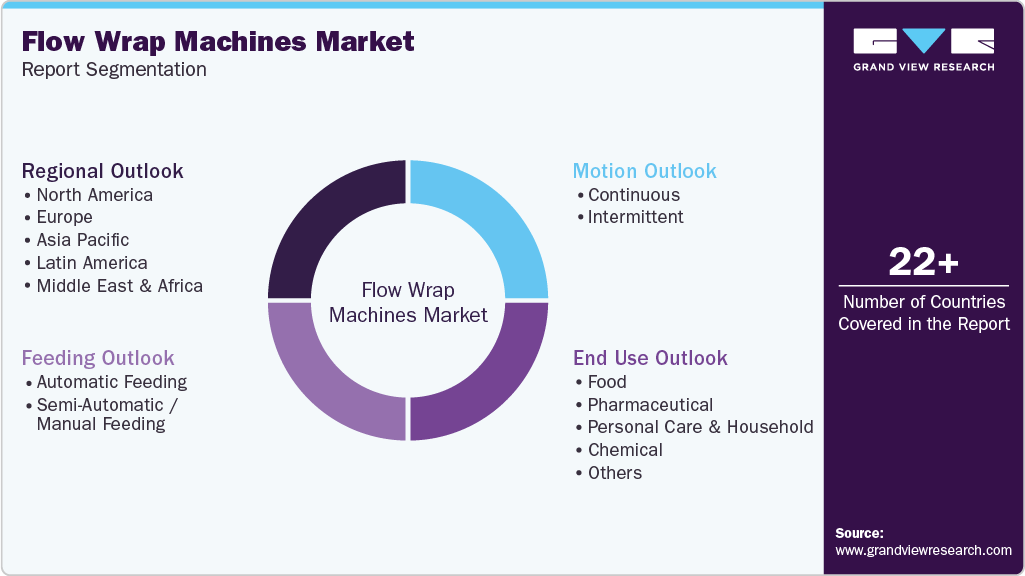
This report forecasts revenue growth at global, regional & country levels and provides an analysis on the industry trends in each of the sub-segments from 2021 to 2033. For this study, Grand View Research has segmented the flow wrap machines market report based on motion, feeding, end use, and region:
 To learn more about this report, Download Free Sample Report
 -
Motion Outlook (Revenue, USD Billion, 2021 - 2033)
-
Continuous
-
Intermittent
-
-
Feeding Outlook (Revenue, USD Billion, 2021 - 2033)
-
Automatic Feeding
-
Semi-Automatic / Manual Feeding
-
-
End Use Outlook (Revenue, USD Billion, 2021 - 2033)
-
Food
-
Pharmaceutical
-
Personal Care & Household
-
Chemical
-
Others
-
-
Regional Outlook (Revenue, USD Billion, 2021 - 2033)
-
North America
-
U.S.
-
Canada
-
Mexico
-
-
Europe
-
Germany
-
France
-
UK
-
Spain
-
Italy
-
-
Asia Pacific
-
China
-
India
-
Japan
-
South Korea
-
Australia
-
-
Latin America
-
Brazil
-
Argentina
-
-
Middle East & Africa
-
Saudi Arabia
-
UAE
-
South Africa
-
-
Research Methodology
The flow wrap machines market figures in this report are based on a proven research process that combines executive interviews with secondary research from proprietary databases, company filings, and recognized regulatory and institutional sources. Market size is built through value-chain sizing—reconciling supply-side and demand-side estimates—and triangulated with bottom-up and top-down approaches. Every estimate passes multiple levels of expert validation before publication, with each flow wrap machines segment quantified using the revenue-capture definitions in the table below.
Segment Definition
Motion
Revenue Capture Definition
Continuous
Revenue generated from the sale of flow wrap machines designed for continuous-motion operation, including machines and associated configurations supplied with continuous product movement, film feeding, sealing, and cutting mechanisms.
Intermittent
Revenue generated from the sale of flow wrap machines designed for intermittent-motion operation, including machines and configurations that perform packaging cycles through periodic product positioning and machine movement.
Feeding
Revenue Capture Definition
Automatic Feeding
Revenue generated from the sale of flow wrap machines incorporating automatic product-feeding mechanisms, including machines supplied with integrated or synchronized feeding systems.
Semi-Automatic / Manual Feeding
Revenue generated from the sale of flow wrap machines requiring semi-automatic or manual product feeding, including equipment configured for operator-assisted product loading.
End Use
Revenue Capture Definition
Food
Revenue generated from the sale of flow wrap machines purchased by food-product manufacturers and packaging operators for their packaging requirements.
Pharmaceutical
Revenue generated from the sale of flow wrap machines purchased by pharmaceutical manufacturers and packaging operators for pharmaceutical product packaging requirements.
Personal Care & Household
Revenue generated from the sale of flow wrap machines purchased by personal care and household product manufacturers and packaging operators for their packaging requirements.
Chemical
Revenue generated from the sale of flow wrap machines purchased by chemical manufacturers and packaging operators for chemical product packaging requirements.
Others
Revenue generated from the sale of flow wrap machines purchased for packaging requirements outside the defined food, pharmaceutical, personal care & household, and chemical segments.
Estimation Model
Layer No.
Layer Name
Key Question
Description
01
Packaging Demand Layer
Where is demand for flow wrap machines generated?
Establish the underlying addressable demand for flow wrap machines across food, pharmaceutical, personal care & household, chemical, and other end-use industries. Evaluate production volumes, product formats, packaging requirements, replacement cycles, and packaging-line configurations to determine equipment requirements.
02
Packaging Capacity & Automation Layer
What factors create new machine demand?
Quantify equipment requirements arising from new production capacity, packaging-line expansion, automation, plant modernization, and machine replacement. Evaluate investment patterns, throughput requirements, and integration of automated packaging systems to identify new procurement opportunities.
03
Product Adoption Layer
Which flow wrap machine configurations are being adopted?
Determine the adoption mix across continuous and intermittent motion, automatic and semi-automatic/manual feeding, and end-use industries. Incorporate throughput, product characteristics, automation intensity, flexibility, sealing requirements, and line-integration needs to estimate configuration-level adoption.
04
Revenue Generation Layer
How much revenue is generated from flow wrap machine sales?
Convert estimated annual machine shipments by motion, feeding configuration, end-use industry, and region into market value using machine-level pricing and configuration differences. Capture revenue generated exclusively from the sale of new flow wrap machines through manufacturers, distributors, system integrators, and direct sales channels.
Customization Table
This report has been delivered with the following In-depth customizations
CLIENT REQUEST
CUSTOMIZATION DELIVERED
VALUE ADDS
Competitive Benchmarking
A competitive benchmarking analysis was conducted covering leading flow wrap machine manufacturers, with evaluation across product portfolios, machine configurations, motions, feeding systems, operating speeds, sealing capabilities, automation features, line integration, geographic presence, aftermarket support, and strategic developments.
The analysis provides a structured comparison of supplier capabilities, product differentiation, automation offerings, customization potential, service coverage, and competitive positioning across the flow wrap machines market.
Regional Segmentation
A regional assessment was conducted by evaluating flow wrap machine demand across new packaging-line installations, production capacity additions, equipment replacement, plant modernization, and packaging automation investments. Industry-level packaging activity and capital expenditure were analyzed across major regional markets.
The assessment provides visibility into regional demand patterns, market attractiveness, investment activity, and expansion potential, supporting geographic prioritization and regional market-entry strategies.
Opportunity Assessment
An opportunity assessment was conducted by evaluating demand generated by packaging-line automation, replacement of aging equipment, production capacity expansion, higher throughput requirements, flexible machine configurations, and integration with automated packaging systems across major end-use industries.
The assessment identifies potential revenue pools, attractive end-use segments, technology adoption opportunities, and areas for product portfolio development within the flow wrap machines market.
Frequently Asked Questions About This Report
The global flow wrap machines market size was valued at USD 3.3 billion in 2025 and reaching to USD 3.5 billion in 2026.
The global flow wrap machines market is projected to reach USD 5.4 billion by 2033 growing at a CAGR of 6.5% from 2026 to 2033.
Asia Pacific dominated the global flow wrap machines market with the largest revenue share of 37.7% in 2025, supported by expanding food processing, manufacturing activity, and adoption of automated packaging equipment.
China held the largest share of the Asia Pacific flow wrap machines market in 2025, supported by its extensive manufacturing base, large food-processing industry, and growing adoption of automated packaging equipment.
The continuous segment is projected to register the fastest CAGR from 2026 to 2033, driven by demand for high-speed packaging, consistent product handling, and efficient operation across high-volume packaging lines.
The automatic feeding segment accounted for the largest revenue share in 2025, at 64.9%. Its adoption is supported by higher throughput requirements, consistent product handling, reduced manual intervention, and integration with automated packaging lines.
The food segment dominated the market in 2025, accounting for 51.6% of the global revenue share. Extensive use of flow wrapping for snacks, bakery products, confectionery, processed foods, and other packaged products supports its leading position.
Key players include Syntegon Technology GmbH, IMA Group, ULMA Packaging, FUJI MACHINERY CO., LTD., Omori Machinery Co., Ltd., PFM Packaging Machinery S.p.A., BW Flexible Systems, Theegarten-Pactec GmbH & Co. KG, PAC Machinery, Paxiom Group, Mespack, Cavanna Packaging Group S.p.A., Reepack S.r.l., Campbell Wrapper Corporation, and JOIEPACK Industrial Co., Ltd.
Market growth is driven by increasing demand for packaged and convenience foods, higher production volumes, packaging-line automation, and the need for flexible wrapping formats. Adoption of automated packaging systems across food, pharmaceutical, personal care, and consumer goods applications is creating further opportunities for flow wrap machinery.
About the Author(s)
Advanced Interior Materials Research Team
Advanced Materials · Advanced Interior MaterialsThis report was authored by the advanced interior materials research team at Grand View Research - comprising two research analysts, one senior research analyst, and one industry expert - with specialized expertise in the advanced interior materials segment of the advanced materials industry. All findings are based on proprietary advanced materials databases, executive interviews, and regulatory analysis, subject to internal peer review prior to publication.
Last Updated:
Speak to Analyst

Customize this report to your needs - add regions, segments, or data points, with 20% free customization.
Or view our licence options:


ISO 9001:2015 & 27001:2022 Certified
We are GDPR and CCPA compliant! Your transaction & personal information is safe and secure. For more details, please read our privacy policy.


