
- Home
- »
- Plastics, Polymers & Resins
- »
-
Fluid Dispensing Equipment Market Size Report, 2026-2033GVR Report cover
![Fluid Dispensing Equipment Market (2026 - 2033)Report]()
Fluid Dispensing Equipment Market (2026 - 2033)
Size, Share & Trends Analysis Report By Product (Flux, Lubricant, Solder Paste, Adhesives & Sealants, Conformal Coatings), By Application (Medical Devices, Construction, Transportation), By Region, And Segment Forecasts
Market Size, 2025
$8.9BMarket Estimate, 2026
$9.3BMarket Forecast, 2033
$13.7BCAGR, 2026–2033
5.7%Fluid Dispensing Equipment Market Summary
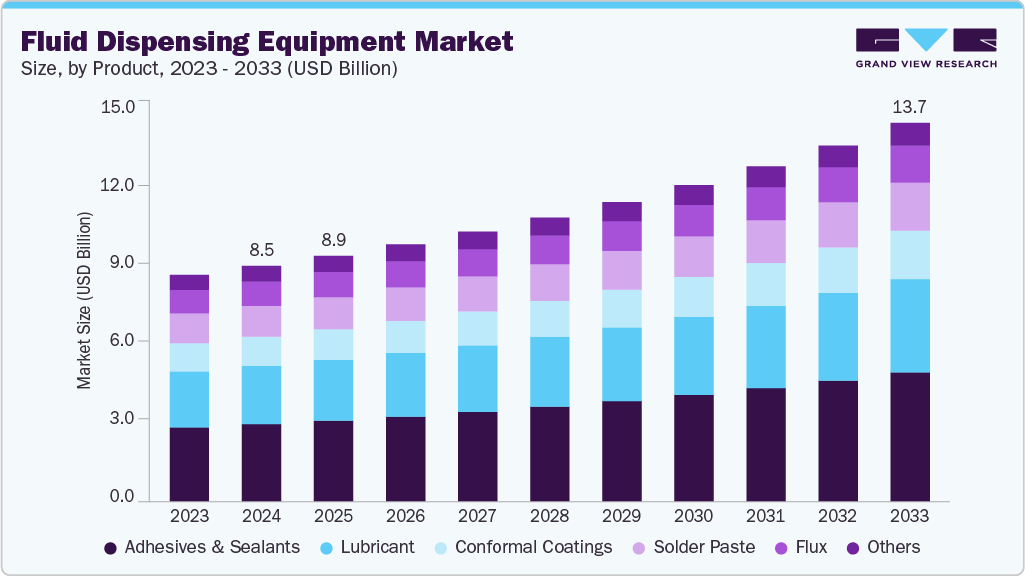
The global fluid dispensing equipment market size was valued at USD 8.9 billion in 2025 and is projected to grow from USD 9.3 billion in 2026 to USD 13.7 billion by 2033, at a CAGR of 5.7% from 2026 to 2033. The market in Asia Pacific dominated with a revenue share of 45.1% in 2025. The growing demand for miniaturized and high-precision components in electronics and medical devices is accelerating the adoption of advanced fluid dispensing systems.

Key Market Trends & Insights
- By application: Electrical & electronics assembly segment held the largest market share of 34.6% in 2025.
- By product: Adhesives & sealants segment held the largest market share of 33.0% in 2025.
Regional Highlights
- Largest regional market: Asia Pacific (45.1% revenue share, 2025)
- By country: China held the largest market share in 2025
Market Size & Forecast
- Market size in 2025: USD 8.9 Billion
- Estimated market size in 2026: USD 9.3 Billion
- Projected market size by 2033: USD 13.7 Billion
- CAGR (2026-2033): 5.7%
Manufacturers seek non-contact and micro-dispensing technologies to handle complex assemblies with higher accuracy. Rising use of adhesives, sealants, and lubricants in transportation, aerospace, and renewable energy sectors is fueling demand for controlled dispensing solutions. High-viscosity fluid handling and two-component systems are increasingly critical in structural bonding and battery manufacturing. In addition, stringent quality and traceability standards are prompting the integration of smart dispensing systems. Emerging economies are also seeing growth due to expanding industrialization and infrastructure projects.Market Dynamics
The fluid dispensing equipment market is driven by increasing automation in manufacturing, growing demand for precision dispensing, and expanding applications across electronics, automotive, healthcare, aerospace, and packaging industries. Manufacturers are adopting advanced dispensing systems to improve production efficiency, minimize material waste, and ensure consistent product quality. The rising use of adhesives, sealants, lubricants, and specialty chemicals in industrial processes further supports market growth. However, high equipment costs and integration complexities can limit adoption, particularly among smaller manufacturers. Opportunities are emerging from Industry 4.0 technologies, electric vehicle production, medical device manufacturing, and the development of smart dispensing systems with real-time monitoring and automated process control.
The fluid dispensing equipment market is primarily driven by the increasing need for precision manufacturing and industrial automation across various industries. Modern production processes require accurate dispensing of adhesives, sealants, lubricants, coatings, solder pastes, and other fluids to maintain product quality and reduce material waste. Industries such as electronics, automotive, aerospace, healthcare, and consumer goods are adopting automated dispensing systems to improve production speed, consistency, and operational efficiency. The growth of miniaturized electronic components and advanced medical devices has increased the demand for highly accurate fluid application technologies capable of handling small volumes with tight tolerances. In the automotive sector, particularly electric vehicle manufacturing, dispensing equipment plays a critical role in battery assembly and lightweight material bonding. Integration with robotic systems and smart manufacturing platforms further enhances productivity while reducing labor requirements and production errors. As manufacturers continue investing in automation and high-quality production standards, demand for advanced fluid dispensing equipment is expected to increase steadily.
The fluid dispensing equipment market faces restraints due to the significant investment required for advanced dispensing systems and their integration into existing manufacturing operations. Automated dispensing equipment often involves substantial costs for machinery, robotics, software, installation, and employee training, creating financial challenges for small and medium-sized manufacturers. Industries with limited production volumes may find it difficult to justify the high initial expenditure despite long-term operational benefits. Integrating dispensing systems with existing production lines and factory automation platforms can also be technically complex and may require process modifications or specialized engineering support.
The rapid expansion of electric vehicle production and smart manufacturing technologies presents significant growth opportunities for the fluid dispensing equipment market. Electric vehicle manufacturing requires precise dispensing of adhesives, thermal interface materials, sealants, and encapsulants for battery systems, electronic components, and lightweight structural assemblies. Increasing investments in battery production facilities and advanced automotive manufacturing are creating sustained demand for high-precision dispensing solutions. At the same time, Industry 4.0 initiatives are encouraging manufacturers to adopt intelligent dispensing systems equipped with sensors, artificial intelligence, and real-time process monitoring capabilities. These technologies improve dispensing accuracy, reduce waste, and enable predictive maintenance, enhancing overall production efficiency.
Market Concentration & Characteristics
The global fluid dispensing equipment industry is moderately concentrated, with a few key players holding significant market shares. Some companies dominate due to strong technological capabilities and broad global reach. However, the presence of several regional and niche manufacturers adds a degree of fragmentation. The balance between innovation-driven leaders and specialized local firms keeps competition active.
The fluid dispensing equipment industry is driven by continuous innovation, especially in micro-dispensing, non-contact systems, and automation. Companies are investing heavily in R&D to improve precision, speed, and compatibility with complex materials. Advancements in electronics, medical devices, and EV manufacturing are pushing technical boundaries. Innovation is a key differentiator in gaining market share and meeting evolving application needs.

Mergers and acquisitions are moderately active in this sector, mainly involving larger firms acquiring niche or regional players. These deals help companies expand technology portfolios, enter new markets, and strengthen distribution networks. Strategic acquisitions also enhance capabilities in specialized dispensing for electronics or medical industries. M&A activity reflects the industry's push for consolidation and product line expansion.
Regulations influence the industry mainly through quality, safety, and environmental standards across end-use sectors. In medical and electronics manufacturing, compliance with FDA, ISO, and RoHS is essential for equipment integration. Fluid handling systems must also meet cleanroom or hygienic design standards in sensitive applications. Regulatory compliance encourages manufacturers to adopt more advanced, controlled dispensing technologies.
Analyst Perspective
The fluid dispensing equipment market is benefiting from growing demand for precision manufacturing across industries such as electronics, automotive, medical devices, aerospace, and consumer goods. As products become increasingly complex and miniaturized, manufacturers are investing in advanced dispensing technologies that can deliver accurate and repeatable application of adhesives, sealants, lubricants, coatings, and other specialty fluids. Automation is emerging as a key growth driver, with companies seeking to improve production efficiency, reduce material waste, and enhance product quality through robotic and digitally controlled dispensing systems. Additionally, the expansion of electric vehicle production, semiconductor manufacturing, and medical device assembly is creating new opportunities for high-precision dispensing solutions. Going forward, equipment providers that offer automated, intelligent, and application-specific dispensing technologies are expected to be well-positioned to capitalize on evolving manufacturing requirements.
Drivers, Opportunities & Restraints
The growing demand for precision manufacturing in electronics, transportation, and medical sectors is a key driver for fluid dispensing equipment. Industries are shifting toward automation to enhance efficiency and reduce human error in fluid application. Rising use of adhesives and sealants in product assembly further boosts equipment adoption. In addition, miniaturization trends demand advanced, micro-scale dispensing technologies.
Expanding industrialization in emerging markets presents strong growth potential for equipment manufacturers. Adoption of electric vehicles and renewable energy systems opens new application areas for high-viscosity and 2K dispensing systems. Integration of IoT and AI in dispensing solutions creates opportunities for smarter, more efficient operations. Customization and modular system designs are also gaining traction across end-use industries.
High initial investment costs for advanced dispensing systems can limit adoption, especially among small and mid-sized manufacturers. Variability in raw material properties and fluid behavior poses challenges for standardizing equipment performance. Limited technical expertise in handling automated systems may slow adoption in certain regions. In addition, fluctuating demand in key end-use sectors can impact market stability.
Product Insights
Based on product, the adhesives & sealants segment led the market with the largest revenue share of 33% in 2025, due to their widespread use in electronics, transportation, and industrial assembly. These materials require precise application to ensure strong bonding, leak prevention, and product integrity. High-viscosity fluid handling systems are crucial for consistent performance. Their versatility and critical role in structural and functional applications drive consistent demand.
The conformal coatings segment is anticipated to witness the significant CAGR during the forecast period, as electronic components become more compact and sensitive. These coatings protect against moisture, dust, and chemical exposure, which is essential for durability and reliability. Increasing use of PCBs in transportation and consumer electronics is driving their adoption. Advanced dispensing systems enable uniform application across complex geometries, enhancing performance.
Application Insights
Based on application, the electrical & electronics assembly segment led the market with the largest revenue share of 34.6% in 2025, due to high demand for precision in component placement and bonding. Fluid dispensing equipment ensures accurate application of adhesives, sealants, and coatings on densely packed PCBs. The need for miniaturization and reliability in smartphones, wearables, and consumer electronics drives usage. Automation in assembly lines further boosts equipment deployment in this sector.
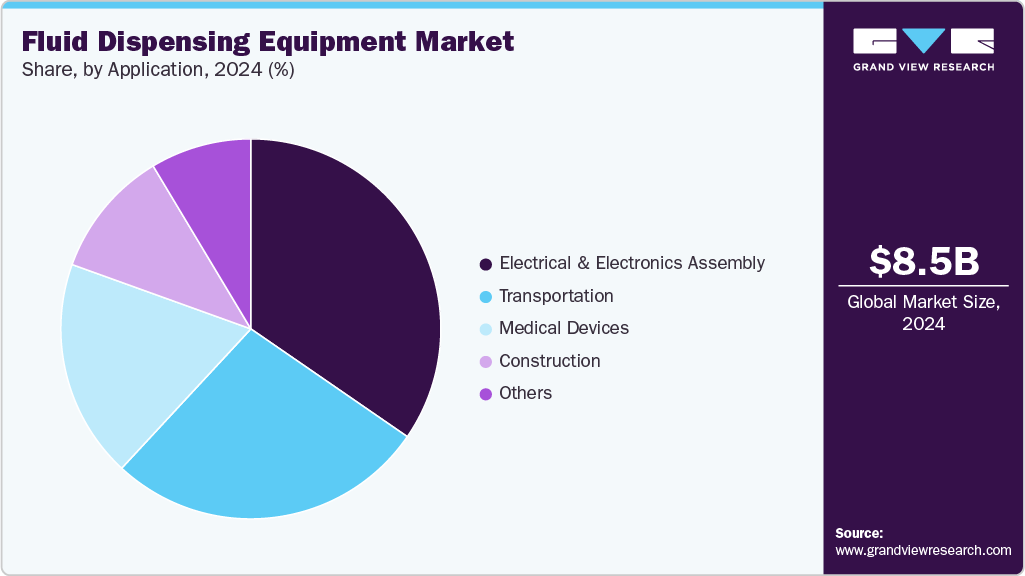
The transportation segment is anticipated to grow at the fastest CAGR during the forecast period, fueled by advancements in electric vehicles, aerospace, and railway manufacturing. These industries require high-performance adhesives, sealants, and lubricants for bonding, sealing, and component protection. The shift toward lightweight materials and improved safety features increases the demand for precise dispensing technologies. Moreover, automation in production lines ensures efficiency and consistency, supporting rapid market expansion.
Regional Insights
The fluid dispensing equipment market in North America is anticipated to grow at a substantial CAGR of 4.9% during the forecast period, due to advanced manufacturing capabilities and strong demand from electronics and medical sectors, due to advanced manufacturing capabilities and strong demand from electronics and medical sectors. The U.S. is a key contributor, driven by automation adoption and R&D investments. Major players have established production and support centers across the region. The presence of high-tech industries sustains steady equipment demand.
U.S. Fluid Dispensing Equipment Market Trends
The fluid dispensing equipment market in the U.S. dominates the North American market in 2025, due to its strong base in electronics, transportation, and medical device manufacturing, due to its strong base in electronics, transportation, and medical device manufacturing. High automation levels and early adoption of advanced dispensing technologies drive demand. The presence of leading manufacturers and R&D centers further strengthens its position. Regulatory standards in healthcare and electronics also support consistent market growth.
The Canada fluid dispensing equipment market is experiencing steady growth, driven by expanding manufacturing and technology sectors, coupled with increasing government initiatives for industrial innovation. The country’s investments in clean energy and EV infrastructure are boosting demand for precision fluid handling. Growth in medical equipment and electronics assembly also supports equipment adoption.
Europe Fluid Dispensing Equipment Market Trends
The fluid dispensing equipment market in Europe holds a significant share owing to its robust transportation, aerospace, and electronics manufacturing base. Countries like Germany and France lead in adopting high-precision dispensing technologies. Environmental regulations also push industries toward cleaner, efficient fluid handling systems. Innovation and compliance needs drive continuous upgrades in dispensing solutions.
The Germany fluid dispensing equipment market is a key market in Europe due to its leadership in transportation and industrial automation. High demand for precise adhesive and sealant application supports the use of advanced dispensing systems. The country's strong focus on innovation and Industry 4.0 initiatives drives equipment upgrades. Growing use of electronics in vehicles further fuels market expansion.
The fluid dispensing equipment market in UK is growing steadily, supported by investments in medical devices, electronics, and aerospace manufacturing. Increased demand for reliable and efficient fluid application tools drives equipment adoption. The push for sustainable and high-performance products encourages the use of advanced dispensing technologies.
Asia Pacific Fluid Dispensing Equipment Market Trends
Asia Pacific dominates the fluid dispensing equipment market with the largest revenue share of 45.1% in 2025, due to large-scale electronics and semiconductor production, especially in China, Japan, and South Korea. Rapid industrialization and the expansion of EV manufacturing further boost demand. Cost-effective production and growing automation in developing nations enhance regional growth. Government support for tech manufacturing strengthens market presence.
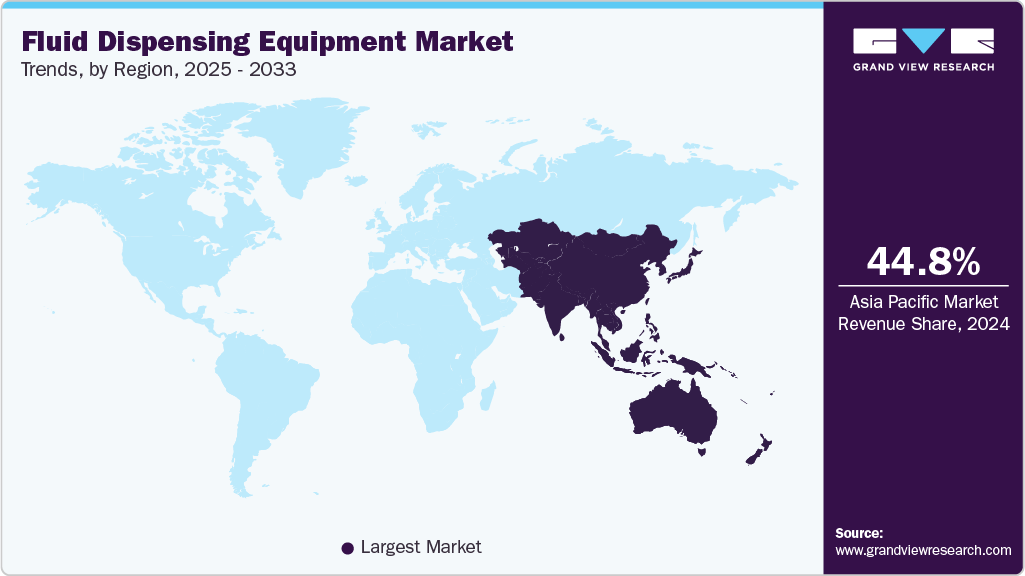
The fluid dispensing equipment market in the China held the largest share in the Asia Pacific region in 2025, due to its dominance in electronics and semiconductor manufacturing. The expansion of EV production and consumer electronics drives demand for high-precision dispensing solutions. Government support for automation and smart factories accelerates the adoption of advanced systems. Domestic players and foreign investments continue to strengthen China’s market position.
The India fluid dispensing equipment market is growing steadily, fueled by increasing investments in electronics manufacturing and transportation assembly. Government initiatives like "Make in India" promote local production, boosting demand for fluid handling equipment. The rise in medical device manufacturing also supports the adoption of precision dispensing technologies. Growing awareness of automation benefits is gradually driving industrial upgrades.
Middle East & Africa Fluid Dispensing Equipment Market Trends
The fluid dispensing equipment market in the Middle East and Africa is emerging market for fluid dispensing equipment, led by manufacturing growth in the UAE, South Africa, and Saudi Arabia. Rising demand in the construction, electronics, and packaging industries contributes to market expansion. Government-led industrial diversification is encouraging technological upgrades. However, adoption is still in early stages compared to other regions.
The Saudi Arabia fluid dispensing equipment market is witnessing growth due to its push for industrial diversification under Vision 2030. Investments in manufacturing, electronics, and transportation sectors are increasing the demand for automated dispensing systems. The country's focus on localizing medical device production further supports market expansion. Emerging industrial zones and infrastructure projects are driving equipment adoption across various applications.
Central & South America Fluid Dispensing Equipment Market Trends
The fluid dispensing equipment market in Central & South America is witnessing steady growth, supported by expanding industrial sectors in Brazil and Argentina. Increasing investments in electronics and transportation assembly lines are creating new opportunities. The need for accurate adhesive application in consumer products drives adoption. However, limited infrastructure may slightly slow the pace of high-end system deployment.
The Brazil fluid dispensing equipment market is growing due to the expansion of its transportation, electronics, and packaging industries. Increasing adoption of automation in manufacturing is driving demand for precise fluid application systems. Investments in renewable energy and infrastructure projects are creating new opportunities for equipment use. Local production capabilities combined with imports ensure a steady supply to meet rising needs.
Key Fluid Dispensing Equipment Company Insights
Some of the key players operating in the market include Nordson Corporation., Graco Inc., Musashi Engineering, Inc.
-
Nordson Corporation specializes in precision dispensing and fluid management systems tailored for industrial and electronics manufacturing. It provides equipment for applying adhesives, sealants, coatings, and biomaterials with high accuracy. The company is known for supporting automation in micro-dispensing and surface treatment. Its operations span multiple industries, including packaging, medical devices, and semiconductor assembly. Nordson maintains a global presence through technical centers, service networks, and continuous investment in R&D.
-
Graco Inc. develops and manufactures equipment used to pump, mix, spray, and dispense a wide range of fluids. Its systems are widely applied in construction, transportation, food processing, and general manufacturing sectors. Graco structures its business into dedicated divisions that address contractor, industrial, and process needs. The company emphasizes durable design and technical performance in both portable and integrated systems. With a broad international distributor network, it maintains a strong global footprint.
Key Fluid Dispensing Equipmen Companies:
The following are the leading companies in the fluid dispensing equipment market. These companies collectively hold the largest market share and dictate industry trends.
- Nordson Corporation.
- Graco Inc.
- Musashi Engineering, Inc.
- GPD Global.
- Fisnar
- IVEK Corporation
- Henkel Slovenija d.o.o.
- OK International, Inc.
- DOPAG India Pvt Ltd.
- Valco Melton Inc.
- Dymax
- ViscoTec Pumpen- u. Dosiertechnik GmbH
- ITW Dynatec
- Anda Technologies USA, INC.
- INTERTRONICS.
Competitive Benchmarking
Category
Operating Strategies
Competitive Edge
Weakness
Established Players (e.g., Nordson Corporation, Graco Inc., Musashi Engineering, Inc., Henkel Slovenija d.o.o., Valco Melton Inc.)
- Mature fluid dispensing equipment manufacturers focus on expanding automated dispensing portfolios, integrating smart control technologies, strengthening global distribution networks, and offering customized solutions for electronics, automotive, medical, and industrial manufacturing applications through long-term customer partnerships.
- These companies benefit from strong brand recognition, extensive R&D capabilities, broad product portfolios, global service networks, and advanced automation expertise. Their ability to provide integrated dispensing systems and technical support strengthens customer retention and market presence.
- Mature players face higher operating costs, complex organizational structures, and slower product development cycles. Dependence on established product platforms and extensive global operations reduce responsiveness to niche market opportunities and evolving customer demands.
Emerging & Regional Players (e.g GPD Global, Fisnar, DOPAG India Pvt Ltd., Anda Technologies USA, Inc., INTERTRONICS)
- These players emphasize niche application development, cost-competitive products, flexible manufacturing, and rapid product innovation. They target regional markets and small to medium-sized manufacturers through strategic collaborations, localized support, and adaptable dispensing technologies.
- Emerging players gain advantages through operational flexibility, competitive pricing, faster product development, and customized solutions for specialized applications. Their agility enables rapid adaptation to changing manufacturing requirements and evolving industry technologies.
- These players often encounter limited financial resources, smaller distribution networks, and lower brand recognition. Challenges in scaling production, expanding global operations, and competing for large industrial contracts may restrict their market growth and competitive positioning.
Recent Developments
-
In July 2025, Nordson launched the VersaBlue II Melter, designed for hygiene product manufacturing like diapers and incontinence items. It offers improved adhesive dosing, energy efficiency, and smart connectivity features. The system supports modern protocols like EtherCAT and OPC UA. Its design aims to boost precision and reduce waste in nonwoven applications.
-
In July 2025, Graco Inc. has completed the acquisition of Color Service S.r.l., an Italian company known for automated powder and liquid dosing systems. The deal, valued at USD 71.1 million, strengthens Graco’s presence in precision material handling. Color Service adds specialized dosing technology and global reach. The move supports Graco’s growth strategy in advanced dispensing solutions.
-
In May 2025,Musashi Engineering introduced the HYPER SOLDERJET, a high-speed jet dispenser designed for precise, non-contact solder paste application. It reduces clogging issues and ensures stable performance even on uneven surfaces. The system supports various pastes, including silver and gold. Its design improves accuracy and efficiency in electronics manufacturing.
Fluid Dispensing Equipment Market Report Scope
Report Attribute
Details
Market size in 2025
USD 8.9 billion
Estimated market size in 2026
USD 9.3 billion
Projected market size by 2033
USD 13.7 billion
Growth rate
CAGR of 5.7% from 2026 to 2033
Base year for estimation
2025
Historical data
2021 - 2024
Forecast period
2026 - 2033
Quantitative units
Revenue in USD million and CAGR from 2026 to 2033
Report coverage
Revenue forecast, company ranking, competitive landscape, growth factors, and trends
Segments covered
Product, application, region
Regional scope
North America; Europe; Asia Pacific; Central & South America; Middle East & Africa
Country scope
U.S.; Canada; Mexico; UK; Germany; France; Spain; Italy; China; Japan; India ; South Korea; Australia, Brazil; Argentina; Saudi Arabia; UAE; South Africa
Key companies profiled
Nordson Corporation.; Graco Inc.; Musashi Engineering, Inc.; GPD Global.; Fisnar.; IVEK Corporation; Henkel Slovenija d.o.o.; OK International, Inc.; DOPAG India Pvt Ltd.; Valco Melton Inc.; Dymax; ViscoTec Pumpen- u. Dosiertechnik GmbH; ITW Dynatec; Anda Technologies USA, Inc.; INTERTRONICS
Customization scope
Free report customization (equivalent up to 8 analysts' working days) with purchase. Addition or alteration to country, regional & segment scope.
Pricing and purchase options
Avail customized purchase options to meet your exact research needs. Explore purchase options
Global Fluid Dispensing Equipment Market Report Segmentation
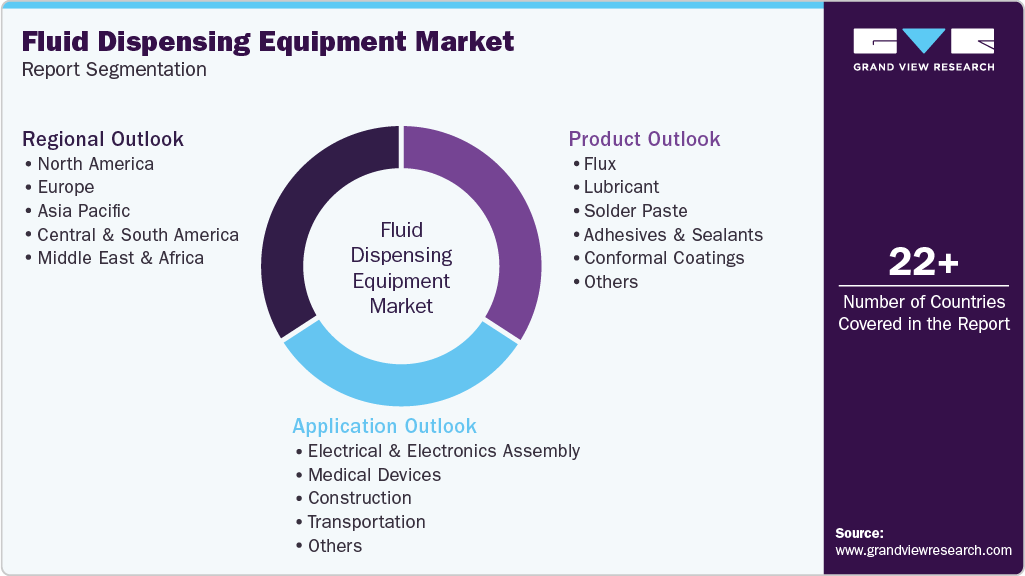
This report forecasts revenue growth at global, regional, and country levels and provides an analysis of the latest industry trends in each of the sub-segments from 2021 to 2033. For this study, Grand View Research has segmented the global fluid dispensing equipment market report based on product, application, and region.
-
Product Outlook (Revenue, USD Million, 2021 - 2033)
-
Flux
-
Lubricant
-
Solder Paste
-
Adhesives & Sealants
-
Epoxy Adhesives
-
Epoxy Underfill
-
Others
-
-
Conformal Coatings
-
Others
-
-
Application Outlook (Revenue, USD Million, 2021 - 2033)
-
Electrical & Electronics Assembly
-
Semiconductor Packaging
-
Printed Circuit Boards
-
Others
-
-
Medical Devices
-
Construction
-
Transportation
-
Others
-
-
Regional Outlook (Revenue, USD Million, 2021 - 2033)
-
North America
-
U.S.
-
Canada
-
Mexico
-
-
Europe
-
Germany
-
France
-
UK
-
Spain
-
Italy
-
-
Asia Pacific
-
China
-
India
-
Japan
-
Australia
-
South Korea
-
-
Central & South America
-
Brazil
-
Argentina
-
-
Middle East & Africa
-
Saudi Arabia
-
South Africa
-
UAE
-
-
Research Methodology
The fluid dispensing equipment market figures in this report are based on a proven research process that combines executive interviews with secondary research from proprietary databases, company filings, and recognized regulatory and institutional sources. Market size is built through value-chain sizing - reconciling supply-side and demand-side estimates - and triangulated with bottom-up and top-down approaches. Every estimate passes multiple levels of expert validation before publication, with each fluid dispensing equipment segment quantified using the revenue-capture definitions in the table below.
Segment Definition
Segment - Product
Revenue Capture Definition
Flux
Revenue is generated through fluid dispensing equipment used for precise application of flux during soldering and metal joining processes. Demand is driven by electronics manufacturing, PCB assembly, and semiconductor production requiring controlled dispensing.
Lubricant
Revenue is captured through dispensing systems designed for accurate application of lubricants and greases in automotive, industrial machinery, and manufacturing operations. Demand is supported by automation and preventive maintenance requirements.
Solder Paste
Revenue is generated through dispensing equipment used for solder paste application in printed circuit board and electronic component assembly. Demand is driven by miniaturized electronics, consumer devices, and advanced semiconductor manufacturing.
Adhesives & Sealants
Revenue is captured through dispensing systems for precise application of adhesives and sealants in automotive, aerospace, construction, and industrial assembly operations. Demand is supported by lightweight material bonding and automated manufacturing processes.
Conformal Coatings
Revenue is generated through dispensing equipment used for protective coating applications on electronic assemblies and circuit boards. Demand is driven by the need for moisture, dust, and chemical resistance in electronic products.
Others
This segment includes dispensing equipment for encapsulants, potting compounds, thermal interface materials, inks, and specialty fluids. Revenue is supported by diverse industrial, medical, and advanced manufacturing applications.
Segment - Application
Revenue Capture Definition
Electrical & Electronics Assembly
Revenue is generated through fluid dispensing equipment used for applying solder paste, flux, adhesives, sealants, and coatings during electronic component and PCB assembly. Demand is driven by consumer electronics and semiconductor manufacturing.
Medical Devices
Revenue is captured through dispensing systems used for precision application of adhesives, coatings, and specialty fluids in medical device manufacturing. Demand is supported by stringent quality standards and growth in healthcare technologies.
Construction
Revenue is generated through dispensing equipment used for applying adhesives, sealants, and protective materials in building and infrastructure projects. Demand is driven by urbanization and increasing adoption of automated construction processes.
Transportation
Revenue is captured through dispensing systems used in automotive, aerospace, rail, and other transportation manufacturing for applying adhesives, lubricants, sealants, and thermal materials. Demand is supported by lightweight assembly and vehicle electrification trends.
Others
Revenue is generated through fluid dispensing equipment used across packaging, consumer goods, industrial machinery, renewable energy, and general manufacturing applications requiring accurate and repeatable fluid application processes.
Estimation Model
Layer Name
Key Question
Description
End-use Industry Demand Layer
Which industries generate demand for fluid dispensing equipment?
The estimation begins by evaluating fluid dispensing requirements across electrical and electronics assembly, medical devices, construction, transportation, and other manufacturing industries. Production volumes, automation levels, and precision fluid application needs establish the base market demand.
Product Consumption Layer
Which fluids drive equipment adoption?
This layer refines demand by assessing the use of dispensing equipment for flux, lubricants, solder paste, adhesives and sealants, conformal coatings, and specialty fluids. Material consumption patterns and application complexity influence equipment selection and market penetration.
Automation and Replacement Demand Layer
What determines annual equipment purchases?
Market demand is estimated through industrial automation trends, production capacity expansions, equipment replacement cycles, manufacturing modernization, and investments in precision dispensing technologies. Growth in electronics, EVs, and medical devices further supports recurring demand.
Revenue Layer
How much revenue is generated from fluid dispensing equipment?
Revenue is estimated by aggregating fluid dispensing equipment sales across product types, applications, and end-use industries. Equipment pricing, regional manufacturing activity, automation investments, distribution networks, and company revenues are incorporated to validate the total market size.
Delivered Customizations
This report has been delivered with the following In-depth customizations
CLIENT REQUEST
CUSTOMIZATION DELIVERED
VALUE ADDS
Regional Segmentation
Detailed regional analysis was conducted across North America, Europe, Asia Pacific, Latin America, and the Middle East & Africa, including country-level assessment for key markets such as the U.S., Germany, China, India, Brazil, and Saudi Arabia. The study evaluated electronics manufacturing, medical device production, automotive assembly, construction activities, industrial automation trends, and technological advancements influencing fluid dispensing equipment adoption across regional markets.
Helped identify high-growth regional markets, country-specific opportunities, and evolving demand trends across electronics, medical, transportation, construction, and industrial manufacturing sectors. The analysis also supported market entry strategies, regional expansion planning, and identification of emerging advanced manufacturing hubs.
Competitive Benchmarking
Comprehensive benchmarking was carried out for major market participants based on product portfolio, dispensing technologies, automation capabilities, precision engineering, regional presence, research and development activities, and distribution network strength. The assessment also compared established and emerging players operating in the fluid dispensing equipment market.
Assisted clients in understanding competitor positioning, technology capabilities, and competitive gaps within the market. The study supported strategic planning, partnership evaluation, product differentiation, and investment decisions across precision dispensing and automated manufacturing applications.
Opportunity Assessment
In-depth opportunity assessment was conducted by analyzing industrial automation, electric vehicle manufacturing, semiconductor production, medical device expansion, smart factory investments, and increasing adoption of robotic dispensing systems. The study also identified emerging opportunities in precision fluid control, AI-enabled dispensing technologies, IoT-integrated systems, advanced adhesives applications, and high-performance manufacturing processes.
Enabled clients to identify high-growth investment areas, prioritize regional expansion strategies, and evaluate future revenue opportunities across electronics, medical devices, transportation, construction, and industrial manufacturing sectors. The analysis also supported product development planning, technology adoption strategies, and long-term business growth initiatives in the fluid dispensing equipment market.
Frequently Asked Questions About This Report
The global fluid dispensing equipment market size was valued at USD 8.9 billion in 2025 and is expected to be USD 9.3 billion in 2026.
The adhesives & sealants segment led the market with the largest revenue share of 33.0% in 2025.
Some of the key players operating in the fluid dispensing equipment market include Nordson Corporation., Graco Inc., Musashi Engineering, Inc., GPD Global., Fisnar., IVEK Corporation, Henkel Slovenija d.o.o., OK International, Inc., DOPAG India Pvt Ltd., Valco Melton Inc., Dymax, ViscoTec Pumpen- u. Dosiertechnik GmbH, ITW Dynatec, Anda Technologies USA, INC., INTERTRONICS.
The fluid dispensing equipment market is driven by rising demand for precision in electronics, transportation, and medical device manufacturing. Growing automation and Industry 4.0 adoption enhance production efficiency and quality. Additionally, the need for accurate application of adhesives, sealants, and coatings supports market growth across diverse industries.
The global fluid dispensing equipment market, in terms of revenue, is expected to grow at a compound annual growth rate of 5.7% from 2026 to 2033 to reach USD 13.7 billion by 2033.
Asia Pacific dominated the fluid dispensing equipment market with the largest revenue share of 45.1% in 2025.
Asia Pacific is anticipated to be one of the fastest-growing regional markets over the forecast period, driven by expanding electronics manufacturing, industrial automation, and increasing investments in advanced production technologies.
The electrical & electronics assembly segment accounted for the largest revenue share of 34.6% in 2025.
Key trends include increasing adoption of robotic dispensing systems, integration of smart manufacturing technologies, growing demand for high-precision fluid application, and rising use of automated dispensing solutions in electronics and medical device production.
About the Author(s)
Plastics, Polymers & Resins Research Team
Bulk Chemicals · Plastics, Polymers & ResinsThis report was authored by the plastics, polymers & resins research team at Grand View Research - comprising two research analysts, one senior research analyst, and one industry expert - with specialized expertise in the plastics, polymers & resins segment of the bulk chemicals industry. All findings are based on proprietary bulk chemicals databases, executive interviews, and regulatory analysis, subject to internal peer review prior to publication.
Last Updated:
Speak to Analyst


Customize this report to your needs — add regions, segments, or data points, with 20% free customization.
Or view our licence options:


ISO 9001:2015 & 27001:2022 Certified
We are GDPR and CCPA compliant! Your transaction & personal information is safe and secure. For more details, please read our privacy policy.


