
- Home
- »
- Advanced Interior Materials
- »
-
Epoxy Adhesives Market Share Report, 2021-2028GVR Report cover

Epoxy Adhesives Market (2021 - 2028) Size, Share & Trends Analysis Report By Application (Automotive & Transportation, Building & Construction), By Technology, By Region, And Segment Forecasts
Market Size, 2020
$6.8BMarket Estimate, 2026
$7.2BMarket Forecast, 2028
$10.5BCAGR, 2021–2028
5.6%Epoxy Adhesives Market Summary
The global epoxy adhesives market size was valued at USD 6.8 billion in 2020 and is expected to reach USD 10.5 billion by 2028, expanding at a compound annual growth rate (CAGR) of 5.6% from 2021 to 2028. The growth in major end-use industries such as energy, construction, and automotive is expected to boost the demand for epoxy adhesives over the forecast period.
Key Market Trends & Insights
- The Asia Pacific dominated the market and held the largest revenue share of over 45.0% in 2020.
- By technology, the two component segment accounted for a volume share of more than 44.0% in 2020.
- By application, the automotive and transportation segment accounted for the largest revenue share of more than 42.0% in 2020.
Market Size & Forecast
- 2020 Market Size: USD 6.8 Billion
- 2028 Projected Market Size: USD 10.5 Billion
- CAGR (2021-2028): 5.6%
- Asia Pacific: Largest market in 2020
Prism AI by Grand View Research Free to tryAsk a question about the epoxy adhesives marketTry asking✓Every figure cited from GVR research Prefer the report? Download free sample →
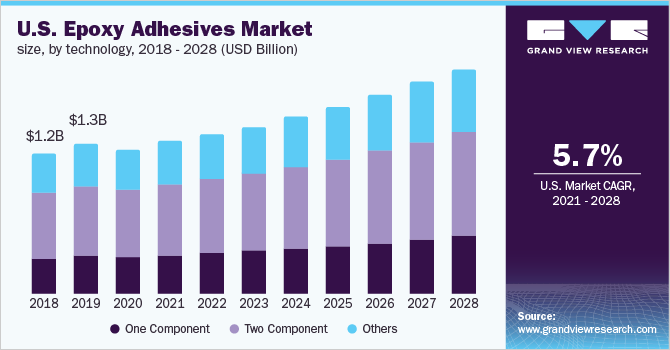
Increasing focus on infrastructural developments to propel economic growth, coupled with growing investments in producing Electric Vehicles (EVs) and incorporation of lightweight materials in the automotive industry, is expected to benefit market growth across the forecast period.The U.S. manufacturing sector was largely impacted in 2020 on account of the increasing spread of the coronavirus. Companies were compelled to suspend operations, thereby affecting the demand for raw materials. However, the market for epoxy adhesives is projected to pick up pace owing to growth in EVs and housing projects in the U.S. For instance, in November 2020, Pepper Construction began the construction of a new multi-family residential project in Wisconsin, U.S.
 Source: Grand View Research, IR Documents, Primary Interviews, Paid DatabasesTo learn more about this report,
 Download Free Sample Report
The U.S. manufacturing sector was largely impacted in 2020 on account of the increasing spread of the coronavirus. Companies were compelled to suspend operations, thereby affecting the demand for raw materials. However, the market for epoxy adhesives is projected to pick up pace owing to growth in EVs and housing projects in the U.S. For instance, in November 2020, Pepper Construction began the construction of a new multi-family residential project in Wisconsin, U.S.
The emergence of the COVID-19 pandemic is an ongoing challenge for the industry, which led to a decline in market growth in 2020. A large number of industries have largely been impacted by the pandemic and witnessed a significant downfall in the first half of 2020. The crisis led to the emergence of new challenges for industries, which includes cost escalation of raw materials, disruption of the supply chain, production stoppages, and workforce minimal capacities.
The market scenario started recovering in the second half of 2020. However, with the continuing second and third waves of the virus, restrictions were seen in the first quarter of 2021. Demand from end-use industries but restrictions in transportation and minimal production led to an increase in prices of materials such as phenols, epichlorohydrin, and solvents, which are used in epoxy resins and curing agents.
Market Dynamics
The increasing popularity of renewable energy power generation methods is responsible for the growth of the solar industry. Adhesives are of vital significance in solar panel installation and contribute greatly to their efficiency. Factors such as ability to withstand extreme temperature, humidity & water; carrying load; UV resistance; and sustainability in energy are to be considered while choosing adhesives for solar applications.
Epoxy adhesives adhere to the above-mentioned criteria and thus find extensive applications in the solar industry. For example, Araldite 2031, a flexible black epoxy adhesive, is suitable for use in the thin film roof assembly of solar panels owing to its ability to withstand high temperatures and adverse conditions. Thus, expansion in solar capacity is anticipated to benefit the growth of the epoxy adhesives market over the forecast period.
VOC emissions that occur during the commercial and industrial application of adhesives pose both environmental and health risks. In order to regulate such industrial emissions, several countries have set guidelines to restrict the number of gaseous emissions during the application of adhesives.
The adhesives market has always been under strict scrutiny from various regional and national-level regulatory bodies across the globe. For instance, in the U.S., the Environmental Protection Agency (EPA) enforces manufacturers and suppliers of adhesives to comply with the established VOC standards. Furthermore, the Air Resources Board (ARB) in the U.S. issued a document for determining Reasonably Available Control Technology (RACT) in order to keep a check on pollution caused by adhesive application.
Technology Insights
The two component segment accounted for a volume share of more than 44.0% in 2020. The high share can be attributed to its preference, owing to advantages such as vibration & shock resistance, tolerance to thermal cycling, long-term durability, strong adhesion to different substrates, uniform stress distribution, fast curing at ambient temperatures, ease of application, and dimensional stability. The two component epoxies are widely used structural adhesives in applications that require high strength.
The one component segment is expected to witness a faster growth rate of 6.2%, in terms of revenue, during the forecast period. It is used in applications for structural bonding, repairing, hemming adhesion, bonding, and others in various industries including automotive, aerospace, electronics, and metal fabrication industries. One component epoxy adhesive offers excellent performance against high temperature & resistance against strong chemicals and harsh environmental conditions, which makes it preferable for heavy wear-and-tear applications such as tools & machinery and heavy industries.
The others’ segment includes waterborne and radiation-cured epoxy adhesives. The waterborne epoxy adhesives are gaining preference owing to stringent regulations against solvent-based adhesives due to their harmful VOCs. Waterborne epoxy resins also offer high performance and reduce the risk of VOCs and enhance worker safety.
Application Insights
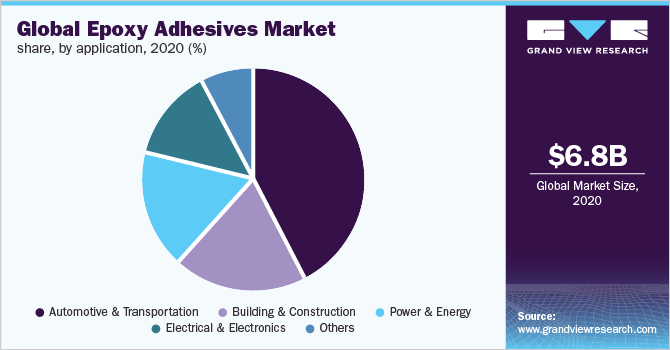
Based on application, the automotive and transportation segment accounted for the largest revenue share of more than 42.0% in 2020. Epoxy adhesives adhere to a variety of substrates and offer strong bonds, which makes them applicable in vehicles and aircraft. In May 2021, Airbus announced its plan to increase the production of A320neo planes by 10% by the end of 2021. Growth in aircraft production is expected to augment segment growth across the forecast period.
 To learn more about this report, Download Free Sample Report
The building and construction segment is another major application of the market, where epoxy adhesives are used as structural adhesives owing to their high performance. They provide versatility, long durability, and a high degree of heat resistance for binding a wide range of materials including wood, metal, plastic, and masonry. As a result, they find application in walls, roofs, laminated wood for decks, and other building applications such as attaching countertops to substrates, fastening concrete elements, and other materials.
The power and energy segment is expected to be the fastest-growing segment in the epoxy adhesives market over the forecast period. Growth in wind power installations accelerates the usage of epoxy adhesives; for instance, wind turbine blade assemblies are made of many bonded and fastened elements. Other applications include bonding, metal insert attachment, thread locking, and joining of external parts and components. Growth in wind power installations in the coming years is anticipated to augment the growth of the market for epoxy adhesives over the forecast period.
Furthermore, the thermal and electrical conductive properties of epoxy adhesives have augmented their usage in electricals and electronics as well. Electrically conductive adhesives provide strong components and interconnections to gain long-term and reliable performance from electronics. This is anticipated to fuel product demand in the electrical & electronics industry across the forecast period.
Regional Insights
In terms of revenue, Asia Pacific is expected to witness a revenue-based CAGR of 6.2% over the forecast period. The region holds potential growth opportunities from the construction and automotive industries. Factors such as rapid economic growth, rising disposable incomes, and a subsequent increase in the demand for residential housing and solar installations are expected to benefit the demand for epoxy adhesives in the region.
China accounts for a significant share in the market for epoxy adhesives considering the widespread presence of end-use industries. China accounted for the largest share of 32.5% in global vehicle production in 2020. Whereas the global vehicle production declined by 16% from 2019 to 2020 owing to the pandemic, the decline in China was merely 2%. This is a positive aspect for the market to further grow in the country.
Europe held the second-largest revenue share of the market for epoxy adhesives in 2020. The focus on reducing CO2 emissions in Europe by the implementation of Euro 6d emission standards in 2020 is creating a strong growth potential for lightweight materials in the region. Emphasis towards lightweight materials is anticipated to augment demand for adhesives in Europe’s automotive industry over the coming years.
Investments in the energy sector of Europe are further anticipated to benefit market growth. For instance, as of 2020, Germany is the largest energy consumer in Europe and thus, it is encouraging energy projects to meet the growing demand. For instance, in June 2021, Germany awarded 1,161 MW of onshore wind capacity, after the auction that took place on May 1, 2021.
Key Companies & Market Share Insights
Major companies operating in the competitive landscape are primarily focusing on regional expansion, merger and acquisition, and high profit-margin segments along with developing bio-based adhesives to comply with the increasingly stringent environmental regulations.
For instance, in April 2021, Meridian Adhesive Group acquired Pacific Adhesive Systems (PAS), a Malaysia-based company offering high-performance adhesive and coating solutions. PAS has joined Meridian’s Electronic division comprising of Epoxy technology. The vendors are aiming toward more sustainable solutions and accelerating the digital transformation. Some of the prominent players in the epoxy adhesives market include:
-
3M
-
Ashland
-
Bostik
-
Dow
-
H.B. Fuller Company
-
Henkel AG & Co. KGaA
-
Mapei S.P.A
-
Parker Hannifin Corp
-
Permabond LLC
-
Sika AG
Competitive Benchmarking
Operating Strategies
Competitive Edge
Weakness
Mature Players: 3M, Bostik, H.B. Fuller, Henkel AG & Co. KGaA, Dow
- These companies are expanding application coverage across automotive, aerospace, electronics, construction, and industrial assembly through broad epoxy adhesive portfolios.
- Product development efforts are increasingly directed toward low-VOC formulations, high-strength structural adhesives, and lightweight material bonding solutions.
- Growth strategies largely involve acquisitions, global distribution expansion, and co-development initiatives with OEMs and industrial manufacturers.
- Extensive product offerings and strong global brand recognition support broad customer penetration.
- Established manufacturing and technical support infrastructure enables supply reliability and formulation customization.
- Significant R&D investments strengthen innovation capabilities across high-performance adhesive technologies.
- Dependence on epoxy resins and petrochemical feedstocks exposes companies to raw material cost fluctuations.
- Regulatory pressure regarding chemical composition and environmental impact may require continuous reformulation efforts.
- Large organizational structures can sometimes limit responsiveness toward niche application requirements.
Emerging Players: Ashland, Mapei S.p.A., Parker Hannifin Corp, Sika AG, Permabond LLC
- Specialty and application-driven solutions are increasingly being used to target niche industrial requirements and customized bonding applications.
- Several participants are strengthening regional market access and emphasizing technical service support to improve customer engagement.
- Expansion initiatives are also being directed toward high-growth sectors such as EV manufacturing, electronics, and advanced construction materials.
- Greater flexibility allows quicker response to customer-specific formulation requirements.
- Strong application expertise supports differentiation in specialized bonding environments.
- Focused product strategies enable stronger positioning within targeted end-use sectors.
- Smaller scale compared to multinational adhesive manufacturers may limit cost competitiveness.
- Narrower product portfolios may reduce penetration across diversified end-use markets.
- Dependence on selected industrial sectors can increase exposure to cyclical demand fluctuations.
Epoxy Adhesives Market Report Scope
Report Attribute
Details
Market size value in 2021
USD 7.2 billion
Revenue forecast in 2028
USD 10.5 billion
Growth Rate
CAGR of 5.6% from 2021 to 2028
Base year for estimation
2020
Historical data
2017 - 2019
Forecast period
2021 - 2028
Quantitative units
Volume in kilotons, revenue in USD million, and CAGR from 2021 to 2028
Report coverage
Revenue forecast, company ranking, competitive landscape, growth factors, and trends
Segments covered
Technology, application, region
Regional scope
North America; Europe; Asia Pacific; Central & South America; Middle East & Africa
Country scope
U.S.; Canada; Mexico; Germany; France; U.K.; Italy; Turkey; China; Japan; India; South Korea; Brazil; GCC
Key companies profiled
3M; Ashland; Bostik; Dow; H.B. Fuller Company; Henkel AG & Co. KGaA; Mapei S.P.A; Parker Hannifin Corp; Permabond LLC; Sika AG
Customization scope
Free report customization (equivalent up to 8 analysts working days) with purchase. Addition or alteration to country, regional & segment scope.
Pricing and purchase options
Avail customized purchase options to meet your exact research needs. Explore purchase options
Segments Covered in the ReportThis report forecasts revenue growth at the global, regional, and country levels and provides an analysis of the latest industry trends in each of the sub-segments from 2017 to 2028. For the purpose of this study, Grand View Research has segmented the global epoxy adhesives market report on the basis of technology, application, and region:
-
Technology Outlook (Volume, Kilotons; Revenue, USD Million, 2017 - 2028)
-
One Component
-
Two Component
-
Others
-
-
Application Outlook (Volume, Kilotons; Revenue, USD Million, 2017 - 2028)
-
Automotive & Transportation
-
Building & Construction
-
Power & Energy
-
Electrical & Electronics
-
Others
-
-
Regional Outlook (Volume, Kilotons; Revenue, USD Million, 2017 - 2028)
-
North America
-
U.S.
-
Canada
-
Mexico
-
-
Europe
-
Germany
-
France
-
U.K.
-
Italy
-
Turkey
-
-
Asia Pacific
-
China
-
Japan
-
India
-
South Korea
-
-
Central & South America
-
Brazil
-
-
Middle East & Africa
-
GCC
-
-
Delivered Customizations
This report has been delivered with the following In-depth customizations
Client Request
Customization Delivered
Value Adds
Regional Segmentation
Detailed assessment of epoxy adhesive consumption across North America, Europe, Asia Pacific, Latin America, and the Middle East & Africa, with country-level analysis of automotive production, electronics manufacturing, aerospace activity, construction spending, and industrial assembly demand. The assessment also reviews regional shifts toward lightweight materials and advanced bonding technologies.
Highlight regional demand concentration and identify industries driving adhesive consumption growth. Support market prioritization and regional expansion planning based on sector-specific demand patterns.
Competitive Benchmarking
Comparative evaluation of epoxy adhesive manufacturers based on product portfolio breadth, structural versus non-structural adhesive offerings, manufacturing presence, application focus, innovation capabilities, strategic initiatives, and customer reach. Includes vendor landscape analysis covering industrial, electronics, automotive, and specialty adhesive suppliers.
Deliver a clearer understanding of market positioning, technological differentiation, and competitive intensity. Support benchmarking exercises, partnership identification, and strategic decision-making.
Pricing Trend Analysis
Analysis of epoxy adhesive price movements considering epoxy resin costs, curing agents, additives, petrochemical feedstock trends, supply-demand balance, and transportation expenses. The study also reviews pricing variation across structural and specialty adhesive categories.
Improve visibility into cost drivers and pricing fluctuations affecting profitability and procurement strategies. Support budgeting, supplier negotiations, and pricing risk assessment.
Frequently Asked Questions About This Report
The epoxy adhesives market size was estimated at USD 6.8 billion in 2020 and is expected to reach USD 7.2 billion in 2021.
The epoxy adhesives market is expected to grow at a compound annual growth rate of 5.6% from 2021 to 2028 to reach USD 10.5 billion by 2028.
Based on technology, a two-component segment dominated the epoxy adhesives market with a volume share of over 44% in 2020, owing to its versatile performance in terms of application as the resin and hardener formulations provide various optical, electrical, thermal, and mechanical properties.
Some of the key players operating in the epoxy adhesives market include 3M, Ashland, Bostik, Dow, H.B. Fuller Company, Henkel AG & Co. KGaA, Mapei S.P.A, Parker Hannifin Corp, Permabond LLC, and Sika AG.
Increasing investment in building & construction industry along with growing demand for electric vehicles are the major factors attributed to the growth epoxy adhesives market.
About the Author(s)
Advanced Interior Materials Research Team
Advanced Materials · Advanced Interior MaterialsThis report was authored by the advanced interior materials research team at Grand View Research - comprising two research analysts, one senior research analyst, and one industry expert - with specialized expertise in the advanced interior materials segment of the advanced materials industry. All findings are based on proprietary advanced materials databases, executive interviews, and regulatory analysis, subject to internal peer review prior to publication.
Last Updated:
Speak to Analyst

Customize this report to your needs - add regions, segments, or data points, with 20% free customization.
Or view our licence options:


ISO 9001:2015 & 27001:2022 Certified
We are GDPR and CCPA compliant! Your transaction & personal information is safe and secure. For more details, please read our privacy policy.


