
- Home
- »
- Advanced Interior Materials
- »
-
Foam Glass Market Size & Share, Industry Report, 2033GVR Report cover
![Foam Glass Market Size, Share & Trends Report]()
Foam Glass Market (2026 - 2033) Size, Share & Trends Analysis Report By Deposits (Opened Cell, Closed Cell), By Application (Insulation, Building & Construction), By Region (North America, Europe), And Segment Forecasts
- Report ID: GVR-4-68040-244-4
- Number of Report Pages: 110
- Format: PDF
- Historical Range: 2021 - 2024
- Forecast Period: 2026 - 2033
- Industry: Advanced Materials
- Report Summary
- Table of Contents
- Segmentation
- Methodology
- Download FREE Sample
-
 Download Sample Report
Foam Glass Market Summary
The global foam glass market size was estimated at USD 2.4 billion in 2025 and is projected to reach USD 3.5 billion by 2033, growing at a CAGR of 4.7% from 2026 to 2033. The market is witnessing substantial growth driven by the increasing demand for energy-efficient and sustainable building materials across residential, commercial, and industrial construction.
Key Market Trends & Insights
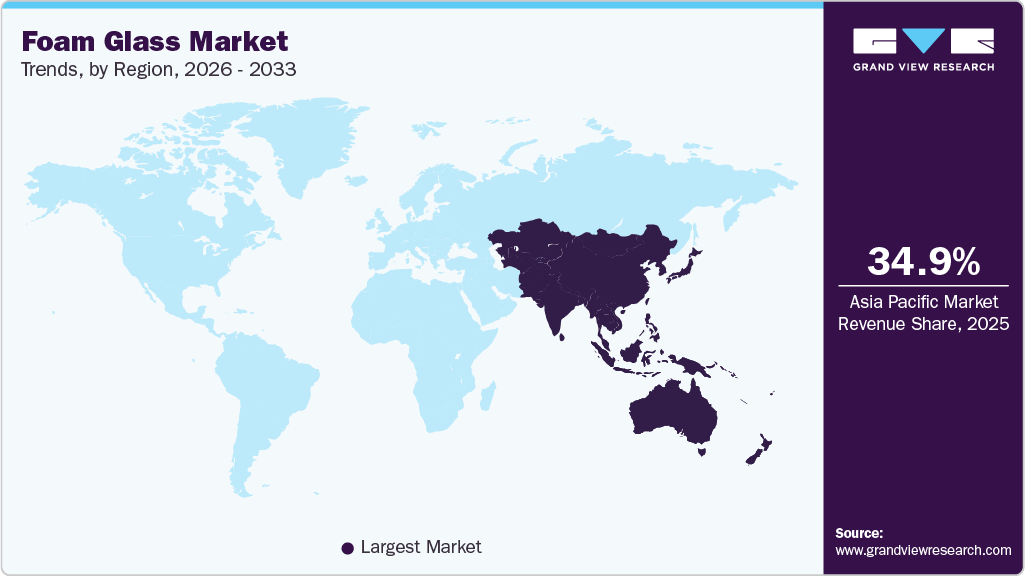
- In 2025, the Asia Pacific led the global foam glass industry, capturing the highest revenue share of 34.9%.
- The market is projected to expand steadily, achieving a CAGR of 4.7% between 2026 and 2033.
- Closed-cell foam glass dominated the market by deposits, representing 64.1% of total revenue in 2025.
- Among applications, the insulation segment is expected to grow the fastest, with a CAGR of 5.2% over the forecast period from 2026 to 2033.
Market Size & Forecast
- 2025 Market Size: USD 2.4 Billion
- 2033 Projected Market Size: USD 3.5 Billion
- CAGR (2026-2033): 4.7%
- Asia Pacific: Largest market in 2025
Foam glass, known for its superior thermal insulation, lightweight structure, and resistance to moisture and fire, is increasingly preferred in green construction projects and infrastructure development. The market is benefiting from continuous technological advancements in manufacturing and product development. Innovations in density control, pore structure, and thermal insulation efficiency are enhancing the performance of foam glass across construction and industrial applications. Manufacturers are increasingly adopting precision foaming techniques and automated production processes to improve uniformity, reduce waste, and tailor products for specific end use requirements. In addition, the integration of foam glass with prefabricated and modular construction systems is gaining traction, as it allows for lightweight, durable, and energy-efficient building solutions.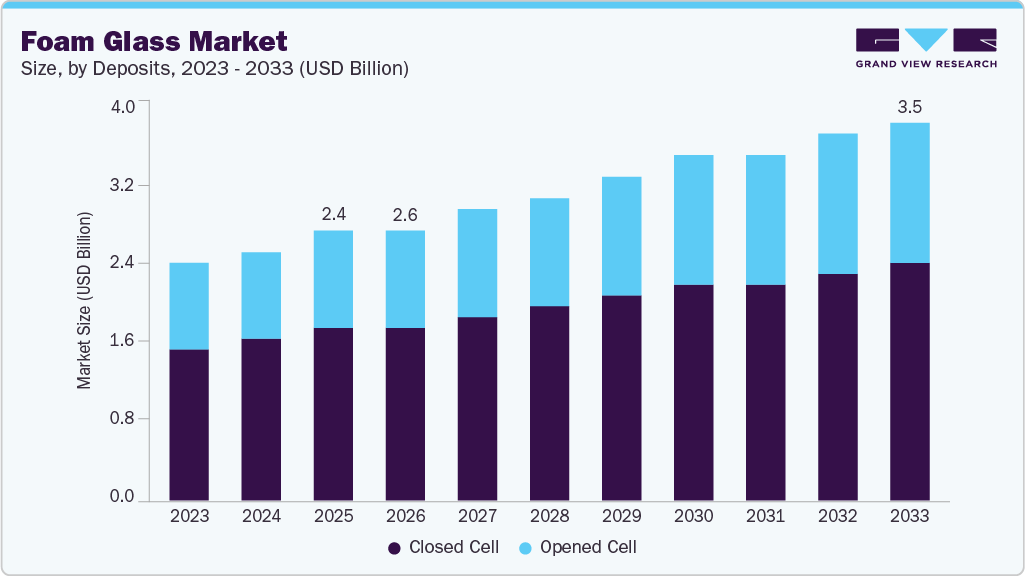
Sustainability remains a key driver in the market, as the material is often produced from recycled glass, supporting circular economy initiatives. Its long lifecycle, low maintenance, and non-toxic composition make it an environmentally friendly choice for insulation and construction projects. With governments and industry standards emphasizing energy efficiency and carbon footprint reduction, foam glass is increasingly used in green buildings and eco-conscious infrastructure. The combination of high performance and sustainable sourcing ensures that foam glass continues to align with global environmental regulations and sustainable construction trends.
Drivers, Opportunities & Restraints
The market is witnessing steady growth due to the rising demand for energy-efficient and durable building materials. Foam glass provides excellent thermal insulation, fire resistance, and moisture protection, which makes it highly suitable for both residential and commercial construction projects. Its lightweight and rigid structure allows for easier handling and installation while reducing the structural load on buildings. In addition, its long lifespan and low maintenance requirements make it an attractive choice for industrial applications, infrastructure projects, and eco-conscious construction. The growing emphasis on green building certifications and energy performance standards further supports its adoption worldwide.
The industry holds significant opportunities arising from the global push towards sustainability and circular economy practices. Foam glass can be manufactured using recycled glass, reducing waste and environmental impact. With governments and organizations increasingly emphasizing eco-friendly construction and sustainable infrastructure development, foam glass is expected to see rising adoption in insulation, modular construction, and civil engineering projects. Furthermore, urbanization and expansion of smart cities in developing regions provide a growing market for lightweight and durable construction materials like foam glass. Advances in production technology also open opportunities to develop customized, high-performance foam glass products tailored to specific applications.
Despite its advantages, the market faces challenges related to cost and manufacturing complexity. Production involves high-temperature processes and specialized equipment, making foam glass more expensive than traditional alternatives such as mineral wool or expanded polystyrene. This cost factor can restrict its use in budget-sensitive residential or commercial projects. Moreover, limited awareness about foam glass benefits in certain regions can slow adoption, as builders and architects may prefer more conventional insulation materials. Finally, the energy-intensive nature of production may pose challenges for manufacturers trying to balance sustainability goals with operational efficiency.
Deposits Insights
In the deposits segment, closed-cell foam glass held the largest market share in 2025, reflecting its widespread adoption in applications that require superior insulation, moisture resistance, and structural strength. Closed-cell foam glass offers higher density and rigidity, making it particularly suitable for industrial insulation, flooring, and roofing applications. Its durability and long service life have contributed to its dominant revenue share, especially in regions where energy efficiency and building longevity are prioritized.
On the other hand, open-cell foam glass is expected to register the fastest CAGR from 2026 to 2033, driven by increasing demand for lightweight, flexible, and acoustically efficient materials. Open-cell foam glass is preferred in applications requiring sound absorption, lower weight, or easier installation, and its adoption is accelerating in emerging markets and modular construction projects. The segment’s faster growth rate highlights a shift in demand dynamics, as more end-users seek cost-effective and versatile insulation solutions that complement modern building designs.
Application Insights
In the application segment, insulation dominated the market in 2025, accounting for the largest revenue share. Its excellent thermal resistance, moisture protection, and fire safety properties make foam glass a preferred choice for walls, roofs, floors, and industrial insulation applications. Furthermore, the insulation segment is expected to register the fastest CAGR from 2026 to 2033, driven by rising global emphasis on energy-efficient buildings, stricter building codes, and increasing adoption of sustainable construction practices. The combination of long-term durability and environmental benefits continues to fuel demand for foam glass in both residential and commercial insulation projects.
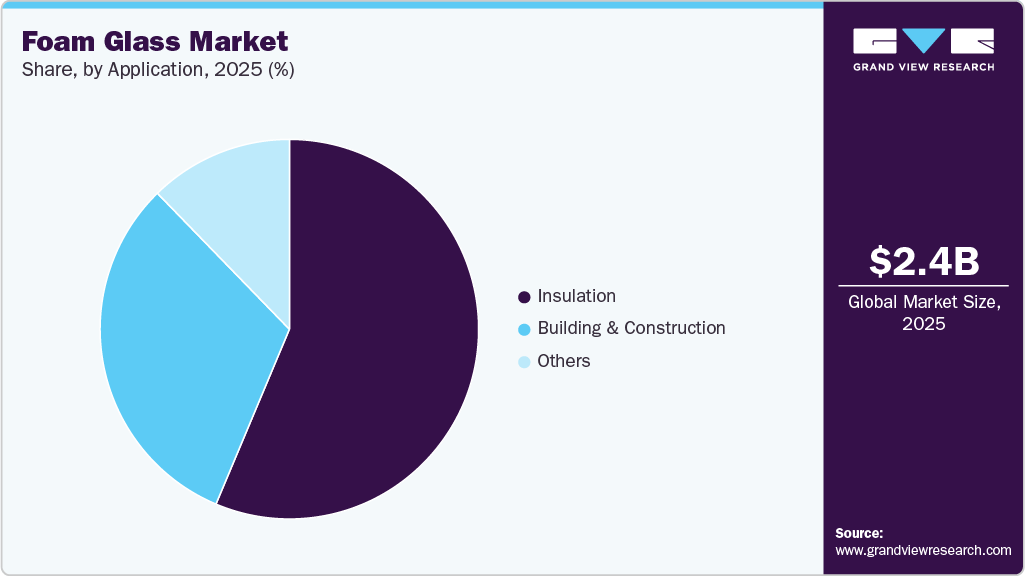
The building & construction and other applications segments also contribute significantly to the market. Foam glass is increasingly used in flooring, modular construction, civil engineering, and infrastructure projects, where its lightweight yet durable nature provides structural support without adding excessive load. In addition, other applications, including industrial piping, marine insulation, and soundproofing, are witnessing steady adoption due to foam glass’s fire-resistant and moisture-impermeable properties. These uses are expected to maintain stable growth, complementing the rapid expansion of the insulation segment in the coming years.
Regional Insights
Asia Pacific Foam Glass Market Trends
Asia Pacific foam glass industry held the largest global revenue share in 2025, driven by rapid urbanization, infrastructure expansion, and rising construction activities. Emerging economies, including China and India, are increasingly adopting foam glass for insulation, modular construction, and industrial applications. The growing awareness of energy efficiency and sustainable building practices is boosting market growth.
North America Foam Glass Market Trends
The North American foam glass industry is driven by stringent energy-efficiency regulations and high demand for sustainable building materials. Industrial and residential sectors increasingly adopt foam glass for insulation, fire protection, and lightweight construction solutions. The region’s established construction and infrastructure industries, combined with a focus on green building standards, continue to support steady market growth.
U.S. Foam Glass Market Trends
The foam glass industry in the U.S. benefits from government incentives for energy-efficient construction and growing awareness of environmentally friendly building materials. Foam glass is widely used in residential and commercial insulation, modular construction, and infrastructure projects. Continued urban development and retrofitting of older buildings sustain demand for high-performance, durable insulation materials.
Europe Foam Glass Market Trends
Europe foam glass industry dominated the global market with strong emphasis on sustainable construction and energy-efficient building codes. Countries such as Germany, France, and the Nordics prioritize the use of eco-friendly insulation materials like foam glass in new construction and renovation projects. Technological advancements and government regulations promoting circular economy practices further enhance market adoption in the region.
Latin America Foam Glass Market Trends
The foam glass industry in Latin America is witnessing gradual growth, supported by infrastructure development and industrial expansion in countries such as Brazil and Mexico. The adoption of foam glass is primarily in insulation for commercial and residential construction, as well as in civil engineering projects. However, slower economic growth and limited awareness of sustainable insulation materials slightly restrain market penetration in the region.
Middle East & Africa Foam Glass Market Trends
The foam glass industry in the Middle East & Africa is expanding due to rapid urbanization, large-scale infrastructure projects, and demand for energy-efficient buildings. High-temperature climates and the need for fire-resistant, durable insulation materials drive adoption in commercial and industrial applications. Investments in smart cities and sustainable construction initiatives are supporting growth in the market.
Key Foam Glass Company Insights
Some of the key players operating in the market include REFAGLASS s.r.o., GLAPOR Werk Mitterteich GmbH, and others
-
GLAPOR Werk Mitterteich GmbH is a Germany-based foam glass manufacturer founded in 2000 and headquartered in Mitterteich, Germany. The company specializes in the production of cellular glass insulation materials used across building and industrial applications. GLAPOR serves infrastructure, residential, and commercial construction sectors with a strong focus on thermal insulation and lightweight construction solutions. It is recognized for its advanced manufacturing processes and consistent product quality. The company emphasizes sustainability through the use of recycled glass and energy-efficient production techniques, positioning itself as a key player in the European foam glass insulation market.
-
REFAGLASS s.r.o. is a Czech Republic-based manufacturer of foam glass insulation materials, headquartered in the Czech Republic. The company focuses on producing high-performance cellular glass blocks and panels used in construction and industrial insulation applications. REFAGLASS serves a wide range of end-use industries, including residential buildings, infrastructure, and energy sectors. It is known for delivering durable, moisture-resistant, and non-combustible insulation solutions. The company emphasizes sustainable production practices by utilizing recycled glass and environmentally friendly manufacturing processes.
-
Zhejiang Zhenshen Insulation Technology Corp. Ltd. is a China-based manufacturer of insulation materials, specializing in foam glass products for industrial and commercial applications. The company is headquartered in Zhejiang, China, and has established a strong presence in both domestic and international markets. Zhejiang Zhenshen focuses on producing high-quality cellular glass insulation materials widely used in petrochemical, LNG, and power generation industries. The company emphasizes product innovation, large-scale manufacturing capabilities, and cost competitiveness. It is also actively engaged in expanding its global footprint through exports and strategic partnerships.
Key Foam Glass Companies:
The following key companies have been profiled for this study on the foam glass market.
- Anhui Huichang New Material Co., Ltd.
- Dehe Technology Group Co., Ltd.
- Earthstone International LLC
- GLAPOR Werk Mitterteich GmbH
- Langfang Yinxing Insulation Materials Co., Ltd.
- Ningbo Yoyo Foam Glass Co., Ltd.
- Owens Corning
- REFAGLASS s.r.o.
- Zhejiang Zhenshen Insulation Technology Corp. Ltd.
- Zibo Baosheng Foam Glass Co., Ltd.
Recent Development
-
In June 2025, Owens Corning announced a strategic investment to expand its FOAMGLAS production facility in Klášterec, Czech Republic, increasing capacity by approximately 50%. The expansion also focuses on reducing carbon intensity through improved manufacturing processes, reflecting the company’s commitment to sustainable insulation solutions and its strategy to meet rising global demand for cellular glass materials.
-
In March 2026, Foamit Group outlined its growth strategy to more than double its revenues by 2028, driven by increasing demand for recycled foam glass aggregates in infrastructure and construction applications. The company’s expansion plans highlight strong market momentum for circular, lightweight materials and reinforce its position as a key supplier in Europe’s sustainable construction ecosystem.
Foam Glass Market Report Scope
Report Attribute
Details
Market definition
The market size represents the revenue generated from the sale of foam glass across various regions in a given year.
Market size value in 2026
USD 2.6 billion
Revenue forecast in 2033
USD 3.5 billion
Growth Rate
CAGR of 4.7% from 2026 to 2033
Base year for estimation
2025
Historical data
2021 - 2024
Forecast period
2026 - 2033
Quantitative Units
Revenue in USD million, volume in kilotons, and CAGR from 2026 to 2033
Report coverage
Volume forecast, revenue forecast, competitive landscape, growth factors, and trends
Segments covered
Deposits, application, and region
Regional scope
North America; Europe; Asia Pacific; Latin America; Middle East & Africa
Country scope
U.S.; Canada; Mexico; Germany; UK; France; Italy; China; India; Japan; South Korea; Brazil
Key companies profiled
Anhui Huichang New Material Co., Ltd.; Dehe Technology Group Co., Ltd.; Earthstone International LLC; GLAPOR Werk Mitterteich GmbH; Langfang Yinxing Insulation Materials Co., Ltd.; Ningbo Yoyo Foam Glass Co., Ltd.; Owens Corning; REFAGLASS s.r.o.; Zhejiang Zhenshen Insulation Technology Corp. Ltd.; Zibo Baosheng Foam Glass Co., Ltd.
Customization scope
Free report customization (equivalent up to 8 analysts working days) with purchase. Addition or alteration to country, regional & segment scope.
Pricing and purchase options
Avail customized purchase options to meet your exact research needs. Explore purchase options
Global Foam Glass Market Report Segmentation
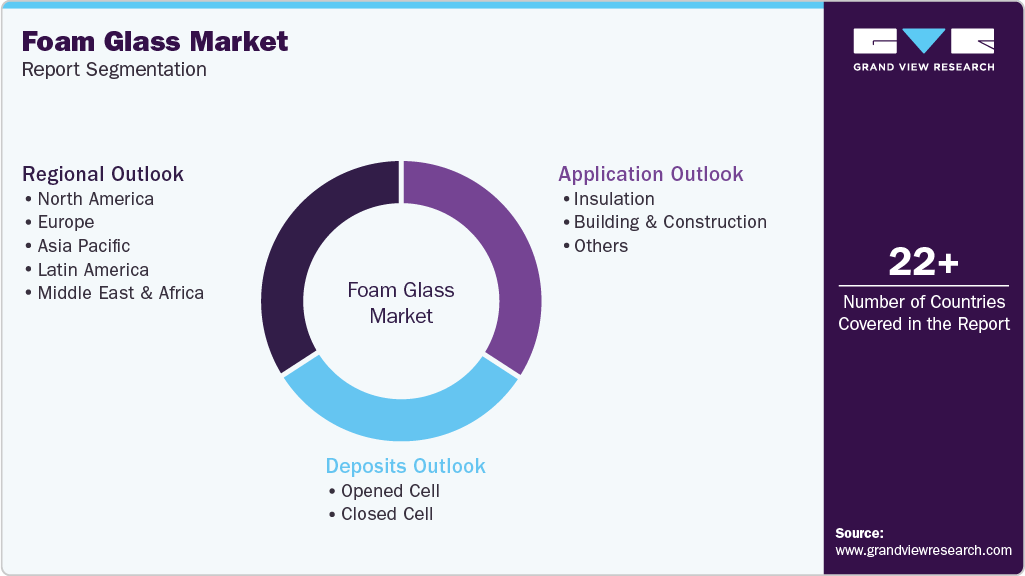
This report forecasts revenue and volume growth at global, regional, and country levels and provides an analysis of the latest industry trends in each of the sub-segments from 2021 to 2033. For this study, Grand View Research has segmented the global foam glass market report based on deposits, application, and region.
-
Deposits Outlook (Volume, Kilotons; Revenue, USD Million, 2021 - 2033)
-
Opened Cell
-
Closed Cell
-
-
Application Outlook (Volume, Kilotons; Revenue, USD Million, 2021 - 2033)
-
Insulation
-
Building & Construction
-
Others
-
-
Regional Outlook (Volume, Kilotons; Revenue, USD Million, 2021 - 2033)
-
North America
-
U.S.
-
Canada
-
Mexico
-
-
Europe
-
Germany
-
UK
-
Italy
-
France
-
-
Asia Pacific
-
China
-
India
-
Japan
-
South Korea
-
-
Latin America
-
Brazil
-
-
Middle East & Africa
-
Frequently Asked Questions About This Report
b. The global foam glass market size was estimated at USD 2.4 billion in 2025 and is expected to reach USD 2.6 billion in 2026.
b. The global foam glass market is expected to grow at a compound annual growth rate of 4.7% from 2026 to 2033 to reach USD 3.5 billion by 2033.
b. Closed-cell foam glass dominated the market by deposits, representing 64.1% of total revenue in 2025. This dominance is attributed to its superior strength, low water absorption, and high thermal insulation performance, making it highly suitable for demanding construction and industrial applications.
b. Some of the key players of the global foam glass market are Anhui Huichang New Material Co., Ltd.; Dehe Technology Group Co., Ltd.; Earthstone International LLC; GLAPOR Werk Mitterteich GmbH; Langfang Yinxing Insulation Materials Co., Ltd.; Ningbo Yoyo Foam Glass Co., Ltd.; Owens Corning; REFAGLASS s.r.o.; Zhejiang Zhenshen Insulation Technology Corp. Ltd.; Zibo Baosheng Foam Glass Co., Ltd., and others.
b. The key factor driving the growth of the global foam glass market is the increasing demand for energy-efficient and sustainable insulation materials in the construction and infrastructure sectors. Additionally, the growing emphasis on recycling and the use of eco-friendly materials in building practices is further supporting market expansion.


Share this report with your colleague or friend.
Need a Tailored Report?
Customize this report to your needs — add regions, segments, or data points, with 20% free customization.


ISO 9001:2015 & 27001:2022 Certified
We are GDPR and CCPA compliant! Your transaction & personal information is safe and secure. For more details, please read our privacy policy.
Trusted market insights - try a free sample
See how our reports are structured and why industry leaders rely on Grand View Research. Get a free sample or ask us to tailor this report to your needs.













