
- Home
- »
- Plastics, Polymers & Resins
- »
-
Formaldehyde-Free Resins Market Size Report, 2026-2033GVR Report cover

Formaldehyde-Free Resins Market (2026 - 2033) Size, Share & Trends Analysis Report By Resin type (Polyurethane Resins, Bio-based & Natural Resins, Acrylic & Epoxy) By Application (Wood Panels & Furniture, Construction & Building Materials), By Region, And Segment Forecasts
Market Size, 2025
$8.3BMarket Estimate, 2026
$9.3BMarket Forecast, 2033
$17.7BCAGR, 2026–2033
9.6%Formaldehyde-Free Resins Market Summary
The global formaldehyde-free resins market size was valued at USD 8.34 billion in 2025 and is projected to grow from USD 9.28 billion in 2026 to USD 17.65 billion by 2033, growing at a CAGR of 9.6% from 2026 to 2033. Asia Pacific dominated the global formaldehyde-free resins industry with the largest revenue share of 36.3% in 2025. The global formaldehyde-free resins market is growing steadily in the construction, furniture, automotive, and packaging industries due to increasing awareness about health risks and stricter environmental regulations, which are encouraging the use of formaldehyde-free solutions.
 Source: Grand View Research, IR Documents, Primary Interviews, Paid DatabasesTo learn more about this report,
 Download Free Sample Report
 Key Market Trends & Insights
- The formaldehyde-free resins industry in India is expected to grow at a CAGR of 11.9% from 2026 to 2033.
- The bio-based & natural resins segment is anticipated to grow at a CAGR of 11.1% in the resin type segment.
- By application, the construction & building materials segment is expected to grow at a 11.1% CAGR in revenue from 2026 to 2033.
Market Size & Forecast
- 2025 Market Size: USD 8.34 Billion
- 2033 Projected Market Size: USD 17.65 Billion
- CAGR (2026-2033): 9.6%
- Asia Pacific: Largest market in 2025
Three ways to get this report
Buy it, customize it, or ask a question.Ask an Analyst
Analyst response in 1 business day
- AccessReport author, directly
- Reply timeWithin 1 working day
- No sales callDirect answer only
- FormatEmail reply
- CostFree, no cost
Get the Full Report
What the study covers
- FormatsPDF · Excel · Dashboard
- Timeline2026–2033 annual, 2025 base
- Coverage20+ countries, 5 regions
- Companies10+ key players profiled
Customize the Report
20% free customization
- IncludeCountries, segments, points
- TailorTo your product definition
- ExtendDeeper competitor detail
- OrA fully bespoke study
- Turnaround5–10 working days
Rapid development of bio-based adhesive chemistries is emerging as a key trend in the formaldehyde-free resins market. Manufacturers are increasingly focusing on lignin and hydroxymethylfurfural (HMF) cross-linked systems to develop fully bio-based adhesives for particleboard, plywood, and engineered wood panels. Demand is rising from furniture, interior construction, and sustainable packaging industries seeking low-emission bonding materials with improved environmental performance. The market is also witnessing growing adoption of renewable feedstocks such as soy protein, tannin, and starch to reduce dependence on petrochemical-based resins while meeting green building certification requirements and circular economy targets. To learn more about this report, Download Free Sample Report
 Growing regulatory pressure on volatile organic compound emissions and hazardous chemical exposure is a major driver for the formaldehyde-free resins market. Increasing concerns regarding indoor air quality, respiratory health, and occupational safety are accelerating the transition toward safer resin technologies across construction, automotive, and consumer goods industries. Manufacturers are replacing conventional formaldehyde hardeners with glyoxal, glutaraldehyde, dimethoxyethanal, and vanillin-based alternatives to comply with stricter environmental regulations and product safety standards. Rising adoption of low-VOC materials in residential furniture, decorative laminates, insulation products, and flooring systems is further strengthening market demand.
Market Dynamics
The formaldehyde-free resins market is witnessing strong demand from the furniture and woodworking industry, supported by rapid urbanization, residential construction growth, and rising disposable income levels. Increasing migration toward urban centers is driving new housing development, which is creating higher consumption of modular furniture, engineered wood products, flooring, and interior decorative materials. Manufacturers are increasingly adopting formaldehyde-free resin systems in panels, laminates, and wood adhesives to comply with indoor air quality standards and low-VOC building regulations. Growing consumer preference for sustainable and low-emission furniture products is further accelerating the transition toward safer resin technologies.
Commercial infrastructure expansion is also contributing significantly to market growth. Rising investments in hospitality, corporate offices, retail spaces, and co-working environments are increasing demand for durable and aesthetically advanced wooden installations. Formaldehyde-free resins are gaining wider adoption in commercial furniture, cabinetry, partitions, and decorative surfaces due to their low toxicity, strong bonding performance, and regulatory compliance advantages. Furniture manufacturers are focusing on bio-based and water-based resin formulations to strengthen sustainability positioning while meeting performance requirements for large-scale production. Increasing emphasis on green building certifications is further supporting long-term market penetration across woodworking applications.
One of the major restraints impacting the formaldehyde-free resins market is supply chain disruption and the higher cost structure associated with alternative feedstocks. Conventional formaldehyde-based resins continue to dominate due to their low production cost, widespread availability, and deeply integrated supply networks across the construction and furniture sectors. In contrast, formaldehyde-free systems rely on bio-based inputs and specialty chemical monomers that require additional testing, qualification, and scaling investments. Limited supplier networks and inconsistent feedstock availability can increase procurement risk, extend production timelines, and create pricing pressure for manufacturers operating in cost-sensitive end-use industries.
Market Concentration & Characteristics
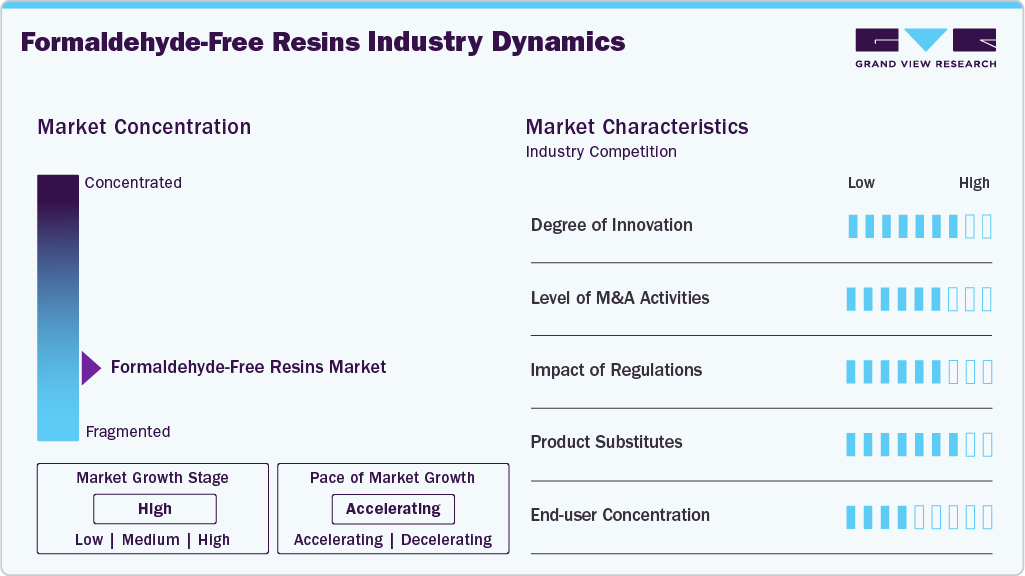
The market growth stage is high, and growth is accelerating. The market exhibits slight fragmentation, with key players dominating the industry landscape. Major companies such as BASF, Henkel Adhesives, Hexion, Sichuan Decision New Material Technology Co., allnex, Cambond, and others play a significant role in shaping the market dynamics. These leading players often drive innovation in the market by introducing new products, technologies, and materials to meet the industry's evolving demands.
The degree of innovation in the formaldehyde-free resins market is driven by strong demand for safer, low-emission, and sustainable materials. Key innovations such as bio-based resin formulations, waterborne systems, and improved performance additives are helping manufacturers reduce toxicity while maintaining strength, durability, and bonding efficiency. These developments are expanding the use of formaldehyde-free resins in furniture, construction, automotive, and packaging applications. As a result, innovation is improving product acceptance, supporting regulatory compliance, and creating new growth opportunities for companies focused on environmentally responsible solutions.
 To learn more about this report, Download Free Sample Report
 Stringent environmental and occupational safety regulations are significantly influencing innovation trends in the formaldehyde-free resins market. Regulatory authorities such as the European Union REACH framework and the U.S. Environmental Protection Agency are tightening restrictions on formaldehyde emissions, hazardous air pollutants, and toxic chemical exposure across furniture, construction, and wood panel industries. These regulations are accelerating the shift toward low-VOC, water-based, and bio-based resin systems with improved environmental performance. Manufacturers are investing in advanced formulations using soy protein, lignin, and other renewable feedstocks to meet evolving compliance standards. Growing adoption of green building certifications and sustainable manufacturing practices is further supporting demand for safer formaldehyde-free resin technologies across industrial applications.
Resin Type Insights
The polyurethane resins segment dominated the market across product type segmentation in terms of revenue, accounting for 41.6% market share in 2025, and is forecast to grow at a 9.7% CAGR from 2026 to 2033. Growing investment in sustainable construction, lightweight automotive manufacturing, and green infrastructure is increasing the demand for formaldehyde-free resins in advanced bonding and coating applications. These resins offer strong adhesion, high abrasion resistance, chemical stability, and low VOC emissions, making them suitable for engineered wood, insulation materials, transportation interiors, and industrial protective products. The expansion of smart buildings, data centers, and residential construction is further supporting the use of environmentally friendly resin systems in building materials. In addition, rising electric vehicle production and increasing automation in automotive manufacturing are driving demand for safer, high-performance resin solutions compatible with modern composite processing and assembly operations.
The bio-based & natural resins segment is expected to expand at an 11.1% CAGR in the formaldehyde-free resins market over the forecast period. Stringent regulations on plastic waste reduction and sustainable packaging are accelerating demand for formaldehyde-free resins across flexible packaging, molded containers, and bio-based film applications. Packaging manufacturers are increasingly adopting low-emission resin systems to meet environmental compliance standards and consumer preference for recyclable and biodegradable materials. These resins support improved product safety while reducing hazardous chemical exposure during production and end use. Rapid growth in ecommerce and quick commerce packaging demand is further supporting market expansion. Rising pharmaceutical packaging requirements are also increasing adoption due to the need for non-toxic, high-purity, and regulatory-compliant packaging materials.
Application Insights
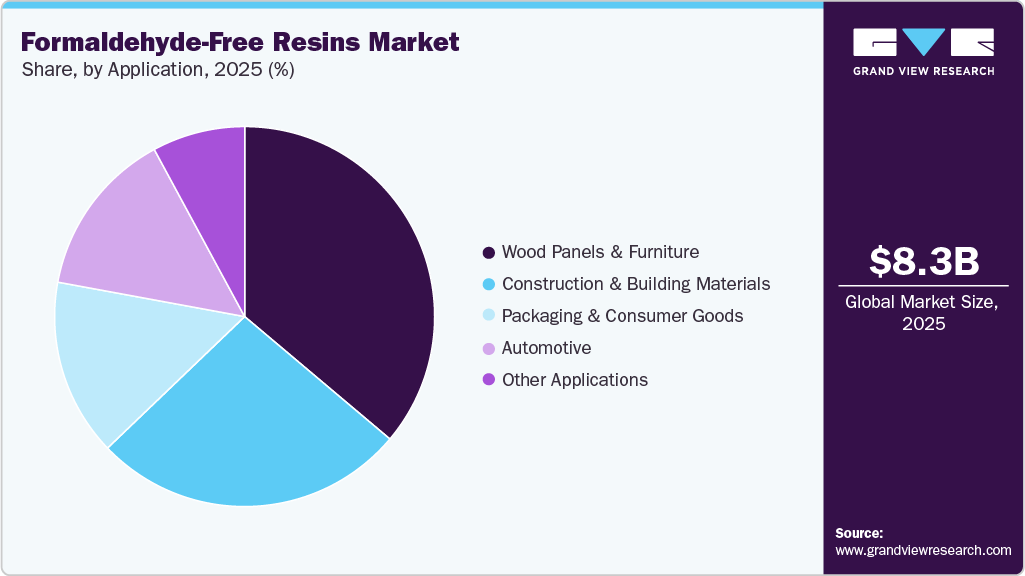
The wood panels & furniture segment led the market by application, accounting for 36.1% of revenue in 2025, and is projected to grow at a 9.5% CAGR from 2026 to 2033. Rising residential construction activity, urbanization, and improving disposable income levels are driving demand for formaldehyde-free resins across furniture and woodworking applications. Increasing migration toward urban areas is accelerating new housing development, which supports the consumption of modular furniture, engineered wood panels, flooring, and interior fittings. Manufacturers are adopting low-emission resin systems to comply with indoor air quality standards and green building requirements. Formaldehyde-free formulations provide strong bonding performance, moisture resistance, and reduced VOC emissions for plywood, particleboard, and decorative laminates. Demand is increasing across residential and commercial projects where sustainability, occupant safety, and durable wood processing materials are critical.
 To learn more about this report, Download Free Sample Report
 The construction & building materials segment is expected to grow at the fastest CAGR of 11.1% over the forecast period. Rising investment in residential construction, commercial infrastructure, and smart urban development is driving demand for formaldehyde-free resins across engineered wood, insulation, flooring, and decorative panel applications. Developing economies are witnessing strong construction activity supported by industrial expansion, transport infrastructure, and urban housing projects. In developed regions, renovation of aging buildings and modernization of public infrastructure are increasing the use of low-emission construction materials.
Regional Insights & Trends
The Asia Pacific formaldehyde-free resins industry held the largest revenue share of 36.3% in 2025. The region is expected to grow at a CAGR of 10.3% over the forecast period, due to rapid industrialization, expanding construction activity, and increasing production of engineered wood products, furniture, and laminates across China, India, Japan, and Southeast Asia. Rising environmental awareness and stricter indoor air quality regulations are accelerating the adoption of low-VOC adhesive systems in residential and commercial infrastructure. Growth in electric vehicles, electronics, and packaging industries is also supporting demand for bio-based and water-based resin technologies used in coatings, composites, insulation materials, and decorative panels.
 To learn more about this report, Download Free Sample Report
 Expansion of India’s residential construction, modular furniture manufacturing, and engineered wood processing industries is significantly driving demand for formaldehyde-free resins. Rising production of plywood, MDF, particleboard, and decorative laminates is increasing the consumption of low-emission adhesive systems across residential and commercial applications. Strengthening environmental regulations and indoor air quality standards are encouraging manufacturers to adopt safer resin technologies with reduced VOC emissions. In addition, growing investments in sustainable construction materials and green-certified infrastructure projects are supporting wider adoption of formaldehyde-free resin systems. Manufacturers are increasingly preferring these resins to improve product compliance, worker safety, and long-term environmental performance
North America Formaldehyde-Free Resins Market Trends
North America is witnessing strong growth in the formaldehyde-free resins market driven by stringent environmental regulations, rising consumer preference for sustainable building materials, and increasing investments in green construction projects. The U.S. and Canada are experiencing higher adoption of formaldehyde-free wood adhesives, insulation binders, and protective coatings across residential, commercial, and industrial applications. Demand is further supported by growth in modular construction, furniture manufacturing, and automotive light-weighting trends, alongside increasing focus on circular economy initiatives and recyclable material development.
The U.S. formaldehyde-free resins market is witnessing strong growth due to tightening environmental regulations and rising demand for low-emission industrial materials across construction and consumer applications. Regulatory standards established by the EPA and CARB are encouraging manufacturers to replace conventional formaldehyde-based binders with safer resin alternatives in engineered wood, insulation, coatings, and furniture production. Growing investments in sustainable construction and green-certified infrastructure projects are further supporting product adoption. In addition, increasing consumer preference for non-toxic and low-VOC materials is accelerating the use of bio-based and water-based formaldehyde-free resins across packaging, automotive interiors, and residential building applications.
Europe Formaldehyde-Free Resins Market Trends
Europe represents a mature yet innovation-driven market for formaldehyde-free resins, supported by strict EU emission standards and sustainability targets under green building regulations. Countries such as Germany, France, and the Nordic nations are emphasizing bio-based raw materials and low-emission wood panels for furniture, flooring, and insulation applications. Increasing investments in sustainable packaging, automotive interiors, and renewable construction materials are encouraging manufacturers to develop advanced resin formulations with improved durability, chemical resistance, and recyclability while reducing dependence on conventional petrochemical-based adhesives.
Latin America Formaldehyde-Free Resins Market Trends
The formaldehyde-free resins market in Latin America is growing steadily due to expanding construction activities, rising urbanization, and increasing awareness regarding indoor air pollution and worker safety. Countries including Brazil and Mexico are witnessing stronger demand for eco-friendly adhesives and coatings in furniture manufacturing, plywood, and decorative laminates. Growth in agricultural processing, packaging, and infrastructure sectors is also creating opportunities for water-based and bio-based resin systems. Government initiatives promoting sustainable industrial practices are gradually encouraging the adoption of low-emission resin technologies across regional manufacturing industries.
Middle East and Africa Formaldehyde-Free Resins Market Trends
The Middle East and Africa formaldehyde-free resins market is gaining momentum due to increasing investments in sustainable infrastructure, commercial construction, and industrial diversification projects. Rising demand for low-emission construction materials in GCC countries is supporting the use of formaldehyde-free adhesives, coatings, and insulation products in modern building applications. In Africa, expanding urban development and furniture manufacturing activities are contributing to gradual market growth. Increasing focus on environmental compliance, green buildings, and energy-efficient construction materials is further encouraging the adoption of advanced eco-friendly resin technologies.
Key Formaldehyde-Free Resins Company Insights
Some of the key players operating in the market include BASF and Henkel Adhesives
-
BASF is a key participant in the formaldehyde-free resins market with a broad portfolio of sustainable resin technologies, specialty polymers, and low-emission adhesive solutions. The company focuses on high-performance applications across construction, automotive, furniture, and industrial coatings sectors. Its emphasis on bio-based raw materials, regulatory compliance, and advanced material innovation strengthens its competitive position in environmentally compliant resin systems. BASF’s global manufacturing footprint and strong research capabilities support the continuous development of formaldehyde-free solutions for evolving end-use requirements.
-
Henkel Adhesives is a prominent company in the formaldehyde-free resins market with strong expertise in industrial adhesives, sealants, and functional coating technologies. The company targets sustainable bonding applications across packaging, woodworking, automotive, electronics, and consumer goods industries. Its focus on low-VOC formulations, circular economy initiatives, and high-performance adhesive systems supports growing demand for safer and environmentally responsible materials. Henkel’s extensive customer network, innovation-driven product strategy, and global production capabilities reinforce its position in the formaldehyde-free resin industry.
Sichuan Decision New Material Technology Co. and Cambond are some of the emerging participants in the formaldehyde-free resins market.
-
Sichuan Decision New Material Technology Co. is strengthening its position in the formaldehyde-free resins market through the development of eco-friendly resin systems for synthetic leather, textile coatings, and industrial finishing applications. The company focuses on low VOC and water-based resin technologies that support compliance with tightening environmental standards in Asia and export markets. Its expanding product portfolio and emphasis on sustainable material innovation are supporting adoption across automotive interiors, footwear, and flexible substrate applications.
-
Cambond is an emerging participant in the formaldehyde-free resins market with a focus on environmentally safe adhesive and bonding materials for wood processing, furniture, and construction applications. The company develops low-emission resin systems designed to improve indoor air quality and meet green building requirements. Its increasing investment in formaldehyde-free binder technologies and customized industrial solutions is supporting demand from engineered wood and decorative panel manufacturers.
Key Formaldehyde-Free Resins Companies:
The following key companies have been profiled for this study on the formaldehyde-free resins market.
- BASF SE
- allnex
- Arkema
- Synthomer plc
- Covestro AG
- Henkel AG & Co. KGaA
- Solenis
- EcoSynthetix Inc.
- Kuraray Co., Ltd.
- Evertree Technologies
Competitive Benchmarking
Operating Strategies
Competitive Edge
Weakness
Mature Players: BASF; Henkel Adhesives; Hexion; Allnex
- Extensive manufacturing capabilities for sustainable and low-emission resin systems serving coatings, wood processing, automotive, packaging, and industrial applications.
- Continuous investment in advanced R&D, application-focused product development, digital manufacturing, and collaborative partnerships to strengthen innovation and operational efficiency.
- Growing emphasis on bio-based raw materials, low-VOC technologies, engineered resin solutions, and circular economy initiatives to support environmentally compliant and high-performance applications..
- Strong global manufacturing capabilities, diversified specialty materials and resin portfolios, and advanced R&D expertise support large-scale industrial applications across coatings, adhesives, and engineered materials markets.
- Established relationships with packaging, furniture, construction, and industrial customers, combined with extensive technical service networks, strengthen customized product development and long-term market presence.
- High specialization in thermoset chemistry, sustainable formulations, regulatory compliance, and application-specific solutions supports competitive positioning across Europe, North America, and other major industrial regions.
- Complex organizational structures and continuous compliance requirements can delay product commercialization while increasing operational expenses and exposure to raw material and energy price volatility.
- Strong dependence on industrial manufacturing, construction, and housing sectors creates cyclical demand patterns, making business performance sensitive to broader economic and infrastructure activity.
- Premium pricing models and rising competition from low-cost regional and multinational resin suppliers can restrict market penetration and reduce pricing flexibility in cost-sensitive markets..
Emerging Players: Sichuan Decision New Material Technology Co.; Cambond
- Expands manufacturing of environmentally friendly resin and adhesive systems for wood processing, decorative surfaces, furniture, laminates, and industrial applications across domestic and selected international markets.
- Prioritizes cost-efficient production, rapid commercialization of new formulations, and customized product development to address evolving low-emission material requirements.
- Focuses on responsive regional supply capabilities and tailored solutions for SMEs, supported by rising demand for sustainable and formaldehyde-free materials in China.
- Cost-efficient manufacturing operations and strong access to China’s expanding industrial sector support broad regional market reach.
- Flexible production infrastructure enables customized product development tailored to local customer requirements.
- Agile operations, competitive pricing, and localized supply capabilities strengthen responsiveness and support deeper regional market penetration.
- Limited global brand visibility and narrower international distribution capabilities compared to large multinational competitors.
- Smaller manufacturing and operational scale with comparatively lower financial capacity for extensive R&D and global expansion activities.
- Restricted presence in high-value premium application segments and slower advancement in advanced sustainability-focused product development.
Recent Developments
-
In March 2026, ResiCare introduced Resi4 CARBON/CARBON and Resi4 ABLATION, two bio-based aramino resins developed without formaldehyde to provide a safer industrial solution for composite applications operating under extreme heat conditions.
-
In October 2025, researchers at Fraunhofer WKI announced progress in the “LowEPanel” research project, which focuses on developing formaldehyde-free adhesives using lignin and hydroxymethylfurfural (HMF) for sustainable particle board production.
Formaldehyde-Free Resins Market Report Scope
Report Attribute
Details
Market size value in 2025
USD 8.34 billion
Market size value in 2026
USD 9.28 billion
Revenue forecast in 2033
USD 17.65 billion
Growth rate
CAGR of 9.6% from 2026 to 2033
Historical data
2021 - 2025
Forecast period
2026 - 2033
Quantitative units
Revenue in USD million/billion, volume in kilotons, and CAGR from 2026 to 2033
Report coverage
Revenue & volume forecast, competitive landscape, growth factors, and trends
Segments covered
Resin type, application, region
Regional scope
North America; Europe; Asia Pacific; Latin America; Middle East & Africa
Country Scope
U.S.; Canada; Mexico; Europe; Germany; UK; France; Italy; Spain; China; India; Japan; South Korea; Australia; Brazil; Argentina; Saudi Arabia; UAE; South Africa
Key companies profiled
BASF SE; allnex; Arkema; Synthomer plc; Covestro AG; Henkel AG & Co. KGaA; Solenis; EcoSynthetix Inc.; Kuraray Co., Ltd.; Evertree Technologies
Customization scope
Free report customization (equivalent to up to 8 analyst working days) with purchase. Addition or alteration to country, regional & segment scope
Pricing and purchase options
Avail customized purchase options to meet your exact research needs. Explore purchase options
Global Formaldehyde-Free Resins Market Report Segmentation
This report forecasts revenue growth at the global, regional, and country levels and provides an analysis of the latest industry trends across sub-segments from 2021 to 2033. For this study, Grand View Research has segmented the global formaldehyde-free resins market report based on resin type, application, and region:
 To learn more about this report, Download Free Sample Report
 -
Resin Type Outlook (Volume, Kilotons; Revenue, USD Billion, 2021 - 2033)
-
Polyurethane (PU) Resins
-
Bio-based & Natural Resins
-
Acrylic & Epoxy
-
Other resin types
-
-
Application Outlook (Volume, Kilotons; Revenue, USD Billion, 2021 - 2033)
-
Wood Panels & Furniture
-
Construction & Building Materials
-
Automotive
-
Packaging & Consumer Goods
-
Other applications
-
-
Regional Outlook (Volume, Kilotons; Revenue, USD Billion, 2021 - 2033)
-
North America
-
U.S.
-
Canada
-
Mexico
-
-
Europe
-
Germany
-
UK
-
France
-
Italy
-
Spain
-
-
Asia Pacific
-
China
-
India
-
Japan
-
South Korea
-
Australia
-
-
Latin America
-
Brazil
-
Argentina
-
-
Middle East & Africa
-
Saudi Arabia
-
UAE
-
South Africa
-
-
Delivered Customizations
This report has been delivered with the following In-depth customizations
Client Request
Customization Delivered
Value Adds
Regional Segmentation
Detailed market sizing and forecast by region covering North America, Europe, Asia-Pacific, Latin America, and the Middle East & Africa. Analysis of regional adoption trends across construction, furniture, automotive, packaging, and insulation industries
Country-level demand mapping for key markets such as the U.S., Germany, China, India, Japan, and Brazil, with regulatory and consumption trend analysis. Identification of high-growth regional clusters and emerging manufacturing hubs for formaldehyde-free resin production
Trade Assessment
Import-export analysis of formaldehyde-free resins and associated raw materials by region. Analysis of global supply-demand balance and manufacturing capacities
Identification of major exporting and importing countries with trade flow visualization. Evaluation of geopolitical and logistics risks affecting resin availability and pricing.
Cross-Segmentation
Market breakdown by resin type, including Polyurethane (PU) Resins, Bio-based & Natural Resins, Acrylic & Epoxy, Other resin types, segmentation by application, such as Wood Panels & Furniture, Construction & Building Materials, Automotive, Packaging & Consumer Goods, Other applications. End-user analysis across residential construction, commercial infrastructure, automotive, industrial manufacturing, and consumer goods.
Identification of fastest-growing application segments with comparative penetration analysis. Strategic insights into niche growth opportunities and product suitability by industry vertical
Frequently Asked Questions About This Report
The global formaldehyde-free resins market was estimated at around USD 8.34 billion in the year 2025 and is expected to reach around USD 9.28 billion in 2026.
The global formaldehyde-free resins market is expected to grow at a compound annual growth rate of 9.6% from 2026 to 2033 to reach around USD 17.65 billion by 2033.
The polyurethane resins led the formaldehyde-free resins market in 2025 with a 41.6 % share. The growth is supported by rising demand for low-emission and environmentally compliant coating, adhesive, and insulation materials across construction, automotive, and furniture applications.
The key players in the formaldehyde-free resins market are BASF, Henkel Adhesives, Hexion, Sichuan Decision New Material Technology Co., Allnex, and Cambond
The formaldehyde-free resins market is growing steadily in the construction, furniture, automotive, and packaging industries due to increasing awareness about health risks and stricter environmental regulations, which are encouraging the use of formaldehyde-free solutions
About the Author(s)
Plastics, Polymers & Resins Research Team
Bulk Chemicals · Plastics, Polymers & ResinsThis report was authored by the plastics, polymers & resins research team at Grand View Research - comprising two research analysts, one senior research analyst, and one industry expert - with specialized expertise in the plastics, polymers & resins segment of the bulk chemicals industry. All findings are based on proprietary bulk chemicals databases, executive interviews, and regulatory analysis, subject to internal peer review prior to publication.
Last Updated:
Speak to Analyst

Customize this report to your needs - add regions, segments, or data points, with 20% free customization.
Or view our licence options:


ISO 9001:2015 & 27001:2022 Certified
We are GDPR and CCPA compliant! Your transaction & personal information is safe and secure. For more details, please read our privacy policy.


