
- Home
- »
- Automotive & Transportation
- »
-
Full Truckload Market Size And Share Report, 2026-2033GVR Report cover

Full Truckload Market (2026 - 2033)
Size, Share & Trends Analysis Report By Truck Type (Dry Van, Refrigerated), By Service (Dedicated Contract Carriage, Spot Freight), By Mode of Transport, By End Use, By Region, And Segment Forecasts
Market Size, 2025
$250.1BMarket Estimate, 2026
$260.4BMarket Forecast, 2033
$388.4BCAGR, 2026–2033
5.9%Full Truckload Market Summary
The global full truckload market size was estimated at USD 250.1 billion in 2025 and is projected to grow from USD 260.4 billion in 2026 to USD 388.4 billion by 2033, growing at a CAGR of 5.9% from 2026 to 2033. The Asia Pacific full truckload market accounted for a 38.5% share of the overall market in 2025.
 Source: Grand View Research, IR Documents, Primary Interviews, Paid DatabasesTo learn more about this report,
 Download Free Sample Report
 Key Market Trends & Insights
- By truck type: Dry van segment accounted for the largest share of 45.0% in 2025.
- By service: Dedicated contract carriage segment held the largest market share in 2025.
- By mode of transport: Roadways segment dominated the market in 2025.
- By end use: Retail & e-commerce segment held the largest market share in 2025.
Regional Highlights
- Largest regional market: Asia Pacific (38.5% revenue share, 2025)
- By country: The India held the largest market share in 2025.
Market Size & Forecast
- Market size in 2025: USD 250.1 Billion
- Estimated market size in 2026: USD 260.4 Billion
- Projected market size by 2033: USD 388.4 Billion
- CAGR (2026-2033): 5.9%
Three ways to get this report
Buy it, customize it, or ask a question.Ask an Analyst
A direct answer, usually in 1 working day
- AccessReport author, directly
- Reply timeWithin 1 working day
- No sales callDirect answer only
- FormatEmail reply
- CostFree, no cost
Get the Full Report
What the study covers
- FormatsPDF · Excel · Dashboard
- Timeline2026–2033 annual, 2025 base
- Coverage20+ countries, 5 regions
- Companies10+ key players profiled
Customize the Report
20% free customization
- IncludeCountries, segments, points
- TailorTo your product definition
- ExtendDeeper competitor detail
- OrA fully bespoke study
- Turnaround5–10 working days
The rise in online shopping has significantly increased demand for fast, reliable delivery services across supply chains. This has encouraged businesses to adopt full truckload transportation to efficiently move large volumes of goods directly between locations. Thus, freight volumes and time-sensitive shipments have risen, contributing to market growth. To learn more about this report, Download Free Sample Report
 The market growth can also be attributed to the expansion of manufacturing and industrial activities worldwide. As production levels increase, the need for efficient, large-scale transportation solutions grows significantly. Companies require reliable logistics to transport raw materials to manufacturing facilities and distribute finished goods to end markets. Full truckload services address this demand by enabling direct, high-capacity freight movement with reduced handling and improved efficiency. This enhances supply chain performance and supports the timely delivery of bulk shipments. Thus, the growth of industrial output continues to drive steady market expansion.
The market is increasingly adopting AI-driven and cloud-based logistics solutions to improve freight efficiency and optimize transportation costs. Various companies have launched advanced freight orchestration platforms that integrate with existing transportation systems to enhance shipment visibility, route planning, and network utilization. For instance, in November 2025, SemiCab launched “Apex,” a new AI-powered SaaS logistics platform designed for 3PLs and enterprise shippers in the U.S. market. The platform aimed to improve freight orchestration, operational efficiency, and cost optimization across the USD 450 billion U.S. full truckload industry. This development highlights the growing role of AI-enabled digital freight management solutions in enhancing efficiency and cost optimization across the global full market.
Regulatory compliance is crucial in the market. Transportation companies must adhere to Department of Transportation (DOT) regulations and other industry-specific standards to ensure safe and efficient freight operations. Companies are increasingly focusing on compliance with driver safety rules, cargo handling regulations, and electronic logging requirements to avoid operational disruptions and legal penalties. For instance, the Electronic Logging Device (ELD) mandate requires truck drivers to use electronic systems to record driving hours and maintain compliance with Hours of Service (HOS) regulations, improving operational transparency and road safety across the full truckload industry.
The market faces several challenges, including rising freight costs driven by fluctuating fuel prices and higher transportation costs during periods of high demand. Fuel price volatility creates difficulties in budgeting and operational cost management for shippers and logistics providers. In addition, sudden increases in freight rates can lead to unexpected expenses, forcing companies to adjust pricing strategies or absorb additional costs, thereby affecting overall market profitability.
Market Dynamics
The market's growth is significantly driven by the ongoing expansion of logistics and transportation infrastructure across major economies. Increasing investments in highways, freight corridors, logistics parks, distribution centers, and warehousing facilities are improving freight connectivity and enabling faster, more efficient movement of goods across regional and long-distance routes. These developments are encouraging businesses to increasingly adopt full truckload transportation services for high-volume and time-sensitive shipments.
Furthermore, companies are expanding their transportation and freight facilities to strengthen operational capabilities and meet growing freight demand. For instance, in January 2026, Maersk, an integrated logistics company, opened a new 165,000 sq. ft. Ground Freight facility in Fontana, California, strategically located in the Inland Empire logistics hub. The expansion was aimed at improving freight distribution efficiency and providing faster and more reliable truckload transportation services across Southern California and North America, thereby supporting market growth.
The market faces significant challenges due to limited truck capacity and the ongoing shortage of qualified drivers, particularly across the European freight transportation sector. Factors such as post-Brexit labor disruptions and increasing freight demand have further strained the availability of trucks and transportation resources. Thus, logistics providers are experiencing difficulties in maintaining efficient freight movement and meeting shipment schedules.
Furthermore, capacity constraints become more severe during peak shipping seasons, when demand for both full truckload transportation rises substantially. The shortage of available trucks often leads to shipment delays, higher freight rates, and missed delivery deadlines, which may negatively impact customer satisfaction and inventory management. These operational disruptions continue to create significant challenges for shippers and transportation companies operating in the global freight and logistics market.
The market is expected to offer significant growth opportunities as rising demand for temperature-controlled transportation across industries such as food & beverages, pharmaceuticals, chemicals, and healthcare drives expansion. Increasing consumption of perishable food products is driving the need for reliable refrigerated freight solutions that ensure product quality, safety, and timely delivery across long distances. Various logistics companies offer refrigerated full truckload services to support cold-chain transportation requirements. For instance, RWI Logistics offers temperature-controlled full truckload services with specialized trailers that maintain temperatures between -20°F and 60°F, ensuring the secure transportation of temperature-sensitive cargo and maintaining product quality throughout transit.
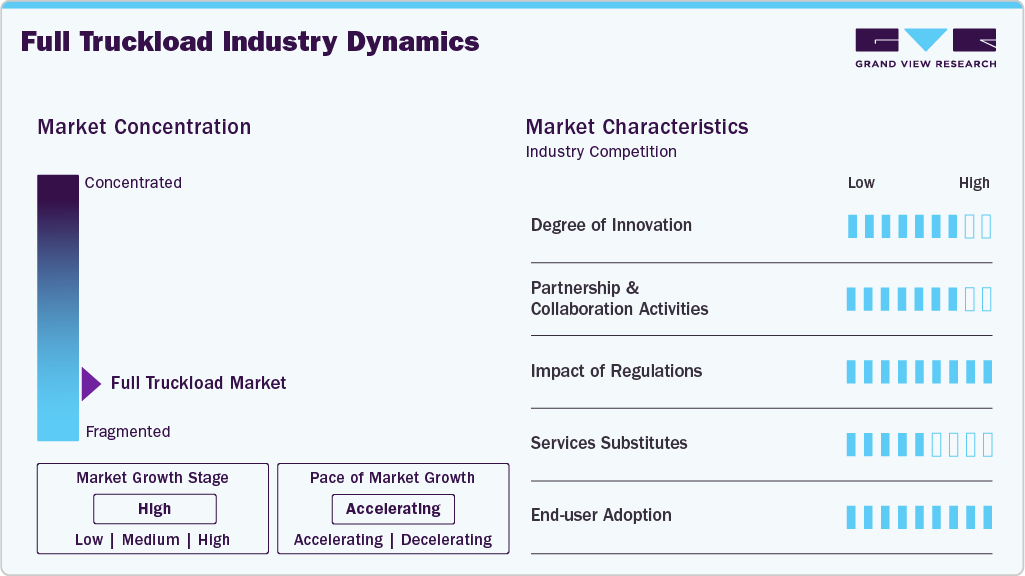
Market Concentration & CharacteristicsThe full truckload industry is highly fragmented and competitive, comprising regional carriers, local fleet operators, third-party logistics providers, and multinational transportation companies. Although major players such as J.B. Hunt Transport Services, Knight-Swift Transportation Holdings, and Schneider National hold significant market share, small- and medium-sized trucking companies handle a large share of freight transportation. The market faces intense competition, pricing pressure, and varying regional transportation capacities.
 To learn more about this report, Download Free Sample Report
 In addition, the market is witnessing increased adoption of digital freight platforms, AI-driven logistics solutions, route-optimization technologies, and real-time freight visibility systems to improve operational efficiency and reduce transportation costs. Furthermore, growing demand for temperature-controlled freight, dedicated contract carriage, and cross-border services is also influencing market trends. Companies are prioritizing fleet modernization, sustainability, and strategic partnerships to improve their market presence and supply chain performance in the evolving full truckload industry.
Truck Type Insights
The dry van segment accounted for the largest share of 45.00% in 2025. Segment growth is driven by rising demand for the transportation of non-perishable goods across industries such as retail, e-commerce, manufacturing, and consumer packaged goods. Dry van trailers provide enclosed, secure transportation, protecting cargo from weather and external damage, making them highly suitable for long-distance freight movement and bulk shipments. Moreover, the rapid expansion of e-commerce and organized distribution networks has significantly increased demand for dry van full truckload services, as businesses require efficient and reliable transportation solutions to move packaged goods rapidly between warehouses and retail outlets.
The refrigerated (reefer) segment is expected to grow at a significant CAGR during the forecast period. The increasing demand for temperature-controlled transportation across industries such as food & beverages, pharmaceuticals, chemicals, and healthcare is expected to drive significant growth of the segment. Rising consumption of frozen foods, dairy products, fresh produce, and temperature-sensitive medicines is increasing the need for reliable refrigerated freight transportation solutions. In addition, the expansion of cold chain logistics infrastructure and growing trade of perishable goods are further supporting segment growth, as reefer trucks help maintain product quality and freshness during long-distance transportation.
Service Insights
The dedicated contract carriage segment dominated the market in 2025. The segment growth is supported by increasing demand for reliable, long-term, and customized freight transportation solutions. Dedicated contract carriage services provide exclusive fleet capacity and optimized delivery schedules for specific customers to help businesses improve supply chain efficiency and ensure timely deliveries. Moreover, the growing focus on operational efficiency and real-time shipment visibility is encouraging companies to adopt dedicated transportation contracts rather than rely on spot freight services. The increasing need for consistent freight movement and secure transportation of high-volume shipments is further supporting the growth of the dedicated contract carriage segment in the market.
The spot freight segment is projected to grow at a significant CAGR over the forecast period. Growth in this segment is driven by rising demand for flexible, on-demand transportation solutions. Shippers are turning to spot freight services to quickly secure truck capacity without long-term contracts. This flexibility enables companies to manage urgent shipments efficiently and maintain logistics continuity. In addition, volatility in freight demand and fluctuating capacity across regions are further encouraging the use of spot freight services. Digital freight platforms and load-matching technologies are streamlining real-time connections between shippers and carriers, enhancing transparency and optimizing route utilization.
Mode of Transport Insights
The roadways segment dominated the market in 2025. The segment growth is driven by extensive network coverage and cost efficiency. Road transportation remains the most widely used mode for freight movement, particularly for non-bulk cargo, as it enables faster transit times and direct delivery between production centers and warehouses. In addition, the dominance of roadways is supported by continuous investments in highway infrastructure and expanding logistics networks. The flexibility and accessibility of road freight services further reinforce their critical role in full truckload transportation, enabling the efficient and reliable movement of goods across regional and cross-border supply chains.
The railways segment is expected to grow at a significant CAGR over the forecast period. The increasing investment in rail freight infrastructure and dedicated freight corridors is expected to drive significant growth of the railways segment. Governments and logistics operators are focusing on modernizing rail networks and improving intermodal connectivity to improve freight capacity and operational efficiency along long-distance trade routes. In addition, the growing emphasis on cost-efficient and sustainable freight transportation is encouraging companies to adopt railway-based logistics solutions, as they consume less fuel and emit fewer carbon emissions than road transportation.
End Use Insights
The retail & e-commerce segment held the largest market share in 2025. The rapid growth of online shopping and rising consumer demand for fast, high-volume deliveries are propelling the segment growth. Retailers and e-commerce companies increasingly use full truckload transportation to move goods efficiently between manufacturers, warehouses, fulfillment centers, and stores, ensuring timely deliveries and streamlined supply chains. In addition, the focus on same-day and next-day delivery is increasing demand for efficient freight transportation. Companies are adopting full truckload services to improve shipment efficiency and manage high-volume inventory, thus reinforcing the segment’s continued dominance in the market.
 To learn more about this report, Download Free Sample Report
 The food & beverages segment is expected to grow at a notable CAGR over the forecast period. The increasing demand for efficient transportation of perishable and packaged food products is expected to drive notable growth of the segment. Rising consumption of processed foods, frozen products, dairy items, and beverages, along with expanding food distribution networks, is driving the need for reliable full-truckload transportation services. In addition, the growing focus on cold chain logistics and product quality maintenance is encouraging food and beverage companies to adopt full truckload solutions to efficiently move large volumes across regional and long-distance supply chains.
Regional Insights
Asia Pacific full truckload market dominated the global market and accounted for a share of 38.48% in 2025. The region’s dominance is driven by rapid manufacturing growth, increased cross-border trade, and strong e-commerce logistics. Significant expansion in transportation infrastructure, logistics parks, and freight corridors is improving supply chain connectivity and freight efficiency. For instance, China’s Ministry of Transport plans to expand the national roadway network to 461,000 km by 2035 to improve freight connectivity and support long-distance cargo transport. In addition, the adoption of digital freight platforms and rising industrial output continue to support market growth.
 To learn more about this report, Download Free Sample Report
 China Full Truckload Market Trends
The full truckload market in China held a significant market share in 2025 in the Asia Pacific region. The market is increasingly driven by the push toward organized digital fleet operations, with logistics providers adopting intelligent transportation systems, AI-based dispatching, and integrated fleet management platforms to improve efficiency and enhance real-time shipment visibility. In addition, the growing emphasis on high-efficiency supply chain networks and the development of urban-rural distribution systems are strengthening long-haul and regional truckload transportation nationwide.
India full truckload market is expected to grow at the fastest rate during the forecast period. Rapid expansion of e-commerce networks in urban and semi-urban areas is driving the country’s growth. The growing use of online retail platforms is driving demand for efficient full truckload transportation to handle high-volume shipments between warehouses, fulfillment centers, and consumers. The development of multimodal logistics hubs and integrated freight corridors is also improving connectivity between production centers and markets, further accelerating the growth of organized full truckload transportation services.
North America Full Truckload Market Trends
The full truckload market in North America is expected to grow at the fastest CAGR during the forecast period. Advanced freight management technologies and increasing demand for time-sensitive deliveries support the region’s growth. Companies are adopting AI-enabled route optimization, real-time tracking, and automated freight matching to reduce empty miles, optimize load utilization, and lower transportation costs. For instance, J.B. Hunt Transport Services, an American transportation and logistics company, has developed J.B. Hunt 360°, a digital platform that provides route optimization and shipment tracking through data-driven automation. The platform supports freight movement across the U.S. and North America through a large carrier network of dedicated fleets, independent drivers, and third-party logistics partners.
The U.S. full truckload market held a dominant position in 2025. Nearshoring and cross-border trade activities have significantly strengthened the U.S. market, particularly through increased manufacturing relocation and trade flows between the U.S. and Mexico. This shift has led to higher demand for long-haul and cross-border full truckload transportation services, as companies seek to optimize supply chains, reduce lead times, and improve cost efficiency. Thus, trucking corridors along the U.S.-Mexico border have become critical freight routes, supporting steady growth in full truckload volumes and strengthening cross-border logistics integration.
Europe Full Truckload Market Trends
The full truckload market in Europe was identified as a lucrative region in 2025. The region’s growth is driven by rising demand for efficient cross-border freight transportation within integrated European supply chains. This enables faster movement of goods between countries, reduces transit delays, and improves overall logistics efficiency across regional trade networks. In addition, the presence of well-established highways and logistics infrastructure across Western and Central Europe is further supporting seamless freight movement.
The UK full truckload market is expected to grow rapidly over the forecast period. Rising demand for fast and reliable domestic freight transportation services in the UK market is driving significant growth by improving supply chain responsiveness and enabling quicker delivery cycles. This supports the efficient movement of goods across key consumption and distribution centers within the country, thereby enhancing overall logistics performance and reducing transit delays.
The full truckload market in Germany held a substantial market share in 2025, supported by its strong manufacturing base and high export-oriented industrial output. This is driving consistent freight volumes, as large-scale production and international trade activities require reliable long-haul trucking for the timely distribution of goods across Europe and global markets.
Key Full Truckload Company Insights
Some of the key companies in the market include J.B. Hunt Transport Services, Knight-Swift Transportation Holdings, Schneider National, and others. Organizations are focusing on increasing their customer base to gain a competitive edge in the industry. Therefore, key players are taking several strategic initiatives, such as mergers and acquisitions, and partnerships with other major companies.
-
Knight-Swift Transportation Holdings, formed by the merger of Knight Transportation and Swift Transportation, is a North American transportation and logistics provider. The company offers full truckload, dedicated, refrigerated, brokerage, intermodal, and less-than-truckload services. Its full truckload operations support long-haul and regional freight across the U.S., Mexico, and Canada, providing dedicated trailer capacity, efficient route management, and timely deliveries. Knight-Swift operates a large fleet serving industries such as retail, industrial, consumer packaged goods, food and beverage, and e-commerce.
-
J.B. Hunt Transport Services is a North American transportation and logistics provider. Its services include full truckload, intermodal, dedicated contract carriage, brokerage, final-mile delivery, and supply chain solutions. The company’s J.B. Hunt 360° platform enhances digital freight matching, shipment visibility, carrier connectivity, and fleet utilization. J.B. Hunt operates a large fleet across the U.S., Canada, and Mexico, serving industries such as retail, manufacturing, consumer goods, automotive, and e-commerce.
Key Full Truckload Companies
The following key companies have been profiled for this study on the full truckload market.
-
J.B. Hunt Transport Services
-
Knight-Swift Transportation Holdings
-
Schneider National
-
C.H. Robinson Worldwide
-
XPO Logistics (XPO Inc.)
-
Werner Enterprises
-
Landstar System
-
FedEx
-
UPS Supply Chain Solutions
-
DHL Supply Chain
Recent Developments
-
In April 2026, Action TESA, an engineered wood manufacturer, partnered with Traqo to enhance its full-truckload logistics operations. The collaboration, which had been active for over four years, enabled improved supply chain efficiency through real-time visibility, automated workflows, competitive rate discovery, and reliable shipment tracking. It supported the streamlined management of thousands of high-volume shipments, covering the inbound movement of raw materials to manufacturing plants and the outbound distribution of finished products across India.
-
In November 2025, SemiCab launched its new AI-powered logistics SaaS platform, “Apex,” to transform the U.S. full-truckload market. The platform was introduced by Algorhythm Holdings, Inc., bringing SemiCab’s AI-driven collaborative logistics technology to 3PLs and multi-enterprise shippers. It aimed to improve freight efficiency, network optimization, and asset utilization across the USD 450 billion U.S. full-truckload industry.
Full Truckload Market Report Scope
Report Attribute
Details
Market size in 2025
USD 250.1 billion
Estimated Market size in 2026
USD 260.4 billion
Projected Market size by 2033
USD 388.4 billion
Growth rate
CAGR of 5.9% from 2026 to 2033
Historical data
2021 - 2025
Forecast period
2026 - 2033
Quantitative units
Revenue in USD million/billion and CAGR from 2026 to 2033
Report coverage
Revenue forecast, company ranking, competitive landscape, growth factors, and trends
Segments covered
Truck type, service, mode of transport, end use, region
Regional scope
North America; Europe; Asia Pacific; Latin America; MEA
Country scope
U.S.; Canada; Mexico; Germany; UK; France; China; Japan; India; South Korea; Australia; Brazil; KSA; UAE; South Africa
Key companies profiled
J.B. Hunt Transport Services; Knight-Swift Transportation Holdings; Schneider National; C.H. Robinson Worldwide; XPO, Inc.; Werner Enterprises; Landstar System; FedEx; UPS Supply Chain Solutions; DHL Supply Chain
Customization scope
Free report customization (equivalent up to 8 analysts working days) with purchase. Addition or alteration to country, regional & segment scope.
Pricing and purchase options
Avail customized purchase options to meet your exact research needs. Explore purchase options
Global Full Truckload Market Report Segmentation
This report forecasts revenue growth at global, regional, and country levels and provides an analysis of the latest industry trends in each of the sub-segments from 2021 to 2033. For this study, Grand View Research has segmented the global full truckload market report based on truck type, service, mode of transport, end use, and region:
-
Truck Type Outlook (Revenue, USD Million, 2021 - 2033)
-
Dry Van
-
Refrigerated (Reefer)
-
Flatbed
-
Tanker
-
Others
-
-
Service Outlook (Revenue, USD Million, 2021 - 2033)
-
Dedicated Contract Carriage
-
Spot Freight
-
Others
-
-
Mode of Transport Outlook (Revenue, USD Million, 2021 - 2033)
-
Roadways
-
Railways
-
Others
-
-
End Use Outlook (Revenue, USD Million, 2021 - 2033)
-
Retail & E-commerce
-
Manufacturing
-
Food & Beverages
-
Automotive
-
Chemicals
-
Others
-
-
Regional Outlook (Revenue, USD Million, 2021 - 2033)
-
North America
-
U.S.
-
Canada
-
Mexico
-
-
Europe
-
Germany
-
UK
-
France
-
-
Asia Pacific
-
China
-
Japan
-
India
-
South Korea
-
Australia
-
-
Latin America
-
Brazil
-
-
Middle East and Africa (MEA)
-
KSA
-
UAE
-
South Africa
-
-
Delivered Customizations
This report has been delivered with the following In-depth customizationsClient Request
Customization Delivered
Value Adds
Regional Full Truckload Industry Opportunity Assessment
Country/region-wise market sizing and forecasts
Analysis of demand, adoption trends, and regulatory landscape
Identification of high-growth regions and investment hotspots
Identified region-specific growth opportunities
Supported expansion and go-to-market strategy
Enabled informed regional investment decisions
Cross-Segmentation Analysis for the Full Truckload Industry
Criss-cross market analysis by truck type, by service, by mode of transportation, by end use
Demand and adoption assessment across key segments
Segment attractiveness and growth potential benchmarking
Identified high-potential market segments
Supported targeted product positioning and marketing strategy
Improved customer and segment prioritization
Competitive Benchmarking and Strategic Positioning in the Full Truckload Industry
Benchmarking of key competitors across products, pricing, partnerships, and innovation
Comparative assessment of market share, capabilities, and strategies
Analysis of competitive strengths, gaps, and differentiation areas
Identified competitive white spaces and growth gaps
Supported strategic positioning and differentiation
Enabled data-driven competitive strategy development
Frequently Asked Questions About This Report
The global full truckload market size was estimated at USD 250.1 billion in 2025 and is expected to reach USD 260.4 billion in 2026.
The global full truckload market is expected to grow at a compound annual growth rate of 5.9% from 2026 to 2033 to reach USD 388.4 billion by 2033.
The dry van segment accounted for the largest share of 45.0% in 2025. The segment growth is attributed to the rising demand for transportation of non-perishable goods across industries such as retail, e-commerce, manufacturing, and consumer packaged goods.
Some key players operating in the full truckload market include J.B. Hunt Transport Services; Knight-Swift Transportation Holdings; Schneider National; C.H. Robinson Worldwide; XPO, Inc.; Werner Enterprises; Landstar System; FedEx; UPS Supply Chain Solutions; DHL Supply Chain
The rise in online shopping has significantly increased the demand for fast and reliable delivery services across supply chains. This has encouraged businesses to adopt full truckload transportation to efficiently move large volumes of goods directly between locations.
The Asia Pacific full truckload market dominated with a share of 38.5% in 2025.
The dedicated contract carriage segment held the largest market share in 2025.
Roadways segment dominated the market in 2025.
Retail & e-commerce segment held the largest market share in 2025.
About the Author(s)
Automotive & Transportation Research Team
Technology · Automotive & TransportationThis report was authored by the automotive & transportation research team at Grand View Research - comprising two research analysts, one senior research analyst, and one industry expert - with specialized expertise in the automotive & transportation segment of the technology industry. All findings are based on proprietary technology databases, executive interviews, and regulatory analysis, subject to internal peer review prior to publication.
Last Updated:
Speak to Analyst

Customize this report to your needs - add regions, segments, or data points, with 20% free customization.
Or view our licence options:


ISO 9001:2015 & 27001:2022 Certified
We are GDPR and CCPA compliant! Your transaction & personal information is safe and secure. For more details, please read our privacy policy.


