
- Home
- »
- Advanced Interior Materials
- »
-
Galvanized Steel Market Size And Share Report, 2026-2033GVR Report cover

Galvanized Steel Market (2026 - 2033)
Size, Share & Trends Analysis Report By End-use (Automotive, Building & Construction, Appliances), By Region (North America, Europe, Asia Pacific), And Segment Forecasts
Market Size, 2025
$253.5BMarket Estimate, 2026
$267.6BMarket Forecast, 2033
$414.6BCAGR, 2026–2033
6.5%Galvanized Steel Market Summary
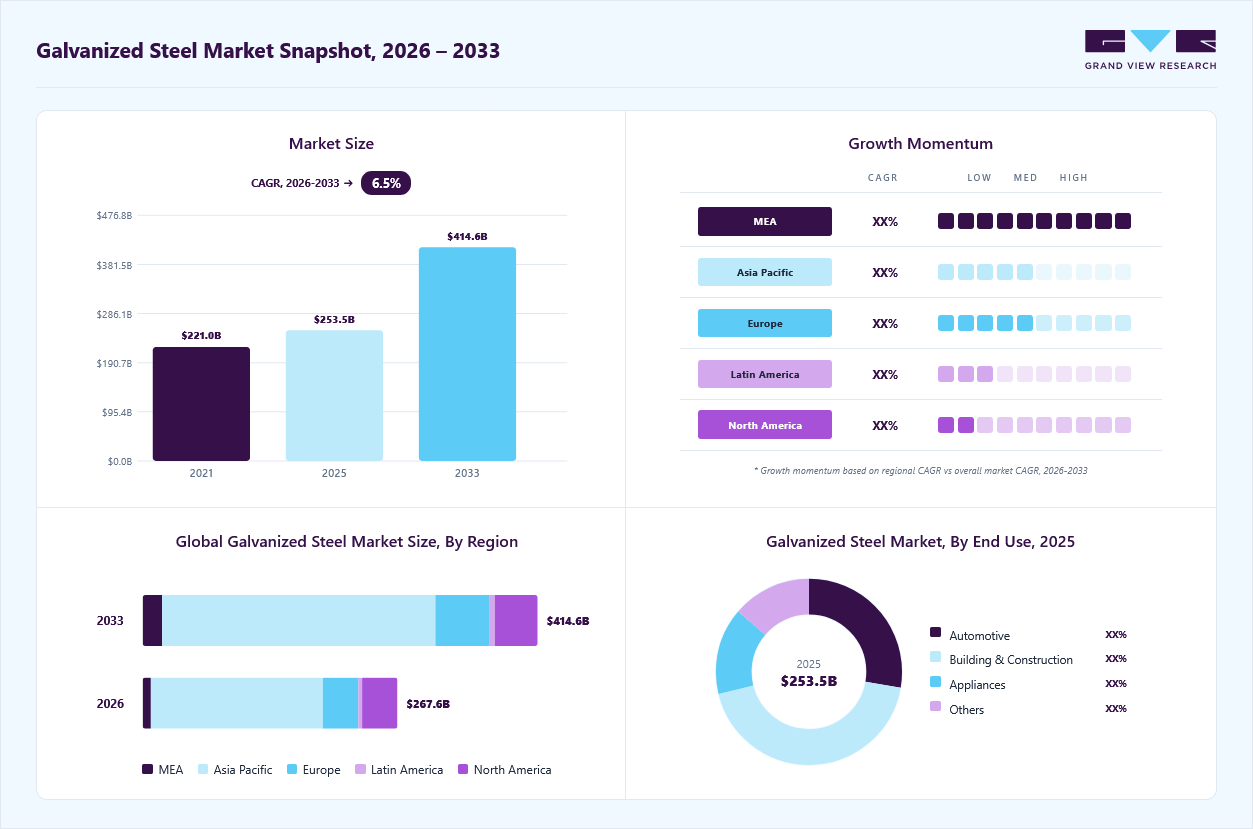
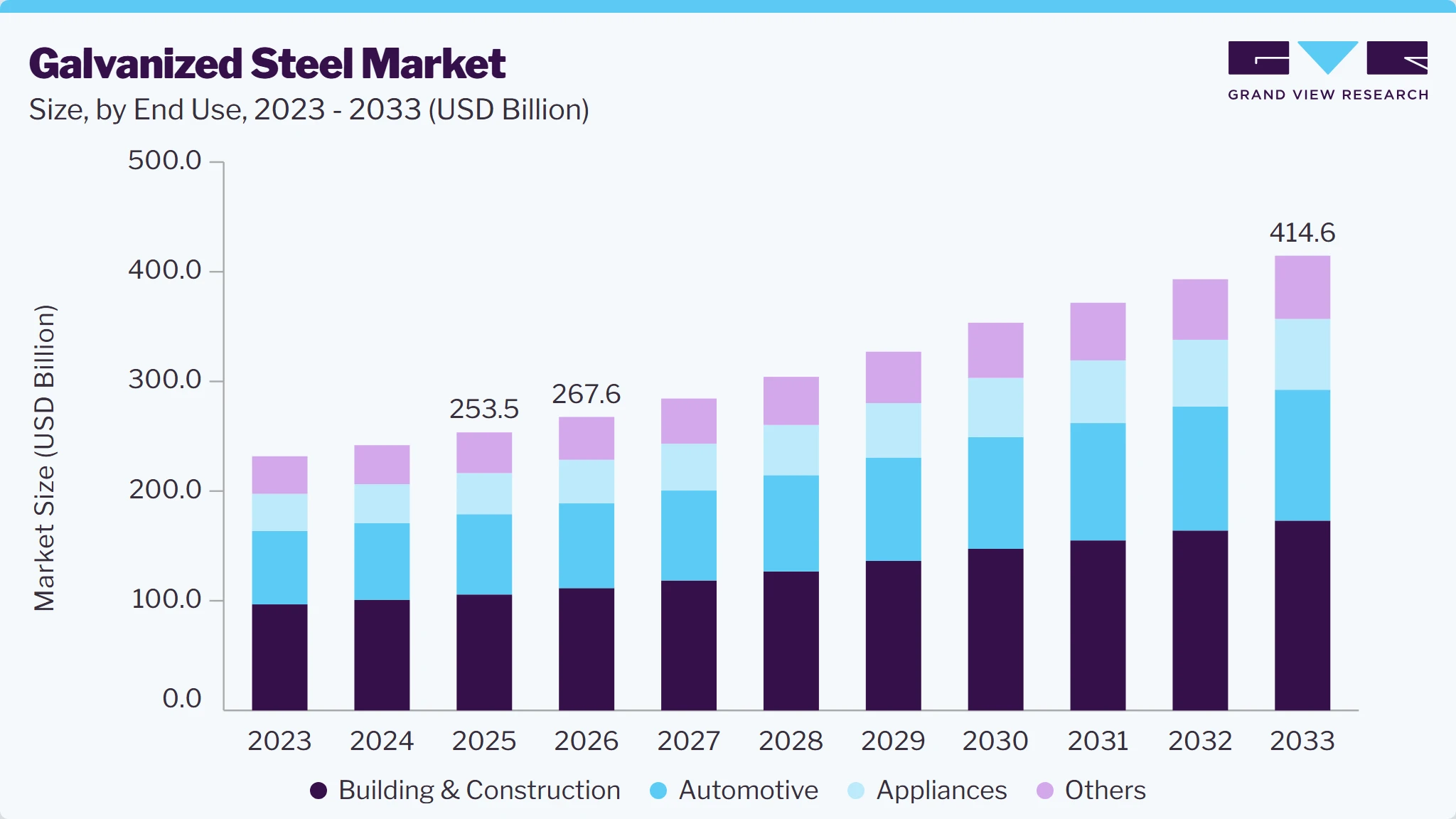
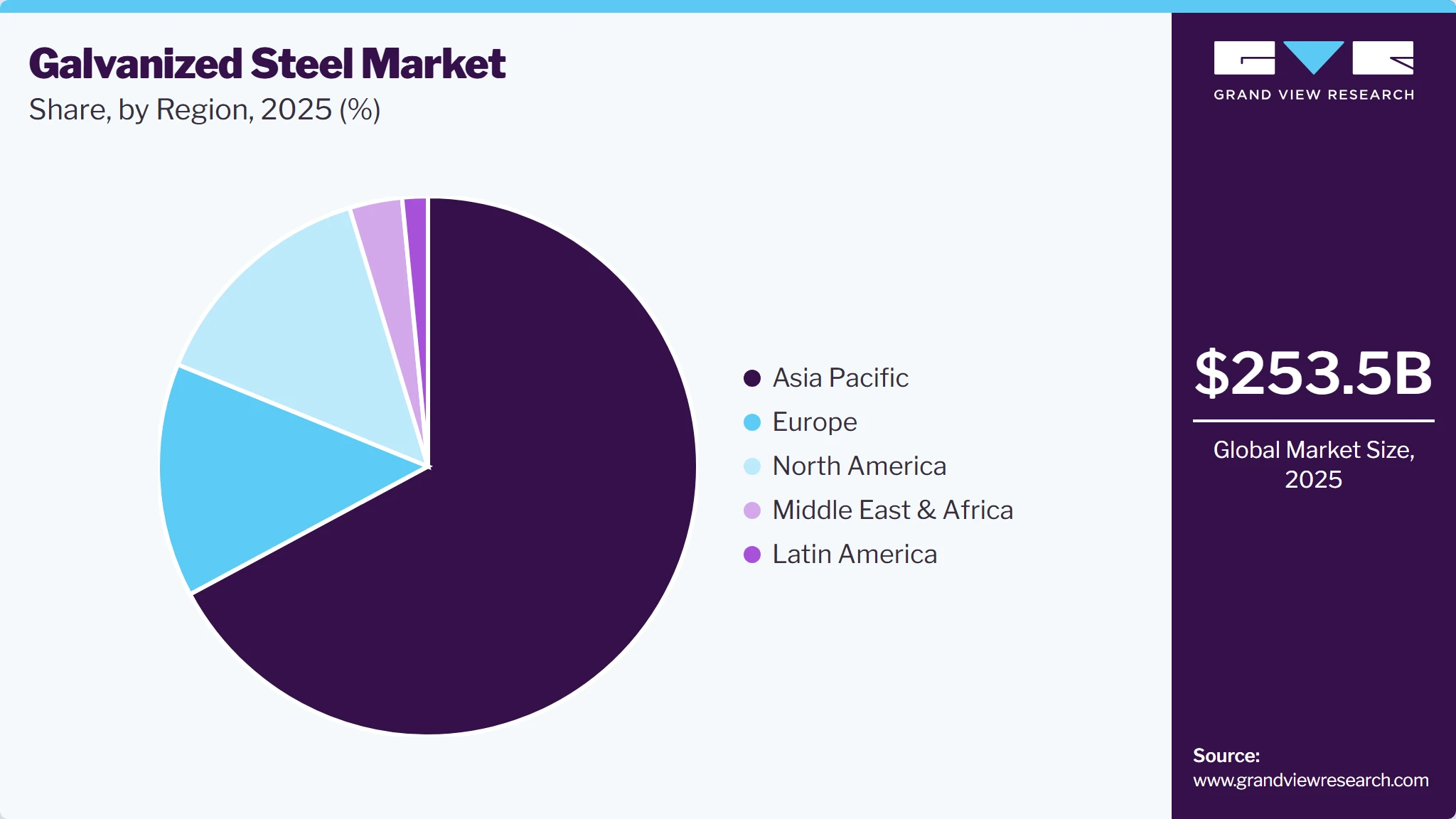
The global galvanized steel market size was valued at USD 253.5 billion in 2025 and is projected to grow from USD 267.6 billion in 2026 to USD 414.6 billion by 2033, growing at a CAGR of 6.5% from 2026 to 2033. The Asia Pacific market held the largest share of 67.2% of the global market in 2025. Increasing investments in the chloride production processes and the flourishing construction industry worldwide are anticipated to contribute to the growth of the market for titanium dioxide (TiO2)in the coming years.
 Source: Grand View Research, IR Documents, Primary Interviews, Paid DatabasesTo learn more about this report,
 Download Free Sample Report
Key Market Trends & Insights
- By application: The building & construction segment led the market with the largest revenue share of 41.7% in 2025.
Regional Highlights
- Largest regional market: Asia Pacific (67.2% revenue share, 2025)
- By country: The China held the largest market share in 2025.
Market Size & Forecast
- Market size in 2025: USD 253.5 Billion
- Estimated market size in 2026: USD 267.6 Billion
- Projected market size by 2033: USD 414.6 Billion
- CAGR (2026-2033): 6.5%
Three ways to get this report
Buy it, customize it, or ask a question.Ask an Analyst
Analyst response in 1 business day
- AccessReport author, directly
- Reply timeWithin 1 working day
- No sales callDirect answer only
- FormatEmail reply
- CostFree, no cost
Get the Full Report
What the study covers
- FormatsPDF · Excel · Dashboard
- Timeline2026–2033 annual, 2025 base
- Coverage20+ countries, 5 regions
- Companies10+ key players profiled
Customize the Report
20% free customization
- IncludeCountries, segments, points
- TailorTo your product definition
- ExtendDeeper competitor detail
- OrA fully bespoke study
- Turnaround5–10 working days
The increasing urbanization and ongoing infrastructure development in emerging economies have heightened the demand for galvanized steel in applications such as roofing, bridges, and protective coatings. This trend is especially pronounced in developing regions where infrastructure modernization is a critical priority.Automakers are increasingly using galvanized steel in the production of vehicles to enhance durability, safety, and longevity. The material provides excellent resistance to rust and corrosion, which is crucial for vehicles exposed to varied weather conditions. Additionally, the automotive industry's push for lightweight and fuel-efficient vehicles has led to innovations in steel production, making galvanized steel an attractive option. As the demand for automobiles continues to grow, particularly in emerging markets, the need for galvanized steel in vehicle manufacturing is expected to rise.
 To learn more about this report, Download Free Sample Report
Galvanized steel's durability, cost-effectiveness, and resistance to corrosion make it a preferred material for constructing buildings, infrastructure, and other architectural projects. The global trend toward sustainable construction practices has also boosted the demand for the product. As governments and organizations adopt green building standards and energy-efficient designs, the role of materials in constructing eco-friendly buildings continues to grow. The versatility of galvanized steel and its ability to be recycled aligns with the growing emphasis on sustainability within the construction sector.
New galvanizing methods, such as hot dip galvanizing and electro-galvanizing, have improved the efficiency, performance, and aesthetic appeal. These innovations have made the material more accessible and attractive to various industries. Additionally, the development of new coatings and alloys has enhanced the properties of galvanized steel, making it even more versatile and durable. As steel manufacturers continue to innovate, the applications for galvanized steel are expanding, further driving market growth.
Market Dynamics
The galvanized steel market is experiencing robust growth, driven by increasing demand from the construction, automotive, infrastructure, energy, and industrial sectors. Rapid urbanization, expanding transportation networks, and rising investments in residential and commercial construction projects are significantly boosting galvanized steel consumption worldwide. Governments across North America, Europe, Asia Pacific, and the Middle East are investing heavily in infrastructure modernization, including bridges, highways, railways, airports, power transmission systems, and public utilities, where galvanized steel is widely preferred for its superior corrosion resistance and long service life. Additionally, the growing adoption of galvanized steel in automotive manufacturing to improve vehicle durability and reduce maintenance costs is further supporting market expansion.
Increasing investments in infrastructure and construction projects worldwide are a major factor driving the galvanized steel market. Governments are allocating substantial budgets toward the development of transportation networks, smart cities, industrial parks, renewable energy installations, and public infrastructure. Galvanized steel is extensively used in structural frameworks, roofing, fencing, transmission towers, guardrails, and utility poles due to its high strength, durability, and corrosion-resistant properties. The growing emphasis on long-lasting and low-maintenance construction materials is further accelerating demand across both developed and emerging economies.
Furthermore, rapid urbanization and industrial expansion in Asia Pacific, the Middle East, and Africa are creating significant demand for galvanized steel products. The expansion of commercial buildings, residential housing projects, warehouses, manufacturing facilities, and logistics infrastructure continues to support market growth. As governments and private developers increasingly prioritize durable and cost-effective construction solutions, galvanized steel consumption is expected to remain strong throughout the forecast period.
Fluctuations in the prices of key raw materials, particularly steel and zinc, represent a significant challenge for the galvanized steel market. Changes in mining output, global trade policies, energy costs, and supply chain disruptions can lead to substantial variations in production costs. These price fluctuations impact manufacturer profit margins and create uncertainty for end users, particularly in price-sensitive industries such as construction and infrastructure. Additionally, stringent environmental regulations related to steel manufacturing and zinc processing may increase compliance and operational costs for producers.
The increasing deployment of renewable energy projects and sustainable infrastructure developments presents a significant growth opportunity for the galvanized steel market. Galvanized steel is widely utilized in solar mounting structures, wind turbine components, transmission infrastructure, and energy storage facilities due to its excellent corrosion resistance and long operational lifespan. Governments worldwide are accelerating investments in renewable energy generation and grid modernization to support decarbonization goals, creating substantial demand for galvanized steel products. In addition, the growing focus on sustainable construction practices and lifecycle cost optimization is driving the adoption of galvanized steel in green building projects. Its recyclability, durability, and low maintenance requirements make it an attractive material for environmentally conscious infrastructure development. As investments in renewable energy, smart cities, and resilient infrastructure continue to increase, galvanized steel manufacturers are expected to benefit from expanding application opportunities across multiple end-use industries.
Analyst Perspective
The galvanized steel market is witnessing steady growth, driven by increasing demand from the construction, automotive, infrastructure, and renewable energy sectors. Rapid urbanization, industrial development, and government investments in transportation and utility infrastructure are supporting consumption, while the material's superior corrosion resistance and durability continue to enhance its adoption. Despite challenges related to raw material price volatility and environmental regulations, long-term market prospects remain strong, supported by expanding infrastructure projects and growing demand for sustainable, low-maintenance steel solutions.
End-use Insights
Galvanized steel is widely used in structural applications due to its durability, strength, and corrosion resistance, making it an ideal material for building frames, roofs, facades, and infrastructure. In the building industry, especially in regions with harsh weather conditions, the protective coating of galvanized steel helps prevent rusting. It ensures long-lasting performance, which is crucial for maintaining structural integrity. This demand is further bolstered by the growing need for high-quality, durable construction materials in both residential and commercial sectors.
The appliances segment is anticipated to register the fastest CAGR over the forecast period. Rising disposable incomes and changing lifestyles have made appliances like refrigerators, washing machines, and air conditioners more accessible to households in developed and emerging markets. As urbanization increases and middle-class populations expand, the need for durable, high-quality appliances rise, directly boosting the demand for galvanized steel. Galvanized steel offers strength, corrosion resistance, and longevity, making it ideal for appliance manufacturers prioritizing durability and performance.
Regional Insights
North America’s galvanized steel market is anticipated to grow significantly over the forecast period. North America, particularly the U.S. and Canada, has a well-established automotive manufacturing industry, where galvanized steel is heavily utilized in vehicle production. The material is prized for resisting corrosion, making it ideal for automotive components exposed to harsh weather conditions. As consumer demand for vehicles remains robust, coupled with rising vehicle production and stringent regulatory standards for durability and environmental sustainability, the demand for galvanized steel in the automotive sector is expected to continue growing.
 To learn more about this report, Download Free Sample Report
U.S. Galvanized Steel Market Trends
The U.S. galvanized steel market is expected to grow steadily, driven by rising demand in construction, automotive, and infrastructure sectors. Increasing investments in renewable energy and transportation are estimated to boost consumption. Stringent regulations on corrosion resistance in industrial applications are forecasted to support market expansion.
Europe Galvanized Steel Market Trends
Governments are investing heavily in upgrading and expanding transportation networks, including roads, bridges, and railways. For instance, the European Union has allocated USD 14.5 billion in funding for infrastructure projects under its Green Deal initiative, which aims to enhance connectivity while promoting sustainability. This increased investment leads to a higher demand for durable materials.
Asia Pacific Galvanized Steel Market Trends
Asia Pacific dominated the galvanized steel market with the largest revenue share of 67.2% in 2025. The Asia Pacific galvanized steel market is experiencing significant growth, particularly in countries such as China, India, and Southeast Asian countries continue to expand their manufacturing sectors and urban infrastructure, the need for high-quality steel products, including galvanized steel, has surged. Galvanized steel's corrosion resistance and ability to withstand harsh environmental conditions make it ideal for construction, automotive, and infrastructure projects, fuelling its demand in these rapidly developing markets.
China Galvanized Steel Market Trends
The galvanized steel market in China held the largest share in the Asia Pacific region in 2025.
Central & South America Galvanized Steel Market Trends
Many countries in South America, including Brazil, Argentina, and Mexico, have well-established automotive manufacturing industries that rely heavily on galvanized steel. The material is essential for producing automotive parts and components, such as vehicle bodies and chassis, which must withstand harsh environmental conditions. As automotive production continues to rise, particularly with vehicle exports, the demand for galvanized steel is expected to grow.
Middle East & Africa Galvanized Steel Market Trends
Countries in the MEA region are increasingly focusing on environmentally friendly and energy-efficient construction practices. Galvanized steel is a highly sustainable material because it is 100% recyclable, and it helps improve the energy efficiency of buildings by providing long-lasting solutions that reduce the need for frequent replacements. As the region builds more eco-friendly buildings, including smart cities and green infrastructure, the demand for galvanized steel as a sustainable material is growing.
Key Galvanized Steel Company Insights
Some of the key players operating in the market include ArcelorMittal, thyssenkrupp, and others
-
ArcelorMittal is recognized as the world’s leading integrated steel and mining company, with a significant presence in the galvanized steel market. The company operates with an annual production capacity of approximately 114 million tons of crude steel. Its diverse portfolio includes flat steel products, long steel products, pipes, and tubes. The company's galvanized products are engineered to withstand severe forming operations without flaking or peeling, making them ideal for various automotive, construction, and machinery applications.
-
thyssenkrupp is a global steel industry company renowned for its innovative solutions and high-quality products. The company operates multiple production facilities, including a state-of-the-art hot-dip galvanizing line in Dortmund. It has recently enhanced its capacity to produce around one million metric tons of hot-dip galvanized steel annually.
Key Galvanized Steel Companies
The following key companies have been profiled for this study on the galvanized steel market.
-
ArcelorMittal
-
Nippon Steel Corporation
-
thyssenkrupp
-
Steel Dynamics Inc.
-
POSCO HOLDINGS INC.
-
JFE Steel Corporation
-
JSW Steel Limited
-
Tata Steel
-
NLMK Group
-
Jiangsu Shagang Group
Competitive Benchmarking
Category
Operating Strategies
Competitive Edge
Weakness
Established Players (e.g., ArcelorMittal, Nippon Steel Corporation, POSCO HOLDINGS INC., thyssenkrupp, JFE Steel Corporation)
- Focus on large-scale production of galvanized steel sheets, coils, structural steel, and value-added coated products.
- Emphasize integrated steelmaking operations, captive raw material sourcing, advanced galvanizing technologies, and global distribution networks.
- Invest heavily in capacity expansion, product innovation, decarbonization initiatives, digital manufacturing, and high-performance steel grades for automotive and construction applications.
- Possess extensive manufacturing capacities, advanced galvanizing facilities, strong R&D capabilities, and global customer relationships.
- Benefit from economies of scale, diversified end-use exposure, strong procurement capabilities, and broad geographic reach.
- Well-positioned to secure large contracts from automotive OEMs, infrastructure developers, appliance manufacturers, and industrial customers.
- Face high capital expenditure requirements for steelmaking, galvanizing lines, environmental compliance, and modernization projects.
- Subject to fluctuations in raw material prices, energy costs, and global steel demand cycles.
- Increasing pressure from carbon emission regulations, trade restrictions, and low-cost regional competitors.
Emerging & Regional Players (e.g., Steel Dynamics Inc., JSW Steel Limited, Tata Steel, NLMK Group, Jiangsu Shagang Group)
- Focus on regional galvanized steel production, selective capacity expansion, and strengthening domestic distribution networks.
- Pursue operational efficiency, product portfolio diversification, strategic partnerships, and downstream value-added processing.
- Target high-growth sectors such as construction, infrastructure, appliances, renewable energy, and automotive manufacturing.
- Greater flexibility in responding to regional market requirements and customer specifications.
- Strong positioning in domestic markets with established distribution channels and customer relationships.
- Ability to capitalize on regional infrastructure investments and industrial growth opportunities.
- Limited international presence and lower production scale compared with leading global steel producers.
- Higher exposure to regional economic conditions, trade policies, and domestic demand fluctuations.
- May face challenges in competing with larger integrated producers on pricing, technology investments, and global supply capabilities.
Galvanized Steel Market Report Scope
Report Attribute
Details
Market size value in 2025
USD 253.5 billion
Estimated market size in 2026
USD 267.6 billion
Projected market size by 2033
USD 414.6 billion
Growth rate
CAGR of 6.5% from 2026 to 2033
Base year for estimation
2025
Historical data
2021 - 2024
Forecast period
2026 - 2033
Quantitative units
Revenue in USD million, volume in kilotons, and CAGR from 2026 to 2033
Report coverage
Revenue forecast, volume forecast, company ranking, competitive landscape, growth factors, and trends
Segments covered
End use, region
Regional scope
North America; Europe; Asia Pacific; Latin America; Middle East & Africa
Country scope
U.S.; Canada; Mexico; Germany; France; Italy; Russia; China; India; Japan; Indonesia; Brazil; Saudi Arabia
Key companies profiled
ArcelorMittal; Nippon Steel Corporation; thyssenkrupp; Steel Dynamics Inc.; POSCO HOLDINGS INC.; JFE Steel Corporation; JSW Steel Limited; Tata Steel; NLMK Group; Jiangsu Shagang Group
Customization scope
Free report customization (equivalent up to 8 analysts' working days) with purchase-addition or alteration to country, regional & segment scope.
Pricing and purchase options
Avail customized purchase options to meet your exact research needs. Explore purchase options
Global Galvanized Steel Market Report Segmentation
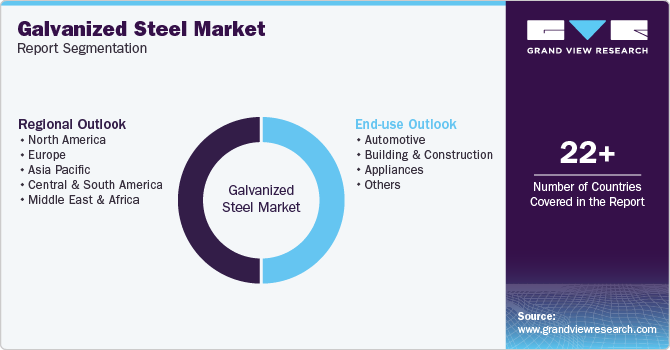
This report forecasts revenue and volume growth at global, regional, and country levels and provides an analysis of the latest industry trends in each of the sub-segments from 2021 to 2033. For this study, Grand View Research has segmented the global galvanized steel market report based on end-use, and region.
 To learn more about this report, Download Free Sample Report
-
End-use Outlook (Volume, Kilotons; Revenue, USD Million, 2021 - 2033)
-
Automotive
-
Building & Construction
-
Appliances
-
Others
-
-
Regional Outlook (Volume, Kilotons; Revenue, USD Million, 2021 - 2033)
-
North America
-
U.S.
-
Canada
-
Mexico
-
-
Europe
-
Germany
-
France
-
Russia
-
Italy
-
-
Asia Pacific
-
China
-
India
-
Japan
-
Indonesia
-
-
Central & South America
-
Brazil
-
-
Middle East & Africa
-
Saudi Arabia
-
-
Research Methodology
The galvanized steel market figures in this report are based on a proven research process that combines executive interviews with secondary research from proprietary databases, company filings, and recognized regulatory and institutional sources. Market size is built through value-chain sizing - reconciling supply-side and demand-side estimates - and triangulated with bottom-up and top-down approaches. Every estimate passes multiple levels of expert validation before publication, with each galvanized steel segment quantified using the revenue-capture definitions in the table below.
Segment Definition
End Use
Revenue Capture Definition
Automotive
This segment includes galvanized steel utilized in the manufacturing of vehicle body panels, chassis components, structural reinforcements, underbody parts, doors, hoods, roofs, and other corrosion-resistant automotive components. Revenue is generated from the sale of galvanized steel to automotive OEMs and component manufacturers seeking enhanced durability, safety, and extended vehicle lifespan.
Building & Construction
This segment comprises galvanized steel supplied for residential, commercial, industrial, and infrastructure construction applications. Revenue is derived from the use of galvanized steel in structural sections, roofing, wall panels, fencing, guardrails, bridges, transmission towers, utility poles, and other construction components requiring long-term corrosion protection and low maintenance.
Appliances
This segment includes galvanized steel used in the production of household and commercial appliances such as refrigerators, washing machines, air conditioners, ovens, water heaters, and electrical cabinets. Revenue is generated from supplying galvanized steel sheets and coils that provide durability, corrosion resistance, and aesthetic surface quality for appliance manufacturing.
Others
This segment covers galvanized steel utilized across diverse industries, including agriculture, renewable energy, industrial equipment, HVAC systems, storage tanks, telecommunications, and general engineering applications. Revenue is generated from the sale of galvanized steel products for applications requiring strength, weather resistance, and extended service life under varying environmental conditions.
Estimation Model
Layer Name
Key Question
Description
End-Use Industry Demand Base Layer
What forms the demand base?
Identify galvanized steel demand generated across key end-use industries, including automotive, building & construction, appliances, infrastructure, energy, industrial equipment, and agriculture. Assess steel consumption associated with vehicle production, residential and commercial construction, transportation infrastructure, utility networks, manufacturing facilities, and consumer durable goods. This layer establishes the total addressable demand for galvanized steel globally.
Galvanized Steel Production & Supply Layer
Where is galvanized steel produced and supplied?
Estimate galvanized steel availability from major steel producers and galvanizing facilities across key regions. Analyze production capacities, zinc coating operations, raw material availability, trade flows, import-export dynamics, and regional supply-demand balances. Evaluate the role of integrated steel manufacturers, service centers, and distributors in ensuring product availability across end-use sectors.
Application Consumption Intensity Layer
How much galvanized steel is consumed?
Analyze galvanized steel consumption intensity across automotive body structures, construction frameworks, roofing systems, transmission towers, appliances, agricultural equipment, and industrial applications. Evaluate steel usage per unit of production, infrastructure project requirements, durability specifications, corrosion protection needs, and replacement cycles. Consumption intensity varies by end-use application, product standards, environmental exposure conditions, and regional construction practices.
Revenue Layer
How is market revenue generated?
Market revenue is quantified through the production and sale of galvanized steel sheets, coils, plates, pipes, wires, and structural products across multiple end-use industries. Revenue generation is influenced by galvanized steel pricing, zinc coating specifications, raw material costs, manufacturing capacity utilization, trade dynamics, and end-user demand. Growth in construction activity, infrastructure investments, automotive production, industrialization, and renewable energy installations drives overall market value.
Delivered Customizations
This report has been delivered with the following In-depth customizations
Client Request
Customization Delivered
Value Adds
Global Trade Analysis
Detailed assessment of galvanized steel import-export trends by country and region, including trade volumes, trade values, major exporting and importing countries, key trade routes, tariff structures, and evolving trade policies. Analyzed regional supply-demand gaps and cross-border trade flows influencing market dynamics.
Enabled identification of high-potential export markets, sourcing opportunities, trade risks, and competitive advantages. Supported market expansion planning, supply chain optimization, and strategic decision-making based on global trade patterns.
Pricing & Cost Structure Analysis
Evaluation of galvanized steel pricing dynamics influenced by hot-rolled steel prices, zinc costs, galvanizing expenses, energy costs, transportation charges, and regional supply-demand balances. Included analysis of regional price variations and key cost components.
Supported pricing strategy development, profitability assessment, cost benchmarking, and supply chain optimization across regions.
Competitive Landscape & Market Share Analysis
Comprehensive assessment of leading galvanized steel manufacturers, including production capacities, galvanizing capabilities, geographic presence, product portfolio, strategic initiatives, and estimated market shares.
Provided insights into competitive positioning, benchmarking opportunities, partnership targets, and potential acquisition candidates.
Frequently Asked Questions About This Report
The global galvanized steel market was valued at USD 253.5 billion in 2025 and is projected to reach USD 267.6 billion in 2026.
The galvanized steel market is projected to grow at a CAGR of 6.5% from 2026 to 2033, reaching USD 414.6 billion by 2033.
Asia Pacific dominated the galvanized steel market, accounting for a 67.2% revenue share in 2025.
China dominated the market, accounting for a 64.1% share of the Asia Pacific galvanized steel market revenue in 2025.
The Middle East & Africa region is expected to register the fastest CAGR of 13.1% during the forecast period.
The appliance segment is expected to grow at the fastest CAGR over the forecast period.
Based on applications, the building & construction segment accounted for the largest market share, representing 41.7% of total revenue in 2025.
The key players operating in the galvanized steel market are ArcelorMittal, Nippon Steel Corporation, thyssenkrupp, Steel Dynamics Inc., POSCO HOLDINGS INC., JFE Steel Corporation, JSW Steel Limited, Tata Steel, NLMK Group, Jiangsu Shagang Group, among others.
The key factor driving the growth of the global galvanized steel market is the rising demand from the construction and infrastructure sectors, supported by increasing urbanization, industrialization, and investments in durable, corrosion-resistant building materials
About the Author(s)
Advanced Interior Materials Research Team
Advanced Materials · Advanced Interior MaterialsThis report was authored by the advanced interior materials research team at Grand View Research - comprising two research analysts, one senior research analyst, and one industry expert - with specialized expertise in the advanced interior materials segment of the advanced materials industry. All findings are based on proprietary advanced materials databases, executive interviews, and regulatory analysis, subject to internal peer review prior to publication.
Last Updated:
Speak to Analyst

Customize this report to your needs - add regions, segments, or data points, with 20% free customization.
Or view our licence options:


ISO 9001:2015 & 27001:2022 Certified
We are GDPR and CCPA compliant! Your transaction & personal information is safe and secure. For more details, please read our privacy policy.


