
- Home
- »
- Conventional Energy
- »
-
Gasoline As A Fuel Market Size & Share Report, 2026-2033GVR Report cover

Gasoline As A Fuel Market (2026 - 2033)
Size, Share & Trends Analysis Report By Grade, By Application, By Distribution Channel (Retail Fuel Stations, Bulk/Commercial Sales), By Region, And Segment Forecasts
Market Size, 2025
$1.8TMarket Estimate, 2026
$1.8TMarket Forecast, 2033
$2.1TCAGR, 2026–2033
1.7%Gasoline As A Fuel Market Summary
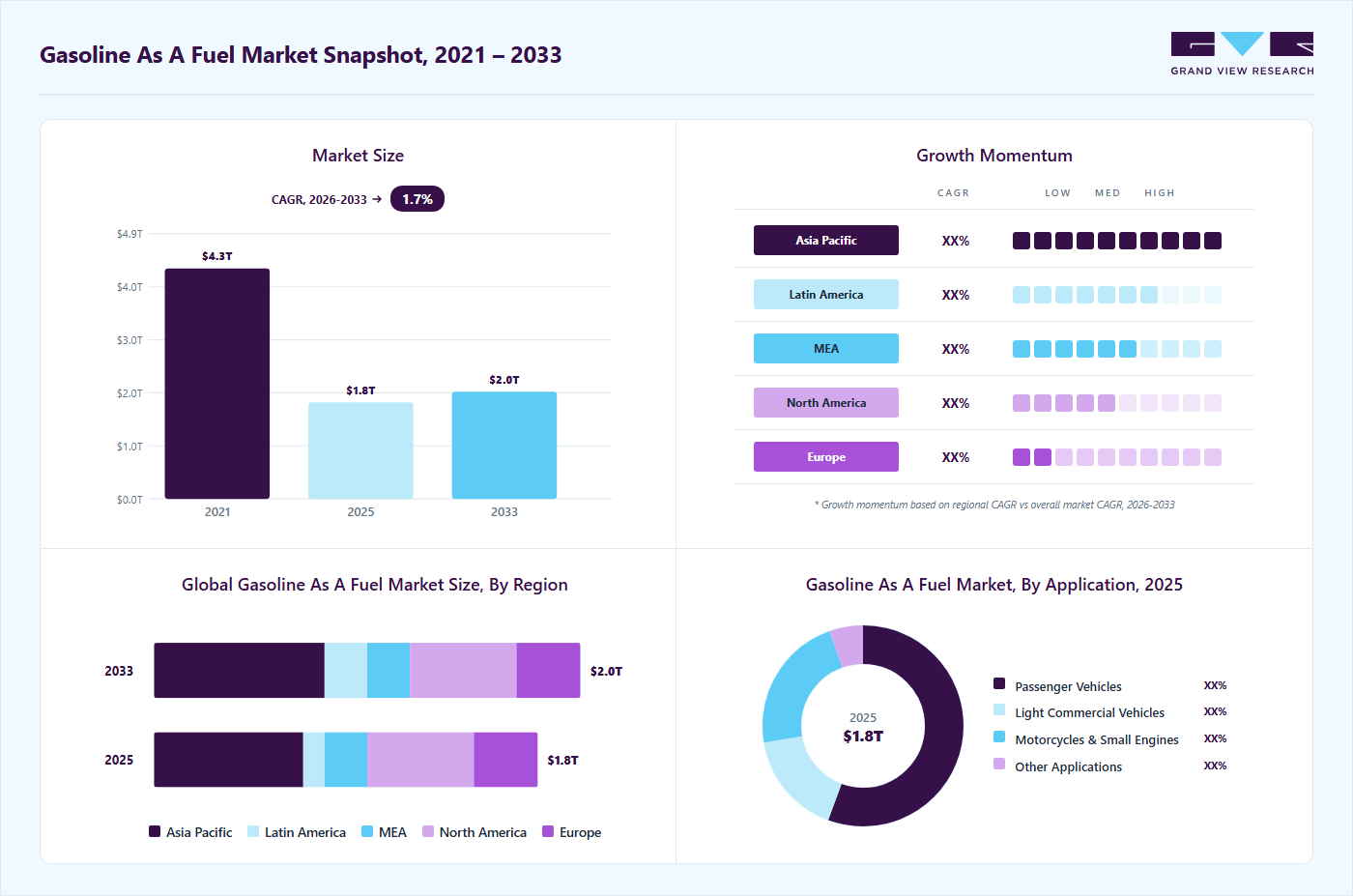
The global gasoline as a fuel market size was estimated at USD 1.8 trillion in 2025 and is projected to grow from USD 1.8 trillion in 2026 to USD 2.1 trillion by 2033, at a CAGR of 1.7% from 2026 to 2033. Asia Pacific held the largest revenue share of 39.7% of the global market in 2025. The market is primarily driven by the large and persistent global base of internal combustion engine (ICE) vehicles, particularly in emerging economies, where rising urbanization, higher disposable incomes, and expanding middle-class populations are fueling vehicle ownership.
 Source: Grand View Research, IR Documents, Primary Interviews, Paid DatabasesTo learn more about this report,
 Download Free Sample Report
 Key Market Trends & Insights
- By grade: Regular (87 octane) segment held the largest market share of 72.0% in 2025.
- By application: Passenger vehicles segment held the largest market share of 57.9% in 2025.
- By distribution channel: Retail fuel stations segment held the largest market share of 87.8% in 2025.
Regional Highlights
- Largest regional market: Asia Pacific (39.7% market share, 2025)
- Fastest-growing regional market: Asia Pacific (2.1% CAGR from 2026–2033)
Market Size & Forecast
- Market size in 2025: USD 1.8 Trillion
- Estimated market size in 2026: USD 1.8 Trillion
- Projected market size by 2033: USD 2.1 Trillion
- CAGR (2026–2033): 1.7%
Three ways to get this report
Buy it, customize it, or ask a question.Ask an Analyst
Analyst response in 1 business day
- AccessReport author, directly
- Reply timeWithin 1 working day
- No sales callDirect answer only
- FormatEmail reply
- CostFree, no cost
Get the Full Report
What the study covers
- FormatsPDF · Excel · Dashboard
- Timeline2026–2033 annual, 2025 base
- Coverage20+ countries, 5 regions
- Companies10+ key players profiled
Customize the Report
20% free customization
- IncludeCountries, segments, points
- TailorTo your product definition
- ExtendDeeper competitor detail
- OrA fully bespoke study
- Turnaround5–10 working days
Sustained demand from two-wheelers and light commercial vehicles, especially in the Asia Pacific, further supports consumption growth, while limited electric vehicle (EV) infrastructure and affordability constraints in developing regions reinforce continued reliance on gasoline. The market is experiencing steady growth, driven by rapid urbanization and a growing middle-class population in developing countries. The rising pressure to reduce vehicular emissions and improve fuel efficiency, coupled with stricter government regulations worldwide, is driving the adoption of cleaner, higher-quality gasoline blends. In addition, the expansion of gasoline distribution infrastructure, including retail fuel stations, storage terminals, and pipeline networks, is enabling fuel suppliers and consumers to enhance accessibility while improving operational efficiency.
 To learn more about this report, Download Free Sample Report
 The continued reliance on internal combustion engine vehicles across the passenger and light commercial segments is significantly influencing market expansion. Gasoline as a fuel plays a critical role in ensuring a reliable energy supply for road transportation while supporting compliance with evolving emission standards. Technological advancements, particularly in refining processes, fuel additives, and blending technologies such as ethanol integration, are improving fuel performance, efficiency, and environmental compatibility. Simultaneously, ongoing investments in refining capacity and distribution networks, along with an increasing focus on sustainability and energy efficiency, are reinforcing the strategic importance of gasoline as a fuel in supporting a reliable, accessible, and evolving global transportation energy ecosystem.
Drivers, Opportunities & Restraints
The primary driver of the market is the expanding global vehicle fleet, particularly in developing economies, where rising incomes, improved infrastructure, and increased demand for personal mobility are driving gasoline consumption. As urbanization accelerates and transportation needs grow, gasoline remains a widely accessible and reliable fuel for passenger vehicles and light-duty commercial applications. In addition to transportation demand, the increasing use of portable gasoline generators for residential backup power, events, and small-scale industrial operations is creating new avenues for market growth, especially in regions with inconsistent electricity supply.
A significant opportunity lies in the expanding adoption of gasoline for portable power generation across residential and commercial applications within the gasoline as a fuel ecosystem. The increasing need for energy resilience during grid outages is driving the demand for gasoline-powered portable generators, particularly in regions with unreliable electricity supply, encouraging investments in distribution networks and fuel accessibility to ensure reliable and immediate power backup. This growing demand is driving the development of efficient supply chains and storage solutions to serve both urban and remote locations. The niche and premium segments are gaining traction, with rising demand for high-octane gasoline to support modern, turbocharged engines that require enhanced performance and efficiency.
However, the gasoline as a fuel market faces challenges related to its environmental impact and increased regulatory scrutiny. The combustion of gasoline results in significant carbon emissions, with approximately 19.6 pounds of carbon dioxide (CO₂) released per gallon burned, contributing to climate change and global warming concerns. In addition to CO₂, gasoline-powered engines emit nitrogen oxides (NOx), volatile organic compounds (VOCs), and particulate matter, which contribute to air pollution, ground-level smog formation, and adverse respiratory health effects. The reason behind this challenge lies in the growing global emphasis on decarbonization and stricter emission standards, prompting governments and regulatory bodies to impose tighter controls on fuel quality and vehicle emissions.
The market faces several policy-related restraints that may hamper its growth trajectory. Government regulations focused on reducing carbon emissions, including aggressive fuel taxation and stricter environmental mandates, are increasing the cost of gasoline consumption and limiting its long-term attractiveness. These policies are particularly prominent in developed regions, where authorities are actively promoting the transition toward cleaner energy alternatives such as biofuels, hydrogen, and electrification.
Grade Insights
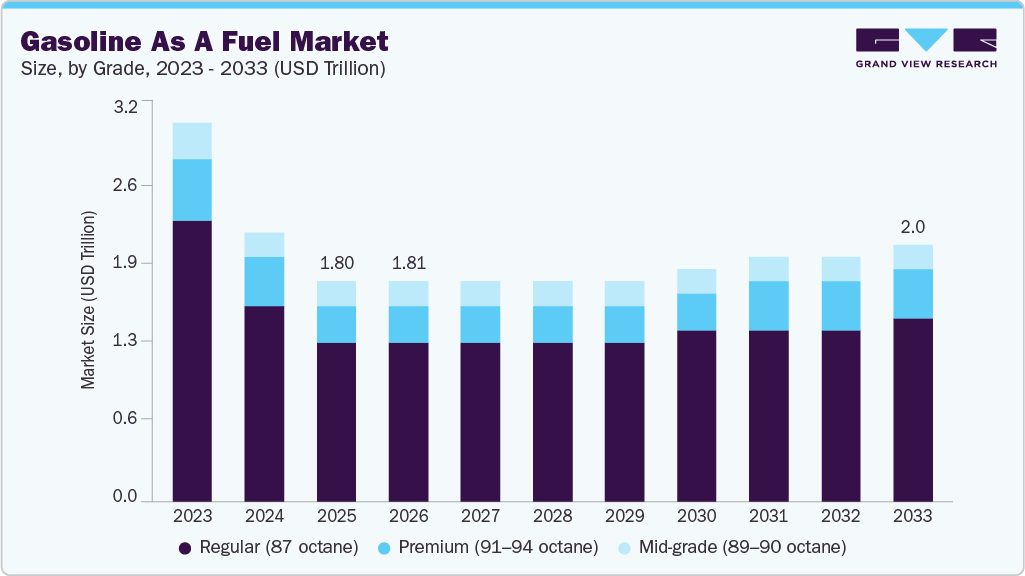
Based on grade, the regular (87 octane) segment accounted for the largest revenue share of 72.0% in 2025, driven by its cost efficiency and widespread compatibility with standard internal combustion engine vehicles. This grade is generally the most affordable option at fuel stations, making it the preferred choice for a large share of consumers seeking economical, reliable transportation fuel. Its accessibility and pricing advantage support consistent demand across both urban and rural markets, ensuring broad adoption among everyday vehicle users. The modern vehicles are calibrated to perform optimally on this grade, meaning higher-octane fuels do not necessarily improve performance, efficiency, or emissions for such engines.
The premium (91-94 octane) grade is expected to be the fastest-growing segment with a CAGR of 2.4% over the forecast period, driven by increasing adoption across high-performance and luxury vehicles. Premium gasoline is gaining significant traction as modern engines with higher compression ratios and advanced technologies require fuels that can support enhanced performance while maintaining engine integrity. Its ability to prevent premature ignition (knocking or pinging), which can otherwise lead to severe engine damage, makes it particularly well-suited for vehicles designed for superior power and efficiency.
Application Insights
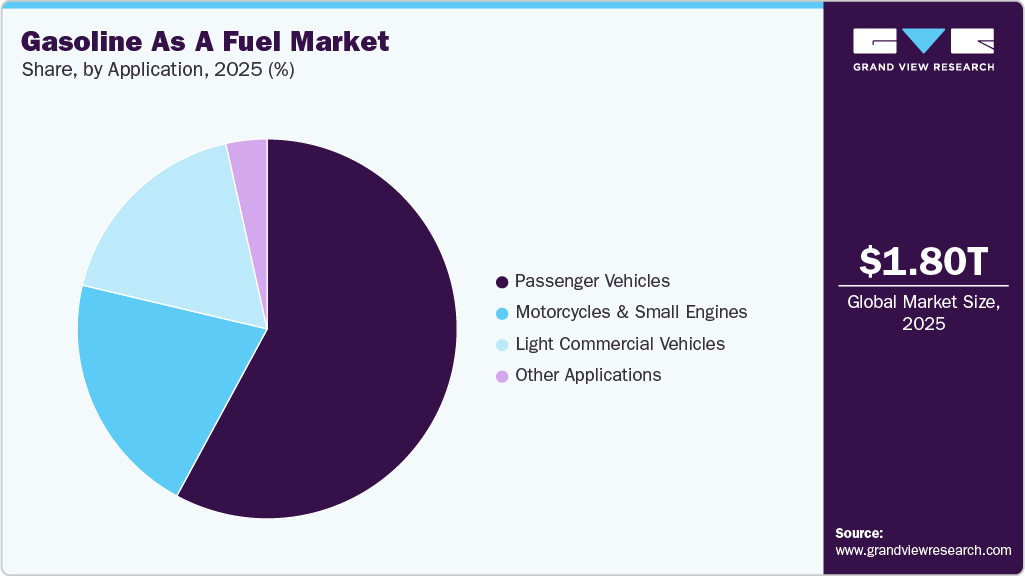
Based on application, the passenger vehicles segment accounted for the largest revenue share of 57.9% in 2025, driven by the widespread use of gasoline in personal transportation globally, particularly in emerging economies where rising incomes and improving infrastructure are accelerating vehicle ownership. Passenger vehicles represent a key segment within the market, supported by the extensive presence of internal combustion engine (ICE) cars, established fuel distribution networks, and the continued demand for convenient and reliable mobility solutions. Their high population base, daily usage patterns, and consistent refueling needs make them a dominant contributor to gasoline consumption.
 To learn more about this report, Download Free Sample Report
 The motorcycles & small engines segment is projected to register the fastest CAGR of 2.2% during the forecast period, supported by the increasing adoption of two-wheelers and the widespread use of gasoline-powered small equipment across residential and commercial applications. The number of motorcycles and scooters is expected to expand significantly, particularly in developing regions, where affordability, fuel efficiency, and ease of mobility make them a preferred mode of transportation. Gasoline as a fuel plays a critical role in supporting these applications by providing a reliable and easily accessible energy supply across both urban and rural areas.
Distribution Channel Insights
Based on distribution channel, the retail fuel stations segment dominated the market with the largest revenue share of 87.8% in 2025, driven by the widespread presence of established fueling infrastructure that supports large-scale gasoline distribution to end users. Retail fuel stations serve as primary access points for consumers, offering convenient, immediate fuel for passenger vehicles, motorcycles, and light commercial fleets. These stations are evolving into multi-functional service hubs, with operators enhancing storage capacity, digital payment systems, and customer services to improve efficiency and user experience. This infrastructure advantage enables more effective distribution while ensuring a consistent fuel supply across urban and rural locations.
The bulk/commercial sales segment is expected to grow at the fastest CAGR of 2.8% during the forecast period, driven by its growing role in supporting gasoline as a fuel across diverse commercial and industrial applications. The increasing demand from sectors such as construction, agriculture, logistics, and backup power generation is accelerating the need for large-volume fuel supply through bulk procurement channels. Its ability to enable efficient and cost-effective fuel delivery to businesses, fleet operators, and industrial users makes it particularly well-suited for operations that require consistent and high-volume fuel consumption.
Regional Insights
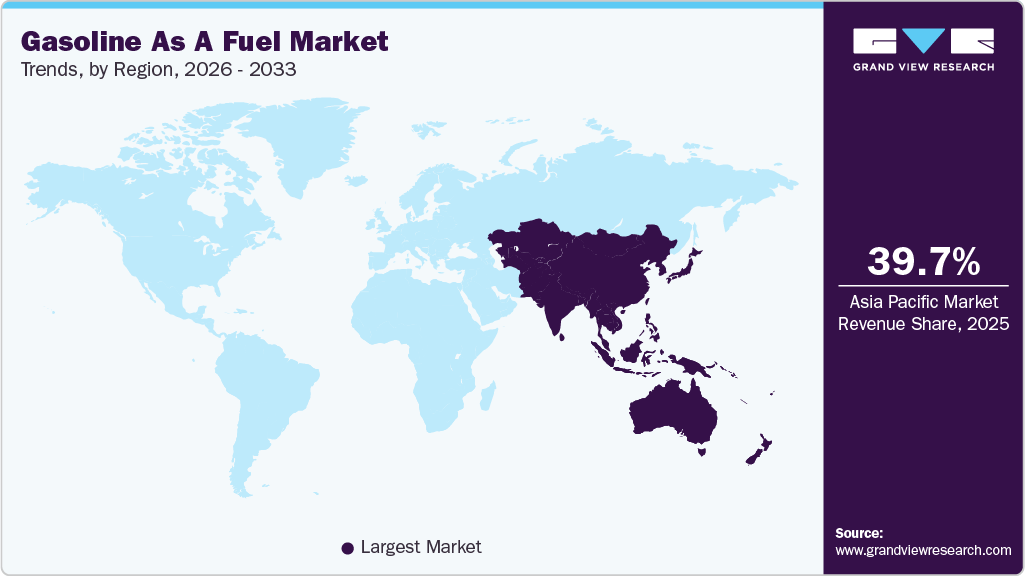
The Asia Pacific gasoline as a fuel industry accounted for the largest revenue share of 39.7% in 2025, primarily driven by rising vehicle ownership and expanding mobility demand across densely populated economies such as China and India. The rapid increase in disposable incomes, urbanization, and improving road infrastructure is significantly boosting passenger and commercial vehicle fleets, thereby sustaining strong gasoline consumption across the region. Besides, large-scale infrastructure development projects, including initiatives such as the “One Belt One Road,” are enhancing connectivity and increasing the demand for transportation fuels. The region’s ongoing industrialization is further reinforcing demand for gasoline for logistics, freight movement, and commercial transport, positioning the Asia Pacific as the dominant market for gasoline as a fuel solution.
 To learn more about this report, Download Free Sample Report
 Asia Pacific is also projected to register the fastest CAGR of 2.1% over the forecast period, supported by continuous expansion in industrial activity and accelerating economic development in emerging economies. The increasing demand for efficient transportation fuels across manufacturing, construction, and supply chain operations is driving sustained gasoline consumption in the region. In addition, rapid urban expansion and the growth of small and medium-scale enterprises are contributing to higher mobility needs and fuel usage. Despite growing interest in alternative energy sources, gasoline remains a critical and widely accessible fuel, with ongoing infrastructure development and rising transportation demand strengthening the region’s position as the fastest-growing market.
The China gasoline as a fuel industry is being supported by its strong position as a leading automobile exporter, even as domestic demand for internal combustion engine (ICE) vehicles gradually declines. The country is increasingly supplying gasoline-powered vehicles to regions such as Latin America, Africa, and Southeast Asia, where electric vehicle infrastructure remains limited. This export-driven trend is sustaining gasoline demand indirectly, as these vehicles continue to rely on conventional fuels in their destination markets. As a result, China continues to play a significant role in supporting global gasoline consumption through its expanding automotive export presence.
Europe Gasoline As A Fuel Market Trends
The gasoline as a fuel industry in Europe captured a revenue share of 16.2% in 2025, driven by stringent emissions regulations and strong policy support for cleaner and more efficient fuel utilization. Strict environmental standards, such as Euro 6 norms, along with regional decarbonization initiatives, are accelerating the transition to higher-quality, lower-emission gasoline formulations. Countries across the region are actively promoting the use of premium fuels, supported by advanced refining capabilities, well-developed fuel distribution networks, and regulatory frameworks that aim to reduce greenhouse gas emissions and improve air quality. Continuous investments in refinery upgrades, fuel quality enhancement, and advanced blending technologies further reinforce the growth of the market in Europe. The presence of a highly mature automotive sector and a large base of modern, fuel-efficient vehicles is enabling consistent demand for high-octane (RON) gasoline.
North America Gasoline As A Fuel Market Trends
The gasoline as a fuel industry in the North America held the second-largest revenue share in 2025, supported by its well-established infrastructure and high reliability across distribution networks. Gasoline remains a preferred fuel due to the extensive presence of refineries, pipelines, storage facilities, and retail fuel stations, ensuring consistent availability and ease of transportation. This strong infrastructure foundation enables efficient fuel supply across urban and remote areas, reinforcing consumer confidence and supporting sustained demand. In addition, continuous technological advancements are playing a crucial role in maintaining gasoline’s relevance in the region.
Latin America Gasoline As A Fuel Market Trends
The gasoline as a fuel industry in Latin America is a growing market, driven by increasing government initiatives and evolving regulatory frameworks aimed at promoting cleaner and more efficient fuel utilization. Countries across the region are strengthening environmental standards and implementing policies to improve fuel quality and reduce emissions, encouraging the adoption of upgraded gasoline formulations. This shift supports the modernization of fuel infrastructure and enhances the overall efficiency of transportation systems across key markets. The region is also witnessing a gradual transition toward more sustainable mobility solutions, with governments integrating clean transport strategies into national energy plans and adjusting subsidies to promote efficiency and lower emissions.
Middle East & Africa Gasoline As A Fuel Market Trends
The gasoline as a fuel industry in the Middle East & Africa (MEA) region is driven by its high energy density and suitability for a wide range of transportation and industrial applications. Gasoline remains a preferred fuel for critical applications due to its ability to deliver reliable, efficient energy, supporting mobility and operational needs across diverse sectors. This advantage is particularly important in regions where a consistent, high-performance fuel supply is essential to economic activity. Ongoing industrialization and rapid urbanization across the region are further accelerating gasoline demand, as expanding cities and infrastructure development increase the need for robust transportation and energy solutions.
Key Gasoline As A Fuel Company Insights
Some of the key participants in the market include Sinopec, China National Petroleum Corporation, ExxonMobil, Saudi Aramco, Valero Energy Corporation, Marathon Petroleum Corporation, Rosneft, Indian Oil Corporation (IOC), Shell plc, Petrobras, Reliance Industries Limited, and BP plc. These companies collectively hold the largest market share in the gasoline as a fuel market and play a critical role in shaping industry trends and competitive dynamics. They are increasingly focusing on improving fuel efficiency and reducing emissions through the development of cleaner gasoline formulations, including low-sulfur and ethanol-blended fuels, to align with evolving environmental standards and regulatory requirements. The significant investments are being directed toward expanding refining capacity and strengthening distribution infrastructure, including storage terminals, pipelines, and retail fuel networks, to enhance fuel accessibility, improve supply reliability, and support growing demand across both urban and remote regions.
Their operations typically encompass the development and deployment of integrated gasoline supply solutions, including refining, storage, transportation, and distribution systems to ensure consistent and efficient fuel delivery. Industry leaders are increasingly emphasizing the use of advanced refining technologies, digital monitoring systems, and automation to optimize fuel production, maintain quality, and improve operational efficiency. The integration of technologies such as real-time monitoring, predictive maintenance, and automated control systems is enabling enhanced asset performance, reduced downtime, and improved supply chain coordination across gasoline operations.
As global demand for transportation fuels continues to evolve alongside tightening emission standards, companies operating in the gasoline as a fuel market are prioritizing infrastructure expansion, supply chain integration, and geographic diversification. Strategic collaborations between refiners, fuel distributors, and automotive stakeholders are becoming increasingly common to build resilient and efficient fuel supply networks. Furthermore, evolving energy dynamics, including the gradual transition toward cleaner fuels and enhanced fuel efficiency, are reshaping the competitive landscape.
Key Gasoline As A Fuel Companies:
The following key companies have been profiled for this study on the gasoline as a fuel market.
- Sinopec
- China National Petroleum Corporation
- ExxonMobil
- Saudi Aramco
- Valero Energy Corporation
- Marathon Petroleum Corporation
- Rosneft
- IndianOil Corporation
- Shell plc
- Petrobras
- Reliance Industries Limited
- BP plc
Recent Developments
-
In January 2026, Shell plc, through its subsidiary Shell Eastern Trading Pte. Ltd., completed the acquisition of Pavilion Energy Pte. Ltd., strengthening its integrated energy portfolio and expanding its capabilities across fuel supply, trading, and distribution networks. This strategic move aligns with the company’s objective to enhance its global market position, improve supply chain integration, and support evolving fuel demand dynamics.
-
In January 2026, Jio-bp launched petrol with ACTIVE Technology in India, designed to remove engine deposits and improve fuel efficiency. This innovation reflects the company’s focus on advanced fuel formulations, enhancing engine performance, and delivering improved efficiency for consumers, while strengthening its competitive positioning in the gasoline retail market.
Gasoline As A Fuel Market Report Scope
Report Attribute
Details
Market size value in 2025
USD 1.8 trillion
Estimated Market size in 2026
USD 1.81 trillion
Projected Market size by 2033
USD 2.1 trillion
Growth rate
CAGR of 1.7% from 2026 to 2033
Base year for estimation
2025
Historical data
2021 - 2024
Forecast period
2026 - 2033
Quantitative Units
Revenue in USD Trillion, Volume in Million Tons, and CAGR from 2026 to 2033
Report coverage
Revenue forecast, competitive landscape, growth factors, and trends
Segments covered
Grade, application, distribution channel, region
Regional scope
North America; Europe; Asia Pacific; Latin America; Middle East & Africa
Country scope
U.S.; Canada; Mexico; Germany; UK; France; Italy; Spain; China; India; Australia;Japan; South Korea; Brazil; Argentina; UAE; Saudi Arabia; South Africa
Key companies profiled
Sinopec; China National Petroleum Corporation; ExxonMobil; Saudi Aramco; Valero Energy Corporation; Marathon Petroleum Corporation; Rosneft; IndianOil Corporation; Shell plc; Petrobras; Reliance Industries Limited; BP plc
Customization scope
Free report customization (equivalent up to 8 analysts working days) with purchase. Addition or alteration to country, regional & segment scope.
Pricing and purchase options
Avail customized purchase options to meet your exact research needs. Explore purchase options
Global Gasoline As A Fuel Market Report Segmentation
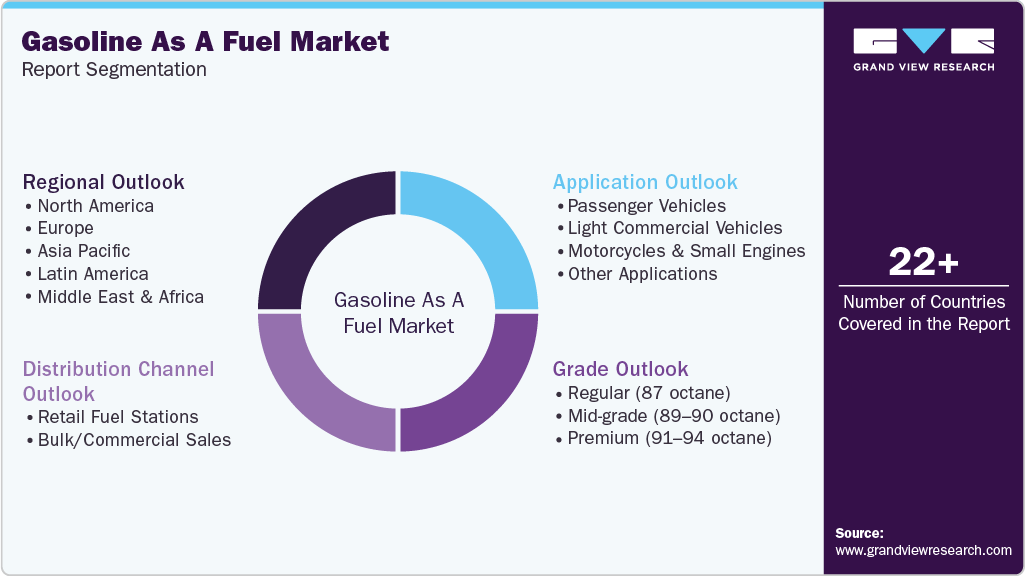
This report forecasts revenue growth at global, regional, and country levels and provides an analysis of the latest industry trends in each of the sub-segments from 2021 to 2033. For the purpose of this study, Grand View Research has segmented the global gasoline as a fuel market report based on grade, application, distribution channel, and region.
 To learn more about this report, Download Free Sample Report
 -
Grade Outlook (Volume, Million Tons; Revenue, USD Trillion, 2021 - 2033)
-
Regular (87 octane)
-
Mid-grade (89-90 octane)
-
Premium (91-94 octane)
-
-
Application Outlook (Volume, Million Tons; Revenue, USD Trillion, 2021 - 2033)
-
Passenger Vehicles
-
Light Commercial Vehicles
-
Motorcycles & Small Engines
-
Other Applications
-
-
Distribution Channel Outlook (Volume, Million Tons; Revenue, USD Trillion, 2021 - 2033)
-
Retail Fuel Stations
-
Bulk/Commercial Sales
-
-
Regional Outlook (Volume, Million Tons; Revenue, USD Trillion, 2021 - 2033)
-
North America
-
U.S.
-
Canada
-
Mexico
-
-
Europe
-
Germany
-
UK
-
France
-
Italy
-
Spain
-
-
Asia Pacific
-
China
-
India
-
Australia
-
Japan
-
South Korea
-
- Latin America
- Brazil
-
Argentina
-
Middle East & Africa
-
Saudi Arabia
-
UAE
-
South Africa
-
-
Frequently Asked Questions About This Report
Some of the key participants in the global gasoline as a fuel market include Sinopec, China National Petroleum Corporation, ExxonMobil, Saudi Aramco, Valero Energy Corporation, Marathon Petroleum Corporation, Rosneft, IndianOil Corporation, Shell plc, Petrobras, Reliance Industries Limited, BP plc, among others.
The key factors driving the growth of the global gasoline as a fuel market include the rapid expansion of vehicle fleets, particularly in developing economies, driven by rising disposable incomes, urbanization, and improving road infrastructure. Increasing demand for personal mobility and the widespread use of passenger vehicles and two-wheelers continue to support consistent gasoline consumption.
The global gasoline as a fuel market was estimated at USD 1.8 trillion in 2025 and is expected to reach USD 1.8 trillion in 2026.
The global gasoline as a fuel market is expected to grow at a compound annual growth rate of 1.7% from 2026 to 2033 to reach USD 2.1 trillion by 2033.
Based on the grade segment, the regular (87 octane) segment held the largest revenue share of more than 72% in 2025.
Passenger vehicles segment dominated with 57.9% share in 2025, while motorcycles & small engines segment is expected to register the fastest growth.
Retail fuel stations segment held the largest share of 87.8% in 2025, while the bulk/commercial sales segment is expected to grow fastest.
Asia Pacific held the largest revenue share of 39.7% in 2025.
Asia Pacific is projected to register the fastest CAGR of 2.1% over the forecast period.
About the Author(s)
Conventional Energy Research Team
Energy & Power · Conventional EnergyThis report was authored by the conventional energy research team at Grand View Research - comprising two research analysts, one senior research analyst, and one industry expert - with specialized expertise in the conventional energy segment of the energy & power industry. All findings are based on proprietary energy & power databases, executive interviews, and regulatory analysis, subject to internal peer review prior to publication.
Last Updated:
Speak to Analyst

Customize this report to your needs - add regions, segments, or data points, with 20% free customization.
Or view our licence options:


ISO 9001:2015 & 27001:2022 Certified
We are GDPR and CCPA compliant! Your transaction & personal information is safe and secure. For more details, please read our privacy policy.


