
- Home
- »
- Advanced Interior Materials
- »
-
Gear Market Size, Share & Trends Report, 2026-2033GVR Report cover

Gear Market (2026 - 2033)
Size, Share & Trends Analysis Report By Gear Type (Spur Gears, Helical Gears, Bevel Gears, Worm Gears), By Material Share (Steel, Aluminum, Cast Iron), By End Use (Automotive, Industrial Machinery), By Region, And Segment Forecasts
Market Size, 2025
$216.2BMarket Estimate, 2026
$228.8BMarket Forecast, 2033
$349.0BCAGR, 2026–2033
6.2%Gear Market Summary
The global gear market size was valued at USD 216.2 billion in 2025 and is projected to grow from USD 228.8 billion in 2026 to USD 349.0 billion by 2033, at a CAGR of 6.2% from 2026 to 2033. Asia Pacific dominated the market, accounting for the largest revenue share of 43.5% in 2025. The global gear market is driven by the expansion of automotive production, industrial machinery, construction equipment, mining systems, and material handling operations that rely on mechanical power transmission.
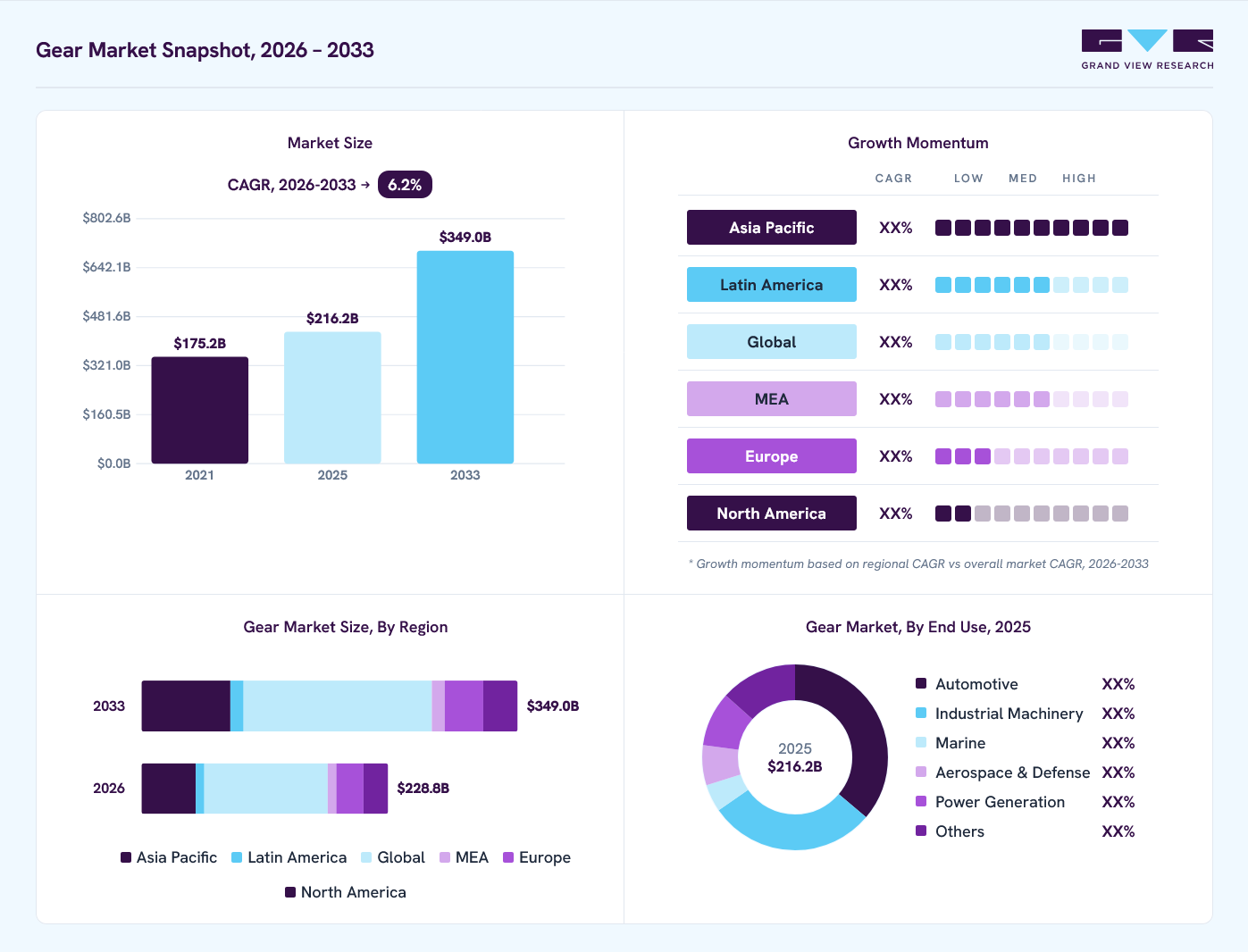 Source: Grand View Research, IR Documents, Primary Interviews, Paid DatabasesTo learn more about this report,
 Download Free Sample Report
Key Market Trends & Insights
- By gear type: Spur gears segment dominated the market in 2025, accounting for 25.3% market share.
- By material: Aluminum segment is projected to register the fastest CAGR of 7.4% during the forecast period.
- By end use: Aerospace & defense segment is expected to grow at 7.7% from 2026 to 2033.
Regional Highlights
- Largest regional market: Asia Pacific (43.5% revenue share, 2025)
- By country: China held the largest market share in 2025.
Market Size & Forecast
- Market Size in 2025: USD 216.2 Billion
- Estimated Market Size in 2026: USD 228.8 Billion
- Projected Market Size by 2033: USD 349.0 Billion
- CAGR (2026-2033): 6.2%
GVR research-powered AIAsk Prism AI about the gear marketGet cited answers from GVR research on market growth, segments, regulations and forecasts.Start with✓ Source-linked answers ✓ Market-specific context ✓ Traceable figuresExplore Prism AI ↗
Growth in manufacturing capacity and automation is increasing demand for precision gears capable of handling higher torque, speed, and operating loads. Additionally, the transition toward electric and hybrid mobility is creating demand for compact, lightweight, and low-noise gear systems suited to new drivetrain architectures. Renewable energy investments, particularly in wind power, are driving demand for high-load gear systems used in turbines, while the modernization of aging industrial equipment is sustaining replacement demand. Increasing focus on predictive maintenance, equipment reliability, and customized transmission solutions is further supporting aftermarket opportunities and specialized gear production.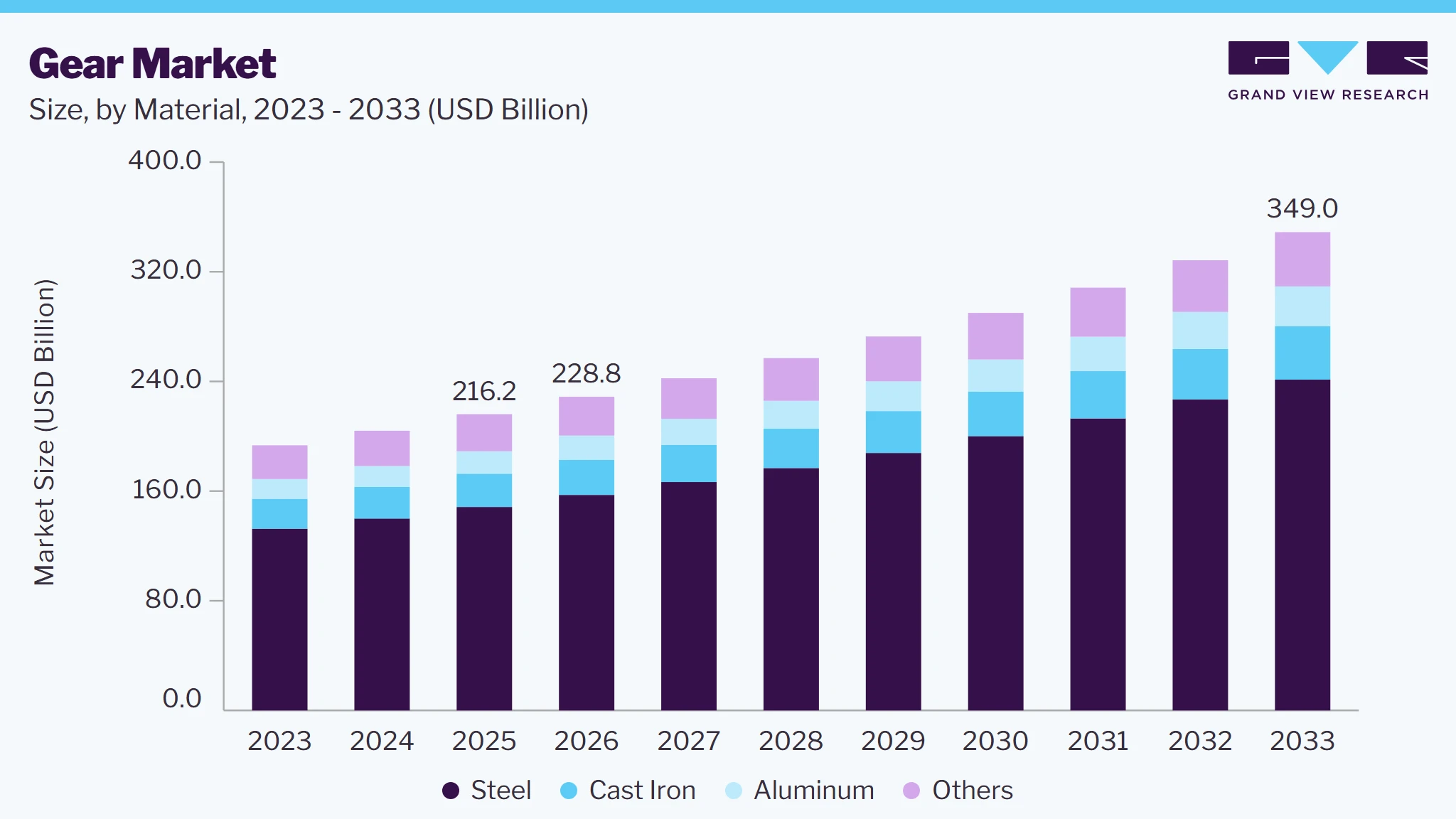 To learn more about this report, Download Free Sample Report
Market Dynamics
The global gear market is influenced by changes in vehicle production, industrial capital expenditure, infrastructure development, energy generation, and machinery replacement cycles. Demand is also affected by the operating requirements of equipment, including transmission capacity, speed range, durability, and service life. Shifts in drivetrain architecture and increasing deployment of electrically powered equipment are modifying the type and configuration of gearing required across transportation and industrial applications.
Rising production of vehicles, construction machinery, agricultural equipment, machine tools, and industrial systems is increasing the requirement for mechanical transmission components. Gear demand is closely linked to equipment output because transmissions, reduction units, drive assemblies, and other power-transfer mechanisms require application-specific gearing. Expansion of manufacturing capacity in emerging economies and continued investment in machinery-intensive industries are broadening the addressable demand base for gear manufacturers.
Fluctuations in the prices of steel, aluminum, alloying elements, and other input materials can affect gear manufacturing economics. Energy-intensive processes such as forging, heat treatment, machining, and grinding further expose producers to changes in electricity and fuel expenses. Cost volatility can place pressure on supplier margins and complicate long-term pricing arrangements, particularly for manufacturers operating under fixed-price contracts or serving cost-sensitive machinery markets.
Vehicle electrification is creating new requirements for gearing designed around high rotational speeds, compact transmission layouts, low noise, and efficient power transfer. Electric vehicles, hybrid systems, electric construction equipment, and automated mobile machinery are expanding the need for specialized reduction gears and transmission assemblies. Similar requirements are emerging in robotics, autonomous equipment, and renewable-energy systems, providing manufacturers with opportunities to develop gear solutions aligned with changing drivetrain architectures and equipment designs.
Market Concentration & Characteristics
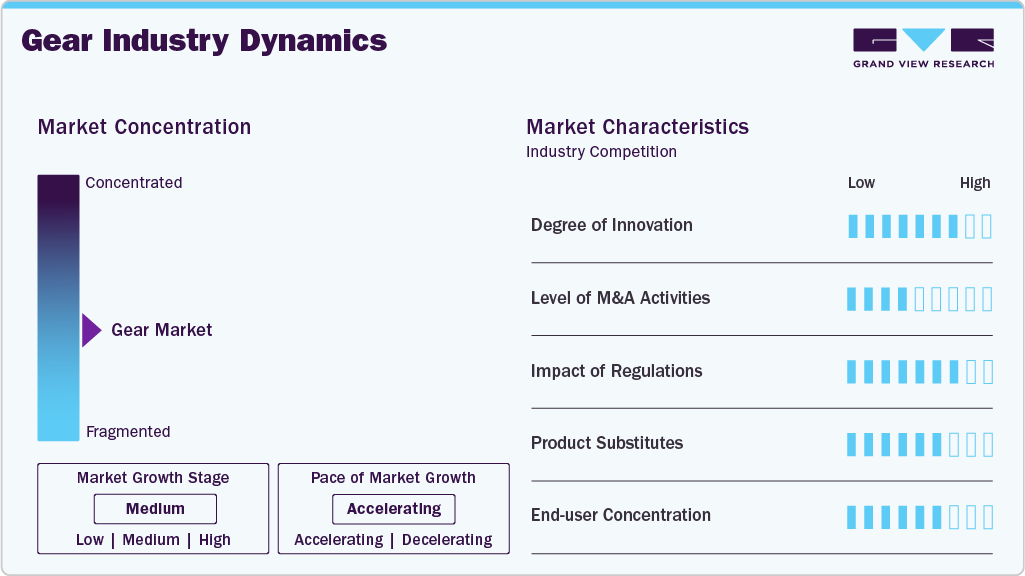
The global gear market remains highly fragmented, with participation spread across multinational manufacturers, independent gear specialists, contract producers, and regional suppliers. Large companies generally serve multiple industries through diversified manufacturing networks, whereas smaller participants often concentrate on specific gear types, customer groups, or geographic markets. The competitive environment is influenced by production capacity, engineering expertise, quality control, order flexibility, geographic proximity, and the ability to fulfill both standardized and customized requirements.
Technology and product specifications represent important areas of differentiation. Gear manufacturers compete through advancements in tooth-profile design, metallurgy, heat treatment, surface finishing, machining accuracy, and dimensional inspection. Requirements vary considerably by application: automotive systems emphasize compact construction and smooth operation, industrial machinery requires dependable torque transmission, while wind turbines and heavy equipment demand components capable of handling sustained mechanical loads. These differences encourage manufacturers to maintain application-specific production and engineering capabilities rather than relying solely on standardized offerings.
 To learn more about this report, Download Free Sample Report
The market also has a strong engineering-to-order component, particularly where customers require modifications in geometry, dimensions, materials, transmission ratios, or operating characteristics. Prototyping, testing, reverse engineering, refurbishment, and replacement-part manufacturing provide additional avenues for suppliers to differentiate their services. Emerging demand from electric drivetrains, robotics, automated production systems, renewable-energy equipment, and advanced machinery is changing product specifications and creating opportunities for suppliers with specialized design and manufacturing capabilities. Regional producers continue to participate through shorter production cycles, smaller order quantities, localized technical assistance, and cost-oriented manufacturing models.
Analyst Perspective
The global gear market is increasingly defined by the technical requirements of modern transmission systems rather than by gear volumes alone. Buyers are placing greater emphasis on dimensional accuracy, tooth geometry, material properties, noise and vibration characteristics, service life, and compatibility with increasingly compact and automated equipment designs. This is encouraging suppliers to move toward precision manufacturing, application-specific engineering, and tighter quality control, particularly for high-value equipment. Market opportunities also differ between standardized gear products and customized solutions, with the latter allowing manufacturers to address complex mechanical specifications and generate higher-value orders. Competitive positioning therefore depends not only on production capacity, but also on machining capabilities, engineering expertise, customization, quality consistency, and the ability to meet increasingly specific customer requirements.
Gear Type Insights
By gear type, spur gears accounted for the largest revenue share, reflecting their established use in mechanical systems requiring direct power transfer between parallel shafts. Their simple tooth arrangement allows comparatively straightforward production, inspection, installation, and replacement, making them suitable for a wide range of standardized transmission assemblies. Demand remains broad across machinery where cost considerations, uncomplicated construction, and ease of maintenance are important purchasing factors.
Worm gears are projected to register the fastest CAGR of 6.9% during the forecast period, supported by their ability to achieve substantial speed reduction through a compact gear arrangement. The configuration is particularly relevant where space utilization, controlled movement, and high reduction ratios are required within the same assembly. Their suitability for hoists, elevators, conveyors, gates, actuators, and positioning mechanisms is expanding their application base, particularly in equipment requiring controlled output motion or resistance to reverse movement.
Material Share Insights
Steel accounted for the largest revenue share of 68.7% in 2025, reflecting its established role in gear manufacturing for applications subject to high mechanical stress and continuous operation. Carbon steel, alloy steel, and other steel grades provide manufacturers with flexibility to match hardness, tensile strength, fatigue resistance, and wear characteristics with specific operating conditions. Their extensive use across automotive transmissions, industrial drives, construction equipment, mining machinery, and power-generation systems continues to sustain demand.
Aluminum is projected to register the fastest CAGR during the forecast period, supported by the increasing emphasis on weight reduction across next-generation equipment. Its lower density enables designers to reduce component mass and develop lighter transmission assemblies, which is particularly relevant for electric vehicles, portable machinery, robotics, and compact electromechanical systems. Improvements in alloy development, casting, machining, and surface-treatment techniques are also broadening the range of applications where aluminum-based components can meet required mechanical and durability specifications.
End Use Insights
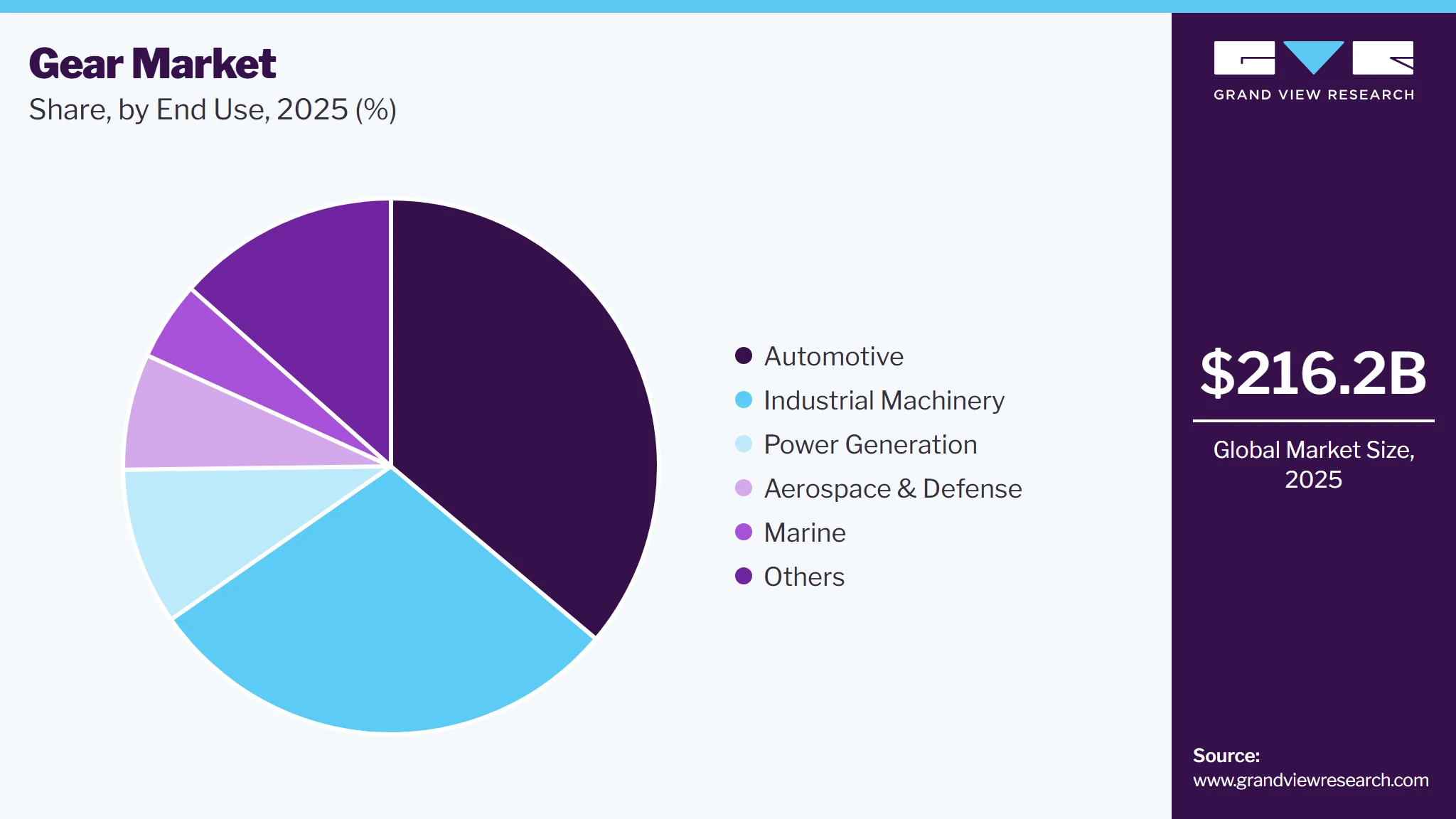
By end use, automotive accounted for the largest revenue share of 36.1%. The segment encompasses a wide range of gear applications, including transmissions, differentials, steering mechanisms, transfer cases, and other vehicle subsystems. The large installed base of passenger cars, commercial vehicles, and off-road vehicles creates recurring requirements across original equipment production, replacement components, and service parts. Differences in vehicle class, drivetrain configuration, transmission architecture, and performance specifications also result in varied gear designs and product requirements within the automotive industry.
 To learn more about this report, Download Free Sample Report
Aerospace & defense is projected to register the fastest CAGR during the forecast period. Gear requirements in this segment extend across aircraft actuation systems, landing gear mechanisms, rotorcraft systems, auxiliary equipment, defense vehicles, and unmanned platforms. Unlike high-volume automotive applications, aerospace and defense programs generally place greater emphasis on application-specific engineering, traceability, stringent qualification procedures, and extended operating reliability. Expansion of aircraft fleets, development of unmanned systems, and modernization of defense platforms are increasing the number of applications requiring specialized gearing and precision transmission components.
Regional Insights
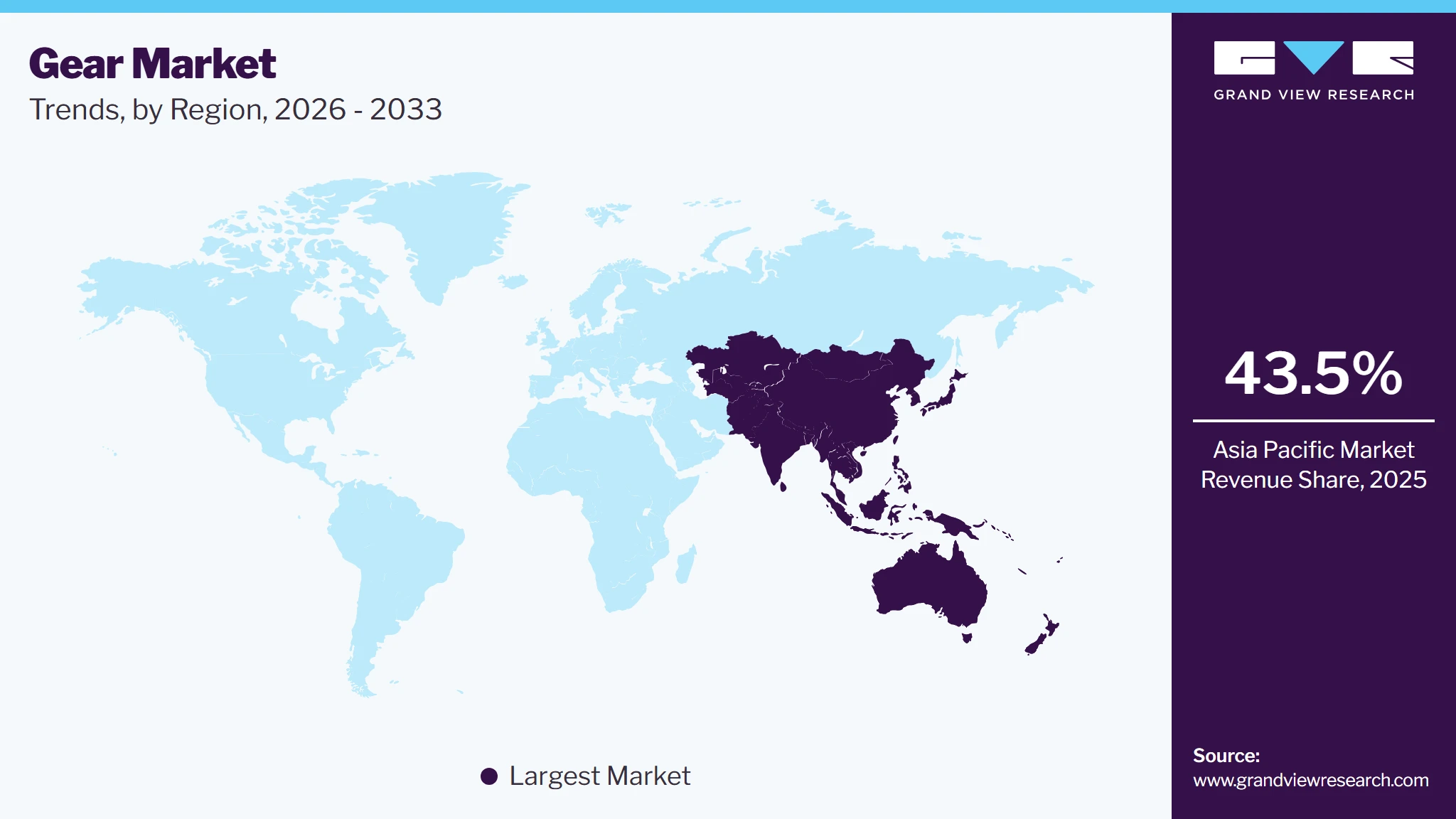
Asia Pacific dominated the market, accounting for the largest revenue share of 43.5% in 2025. The region has a broad gear manufacturing and consumption base, with demand distributed across automotive drivetrains, industrial transmission systems, construction machinery, agricultural equipment, mining machinery, and power-generation assets. The region combines high-volume gear production with specialized manufacturing for heavy-duty and precision applications. A large installed base of machinery also generates recurring replacement requirements, while the presence of integrated component supply chains supports domestic production of forged, machined, heat-treated, and finished gears.
 To learn more about this report, Download Free Sample Report
China Gear Market Trends
China has a deeply established gear industry supported by high vehicle production, extensive machinery manufacturing, and large-scale deployment of construction, agricultural, mining, and material-handling equipment. Demand spans both standardized transmission components and engineered gears designed for specific load and speed requirements. The country's mature metalworking and component-supply ecosystem also supports local production across multiple stages of gear manufacturing, reducing reliance on imported components for a wide range of applications.
India's gear market is linked to the expansion of automotive production, industrial equipment, construction machinery, agricultural mechanization, rail transportation, and renewable-energy infrastructure. Increasing domestic production of vehicles and machinery is broadening requirements for transmission and power-transfer components, while the installed base of industrial equipment generates a parallel replacement market. Growth in local engineering and component manufacturing is also increasing the availability of domestically produced gears for both OEM and aftermarket applications.
North America Gear Market Trends
North America's gear market combines established OEM demand with a substantial replacement and refurbishment base. Automotive transmissions, aerospace systems, agricultural machinery, mining equipment, industrial drives, and heavy-duty equipment represent distinct demand pools with different specifications for gear geometry, load capacity, operating life, and dimensional control. The region's mature equipment base makes aftermarket supply an important component of the market, particularly for machinery where replacing individual gear components can extend equipment service life.
The U.S. has a diversified gear market spanning automotive powertrains, aerospace systems, industrial machinery, agricultural equipment, construction machinery, and specialized transmission systems. Demand is differentiated by the engineering requirements of each application, ranging from high-volume automotive components to lower-volume gears manufactured for specialized equipment. Domestic engineering capabilities and an extensive installed machinery base also sustain requirements for replacement gears, rebuilt assemblies, and application-specific components.
The Canada gear market is witnessing growth as the demand is closely associated with equipment-intensive sectors such as mining, agriculture, forestry, construction, and energy. These industries require gearing capable of transmitting high torque under demanding operating conditions, particularly in mobile and stationary heavy equipment. Replacement and refurbishment activity forms an important part of demand, as gears used in resource and agricultural machinery are subject to prolonged operating cycles and substantial mechanical loads.
Europe Gear Market Trends
Europe has a mature and technically diverse gear market, supported by established automotive and machinery industries alongside aerospace, rail, robotics, agricultural equipment, and wind-energy applications. The regional market includes both large-volume standardized production and highly engineered gearing produced to customer-specific specifications. A strong concentration of engineering companies and specialized component suppliers also contributes to demand for precision manufacturing, application development, and small-batch production.
The Germany gear market maintains a broad gear demand base through its automotive industry, machine-tool manufacturing, industrial equipment production, automation systems, and engineering sector. Gear requirements extend from vehicle transmission components to precision gearing used in machine tools and specialized industrial systems. The country's concentration of machinery manufacturers also supports demand for customized gear dimensions, transmission ratios, and configurations developed around specific equipment designs.
The France gear market is witnessing rise in demand influenced by its aerospace, automotive, rail, industrial equipment, and agricultural machinery industries. Aerospace and rail applications generate requirements for specialized gearing subject to strict dimensional and reliability specifications, while automotive and machinery production provides broader component demand. The country's established engineering sector also supports aftermarket requirements for replacement and remanufactured gear components.
Middle East & Africa Gear Market Trends
The Middle East & Africa market is shaped by equipment used in oil and gas, mining, construction, power generation, transportation, and industrial projects. Gear requirements are concentrated in heavy-duty systems such as compressors, conveyors, cranes, drilling equipment, pumps, and mobile machinery. Harsh operating environments and the high cost of equipment downtime can increase the importance of replacement components, refurbishment, and maintenance-oriented gear supply.
Saudi Arabia gear market demand is being shaped by industrial diversification, infrastructure development, mining activity, power projects, and the expansion of domestic manufacturing. Heavy equipment, material-handling systems, industrial drives, and energy-related machinery require a range of reduction and transmission gearing. The development of local industrial capabilities is also creating scope for regional maintenance and component supply, including replacement gears for equipment operating across large industrial and infrastructure sites.
Latin America Gear Market Trends
Latin America's gear market is closely connected with automotive production, agricultural machinery, mining equipment, construction, energy infrastructure, and industrial processing. Demand characteristics vary substantially by application, with agricultural and mining operations generating requirements for robust gearing while automotive production contributes higher-volume transmission demand. The region's extensive use of imported and locally assembled machinery also creates a recurring need for replacement components and compatible gear assemblies.
Brazil gear market has a diversified demand base supported by automotive manufacturing, agricultural mechanization, mining, construction equipment, and industrial production. Agricultural machinery represents an important application area for gears used in tractors, harvesters, planting equipment, and related systems, while mining and construction operations require heavy-duty gearing for material handling and processing equipment. Automotive production adds demand for transmission and drivetrain components, creating a market that combines high-volume OEM requirements with specialized industrial and replacement applications.
Key Gear Company Insights
Some of the key players operating in the market include ZF Friedrichshafen AG, SEW-EURODRIVE GmbH & Co. KG, among others.
-
ZF Friedrichshafen AG, headquartered in Friedrichshafen, Germany, is a global technology company supplying mobility and industrial technology solutions across passenger cars, commercial vehicles, and industrial applications. The company’s portfolio includes transmissions, driveline systems, gearboxes, and other power-transfer technologies, with industrial products serving applications in construction machinery, mining, marine, offshore, and other heavy-duty equipment. Within the gear market, ZF participates through a broad range of transmission and gear solutions designed for different torque, load, speed, and operating requirements, supported by its engineering, manufacturing, and global service capabilities.
-
SEW-EURODRIVE GmbH & Co. KG, headquartered in Bruchsal, Germany, is a family-owned manufacturer of drive technology and automation solutions for industrial and mechanical engineering applications. The company offers gearmotors, gear units, industrial gear units, motors, drive electronics, and automation systems, with its gear portfolio covering configurations such as helical, helical-bevel, helical-worm, parallel-shaft, and planetary gear units. Its products are used across material handling, logistics, manufacturing, process industries, and other machinery applications, with the company combining mechanical drive components with electronic and automation technologies to provide integrated drive solutions.
Key Gear Companies
The following key companies have been profiled for this study on the gear market.
-
ZF Friedrichshafen AG
-
SEW-EURODRIVE GmbH & Co. KG
-
Sumitomo Heavy Industries, Ltd.
-
Bonfiglioli Riduttori S.p.A.
-
Flender GmbH
-
Dana Incorporated
-
Regal Rexnord Corporation
-
NORD Drivesystems
-
David Brown Santasalo
-
Elecon Engineering Company Limited
-
Bharat Gears Limited
-
KHK Gears (Kohara Gear Industry Co., Ltd.)
-
Renold plc
-
Comer Industries S.p.A.
-
Rossi S.p.A.
Competitive Benchmarking
Category
Operating Strategies
Competitive Edge
Weakness
Established Players (e.g., ZF Friedrichshafen AG; SEW-EURODRIVE GmbH & Co. KG; Sumitomo Heavy Industries, Ltd.; Bonfiglioli Riduttori S.p.A.; Flender GmbH; Regal Rexnord Corporation; NORD Drivesystems; David Brown Santasalo; Elecon Engineering Company Limited)
- Broaden gear, gear unit, and transmission portfolios across spur, helical, bevel, planetary, worm, and application-specific configurations.
- Invest in precision machining, heat treatment, grinding, testing, application engineering, and global manufacturing and service networks.
- Diversified product portfolios established OEM relationships, and extensive manufacturing infrastructure across multiple gear and transmission applications.
- Strong engineering capabilities for customized gearing, integrated drive systems, and technically demanding load and torque requirements.
- High capital requirements for precision manufacturing, testing, and production infrastructure can increase operating costs.
- Broad product portfolios and multinational operations can add manufacturing, inventory, and supply-chain complexity.
Emerging & Regional Players (e.g., Dana Incorporated; Bharat Gears Limited; KHK Gears; Renold plc; Comer Industries S.p.A.; Rossi S.p.A.)
- High capital requirements for precision manufacturing, testing, and production infrastructure can increase operating costs.
- Broad product portfolios and multinational operations can add manufacturing, inventory, and supply-chain complexity.
- Flexible production capabilities and closer access to regional OEMs and aftermarket customers.
- Ability to address specific dimensional, load, speed, and operating requirements through focused product development.
- Flexible production capabilities and closer access to regional OEMs and aftermarket customers.
- Ability to address specific dimensional, load, speed, and operating requirements through focused product development.
Recent Developments
-
In October 2025, ZF Friedrichshafen AG presented a new single-stage spur gear drive at the 16th International Railway Equipment Exhibition (IREE) in New Delhi, developed specifically for Indian railway applications. The gearbox is designed for high-speed trains, including Vande Bharat Express, and incorporates a newly developed sphero cast housing suited to India's varied operating conditions.
-
In April 2025, SEW-EURODRIVE introduced the PxG integrated precision planetary gearmotor, designed for servo applications requiring compact construction, high positioning accuracy, and dynamic motion control. The product combines a precision planetary gear unit and high-performance motor in an integrated configuration, reducing installation length by up to 40% compared with conventional servo planetary gearmotors with adapter-mounted designs.
Gear Market Report Scope
Report Attribute
Details
Market size in 2025
USD 216.2 billion
Estimated market size in 2026
USD 228.8 billion
Projected market size by 2033
USD 349.0 billion
Growth rate
CAGR of 6.2% from 2026 to 2033
Base year for estimation
2025
Historical data
2021 - 2024
Forecast period
2026 - 2033
Quantitative units
Revenue in USD billion and CAGR from 2026 to 2033
Report coverage
Revenue forecast, company market position analysis, competitive landscape, growth factors, and trends
Segments covered
Gear type, material share, end use, region
Regional scope
North America; Europe; Asia Pacific; Latin America; Middle East & Africa
Country Scope
U.S.; Canada; Mexico; Germany; UK; Italy; Spain; France; China; Japan; India; Australia; South Korea; Brazil; Argentina; Saudi Arabia; UAE; South Africa
Key companies profiled
ZF Friedrichshafen AG; SEW-EURODRIVE GmbH & Co. KG; Sumitomo Heavy Industries, Ltd.; Bonfiglioli Riduttori S.p.A.; Flender GmbH; Dana Incorporated; Regal Rexnord Corporation; NORD Drivesystems; David Brown Santasalo; Elecon Engineering Company Limited; Bharat Gears Limited; KHK Gears (Kohara Gear Industry Co., Ltd.); Renold plc; Comer Industries S.p.A.; Rossi S.p.A..
Customization scope
Free report customization (equivalent up to 8 analysts working days) with purchase. Addition or alteration to country, regional & segment scope.
Pricing and purchase options
Avail customized purchase options to meet your exact research needs. Explore purchase options
Global Gear Market Report Segmentation
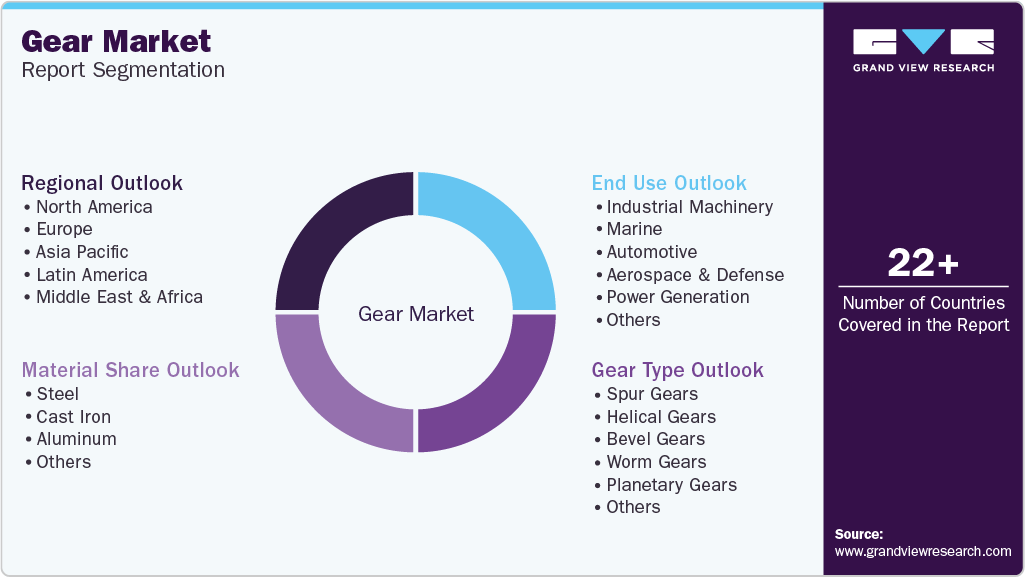
This report forecasts revenue growth at global, regional & country levels and provides an analysis on the industry trends in each of the sub-segments from 2021 to 2033. For the purpose of this study, Grand View Research has segmented the gear market on the basis of gear type, material share, end use, and region:
 To learn more about this report, Download Free Sample Report
-
Gear Type Outlook (Revenue, USD Billion, 2021 - 2033)
-
Spur Gears
-
Helical Gears
-
Bevel Gears
-
Worm Gears
-
Planetary Gears
-
Others
-
-
Material Share Outlook (Revenue, USD Billion, 2021 - 2033)
-
Steel
-
Cast Iron
-
Aluminum
-
Others
-
-
End Use Outlook (Revenue, USD Billion, 2021 - 2033)
-
Industrial Machinery
-
Marine
-
Automotive
-
Aerospace & Defense
-
Power Generation
-
Others
-
-
Regional Outlook (Revenue, USD Billion, 2021 - 2033)
-
North America
-
U.S.
-
Canada
-
Mexico
-
-
Europe
-
Germany
-
France
-
UK
-
Spain
-
Italy
-
-
Asia Pacific
-
China
-
India
-
Japan
-
South Korea
-
Australia
-
-
Latin America
-
Brazil
-
Argentina
-
-
Middle East & Africa
-
Saudi Arabia
-
UAE
-
South Africa
-
-
Research Methodology
The gear market figures in this report are based on a proven research process that combines executive interviews with secondary research from proprietary databases, company filings, and recognized regulatory and institutional sources. Market size is built through value-chain sizing-reconciling supply-side and demand-side estimates-and triangulated with bottom-up and top-down approaches. Every estimate passes multiple levels of expert validation before publication, with each gear segment quantified using the revenue-capture definitions in the table below.
Segment Definition
Gear Type
Revenue Capture Definition
Spur Gears
Revenue generated from the sale of spur gears, including standard, precision-machined, and customized configurations with straight teeth, supplied as individual gears or as part of gear assemblies.
Helical Gears
Revenue generated from the sale of helical gears, including standard and engineered configurations with single or multiple helical tooth arrangements, supplied individually or as matched gear sets.
Bevel Gears
Revenue generated from the sale of bevel gears, including straight, spiral, and other precision-manufactured bevel configurations, sold as individual components or assembled gear sets.
Worm Gears
Revenue generated from the sale of worm gears, including worm shafts, worm wheels, and matched worm gear sets supplied as individual components or integrated assemblies.
Planetary Gears
Revenue generated from the sale of planetary gear products and assemblies, including configurations comprising sun, planet, and ring gears, whether supplied as individual components or complete planetary sets.
Others
Revenue generated from the sale of gear products outside the primary categories, including rack-and-pinion gears, internal gears, hypoid gears, crown gears, and other specialized or customized gear configurations.
Material Share
Revenue Capture Definition
Steel
Revenue generated from the sale of gears manufactured using carbon steel, alloy steel, stainless steel, and other steel grades, covering both standard and customized gear products.
Cast Iron
Revenue generated from the sale of gears manufactured from gray cast iron, ductile iron, and other cast iron grades, including standard and customized gear configurations.
Aluminum
Revenue generated from the sale of gears manufactured from aluminum and aluminum alloys, including machined, cast, and customized gear products.
Others
Revenue generated from the sale of gears manufactured from materials other than steel, cast iron, and aluminum, including bronze, brass, engineering plastics, composites, and specialized alloys.
End Use
Revenue Capture Definition
Industrial Machinery
Revenue generated from the sale of gears to industrial machinery manufacturers, equipment producers, system integrators, and industrial component suppliers, including direct and customized gear orders.
Marine
Revenue generated from the sale of gears to shipbuilders, marine equipment manufacturers, propulsion-system suppliers, and other marine-sector customers through direct sales or equipment supply contracts.
Automotive
Revenue generated from the sale of gears to vehicle manufacturers, automotive transmission and drivetrain suppliers, and component manufacturers through original-equipment and replacement-component sales.
Aerospace & Defense
Revenue generated from the sale of gears to aerospace manufacturers, defense equipment producers, military-system suppliers, and qualified component suppliers through direct orders and contracted supply programs.
Power Generation
Revenue generated from the sale of gears to power-generation equipment manufacturers, turbine and generator suppliers, engineering contractors, and other power-sector equipment providers.
Others
Revenue generated from the sale of gears to customers across other industries, including construction equipment, agricultural machinery, mining equipment, railways, material handling, and specialized machinery manufacturers.
Estimation Model
Layer Name
Key Question
Description
Gear Demand Assessment Layer
Where is the underlying demand for gears concentrated?
Assess gear requirements across industrial machinery, automotive, marine, aerospace & defense, power generation, and other end-use sectors. The analysis considers equipment production, installed machinery base, transmission requirements, replacement cycles, and sector-specific operating conditions to determine the addressable market for gear products.
Equipment & Replacement Demand Layer
What factors translate equipment activity into gear requirements?
Evaluate new equipment production, machinery upgrades, capacity additions, fleet expansion, maintenance requirements, and replacement of worn or obsolete gears. The layer distinguishes original-equipment demand from replacement requirements to establish the volume of gears entering the market through new installations and the existing equipment base.
Product & Material Mix Layer
Which gear configurations and materials capture market demand?
Analyze the market mix across spur, helical, bevel, worm, planetary, and other gear types, as well as steel, cast iron, aluminum, and other materials. Assessment incorporates design specifications, load and torque requirements, dimensional characteristics, material selection, precision requirements, and customization levels to determine the product composition of the market.
Revenue Generation Layer
How is market revenue quantified across segments and regions?
Quantify annual gear sales revenue by gear type, material, end-use industry, and geographic market. Revenue estimation incorporates shipment volumes, manufacturer selling prices, gear specifications, customization, material grade, order volumes, product mix, and regional pricing differences to establish the total market value.
Delivered Customizations
This report has been delivered with the following In-depth customizations
Client Request
Customization Delivered
Value Adds
Competitive Benchmarking
A structured benchmarking framework was developed for leading gear manufacturers, comparing product portfolios, gear design and machining capabilities, customization depth, manufacturing footprint, quality standards, customer coverage, distribution models, and strategic developments. The assessment also considered differences between suppliers focused on standardized products and those serving engineered gear requirements.
Enabled stakeholders to evaluate supplier capabilities on a like-for-like basis, identify competitive differentiation, understand positioning across product categories, and assess potential gaps in the existing supplier landscape.
Regional Segmentation
Regional and country-level market analysis was developed across North America, Europe, Asia Pacific, Latin America, and the Middle East & Africa, incorporating industrial output, automotive production, machinery manufacturing, capital equipment investment, import-export activity, installed equipment base, and aftermarket requirements.
Provided a clearer view of how market value is distributed geographically and the structural factors influencing regional development, supporting decisions related to market prioritization, sales coverage, sourcing, and geographic expansion.
Opportunity Assessment
A targeted opportunity assessment was developed across gear types, material categories, end-use industries, and original-equipment and replacement demand. The analysis examined product specifications, precision requirements, customization levels, equipment replacement cycles, and areas where changing machinery designs may alter gear requirements.
Helped stakeholders distinguish volume-driven opportunities from higher-value engineered requirements, identify portfolio gaps, determine areas for product or capacity expansion, and support investment and market-entry planning.
About the Author(s)
Advanced Interior Materials Research Team
Advanced Materials · Advanced Interior MaterialsThis report was authored by the advanced interior materials research team at Grand View Research - comprising two research analysts, one senior research analyst, and one industry expert - with specialized expertise in the advanced interior materials segment of the advanced materials industry. All findings are based on proprietary advanced materials databases, executive interviews, and regulatory analysis, subject to internal peer review prior to publication.
Last Updated:
Speak to Analyst

Customize this report to your needs - add regions, segments, or data points, with 20% free customization.
Or view our licence options:


ISO 9001:2015 & 27001:2022 Certified
We are GDPR and CCPA compliant! Your transaction & personal information is safe and secure. For more details, please read our privacy policy.


