
- Home
- »
- Next Generation Technologies
- »
-
Generative AI In Animation Market Size Report, 2026-2033GVR Report cover

Generative AI In Animation Market (2026 - 2033)
Size, Share & Trends Analysis Report By Type (GANs, VAEs, Transformers), By Component (Solutions, Services), By End Use (Advertising, Movie Production, Gaming, Televisions), By Region, And Segment Forecasts
Market Size, 2025
$916.6MMarket Estimate, 2026
$1,315.8MMarket Forecast, 2033
$13,386.5MCAGR, 2026–2033
39.3%Generative AI In Animation Market Summary
The global generative AI in animation market size was valued at USD 916.6 million in 2025 and is projected to grow from USD 1,315.8 million in 2026 to USD 13,386.5 million by 2033, at a CAGR of 39.3% from 2026 to 2033. The market in North America dominated with a revenue share of 33.0% in 2025. Companies across the U.S. and Canada are increasingly adopting generative AI solutions to streamline animation workflows, automate character design, enhance visual effects, and accelerate content production.
 Source: Grand View Research, IR Documents, Primary Interviews, Paid DatabasesTo learn more about this report,
 Download Free Sample Report
 Key Market Trends & Insights
- By component: Solutions segment held the largest market share of 57.8% in 2025.
- By type: Transformers segment held the largest market share of 41.1% in 2025.
- By end use: Gaming segment held the largest market share of 28.1% in 2025.
Regional Highlights
- Largest regional market: North America (33.0% revenue share, 2025)
- Fastest-growing regional market: Asia Pacific (highest CAGR, 2026-2033)
- By country: The U.S. held the largest market share in 2025
Market Size & Forecast
- Market size in 2025: USD 916.6 Million
- Estimated market size in 2026: USD 1,315.8 Million
- Projected market size by 2033: USD 13,386.5 Million
- CAGR (2026-2033): 39.3%
Three ways to get this report
Buy it, customize it, or ask a question.Ask an Analyst
A direct answer, usually in 1 working day
- AccessReport author, directly
- Reply timeWithin 1 working day
- No sales callDirect answer only
- FormatEmail reply
- CostFree, no cost
Get the Full Report
What the study covers
- FormatsPDF · Excel · Dashboard
- Timeline2026–2033 annual, 2025 base
- Coverage20+ countries, 5 regions
- Companies10+ key players profiled
Customize the Report
20% free customization
- IncludeCountries, segments, points
- TailorTo your product definition
- ExtendDeeper competitor detail
- OrA fully bespoke study
- Turnaround5–10 working days
The growing demand for high-quality animated content across film, television, gaming, advertising, and digital media platforms continues to fuel market expansion. Furthermore, the integration of AI-powered tools for storyboarding, motion generation, facial animation, and real-time rendering is enabling studios to reduce production costs and improve creative efficiency.
By efficiently handling large workloads, from creating numerous characters to intricate scenes, AI-powered tools enable both small and large studios to meet production demands effectively. Moreover, the continuous refinement and advancement of generative AI algorithms result in animations of exceptional quality, often comparable to those crafted by human animators. This combination of scalability and quality enhancement optimizes production processes and also elevates the standard of animated content, driving widespread adoption and market expansion within the animation industry.
 To learn more about this report, Download Free Sample Report
 The growing demand for high-quality animated content, fueled by the rise of streaming platforms and online content consumption, is a key driver propelling the adoption of generative AI in the animation market. Audiences seek fresh and engaging content, so studios face pressure to produce at scale without compromising quality. Generative AI offers a solution by simplifying animation processes, enabling animators to create captivating content more efficiently. This efficiency is crucial in meeting the increasing demand for diverse and innovative animations across various platforms. Moreover, AI-powered tools empower creators to experiment with new styles and techniques, enriching the content with a wider array of offerings. Adobe Systems Incorporated, Autodesk, Inc., and NVIDIA Corporation are among the frontrunners in this pursuit. As AI progresses, it promises to transform animation, ushering in an era defined by unparalleled creativity and productivity.
NLP enables animators to provide textual descriptions or commands to AI systems, guiding them in generating animations directly from natural language inputs. This simplifies the animation process, enabling quicker iteration and exploration of ideas, which enhances efficiency and productivity. NLP enables AI systems to understand better and interpret human intentions and preferences, leading to more personalized and engaging animated content. This personalized approach is particularly beneficial in gaming, advertising, and virtual reality industries, where user engagement is crucial. NLP enhances the capabilities of Generative AI in animation, offering increasingly intuitive and efficient animation solutions. This promotes creativity and innovation, as animators can experiment with new styles and concepts that were previously not feasible or too resource-intensive. NLP facilitates seamless communication between animators and AI systems, enabling more effective collaboration and feedback. This leads to a more dynamic and iterative animation process, where creatives can refine their ideas and adapt to changing requirements.
Market Dynamics
The Generative AI in Animation Market is experiencing substantial growth, driven by the increasing demand for high-quality animated content, the need for faster production cycles, and the growing adoption of artificial intelligence technologies across animation workflows. Generative AI solutions enable animation studios and content creators to automate character design, storyboard generation, motion synthesis, visual effects creation, and rendering processes, significantly improving efficiency and reducing production costs. The rapid expansion of streaming platforms, gaming industries, virtual production, and immersive digital experiences is generating strong demand for AI-powered animation tools capable of accelerating content development while maintaining creative quality.
The Generative AI in Animation Market is primarily driven by the growing need to streamline animation production and reduce development timelines. Traditional animation processes are often labor-intensive, requiring extensive manual effort for character modeling, scene creation, rigging, and motion design. Generative AI technologies help automate repetitive tasks, generate realistic animations, and enhance creative workflows, allowing studios to produce content more efficiently. The increasing consumption of animated content across films, television series, gaming, advertising, social media, and virtual environments is further driving the adoption of AI-powered animation solutions. Additionally, advancements in machine learning, natural language processing, and computer vision are enabling the creation of highly realistic and personalized animated experiences.
Despite strong growth potential, the Generative AI in Animation Market faces challenges related to maintaining creative control and the costs associated with implementing advanced AI technologies. Animation studios often require significant investments in AI infrastructure, software platforms, computing resources, and workforce training to integrate generative AI into existing production pipelines. Concerns regarding the quality, originality, and artistic authenticity of AI-generated content may also limit adoption among some creators and production houses. Furthermore, intellectual property issues, copyright considerations, and ethical concerns surrounding AI-generated media continue to present challenges for widespread industry acceptance.The growing adoption of virtual production technologies, metaverse applications, augmented reality (AR), virtual reality (VR), and interactive gaming presents significant opportunities for the Generative AI in Animation Market. Animation studios and content developers are increasingly leveraging generative AI to create dynamic characters, realistic environments, procedural animations, and personalized user experiences. The emergence of AI-powered real-time rendering, automated motion capture, and text-to-animation technologies is opening new avenues for innovation across entertainment and digital media industries. Additionally, increasing investments in streaming content, gaming development, digital advertising, and immersive storytelling platforms are expected to drive substantial market growth throughout the forecast period.
Market Concentration & Characteristics
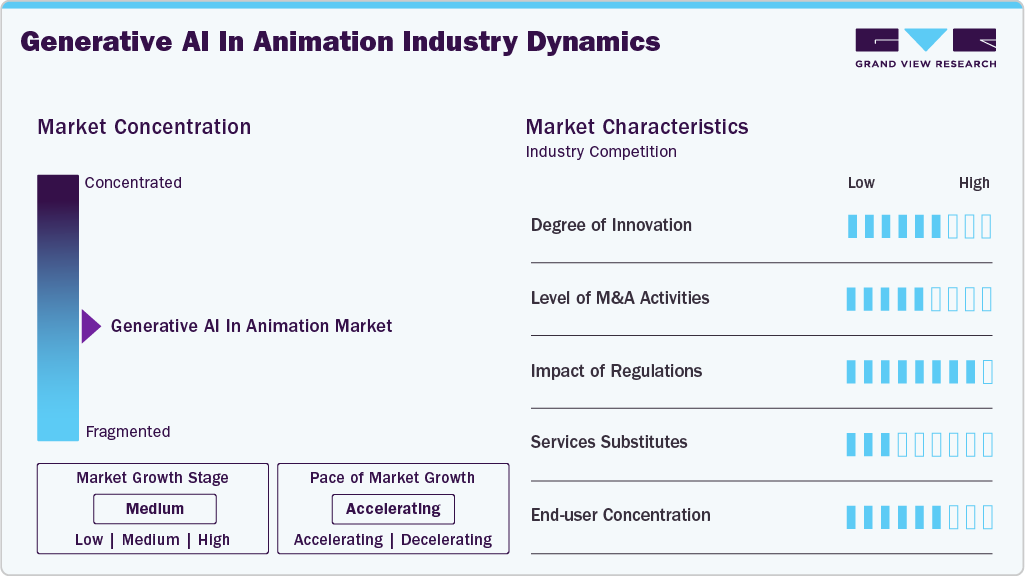
Generative AI in Animation Market is moderately concentrated, characterized by the presence of established animation software providers, technology companies, creative content studios, and AI-powered animation platform developers competing on animation quality, workflow automation, content generation capabilities, rendering efficiency, and creative innovation. Key market participants include Adobe, Autodesk Inc., DreamWorks Animation, Google LLC, Kartoon Studios, Inc., NVIDIA Corporation, Renderforest, ServiceNow, thefablestudio.co, and Walt Disney Animation Studios. These companies are increasingly investing in generative AI technologies, machine learning models, cloud-based animation platforms, real-time rendering solutions, and automated content creation tools to strengthen their competitive positioning. Strategic partnerships, product innovation, AI model advancements, acquisitions, and continuous developments in animation production technologies are further intensifying competition across the market.
 To learn more about this report, Download Free Sample Report
 Analyst Perspective
Generative AI in Animation Market is emerging as a transformative force within the media and entertainment industry, driven by the increasing demand for high-quality animated content, faster production cycles, and cost-efficient content creation workflows. Generative AI technologies are playing a crucial role in reshaping animation production by enabling automated character design, storyboard generation, motion synthesis, visual effects creation, voice generation, lip-syncing, scene development, and real-time rendering across applications such as films, gaming, advertising, OTT platforms, and digital media. The market is benefiting from rapid advancements in transformer models, generative adversarial networks (GANs), variational autoencoders (VAEs), diffusion models, computer vision, and multimodal AI technologies. Furthermore, growing investments in virtual production, cloud-based animation platforms, immersive media experiences, metaverse applications, and AI-driven creative solutions are strengthening the market's long-term growth outlook while enabling organizations to deliver highly engaging, personalized, and visually sophisticated animated content at scale.
Component Insights
Based on component, the solutions segment led the market with the largest revenue share of 57.8% in 2025. The solution segment dominates the generative AI animation market due to the comprehensive offerings provided by solution providers, including end-to-end services and support. These solutions typically integrate AI technologies with animation software, offering seamless workflows and simplified production processes. Animation studios and content creators prefer solutions that provide a holistic approach, covering various aspects of the animation production pipeline, from character design to scene generation and rendering. Moreover, solution providers often offer customizable options customized to the specific needs and preferences of their clients, further solidifying their dominance in the market. The expertise and experience of solution providers in implementing generative AI technologies contribute to their dominance, as clients trust their capabilities to deliver high-quality results efficiently.
The services segment is predicted to experience significant growth in the forecast period. Animation studios and content creators seek services such as consulting, training, and customization to integrate generative AI technologies into their workflows effectively. Moreover, as the complexity of animation projects grows, there is a need for services that provide technical assistance, troubleshooting, and ongoing maintenance to ensure the smooth operation of AI-powered tools. Moreover, services facilitate knowledge transfer and skill development within organizations, empowering teams to harness the full potential of generative AI for animation production. As the market matures and the adoption of generative AI increases, the demand for services is anticipated to grow further, driven by the desire for expertise and support in maximizing the benefits of AI technology in animation.
End Use Insights
Based on end use, the gaming segment led the market with the largest revenue share of 28.1% in 2025. Gaming companies are increasingly incorporating advanced animation techniques to enhance the realism and immersion of their games, driving demand for generative AI solutions. These solutions enable gaming developers to create lifelike characters, dynamic environments, and fluid animations, elevating the gaming experience for players. Moreover, generative AI offers efficiencies in content creation, enabling gaming studios to produce high-quality animations at scale and reduce production costs. Moreover, as the gaming industry expands and diversifies, there is a growing need for innovative and visually compelling content to capture the attention of players, further fueling the adoption of generative AI in animation. Furthermore, advancements in hardware and software technologies have made generative AI more accessible to gaming developers, facilitating its integration into game development pipelines.
 To learn more about this report, Download Free Sample Report
 The advertising segment is projected to grow significantly over the forecast period. Advertisers are increasingly seeking innovative and engaging ways to capture audience attention in a crowded digital sector. Generative AI in animation offers unique opportunities to create dynamic and personalized advertising content that resonates with viewers, driving higher levels of engagement and brand recall. Moreover, advancements in AI technology have made it easier and more cost-effective for advertisers to produce high-quality animated ads on a scale and serve diverse target audiences and platforms. Moreover, as consumer preferences shift towards interactive and immersive content experiences, advertisers are increasingly turning to generative AI to create interactive advertisements and virtual experiences that drive customer engagement and brand loyalty.
Type Insights
Based on type, the transformers segment led the market with the largest revenue share of 41.1% in 2025. The transformer segment is experiencing growth in the generative AI animation market due to its ability to handle complex sequential data and capture long-range dependencies, which is essential for generating realistic and coherent animations. Transformers, with their self-attention mechanism, excel in understanding contextual relationships within input sequences, allowing them to produce high-quality animation outputs. This capability makes transformers particularly suited for tasks such as scene generation, character animation, and motion prediction, where context and continuity are crucial. Moreover, the versatility of transformers enables them to adapt to various animation styles and genres and serve the diverse needs of animation studios and content creators.
The GANs segment is projected to grow significantly over the forecast period. GANs are poised for growth in the generative AI animation market due to their ability to generate diverse and realistic animation content by learning from large datasets. Their adversarial training framework enables them to produce visually appealing animations with enhanced creativity and variation. GANs excel in tasks such as character design, scene generation, and animation interpolation, offering valuable tools for animation studios and content creators. Moreover, GANs' capability to generate novel content and preserve the style and aesthetics of input data makes them highly valuable for creating engaging and immersive animation experiences. As the demand for high-quality and customizable animation content increases, GANs are expected to drive innovation and advancement in generative AI animation technology.
Regional Insights
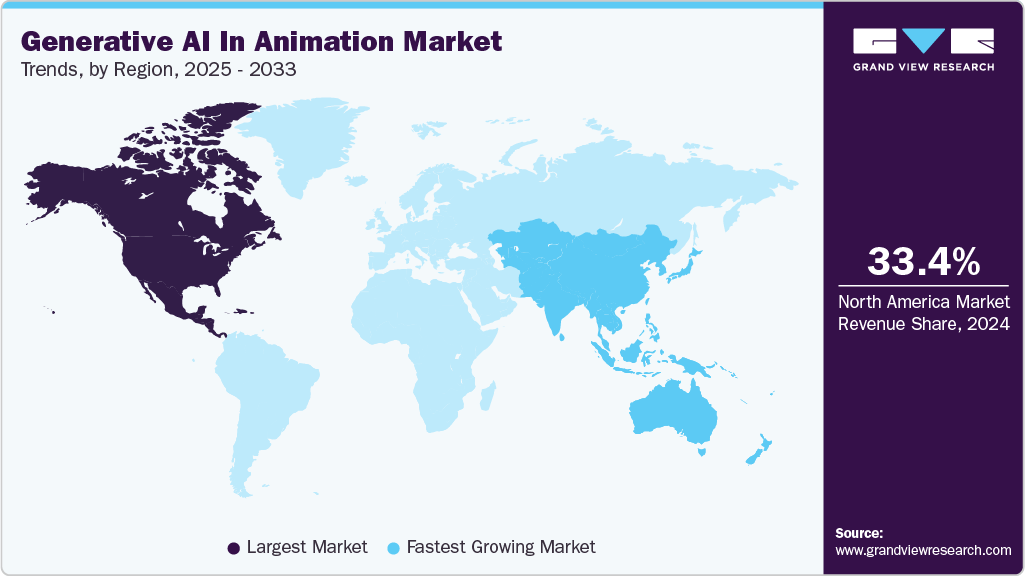
North America dominated the generative AI in animation market with the largest revenue share of 33.0% in 2025. North America's dominance in the market is anchored in its extensive network of established animation studios, technology companies, and research institutions. These entities are at the forefront of pioneering and integrating AI technologies. With abundant resources, specialized expertise, and advanced infrastructure, they lead the industry's innovation trajectory. These organizations have the resources, expertise, and infrastructure to drive innovation and lead the market. Moreover, North America has a thriving entertainment industry, including film, television, gaming, and advertising, which are major consumers of animation services and technologies. The presence of these industries creates a strong demand for generative AI in animation, driving market growth in the region.
 To learn more about this report, Download Free Sample Report
 U.S. Generative AI in Animation Market Trends
The generative AI in animation market in the U.S. held the largest share in the North America region in 2025. The growth of the market in the U.S. is propelled by the expanding adoption of AI technologies across diverse industries. As businesses across sectors recognize the transformative potential of AI, they increasingly seek innovative animation solutions powered by generative AI.
Europe Generative AI in Animation Market Trends
In Europe, the generative AI in animation market is witnessing substantial growth, propelled by the continent's diverse cultural sector. This diversity creates a demand for customized and culturally relevant animation content. Generative AI technology promotes the customization and adaptation of content to serve the specific preferences and needs of European audiences.
Asia Pacific Generative AI in Animation Trends
Asia Pacific is anticipated to register the fastest CAGR over the forecast period. The Asia Pacific region is experiencing rapid growth and adoption of generative AI in animation, driven by the increasing demand for high-quality animation content in sectors such as entertainment, gaming, advertising, and education. Emerging markets in the Asia Pacific, such as China, India, South Korea, and Japan, are emerging as key players in the global animation industry. These countries are investing heavily in AI technologies and are utilizing generative AI to produce innovative and engaging animation content.
Key Generative AI In Animation Company Insights
Some key companies in the generative AI in animation industry are Adobe, Autodesk Inc. and thefablestudio.co.
-
Adobe Inc., a leader in creative software, has been actively integrating generative AI into its animation tools through its proprietary AI engines, Adobe Firefly and Adobe Sensei. Firefly enables creators to generate backgrounds, characters, and scene elements using text prompts, enhancing workflows in tools like After Effects, Animate, and Character Animator. Adobe Sensei powers intelligent features such as auto-rigging, lip-syncing, and motion tracking, streamlining traditionally time-consuming animation tasks. The company positions its AI capabilities as tools to augment human creativity rather than replace it, focusing on ethical AI use and content authenticity.
-
thefablestudio.co. is a pioneer in generative AI for animation. The company focuses on developing AI-driven virtual beings and story-generation tools. In 2023, it introduced SHOW‑1, an AI system capable of writing, animating, voicing, and editing full episodes autonomously demonstrated with an AI-generated South Park-style episode. Building on this, Fable launched Showrunner in 2024, the world’s first AI-generated streaming platform, where users can create and share animated episodes using text prompts. The platform uses a mix of large language models, image diffusion, and neural voice synthesis to automate storytelling while allowing user customization.
Key Generative AI In Animation Companies:
The following key companies have been profiled for this study on the generative AI in animation market.
- Adobe
- Autodesk Inc.
- DreamWorks Animation
- Google LLC
- Kartoon Studios, Inc.
- NVIDIA Corporation
- Renderforest
- ServiceNow
- thefablestudio.co
- Walt Disney Animation Studios
Competitive Benchmarking
Category
Operating Strategies
Competitive Edge
Weakness
Established Players: Adobe; Autodesk Inc.; Google LLC; NVIDIA Corporation; Walt Disney Animation Studios; DreamWorks Animation.
- Focus on expanding generative AI capabilities across animation production workflows, including character creation, storyboard generation, motion synthesis, visual effects, rendering, content personalization, and real-time animation. Emphasize strategic partnerships, technology integration, cloud-based creative platforms, proprietary AI model development, and continuous investment in artificial intelligence and digital content creation technologies to strengthen market leadership.
- Strong global brand recognition, extensive creative software ecosystems, advanced AI research capabilities, large customer bases, scalable cloud and computing infrastructure, deep animation expertise, and established relationships across media, entertainment, gaming, and content production industries.
- High operational and R&D costs, complexity in integrating AI across large production pipelines, intellectual property and copyright concerns, dependence on large-scale content production cycles, and challenges in balancing automation with creative control and artistic quality.
Emerging Players: Renderforest; ServiceNow; Kartoon Studios, Inc.; thefablestudio.co.
- Focus on specialized generative AI applications for content creation, automated animation production, cloud-based creative services, workflow optimization, and AI-powered storytelling solutions.
- Invest in product innovation, platform enhancements, strategic collaborations, regional expansion, and niche animation and content creation offerings to accelerate market adoption and customer acquisition
- Strong agility in innovation, specialized AI-driven animation capabilities, faster product development cycles, flexible cloud-based platforms, targeted industry solutions, and the ability to rapidly address evolving content creation and animation requirements.
- Limited global market presence, smaller customer bases, lower brand recognition, resource constraints compared to larger competitors, dependence on specific market segments, and challenges in scaling operations, AI infrastructure, and R&D investments to compete with established industry leaders.
Recent Developments
-
In June 2025, Meta is launching a generative AI video editing feature on the Meta AI app, website, and the Edits app in the U.S. This tool allows users to transform video clips using preset AI prompts, changing locations, styles, outfits, lighting, and moods. Users can reimagine their videos as vintage comic book scenes, dreamy, cinematic moments, or even stylized video game sequences. The goal is to bring creative AI video generation and editing capabilities across Meta’s platforms.
-
In May 2025, Cartwheel launched a 3D animation AI tool suite designed to simplify and accelerate the animation process while giving creatives greater control. The tool transforms video, text, and motion libraries into production-ready 3D character animations that can be easily edited and integrated into existing workflows. Users can prototype, refine, and customize animations in any 3D format without disrupting their current pipelines. Aimed at industries such as film, anime, gaming, advertising, and social media, Cartwheel's platform reduces tedious tasks and frees up resources for more creative exploration.
-
In May 2024, Google LLC introduced AI-powered features to improve search and advertisement capabilities, including testing advertisements within Search Generative Experience and enabling advertisers to create animated ads from still images. These features enable advertisers to incorporate brand-specific fonts and colors in ads, enhancing the customization options available through Google's Performance Max platform
-
In May 2024, Autodesk acquired Wonder Dynamics, a U.S.-based AI-based video production tools provider, to integrate its cloud-based 3D animation and VFX solution with AI into established tools, aiming to simplify processes and enhance creativity. This acquisition strengthens Autodesk's strategic goal of utilizing AI to connect teams, data, and processes in the Media and entertainment industry.
-
In April 2024, Kartoon Studios, Inc. launched an AI toolkit to improve animation quality and workflow efficiency. This generative AI toolkit represents a significant advancement in animation production, harnessing AI technology to optimize workflows and elevate the quality of animated content.
Generative AI In Animation Market Report Scope
Report Attribute
Details
Market size in 2025
USD 916.6 million
Estimated market size in 2026
USD 1,405.8 million
Projected market size by 2033
USD 13,386.5 million
Growth rate
CAGR of 39.3% from 2026 to 2033
Base year for estimation
2025
Historical data
2021 - 2024
Forecast period
2026 - 2033
Quantitative units
Revenue in USD billion/billion and CAGR from 2026 to 2033
Report coverage
Revenue forecast, company ranking, competitive landscape, growth factors, and trends
Segments covered
Type, component, end use, region
Regional scope
North America; Europe; Asia Pacific; Latin America; MEA
Country scope
U.S.; Canada; Mexico; UK; Germany; France; China; Japan; India; South Korea; Australia; Brazil; KSA; UAE; South Africa
Key companies profiled
Adobe; Autodesk Inc.; DreamWorks Animation; Google LLC; Kartoon Studios, Inc.; NVIDIA Corporation; Walt Disney Animation Studios; Renderforest; Walt Disney Animation Studios
Customization scope
Free report customization (equivalent up to 8 analysts' working days) with purchase. Addition or alteration to country, regional & segment scope.
Pricing and purchase options
Avail customized purchase options to meet your exact research needs. Explore purchase options
Global Generative AI In Animation Market Report Segmentation
This report forecasts revenue growth at global, regional, and country levels and provides an analysis of the latest industry trends in each of the sub-segments from 2021 to 2033. For this study, Grand View Research has segmented the global generative AI in animation market report based on type, component, end use, and region:
 To learn more about this report, Download Free Sample Report
 -
Type Outlook (Revenue, USD Million, 2021 - 2033)
-
Transformers
-
GANs
-
VAEs
-
Others
-
-
Component Outlook (Revenue, USD Million, 2021 - 2033)
-
Solutions
-
Services
-
-
End Use Outlook (Revenue, USD Million, 2021 - 2033)
-
Televisions (Over-the-Top)
-
Advertising
-
Movie Production
-
Gaming
-
Others
-
-
Regional Outlook (Revenue, USD Million, 2021 - 2033)
-
North America
-
U.S.
-
Canada
-
Mexico
-
-
Europe
-
UK
-
Germany
-
France
-
-
Asia Pacific
-
China
-
Japan
-
India
-
South Korea
-
Australia
-
-
Latin America
-
Brazil
-
-
Middle East and Africa (MEA)
-
KSA
-
UAE
-
South Africa
-
-
Research Methodology
The generative AI in animation market figures in this report are based on a proven research process that combines executive interviews with secondary research from proprietary databases, company filings, and recognized regulatory and institutional sources. Market size is built through value-chain sizing - reconciling supply-side and demand-side estimates - and triangulated with bottom-up and top-down approaches. Every estimate passes multiple levels of expert validation before publication, with each generative AI in animation segment quantified using the revenue-capture definitions in the table below.
Segment Definition
Segment - Type
Revenue capture definition
Transformer
Revenue in this segment is generated through the licensing and commercialization of transformer-based artificial intelligence models and architectures used in animation content creation and production workflows. These solutions include large language models (LLMs), text-to-image generators, text-to-video systems, multimodal AI models, attention-based neural networks, and foundation models that enable automated script generation, storyboard creation, character design, animation synthesis, motion generation, scene composition, voice generation, lip-syncing, visual effects enhancement, and real-time content personalization.
GANs
Revenue in this segment is generated through the deployment, and commercialization of Generative Adversarial Network (GAN)-based technologies used in animation content creation and enhancement. These solutions include AI-powered image generation, character design tools, facial animation systems, style transfer applications, texture synthesis platforms, motion enhancement tools, and visual effects generation software. GAN-based models enable the creation of realistic characters, backgrounds, environments, animations, and artistic styles by generating high-quality visual content from training data.
VAEs
Revenue in this segment is generated through the development, licensing, deployment, and commercialization of Variational Autoencoder (VAE)-based technologies used in animation content generation and optimization. These solutions include character generation systems, facial expression synthesis tools, motion interpolation platforms, scene generation applications, image reconstruction software, animation enhancement tools, and latent-space content creation models.
Others
Revenue in this segment is generated through the commercialization of alternative generative AI technologies used in animation production and content creation beyond Transformers, GANs, and VAEs. These solutions include diffusion models, neural radiance fields (NeRFs), reinforcement learning-based animation systems, procedural content generation tools, recurrent neural networks (RNNs), computer vision models, and hybrid AI architectures-
Segment - Component
Revenue capture definition
Solutions
Revenue in this segment is generated through the development, licensing, deployment, and sale of generative AI-powered software solutions designed for animation content creation, production, and enhancement. These solutions include AI-based character design platforms, text-to-animation tools, storyboard generation software, motion synthesis systems, visual effects creation tools, automated rigging solutions, facial animation platforms, voice generation applications, real-time rendering software, and content personalization systems
Services
Revenue in this segment is generated through the provision of professional, consulting, integration, customization, maintenance, and support services related to generative AI technologies for animation production and content creation. These services include AI model development, workflow integration, animation pipeline optimization, content generation consulting, training and support, cloud deployment, system upgrades, and managed AI services.
Segment - End Use
Revenue capture definition
Televisions (Over-the-Top)
Revenue in this segment is generated through the adoption and utilization of generative AI technologies by over-the-top (OTT) television platforms and streaming service providers for animated content creation, enhancement, and personalization. These applications include AI-powered content generation, automated animation production, personalized content recommendations, multilingual dubbing and voice synthesis, visual effects enhancement, subtitle generation, and audience engagement optimization.
Advertising
Revenue in this segment is generated through the adoption and utilization of generative AI technologies for creating, enhancing, and personalizing animated advertising content across digital, broadcast, social media, and marketing platforms. These applications include AI-powered ad creation, animated video generation, character and mascot design, motion graphics production, visual effects enhancement, personalized advertising campaigns, and multilingual content localization
Film Industry
This segment generates revenue from the adoption of generative AI technologies by film studios, production companies, and visual effects teams to create, enhance, and optimize animated and cinematic content. These applications include AI-powered character design, storyboard generation, scene creation, animation synthesis, visual effects production, facial animation, voice generation, and post-production enhancement.
Gaming
This segment generates revenue from the utilization of generative AI technologies by game developers, publishers, and interactive entertainment companies to create, enhance, and optimize animated gaming content and experiences. These applications include AI-powered character creation, environment generation, animation synthesis, procedural content development, non-player character (NPC) behavior modeling, visual effects production, asset generation, and real-time content personalization
Others
This segment generates revenue from the application of generative AI technologies across various animation-related industries such as education and e-learning, publishing, corporate communications, healthcare and medical visualization, simulation, AR/VR experiences, metaverse applications, and digital marketing content creation.
Estimation Model
Layer Name
Key Question
Description
Addressable Animation Content Creator Base Layer
Which organizations utilize generative AI in animation?
Identify the global addressable base of organizations adopting generative AI technologies for animation production, including animation studios, film production companies, gaming developers, OTT platforms, advertising agencies, media & entertainment companies, educational content providers, and digital content creators. Consider organizations seeking to improve content creation efficiency, automate animation workflows, and enhance visual storytelling capabilities.
Generative AI Adoption & Integration Layer
Which animation functions deploy generative AI technologies?
Apply generative AI adoption rates across animation workflows based on the deployment of transformers, GANs, VAEs, diffusion models, computer vision systems, and AI-powered content generation technologies for character design, storyboard creation, motion generation, visual effects production, voice synthesis, lip-syncing, scene generation, rendering, and content personalization.
Solution Consumption Layer
How extensively are generative AI animation solutions utilized?
Estimate solution consumption based on the number of AI-powered animation software licenses, cloud-based animation platforms, content generation tools, rendering solutions, creative workflow applications, AI models, and managed services deployed per organization. Consider usage intensity across production pipelines, animation projects, visual effects workflows, gaming environments, and digital content creation platforms.
Revenue Generation Layer
How much revenue is generated?
Calculate market revenue by multiplying the volume of generative AI software solutions, cloud-based platforms, animation tools, professional services, managed services, and content generation applications deployed across organizations by their respective average selling prices (ASPs), subscription fees, licensing costs, service contracts, and recurring revenue streams.
Delivered Customizations
This report has been delivered with the following In-depth customizations
Client Request
Customization Delivered
Value Adds
Competitive Landscape & Strategic Benchmarking
Performed an in-depth evaluation of major generative AI animation software providers, animation studios, cloud technology companies, content creation platforms, and AI-driven creative solution vendors. Assessed market positioning, generative AI capabilities, animation technology portfolios, product innovation strategies, deployment approaches, strategic alliances, acquisitions, and recent developments across the Generative AI in Animation ecosystem.
Helps stakeholders identify leading market participants, evaluate competitive positioning, benchmark technological capabilities, uncover partnership and acquisition prospects, and gain a deeper understanding of evolving competitive dynamics within the animation and digital content creation landscape.
End-Use Demand & Application Analysis
Analyzed generative AI adoption trends across key application areas including film production, gaming, advertising, OTT streaming platforms, digital content creation, virtual production, visual effects, character generation, storyboard creation, and animation workflow automation. Evaluated user requirements, adoption patterns, investment trends, and growth drivers across media, entertainment, gaming, and creative industries
Provides actionable insights into demand patterns, application-specific adoption trends, emerging use cases, and high-growth opportunities, supporting informed decision-making for market entry, business expansion, product development, and commercialization strategies.
Technology Innovation & Growth Opportunity Assessment
Assessed the impact of transformers, GANs, VAEs, diffusion models, computer vision, multimodal AI, real-time rendering technologies, automated content generation tools, and cloud-based animation platforms on market development. Identified emerging innovation areas, untapped growth opportunities, and high-potential application segments across the animation value chain.
Supports long-term strategic planning by highlighting attractive investment opportunities, prioritizing technology innovation initiatives, identifying future revenue streams, and understanding the key trends shaping the evolution of the Generative AI in Animation Market.
Frequently Asked Questions About This Report
Transformer leads the market with revenue share of 41.1% in 2025, While GANs is the fastest growing segment in the market.
Solutions leads the market with revenue share of 57.8% in 2025 & is the fastest growing segment in the market.
Asia Pacific is the fastest growing region with CAGR 42.6% from 2026 to 2033 in the generative AI in animation market.
North America dominated the generative AI in animation market with a share of 33.0% in 2025. This is attributable to its strong ecosystem of leading animation studios, advanced technological infrastructure, and robust investment in AI research and development.
Gaming leads the market with a revenue share of 28.1% in 2025, while advertising is the fastest-growing segment in the market.
The global generative AI in animation market size was valued at USD 916.6 million in 2025 and is estimated at USD 1,315.8 million for 2026.
The global generative AI in animation market is expected to grow at a CAGR of 39.3% from 2026 to 2033, reaching USD 13,386.5 million by 2033.
Some key players operating in the generative AI in animation market include Adobe, Autodesk Inc., Blue Sky Studios, DreamWorks Animation, Google LLC, Kartoon Studios, Inc., NVIDIA Corporation, Pixar Animation Studios, ServiceNow, Walt Disney Animation Studios.
Key factors that are driving the market growth include advancements in artificial intelligence, increasing adoption of cloud-based solutions, rising cybersecurity concerns, and the proliferation of Internet of Things (IoT) devices.
About the Author(s)
Next Generation Technologies Research Team
Technology · Next Generation TechnologiesThis report was authored by the next generation technologies research team at Grand View Research - comprising two research analysts, one senior research analyst, and one industry expert - with specialized expertise in the next generation technologies segment of the technology industry. All findings are based on proprietary technology databases, executive interviews, and regulatory analysis, subject to internal peer review prior to publication.
Last Updated:
Speak to Analyst

Customize this report to your needs - add regions, segments, or data points, with 20% free customization.
Or view our licence options:


ISO 9001:2015 & 27001:2022 Certified
We are GDPR and CCPA compliant! Your transaction & personal information is safe and secure. For more details, please read our privacy policy.


