
- Home
- »
- Advanced Interior Materials
- »
-
Geopolymer Concrete Market Size, Share Report, 2026-2033GVR Report cover

Geopolymer Concrete Market (2026 - 2033)
Size, Share & Trends Analysis Report By Material (Fly Ash-Based, Slag-Based), By End-use (Residential, Commercial), By Region (North America, Europe, APAC, Central & South America, MEA), And Segment Forecasts
Market Size, 2025
$8.9BMarket Estimate, 2026
$9.9BMarket Forecast, 2033
$20.9BCAGR, 2026–2033
11.3%Geopolymer Concrete Market Summary
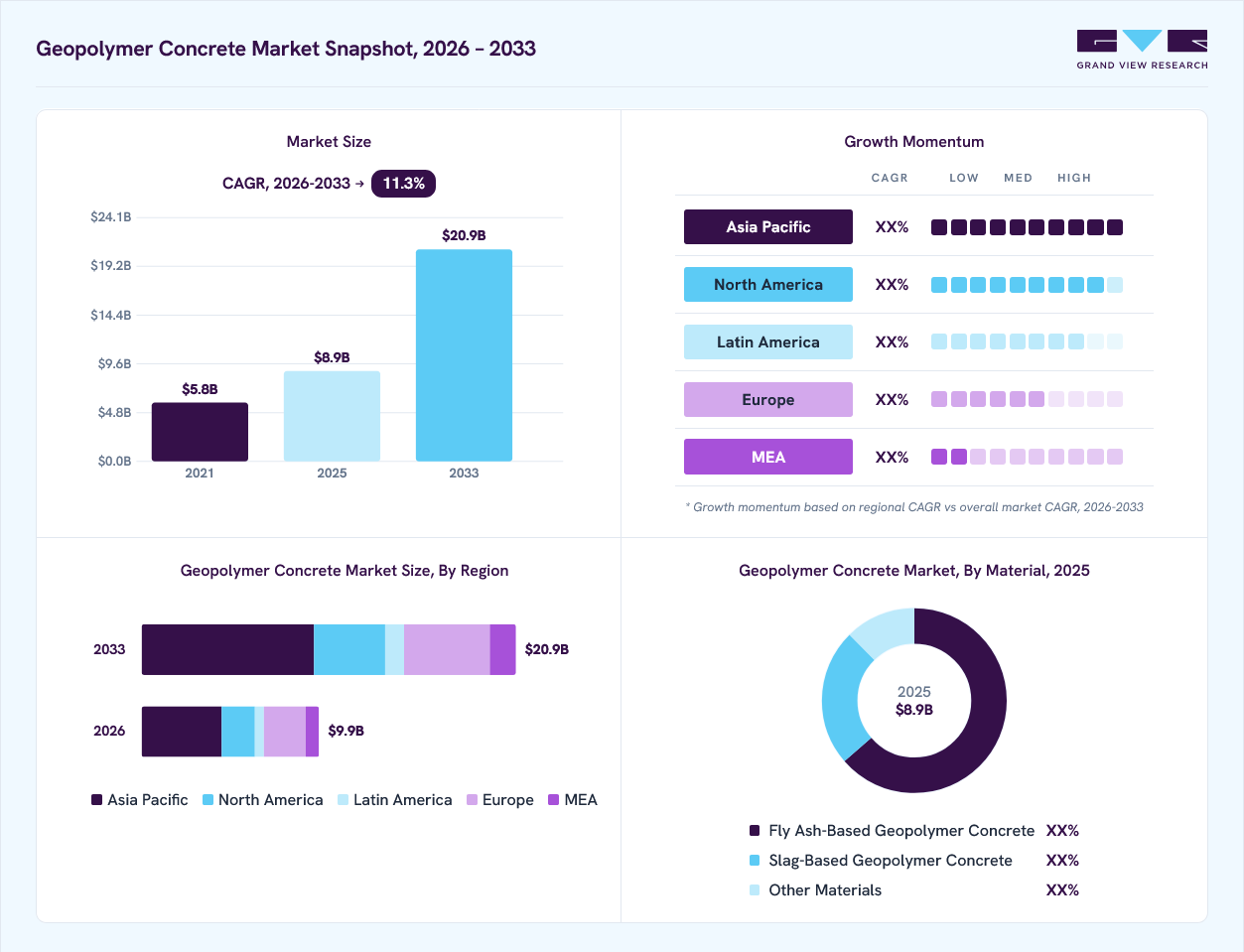
The global geopolymer concrete market size was valued at USD 8.9 billion in 2025 and is projected to grow from USD 9.9 billion in 2026 to USD 20.9 billion by 2033, at a CAGR of 11.3% from 2026 to 2033. Asia Pacific dominated the market, accounting for a revenue share of 45.0% in 2025. Geopolymer concrete is gaining attention due to its environmentally friendly profile, primarily because it produces significantly lower carbon emissions compared to traditional Portland cement.
 Source: Grand View Research, IR Documents, Primary Interviews, Paid DatabasesTo learn more about this report,
 Download Free Sample Report
Key Market Trends & Insights
- By material: Fly ash-based geopolymer concrete segment led the market with the largest revenue share of 63.6% in 2025.
- By end use: Infrastructure & public works segment led the market with the largest revenue share of 46.2% in 2025.
Regional Highlights
- Largest regional market: Asia Pacific (45.0% revenue share, 2025)
- By country: China held the largest share in the Asia Pacific region in 2025.
Market Size & Forecast
- Market size in 2025: USD 8.9 Billion
- Estimated market size in 2026: USD 9.9 Billion
- Projected market size by 2033: USD 20.9 Billion
- CAGR (2026-2033): 11.3%
Prism AI by Grand View Research Free to tryAsk a question about the geopolymer concrete marketTry asking✓Every figure cited from GVR research Prefer the report? Download free sample →
This characteristic aligns with global efforts to reduce greenhouse gas emissions in the construction industry. In addition, geopolymer concrete offers superior durability and resistance to chemicals, making it suitable for infrastructure projects requiring longevity and minimal maintenance.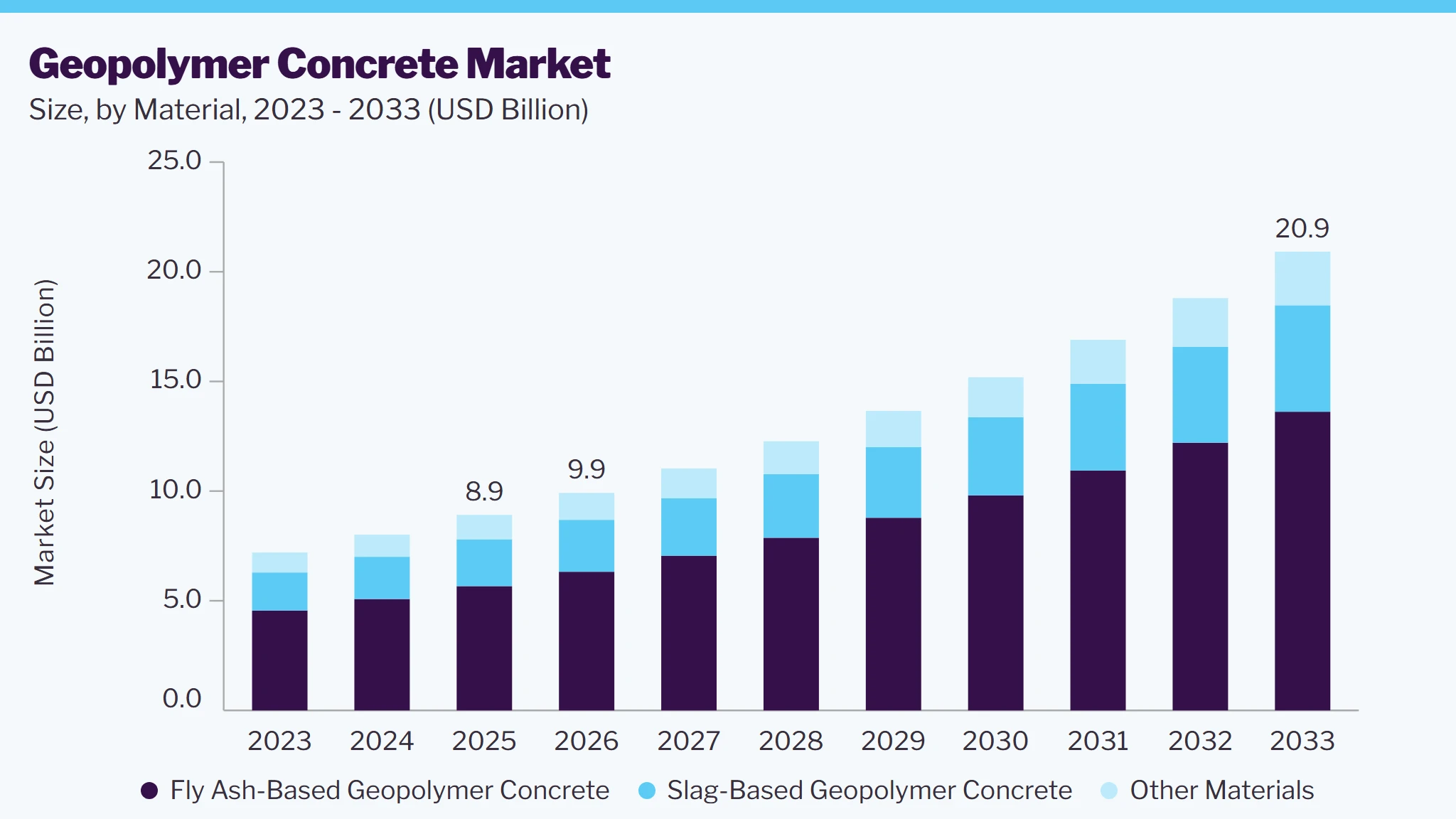 To learn more about this report, Download Free Sample Report
The utilization of industrial by-products, such as fly ash and slag, in geopolymer concrete contributes to waste reduction and promotes sustainable construction practices. This approach not only addresses environmental concerns but also provides a cost-effective alternative to conventional concrete, appealing to both developers and policymakers focused on sustainable development.
Despite its benefits, the adoption of geopolymer concrete faces challenges, including limited awareness and understanding among construction professionals and clients. In addition, the lack of standardized codes and specifications can deter widespread acceptance. The initial costs associated with research, development, and implementation may also pose financial barriers to some organizations.
Companies are engaged in educational initiatives to raise awareness about the benefits of geopolymer concrete among architects, engineers, and contractors. By contributing to the development of standardized guidelines and participating in policy discussions, they aim to facilitate regulatory acceptance and promote wider adoption of geopolymer concrete in various construction sectors.
Market Dynamics
The geopolymer concrete market is experiencing strong growth as the construction industry shifts toward low-carbon and sustainable building materials. Increasing pressure to reduce greenhouse gas emissions from conventional cement production, coupled with the utilization of industrial by-products such as fly ash and ground granulated blast furnace slag (GGBS), is driving adoption. Infrastructure modernization, green building initiatives, and advancements in geopolymer formulations are further supporting market expansion. However, limited standardization, raw material variability, and higher initial implementation complexity continue to restrain widespread commercialization.
The construction sector is under increasing pressure to reduce its environmental footprint, making geopolymer concrete an attractive alternative to ordinary Portland cement. Geopolymer concrete significantly lowers carbon emissions by utilizing industrial waste materials as binders instead of clinker, while also improving waste utilization and supporting circular economy initiatives. Governments, infrastructure developers, and commercial builders are increasingly incorporating sustainable materials into public and private construction projects, creating favorable demand for geopolymer concrete.
In addition to its environmental benefits, geopolymer concrete offers excellent mechanical strength, chemical resistance, fire resistance, and long-term durability. These performance advantages make it suitable for infrastructure applications such as bridges, marine structures, pavements, tunnels, and industrial facilities where extended service life and reduced maintenance costs are critical. Continuous research into ambient-cured formulations and improved activator technologies is further enhancing commercial adoption.
Despite its advantages, the market faces challenges due to the absence of universally accepted standards, design codes, and construction guidelines for geopolymer concrete. Variations in the chemical composition of fly ash, slag, and other precursor materials can affect product consistency and performance, requiring careful quality control and specialized expertise. Limited contractor familiarity and the need for customized mix designs also slow adoption in conventional construction projects.
Growing investments in sustainable infrastructure, net-zero construction, and circular economy practices present significant opportunities for the geopolymer concrete market. The increasing regulatory emphasis on reducing embodied carbon in buildings, combined with innovations in alternative aluminosilicate feedstocks, ambient-curing technologies, and large-scale precast applications, is expected to accelerate commercialization. Emerging economies investing heavily in transportation, industrial, and urban infrastructure are also creating long-term growth opportunities for geopolymer concrete manufacturers.
Market Concentration & Characteristics
The global geopolymer concrete industry is characterized by a mix of established companies and emerging players. The organizations are focusing on innovation and strategic partnerships to enhance their market presence. Investments in research and development are leading to improved formulations of geopolymer concrete, enhancing its performance and broadening its applicability. Collaborations with academic institutions and participation in pilot projects help demonstrate the material's viability and build credibility within the industry.
 To learn more about this report, Download Free Sample Report
The threat of substitution for geopolymer concrete primarily comes from advancements in traditional concrete technologies and the development of alternative low-carbon materials. Innovations such as carbon capture and storage in cement production, as well as the use of supplementary cementitious materials like calcined clay, offer competitive solutions that may limit the adoption of geopolymer concrete. In addition, the construction industry's familiarity with conventional materials and established supply chains can make transitioning to new materials challenging.
Analyst Perspective
The geopolymer concrete market is expected to witness sustained growth as the construction industry accelerates its transition toward low-carbon and resource-efficient building materials. The increasing emphasis on reducing the carbon footprint of cement production, coupled with the growing use of industrial by-products such as fly ash and slag, is strengthening market adoption across infrastructure and commercial construction. Continuous advancements in ambient-cure geopolymer formulations, improved material performance, and supportive sustainability regulations are expanding commercial viability. Although challenges related to standardization, raw material consistency, and market awareness remain, ongoing innovation and increasing investments in green infrastructure are expected to position geopolymer concrete as a key alternative to conventional cement-based concrete over the long term.
Material Insights
Based on material, the fly ash-based geopolymer concrete segment led the market with the largest revenue share of 63.6% in 2025 and is expected to grow at a CAGR of 11.6% over the forecast period. Fly ash-based geopolymer concrete is experiencing increased demand due to the abundant availability of fly ash as an industrial by-product, particularly in regions with significant coal-fired power generation. Its utilization in concrete production not only addresses waste management issues but also enhances the mechanical properties and durability of the resulting material, making it attractive for various construction applications.
Slag-based geopolymer concrete benefits from the use of blast furnace slag, a by-product of steel manufacturing. This approach contributes to resource efficiency and offers improved resistance to aggressive environments, making it suitable for infrastructure projects exposed to harsh conditions. The emphasis on sustainable construction practices is further expected to drive the demand for slag-based geopolymer concrete.
End use Insights
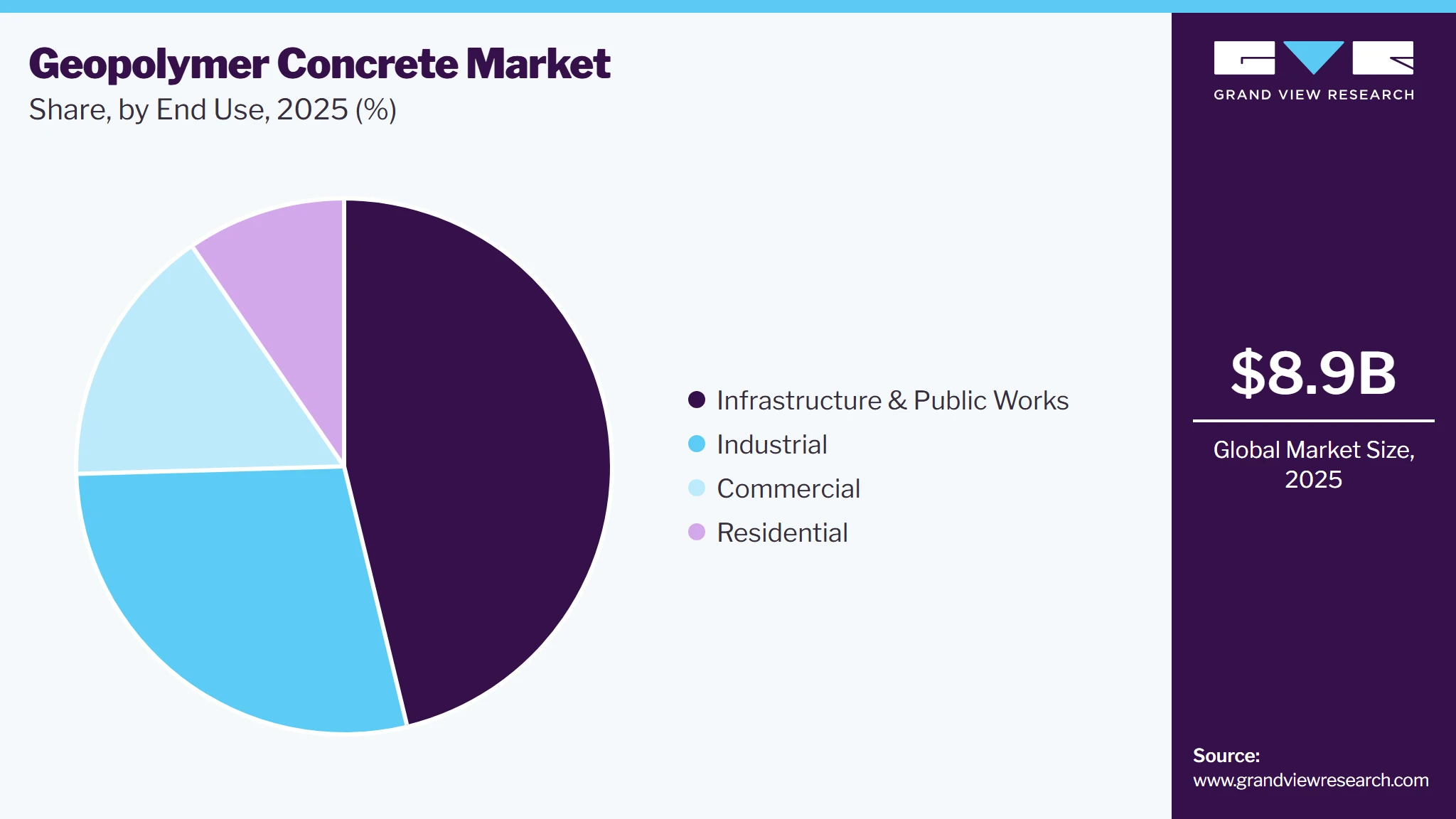
Based on end use, the infrastructure & public works segment led the market with the largest revenue share of 46.2% in 2025 and is expected to grow at a CAGR of 11.7% over the forecast period. The infrastructure and public works sector is increasingly adopting geopolymer concrete due to its durability and reduced environmental impact. Projects such as bridges, roads, and tunnels benefit from the material's longevity and resistance to degradation, leading to lower maintenance costs and extended service life.
 To learn more about this report, Download Free Sample Report
The demand for geopolymer concrete in industrial end use is valued for its chemical resistance and thermal stability, making it suitable for facilities exposed to aggressive substances and high temperatures. Applications in industrial flooring, waste containment, and precast components are expanding as industries seek materials that offer both performance and sustainability.
Regional Insights
The geopolymer concrete industry in North America is growing in demand due to the rising emphasis on sustainable construction practices and stringent environmental regulations. The region's commitment to reducing the carbon footprint of the construction industry aligns with the benefits offered by geopolymer technology.
U.S. Geopolymer Concrete Market Trends
The US geopolymer concrete industry is experiencing increased interest in geopolymer concrete, particularly in infrastructure rehabilitation projects. The material's durability and eco-friendly characteristics support the country's efforts to modernize aging infrastructure sustainably.
Asia Pacific Geopolymer Concrete Market Trends
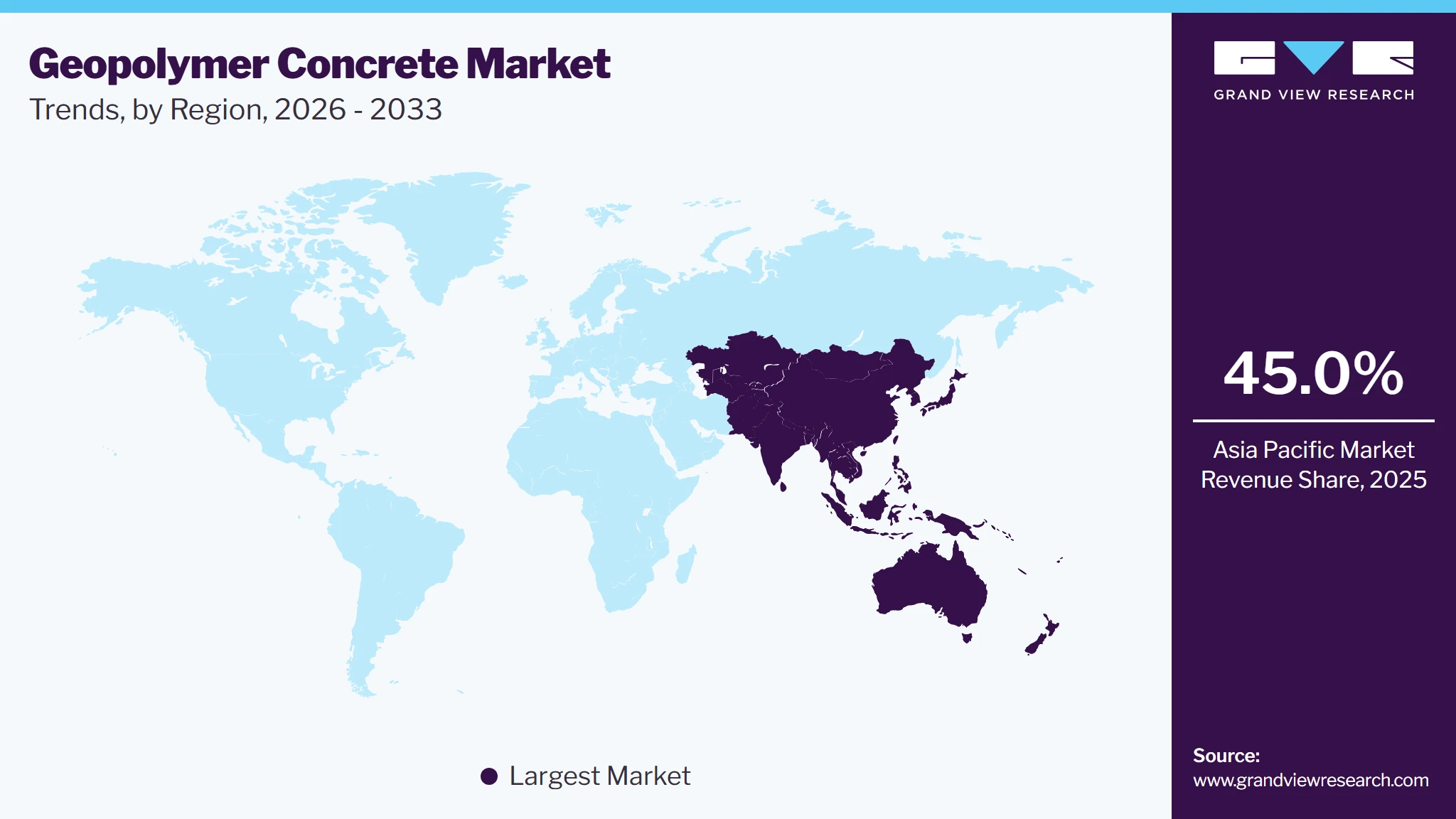
Asia Pacific dominated the geopolymer concrete market with the largest revenue share of 45.0% in 2025. The Asia Pacific region is witnessing a surge in geopolymer concrete demand, driven by rapid urbanization and infrastructure development. Countries like China and India are investing heavily in sustainable construction materials to meet environmental goals and manage industrial by-products effectively.
 To learn more about this report, Download Free Sample Report
The geopolymer concrete market in China held the largest share in the Asia Pacific region in 2025. China geopolymer concrete industry focuses on reducing carbon emissions and utilizing industrial waste, which has led to increased adoption of geopolymer concrete. The government's support for green building initiatives and the need for durable infrastructure contribute to this growing demand.
Europe Geopolymer Concrete Market Trends
Europe geopolymer concrete industry, with its stringent environmental policies and focus on circular economy principles, is driving the adoption of geopolymer concrete. The construction sector's commitment to reducing CO2 emissions and enhancing sustainability aligns with the advantages of geopolymer materials.
Germany's geopolymer concrete industry is led by engineering excellence and emphasis on sustainable construction practices that have resulted in the integration of geopolymer concrete in various projects. The country's proactive approach to environmental stewardship supports the material's growing acceptance.
Latin America Geopolymer Concrete Market Trends
Latin American geopolymer concrete industry is driven by countries exploring geopolymer concrete as a solution to manage industrial waste and promote sustainable development. The region's focus on infrastructure expansion presents opportunities for eco-friendly construction materials.
Middle East & Africa Geopolymer Concrete Market Trends
The Middle East and Africa geopolymer concrete industry is recognizing the potential of geopolymer concrete in addressing environmental challenges and enhancing construction durability. The material's resistance to high temperatures and aggressive environments makes it suitable for the region's climatic conditions.
Key Geopolymer Concrete Company Insights
Some of the key players operating in the market include Geopolymer Solutions, LLC and SLB.
-
Geopolymer Solutions, LLC was established in 2010 and is headquartered in LaPlace, Louisiana, United States. The company specializes in the production of high-performance geopolymer concrete and fireproofing materials under its Cold Fusion Concrete brand. Its solutions are widely used across industrial sectors such as petrochemical, wastewater, infrastructure, and power generation due to their superior resistance to chemicals, fire, and high temperatures. Geopolymer Solutions serves clients across North America and globally through strategic distribution networks and tailored engineering support.
Alchemy Geopolymer Solutions and Ultra High Materials, Inc. are some of the emerging market participants in the geopolymer concrete industry.
-
Alchemy Geopolymer Solutions was established in 2013 and is headquartered in Texas, United States. The company focuses on the development and manufacturing of advanced geopolymer materials designed for demanding industrial environments. Its core product offerings include geopolymer concrete, mortars, and protective coatings, all engineered for high durability, fire resistance, and sustainability. Alchemy Geopolymer Solutions serves clients across North America and internationally, with applications in infrastructure, petrochemical, wastewater, and power industries.
Key Geopolymer Concrete Companies:
The following key companies have been profiled for this study on the geopolymer concrete market.
-
Geopolymer Solutions, LLC
-
SLB
-
Alchemy Geopolymer Solutions
-
Ultra High Materials, Inc.
-
Dasco Company
Geopolymer Concrete Market Report Scope
Report Attribute
Details
Market size in 2025
USD 8.9 billion
Estimated market size in 2026
USD 9.9 billion
Projected market size by 2033
USD 20.9 billion
Growth rate
CAGR of 11.3% from 2026 to 2033
Base year for estimation
2025
Historical data
2021 - 2024
Forecast period
2026 - 2033
Quantitative units
Revenue in USD million/billion, and CAGR from 2026 to 2033
Report coverage
Revenue forecast, company ranking, competitive landscape, growth factors, and trends
Segments covered
Material, end use, region
Regional scope
North America; Europe; Asia Pacific; Central & South America; Middle East & Africa
Country scope
U.S.; Canada; Mexico; UK; Germany; France; Italy; Spain; China; India; Japan; South Korea
Key companies profiled
Geopolymer Solutions, LLC; SLB; Alchemy Geopolymer Solutions; Ultra High Materials, Inc.; Dasco Company
Customization scope
Free report customization (equivalent up to 8 analysts' working days) with purchase. Addition or alteration to country, regional & segment scope.
Pricing and purchase options
Avail customized purchase options to meet your exact research needs. Explore purchase options
Global Geopolymer Concrete Market Report Segmentation
This report forecasts revenue growth at global, regional, and country levels and provides an analysis of the latest industry trends in each of the sub-segments from 2021 to 2033. For this study, Grand View Research has segmented the global geopolymer concrete market report based on material, end use, and region:
 To learn more about this report, Download Free Sample Report
-
Material Outlook (Revenue, USD Million, 2021 - 2033)
-
Fly Ash-Based Geopolymer Concrete
-
Slag-Based Geopolymer Concrete
-
Other Materials
-
-
End Use Outlook (Revenue, USD Million, 2021 - 2033)
-
Residential
-
Commercial
-
Industrial
-
Infrastructure & Public Works
-
-
Regional Outlook (Revenue, USD Million, 2021 - 2033)
-
North America
-
U.S.
-
Canada
-
Mexico
-
-
Europe
-
Germany
-
UK
-
France
-
Italy
-
Spain
-
-
Asia Pacific
-
China
-
India
-
Japan
-
South Korea
-
-
Central & South America
-
Middle East & Africa
-
Research Methodology
The geopolymer concrete market figures in this report are based on a proven research process that combines executive interviews with secondary research from proprietary databases, company filings, and recognized regulatory and institutional sources. Market size is built through value-chain sizing - reconciling supply-side and demand-side estimates - and triangulated with bottom-up and top-down approaches. Every estimate passes multiple levels of expert validation before publication, with each geopolymer concrete segment quantified using the revenue-capture definitions in the table below.
Segment Definition
Segment - Material
Revenue capture definition
Fly Ash-Based Geopolymer Concrete
Revenue generated from the sale of fly ash-based geopolymer concrete manufactured using fly ash as the primary aluminosilicate precursor. This includes precast and cast-in-place concrete used in residential, commercial, industrial, and infrastructure applications.
Slag-Based Geopolymer Concrete
Revenue generated from the sale of slag-based geopolymer concrete utilizing ground granulated blast furnace slag (GGBS) as the primary binder. This includes high-strength and rapid-setting concrete solutions for structural, industrial, and infrastructure construction.
Other Materials
Revenue generated from the sale of geopolymer concrete produced using alternative precursor materials such as metakaolin, rice husk ash, red mud, silica fume, volcanic ash, and other aluminosilicate sources for specialized construction applications.
Segment End Use
Revenue capture definition
Residential
Revenue generated from the use of geopolymer concrete in residential construction projects, including single-family homes, apartments, housing complexes, foundations, walls, pavements, and other structural and non-structural building components.
Commercial
Revenue generated from the application of geopolymer concrete in commercial buildings such as offices, retail complexes, hotels, educational institutions, healthcare facilities, and mixed-use developments requiring durable and sustainable construction materials.
Industrial
Revenue generated from the use of geopolymer concrete in industrial facilities, including manufacturing plants, warehouses, processing units, power plants, chemical facilities, and heavy-duty flooring requiring high chemical and thermal resistance.
Infrastructure & Public Works
Revenue generated from the application of geopolymer concrete in public infrastructure projects such as bridges, highways, tunnels, railways, airports, ports, marine structures, dams, water treatment facilities, and other government-funded civil engineering works.
Estimation Model
Layer Name
Key Question
Description
Raw Material & Geopolymer Binder Production
What is the production capacity and supply of geopolymer concrete raw materials by material type?
Estimates the supply of fly ash, ground granulated blast furnace slag (GGBS), metakaolin, alkaline activators, and other geopolymer precursor materials by evaluating industrial by-product availability, manufacturing capacity, processing technologies, and supplier output across major producing regions.
Concrete Manufacturing & Construction Integration
How much geopolymer concrete is incorporated into construction projects?
Evaluates the consumption of geopolymer concrete by ready-mix producers, precast manufacturers, and construction contractors, considering production volumes, mix designs, material substitution rates, and adoption across residential, commercial, industrial, and infrastructure projects.
End-Use Application Demand
Which applications generate the highest demand for geopolymer concrete?
Measures demand across residential buildings, commercial developments, industrial facilities, and infrastructure & public works by analyzing construction activity, green building adoption, infrastructure investments, sustainability targets, and replacement of conventional Portland cement concrete.
Regional Revenue Validation
What is the final market value by region and segment?
Validates market estimates through regional construction spending, infrastructure investments, geopolymer concrete pricing trends, production capacity, government sustainability initiatives, import-export analysis, and demand across major end-use sectors to derive the final market size.
Delivered Customizations
This report has been delivered with the following In-depth customizations
Client Request
Customization Delivered
Value Adds
Market Opportunity Assessment
Detailed evaluation of fly ash-based, slag-based, and other geopolymer concrete materials across residential, commercial, industrial, and infrastructure & public works applications. The analysis includes demand trends, adoption rates, pricing outlook, and application-specific growth opportunities.
Enables clients to identify the most attractive market segments, optimize product portfolios, prioritize high-growth applications, and develop targeted market entry and expansion strategies.
Competitive Landscape & Technology Benchmarking
Comprehensive evaluation of key manufacturers, proprietary geopolymer technologies, production capabilities, product portfolios, strategic partnerships, recent innovations, and competitive positioning across major regional markets.
Supports competitive intelligence, technology selection, partnership identification, product differentiation, and long-term strategic planning.
Regional Opportunity & Infrastructure Analysis
In-depth assessment of regional market dynamics, construction activity, infrastructure investments, government sustainability initiatives, environmental regulations, and adoption trends influencing geopolymer concrete demand across major countries and regions.
Helps companies prioritize regional investments, identify emerging growth markets, mitigate regulatory risks, and formulate effective expansion and commercialization strategies.
Frequently Asked Questions About This Report
Asia Pacific held the highest revenue market share of 45.0% in 2025, driven by rapid urbanization, large-scale infrastructure development, abundant availability of industrial by-products, and strong government emphasis on sustainable and low-carbon construction practices.
The fly ash-based geopolymer concrete segment is the fastest-growing material in the geopolymer concrete market.
The infrastructure & public works segment is the fastest-growing end-use segment in the geopolymer concretes market.
The infrastructure & public works segment accounted for the largest revenue share of 46.2% in 2025, driven by rising investments in transportation networks, bridges, tunnels, marine structures, and government-led sustainable infrastructure projects requiring durable, low-carbon construction materials.
Key factors driving the geopolymer concrete market include increasing demand for low-carbon construction materials, stringent environmental regulations, expanding green infrastructure investments, and growing utilization of industrial by-products such as fly ash and slag.
The geopolymer concrete market size was estimated at USD 8.9 billion in 2025 and is expected to reach USD 9.9 billion in 2026.
The geopolymer concrete market is expected to grow at a compound annual growth rate of 11.3% from 2026 to 2033 to reach USD 20.9 billion by 2033.
The fly ash-based geopolymer concrete segment held the highest revenue market share of 63.6% in 2025, driven by its widespread availability, cost-effectiveness, lower carbon footprint, and extensive adoption in sustainable infrastructure and commercial construction projects.
Some of the key players operating in the geopolymer concrete market include Geopolymer Solutions, LLC; SLB; Alchemy Geopolymer Solutions; Ultra High Materials, Inc.; and Dasco Company.
About the Author(s)
Advanced Interior Materials Research Team
Advanced Materials · Advanced Interior MaterialsThis report was authored by the advanced interior materials research team at Grand View Research - comprising two research analysts, one senior research analyst, and one industry expert - with specialized expertise in the advanced interior materials segment of the advanced materials industry. All findings are based on proprietary advanced materials databases, executive interviews, and regulatory analysis, subject to internal peer review prior to publication.
Last Updated:
Speak to Analyst

Customize this report to your needs - add regions, segments, or data points, with 20% free customization.
Or view our licence options:


ISO 9001:2015 & 27001:2022 Certified
We are GDPR and CCPA compliant! Your transaction & personal information is safe and secure. For more details, please read our privacy policy.


