Market Size & Trends
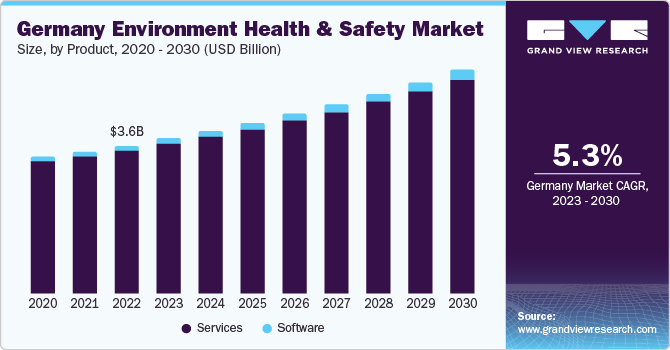
The Germany environment health & safety market size was estimated at USD 3.64 billion in 2022 and is anticipated to expand at a compound annual growth rate (CAGR) of 5.3% from 2023 to 2030. The rising public apprehension about environmental issues in the past few years has resulted in the formulation of environmental protection laws, which is expected to drive market growth. The adoption of environment health & safety (EHS) practices aids managers in risk assessment and minimizes workplace accidents. The heightened awareness among German companies about the advantages of EHS, including cost savings, employee safety, and the efficient management of environmental, health, and safety risks, is projected to boost the growth. The increased investments in EHS services to ensure compliance with stringent environmental regulations are poised to further drive the market expansion.
The industrial waste management sector is projected to maintain its leadership throughout the forecast period, primarily due to strict regulations governing the disposal of various materials like chemical solvents, paints, sandpaper, paper products, industrial byproducts, metals, and radioactive waste. Factors such as increased societal pressure and the growing number of bilateral and multilateral environmental agreements are expected to drive the demand for EHS services and software in this context.
Germany's key industries include chemical manufacturing, automotive, mechanical engineering, and electrical sectors. The substantial presence of major players in manufacturing and the chemical industry within the country, in conjunction with stringent environmental, health, and safety regulations, is expected to contribute significantly to the growth of the Germany environment health & safety (EHS) market throughout the forecast period.
The German government is actively engaged in initiatives aimed at establishing strict waste disposal standards and imposing stringent requirements for incineration processes. In recent decades, Germany has experienced a constant rise in waste recovery rates. Several factors, including population growth, high rate of industrialization, geographic positioning, and fossil fuel reliance, have led to a strong emphasis on environmental protection as a public concern and a priority. Germany's legislation is being increasingly influenced by international laws, especially those from the European Union (EU), which further boosts the growth of the country's EHS market.
The expansion of EHS software can be attributed to the rapid advancements in EHS software technology, including Internet of Things (IoT), mobility, smart sensors, and Big Data analysis. These technological innovations have expanded the applications of EHS software, broadening its usage across various sectors. Moreover, continuous technological progress, alongside the significant presence of leading EHS IT service providers like SAP SE, is anticipated to propel the growth of the Germany EHS software market throughout the forecast period.
The growing adoption of EHS practices in wastewater management is instrumental in helping organizations mitigate the risks of water and soil contamination. Stricter emission standards set by the European Union (EU) and policies enforced by the Umweltbundesamt (German Environment Agency) require the proper treatment of effluents before their release into water bodies. This, in turn, has significantly driven the EHS market in the context of wastewater management applications.
Product Insights
The environmental health & safety (EHS) software product segment led the market and accounted for 3.8% of the revenue share in 2022. EHS software providers offer tailored solutions to clients to address their specific needs. EHS software finds primary application in industries such as chemicals, manufacturing, pharmaceuticals, and oil & gas, which is expected to be a key driver for market growth in the forthcoming years.
Environment, health, and safety (EHS) software offer a wide array of functions, including audit and inspection, air emission measurement, incident management, risk analysis, compliance management, change management, chemical management, performance metrics, training management, water quality, safety meetings, ergonomics, and corrective actions. These diverse capabilities are expected to fuel the demand for EHS software in the coming years. For instance, Health & Safety Institute, a prominent player in the EHS software, training, and compliance solutions, acquired in February 2020 by adding Donesafe to its portfolio. This strategic move enhances HSI's existing workplace safety training, chemical management, and emergency care training products by encompassing health and safety, supplier management, quality management, and environmental activities.
The Germany environment health & safety (EHS) service product segment is likely to grow at a CAGR of 5.3% over the forecast period. The largest product segment in the EHS industry is environmental health & safety (EHS) services. This segment encompasses a wide range of services, including the development and implementation of EHS compliance programs, the design of EHS management information systems, process safety evaluations and management, implementation and support, water quality services, and EHS consulting. For example, EHS services are instrumental in assisting mining companies by offering technical and regulatory guidance and conducting site audits during exploration and drilling operations. EHS service providers also aid clients in identifying and reporting necessary improvements to achieve better outcomes with reduced environmental impact.
End-use Insights
The energy & mining end-use segment accounted for 20.0% of the revenue share in the market in 2022. EHS services in the mining & energy space comprise a variety of offerings, including regulatory and social studies, feasibility assessments, engineering for the mining infrastructure, strategic environmental approvals and design, procurement and construction management, mining operations, reclamation and rehabilitation, project evaluation, and planning. These factors are expected to drive the demand for EHS services in the energy and mining segment in the coming years.
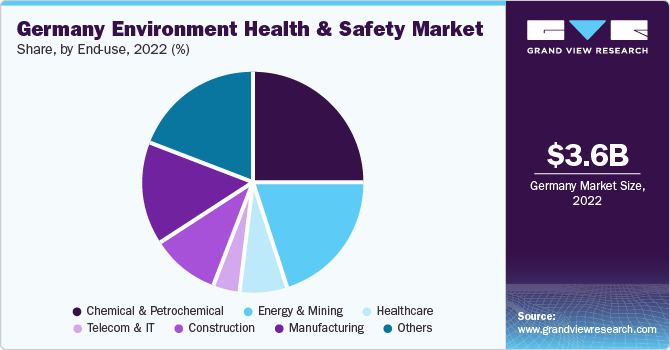
The healthcare segment is expected to expand at a CAGR of 6.1% during the projection years. The healthcare industry utilizes environmental health & safety (EHS) services to manage facilities, laboratories, and pharmacies; keep abreast of the changing regulatory landscape; enhance operational efficiency; and ensure worker safety from biohazards.
Management professionals in the construction segment are increasingly focusing on implementing environmentally friendly and efficient practices in various aspects of project management, subcontractor management, construction techniques, quality assurance, health and safety, and quality control, among other factors affecting construction projects. These considerations are expected to drive the demand for EHS solutions in the construction end-use segment in the years to come.
For example, Larsen & Toubro (L&T) is committed to providing a safe and healthy work environment for its employees. The conglomerate has undertaken the goal of becoming a "Zero Harm" organization, indicating its dedication to taking every precaution to prevent workplace accidents and injuries. This commitment involves the implementation of strict safety policies, comprehensive training programs, ongoing monitoring and improvement of workplace safety standards, and the utilization of cutting-edge technology for SMART applications.
Deployment Mode Insights
The cloud deployment mode segment accounted for 31.3% of the revenue share in 2022. Cloud-based delivery is anticipated to have gained extensive popularity among large as well as small to medium-sized businesses (SMEs) owing to its economical nature and ease of implementation. With software vendors ensuring continuous support and maintenance along with cost savings, SMEs prefer to opt for cloud-based solutions over on-premises alternatives.
Cloud-based software is hosted on servers that are owned by different providers, making both the data and program easily accessible to users online. This concept is closely related to Software as a Service (SaaS), which includes well-known cloud software examples such as Dropbox, Office 365, and Google Documents. The infrastructure for cloud software is also owned and maintained by the providers, who host the data. This cloud-based approach is especially advantageous for EHS departments as it allows for remote audits and inspections instead of physically visiting each facility, which enhances efficiency and convenience. These factors are expected to drive demand in the forecast period.
On-premise deployment mode segment accounted for 68.7% of the revenue share in 2022. On-site servers offer a streamlined process due to benefits such as full control over upgrades and maintenance. On-premise packages are installed directly on the server at the business location of the user. However, they can be expensive in terms of installation, operation, and updating, and require a substantial investment of time, effort, and resources from an organization's IT staff.
Several on-premise solutions can operate in the absence of an internet connection, but they lack support for a mobile workforce. With more businesses adopting satellite offices and remote work arrangements, employees need access to applications while on the go. Additionally, data loss is a concern associated with on-premise software, which businesses must consider, potentially impeding the growth of this segment.
Key Companies & Market Share Insights
To increase market penetration and meet the shifting technological demands from various applications, including chemicals & petrochemicals, telecom & IT, energy & mining, healthcare, construction, manufacturing, and others, the manufacturers employ a variety of strategies, including acquisitions, mergers, joint ventures, new product developments, and geographic expansions.
For instance, in May 2023, SAI360 entered into a definitive agreement to acquire Evotix. This acquisition is in line with the strategic growth goals of both companies, positioning them as global leaders in Environmental, Health, Safety, and Sustainability (EHS&S). By combining their strengths, they aim to establish a comprehensive EHS&S solution provider, catering to mid-market to global enterprises, and offering a wide range of product and service solutions in this domain.
Key Germany Environment Health & Safety Companies:
- VelocityEHS
- Quentic
- Cority
- EVOTIX
- Intelex Technologies
- Benchmark Digital Partners LLC
- NEOEHS
- ETQ, LLC
- UL LLC
- Sphera
Germany Environment Health & Safety Market Report Scope
|
Report Attribute
|
Details
|
|
Revenue forecast in 2030
|
USD 5.5 billion
|
|
Growth rate
|
CAGR of 5.3% from 2023 to 2030
|
|
Base year for estimation
|
2022
|
|
Historical data
|
2018 - 2021
|
|
Forecast period
|
2023 - 2030
|
|
Quantitative units
|
Revenue in USD billion and CAGR from 2023 to 2030
|
|
Report coverage
|
Revenue forecast, company market position analysis, competitive landscape, growth factors, and trends
|
|
Segments covered
|
Product, deployment mode, end-use
|
|
Country Scope
|
Germany
|
|
Key companies profiled
|
VelocityEHS, Quentic, Cority, EVOTIX, Intelex Technologies, Benchmark Digital Partners LLC, NEOEHS, ETQ, LLC, UL LLC, Sphera
|
|
Customization scope
|
Free report customization (equivalent up to 8 analysts working days) with purchase. Addition or alteration to country, regional & segment scope.
|
|
Pricing and purchase options
|
- Avail customized purchase options to meet your exact research needs. Explore purchase options
|
Germany Environment Health & Safety Market Report Segmentation
This report forecasts revenue growth at the country level and analyzes the industry trends in each of the sub-segments from 2018 to 2030. For this study, Grand View Research has segmented the Germany environment health & safety market report based on product, deployment mode, and end-use:
-
Product Outlook (Revenue, USD Billion, 2018 - 2030)
-
Software
-
Services
-
Analytics
-
Project Deployment & Implementation
-
Business Consulting & Advisory
-
Audit, Assessment, & Regulatory Compliance
-
Certification
-
Others
-
Deployment Mode Outlook (Revenue, USD Billion, 2018 - 2030)
-
End-use Outlook (Revenue, USD Billion, 2018 - 2030)
-
Chemical & Petrochemical
-
Energy & Mining
-
Healthcare
-
Telecom & IT
-
Construction
-
Manufacturing
-
Others
Frequently Asked Questions About This Report
b. The Germany environment health & safety market size was estimated at USD 3.64 billion in 2022 and is expected to reach USD 3.8 billion in 2023.
b. The Germany environment health & safety market, in terms of revenue, is expected to grow at a compound annual growth rate of 5.3% from 2023 to 2030 to reach USD 5.5 billion by 2030.
b. Germany’s on-premise segment dominated the environment health & safety (EHS) market with a revenue share of 31.3% in 2022. On-site servers streamline the process due to advantages like complete control over upgrades and maintenance. On-premise packages are furthermore deployed directly onto the server at the user's place of business.
b. Some of the key players operating in the Germany environment health & safety market include VelocityEHS, Quentic, Cority, EVOTIX, Intelex Technologies, Benchmark Digital Partners LLC, NEOEHS, ETQ, LLC, UL LLC, Sphera, among others.
b. The key factors that are driving the Germany environment health & safety market include the growth due to the rising stringency of government regulations in various economies. In addition, industries such as energy and chemicals, which involve the handling of hazardous materials by workers, are increasingly adopting environmental health and safety (EHS) services and software to enhance workplace safety and prevent accidents.

 Download Sample Report