
- Home
- »
- Advanced Interior Materials
- »
-
Glass Lined Equipment Market Size Report, 2026-2033GVR Report cover

Glass Lined Equipment Market (2026 - 2033)
Size, Share & Trends Analysis Report By Product (Reactors, Agitators, Storage Tanks, Heat Exchangers), By End Use (Pharmaceutical, Chemicals, Agriculture, Food & Beverage), And Segment Forecasts
Market Size, 2025
$2.4BMarket Estimate, 2026
$2.6BMarket Forecast, 2033
$4.6BCAGR, 2026–2033
8.4%Glass Lined Equipment Market Summary
The global glass lined equipment market size was valued at USD 2.4 billion in 2025 and is projected to grow from USD 2.6 billion in 2026 to USD 4.6 billion by 2033, at a CAGR of 8.4% from 2026 to 2033. The market in Asia Pacific dominated with a revenue share of 40.5% in 2025. The demand for glass-lined equipment is primarily driven by its exceptional corrosion resistance and durability, making it a preferred choice in industries such as pharmaceuticals, chemicals, and food processing.
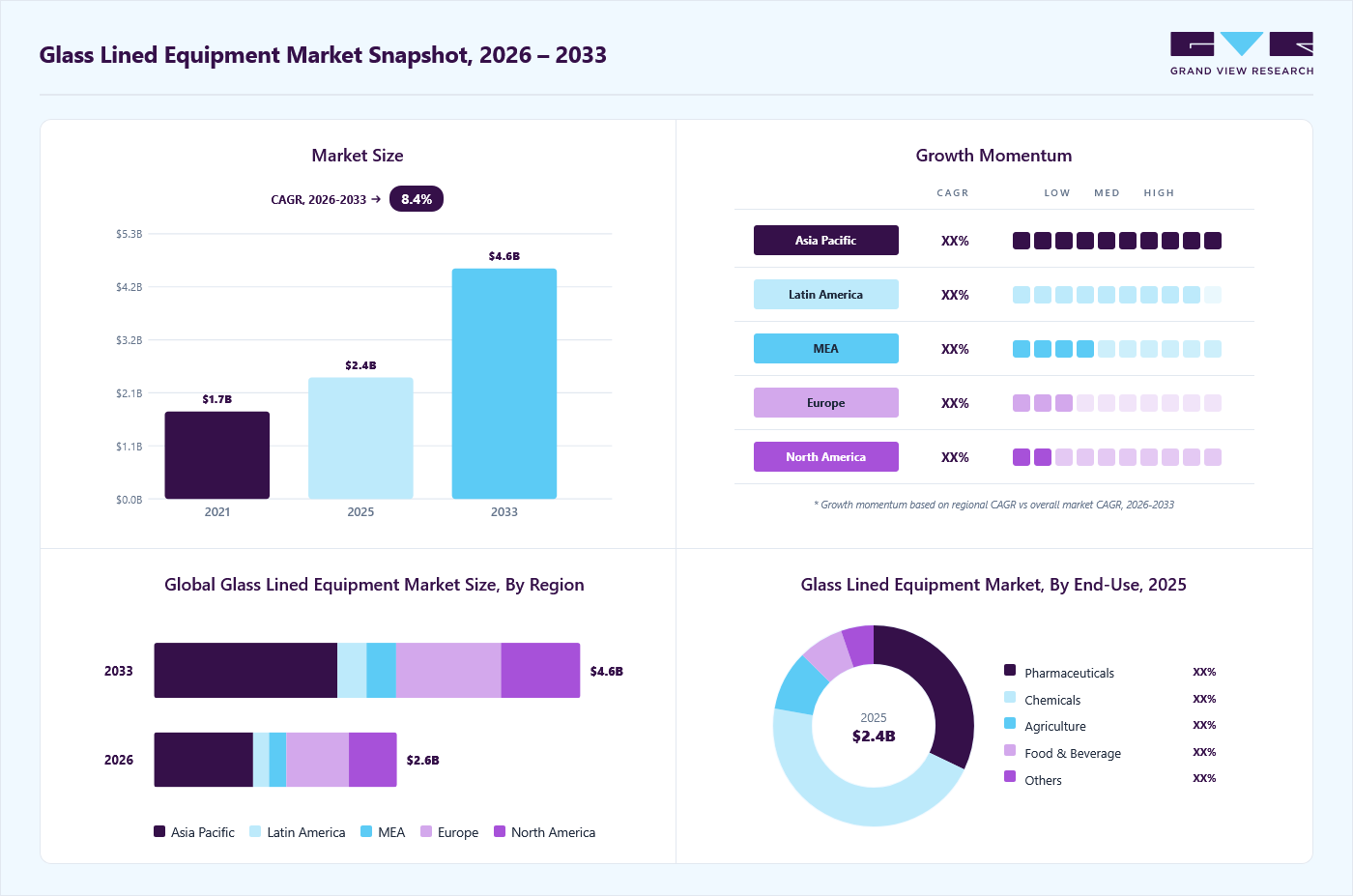 Source: Grand View Research, IR Documents, Primary Interviews, Paid DatabasesTo learn more about this report,
 Download Free Sample Report
Key Market Trends & Insights
- By end use: Chemicals segment held the largest market share of 45.6% in 2025.
- By product: Reactors segment held the largest market share of 40.3% in 2025.
Regional Highlights
- Largest regional market: Asia Pacific (40.5% revenue share, 2025)
- By country: China held the largest market share in 2025
Market Size & Forecast
- Market size in 2025: USD 2.4 Billion
- Estimated market size in 2026: USD 2.6 Billion
- Projected market size by 2033: USD 4.6 Billion
- CAGR (2026-2033): 8.4%
Prism AI by Grand View Research Free to tryAsk a question about the glass lined equipment marketTry asking✓Every figure cited from GVR research Prefer the report? Download free sample →
The inert nature of glass lining ensures product purity, crucial for industries with stringent quality standards. In addition, the increasing focus on environmental sustainability has propelled the demand for glass-lined equipment, as it is a recyclable and eco-friendly alternative. Moreover, stringent regulatory standards regarding product safety and hygiene further contribute to market growth, as glass-lined equipment effectively meets these criteria. The rising investments in infrastructure development and the expansion of manufacturing facilities globally also play a significant role in the market's upward trajectory. To learn more about this report, Download Free Sample Report
Market Dynamics
The glass lined equipment market is experiencing steady growth due to increasing demand from pharmaceutical, chemical, and specialty chemical industries that require corrosion-resistant and contamination-free processing solutions. Rising investments in API manufacturing, specialty chemical production, and capacity expansions across emerging economies are driving equipment installations. The market also benefits from stringent product quality regulations and the need for safe handling of aggressive chemicals. However, high initial equipment costs and longer procurement timelines can limit adoption among small and medium-sized manufacturers.
The rapid expansion of pharmaceutical production, particularly active pharmaceutical ingredient (API) manufacturing, is a major factor driving demand for glass lined equipment. Pharmaceutical manufacturers require highly corrosion-resistant and inert processing systems to maintain product purity and comply with stringent regulatory standards. Glass-lined reactors, storage tanks, and heat exchangers are widely used because they minimize contamination risks while providing excellent resistance to corrosive chemicals and solvents.
In addition, increasing investments in domestic drug manufacturing, biologics production, and pharmaceutical facility expansions across Asia-Pacific, North America, and Europe are creating sustained demand for glass lined process equipment. As governments and private companies continue to strengthen pharmaceutical supply chains and local production capabilities, the need for reliable and durable processing infrastructure is expected to increase significantly.
The high upfront cost associated with manufacturing, installation, and maintenance of glass lined equipment remains a key restraint for market growth. Glass lining is a specialized process that requires advanced manufacturing expertise and rigorous quality control, leading to higher equipment prices compared to conventional stainless-steel alternatives. Furthermore, any damage to the glass lining can result in costly repairs, operational downtime, and replacement expenses, which may discourage adoption among cost-sensitive end users and smaller processing facilities.
The increasing global demand for specialty chemicals presents a significant growth opportunity for the glass lined equipment market. Specialty chemical manufacturers frequently process highly corrosive materials and require equipment capable of maintaining product purity while withstanding aggressive operating conditions. As industries such as electronics, coatings, personal care, agrochemicals, and advanced materials continue to expand, manufacturers are investing in new production plants and capacity upgrades. This trend is expected to create substantial demand for glass lined reactors, storage vessels, and heat transfer equipment, particularly in rapidly industrializing regions where specialty chemical production is growing at a strong pace.
Market Concentration & Characteristics
The glass lined equipment industry exhibits a moderate to high level of concentration, with a few global manufacturers, including Pfaudler, De Dietrich Process Systems, Thaletec, and GMM Pfaudler, holding significant market shares. These players dominate due to their strong technological expertise, extensive product portfolios, and established relationships with end users in the chemical, pharmaceutical, and food processing industries. Smaller regional manufacturers primarily compete on cost and customization, although entry barriers remain high due to stringent quality requirements and specialized production processes. Consolidation through mergers and acquisitions has further strengthened the dominance of top-tier players, expanding their geographic reach and service capabilities.
Ongoing advancements in material durability, coating technologies, and digital monitoring systems drive innovation in the glass lined equipment industry. Manufacturers are developing enhanced glass formulations with higher corrosion and thermal shock resistance to extend equipment lifespan and performance under aggressive chemical conditions. Integration of IoT-based monitoring and predictive maintenance solutions is emerging as a differentiating factor, enabling users to optimize operational efficiency and minimize downtime. In addition, growing emphasis on custom-engineered reactor designs and modular configurations reflects the market’s shift toward tailored process solutions that meet diverse industry-specific needs.
 To learn more about this report, Download Free Sample Report
The market is strongly influenced by safety, environmental, and manufacturing regulations, particularly in end-use sectors such as pharmaceuticals, food & beverages, and specialty chemicals. Compliance with standards such as ASME, ISO, and FDA requirements governs the selection of materials, design of equipment, and quality assurance procedures. Environmental regulations promoting safer chemical processing and containment of hazardous materials have increased the adoption of glass-lined reactors and storage vessels. Furthermore, stricter Good Manufacturing Practice (GMP) and REACH (Registration, Evaluation, Authorisation and Restriction of Chemicals) compliance obligations drive end users to prioritize certified suppliers, reinforcing the importance of regulatory adherence as a competitive differentiator.
Analyst Perspective
The glass lined equipment market is positioned for steady growth, supported by increasing investments in pharmaceutical, specialty chemical, and agrochemical manufacturing facilities worldwide. As manufacturers continue to prioritize corrosion resistance, operational safety, and product purity, glass-lined equipment remains a preferred choice for critical processing applications. Demand is expected to be particularly strong in emerging economies where industrial capacity expansions and localization of pharmaceutical production are accelerating. While high capital costs and maintenance requirements may pose challenges, ongoing technological advancements, expanding chemical production capacities, and stringent quality standards are expected to sustain long-term market opportunities for equipment manufacturers and solution providers.
Product Insights
Based on product, reactors segment led the market with the largest revenue share of 40.3% in 2025. Reactors are a crucial component of production lines in modern process plants, and they are widely employed in various industries, including pharmaceuticals, petrochemicals, pesticides, light industries, food, dyes, and scientific research. In the chemical and pharmaceutical industries, glass lined reactors are used owing to their chemical compatibility.
The increasing demand for glass-lined agitators is primarily driven by their pivotal role in enhancing mixing efficiency and optimizing chemical processes across various industries, including pharmaceuticals, chemicals, and food processing. These agitators provide a corrosion-resistant and inert solution, essential for maintaining product purity and quality in harsh chemical environments. As industries strive for operational excellence and adherence to stringent quality standards, the reliability and durability of these agitators become indispensable, making them a key enabler for efficient mixing, reaction control, and overall process optimization.
End Use Insights
Based on end use, chemicals segment led the market with the largest revenue share of 45.6% in 2025. Glass-lined agitators are essential for crude oil storage tanks, as well as for the refining and processing phases in the petrochemical industry. In crude oil storage tanks, the deposition of sludge, which is composed of both inorganic and organic materials, must be agitated to ensure that it remains suspended off the bottom. This reduces the difficulty of the downstream process and prevents settling in the tank, which can impact the tank's capacity and the agitator's performance.
 To learn more about this report, Download Free Sample Report
Various types of glass lined equipment are utilized in the pharmaceutical manufacturing industry. The functions and applications of a pharmaceutical department are to determine the criteria for selecting glass lined equipment for vessels. In the pharmaceutical industry, some departments use this equipment as their primary vessel, for instance, the injectable department, where the use of conventional equipment is not feasible.
Regional Insights
Asia Pacific dominated the glass lined equipment market with the largest revenue share of 40.5% in 2025. The pharmaceutical industries in China, Japan, and India are anticipated to experience significant growth in the coming years, driven by the continuous increase in the aging populations of these countries. This is anticipated to lead pharmaceutical companies to invest in the region. All these factors are expected to increase the adoption of technologically advanced processes in the region, driving market expansion.
 To learn more about this report, Download Free Sample Report
China Glass Lined Equipment Market Trends
The glass lined equipment market in the China held the largest share in the Asia Pacific region in 2025. Strong government support for sustainable and high-quality industrial processes has boosted demand for corrosion-resistant and contamination-free systems. With ongoing investments in domestic production and export capacity, China continues to strengthen its role as a global manufacturing hub for glass-lined equipment.
India glass lined equipment market is growing steadily, supported by rising demand from the pharmaceutical, agrochemical, and specialty chemical industries. The increasing focus on environmental compliance, process safety, and equipment durability is driving adoption, while government initiatives promoting local manufacturing under the “Make in India” program are enhancing domestic production. Replacement demand and modernization in existing plants are also contributing to sustained market growth.
North America Glass Lined Equipment Market Trends
The glass lined equipment market in North America is propelled by the expansion of the pharmaceutical, biotechnology, and food processing industries, sectors that demand high-purity, corrosion-resistant systems. The region’s mature regulatory environment, including stringent safety and hygiene standards, supports strong adoption of glass-lined reactors and storage vessels designed for process safety and product integrity.
The U.S. glass lined equipment market is underpinned by strong demand from the pharmaceutical, biotechnology, and specialty chemical sectors, where purity, corrosion resistance, and regulatory compliance are critical. Domestic manufacturers are investing in improved glass formulations and modular reactor systems to meet the evolving requirements of high-purity processing environments. At the same time, growth is being supported by upgrades and capacity expansions in life-sciences manufacturing and food-grade processing that favour glass-lined vessels for their inert surfaces.
Europe Personal Glass Lined Equipment Market Trends
The glass lined equipment market in Europe is driven by the demand of the chemical and pharmaceutical industries for high-performance and hygienic equipment, as well as the presence of engineering-intensive manufacturing hubs. European operators increasingly invest in glass-lined equipment due to its ability to meet rigorous contamination control, durability, and regulatory compliance requirements in batch processing and specialty manufacturing.
Germany glass lined equipment market is supported by the country’s advanced chemical-processing and engineering base, stringent industrial safety standards, and high expectations for equipment longevity and reliability. German users are increasingly favouring glass-lined reactors and storage tanks in the food & beverage, chemical intermediates, and pharmaceutical industries due to the material’s combination of inertness, cleanability, and provenance. Local manufacturers and engineering firms are responding with tailored designs, enhanced process documentation, and certifications to align with German and European quality standards.
The glass lined equipment market in the UK is benefiting from strong demand in the pharmaceutical and food-processing segments, where hygiene, contamination control, and corrosion resistance are paramount. UK suppliers and licensors emphasise glass-lined equipment as a competitive solution for batch-process industries, supported by the country’s regulatory framework around safety and product purity. As manufacturing operations shift to higher-value, lower-volume production, the UK market is seeing rising uptake of modular and custom glass-lined systems that address flexibility, cleanability, and rapid turnaround.
Latin America Glass Lined Equipment Market Trends
The glass lined equipment market in Latin America is emerging as industrial facilities in pharmaceutical, agrochemical, and food processing sectors upgrade their infrastructure. Growth is anchored by increasing investments in manufacturing modernization and stronger importation of advanced process equipment, even though local capacity and technological adoption remain in early stages.
Brazil glass lined equipment market is growing as pharmaceutical, agrochemical, and food processing industries expand and modernize. The drive for higher manufacturing standards and chemical-process safety is leading Brazilian operators to invest in glass-lined reactors and vessels that offer enhanced corrosion-resistance and contamination control. While local capacity remains more limited compared to mature markets, growth opportunities are emerging as Brazil emphasizes advanced manufacturing and seeks to upgrade its process-equipment base.
Middle East & Africa Glass Lined Equipment Market Trends
The glass lined equipment market in the Middle East & Africa region is gaining momentum as a growth market, supported by industrial diversification and infrastructure development, particularly in the Gulf Cooperation Council (GCC) states. The need for durable, corrosion-resistant systems suitable for harsh operating environments and specialized chemical processing drives demand. However, market maturity and regional supply chains are still under development.
Saudi Arabia glass lined equipment market growth is closely tied to the kingdom’s investment in chemical, pharmaceutical, and food-processing infrastructure as part of its industrial diversification plans. As local and regional manufacturing facilities are developed, the demand for glass-lined equipment that can handle corrosive reagents, maintain product purity, and meet international quality standards is increasing. Suppliers are leveraging this to introduce glass-lined reactors and storage tanks suited to the harsh operating conditions and high-reliability requirements of the Middle East region.
Key Glass Lined Equipment Company Insights
Some of the key players operating in the market include GMM Pfaudler and Buchiglasuster.
-
GMM Pfaudler is a global engineering and manufacturing company specializing in corrosion-resistant technologies and systems for the chemical, pharmaceutical, food, and process industries. The company offers a broad product range, including glass-lined equipment, reactors, filtration systems, and drying systems. Originating in India, the company has a global footprint spanning multiple continents, focusing on integrated process and system solutions, as well as lifecycle services.
-
Buchiglasuster is a Swiss manufacturer specializing in advanced reactor systems and pilot plants for the chemical and pharmaceutical industries, delivering equipment from laboratory scale through to production. Known for its glass, glass-lined steel, and pressure-reactor solutions, the company emphasizes high performance under challenging conditions (corrosion, pressure). It supports customers through a full lifecycle of services, from design to after-sales.
Key Glass Lined Equipment Companies:
The following key companies have been profiled for this study on the glass lined equipment market.
-
GMM Pfaudler
-
Büchiglasuster
-
SGT Glass-Lined Equipment Co., Ltd.
-
HLE Glascoat
-
THALETEC
-
3V Tech S.p.A.
-
Standard Group of Companies Ltd.
-
Zibo Taiji Industrial Enamel Co., Ltd.
-
Jiangsu Yangyang Chemical Equipments Manufacture Co., Ltd.
-
SACHIN INDUSTRIES LTD.
-
JUNG HYUN PLANT
-
Goel Scientific Glass Works Ltd.
-
Glasigen Lined Equipment PVT LTD.
-
TANGLIAN
-
PFG GLASSKEM INC.
Competitive Benchmarking
Category
Operating Strategies
Competitive Edge
Weakness
Established Players (e.g., GMM Pfaudler, HLE Glascoat, THALETEC, 3V Tech S.p.A., Büchiglasuster, Standard Group of Companies Ltd.)
- Focus on supplying high-performance glass-lined reactors, storage systems, and turnkey process solutions to pharmaceutical and chemical manufacturers.
- Strengthen market presence through technological innovation, capacity expansion, global distribution networks, and aftermarket service offerings.
- Strong brand reputation, extensive industry experience, and established customer relationships across key end-use industries.
- Advanced engineering capabilities and comprehensive product portfolios that meet stringent quality and regulatory requirements.
- Higher manufacturing and product costs compared to regional competitors.
- Dependence on large capital projects, making demand vulnerable to industrial investment cycles.
Emerging & Regional Players (e.g., SGT Glass-Lined Equipment Co., Ltd., Zibo Taiji Industrial Enamel Co., Ltd., Jiangsu Yangyang Chemical Equipments Manufacture Co., Ltd., SACHIN INDUSTRIES LTD., Glasigen Lined Equipment Pvt. Ltd., PFG GLASSKEM INC.)
- Emphasize cost-competitive manufacturing and regional customer acquisition in growing pharmaceutical and chemical markets.
- Focus on customized solutions, flexible production volumes, and faster delivery schedules to compete with global players.
- Competitive pricing structures and strong responsiveness to local market requirements.
- Ability to capitalize on rising industrialization and capacity expansions in emerging economies.
- Limited international footprint and comparatively smaller service and distribution networks.
- Lower investment capacity for advanced R&D, technology development, and large-scale manufacturing expansion.
Recent Developments
-
In May 2025, Zibo Taiji Industrial Enamel Co., Ltd. announced the successful production of a 100,000-liter large-scale glass-lined reactor. This milestone marks a significant advancement in the company’s engineering innovation and manufacturing capabilities, enhancing its ability to supply high-capacity, reliable equipment to the global chemical, pharmaceutical, and process industries.
-
In May 2025, Standard Glass Lining Technology Ltd. (SGLTL) announced a partnership with AGI Group to develop glass-lined shell and tube heat exchangers in India jointly. This collaboration grants SGLTL a 20-year manufacturing and marketing license, enhancing its technical capabilities and market reach.
Glass Lined Equipment Market Report Scope
Report Attribute
Details
Market size in 2025
USD 2.4 billion
Estimated market size in 2026
USD 2.6 billion
Projected market size by 2033
USD 4.6 billion
Growth rate
CAGR of 8.4% from 2026 to 2033
Base year for estimation
2025
Historical data
2021 - 2024
Forecast period
2026 - 2033
Quantitative units
Revenue in USD billion and CAGR from 2026 to 2033
Report coverage
Revenue forecast, company ranking, competitive landscape, growth factors, and trends
Segments covered
Product, end use, region.
Regional scope
North America; Europe; Asia Pacific; Central & South America; Middle East & Africa
Country scope
U.S.; Canada; Mexico; Germany; France; Italy; UK; Spain; China; India; Japan; South Korea; Australia; Brazil; Argentina; Saudi Arabia; South Africa
Key companies profiled
GMM Pfaudler; Büchiglasuster; SGT Glass-Lined Equipment Co., Ltd.; HLE Glascoat; THALETEC; 3V Tech S.p.A.; Standard Group of Companies Ltd.; Zibo Taiji Industrial Enamel Co., Ltd.; Jiangsu Yangyang Chemical Equipment Manufacture Co., Ltd.; SACHIN INDUSTRIES LTD.; JUNG HYUN PLANT; Goel Scientific Glass Works Ltd.; Glasigen Lined Equipment Pvt. Ltd.; TANGLIAN; PFG GLASSKEM INC.
Customization scope
Free report customization (equivalent up to 8 analysts' working days) with purchase. Addition or alteration to country, regional & segment scope.
Pricing and purchase options
Avail customized purchase options to meet your exact research needs. Explore purchase options
Global Glass Lined Equipment Market Report Segmentation
This report forecasts revenue growth at global, regional & country levels and provides an analysis of the industry trends in each of the sub-segments from 2021 to 2033. For this study, Grand View Research has segmented the global glass lined equipment market based on product, end use, and region:
 To learn more about this report, Download Free Sample Report
-
Product Outlook (Revenue, USD Million, 2021 - 2033)
-
Reactors
-
Agitators
-
Heat Exchangers
-
Storage Tanks
-
Others
-
-
End Use Outlook (Revenue, USD Million, 2021 - 2033)
-
Pharmaceuticals
-
API
-
Others
-
-
Chemicals
-
Petrochemicals
-
Specialty Chemical
-
Others
-
-
Agriculture
-
Food & Beverage
-
Others
-
-
Region Outlook (Revenue, USD Million, 2021 - 2033)
-
North America
-
U.S.
-
Canada
-
Mexico
-
-
Europe
-
Germany
-
France
-
Italy
-
UK
-
Spain
-
-
Asia Pacific
-
China
-
Japan
-
Australia
-
India
-
South Korea
-
-
Central & South America
-
Brazil
-
Argentina
-
-
Middle East & Africa
-
Saudi Arabia
-
South Africa
-
-
Research Methodology
The glass lined equipment market figures in this report are based on a proven research process that combines executive interviews with secondary research from proprietary databases, company filings, and recognized regulatory and institutional sources. Market size is built through value-chain sizing - reconciling supply-side and demand-side estimates - and triangulated with bottom-up and top-down approaches. Every estimate passes multiple levels of expert validation before publication, with each glass lined equipment segment quantified using the revenue-capture definitions in the table below.
Segment Definition
Product
Revenue Capture Definition
Reactors
Revenue is captured from the sale of glass-lined reactors used for chemical reactions, mixing, synthesis, crystallization, and batch processing operations. This segment includes standard and customized reactor systems supplied to pharmaceutical, chemical, and agrochemical manufacturing facilities.
Agitators
Revenue is generated through the supply of glass-lined agitators and mixing systems designed for use within reactors and process vessels. The segment covers agitator assemblies, impellers, shafts, and related components used in corrosive processing environments.
Heat Exchangers
Revenue includes sales of glass-lined heat exchangers used for heating, cooling, condensation, and thermal transfer applications. Demand is primarily derived from industries requiring corrosion-resistant temperature control solutions during production processes.
Storage Tanks
Revenue is captured from glass-lined storage tanks utilized for storing raw materials, intermediates, solvents, chemicals, and finished products. The segment includes vertical and horizontal storage vessels designed to prevent contamination and corrosion.
Others
Revenue comprises sales of ancillary glass-lined process equipment such as evaporators, dryers, receivers, columns, and specialized vessels. These products support various downstream processing, recovery, and material handling operations within manufacturing plants.
End Use
Revenue Capture Definition
Pharmaceuticals
Revenue is captured from the sale of glass-lined reactors, storage tanks, heat exchangers, and associated process equipment used in pharmaceutical manufacturing facilities. Demand is driven by API production, drug formulation processes, and stringent requirements for product purity, contamination control, and corrosion resistance.
Chemicals
Revenue is generated through the supply of glass-lined equipment utilized in petrochemical, specialty chemical, agrochemical, and fine chemical manufacturing operations. This segment accounts for a significant share of market revenue due to the extensive use of corrosive chemicals and complex reaction processes.
Agriculture
Revenue includes glass-lined equipment deployed in the production of fertilizers, pesticides, herbicides, and other agricultural chemicals. Market earnings are supported by the need for durable processing systems capable of handling aggressive chemical formulations.
Food & Beverage
Revenue is captured from the sale of glass-lined vessels and processing equipment used in the production of food additives, ingredients, flavors, and specialty beverages. Demand is supported by hygiene requirements, product quality standards, and resistance to acidic processing environments.
Others
Revenue is generated from glass-lined equipment supplied to research institutions, pilot plants, laboratories, and water treatment facilities. The segment benefits from specialized applications requiring corrosion resistance, process reliability, and safe chemical handling capabilities.
Estimation Model
Layer Name
Key Question
Description
End-Use Industry Demand Layer
Which industries generate demand for glass lined equipment?
Market sizing begins by analyzing demand from pharmaceuticals, chemicals, agriculture, food & beverage, and other industrial sectors where corrosion-resistant processing equipment is required.
Technology Adoption Layer
What proportion of process equipment demand is fulfilled by glass lined technology?
This layer evaluates the adoption of glass-lined equipment compared with alternatives such as stainless steel, alloy-based, and fluoropolymer-lined equipment based on corrosion resistance, purity requirements, and process compatibility.
Equipment Layer
Which glass lined equipment categories contribute to market revenue?
Demand is allocated across reactors, agitators, heat exchangers, storage tanks, and other glass-lined process equipment based on installation volumes, replacement cycles, and industry-specific usage patterns.
Revenue Layer
What is the total revenue generated from glass lined equipment sales?
Final market revenue is derived by combining equipment demand, product mix, and regional sales across end-use industries to estimate the overall market value.
Delivered Customizations
This report has been delivered with the following In-depth customizations
Client Request
Customization Delivered
Value Adds
Comprehensive Assessment of the Market
Delivered a detailed analysis of the glass lined equipment market, including market size estimates, growth forecasts, market dynamics, technological trends, regulatory influences, and demand outlook across major regions. The study covered both current market conditions and future growth opportunities across the value chain.
Enabled stakeholders to gain a holistic understanding of market evolution, identify growth drivers, evaluate risks, and support long-term strategic planning and investment decisions.
Detailed Segment-Level Analysis and Opportunity Mapping
Provided extensive segmentation analysis by product type, end-use industry, and region, along with revenue contribution assessments and growth potential evaluation for each segment. The report also highlighted emerging application areas and demand hotspots influencing future market expansion.
Assisted decision-makers in identifying high-growth segments, prioritizing target industries, optimizing resource allocation, and developing market-specific expansion strategies.
Competitive Intelligence and Strategic Benchmarking
Delivered an in-depth competitive landscape assessment covering key market participants, market positioning, business strategies, product offerings, expansion activities, and competitive benchmarking. The report also evaluated industry structure, market concentration, and strategic developments shaping competitive dynamics.
Offered actionable insights for competitive positioning, partnership evaluation, market entry planning, and benchmarking against industry leaders, helping clients strengthen their strategic decision-making capabilities.
Frequently Asked Questions About This Report
The global glass lined equipment market size was valued at USD 2.4 billion in 2025 and is expected to reach USD 2.6 billion in 2026.
Some of the key players operating in the glass lined equipment market include GMM Pfaudler, Büchiglasuster, SGT Glass-Lined Equipment Co., Ltd, HLE Glascoat, THALETEC, 3V Tech S.p.A., Standard Group of Companies Ltd, Zibo Taiji Industrial Enamel Co., Ltd, Jiangsu Yangyang Chemical Equipments Manufacture Co., Ltd, SACHIN INDUSTRIES LTD, JUNG HYUN PLANT, Goel Scientific Glass Works Ltd, Glasigen Lined Equipment Pvt. Ltd, TANGLIAN, and PFG GLASSKEM INC.
The glass-lined equipment market is primarily driven by its exceptional corrosion resistance and durability, making it a preferred choice in industries such as pharmaceuticals, chemicals, and food processing. The inert nature of glass lining ensures product purity, crucial for industries with stringent quality standards.
Asia Pacific is anticipated to be one of the fastest-growing regional markets over the forecast period, driven by expanding chemical manufacturing, increasing pharmaceutical production, and growing industrial investments.
The reactors segment led the market with the largest revenue share of 40.3% in 2025.
The chemicals segment accounted for the largest revenue share of 45.6% in 2025.
Key trends include increasing demand for corrosion-resistant processing equipment, expansion of specialty chemical production, adoption of advanced glass lining technologies, and growing investments in pharmaceutical manufacturing facilities.
The global glass lined equipment market, in terms of revenue, is expected to grow at a compound annual growth rate of 8.4% from 2026 to 2033 to reach USD 4.6 billion by 2033
Asia Pacific dominated the glass lined equipment market with the largest revenue share of 40.5% in 2025
About the Author(s)
Advanced Interior Materials Research Team
Advanced Materials · Advanced Interior MaterialsThis report was authored by the advanced interior materials research team at Grand View Research - comprising two research analysts, one senior research analyst, and one industry expert - with specialized expertise in the advanced interior materials segment of the advanced materials industry. All findings are based on proprietary advanced materials databases, executive interviews, and regulatory analysis, subject to internal peer review prior to publication.
Last Updated:
Speak to Analyst

Customize this report to your needs - add regions, segments, or data points, with 20% free customization.
Or view our licence options:


ISO 9001:2015 & 27001:2022 Certified
We are GDPR and CCPA compliant! Your transaction & personal information is safe and secure. For more details, please read our privacy policy.


