
- Home
- »
- Advanced Interior Materials
- »
-
Granulator Machine Market Size & Share Report, 2026-2033GVR Report cover
![Granulator Machine Market Size, Share & Trends Report]()
Granulator Machine Market (2026 - 2033) Size, Share & Trends Analysis Report By Automation Level (Manual, Semi-Automatic, Automatic), By Machine (High Shear Granulator, Oscillating Granulators), By End-use (Food, Pharmaceutical, Plastic), By Region, And Segment Forecasts
Market Size, 2025
$3.6BMarket Estimate, 2026
$3.7BMarket Forecast, 2033
$5.2BCAGR, 2026–2033
4.9%Granulator Machine Market Summary
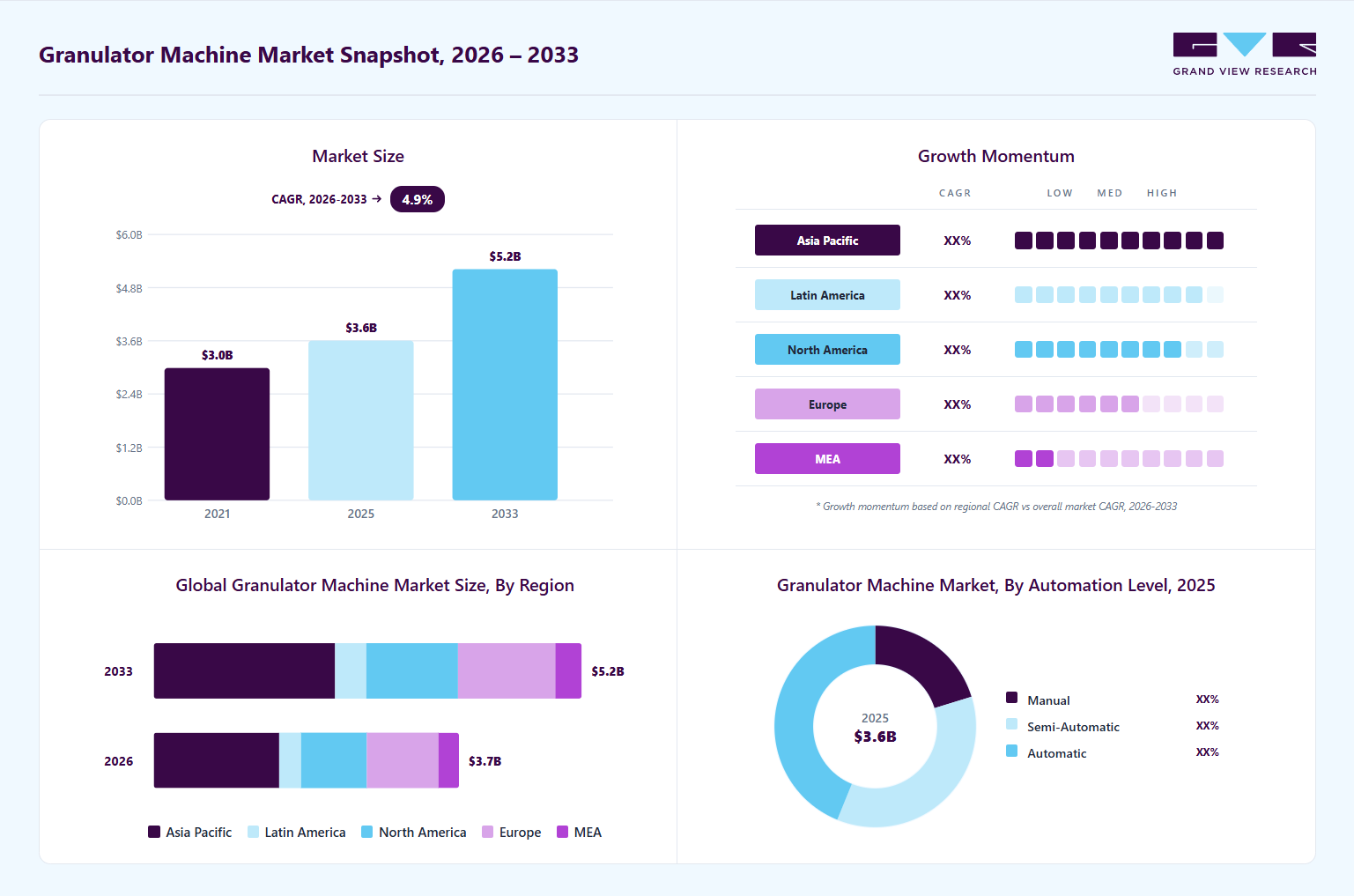
The global granulator machine market size was valued at USD 3.61 billion in 2025 and is projected to grow from USD 3.73 billion in 2026 to USD 5.22 billion by 2033, at a CAGR of 4.9% from 2026 to 2033. Asia Pacific dominated the market with the largest revenue share of 40.9% in 2025. The market is expected to grow significantly due to increasing demand from the pharmaceutical, plastics, chemical, food processing, and recycling industries.
Key Market Trends & Insights
- The market in China held a significant revenue share of the regional market in 2025.
- Based on automation level, the semi-automatic segment is projected to grow at 4.8% CAGR during the forecast period.
- On the basis of the machine, the roller compactor granulator segment is projected to expand at a CAGR of 5.6% from 2026 to 2033 in terms of revenue.
- Based on end-use, the plastic segment dominated the market in 2025, accounting for 31.7% market share.
Market Size & Forecast
- 2025 Market Size: USD 3.61 Billion
- 2033 Projected Market Size: USD 5.22 Billion
- CAGR (2026-2033): 4.9%
- Asia Pacific: Largest market in 2025
Granulator machines are widely used for size reduction, material processing, and recycling operations to improve production efficiency and material handling. Rising plastic recycling activity and increased focus on waste management are driving demand for industrial granulation equipment.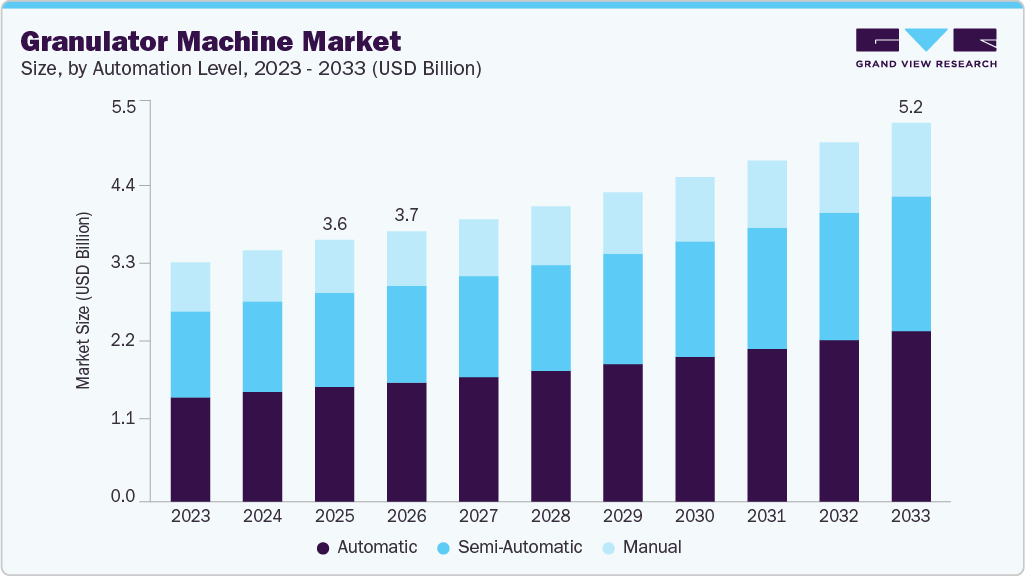
In the pharmaceutical industry, granulator machines are widely used in tablet manufacturing and powder processing to improve material consistency, flow properties, and uniform mixing of active ingredients. Wet and dry granulation processes help produce granules with controlled particle size and density, supporting efficient tablet compression and dosage accuracy. Increasing pharmaceutical production and demand for high-quality solid dosage forms are driving greater adoption of granulator machines in pharmaceutical manufacturing operations.
Market Dynamics
Increasing plastic recycling activities and rising focus on industrial waste management across manufacturing sectors are fueling the granulator machines market. Granulator machines are widely used to reduce plastic scrap, industrial waste, and recyclable materials into smaller particles for reuse in production processes. Governments and industries are increasingly implementing recycling initiatives and sustainability programs to reduce landfill waste and improve material recovery efficiency.
Rising consumption of plastic products in packaging, automotive, electronics, and consumer goods industries is generating higher volumes of recyclable waste, thereby increasing demand for granulation equipment. Manufacturers are also adopting advanced granulator systems to improve processing efficiency, reduce material loss, and support circular economy practices. Growth in recycling infrastructure development and stricter environmental regulations regarding plastic disposal are further supporting the adoption of industrial granulator machines across recycling and material recovery operations worldwide.
High equipment and maintenance costs are restraining the growth of the granulator machine market, particularly for small and medium-sized industrial operators. Advanced granulator machines equipped with automated controls, high-capacity processing systems, and energy-efficient technologies require significant capital investment. In addition to initial purchase costs, operators also face ongoing expenses related to maintenance, spare parts replacement, blade sharpening, and energy consumption.
Processing abrasive or heavy industrial materials can increase wear on machine components, leading to higher maintenance frequency and operational downtime. Smaller recycling facilities and manufacturing companies may delay adoption of advanced granulation systems due to budget limitations and long return-on-investment periods.
Market Concentration & Characteristics
The granulator machine market is fragmented due to the presence of numerous global, regional, and local manufacturers offering different types of granulation equipment for pharmaceutical, plastics, chemical, food processing, and recycling applications. Companies compete based on machine capacity, automation level, energy efficiency, and processing technology. Variations in industrial requirements and material handling applications increase product differentiation. Regional manufacturers also provide customized granulator solutions and cost-competitive equipment.
Manufacturers are introducing advanced wet and dry granulators that improve process control, ensure material consistency, and reduce operational downtime. Companies are also focused on integrating smart monitoring systems, precision particle-size control, and hygienic designs for pharmaceutical and food processing applications. In addition, recycling industries are adopting high-capacity granulators for efficient processing of plastic and industrial waste.
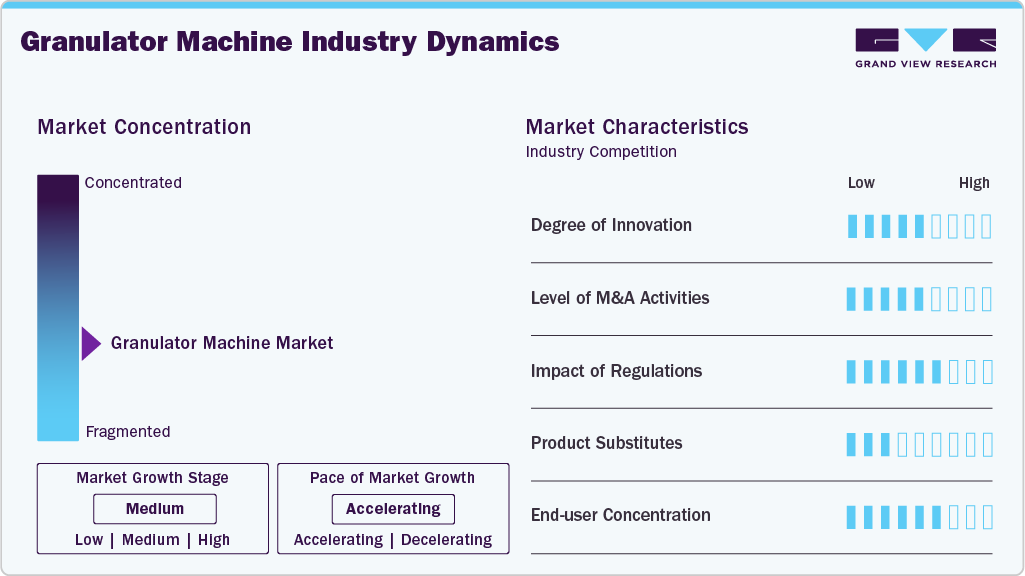
Increasing requirements related to industrial safety, environmental protection, pharmaceutical manufacturing standards, and waste recycling practices are influencing the granulator machine market. Pharmaceutical and food processing industries require granulator machines that comply with hygiene, contamination control, and quality standards. Environmental regulations promoting plastic recycling and waste reduction are also increasing demand for recycling granulators. Besides, workplace safety standards encourage the adoption of enclosed, automated, and dust-control granulator machines to improve operator safety and industrial processing efficiency.
Automation Level Insights
The automatic segment led the market and accounted for 43.9% of global revenue share in 2025, due to increasing adoption of automated material processing and recycling operations across industrial sectors. Automatic granulator machines improve processing efficiency, reduce manual labor, and support continuous high-volume production. Industries including plastics recycling, pharmaceuticals, and food processing are increasingly adopting automated granulation systems to improve operational consistency, material handling, and overall production efficiency.
The semi-automatic segment is expected to grow considerably over the forecast period due to its balance between operational efficiency and lower investment cost compared to fully automated systems. Small and medium-sized manufacturers commonly adopt semi-automatic granulators for controlled material processing and moderate production volumes. These machines improve processing accuracy, reduce manual handling effort, and support flexible production requirements across recycling, pharmaceutical, and industrial material processing applications.
Machine Insights
The high shear granulator segment dominated the market in 2025, accounting for 33.6% of the market share, driven by increasing demand from pharmaceutical and food processing industries requiring uniform granule formation and efficient mixing processes. High shear granulators improve particle consistency, material density, and processing speed. Rising pharmaceutical tablet production and demand for controlled granulation processes are boosting the adoption of high-shear granulator systems across industrial manufacturing operations.
The roller compactor granulator segment is projected to expand significantly over the forecast period, driven by the growing adoption of dry granulation processes in pharmaceutical and chemical manufacturing applications. Roller compactor granulators support the processing of moisture-sensitive materials and improve powder flow properties without the use of liquid binders. The growing demand for energy-efficient, continuous granulation systems is driving the adoption of roller compactor technologies in pharmaceutical production and industrial material processing operations.
End-use Insights
The plastic segment led the market in 2025 in terms of revenue due to increasing plastic recycling activities and rising demand for processed plastic materials across the packaging, automotive, and consumer goods industries. Granulator machines are widely used for reducing plastic scrap and waste into reusable granules. Growing focus on waste reduction and circular economy practices is further supporting the adoption of plastic granulation equipment.
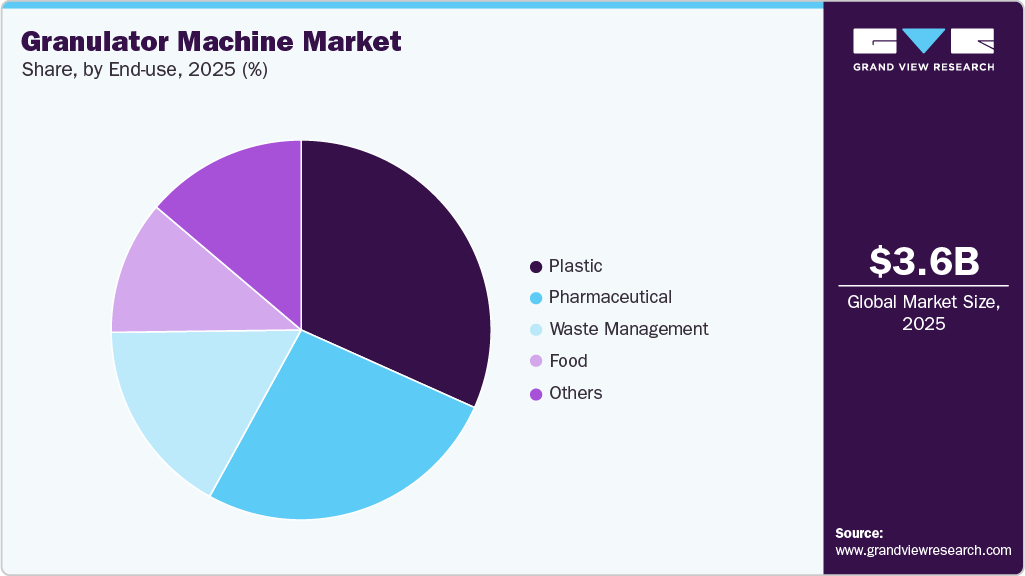
The pharmaceutical segment is expected to grow at a 5.1% CAGR during the forecast period, driven by increased production of tablets, capsules, and other solid dosage forms. Granulator machines improve powder mixing, particle uniformity, and material flow properties required in pharmaceutical manufacturing. Rising pharmaceutical production, expansion of generic drug manufacturing, and increasing demand for controlled granulation processes are supporting the adoption of advanced granulator systems in pharmaceutical processing operations.
Regional Insights
Asia Pacific dominated the market with the largest revenue share of 40.9% in 2025. The granulator machine industry in the Asia Pacific is growing due to rapid industrialization, expansion of plastics manufacturing, and increasing recycling activities across regional economies. The region has a strong demand for granulation equipment from the pharmaceutical, packaging, chemical, and food processing industries. Rising industrial waste generation and the growing focus on recycling infrastructure development are driving the adoption of advanced granulator systems. Growth in manufacturing activities and investment in automated industrial processing technologies are further contributing to market expansion across the Asia Pacific countries.

China Granulator Machine Market Trends
The China granulator machine market has gained traction from the large plastics manufacturing industry and the expanding recycling sector. The country generates significant industrial and plastic waste, increasing demand for granulation equipment used in recycling and material recovery operations. Pharmaceutical and chemical manufacturing activities are also supporting market growth. The increasing government focus on environmental protection and industrial waste reduction is driving the adoption of energy-efficient, automated granulator machines across recycling, packaging, and industrial processing applications in China.
The granulator machine market in India is expanding due to increasing pharmaceutical manufacturing, plastics processing, and industrial recycling activities. Rising demand for tablets, capsules, and packaged products is supporting the adoption of granulator machines in the pharmaceutical and food processing industries. The expansion of plastic recycling infrastructure and the growing focus on waste management are also contributing to market growth. In addition, industrial modernization and increased investment in manufacturing facilities are driving demand for automated, cost-efficient granulation equipment across multiple industrial sectors in India.
North America Granulator Machine Market Trends
The North America granulator machine market is driven by increasing plastic recycling activities, pharmaceutical manufacturing expansion, and industrial automation adoption. Industries across the region are investing in advanced material processing equipment to improve operational efficiency and waste management. Demand for granulator machines is also rising in packaging, chemical processing, and food manufacturing sectors. Increasing environmental regulations on industrial waste reduction and recycling practices are further driving the adoption of automated, energy-efficient granulation systems across manufacturing and recycling operations.
The granulator machine market in the U.S. is growing significantly, due to the expansion of pharmaceutical production, plastics recycling, and industrial manufacturing activities. Increasing investment in recycling infrastructure and sustainable material processing technologies is driving demand for advanced granulator systems. Pharmaceutical manufacturers are also adopting granulation equipment for tablet and powder processing applications. Growth in the packaging, automotive, and consumer goods industries is increasing the generation of recyclable materials, supporting demand for industrial granulation equipment across the country's recycling and manufacturing sectors.
Europe Granulator Machine Market Trends
The granulator machine market in Europe is gaining momentum from strong environmental regulations, promoting recycling and sustainable industrial processing practices. The region has a significant demand for granulation equipment in plastics recycling, pharmaceutical manufacturing, and food processing industries. Manufacturers are increasingly adopting automated, energy-efficient granulator systems to improve operational performance and reduce waste. The expansion of circular economy initiatives and increased investment in advanced recycling technologies are also supporting market growth.
The Germany granulator machine market is witnessing a strong industrial manufacturing base and an advanced recycling infrastructure. The country has a high demand for granulation equipment in the pharmaceutical, plastics, chemical, and automotive industries. Manufacturers are increasingly adopting automated material processing systems to improve operational efficiency and support sustainable production practices. Germany’s focus on industrial automation and environmental compliance is also driving the adoption of energy-efficient granulator machines for recycling and industrial material handling across manufacturing sectors.
The granulator machine market in the UK is growing due to increasing recycling initiatives, pharmaceutical production activities, and food processing operations. Demand for granulator machines is rising as manufacturers focus on reducing waste, improving material recovery, and increasing operational efficiency. Pharmaceutical companies are also adopting advanced granulation equipment for solid dosage manufacturing applications. In addition, the growing emphasis on sustainable packaging and industrial recycling practices is supporting the adoption of granulator systems across the plastics processing, chemical manufacturing, and industrial waste management sectors in the country.
Middle East & Africa Granulator Machine Market Trends
The granulator machine market in the Middle East and Africa region is growing due to increasing industrial development, expansion of plastics processing industries, and rising investment in recycling infrastructure. Demand for granulator equipment is increasing in packaging, chemical processing, and industrial waste management applications. Growth in pharmaceutical manufacturing and food processing activities is also supporting market expansion. In addition, governments across the region are promoting industrial diversification and sustainable waste management practices, increasing the adoption of granulation technologies in industrial operations.
The Saudi Arabia granulator machine market is experiencing growth due to the expansion of the petrochemical, plastics, and industrial manufacturing sectors. Increasing focus on industrial diversification and recycling initiatives is driving demand for granulation equipment used in material processing and waste recovery operations. Growth in the pharmaceutical manufacturing and packaging industries is also supporting the adoption of granulator systems. In addition, investment in industrial automation and sustainable manufacturing technologies is driving increased adoption of advanced granulation equipment across industrial processing applications in the country.
Latin America Granulator Machine Market Trends
The granulator machine market in Latin America is expected to grow at 5.2% CAGR during the forecast period. Increasing plastics recycling activities, pharmaceutical production, and industrial manufacturing expansion are driving the market in Latin America. Companies across the region are adopting granulator machines to improve material processing efficiency and support recycling operations. Growth in the packaging, food processing, and chemical industries is also driving market demand. In addition, rising awareness of industrial waste management and sustainable manufacturing practices is driving the adoption of granulation equipment across the recycling and industrial processing sectors in Latin American countries.
The Brazil granulator machine market is experiencing growth due to the expansion of plastics manufacturing, food processing, and pharmaceutical industries. Increasing recycling activities and industrial waste management initiatives are driving demand for granulation equipment used in material recovery operations. Manufacturers are adopting granulator systems to improve operational efficiency and reduce material waste. Growth in packaging production and industrial processing activities is also supporting market development. In addition, increasing investment in manufacturing modernization is contributing to higher adoption of advanced granulation technologies in Brazil.
Key Granulator Machine Company Insights
Some of the key players operating in the market include GEA Group Aktiengesellschaft, Glatt, Freund-Vector, and Rapid Granulator, among others.
-
GEA Group Aktiengesellschaft is a Germany-based industrial engineering company providing processing and manufacturing equipment for food, pharmaceutical, chemical, and industrial applications. The company offers granulation, drying, mixing, and material-handling systems for pharmaceutical and industrial production processes. GEA Group Aktiengesellschaft focuses on automated, energy-efficient processing technologies that support large-scale manufacturing, material consistency, and operational efficiency across multiple industrial sectors worldwide.
-
Glatt is a manufacturer of process technologies and equipment for pharmaceutical, biotechnology, food, and chemical industries. The company provides granulators, fluid-bed systems, coating equipment, and particle-processing technologies for solid dosage manufacturing and industrial material processing. Glatt focuses on integrated processing solutions, process optimization, and advanced granulation technologies designed to improve product quality, production efficiency, and controlled manufacturing operations.
Key Granulator Machine Companies
The following key companies have been profiled for this study on the granulator machine market.
-
Allpack
-
Cumberland
-
Fluid Air
-
Freund-Vector
-
GEA Group Aktiengesellschaft
-
Getecha
-
Glatt
-
GlobePharma
-
Levstal
-
Rapid Granulator
-
ServoLiFT
-
THM recycling solutions
-
Vaner Machinery
-
Wittmann
-
Xertecs
Competitive Benchmarking
Operating Strategies
Competitive Edge
Weaknesses
Mature Players: GEA Group Aktiengesellschaft; Glatt; Freund-Vector
- Mature players in the granulator machine market focus on large-scale manufacturing, advanced automation technologies, and long-term partnerships with pharmaceutical, plastics, and industrial processing companies.
- They emphasize product standardization, global distribution networks, and after-sales technical support.
- Mature companies benefit from strong brand recognition, advanced engineering capabilities, and broad product portfolios covering pharmaceutical, plastics, food processing, and recycling applications.
- Their competitive advantage comes from large manufacturing capacity, global distribution networks, and established customer relationships.
- Mature players often face high manufacturing and operational costs due to advanced production facilities, global service networks, and continuous investment in research and development.
- Their large organizational structures may reduce flexibility in responding quickly to customized or low-cost market requirements.
Emerging Players: Allpack; Getecha; Levstal; Vaner Machinery
- Emerging players in the granulator machine market generally focus on cost-competitive equipment, regional market expansion, and flexible manufacturing operations.
- Many target small and medium-sized industrial customers by offering compact granulators and application-specific processing solutions.
- Emerging companies gain a competitive advantage through lower production costs, flexible manufacturing capabilities, and quicker response to customer-specific processing requirements.
- Their smaller operational structures allow easier customization and competitive pricing strategies.
- Emerging players often face limitations in production scale, research investment, and global distribution capabilities compared to established manufacturers.
- Limited financial resources can restrict the development of advanced automation and digital process control technologies.
Recent Developments
-
In May 2026, Blower Application Co. (BloApCo) launched the Titan Series industrial shredders and granulators to expand into high-growth recycling and industrial processing markets. The product line includes double-shaft shredders, single-shaft shredders, and high-speed granulators designed for multiple materials and applications.
-
In February 2025, CMG launched the G55 granulator line for high-capacity industrial processing applications. The series is designed to improve productivity, regrind quality, operational efficiency, and dust reduction in recycling and material processing operations. With processing capacities ranging from 700 kg/h to 1,300 kg/h, the new granulators support large-scale industrial recycling and material size-reduction applications while reducing total operating costs.
Granulator Machine Market Report Scope
Report Attribute
Details
Market size in 2025
USD 3.61 billion
Market size in 2026
USD 3.73 billion
Revenue forecast in 2033
USD 5.22 billion
Growth rate
CAGR of 4.9% from 2026 to 2033
Base year for estimation
2025
Historical data
2021 - 2024
Forecast period
2026 - 2033
Quantitative units
Revenue in USD billion and CAGR from 2026 to 2033
Report coverage
Revenue forecast, company market position analysis, competitive landscape, growth factors, and trends
Segments covered
Machine, automation level, end-use, region
Regional scope
North America; Europe; Asia Pacific; Latin America; Middle East & Africa
Country Scope
U.S.; Canada; Mexico; Germany; UK; Italy; Spain; France; China; Japan; India; Australia; South Korea; Brazil; Argentina; Saudi Arabia; UAE; South Africa
Key companies profiled
Allpack; Cumberland; Fluid Air; Freund-Vector; GEA Group Aktiengesellschaft; Getecha; Glatt; GlobePharma; Levstal; Rapid Granulator; ServoLiFT; THM Recycling Solutions; Vaner Machinery; Wittmann; Xertecs
Customization scope
Free report customization (equivalent up to 8 analysts working days) with purchase. Addition or alteration to country, regional & segment scope.
Pricing and purchase options
Avail customized purchase options to meet your exact research needs. Explore purchase options
Global Granulator Machine Market Report Segmentation
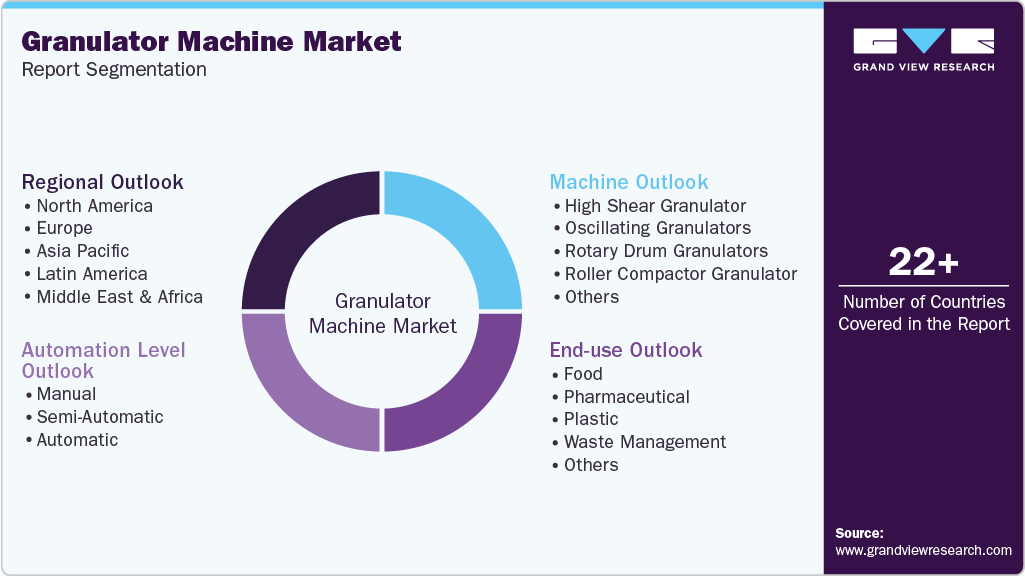
This report forecasts revenue growth at global, regional & country levels and provides an analysis on the industry trends in each of the sub-segments from 2021 to 2033. For this study, Grand View Research has segmented the global granulator machine market report on the basis of automation level, machine, end-use, and region:
-
Automation Level Outlook (Revenue, USD Billion, 2021 - 2033)
-
Manual
-
Semi-Automatic
-
Automatic
-
-
Machine Outlook (Revenue, USD Billion, 2021 - 2033)
-
High Shear Granulator
-
Oscillating Granulators
-
Rotary Drum Granulators
-
Roller Compactor Granulator
-
Others
-
-
End-use Outlook (Revenue, USD Billion, 2021 - 2033)
-
Food
-
Pharmaceutical
-
Plastic
-
Waste Management
-
Others
-
-
Regional Outlook (Revenue, USD Billion, 2021 - 2033)
-
North America
-
U.S.
-
Canada
-
Mexico
-
-
Europe
-
Germany
-
France
-
UK
-
Spain
-
Italy
-
-
Asia Pacific
-
China
-
India
-
Japan
-
South Korea
-
Australia
-
-
Latin America
-
Brazil
-
Argentina
-
-
Middle East & Africa
-
Saudi Arabia
-
UAE
-
South Africa
-
-
Delivered Customizations
This report has been delivered with the following In-depth customizations
Client Request
Customization Delivered
Value Adds
Regional Segmentation
Detailed regional analysis was conducted across North America, Europe, Asia Pacific, Latin America, and Middle East & Africa, including country-level assessment for key markets such as the U.S., Germany, China, India, Brazil, and Saudi Arabia. The study evaluated plastics recycling activities, pharmaceutical manufacturing, industrial processing demand, food production trends, waste management infrastructure, and environmental regulations influencing granulator machine adoption across regional markets.
Helped identify high-growth regional markets, country-specific opportunities, and evolving demand trends across recycling, pharmaceutical, plastics processing, and industrial manufacturing sectors. The analysis also supported market entry strategies, regional expansion planning, and identification of emerging industrial processing hubs.
Competitive benchmarking
Comprehensive benchmarking was carried out for major market participants based on product portfolio, automation capabilities, processing technologies, regional presence, pricing strategy, manufacturing capabilities, and distribution network strength. The assessment also compared mature and emerging players operating in the granulator machine market.
Assisted clients in understanding competitor positioning, technology capabilities, and competitive gaps within the market. The study supported strategic planning, partnership evaluation, and differentiation opportunities across pharmaceutical processing, plastics recycling, food manufacturing, and industrial material processing applications.
Opportunity assessment
In-depth opportunity assessment was conducted by analyzing plastics recycling expansion, pharmaceutical production growth, industrial automation adoption, waste management initiatives, and increasing demand for efficient material processing systems. The study also identified emerging opportunities in energy-efficient granulators, automated processing technologies, smart monitoring systems, and high-capacity recycling equipment applications.
Enabled clients to identify high-growth investment areas, prioritize regional expansion strategies, and evaluate future revenue opportunities across recycling, pharmaceutical, packaging, food processing, and industrial manufacturing sectors. The analysis also supported product development planning, technology adoption strategies, and long-term business growth initiatives in the granulator machine market.
Frequently Asked Questions About This Report
The global granulator machine market size was estimated at USD 3.61 billion in 2025 and is expected to reach USD 3.73 billion in 2026.
The automatic segment led the market and accounted for 43.9% of the global market revenue share in 2025 due to increasing adoption of automated material processing and recycling operations across industrial sectors. Automatic granulator machines improve processing efficiency, reduce manual labor, and support continuous high-volume production.
Some of the key players operating in the granulator machine include Allpack, Cumberland, Fluid Air, Freund-Vector, GEA Group Aktiengesellschaft, Getecha, Glatt, GlobePharma, Levstal, Rapid Granulator, ServoLiFT, THM Recycling Solutions, Vaner Machinery, Wittmann, Xertecs.
The granulator machine market is driven by increasing plastic recycling activities, rising pharmaceutical production, growing industrial automation, expanding food and chemical processing industries, and increasing demand for efficient material size reduction and waste management solutions. Adoption of energy-efficient and automated granulation systems is also supporting market growth across industrial processing applications.
The global granulator machine market, in terms of revenue, is expected to grow at a compound annual growth rate of 4.9% from 2026 to 2033 to reach USD 315.8 billion by 2033.
About the Author(s)
Advanced Interior Materials Research Team
Advanced Materials · Advanced Interior MaterialsThis report was authored by the advanced interior materials research team at Grand View Research - comprising two research analysts, one senior research analyst, and one industry expert - with specialized expertise in the advanced interior materials segment of the advanced materials industry. All findings are based on proprietary advanced materials databases, executive interviews, and regulatory analysis, subject to internal peer review prior to publication.
Last Updated:
Speak to Analyst


Need a Tailored Report?
Customize this report to your needs — add regions, segments, or data points, with 20% free customization.
Or view our licence options:


ISO 9001:2015 & 27001:2022 Certified
We are GDPR and CCPA compliant! Your transaction & personal information is safe and secure. For more details, please read our privacy policy.












