
- Home
- »
- Organic Chemicals
- »
-
Green Mold Additives Market Size, Share Report, 2026-2033GVR Report cover

Green Mold Additives Market (2026 - 2033)
Size, Share & Trends Analysis Report By Product (Bentonite Binders, Lustrous Carbon Formers, Organic & Cellulosic Additives, Mineral / Iron Oxide Additives, Slag Additives, Anti-Defect / Performance Additives), By End Use, By Region, And Segment Forecasts
Market Size, 2025
$1.5BMarket Estimate, 2026
$1.6BMarket Forecast, 2033
$2.3BCAGR, 2026–2033
5.4%Green Mold Additives Market Summary
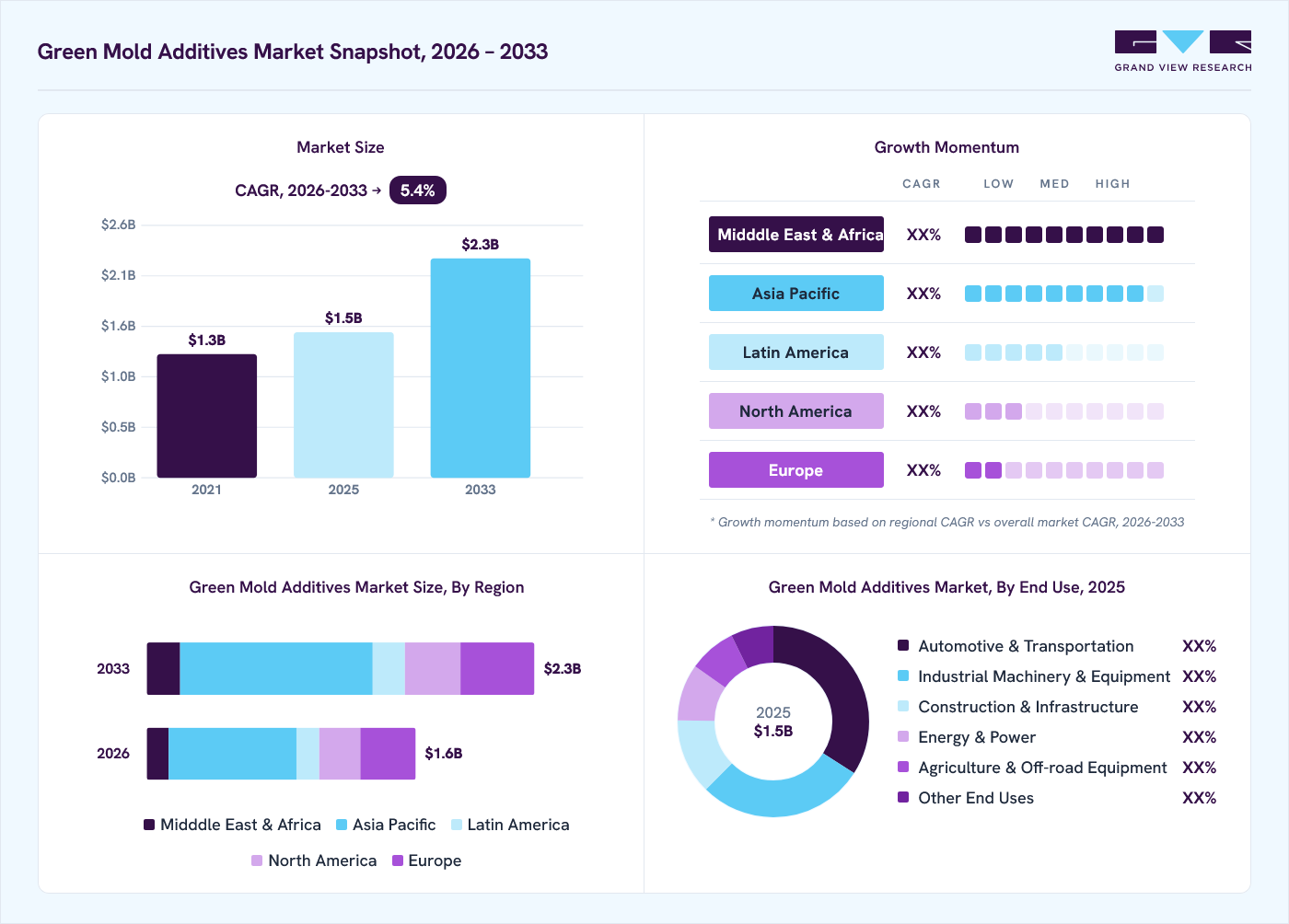
The global green mold additives market size was valued at USD 1.5 billion in 2025 and is projected to grow from USD 1.6 billion in 2026 to USD 2.3 billion by 2033, at a CAGR of 5.4% from 2026 to 2033. The market in Asia Pacific dominated with a revenue share of 47.2% in 2025. The green mold additives market is expanding as foundries seek improved casting quality, lower defect rates, efficient sand reuse, and consistent production performance.
 Source: Grand View Research, IR Documents, Primary Interviews, Paid DatabasesTo learn more about this report,
 Download Free Sample Report
Key Market Trends & Insights
- By product: Anti-defect / performance additives segment held the largest market share of 30.3% in 2025.
- By end use: Automotive & transportation segment held the largest market share of 34.0% in 2025.
Regional Highlights
- Largest regional market: Asia Pacific (47.2% revenue share, 2025)
- Fastest-growing regional market: Middle East & Africa (highest CAGR, 2026-2033)
- By country: China held the largest market share in 2025
Market Size & Forecast
- Market size in 2025: USD 1.5 Billion
- Estimated market size in 2026: USD 1.6 Billion
- Projected market size by 2033: USD 2.3 Billion
- CAGR (2026-2033): 5.4%
Prism AI by Grand View Research Free to tryAsk a question about the green mold additives marketTry asking✓Every figure cited from GVR research Prefer the report? Download free sample →
Demand is closely linked to metal casting activity across automotive components, industrial machinery, construction equipment, agricultural machinery, and energy infrastructure. Green mold additives improve the performance of green sand molding systems by enhancing mold strength, surface finish, permeability, and resistance to casting defects. Bentonite Bindersremain essential for maintaining sand cohesion and mold stability, while lustrous carbon formers help reduce metal penetration and improve the surface quality of cast components. Organic and cellulosic additives support specific molding requirements by influencing sand properties and mold behavior.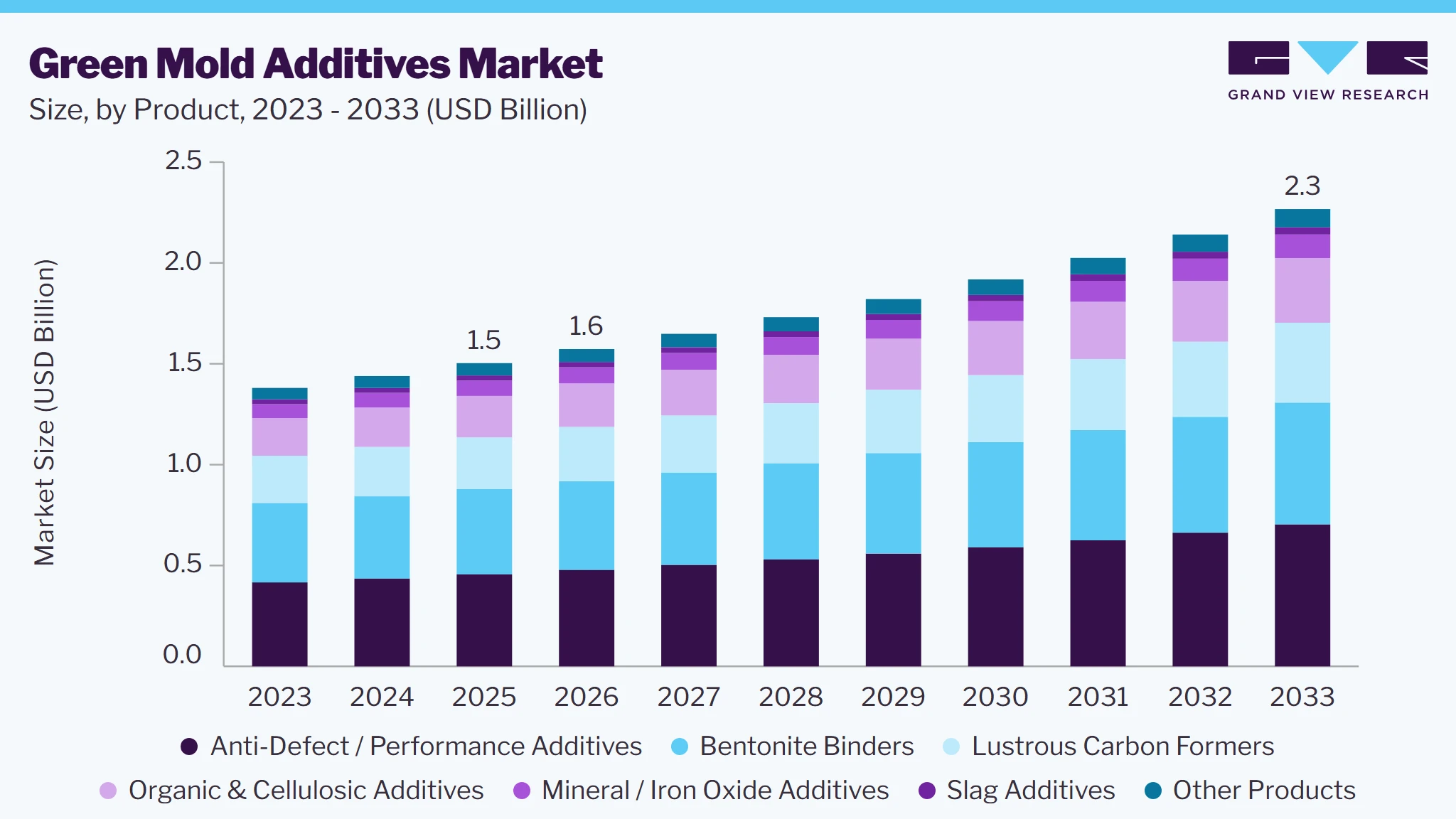 To learn more about this report, Download Free Sample Report
The growing emphasis on reducing scrap, rework, and material waste encourages foundries to optimize additive formulations. Casting defects can increase production costs through rejected components, additional machining, and repeated manufacturing operations. Suitable additive combinations help control these issues while supporting dimensional consistency and reliable casting performance. Demand also benefits from the continued use of green sand molding because sand can be reclaimed and reused, although maintaining its quality requires careful control of moisture, binder levels, and additive concentrations. These operational considerations encourage consistent demand for essential molding materials and specialized performance additives.
Market Dynamics
The green mold additives market grows with demand for reliable metal castings across automotive, machinery, construction equipment, and energy applications. Foundries use additives to improve mold strength, surface finish, permeability, and resistance to casting defects. Bentonite Bindersmaintain mold stability, while carbonaceous and specialty additives help reduce metal penetration and surface imperfections. The need to minimize rejected castings, rework, and production waste encourages optimized additive use. However, demand remains closely tied to foundry output, casting process requirements, raw material availability, and the economics of alternative molding methods.
Foundries require consistent mold properties to manufacture metal components with accurate dimensions, smooth surfaces, and fewer defects. Green mold additives help achieve these requirements by improving sand cohesion, mold strength, thermal behavior, and resistance to metal penetration. Bentonite supports mold integrity, while lustrous carbon formers help produce better casting surfaces. These materials are particularly relevant when manufacturers must meet demanding component specifications and maintain repeatable production quality.
The economic impact of casting defects further strengthens additive demand. Defective components increase scrap rates, consume additional machining time, and raise material and labor costs. Appropriate additive formulations help foundries control these losses while improving production consistency. As manufacturers seek to improve material utilization and operational efficiency, they have incentives to optimize additive selection and dosage. This creates recurring demand for essential molding materials and specialized formulations that deliver measurable improvements in casting quality and process performance.
Green mold additives depend on raw materials such as bentonite, carbonaceous substances, starch, cellulose, and mineral compounds. Changes in mining costs, processing expenses, transportation rates, and raw material availability can increase manufacturing costs and create uncertainty in purchasing budgets. Manufacturers may find it difficult to pass these increases on to foundry customers when contracts are price sensitive or competing suppliers offer similar formulations. Higher input costs can compress profit margins, particularly for standardized additives with limited product differentiation. Foundries may also adjust purchasing volumes or optimize additive dosage to control expenditure. These responses can restrict sales growth and make revenue less predictable for additive manufacturers, especially when raw material prices fluctuate faster than selling prices can be revised.
Additive manufacturers can expand their market opportunities by developing formulations that improve casting quality while reducing total foundry operating costs. Products that control metal penetration, minimize surface defects, maintain mold strength, and support consistent sand reuse can offer customers measurable production benefits. Customized formulations for different metals, casting geometries, and molding conditions can also help suppliers differentiate their offerings from standardized products. Manufacturers can develop lower emission carbonaceous additives and formulations designed to reduce unwanted residues without compromising casting performance. Demonstrating these benefits through foundry trials can strengthen customer relationships and support premium pricing where measurable savings justify the additional cost. Technical collaboration with foundries also creates opportunities for recurring supply agreements and longer term customer retention.
Market Concentration & Characteristics
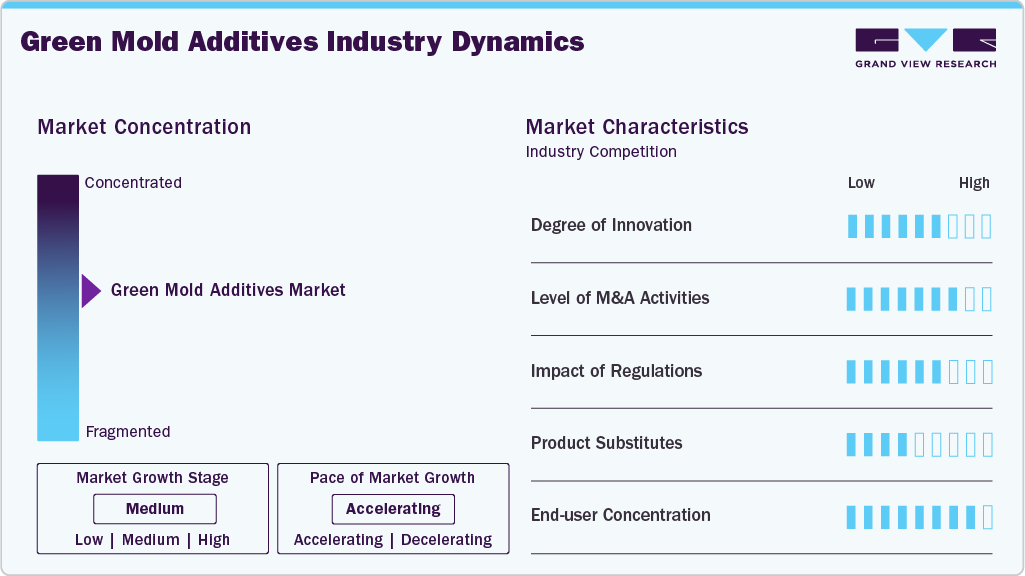
The green mold additives market is characterized by the presence of established foundry material suppliers, specialty chemical manufacturers, and regional producers serving metal casting operations. Competition is shaped by product consistency, technical performance, pricing, and customer relationships. Manufacturers must ensure that additives deliver reliable mold strength, surface finish, permeability, and defect control across different casting conditions. Customer qualification and formulation compatibility also influence supplier selection because changes in additive composition can affect foundry processes and final casting quality.
 To learn more about this report, Download Free Sample Report
The market exhibits recurring demand because foundries continuously require molding materials to maintain production operations. However, purchasing decisions remain sensitive to raw material costs, additive dosage, and measurable performance benefits. Suppliers compete through formulation improvements, technical support, dependable supply, and customized solutions. Product differentiation is particularly relevant for specialized additives that address specific casting defects or improve sand system efficiency, while standardized products generally face stronger price competition.
Analyst Perspective
The green mold additives market is poised for steady growth as foundries prioritize casting quality, operational efficiency, and defect reduction. Anti-Defect / Performance Additives will remain important for improving casting outcomes, while Lustrous Carbon Formers offer promising growth potential. Rising demand for industrial machinery, automotive components, and energy infrastructure is expected to sustain demand through 2033. Manufacturers focusing on cost effective formulations, consistent performance, and reduced emissions could strengthen their competitive positioning.
Product Insights
The anti-defect / performance additives segment accounted for 30.3% of total market revenue in 2025, making it the leading product category. Demand is driven by foundries seeking to minimize casting defects, scrap generation, rework, and associated production costs. These additives help improve mold performance and address issues such as metal penetration, scabbing, and surface imperfections. Their importance across different casting applications supports consistent demand, although the category should be defined carefully to avoid overlap with specific additive types.
The lustrous carbon formers segment is projected to grow at a CAGR of 5.7% from 2026 to 2033. These additives generate a protective carbonaceous layer during metal pouring, helping reduce metal penetration and improve the surface finish of castings. Their use is particularly relevant for applications requiring better surface quality and reduced finishing operations. As foundries seek to improve yield and control machining costs, demand for effective carbon formers is expected to increase, supporting growth over the forecast period.
End Use Insights
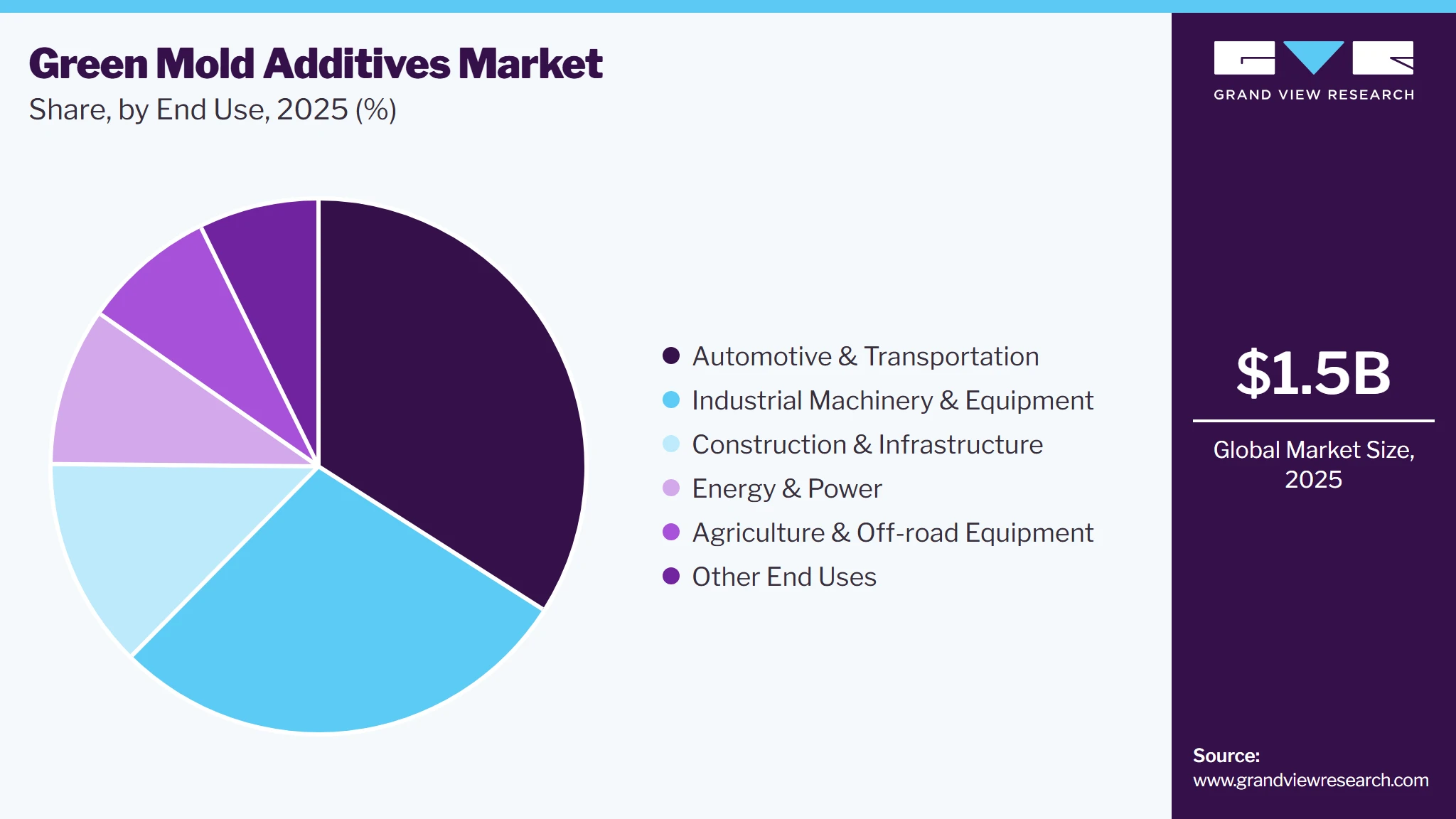
The automotive & transportation segment accounted for 34.0% of total market revenue in 2025, making it the largest end use. Foundries supply cast iron and other metal components for engine systems, brake components, transmission housings, chassis parts, and commercial vehicles. These applications require consistent dimensional accuracy, mechanical performance, and surface quality. Green mold additives help maintain mold integrity and reduce casting defects, supporting production efficiency. Demand remains linked to vehicle manufacturing volumes, component design, and the continued use of cast metal parts.
 To learn more about this report, Download Free Sample Report
The energy & power segment is projected to record the fastest growth, with a CAGR of 6.4% from 2026 to 2033. Power generation equipment, turbines, pumps, valves, and related industrial systems require durable cast metal components that meet demanding operating specifications. Additives that improve mold stability, surface finish, and defect control can help foundries produce these components more consistently. Investment in power infrastructure and equipment replacement may support additional casting demand, although growth will depend on project activity, casting requirements, and the suitability of green sand molding for specific components.
Regional Insights
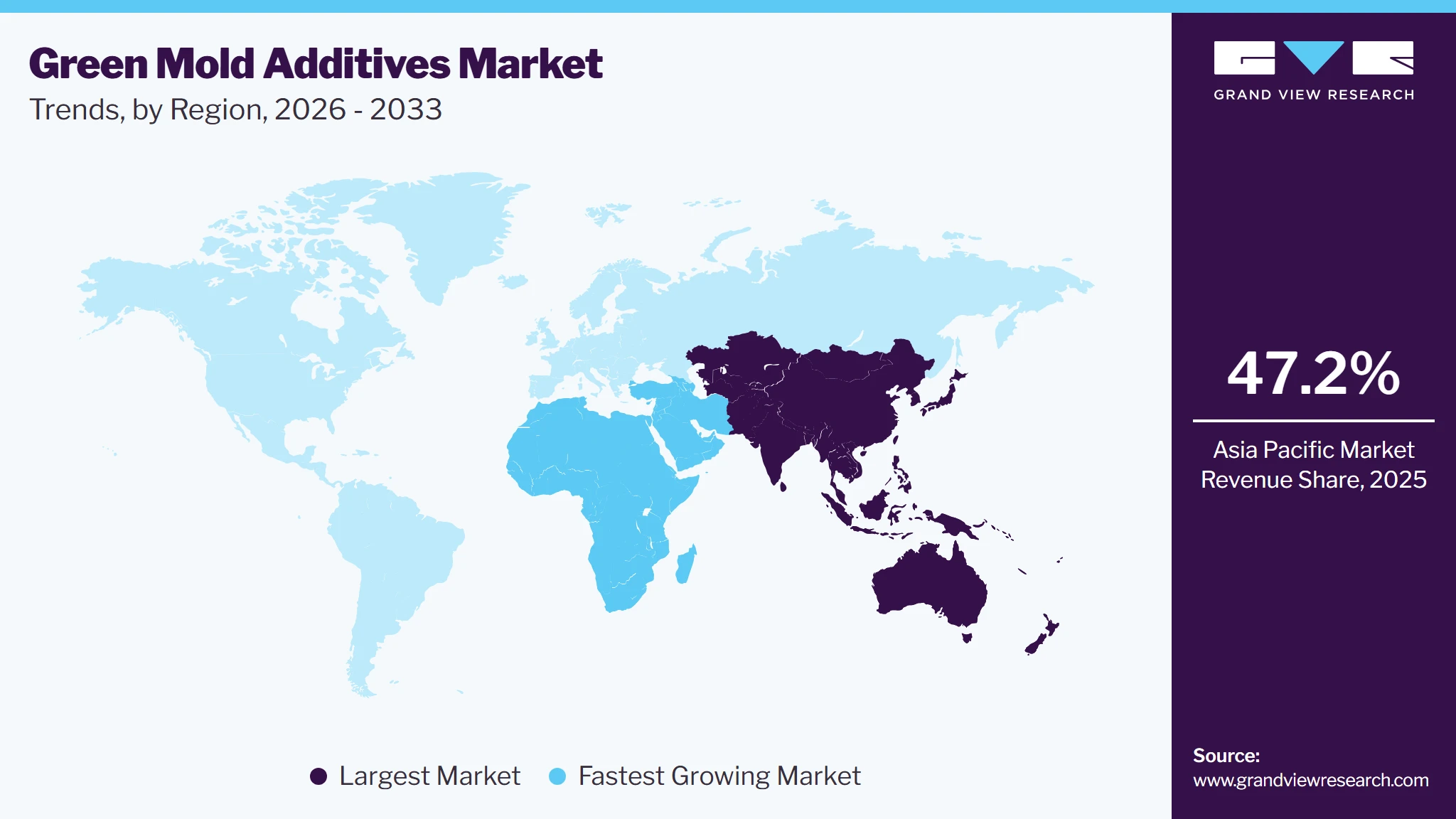
Asia Pacific held the largest share of the green mold additives market in 2025, accounting for 47.2% of revenue. The region's strong position reflects its extensive metal casting industry, supported by automotive manufacturing, industrial machinery production, construction equipment, and infrastructure development. High foundry activity sustains demand for bentonite binders, lustrous carbon formers, and other performance additives used to improve mold strength and casting quality. The region's established manufacturing supply chains further reinforce its market leadership.
 To learn more about this report, Download Free Sample Report
China Green Mold Additives Market Trends
China’s green mold additives market is shaped by its extensive production of cast iron and steel components for vehicles, machine tools, railways, and heavy industrial equipment. Domestic foundries benefit from integrated manufacturing supply chains and strong demand for cost-efficient, high-volume casting production. This supports the use of additives that improve mold stability and surface finish. Growing attention to cleaner production and foundry waste management may also encourage suppliers to develop more efficient formulations.
North America Green Mold Additives Market Trends
North America’s market is influenced by the region’s focus on reshoring manufacturing, modernizing foundries, and strengthening domestic supply chains. Demand comes from specialized castings used in transportation, industrial equipment, and heavy machinery. Foundries increasingly need dependable additive performance to maintain production consistency despite labor shortages and high operating costs. Suppliers offering technical support, customized formulations, and reliable delivery may gain an advantage as manufacturers seek to improve productivity and reduce dependence on costly rework.
The U.S. market reflects demand from domestic foundries serving automotive suppliers, agricultural equipment producers, defense contractors, and manufacturers of pumps and valves. Agricultural and off-road equipment are particularly relevant because cast components must withstand demanding operating conditions. Foundries also face pressure to control waste, energy use, and production expenses. These conditions create opportunities for additives that improve casting yield and process reliability, although demand remains sensitive to manufacturing investment and shifts in domestic component sourcing.
Europe Green Mold Additives Market Trends
Europe’s market is shaped by strict environmental expectations, energy efficiency priorities, and the need for competitive, high-quality manufacturing. Foundries supplying automotive, industrial machinery, and engineering applications must balance casting performance with cost and environmental considerations. This encourages careful control of additive dosage, sand reuse, and process emissions. Differences in industrial structure and manufacturing costs across European countries create varied demand patterns, with suppliers needing to adapt formulations and technical support to local foundry requirements.
Germany’s green mold additives market is closely linked to precision engineering, automotive component production, and its strong industrial machinery sector. Foundries serving these industries must meet demanding requirements for dimensional consistency, surface finish, and process repeatability. The transition in automotive manufacturing toward electric vehicles is also changing component designs and casting requirements, creating both adjustment pressures and new opportunities. Additive suppliers that help foundries adapt molding processes while maintaining quality and controlling costs are well positioned to compete.
Latin America Green Mold Additives Market Trends
Latin America’s market is shaped by Brazil’s domestic metalworking and automotive industries, Mexico’s integration into North American manufacturing supply chains, and regional demand for mining and agricultural equipment. These different industrial bases create varied requirements for foundry additives, from high-volume automotive components to durable parts for heavy machinery. Market expansion depends on local foundry investment, industrial policy, and access to imported raw materials. Currency fluctuations and uneven economic conditions can affect procurement budgets and encourage buyers to prioritize price and supply reliability.
Middle East Green Mold Additives Market Trends
The Middle East & Africa green mold additives market is projected to grow at the fastest rate, with a CAGR of 6.2% from 2026 to 2033. Growth potential is linked to investments in industrial diversification, energy infrastructure, mining equipment, and manufacturing capacity. These activities can increase demand for cast metal components used in machinery, pumps, valves, and industrial systems. As regional foundries expand production capabilities, demand for additives that improve casting consistency and reduce defects may increase, although growth will depend on local foundry development and green sand molding adoption.
Key Green Mold Additives Company Insights
The two key manufacturers in the green mold additives market are Clariant AG and Calderys, recognized for their foundry materials and molding solutions.
-
Clariant AG is a specialty chemicals company with a dedicated foundry additives business. Its portfolio includes GEKO foundry bentonite and ECOSIL lustrous carbon formers for green sand molding. These products help improve mold strength, casting surface quality, sand processing, and production efficiency. The company also develops lower-emission formulations to support environmental performance in metalcasting applications.
-
Calderys is a global industrial materials company specializing in refractory solutions, metal processing, and foundry applications. Its green molding portfolio includes bentonite binders, customized bentonite blends, lustrous carbon formers, and slag additives. These materials are designed to improve molding sand performance, casting surface finish, and sand recovery while helping foundries manage waste and production costs. Its foundry expertise spans a range of metalcasting processes.
Key Green Mold Additives Companies
The following key companies have been profiled for the study on the green mold additives market.
-
Clariant AG
-
Calderys
-
Minerals Technologies Inc.
-
Hüttenes-Albertus
-
LKAB Minerals
-
Imerys
-
Vesuvius / Foseco
-
The Hill & Griffith Company
-
General Chemical Corp.
-
Bentonite Performance Minerals (BPM)
Company Categorization
Operating Strategies
Competitive Edge
Weaknesses
Mature Players: Clariant AG, Calderys, Minerals Technologies Inc., Hüttenes-Albertus, LKAB Minerals, Imerys, Vesuvius / Foseco, The Hill & Griffith Company, General Chemical Corp., Bentonite Performance Minerals (BPM)
- Invest in bentonite processing, carbonaceous additive formulations, and specialty green sand technologies to improve mold strength, casting surface finish, and defect control.
- Expand product portfolios across bentonite binders, lustrous carbon formers, organic additives, and other foundry materials to address diverse casting requirements.
- Strengthen technical support and application testing to optimize additive dosage, sand properties, and production performance for different foundry operations.
- Develop lower-emission formulations and improve sand reuse compatibility to address environmental priorities and foundry efficiency goals.
- Established expertise in foundry minerals, bentonite binders, carbonaceous additives, and green sand molding technologies.
- Broad product portfolios support multiple molding requirements and help address casting defects across different metalcasting applications.
- Established relationships with automotive, machinery, and industrial foundries support repeat purchases and long-term product qualification.
- Technical expertise enables formulation adjustments to improve mold performance, casting quality, and process consistency.
- Large operating structures and extensive product portfolios can increase costs and complicate responses to specialized customer requirements.
- Exposure to bentonite, coal-based materials, minerals, energy, and transportation costs can affect production economics and margins.
- Product performance depends on sand composition, casting metal, and operating conditions, requiring application-specific testing and adjustments.
- Environmental requirements related to emissions, waste management, and foundry sand disposal may increase formulation and compliance costs.
Emerging Players: MPM Private Limited, Atul Chemicals, Goyal Group, Magna Ferrochem, REFCOTEC, Chesapeake Specialty Products
- Focus on selected product categories, including lustrous carbon formers, coal dust, bentonite blends, and specialized foundry additives.
- Develop application-specific formulations to address metal penetration, surface defects, mold performance, and other green sand challenges.
- Build customer relationships through direct technical assistance, customized product specifications, and responsiveness to local foundry requirements.
- Expand regional market access by strengthening production capabilities, product availability, and relationships with foundries in targeted industrial sectors.
- Specialized product portfolios allow focused attention on specific additive requirements and foundry process challenges.
- Regional market knowledge can help companies respond to local casting practices and customer specifications.
- Flexible product development can support customized formulations for foundries with distinct sand systems and defect-control needs.
- Focus on selected additive categories can support technical specialization and efficient customer service.
- Competitive pricing and close customer engagement can help smaller manufacturers serve cost-sensitive foundries and regional metalcasting businesses.
- Narrower product portfolios may limit their ability to meet the full range of additive requirements across large foundry groups.
- Smaller geographic footprints can restrict access to international customers and increase dependence on selected regional markets.
- Dependence on specific raw materials, such as bentonite and carbonaceous inputs, can expose production costs to price fluctuations.
- Expansion may require additional investment in manufacturing capacity, quality assurance, testing, and technical personnel.
- Limited international brand recognition can make it more difficult to secure long-term contracts with large multinational foundry operators.
Recent Developments
-
In September 2025, Sinto America highlighted its BRS-1 Bentonite Recovery System, which is designed to recover and reactivate bentonite from foundry dust for reuse in green-sand molds. The system can recover more than 90% of active clay and reduce the requirement for new bonding materials, supporting greater material efficiency in green-sand foundry operations.
-
In April 2025, Simpson Technologies' sand-reclamation technology was highlighted in connection with Waupaca Foundry's green-sand reclamation operations, where the foundry was able to reclaim its sand more than 30 times before the material reached the end of its usable lifecycle. The development demonstrates the adoption of reclamation technologies to improve material utilization and reduce waste in green-sand molding operations.
Green Mold Additives Market Report Scope
Report Attribute
Details
Market Definition
The green mold additives market comprises materials used in green sand casting to improve mold strength, surface finish, permeability, and defect control. These additives support efficient metalcasting across automotive, machinery, construction, and energy applications.
Market size in 2025
USD 1.5 billion
Estimated market size in 2026
USD 1.6 billion
Projected market size by 2033
USD 2.3 billion
Growth rate
CAGR of 5.4% from 2026 to 2033
Base year for estimation
2025
Historical data
2021 - 2024
Forecast period
2026 - 2033
Quantitative units
Revenue in USD million, and CAGR from 2026 to 2033
Report coverage
Revenue forecast, company ranking, competitive landscape, growth factors, and trends
Segments covered
Product, end use & region
Regional scope
North America, Europe, Asia Pacific, Latin America, and MEA
Country scope
U.S., Canada, Mexico, Germany, UK, France, Italy, Spain, China, India, Japan, South Korea, Brazil, Argentina, Saudi Arabia, South Africa
Key companies profiled
Clariant AG, Calderys, Minerals Technologies Inc., Hüttenes-Albertus, LKAB Minerals, Imerys, Vesuvius / Foseco, The Hill & Griffith Company, General Chemical Corp., Bentonite Performance Minerals (BPM)
Customization scope
Free report customization (equivalent up to 8 analysts’ working days) with purchase. Addition or alteration to country, regional & segment scope.
Pricing and purchase options
Avail customized purchase options to meet your exact research needs. Explore purchase options
Global Green Mold Additives Market Report Segmentation
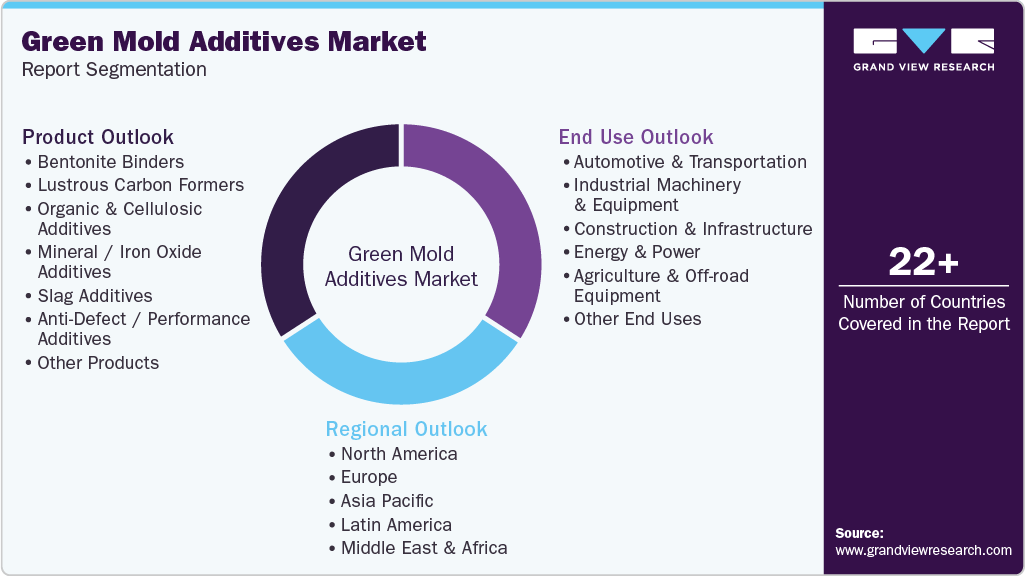
This report forecasts revenue growth at global, regional, and country levels and provides an analysis of the latest industry trends in each of the sub-segments from 2021 to 2033. For this study, Grand View Research has segmented the global green mold additives market report based on product, end use, and region
 To learn more about this report, Download Free Sample Report
-
Product Outlook (Volume, Kilotons; Revenue, USD Million; 2021 - 2033)
-
Bentonite Binders
-
Lustrous Carbon Formers
-
Organic & Cellulosic Additives
-
Mineral / Iron Oxide Additives
-
Slag Additives
-
Anti-Defect / Performance Additives
-
Other Products
-
-
End Use Outlook (Volume, Kilotons; Revenue, USD Million; 2021 - 2033)
-
Automotive & Transportation
-
Industrial Machinery & Equipment
-
Construction & Infrastructure
-
Energy & Power
-
Agriculture & Off-road Equipment
-
Other End Uses
-
-
Regional Outlook (Volume, Kilotons; Revenue, USD Million; 2021 - 2033)
-
North America
-
U.S.
-
Canada
-
Mexico
-
-
Europe
-
Germany
-
UK
-
Italy
-
Spain
-
France
-
-
Asia Pacific
-
China
-
India
-
Japan
-
South Korea
-
-
Latin America
-
Brazil
-
Argentina
-
-
Middle East & Africa
-
Saudi Arabia
-
South Africa
-
-
Research Methodology
The green mold additives market figures in this report are based on a proven research process that combines executive interviews with secondary research from proprietary databases, company filings, and recognized regulatory and institutional sources. Market size is built through value-chain sizing-reconciling supply-side and demand-side estimates-and triangulated with bottom-up and top-down approaches. Every estimate passes multiple levels of expert validation before publication, with each green mold additives segment quantified using the revenue-capture definitions in the table below.
Segment Definition
Product
Revenue capture definition
Bentonite Binders
Revenue is captured through the sale of bentonite-based binders used to provide strength, cohesion, and stability to green molding sand. Recurring purchases by foundries support mold formation, dimensional accuracy, and consistent casting performance.
Lustrous Carbon Formers
Revenue is generated through sales of carbonaceous additives that form a protective carbon layer during metal pouring. Foundries purchase these products to improve casting surface finish, reduce metal penetration, and limit finishing and rework requirements.
Organic & Cellulosic Additives
Revenue is captured through the sale of organic materials, including cellulose-based additives, used to control green sand properties and improve mold performance. Demand comes from foundries seeking better collapsibility, permeability, and casting quality across production runs.
Mineral / Iron Oxide Additives
Revenue is generated through sales of mineral-based additives, including iron oxide materials, used to address specific molding and casting requirements. Purchases are driven by the need to improve casting surface quality, manage expansion-related defects, and maintain process consistency.
Slag Additives
Revenue is captured through sales of specialized additives used to help manage slag-related issues and improve casting process performance where required. Demand depends on metal type, foundry process conditions, and the need to reduce surface defects and related production losses.
Anti-Defect / Performance Additives
Revenue is generated through sales of formulated additives designed to address casting defects and improve overall molding performance. Foundries purchase these products to reduce scabbing, penetration, burn-on, and other quality issues, helping lower scrap, rework, and production costs.
Other Products
Revenue is captured through sales of additional green sand molding additives that do not fall within the main product categories. These products address specialized foundry requirements, including adjustments to sand behavior, mold performance, and casting quality.
End use
Revenue capture definition
Automotive & Transportation
Revenue is generated through sales of green mold additives used by foundries producing cast components for passenger vehicles, commercial vehicles, rail systems, and other transportation equipment. Demand is linked to casting requirements for engine parts, brake components, housings, and structural applications.
Industrial Machinery & Equipment
Revenue is captured through additive sales to foundries manufacturing machine bases, pump housings, valves, gears, and other industrial components. Recurring demand reflects the need for consistent casting quality, dimensional stability, and reliable production across machinery and equipment applications.
Construction & Infrastructure
Revenue is generated through sales of additives used in casting components for construction machinery, infrastructure equipment, pipes, fittings, and related applications. Consumption depends on construction activity, equipment manufacturing, and foundry demand for durable castings with controlled surface quality.
Energy & Power
Revenue is captured through sales of green mold additives used in producing cast components for power generation and energy-related equipment, including selected pumps, valves, and machinery parts. Demand is influenced by power infrastructure investment, equipment maintenance, and industrial casting requirements.
Agriculture & Off-road Equipment
Revenue is generated through sales of additives used in foundries manufacturing cast parts for tractors, harvesters, mining machinery, and off-road equipment. Purchases support the production of durable components that require reliable mold performance and consistent casting quality under demanding operating conditions.
Other End Uses
Revenue is captured through sales of green mold additives for applications outside the principal end-use categories, including general metal products and miscellaneous industrial castings. Demand depends on local foundry activity and the specific molding and quality requirements of these applications.
Estimation Model
The green mold additives market estimation model progressively evaluates foundry production, green sand molding adoption, additive consumption intensity, and product pricing to estimate market demand and revenue across regions and end-use industries.
Layer No.
Layer Name
Key Question
Content
01
Metal Casting Production Base Layer
What forms the demand base?
Identify global metal casting production volumes across major foundry-producing countries and regions. Assess casting output by metal type, including cast iron, steel, and non-ferrous metals, and identify the contribution of automotive, industrial machinery, construction, energy, and agricultural equipment applications. This establishes the underlying production base for green mold additive demand.
02
Green Sand Molding Adoption Layer
Where are green mold additives used?
Estimate the share of casting production manufactured using green sand molding processes. Assess adoption by foundry type, metal category, casting application, and region, accounting for the suitability of green sand molding compared with chemically bonded sand and other casting methods. This layer determines the addressable market for green mold additives.
03
Additive Consumption Intensity Layer
How much additive is consumed?
Estimate additive consumption per unit of green sand casting production, considering sand-to-metal ratios, sand reuse rates, additive dosage, molding requirements, and process conditions. Consumption is assessed across bentonite binders, lustrous carbon formers, organic and cellulosic additives, mineral additives, and performance additives to quantify product-specific demand.
04
Revenue Estimation Layer
How is market revenue generated?
Calculate market revenue by applying average selling prices to estimated additive consumption volumes across product categories, regions, and end-use industries. Account for differences in formulation, product quality, raw material costs, and regional pricing. Aggregate revenues from sales to foundries and relevant industrial customers to establish the total green mold additives market value.
Delivered Customizations
This report has been delivered with the following In-depth customizations:
Customization
Customization Delivered
Value-Added Content
Cross-Segmentation Analysis
Cross-analysis of product categories, including bentonite binders, lustrous carbon formers, organic and cellulosic additives, mineral additives, slag additives, and anti-defect additives, against end-use segments such as automotive, industrial machinery, construction, energy, and agricultural equipment.
Identifies product and application combinations with stronger demand potential, highlights industry-specific additive requirements, and supports targeted market entry and product positioning decisions.
Competitive Benchmarking
Comparative assessment of key manufacturers, including Clariant AG, Calderys, Minerals Technologies Inc., Hüttenes-Albertus, LKAB Minerals, Imerys, and Vesuvius / Foseco, based on product portfolios, technical capabilities, geographic presence, application expertise, and sustainability initiatives.
Clarifies competitor positioning, identifies portfolio gaps, evaluates differentiation opportunities, and supports strategic decisions on product development, customer targeting, and competitive positioning.
Opportunity Assessment
Evaluation of growth opportunities linked to casting quality improvement, defect reduction, sand reuse, lower-emission formulations, and evolving requirements across automotive, industrial machinery, construction, energy, and agricultural equipment applications.
Highlights promising product categories, emerging customer requirements, and high-potential end-use applications to guide innovation priorities, market expansion strategies, and investment decisions.
Frequently Asked Questions About This Report
The global green mold additives market size was valued at USD 1.5 billion in 2025 and is estimated at USD 1.6 billion for 2026.
The global green mold additives market is expected to grow at a CAGR of 5.4% from 2026 to 2033, reaching USD 2.3 billion by 2033.
Key players include Clariant AG, Calderys, Minerals Technologies Inc., Hüttenes-Albertus, LKAB Minerals, Imerys, Vesuvius / Foseco, The Hill & Griffith Company, General Chemical Corp., Bentonite Performance Minerals (BPM).
Market growth is driven by demand for high-quality metal castings, increased automotive and machinery production, reusable green sand molding processes, defect reduction requirements, and foundries’ efforts to improve efficiency and control costs.
Asia Pacific dominated the green mold additives market in 2025, accounting for 47.2% of total revenue, supported by its extensive foundry base and strong automotive, machinery, and infrastructure manufacturing industries.
The automotive & transportation segment dominated the green mold additives market in 2025, accounting for 34.0% of total revenue, driven by demand for cast components used in vehicles and transportation equipment.
Environmental regulations concerning foundry emissions, waste management, and workplace safety encourage manufacturers to adopt lower-emission additives, improve sand reclamation, and reduce waste during metalcasting operations.
The anti-defect / performance additives segment accounted for the largest share of the green mold additives market in 2025, representing 30.3% of revenue, driven by demand for improved casting quality, reduced surface defects, and lower rejection and finishing costs.
The energy & power segment is expected to grow the fastest in the green mold additives market, registering a CAGR of 6.4% from 2026 to 2033, driven by demand for cast components used in pumps, valves, and power generation equipment.
About the Author(s)
Organic Chemicals Research Team
Bulk Chemicals · Organic ChemicalsThis report was authored by the organic chemicals research team at Grand View Research - comprising two research analysts, one senior research analyst, and one industry expert - with specialized expertise in the organic chemicals segment of the bulk chemicals industry. All findings are based on proprietary bulk chemicals databases, executive interviews, and regulatory analysis, subject to internal peer review prior to publication.
Last Updated:
Speak to Analyst

Customize this report to your needs - add regions, segments, or data points, with 20% free customization.
Or view our licence options:


ISO 9001:2015 & 27001:2022 Certified
We are GDPR and CCPA compliant! Your transaction & personal information is safe and secure. For more details, please read our privacy policy.


