
- Home
- »
- Advanced Interior Materials
- »
-
Grinding Machinery Market Size & Share Report, 2026-2033GVR Report cover

Grinding Machinery Market (2026 - 2033)
Size, Share & Trends Analysis Report By Type (Non-Precision Grinder, Precision Grinder), By Application (Automotive, Aerospace, Medical, Construction), By Region (North America, Europe, Asia Pacific, Middle East & Africa), And Segment Forecasts
Market Size, 2025
$6.2BMarket Estimate, 2026
$6.4BMarket Forecast, 2033
$8.9BCAGR, 2026–2033
4.8%Grinding Machinery Market Summary
The global grinding machinery market size was valued at USD 6.2 billion in 2025 and is projected to grow from USD 6.4 billion in 2026 to USD 8.9 billion by 2033, at a CAGR of 4.8% from 2026 to 2033. The market in Asia Pacific dominated with a revenue share of 43.4% in 2025. The market is driven by rising demand for precision manufacturing across automotive, aerospace, and industrial sectors. Similarly, the expansion of construction activities and the growing adoption of CNC and automated grinding solutions support market growth.
 Source: Grand View Research, IR Documents, Primary Interviews, Paid DatabasesTo learn more about this report,
 Download Free Sample Report
 Key Market Trends & Insights
- By type: Precision grinder segment held the largest market share of 66.0% in 2025.
- By application: Automotive industry segment held the largest market share in 2025.
Regional Highlights
- Largest regional market: Asia Pacific (43.4% revenue share, 2025)
- By country: China held the largest market share in 2025
Market Size & Forecast
- Market size in 2025: USD 6.2 Billion
- Estimated market size in 2026: USD 6.4 Billion
- Projected market size by 2033: USD 8.9 Billion
- CAGR (2026-2033): 4.8%
Three ways to get this report
Buy it, customize it, or ask a question.Ask an Analyst
Analyst response in 1 business day
- AccessReport author, directly
- Reply timeWithin 1 working day
- No sales callDirect answer only
- FormatEmail reply
- CostFree, no cost
Get the Full Report
What the study covers
- FormatsPDF · Excel · Dashboard
- Timeline2026–2033 annual, 2025 base
- Coverage20+ countries, 5 regions
- Companies10+ key players profiled
Customize the Report
20% free customization
- IncludeCountries, segments, points
- TailorTo your product definition
- ExtendDeeper competitor detail
- OrA fully bespoke study
- Turnaround5–10 working days
Technological advancements and expanding global manufacturing output further contribute to sustained demand for grinding machinery. The automotive sector requires high-precision components with strict tolerances and superior surface finishes for engine systems, transmission assemblies, and structural parts, which drives demand for advanced grinding machinery. The aerospace industry also emphasizes stringent quality, reliability, and safety standards, increasing the need for grinding equipment to manufacture complex components such as turbine blades, engine housings, and structural elements.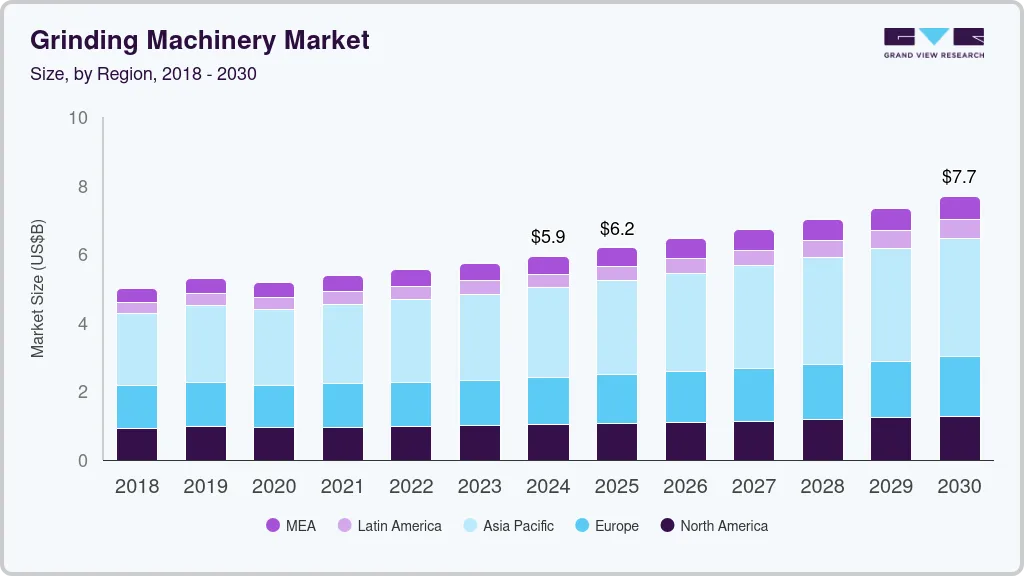 To learn more about this report, Download Free Sample Report
 The expansion of the construction sector, particularly across the Asia Pacific, where infrastructure development remains a key priority, is another major factor driving demand for grinding machinery. Grinding machines are widely used for processing construction materials such as concrete, stone, ceramics, and asphalt, enabling accurate shaping and finishing. India has emerged as an important aerospace manufacturing hub, supported by increasing investments, expanding domestic production capabilities, and collaborations with global aircraft manufacturers. The establishment of new facilities and strengthening of supply chains in cities such as Bengaluru and Hyderabad are contributing to rising demand for high-precision grinding machinery to meet the evolving requirements of the aerospace industry.
Market Concentration & Characteristics
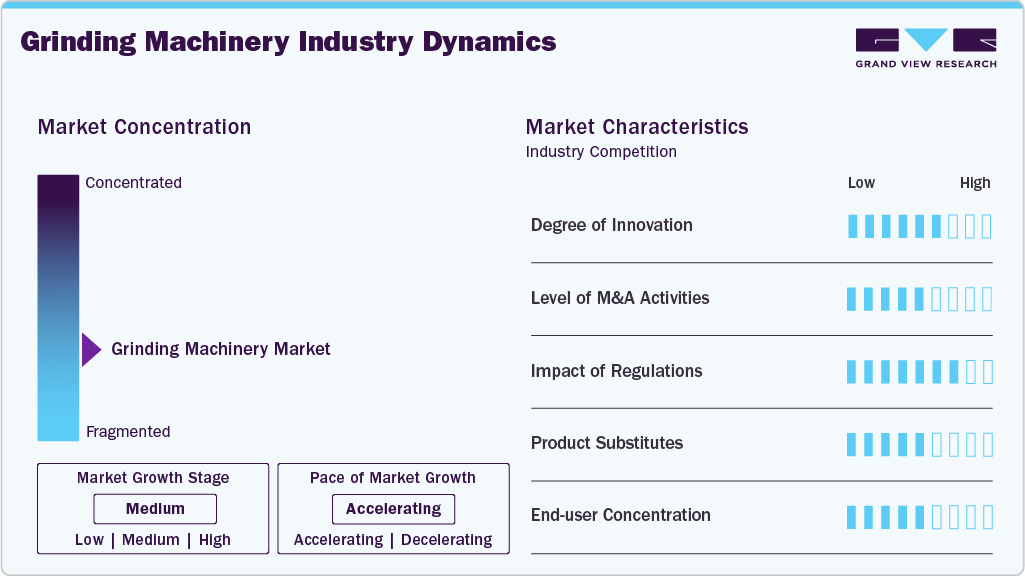
The grinding machinery market is characterized by moderate industry concentration, with a mix of established global manufacturers and numerous regional suppliers competing across different price and technology segments. The industry is influenced by compliance with international machine safety and performance standards, which govern operational efficiency, worker safety, and equipment reliability. Manufacturers must also adhere to regional industrial regulations related to noise control, energy consumption, and workplace safety, which impact product design and manufacturing processes.
The market exhibits diversified end user demand, primarily driven by automotive, aerospace, metal fabrication, and construction equipment manufacturing industries. Growth in precision engineering, rising demand for high-performance components, and expansion of industrial production facilities are creating new opportunities. Additionally, increasing adoption of advanced machining technologies and the shift toward high-volume automated production environments are contributing to sustained demand for grinding machinery across key manufacturing sectors.
 To learn more about this report, Download Free Sample Report
 Market participants focus on strategies such as capacity expansion, technological upgrades, and development of multi-functional grinding systems to strengthen their competitive positioning. Increasing investments in automation, robotic integration, and CNC-enabled precision grinding solutions are shaping product innovation. Companies are also enhancing service capabilities, including predictive maintenance and remote monitoring, to improve operational efficiency and customer retention. Partnerships with industrial distributors and expansion into emerging manufacturing hubs further support market penetration.
Drivers, Opportunities & Restraints
The grinding machinery market is primarily driven by increasing demand for high-precision components across automotive, aerospace, and industrial manufacturing sectors. The growing need for tight tolerances, improved surface finishing, and enhanced component durability is encouraging the adoption of advanced grinding solutions. Rising industrial automation, expansion of CNC-based machining, and growth in global manufacturing output are further supporting market demand. Infrastructure development and construction activities are also increasing the use of grinding equipment for processing materials such as metals, concrete, and ceramics.
Significant opportunities exist with the growing adoption of smart manufacturing and Industry 4.0 technologies, including digital monitoring, predictive maintenance, and automated grinding systems. Expansion of manufacturing activities in emerging economies is creating demand for cost-effective and high-efficiency grinding equipment. Increasing investments in electric vehicle production, renewable energy components, and precision engineering industries are expected to generate new growth avenues. Technological advancements in multi-axis CNC grinding machines and energy-efficient designs further provide opportunities for market expansion.
High initial capital investment and maintenance costs associated with advanced grinding machinery act as key restraints for small and medium-sized manufacturers. The availability of alternative machining processes, such as advanced milling and additive manufacturing, may limit adoption in certain applications. Skilled labor requirements for operating and maintaining precision grinding equipment also pose operational challenges. Economic fluctuations affecting capital expenditure in manufacturing industries and supply chain disruptions for machine components can further restrain market growth.
Type Insights
The precision grinder segment remained the dominant category in the grinding machinery market with a revenue share of 66.0% in 2025. The market is driven by increasing demand for high-precision components across automotive, aerospace, electronics, and advanced manufacturing industries. The need for tight dimensional tolerances, improved surface quality, and consistent performance has accelerated the adoption of CNC-enabled and automated precision grinding systems. These machines are widely used to produce critical components such as bearings, gear assemblies, fuel injection parts, and turbine components. Furthermore, growing investments in smart manufacturing, quality control systems, and high-performance machining technologies are reinforcing the segment’s leading position.
The non-precision grinder segment is projected to record the fastest growth during the forecast period, supported by rising demand for heavy-duty material removal and rough machining applications. These machines are commonly deployed in construction, metal fabrication, mining, and general industrial operations where high accuracy is not the primary requirement. Increasing infrastructure development, expansion of industrial production capacity, and growing demand for cost-effective machining solutions are contributing to segment growth. In addition, rising investments in large-scale construction projects and material processing activities, particularly in emerging economies, are expected to further boost demand for non-precision grinding machinery.
Application Insights
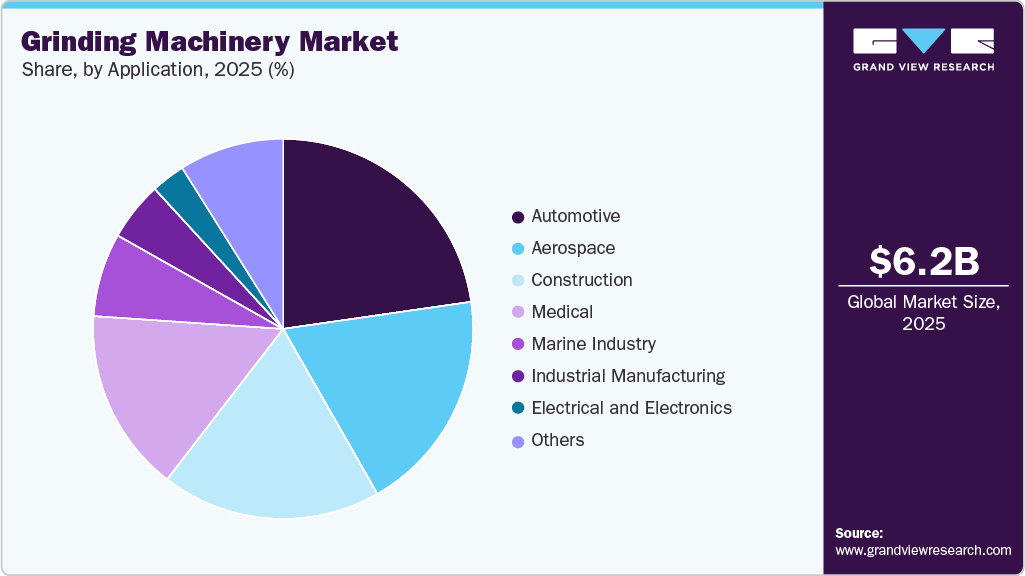
The automotive industry continued to account for the largest revenue share of the grinding machinery market in 2025, supported by its strong reliance on precision grinding for manufacturing engine components, transmission systems, and structural parts. These components require tight tolerances and superior surface finishes, making grinding machinery essential in automotive production. Global vehicle production reached approximately 75.5 million units in 2024 and is estimated to approach nearly 78 million units in 2025, reflecting steady growth in manufacturing activity. South America recorded around 1.7% growth in vehicle output in 2024, with Brazil reporting a 6.3% increase and producing close to 1.9 million vehicles, while additional production expansion in Asia Pacific during 2025 further strengthened demand for grinding machinery across automotive manufacturing facilities.
 To learn more about this report, Download Free Sample Report
 The electrical and electronics segment is expected to register a significant CAGR of 5.6% during the forecast period. The global electronics manufacturing industry exceeded approximately USD 3.3 trillion in 2024 and is projected to reach nearly USD 3.5 trillion in 2025, driven by demand for consumer electronics, semiconductor equipment, and industrial automation systems. Grinding machinery is increasingly used to manufacture thin metal components, precision connectors, and high-accuracy mechanical parts required in electronic devices. Growing investments in robotics and automation, along with expanding precision gear production for robotic systems and semiconductor equipment in 2025, are further supporting the adoption of advanced grinding machinery in the electronics sector.
Regional Insights
The North America grinding machinery market is growing in 2025, due to sustained demand from automotive and aerospace manufacturing activities. The United States remains a major consumer of grinding equipment, driven by the need for precision machining of engine components, transmission assemblies, and structural automotive parts. Increasing adoption of electric vehicles, along with investments in advanced production technologies and automation, is further strengthening demand for high-precision grinding systems. The region’s aerospace and defense sector also contributes significantly, with continued growth in aircraft production, defense procurement, and maintenance activities. Strong industrial infrastructure, technological innovation, and expanding supply chain capabilities across North America are reinforcing the need for advanced grinding machinery in precision manufacturing applications.
U.S. Grinding Machinery Market Trends
Grinding machinery market in the U.S. accounted for the largest share in North America in 2025, supported by strong demand from automotive, aerospace, and metalworking industries that require high-precision machining solutions. The U.S. aerospace parts manufacturing market is estimated at approximately USD 540 million in 2025, driven by increased aircraft production, defense modernization initiatives, and expanding maintenance, repair, and overhaul activities. Growing use of advanced materials and complex component designs in aerospace manufacturing is further increasing the need for precision grinding equipment. Expansion of domestic aircraft component production and continued investments in advanced manufacturing technologies are also supporting market demand.
Canada grinding machinery market is a stable, moderately growing segment within the country’s broader machine tools industry, supported by demand from automotive, aerospace, energy, mining, and general manufacturing sectors. Growth is largely driven by the need for high-precision components, particularly in aerospace and defense, along with refurbishment and maintenance activities in mining and oil & gas equipment.
Asia Pacific Grinding Machinery Market Trends
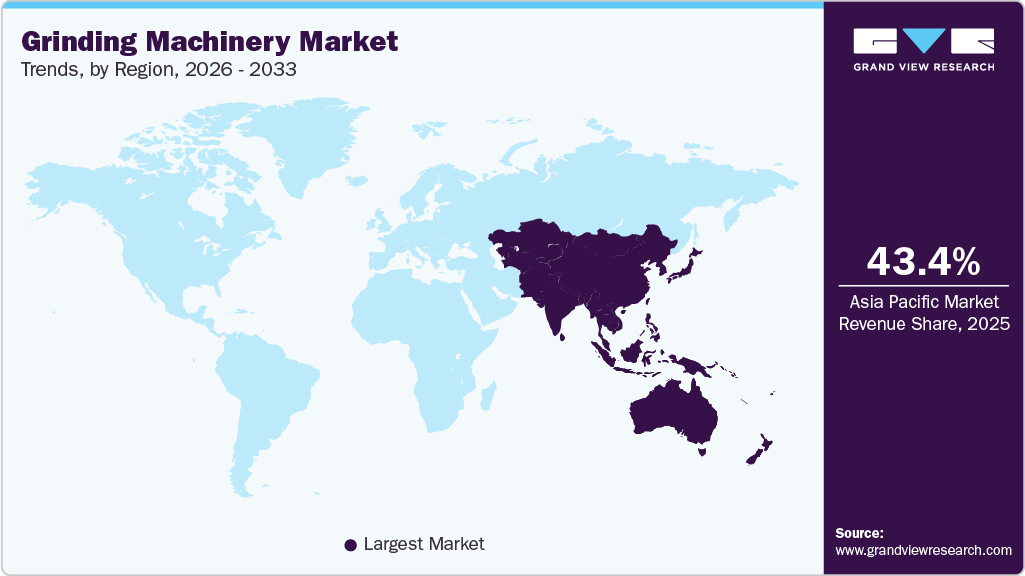
The Asia Pacific grinding machinery market accounted for the largest global revenue share of 43.4% in 2025. The Asia Pacific grinding machinery market is driven by rapid industrialization, urbanization, and expanding infrastructure development across emerging economies. Accelerated growth in manufacturing hubs, large-scale construction activities, and the continuous expansion of industrial corridors, particularly in countries such as China and India, are significantly increasing the size of the industrial workforce and, consequently, the demand for protective footwear. The rise of sectors such as automotive, electronics, chemicals, and heavy engineering further reinforces this demand, as these industries involve high-risk working environments that necessitate robust safety gear
 To learn more about this report, Download Free Sample Report
 Grinding machinery market in China leads the Asia Pacific market in 2025, due to its strong industrial base and rapid urban development, which continue to drive construction and manufacturing activities. Supportive government policies and investments in infrastructure and industrial projects are creating sustained demand for protective footwear. Additionally, there is a growing trend toward the adoption of advanced, durable, and ergonomically designed footwear to enhance worker safety and productivity.
Grinding machinery market in India is emerging as a rapidly growing market, supported by government initiatives aimed at boosting domestic manufacturing and industrial output. Increased investments in sectors such as electronics, automotive, and engineering are contributing to higher demand for safety footwear. Furthermore, stricter regulatory compliance, rising awareness of workplace safety, and the growing preference for affordable, lightweight, and comfortable footwear are positively influencing market expansion in the country.
Europe Grinding Machinery Market Trends
Grinding machinery market in Europe is a mature and innovation-driven segment, supported by a strong industrial base spanning automotive, aerospace, medical devices, and general engineering. Demand is largely centered on high-precision and high-efficiency machining, with widespread adoption of CNC grinding systems, automation, and advanced abrasives. The region benefits from a well-established ecosystem of machine tool manufacturers and technology providers, particularly in Western Europe, and maintains a strong export orientation.
Grinding machinery market in Germany represents the largest and most technologically advanced grinding machinery market in Europe, driven by its world-leading automotive and industrial manufacturing sectors. The country is home to several prominent machine tool builders and is known for its emphasis on precision engineering, quality, and innovation. Demand is fueled by both domestic production and exports, with a strong shift toward CNC, automated, and Industry 4.0-enabled grinding solutions.
France grinding machinery market is comparatively smaller but remains stable, supported primarily by aerospace, defense, and specialized industrial applications. The country places a strong emphasis on high-value, precision manufacturing, particularly in sectors requiring stringent quality standards. Adoption of advanced grinding technologies and automation is gradually increasing, although at a slower pace compared to Germany.
Latin America Grinding Machinery Market Trends
Latin America grinding machinery market is expected to register steady growth during the forecast period, supported by expanding automotive manufacturing and rising industrial investments across the region. Increasing capital expenditure by global vehicle manufacturers to strengthen production capacity and localize supply chains is contributing to higher demand for precision machining equipment. Brazil remains the key automotive production hub, and continued expansion of assembly plants and component manufacturing facilities is increasing the need for grinding machinery used in engines, transmission systems, and structural components. Growth in metal fabrication and general manufacturing activities is also supporting market development.
Grinding machinery market in Brazil continued to dominate the Latin America grinding machinery market in 2025, driven by technological modernization and growing adoption of Industry 4.0 practices. Increasing implementation of automation, digital manufacturing, and CNC-based machining solutions is accelerating demand for advanced grinding equipment across automotive, aerospace, and industrial sectors. Government initiatives promoting industrial competitiveness, along with favorable trade policies and improved access to advanced machinery, are encouraging investments in production facilities. Rising demand for high-precision components and expansion of domestic manufacturing capabilities continue to strengthen the adoption of grinding machinery in Brazil.
Middle East & Africa Grinding Machinery Market Trends
Grinding machinery market in MEA is an emerging and steadily growing in 2025, driven by increasing industrialization, infrastructure development, and economic diversification across key countries such as Saudi Arabia, the UAE, and South Africa. Demand is largely supported by sectors including oil & gas, mining, automotive, aerospace, and general manufacturing, where there is a rising need for precision machining and maintenance of heavy equipment. Governments across the region are actively investing in local manufacturing capabilities and industrial clusters, which is further boosting demand for machine tools, including grinding systems.
Grinding machinery market in Saudi Arabia represents the most prominent and fastest-growing grinding machinery market within the Middle East, supported by strong government-led industrialization initiatives under Vision 2030. The country is actively developing its automotive, aerospace, and energy equipment manufacturing base, which is significantly increasing demand for high-precision machining solutions. Large-scale investments in industrial zones, localization of manufacturing, and the establishment of new production facilities are key growth drivers for grinding machinery adoption.
Key Grinding Machinery Company Insights
The grinding machinery market includes several prominent players such as AMADA MACHINERY CO., LTD., Danobat, ANCA, and JUNKER. These companies focus on automation, digital manufacturing, and precision enhancement while expanding global distribution networks and service capabilities to strengthen market presence.
-
AMADA MACHINERY CO., LTD. offers a broad portfolio of automation systems and precision machining equipment, including high-precision CNC grinding, cutting, bending, and joining solutions. The company continues to strengthen its smart manufacturing ecosystem through digital platforms such as IoT-enabled production monitoring, remote support solutions, and integrated factory management systems. These capabilities improve production efficiency, optimize machine utilization, and support complex manufacturing operations. With a strong global footprint spanning more than 100 countries and multiple manufacturing facilities, the company focuses on expanding advanced CNC and automated grinding solutions to meet increasing demand for precision machining.
-
Danobat specializes in customized grinding systems designed for high-precision applications in automotive, aerospace, railway, and energy sectors. The company emphasizes flexible machine configurations, automation integration, and digital services to improve operational performance and reduce downtime. Continuous development of multi-axis CNC grinding machines, along with tailored engineering solutions, enables the company to address complex component manufacturing requirements. Its focus on innovation, global service capabilities, and customer-specific solutions supports strong positioning in the global grinding machinery market.
Key Grinding Machinery Companies:
The following key companies have been profiled for this study on the grinding machinery market.
- AMADA MACHINERY CO., LTD.
- Danobat
- ANCA
- JUNKER Group
- Körber AG
- Fives Group
- EMAG GmbH & Co. KG
- DMG MORI
- Starrag Group
- Gleason Corporation
- Okamoto Machine Tool Works Ltd.
- United Grinding Group
- Kellenberger
- Studer
- Toyoda Machinery
Recent Developments
-
In March 2026, DMG MORI announced the launch of its advanced CNC vertical multi-process grinding machine, the Vertical Mate 55 (2nd Generation), designed to enhance precision, productivity, and energy efficiency in industrial machining applications. The new model integrates multiple grinding operations including internal diameter (ID), external diameter (OD), and face grinding into a single setup, significantly reducing processing time while maintaining high accuracy.
-
In September 2025, ANCA announced the launch of its advanced software solution, InsertsPRO, designed to streamline and automate indexable and special insert grinding processes. The solution enables manufacturers to eliminate complex manual calculations by automating key functions such as profile design and rake face compensation, significantly improving operational efficiency and accuracy.
Grinding Machinery Market Report Scope
Report Attribute
Details
Market size in 2025
USD 6.2 billion
Estimated market size in 2026
USD 6.4 billion
Projected market size by 2033
USD 8.9 billion
Growth rate
CAGR of 4.8% from 2026 to 2030
Base year for estimation
2025
Historical data
2021 - 2024
Forecast period
2026 - 2033
Quantitative units
Revenue in USD million/billion and CAGR from 2026 to 2033
Report coverage
Revenue forecast, company market position analysis, competitive landscape, growth factors, and trends
Segments covered
Type, application, region
Regional scope
North America; Europe; Asia Pacific; Latin America; Middle East & Africa
Country Scope
U.S.; Canada; Mexico; Germany; UK; France; Spain; Italy; China; Japan; India; South Korea; Australia; Brazil; Argentina; Saudi Arabia; UAE; South Africa
Key companies profiled
AMADA MACHINERY CO., LTD.; Danobat; ANCA; JUNKER Group; Körber AG; Fives Group; EMAG GmbH & Co. KG; DMG MORI; Starrag Group; Gleason Corporation; Okamoto Machine Tool Works Ltd.; United Grinding Group; Kellenberger; Studer; Toyoda Machinery
Customization scope
Free report customization (equivalent up to 8 analysts working days) with purchase. Addition or alteration to country, regional & segment scope.,
Pricing and purchase options
Avail customized purchase options to meet your exact research needs. Explore purchase options
Global Grinding Machinery Market Report Segmentation
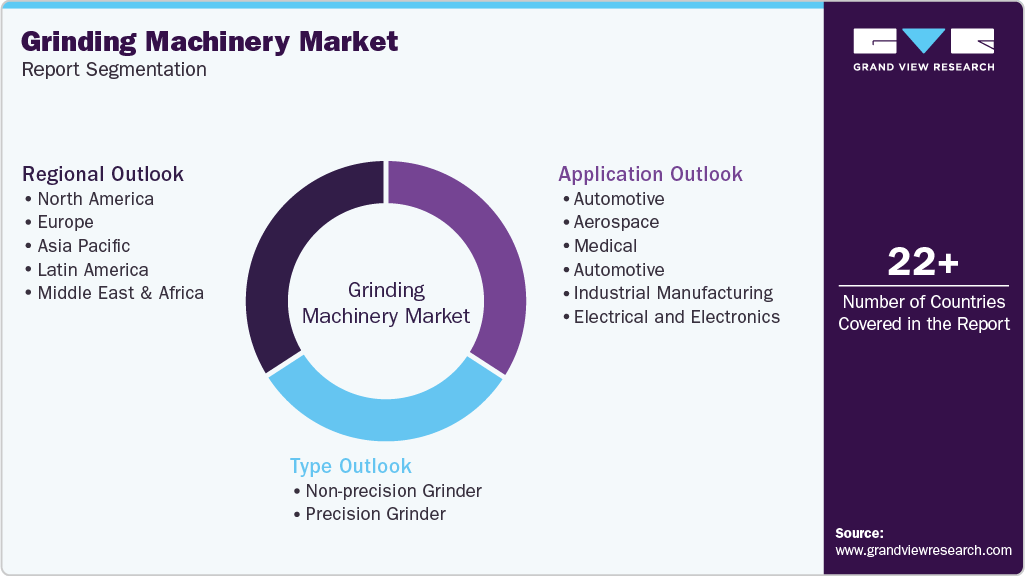
This report forecasts revenue growth at global, regional, and country levels and provides an analysis of the latest industry trends in each of the sub-segments from 2026 to 2033. For this study, Grand View Research has segmented the global grinding machinery industry report based on type, application, and region:
 To learn more about this report, Download Free Sample Report
 -
Type Outlook (Revenue, USD Million, 2021 - 2033)
-
Non-precision Grinder
-
Bench Grinder
-
Portable Grinder
-
Pedestal Grinder
-
Flexible Grinder
-
Precision Grinder
-
-
Precision Grinder
-
Cylindrical Grinding Machines
-
Surface Grinding Machines
-
Centre-less Grinding Machines
-
Tool and Cutter Grinding Machines
-
-
-
Application Outlook (Revenue, USD Million, 2021 - 2033)
-
Automotive
-
Aerospace
-
Medical
-
Automotive
-
Industrial Manufacturing
-
Electrical and Electronics
-
Marine Industry
-
Others
-
-
Regional Outlook (Revenue, USD Million, 2021 - 2033)
-
North America
-
U.S.
-
France
-
Mexico
-
-
Europe
-
Germany
-
UK
-
France
-
China
-
Italy
-
-
Asia Pacific
-
China
-
Japan
-
India
-
South Korea
-
Australia
-
-
Latin America
-
Brazil
-
Argentina
-
-
Middle East and Africa (MEA)
-
Saudi Arabia
-
UAE
-
South Africa
-
-
Frequently Asked Questions About This Report
The precision grinder segment led with a 66.0% revenue share in 2025, while the non-precision grinder segment is the fastest-growing.
The automotive industry segment held the largest revenue share in 2025.
The global grinding machinery market size was valued at USD 6.2 billion in 2025 and is estimated at USD 6.4 billion for 2026.
The global grinding machinery market is expected to grow at a CAGR of 4.8% from 2026 to 2033, reaching USD 8.9 billion by 2033.
Asia Pacific dominated with a 43.4% revenue share in 2025.
Key players include AMADA MACHINERY CO., LTD.; Danobat; ANCA; JUNKER Group; Körber AG; Fives Group; EMAG GmbH & Co. KG; DMG MORI; Starrag Group; Gleason Corporation; Okamoto Machine Tool Works Ltd.; United Grinding Group; Kellenberger; Studer; Toyoda Machinery
The growing construction and automotive industry is expected to drive the demand for grinding machinery market. The automotive industry demands high-precision components with tight tolerances and fine surface finishes for engine parts, transmission components, and chassis elements, driving the demand for precision grinding machines.
About the Author(s)
Advanced Interior Materials Research Team
Advanced Materials · Advanced Interior MaterialsThis report was authored by the advanced interior materials research team at Grand View Research - comprising two research analysts, one senior research analyst, and one industry expert - with specialized expertise in the advanced interior materials segment of the advanced materials industry. All findings are based on proprietary advanced materials databases, executive interviews, and regulatory analysis, subject to internal peer review prior to publication.
Last Updated:
Speak to Analyst

Customize this report to your needs - add regions, segments, or data points, with 20% free customization.
Or view our licence options:


ISO 9001:2015 & 27001:2022 Certified
We are GDPR and CCPA compliant! Your transaction & personal information is safe and secure. For more details, please read our privacy policy.


