
- Home
- »
- Next Generation Technologies
- »
-
Ground Support Equipment Market Size Report, 2026-2033GVR Report cover

Ground Support Equipment Market (2026 - 2033)
Size, Share & Trends Analysis Report By Equipment Type (Non-electric, Electric, Hybrid), By Application (Aircraft Handling, Passenger Handling, Cargo Handling), By Ownership, By End-use, By Region, And Segment Forecasts
Market Size, 2025
$5.4BMarket Estimate, 2026
$5.8BMarket Forecast, 2033
$9.3BCAGR, 2026–2033
7.1%Ground Support Equipment Market Summary
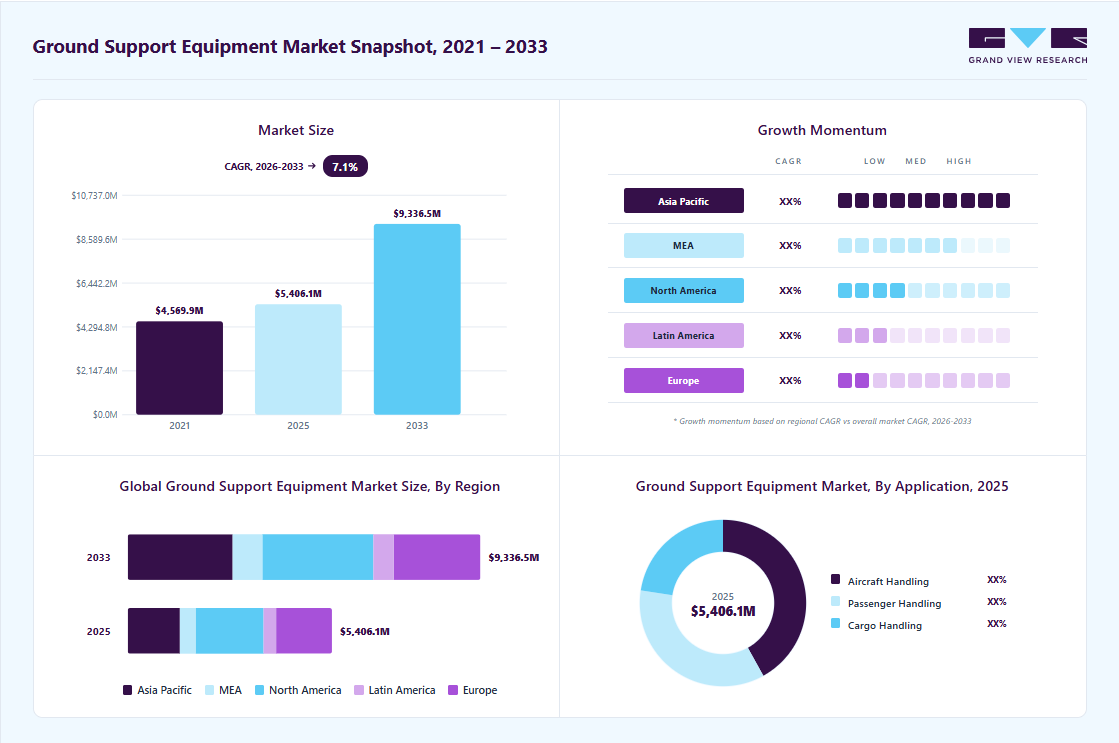
The global ground support equipment market size was valued at USD 5.4 billion in 2025 and is projected to grow from USD 5.8 billion in 2026 to USD 9.3 billion by 2033, at a CAGR of 7.1% from 2026 to 2033. The North America held the largest share of 33.0% of the global market in 2025. This market expansion is driven by the increasing integration of data-driven ground handling operations, the growing deployment of connected and telematics-enabled GSE, and the rising demand for optimized ramp operations to improve airport throughput and minimize delays.
 Source: Grand View Research, IR Documents, Primary Interviews, Paid DatabasesTo learn more about this report,
 Download Free Sample Report
 Key Market Trends & Insights
- By equipment type: Non-electric segment held the largest revenue share of 64.0% in 2025.
- By application: Aircraft handling segment accounted for the largest share of 41.0% in 2025.
- By ownership: Airport owned segment led the market with the largest share of 38.0% in 2025.
Regional Highlights
- Largest regional market: North America (33.0% revenue share, 2025)
- Fastest-growing regional market: Asia Pacific (highest CAGR, 2026-2033)
- By country: The U.S. led the North America market in 2025.
Market Size & Forecast
- Market size in 2025: USD 5.4 Billion
- Estimated market size in 2026: USD 5.8 Billion
- Projected market size by 2033: USD 9.3 Billion
- CAGR (2026-2033): 7.1%
Three ways to get this report
Buy it, customize it, or ask a question.Ask an Analyst
Analyst response in 1 business day
- AccessReport author, directly
- Reply timeWithin 1 working day
- No sales callDirect answer only
- FormatEmail reply
- CostFree, no cost
Get the Full Report
What the study covers
- FormatsPDF · Excel · Dashboard
- Timeline2026–2033 annual, 2025 base
- Coverage20+ countries, 5 regions
- Companies10+ key players profiled
Customize the Report
20% free customization
- IncludeCountries, segments, points
- TailorTo your product definition
- ExtendDeeper competitor detail
- OrA fully bespoke study
- Turnaround5–10 working days
The growth of the ground support equipment market is driven by the convergence of digitalization, automation, and sustainable technologies that redefine operational efficiency across airport ecosystems. The adoption of electric and hybrid-powered GSE units is accelerating as airports and airlines align with global carbon-neutral targets, reducing fuel dependency and maintenance costs. Advanced telematics, IoT sensors, and edge computing enable real-time fleet monitoring, predictive maintenance, and data-driven decision-making, minimizing downtime and enhancing turnaround efficiency.The rapid adoption of advanced fleet orchestration platforms and cloud-based ground operations management systems is significantly transforming airport ramp activities by enabling centralized command and enhanced decision-making. These platforms leverage real-time operational intelligence to streamline equipment dispatching, optimize workforce coordination, and improve turnaround reliability. The integration of edge computing and sensor-based diagnostics further supports predictive performance monitoring, enabling operators to reduce unplanned downtime and enhance operational continuity across busy airport environments.
 To learn more about this report, Download Free Sample Report
 In addition, the market is witnessing growing momentum toward modular and multi-functional ground support equipment designed to support diverse aircraft types and evolving airport layouts. Manufacturers are increasingly developing flexible equipment configurations that can be easily upgraded or reconfigured to meet changing operational requirements. This shift toward adaptable and lifecycle-efficient equipment is enabling airports and ground handlers to maximize asset utilization while controlling long-term maintenance and replacement costs in dynamic aviation ecosystems.
Moreover, the expansion of dedicated air cargo terminals and the surge in time-sensitive logistics operations are driving demand for specialized, high-throughput ground handling solutions. Airports are increasingly investing in high-capacity cargo loaders, automated pallet handling systems, and temperature-controlled support equipment to accommodate pharmaceutical, e-commerce, and perishable goods shipments. This growing emphasis on cargo efficiency and reliability is strengthening the role of the advanced ground support equipment industry.
Furthermore, the emergence of performance-based service contracts and outsourced ground handling models is reshaping procurement strategies across the ground support equipment industry. Airlines and airport authorities are increasingly partnering with service providers that offer integrated maintenance, leasing, and operational support solutions to improve cost predictability and operational flexibility. This transition toward service-oriented business models is encouraging continuous innovation in equipment design, reliability engineering, and lifecycle management, positioning ground support equipment market providers to meet the evolving demands of modern aviation operations.
Equipment Type Insights
The non-electric segment accounted for the largest market share of over 64% in 2025, owing to its continued dominance in high-load and mission-critical ground handling operations that require immediate power delivery and operational flexibility. The non-electric segment benefits from its compatibility with existing airport infrastructure and its ability to support remote or infrastructure-limited locations where charging networks or grid capacity remain constrained. The availability of advanced fuel-efficient engines and hybrid-ready mechanical systems is improving operational efficiency, reinforcing the segment’s strong presence in large international airports and defense aviation facilities.
The electric segment is expected to witness the fastest CAGR of 10.6% from 2026 to 2033. The increasing deployment of high-capacity fast-charging infrastructure and energy management systems is accelerating the growth of the ground support equipment industry. Modern lithium-ion and next-generation solid-state battery technologies enable faster charging cycles and enhanced operational reliability across demanding airport environments. The rising investments in renewable energy integration, smart charging networks, and total cost of ownership optimization strategies are encouraging airports and ground handling operators to transition toward fully electric fleets in the global market.
Application Insights
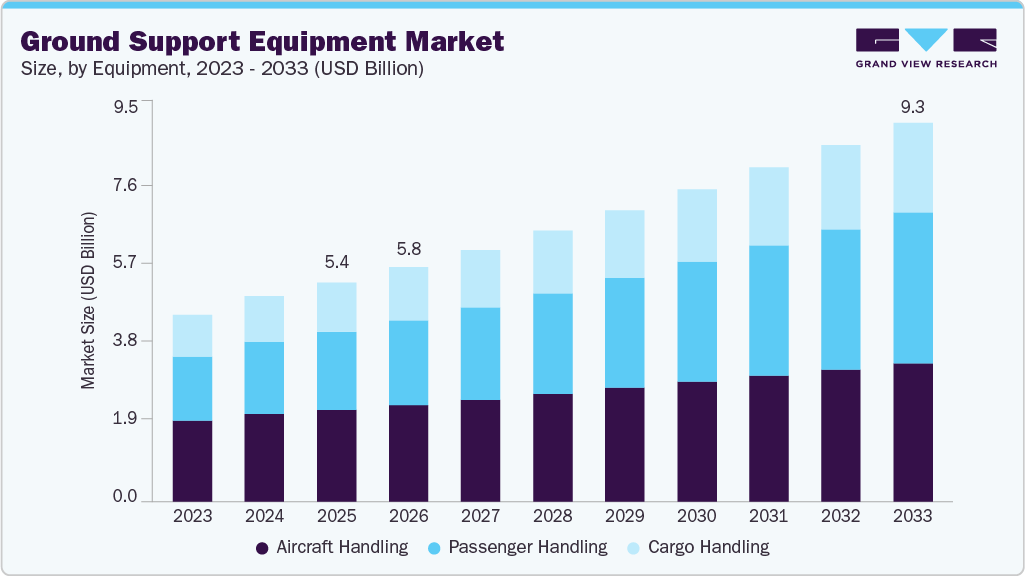
The aircraft handling segment accounted for the largest market share in 2025, propelled by its central role in supporting high-frequency flight operations and maintaining rapid aircraft turnaround in increasingly congested airport environments. Airports and ground service providers are prioritizing investments in high-capacity towing, refueling, and ground power systems capable of supporting next-generation aircraft fleets and larger wide-body aircraft. The continued expansion of international flight networks and cargo-intensive operations further reinforces the segment’s leading position in the ground support equipment market.
 To learn more about this report, Download Free Sample Report
 The passenger handling segment is expected to witness the fastest CAGR from 2026 to 2033. The rising demand for seamless, contactless, and digitally enabled passenger processing is accelerating the growth of the passenger handling segment. Airports are increasingly deploying biometric identification systems, automated passenger flow management platforms, and intelligent queue optimization solutions to handle growing passenger volumes efficiently. The growing focus on reducing wait times, enhancing accessibility, and improving overall terminal throughput is expected to support rapid expansion in the passenger handling segment of the ground support equipment industry.
Ownership Insights
The airport-owned segment accounted for the largest market share in 2025, driven by the increasing need for integrated ground operations management and long-term asset optimization across major aviation hubs. Airports are increasingly investing in proprietary ground support equipment fleets to support centralized control over fleet utilization, safety compliance, and operational standardization. The expansion of mega-airport terminals and multi-runway operations is encouraging airport authorities to maintain dedicated GSE fleets to ensure operational resilience and minimize dependency on third-party service providers.
The leased segment is expected to witness the fastest CAGR from 2026 to 2033, driven by the rising adoption of flexible procurement strategies and performance-based service agreements within the aviation sector. Leasing models are increasingly preferred by airlines and ground handling companies seeking rapid fleet modernization without long-term capital commitments. The availability of short-term and usage-based leasing contracts allows operators to quickly scale equipment capacity during peak travel seasons or special events. The growing presence of specialized GSE leasing companies offering bundled services such as maintenance, upgrades, and technology integration is accelerating the adoption of leased equipment across evolving airport ecosystems.
End-use Insights
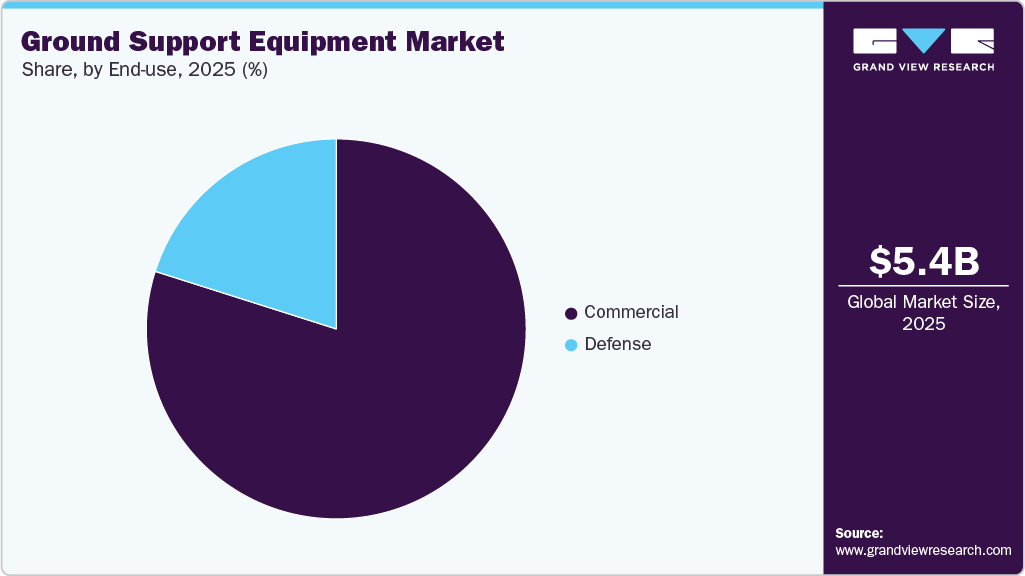
The commercial segment accounted for the largest market share in 2025, owing to the rapid expansion of global airline networks and the increasing demand for high-frequency flight operations. Airports and airlines are investing in high-efficiency ramp support systems and integrated ground handling platforms to manage growing aircraft movements and reduce turnaround bottlenecks. The increasing focus on operational cost optimization and service reliability is reinforcing the commercial segment’s dominant position in the ground support equipment market.
The defense segment is expected to witness a significant CAGR from 2026 to 2033. This growth is driven by the increasing emphasis on rapid deployment capabilities and mission-ready airbase infrastructure. Military organizations are investing in ruggedized and mobile ground support equipment designed to support remote operations and multi-role aircraft platforms. The rising defense budget allocations and the modernization of air logistics and support infrastructure are positioning the defense segment as a key growth area in the ground support equipment industry.
Regional Insights
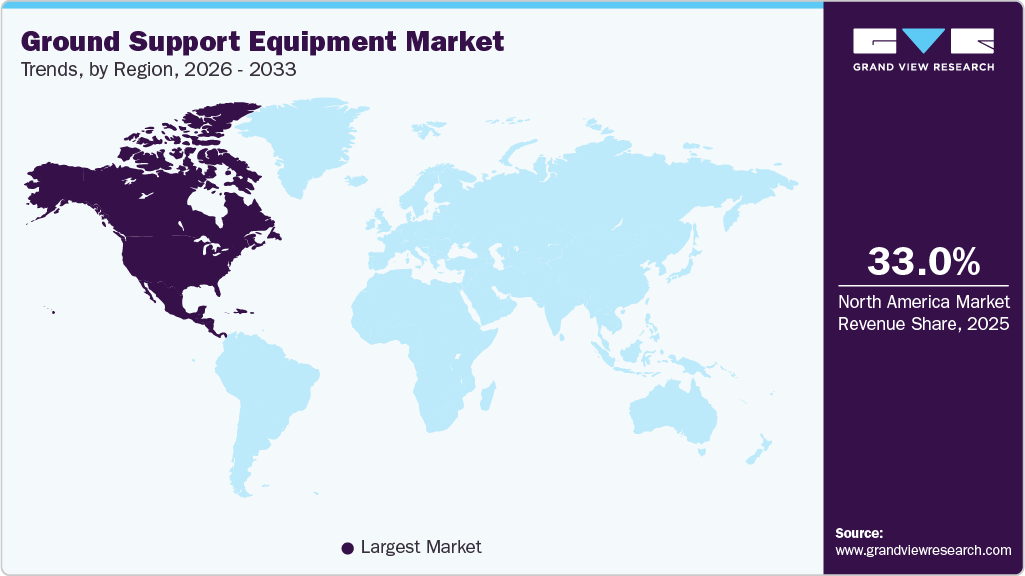
North America significantly dominated the ground support equipment market with a share of over 33% in 2025, driven by the growing emphasis on operational efficiency and turnaround time optimization at high-traffic airports, along with the increasing deployment of advanced fleet analytics and predictive maintenance solutions. The region is witnessing strong adoption of connected GSE ecosystems that enable real-time monitoring and performance tracking. The expansion of e-commerce-driven air cargo networks and the rising demand for specialized cargo handling equipment are further strengthening market growth across both commercial and defense aviation sectors.
 To learn more about this report, Download Free Sample Report
 U.S. Ground Support Equipment Market Trends
The U.S. ground support equipment dominated the market with a share of over 83% in 2025, fueled by increasing investments in next-generation airport technologies, including autonomous towing vehicles and AI-enabled ramp operations. The rising focus on minimizing aircraft turnaround time and improving ground handling precision is encouraging the deployment of smart and ensor-based equipment. The expansion of cargo-centric airport infrastructure and the growing role of private operators in ground handling services are contributing to sustained market growth in the country.
Europe Ground Support Equipment Market Trends
Europe ground support equipment market is expected to grow at a CAGR of 5.7% from 2026 to 2033. The market growth is driven by the increasing adoption of circular economy practices in airport operations, including refurbishment and lifecycle extension of GSE assets. Additionally, the region is experiencing a surge in demand for modular and multi-functional ground support equipment that enhances flexibility across diverse aircraft types. The integration of digital twins and simulation-based airport planning tools is also supporting efficient fleet utilization and operational planning.
The UK ground support equipment market is expected to grow significantly in the coming years, driven by the rising implementation of smart airport frameworks and data-driven decision-making systems. Increasing collaboration between airport authorities and technology providers is fostering innovation in automated ground handling solutions. The growing focus on enhancing passenger experience through faster turnaround and reduced delays is indirectly boosting demand for the ground support equipment industry.
Ground support equipment market in Germany is driven by the increasing focus on Industry 4.0 integration within airport ground operations and the adoption of high-precision, sensor-enabled equipment. The country is witnessing a rising demand for interoperable GSE systems that can seamlessly integrate with airport IT infrastructure. Strong emphasis on engineering excellence and technological innovation is encouraging the development of highly efficient, durable, and digitally connected equipment solutions.
Asia Pacific Ground Support Equipment Market Trends
The Asia-Pacific ground support equipment market is expected to grow at the highest CAGR of 9.2% in 2025, driven by the rapid emergence of secondary and regional airports and the increasing need for cost-efficient and scalable ground handling solutions. The region is experiencing rising adoption of leasing and rental models for GSE, enabling smaller operators to access advanced equipment. The growing penetration of digital platforms for fleet coordination and workforce management is enhancing operational efficiency across aviation hubs in the market.
Ground support equipment market in Japan is gaining traction owing to the increasing adoption of robotics and precision automation in airport ground operations. The country is focusing on integrating advanced control systems and compact equipment designs suited for space-constrained airports. The growing emphasis on disaster-resilient airport infrastructure is encouraging investments in reliable and high-performance GSE solutions.
The China ground support equipment market is rapidly expanding. China's ground support equipment market is driven by the increasing localization of GSE manufacturing and the rapid development of technologically advanced domestic suppliers. The country is witnessing strong growth in smart airport projects that incorporate AI-driven scheduling and automated ground handling systems. The expansion of dedicated air cargo hubs and free trade zones is accelerating demand for high-capacity and specialized ground support equipment across the aviation sector.
Key Ground Support Equipment Company Insights
Some of the key players operating in the market are Oshkosh Aerotech LLC and Textron Inc., among others.
-
Oshkosh Aerotech LLC provides advanced ground support and airport mobility solutions designed to enhance airside operations and aircraft servicing efficiency. The company offers a comprehensive range of products, including aircraft loaders, tow tractors, deicers, and passenger boarding bridges, integrated with digital control systems for improved safety and productivity. Oshkosh Aerotech presence and continuous innovation in electric GSE platforms position it as a leading player in modern airport infrastructure development.
-
Textron Inc. specializes in manufacturing tow tractors, belt loaders, and ground power units that serve both commercial and military aviation sectors. Textron’s focus on electrification, telematics integration, and fleet management solutions enhances operational visibility and sustainability. With a robust global service network and strong OEM relationships, Textron continues to lead the GSE market through innovation, reliability, and its commitment to advancing next-generation electric and hybrid ground support equipment (GSE) solutions.
Mallaghan and TCR Group are some of the emerging market participants in the ground support equipment market.
-
Mallaghan is an emerging innovator in the ground support equipment industry, specializing in the design and manufacture of high-quality passenger stairs, catering trucks, medical lifts, and aircraft maintenance platforms. The company emphasizes customization, safety, and eco-efficiency, offering electric-powered variants to meet evolving airport sustainability requirements. Mallaghan is gaining recognition for its advanced engineering capabilities and flexible design approach, enabling airports and airlines to optimize ground handling operations.
-
TCR Group is rapidly expanding as a key player in GSE rental, leasing, and fleet management services, offering comprehensive end-to-end solutions that maximize equipment uptime and operational efficiency. The company provides electric and hybrid ground support vehicles, telematics-based monitoring, and maintenance support to leading airlines and ground handlers. TCR’s service-driven model and strategic expansion make it one of the fastest-growing companies in the global ground support equipment market.
Key Ground Support Equipment Companies:
The following key companies have been profiled for this study on the ground support equipment market.
- Oshkosh Aerotech LLC
- Textron Inc.
- TCR Group
- Tronair
- Weihai Guangtai Airport Equipment Co., Ltd.
- China International Marine Containers (Group) Co., Ltd.
- TLD Group
- Cavotec Group
- Toyota Material Handling, Inc.
- TREPEL Airport Equipment GmbH
- Global Ground Support LLC
- Mallaghan
- Jalux Inc.
- Rheinmetall AG
Recent Developments
-
In March 2026, Oshkosh Aerotech LLC showcased its PIVOT Passenger Boarding Bridge platform and LEKTRO AP8950SDB Electric Towbarless Tractor in collaboration with Fraport AG and Dubai Airports. The demonstration highlighted integrated gate and ramp automation solutions designed to improve aircraft turnaround efficiency and support smart airport modernization initiatives in the ground support equipment market.
-
In January 2026, Rheinmetall AG initiated deployment programs for advanced airbase logistics and aircraft ground handling vehicles designed to enhance operational readiness and mobility for military aviation units. The development supports ongoing defense modernization programs and the need for resilient ground support infrastructure across military airbases in the global ground support equipment industry.
-
In November 2025, Toyota Material Handling, Inc. launched its Traigo80 Electric Tow Tractor and Core Electric Baggage Tractor Series in partnership with ANA Holdings and Narita International Airport Corporation. The deployment aimed to enhance ground handling productivity and support high-volume passenger and cargo operations in major aviation hubs airbases in the global ground support equipment market.
Ground Support Equipment Market Report Scope
Report Attribute
Details
Market size in 2025
USD 5.4 billion
Estimated market size in 2026
USD 5.8 billion
Projected market size by 2033
USD 9.3 billion
Growth rate
CAGR of 7.1% from 2026 to 2033
Base year for estimation
2025
Historical data
2021 - 2024
Forecast period
2026 - 2033
Quantitative units
Revenue in USD million/billion, and CAGR from 2026 to 2033
Report Product
Revenue forecast, company ranking, competitive landscape, growth factors, and trends
Segments covered
Type, application, ownership, end-use, region
Region scope
North America; Europe; Asia Pacific; Latin America; Middle East & Africa
Country scope
U.S.; Canada; Mexico; UK; Germany; France; Italy; China; Japan; India; South Korea; Australia; Brazil; UAE; Saudi Arabia; South Africa
Key companies profiled
Oshkosh Aerotech LLC; Textron Inc.; TCR Group; Tronair; Weihai Guangtai Airport Equipment Co.Ltd.; China International Marine Containers (Group) Co., Ltd.; TLD Group; Cavotec Group; Toyota Material Handling, Inc.; TREPEL Airport Equipment GmbH; Global Ground Support LLC; Mallaghan; Jalux Inc.; Rheinmetall AG
Customization scope
Free report customization (equivalent to up to 8 analyst’s working days) with purchase. Addition or alteration to country, regional & segment scope.
Pricing and purchase options
Avail customized purchase options to meet you exact research needs. Explore purchase options
Global Ground Support Equipment Market Report Segmentation
This report forecasts revenue growth at global, regional, and country levels and provides an analysis of the latest technological trends in each of the sub-segments from 2021 to 2033. For this study, Grand View Research has segmented the global ground support equipment market report based on equipment type, application, ownership, end-use, and region:
-
Equipment Type Outlook (Revenue, USD Million, 2021 - 2033)
-
Non-Electric
-
Electric
-
Hybrid
-
-
Application Outlook (Revenue, USD Million, 2021 - 2033)
-
Aircraft Handling
-
Passenger Handling
-
Cargo Handling
-
-
Ownership Outlook (Revenue, USD Million, 2021 - 2033)
-
Airport Owned
-
Airline Owned
-
Service Provider
-
Leased
-
-
End-use Outlook (Revenue, USD Million, 2021 - 2033)
-
Commercial
-
Defense
-
-
Regional Outlook (Revenue, USD Million, 2021 - 2033)
-
North America
-
U.S.
-
Canada
-
Mexico
-
-
Europe
-
UK
-
Germany
-
France
-
Italy
-
-
Asia Pacific
-
China
-
Japan
-
India
-
South Korea
-
Australia
-
-
Latin America
-
Brazil
-
-
Middle East and Africa (MEA)
-
UAE
-
Saudi Arabia
-
South Africa
-
-
Frequently Asked Questions About This Report
Asia Pacific is the fastest-growing region over the forecast period.
The commercial segment held the largest revenue share in 2025.
Non-electric segment held the largest share (over 64.0%) in 2025, while electric is the fastest-growing type.
The global ground support equipment market size was valued at USD 5.4 billion in 2025 and is estimated at USD 5.8 billion for 2026.
The global ground support equipment market is expected to grow at a CAGR of 7.1% from 2026 to 2033, reaching USD 9.3 billion by 2033.
Key players include Oshkosh Aerotech LLC; Textron Inc.; TCR Group; Tronair; Weihai Guangtai Airport Equipment Co.Ltd.; China International Marine Containers (Group) Co., Ltd.; TLD Group; Cavotec Group; Toyota Material Handling, Inc.; TREPEL Airport Equipment GmbH; Global Ground Support LLC; Mallaghan; Jalux Inc.; Rheinmetall AG.
The North America ground support equipment market accounted for the largest market share of over 33.0% in 2025, primarily driven by expanding airport modernization programs, increasing air traffic volumes, and strong federal initiatives promoting sustainability and electrification in aviation operations. The Federal Aviation Administration (FAA) and state-level programs are incentivizing the replacement of conventional diesel-powered GSE with electric and hybrid alternatives to reduce emissions and enhance efficiency. The growing investments from major airlines and airport authorities in digitalized fleet management, automation, and smart charging infrastructure are further accelerating market growth.
The airport-owned segment accounted for the largest revenue share of 38.0% in 2025, while leased is the fastest-growing segment.
The aircraft handling segment held the largest revenue share of 41.0% in 2025, while passenger handling is the fastest-growing application.
Key drivers of the ground support equipment market include the increasing air passenger traffic, the expansion of airport infrastructure, rising demand for efficient aircraft turnaround operations, and growing adoption of electric and hybrid GSE to reduce emissions and operational costs.
About the Author(s)
Next Generation Technologies Research Team
Technology · Next Generation TechnologiesThis report was authored by the next generation technologies research team at Grand View Research - comprising two research analysts, one senior research analyst, and one industry expert - with specialized expertise in the next generation technologies segment of the technology industry. All findings are based on proprietary technology databases, executive interviews, and regulatory analysis, subject to internal peer review prior to publication.
Last Updated:
Speak to Analyst

Customize this report to your needs - add regions, segments, or data points, with 20% free customization.
Or view our licence options:


ISO 9001:2015 & 27001:2022 Certified
We are GDPR and CCPA compliant! Your transaction & personal information is safe and secure. For more details, please read our privacy policy.


