
- Home
- »
- Advanced Interior Materials
- »
-
Gypsum Market Size, Share, And Trends Report, 2026-2033GVR Report cover

Gypsum Market (2026 - 2033) Size, Share & Trends Analysis Report By Type (Natural, Synthetic), By Application (Gypsum Board, Cement Additive, Plaster Of Paris, Agriculture), By Region (North America, Europe, Asia Pacific, Latin America, MEA), And Segment Forecasts
Market Size, 2025
$16.9BMarket Estimate, 2026
$17.7BMarket Forecast, 2033
$32.5BCAGR, 2026–2033
9.1%Gypsum Market Summary
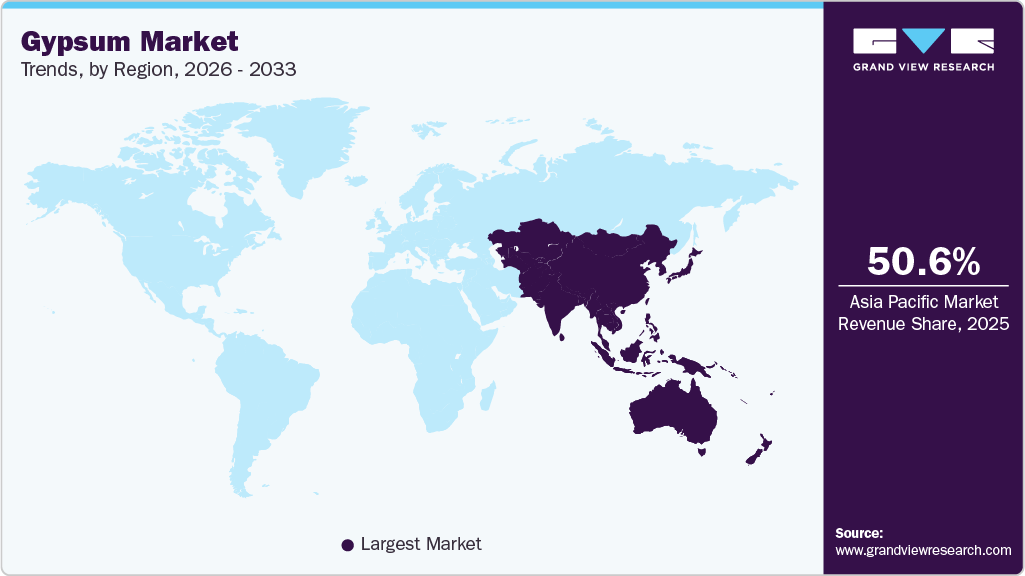
The global gypsum market size was valued at USD 16.9 billion in 2025 and is projected to grow from USD 17.7 billion in 2026 to USD 32.5 billion by 2033, at a CAGR of 9.1% from 2026 to 2033. Asia Pacific dominated the gypsum market with the largest revenue share of 50.6% in 2025. This growth is largely driven by increasing demand for construction materials that offer enhanced fire, moisture, and acoustic insulation, as well as energy efficiency.
 Source: Grand View Research, IR Documents, Primary Interviews, Paid DatabasesTo learn more about this report,
 Download Free Sample Report
 Key Market Trends & Insights
- By type: Synthetic gypsum segment accounted for the largest share in 2025.
- By application: Cement additives segment is projected to grow at the fastest CAGR from 2026 to 2033.
- By application: Gypsum board held the largest share in 2025.
Regional Highlights
- Largest regional market: Asia Pacific (50.6% revenue share, 2025)
- By country: India gypsum market is expected to grow at the fastest CAGR of 10.1% from 2026 to 2033.
Market Size & Forecast
- Market size in 2025: USD 16.9 Billion
- Estimated market size in 2026: USD 17.7 Billion
- Projected market size by 2033: USD 32.5 Billion
- CAGR (2026-2033): 9.1%
GVR research-powered AIAsk Prism AI about the gypsum marketGet cited answers from GVR research on market growth, segments, regulations and forecasts.Start with✓ Source-linked answers ✓ Market-specific context ✓ Traceable figuresExplore Prism AI ↗
The global gypsum industry operates within a regulatory environment shaped by mining legislation, environmental protection policies, building material standards, and occupational safety regulations. Governments and international organizations regulate the extraction of natural gypsum, the manufacturing of gypsum-based materials, and the management of industrial byproducts to ensure responsible resource utilization and product reliability. Regulations also influence trade, transportation, and the use of gypsum in construction and industrial sectors, making compliance an essential requirement for market participants operating across multiple regions.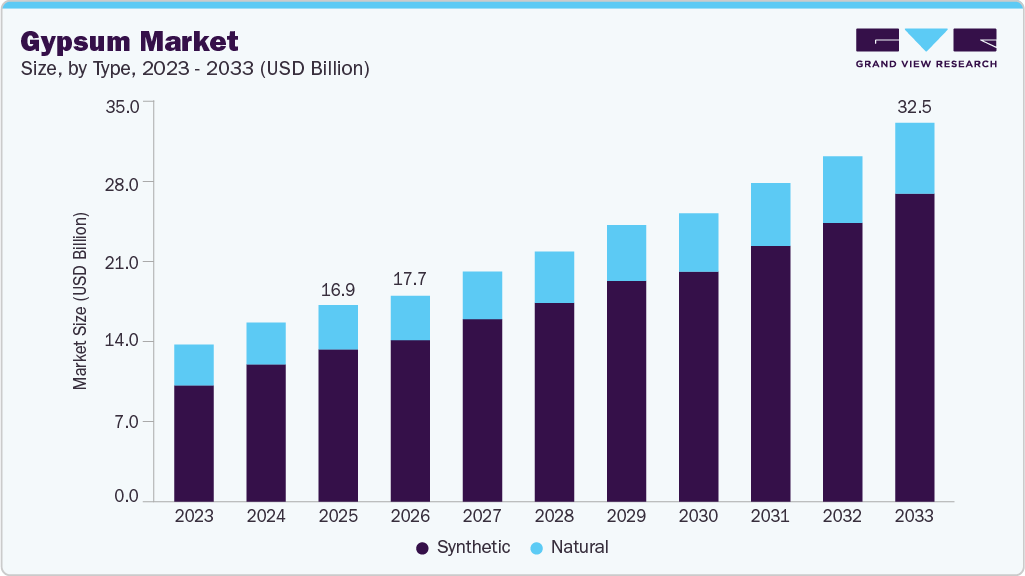 To learn more about this report, Download Free Sample Report
 Moreover, the global push for green buildings and net-zero energy structures is driving the adoption of these materials, which improve insulation and reduce carbon footprints. Its expanding role in innovative ceiling systems, partition walls, and eco-friendly plasters reinforces its position at the core of next-generation, sustainable infrastructure and innovative building solutions.
Drivers, Opportunities & Restraints
The growth of residential and commercial construction globally is a major driver of gypsum demand, as gypsum products such as plaster, drywall, and gypsum boards are extensively used in interior wall systems, ceilings, and partitions. These materials are preferred in modern construction due to their fire resistance, lightweight properties, sound insulation, and ease of installation. As urbanization and housing demand increase across both developed and developing economies, the consumption of gypsum-based materials has expanded significantly.
With rising green construction and sustainability awareness, there is a significant opportunity for gypsum types to expand their footprint in eco-friendly building solutions. Innovations in prefabrication and modular construction open new avenues for gypsum boards and plasters, offering faster project completion and reduced waste. Moreover, the growing focus on renovating and remodeling existing structures in developed markets offers a promising boost to demand. Emerging technologies that enhance gypsum’s performance, such as improved water resistance and durability, also provide potential for broader application beyond traditional construction uses.
Stringent environmental regulations are increasingly influencing the global gypsum market by raising compliance requirements across mining, processing, and manufacturing operations. Gypsum extraction, particularly through open-pit mining, is subject to strict regulations related to land use, dust emissions, water management, and land restoration. In many countries, regulatory authorities require mining companies to conduct detailed environmental impact assessments and implement rehabilitation programs for mined land, which increase operational and capital expenditures.
Type Insights
Synthetic gypsum accounted for the largest share of the gypsum market in 2025. It sees rising demand in the construction sector due to its consistent purity, controlled composition, and sustainable production from industrial byproducts such as flue-gas desulfurization (FGD) processes. It is extensively used in gypsum boards, panels, and wall systems for residential, commercial, and industrial projects, providing superior fire resistance, acoustic insulation, and dimensional stability, while supporting green building practices and reducing reliance on natural gypsum.
Natural gypsum is a soft sulfate mineral composed primarily of calcium sulfate dihydrate (CaSO₄·2H₂O). Its relatively low hardness makes it easy to crush and grind for various uses. Its key properties include excellent fire resistance due to the water content in its crystal structure, which releases steam when heated, helping to slow combustion. Natural gypsum is widely used in the construction industry, primarily for manufacturing plaster, plasterboard (drywall), and a set retarder in cement type. It is essential for producing wall finishes, ceilings, partitions, and decorative moldings. It also finds applications in sculptures, castings, and medical orthopedic devices such as plaster of Paris. Its versatility and safety make it a critical raw material in multiple industrial and agricultural sectors.
Application Insights
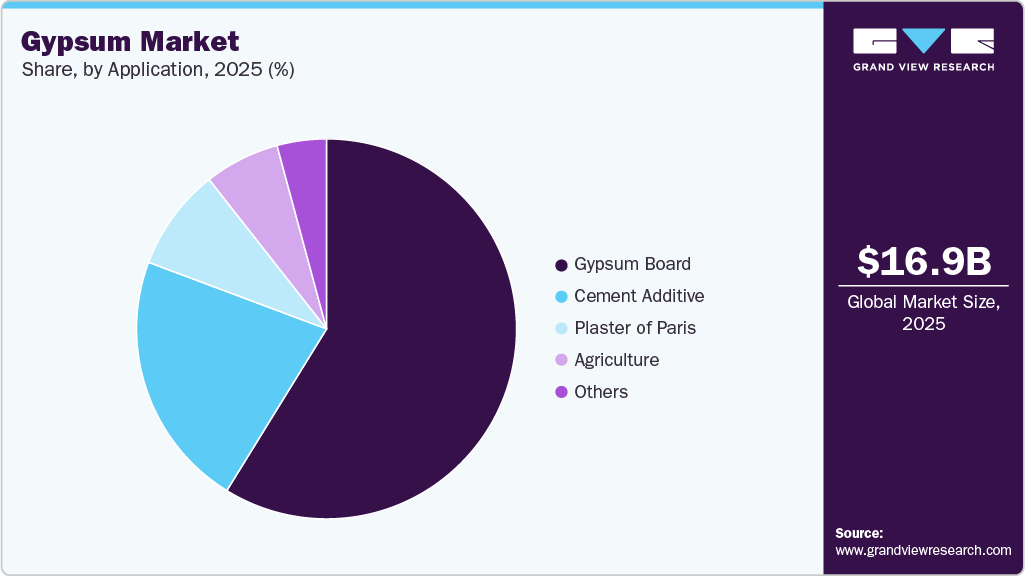
Gypsum board held the largest share of the gypsum industry in 2025, driven by its widespread use and versatility. Known for their lightweight, fire-resistant, and easy-to-install properties, they are the preferred choice for modern construction projects. They are extensively used in residential, commercial, and institutional buildings to create interior walls, ceilings, and partitions.
 To learn more about this report, Download Free Sample Report
 The primary growth driver for gypsum as a cement additive remains its indispensable role as a retarding agent in Portland cement. During the clinker grinding process, gypsum is added in precise concentrations, typically 3% to 5%, to prevent "flash setting." By reacting with tricalcium aluminate to form ettringite, gypsum creates a protective layer that slows early hydration. This allows construction crews the necessary "open time" to mix, transport, and place concretely effectively, a requirement that scales directly with the global expansion of infrastructure projects.
The Plaster of Paris (POP) segment is a significant application area within the gypsum market, primarily due to its widespread use in construction, decorative applications, and industrial molding. POP is widely used for interior wall finishing, ceiling coatings, and architectural moldings because it is easy to apply, lightweight, and provides smooth finishes. For instance, large residential and commercial construction projects in emerging economies such as India, China, and Southeast Asia increasingly adopt gypsum-based plasters to accelerate construction timelines and reduce structural load, thereby boosting the demand for POP products.
Regional Insights
The North America gypsum market growth is primarily driven by the region's robust construction sector, stringent environmental regulations promoting sustainable materials, and significant investments in renovation and recycling infrastructure. These factors collectively ensure steady demand and a resilient supply chain for gypsum products across residential, commercial, and industrial applications. Demand is intrinsically linked to macroeconomic cycles, with new residential construction acting as a primary engine. Housing starts, mortgage rates, and demographic trends like household formation are critical leading indicators; for instance, the U.S. alone consumes approximately 90% of the region's gypsum volume, reaching 30 million tons in 2024.
U.S. Gypsum Market Trends
The U.S. gypsum industry is experiencing notable growth, fueled by strong demand from the construction, agriculture, and infrastructure sectors and shaped by evolving regulatory and environmental policies. In early 2025, the U.S. government initiated discussions around stricter ecological standards for gypsum mining and increased oversight on synthetic gypsum derived from industrial by-products. These policy shifts aim to promote sustainable practices and reduce environmental impact, though they may introduce short-term uncertainties in supply and transportation costs.
Asia Pacific Gypsum Market Trends
The Asia Pacific region remains the largest global market for gypsum, supported by sustained economic growth and infrastructure spending across major economies. The strategic shift toward sustainable manufacturing and prefabrication to mitigate labor shortages and comply with environmental regulations is proliferating the market in the Asia Pacific. In mature markets like Japan and South Korea, escalating labor costs have made gypsum-integrated modular kits, which can reduce on-site man-hours by up to 40%, the new industry standard. Meanwhile, China's current Five-Year Plan is pushing for energy-efficient "green buildings," driving a surge in demand for specialized thermal and acoustic gypsum boards to meet strict energy consumption targets.
 To learn more about this report, Download Free Sample Report
 Europe Gypsum Market Trends
The Europe gypsum industry navigates a complex landscape shaped by supply constraints, regulatory changes, and evolving construction demands. A key challenge facing the region is the tightening supply of natural gypsum, exacerbated by reduced mining activity resulting from stricter environmental regulations and land-use restrictions. This has led to a growing reliance on synthetic gypsum, particularly from flue gas desulfurization processes, to meet domestic demand. In major markets like Germany, France, and the Netherlands, spot availability has become increasingly limited, especially amid heightened construction activity and demand for energy-efficient building materials.
Latin America Gypsum Market Trends
The market in Latin America is primarily driven by expanding construction activities across emerging economies such as Brazil, Mexico, Chile, and Colombia. Rapid urbanization, population growth, and rising demand for residential housing have significantly increased the need for interior construction materials, including gypsum boards, plaster, and ceiling systems.
Middle East & Africa Gypsum Market Trends
The market across the Middle East and Africa is experiencing strong growth driven by accelerating infrastructure development and large-scale construction in major economies such as Saudi Arabia, the UAE, Qatar, and South Africa. The region is considered one of the most dynamic gypsum markets globally, supported by a substantial domestic production capacity of approximately 3,800 thousand metric tons in Saudi Arabia alone. This expansion is closely linked to transformative national development initiatives, including Saudi Vision 2030 and large-scale projects such as NEOM.
Key Gypsum Company Insights
Some of the key players operating in the market include American Gypsum Company, LLC, Beijing New Building Materials Public Limited Company, and others.
-
American Gypsum Company, LLC is a U.S.-based manufacturer specializing in gypsum wallboard and drywall products used in residential, commercial, and industrial construction. Headquartered in Dallas, Texas, the company has been producing and distributing gypsum wallboard products for more than half a century, supplying the drywall industry across the U.S. Its operations focus on delivering high-quality wallboard solutions supported by modern manufacturing facilities, reliable distribution networks, and a strong emphasis on customer service for contractors, architects, builders, and distributors.
-
Beijing New Building Materials Public Limited Company (BNBM) is a Chinese manufacturer of advanced building materials and operates as the new materials platform of China National Building Material Group, a state-owned Fortune Global 500 enterprise. The company focuses on the development, production, and distribution of modern construction materials, supporting large-scale infrastructure and commercial building projects across domestic and international markets.
-
Knauf Group is a multinational, family-owned building materials manufacturer headquartered in Iphofen, Germany. The company was founded in 1932 by brothers Karl and Alfons Knauf and initially focused on gypsum extraction and processing before expanding into a wide portfolio of construction materials and systems. Over the decades, the company has grown into one of the world’s largest producers of gypsum-based building materials, operating in more than 90 countries, employing over 43,000 people, and operating hundreds of production facilities worldwide.
Key Gypsum Companies:
The following key companies have been profiled for this study on the gypsum market.
- American Gypsum Company, LLC
- BNBM
- Etex Group
- Georgia-Pacific
- Gypsemna Co. LLC.
- Knauf Group
- HOLCIM
- National Gypsum Services Company
- Saint-Gobain
- YOSHINO GYPSUM CO., LTD.
Recent Developments
-
In March 2026, Saint-Gobain India’s Gyproc division commissioned India’s first near-net-zero gypsum ceiling tiles plant in Visakhapatnam, Andhra Pradesh, a state-of-the-art facility launched in December 2025 with 5 million square meters annual capacity for Gyprex PVC-laminated tiles compliant with BS EN 520/14190 standards, featuring dust collection and low-carbon processes to support commercial/institutional demand while advancing net-zero by 2050 goals.
-
In March 2026, Prism Johnson Ltd., through its Prism Cement division, launched Prism Chakachak gypsum plaster, a lightweight, quick-setting, eco-friendly product in its Premix Walling range that requires no water curing, offers fire resistance, low shrinkage, and superior thermal/acoustic insulation for smooth, paint-ready wall and ceiling finishes.
-
In May 2025, Eagle Materials Inc. announced plans to invest USD 330 million in modernizing and expanding its gypsum wallboard plant in Duke, Oklahoma, operated by its subsidiary American Gypsum. The project will boost annual production capacity by 300 million square feet, a 25% increase to about 1.5 billion square feet, while incorporating advanced technology to cut natural gas use and manufacturing costs by nearly 20%.
Gypsum Market Report Scope
Report Attribute
Details
Market definition
The market size represents the annual consumption of both natural gypsum and synthetic gypsum (primarily flue gas desulfurization - FGD gypsum) across various end-use industries in a given year.
Market size in 2025
USD 16.9 billion
Estimated Market size in 2026
USD 17.7 billion
Projected Market size by 2033
USD 32.5 billion
Growth rate
CAGR of 9.1% from 2026 to 2033
Base year for estimation
2025
Historical data
2021 - 2024
Forecast period
2026 - 2033
Quantitative Units
Revenue in USD million/billion, volume kilotons, and CAGR from 2026 to 2033
Report coverage
Revenue forecast, volume forecast, competitive landscape, growth factors, and trends
Segments covered
Type, application, region
Regional scope
North America; Europe; Asia Pacific; Latin America; Middle East & Africa
Country scope
U.S.; Canada; Mexico; Germany; UK; France; Italy; China; India; Japan; South Korea; Brazil
Key companies profiled
American Gypsum Company, LLC; BNBM; Etex Group; Georgia-Pacific; Gypsemna Co. LLC.; Knauf Group; HOLCIM; National Gypsum Services Company; Saint-Gobain; YOSHINO GYPSUM CO., LTD.
Customization scope
Free report customization (equivalent up to 8 analysts working days) with purchase. Addition or alteration to country, regional & segment scope.
Pricing and purchase options
Avail customized purchase options to meet your exact research needs. Explore purchase options
Global Gypsum Market Report Segmentation
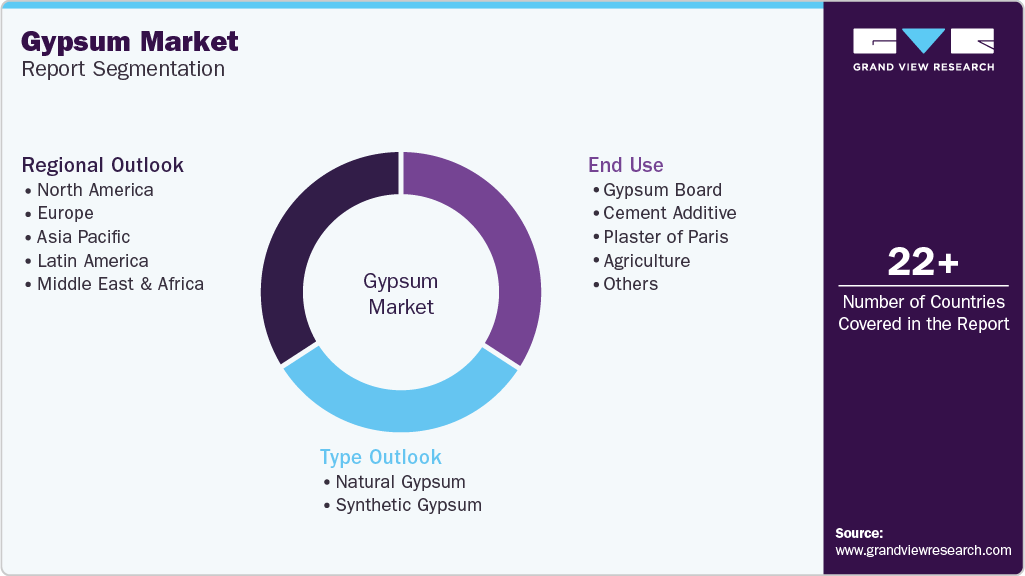
This report forecasts volume & revenue growth at the global, country, and regional levels and analyzes the latest trends in each sub-segment from 2021 to 2033. For this study, Grand View Research has segmented the global gypsum market report by type, application, and region:
 To learn more about this report, Download Free Sample Report
 -
Type Outlook (Volume, Kilotons; Revenue, USD Million, 2021 - 2033)
-
Natural Gypsum
-
Synthetic Gypsum
-
-
Application Outlook (Volume, Kilotons; Revenue, USD Million, 2021 - 2033)
-
Gypsum Board
-
Cement Additive
-
Plaster of Paris
-
Agriculture
-
Others
-
-
Regional Outlook (Volume, Kilotons; Revenue, USD Million, 2021 - 2033)
-
North America
-
U.S.
-
Canada
-
Mexico
-
-
Europe
-
Germany
-
UK
-
France
-
Italy
-
-
Asia Pacific
-
China
-
India
-
Japan
-
South Korea
-
-
Latin America
-
Brazil
-
-
Middle East & Africa
-
Frequently Asked Questions About This Report
The global gypsum market size was valued at USD 16.9 billion in 2025 and is expected to reach USD 17.7 billion in 2026.
The global gypsum market is expected to grow at a compound annual growth rate of 9.1% from 2026 to 2033, reaching USD 32.5 billion by 2033.
Based on types, synthetic gypsum accounted for a revenue share of 77.5% of the gypsum market in 2025, primarily driven by increasing adoption of flue gas desulfurization (FGD) processes and the growing emphasis on sustainable and recycled construction materials.
Key players include American Gypsum Company, LLC; BNBM; Etex Group; Georgia-Pacific; Gypsemna Co. LLC.; Knauf Group; HOLCIM; National Gypsum Services Company; Saint-Gobain; YOSHINO GYPSUM CO., LTD.
Asia Pacific dominated the gypsum market with the largest revenue share of 50.6% in 2025.
Gypsum board held the largest share of the gypsum industry in 2025.
Synthetic gypsum accounted for the largest share of the gypsum market in 2025.
Key factors include the rapid expansion of the construction sector, particularly in emerging economies, where demand for drywall, plaster, and cement is steadily increasing. Additionally, the growing adoption of sustainable building materials and the rising use of synthetic gypsum from industrial by-products are further supporting market growth.
About the Author(s)
Advanced Interior Materials Research Team
Advanced Materials · Advanced Interior MaterialsThis report was authored by the advanced interior materials research team at Grand View Research - comprising two research analysts, one senior research analyst, and one industry expert - with specialized expertise in the advanced interior materials segment of the advanced materials industry. All findings are based on proprietary advanced materials databases, executive interviews, and regulatory analysis, subject to internal peer review prior to publication.
Last Updated:
Speak to Analyst

Customize this report to your needs - add regions, segments, or data points, with 20% free customization.
Or view our licence options:


ISO 9001:2015 & 27001:2022 Certified
We are GDPR and CCPA compliant! Your transaction & personal information is safe and secure. For more details, please read our privacy policy.


