
- Home
- »
- Nutraceuticals & Functional Foods
- »
-
Hair Supplements Market Size & Share Report, 2026-2033GVR Report cover

Hair Supplements Market (2026 - 2033)
Size, Share & Trends Analysis Report By Ingredient Type (Multi-Ingredients), By Ingredients (Vitamin), By Application, By Form, By Type, By End Use, By Distribution Channel (Online And Offline), By Region, And Segment Forecasts
Market Size, 2025
$3.9BMarket Estimate, 2026
$4.3BMarket Forecast, 2033
$9.0BCAGR, 2026–2033
11.1%Hair Supplements Market Summary
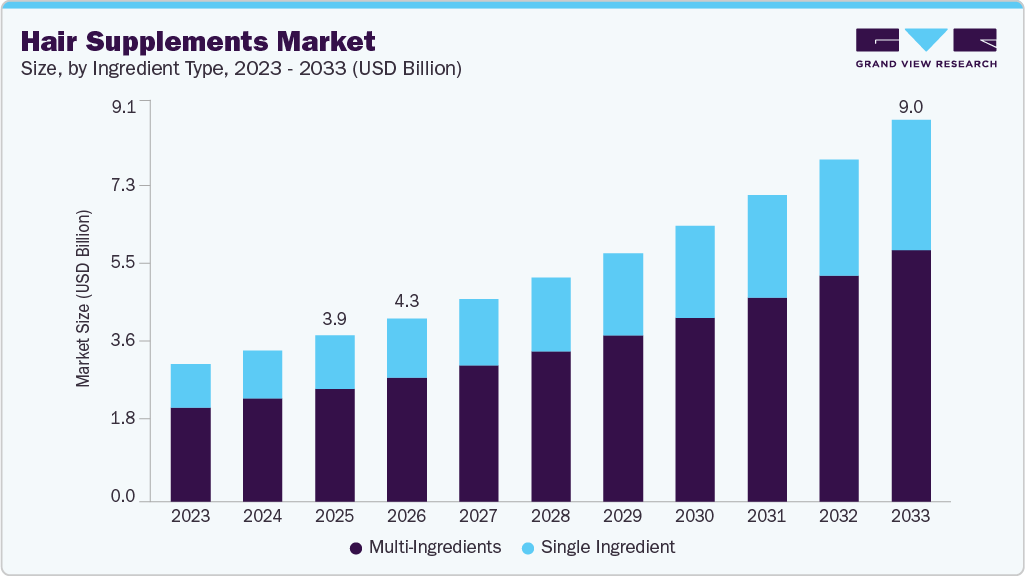
The global hair supplements market size was valued at USD 3.9 billion in 2025 and is projected to grow from USD 4.3 billion in 2026 to USD 9.0 billion by 2033, at a CAGR of 11.1% from 2026 to 2033. Asia Pacific dominated the market, accounting for a revenue share of 48.6% in 2025. The industry is growing as more people experience hair fall and thinning due to stress, lifestyle changes, aging, and nutritional gaps, prompting them to seek simple, non-invasive solutions.
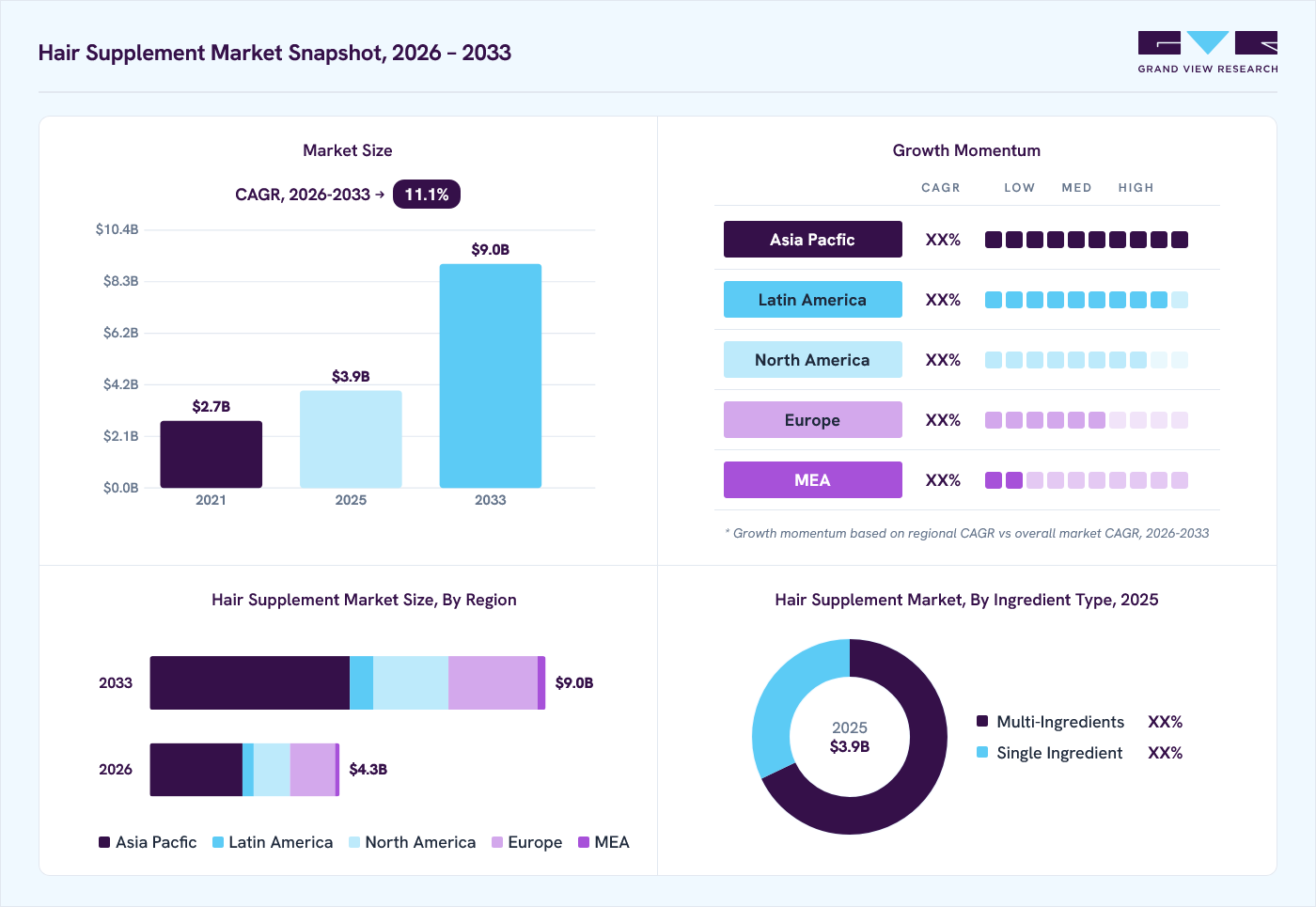 Source: Grand View Research, IR Documents, Primary Interviews, Paid DatabasesTo learn more about this report,
 Download Free Sample Report
 Key Market Trends & Insights
- By ingredient type: Multi-ingredients segment led the market with a share of 67.9% in 2025.
- By ingredient: Vitamin segment led the market with a share of 23.8% in 2025.
- By application: Hair growth/thinning/loss segment led the market with a share of 52.7% in 2025.
- By form: Gummies segment accounted for a market share of 35.8% in 2025.
- By type: OTC segment held a market share of 89.6% in 2025.
- By end use: Female segment accounted for a share of 65.7% in 2025.
- By distribution channel: Offline sales segment accounted for a market share of 75.0% in 2025.
Regional Highlights
- Largest regional market: Asia Pacific (48.6% revenue share, 2025)
- By country: India held the largest market share in 2025
Market Size & Forecast
- Market size in 2025: USD 3.9 Billion
- Estimated market size in 2026: USD 4.3 Billion
- Projected market size by 2033: USD 9.0 Billion
- CAGR (2026-2033): 11.1%
Three ways to get this report
Buy it, customize it, or ask a question.Ask an Analyst
Analyst response in 1 business day
- AccessReport author, directly
- Reply timeWithin 1 working day
- No sales callDirect answer only
- FormatEmail reply
- CostFree, no cost
Get the Full Report
What the study covers
- FormatsPDF · Excel · Dashboard
- Timeline2026–2033 annual, 2025 base
- Coverage20+ countries, 5 regions
- Companies10+ key players profiled
Customize the Report
20% free customization
- IncludeCountries, segments, points
- TailorTo your product definition
- ExtendDeeper competitor detail
- OrA fully bespoke study
- Turnaround5–10 working days
A key trend in the market is the shift toward natural and clean-label formulations, with consumers increasingly preferring supplements made with vitamins, minerals, collagen, and botanicals rather than synthetic compounds. This trend is driven by growing awareness of ingredient safety, interest in plant-based wellness, and the influence of dermatologists and social media promoting holistic approaches to hair health.Rising concerns around hair thinning, shedding, and breakage are strengthening demand for daily nutritional solutions that support long-term hair health. Consumers are increasingly viewing supplementation as part of preventive self-care, creating opportunities for brands to offer targeted formulations addressing specific lifestyle, nutritional, and life-stage needs. The market is consequently shifting from basic biotin-led products toward broader, clinically positioned formulations that combine multiple functional ingredients.
 To learn more about this report, Download Free Sample Report
 Ingredient innovation is also becoming an important competitive lever. Brands are incorporating vitamins, minerals, botanical extracts, and other functional compounds to develop differentiated solutions aligned with specific hair-health concerns. This trend is supported by growing consumer preference for science-backed, transparent, and clean-label formulations, particularly among wellness-oriented buyers seeking alternatives to conventional hair-loss products.
Digital engagement is further accelerating category penetration by improving product discovery, education, and personalization. Direct-to-consumer platforms, online consultations, subscriptions, quizzes, and consumer reviews are enabling brands to build ongoing relationships rather than relying solely on one-time purchases. In July 2025, Nutrafol launched at Ulta Beauty in the U.S., expanding access to its science-backed hair health portfolio across Ulta.com and 500 stores nationwide. The move illustrates how hair supplement is increasingly positioned alongside mainstream beauty and wellness products, expanding their reach beyond specialist and direct-to-consumer channels.
The opportunity is shifting toward personalized formulations, clinical credibility, convenient delivery formats, and omnichannel accessibility. Brands that can combine evidence-led product development with strong digital engagement and retail visibility are better positioned to capture consumers moving toward proactive, long-term hair wellness.
Market Dynamics
The increasing prevalence of hair loss and thinning is strengthening demand for preventive and nutrition-based hair health solutions. The American Academy of Dermatology estimates that hereditary hair loss affects around 80 million Americans, including approximately 50 million men and 30 million women, while stress, illness, childbirth, hormonal changes, and nutritional gaps can also contribute to shedding. This broadening consumer concern is shifting the market from purely cosmetic hair care toward supplements positioned around hair growth, density, strength, and reduced shedding.
Competition from topical and clinical hair-loss solutions remains a key restraint on the hair supplements market, as consumers often associate these options with faster, more visible results. Topical serums, scalp treatments, and hair-thickening products allow targeted application and can deliver immediate cosmetic improvements, whereas supplements typically require sustained use before noticeable benefits emerge. Clinical interventions such as PRP therapy, low-level light therapy, mesotherapy, and hair transplantation further strengthen competitive pressure because they are perceived as medically supervised and more intensive solutions for moderate to severe hair loss. This perception can position supplements as complementary rather than primary treatments, particularly among consumers seeking rapid outcomes, while higher spending on procedures may reduce the budget available for long-term supplement use.
The hair supplements market presents strong opportunities for targeted, clinically positioned, life-stage-specific formulations that address hair thinning associated with nutritional deficiencies, stress, hormonal changes, and aging. The men’s segment is gaining traction, for instance, in May 2025, Garden of Life launched hair-growth supplements in capsule and gummy formats, featuring Actrisave, saw palmetto, biotin, vitamin B12, folate, zinc, and probiotics. Similarly, in October 2025, Vital Nutrients introduced Hair Growth Complex for Women, targeting multiple factors associated with female hair thinning, including hormonal changes, stress, nutritional gaps, inflammation, and oxidative stress. These product developments highlight opportunities for multi-ingredient and condition-specific formulations, particularly those tailored to men and women experiencing life-stage-related hair changes, and consumers seeking proactive hair wellness solutions.
Analyst Perspective
The hair supplements market is gaining traction as consumers increasingly prioritize preventive hair care, hair growth, and overall wellness, driven by rising awareness of nutrition-based solutions and concerns about hair fall and thinning. Market growth is being supported by product innovation, premium formulations, convenient formats, and expanding online distribution. Manufacturers are moving beyond traditional biotin offerings toward multi-ingredient products incorporating vitamins, minerals, collagen, amino acids, and botanical extracts, creating opportunities for product differentiation. Going forward, brands emphasizing formulation efficacy, ingredient transparency, personalization, and consumer trust are likely to strengthen their market position, while e-commerce, direct-to-consumer models, and subscription-based purchasing are expected to support wider adoption and repeat demand.
Consumer Insights
 To learn more about this report, Download Free Sample Report
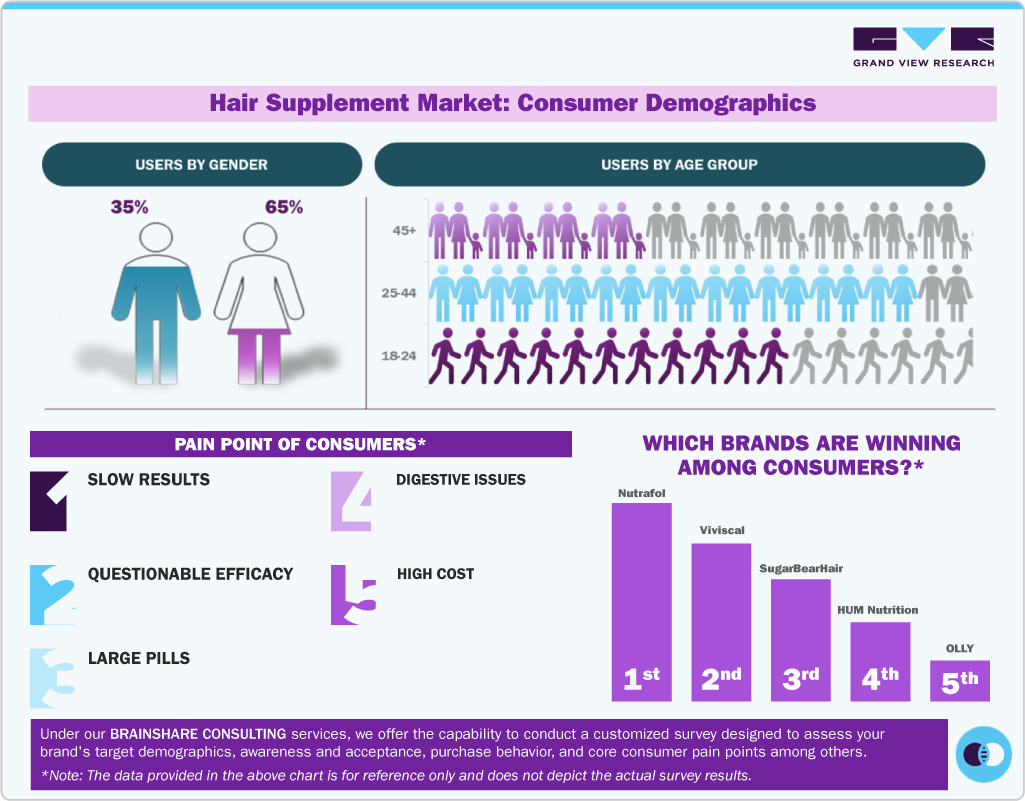
 The rise of nutricosmetics is reshaping how consumers approach hair care, with a strong shift toward “beauty-from-within” and preventive wellness. Instead of waiting for visible thinning or damage, consumers increasingly view hair supplements as a daily internal support system that strengthens follicles, boosts density, and improves resilience over time. Younger demographics, especially Millennials and Gen Z, now treat hair supplements the same way they use multivitamins, collagen peptides, or skin-focused ingestible integrating them into holistic wellness routines that target beauty, nutrition, and long-term hair vitality simultaneously. This nutricosmetic mindset positions hair supplement not as reactive treatments, but as proactive, lifestyle-driven tools for maintaining healthy, youthful hair.
Ingredient type Insights
The multi-ingredients segment accounted for 67.9% share in 2025, supported by consumer preference for comprehensive formulations that address multiple hair-health needs through a single product. Demand is increasingly shifting toward targeted blends featuring ingredients such as biotin, zinc, saw palmetto, and botanical extracts, with consumers valuing convenient and simplified supplementation. In 2025, Ulo launched its Hair Growth Supplement, a once-daily, multi-ingredient formulation that combines saw palmetto, beta-sitosterol, astaxanthin, pumpkin seed oil, biotin, vitamin D3, zinc, and hydrolyzed fish collagen. The product is positioned to support hair growth and scalp health, illustrating the growing preference for comprehensive formulations that combine botanical extracts, vitamins, minerals, antioxidants, and other functional ingredients to address multiple hair-health concerns in a single supplement.
Single-ingredient hair supplements are projected to grow at a CAGR of 11.9% from 2026 to 2033, driven by growing recognition that hair concerns can stem from multiple factors, including nutritional gaps, hormonal changes, stress, inflammation, and scalp health. Consumers are increasingly favoring all-in-one formulations that combine vitamins, minerals, botanical extracts, and other functional ingredients to address several hair-health needs simultaneously. This trend is further supported by the convenience of taking a single comprehensive supplement rather than managing multiple products.
Ingredients Insights
The vitamin segment contributed 23.8% share toward the global market in 2025, supported by consumer awareness of the role of nutritional deficiencies in hair thinning, weakness, and poor hair quality. Vitamins such as D, B-complex, and E remain widely incorporated into formulations due to their familiarity and established role in nutritional health. The segment also benefits from the perception of vitamin-based supplements as convenient and accessible solutions for routine hair-health management, while beauty brands and dermatology-led recommendations continue to strengthen consumer adoption.
Botanical extract-based hair supplements are projected to grow at a CAGR of 11.6% from 2026 to 2033, driven by increasing consumer preference for plant-based and naturally positioned wellness solutions. Ingredients such as saw palmetto, ashwagandha, horsetail, and fenugreek are gaining traction for their positioning around DHT modulation, stress management, hair strength, and overall follicular health. Growing interest in Ayurvedic, herbal, and clean-label formulations is further expanding the addressable consumer base, while botanical blends provide brands with opportunities to differentiate through natural ingredient stories and targeted hair-health claims.
Application Insights
The hair growth segment accounted for 52.7% share of the market in 2025, driven by rising concerns over stress-related shedding, post-illness hair loss, hormonal changes, and age-related thinning. Consumers increasingly seek products positioned to improve hair density, reduce shedding, and strengthen strands, with DHT-modulating botanicals, collagen, biotin, and targeted nutrients remaining popular. Social media, influencer recommendations, and consumer testimonials further support product awareness and adoption. Product innovation is also becoming more targeted. In July 2025, Vegamour launched GRO+ Advanced Hair Growth & Density Supplements, a dual-pill formulation combining a botanical DHT-blocking capsule with a nutrient-focused vitamin softgel. The launch reflects the shift toward targeted, multi-ingredient, efficacy-oriented formulations, enabling brands to differentiate through specialized ingredients and convenient delivery formats.
Scalp care/health supplements are projected to grow at a CAGR of 11.2% from 2026 to 2033, driven by rising consumer awareness of dandruff, scalp inflammation, itchiness, dryness, and sebum imbalance. Consumers are increasingly seeking supplements containing probiotics, anti-inflammatory botanicals, omega fatty acids, and essential nutrients to support scalp and follicular health. The growing “skinification of haircare” trend is further driving demand, as consumers increasingly view scalp health as an extension of their overall skin and wellness routines.
Form Insights
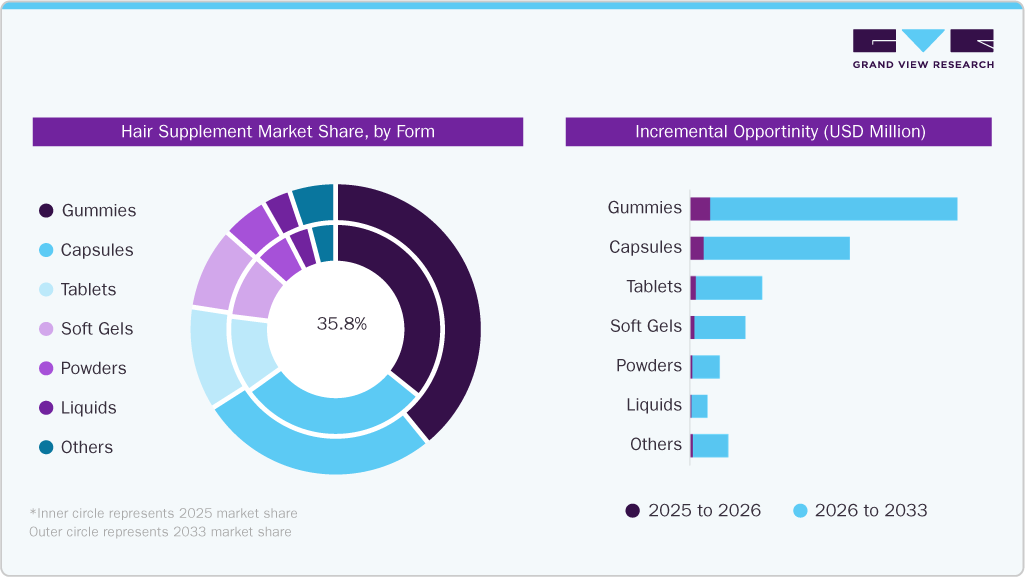
The gummies segment held a 35.8% market share in 2025, supported by their convenient, lifestyle-oriented format, particularly among younger and wellness-focused consumers. The format also enables brands to differentiate through flavors, shapes, and targeted ingredient combinations. In April 2026, Folly launched its hair-health supplement in gummy form in the U.S. and UK, delivering more than 30 clinically studied ingredients through a proprietary microencapsulation technology. The launch highlights ongoing innovation to combine the consumer convenience of gummies with higher ingredient concentrations traditionally associated with pills and capsules.
 To learn more about this report, Download Free Sample Report
 Tablets are projected to register a 10.7% CAGR from 2026 to 2033, supported by their suitability for concentrated, multi-ingredient formulations, dosage consistency, stability, and cost-efficient daily supplementation. The format remains particularly relevant for consumers seeking structured, long-term hair-health regimens. In 2025, Jarrow Formulas expanded its Multi+ portfolio with Women's Multi+ Multivitamin Tablets, incorporating Lustriva to provide additional hair, skin, and nail support. The product illustrates how tablet-based supplements are increasingly incorporating targeted beauty benefits within broader nutritional formulations.
Type Insights
The OTC segment accounted for 89.6% market share in 2025, underpinned by growing consumer adoption of self-care and easily accessible nutritional solutions. Wider availability through pharmacies, beauty retailers, and e-commerce platforms enables consumers to address common hair concerns without a prescription. In February 2025, Xtressé launched its dermatologist-developed Hair Growth Gummies, a biotin-free nutraceutical formulated with research-backed nutrients and botanical ingredients. As a drug-free, nonprescription supplement available directly to consumers and through authorized providers, the product exemplifies the OTC/nonprescription hair-health segment’s shift toward convenient, targeted, and professionally developed solutions.
Prescribed hair supplement is projected to grow at a 9.4% CAGR from 2026 to 2033, driven by increasing consultation with dermatologists for persistent or medically associated hair-loss conditions. Where nutritional deficiencies or underlying factors are identified, healthcare professionals may recommend targeted nutritional interventions, including iron, amino acids, or other condition-specific formulations. Medical oversight and professional validation enhance consumer confidence and support demand for clinically guided supplementation.
End Use Insights
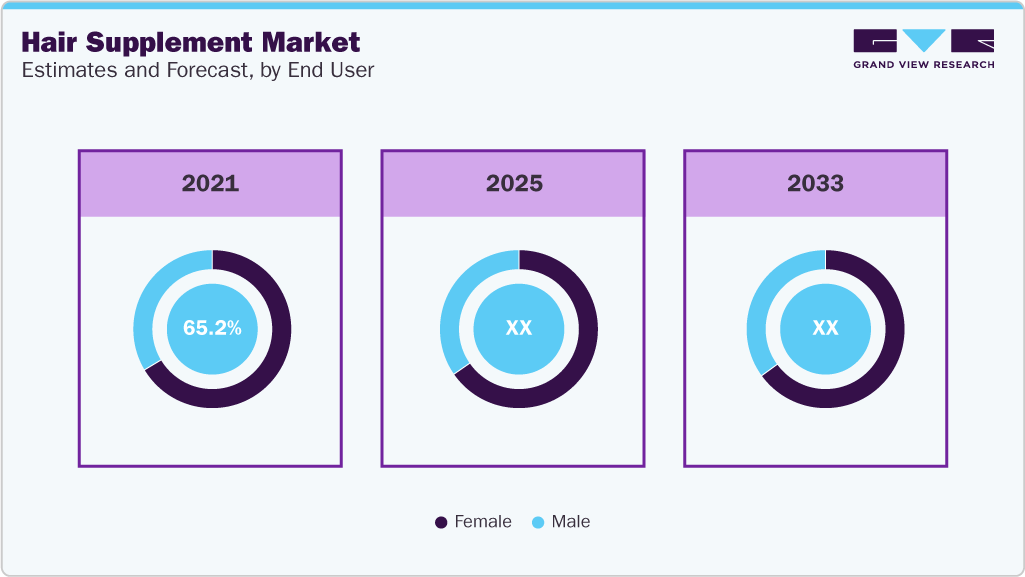
The female segment accounted for 65.7% share in 2025, reflecting stronger consumer engagement with hair wellness and beauty-from-within solutions. Demand is supported by concerns related to hair thinning, breakage, brittleness, and reduced density, alongside growing interest in nutrition-led hair care. Women are increasingly seeking targeted formulations containing biotin, collagen, iron, vitamins, minerals, and botanical ingredients to address specific hair-health needs. The segment is further supported by higher spending on beauty and wellness and growing adoption of preventive, daily supplementation routines.
 To learn more about this report, Download Free Sample Report
 Hair supplements for male are projected to grow at a 10.6% CAGR from 2026 to 2033, driven by rising awareness of male-pattern hair thinning, increasing focus on preventive grooming, and growing interest in oral solutions that complement established hair-care routines. Demand is shifting toward targeted, ingredient-led formulations designed around specific stages and patterns of hair thinning, rather than broad, one-size-fits-all products. In July 2026, Evolv launched Evolv Grow, an oral hair-growth supplement with a dedicated “For Him” formulation targeting early-to-moderate thinning around the crown and hairline. The launch reflects the market’s movement toward gender-specific and condition-focused supplementation, creating opportunities for brands to differentiate through targeted formulations and specialized positioning.
Distribution Channel Insights
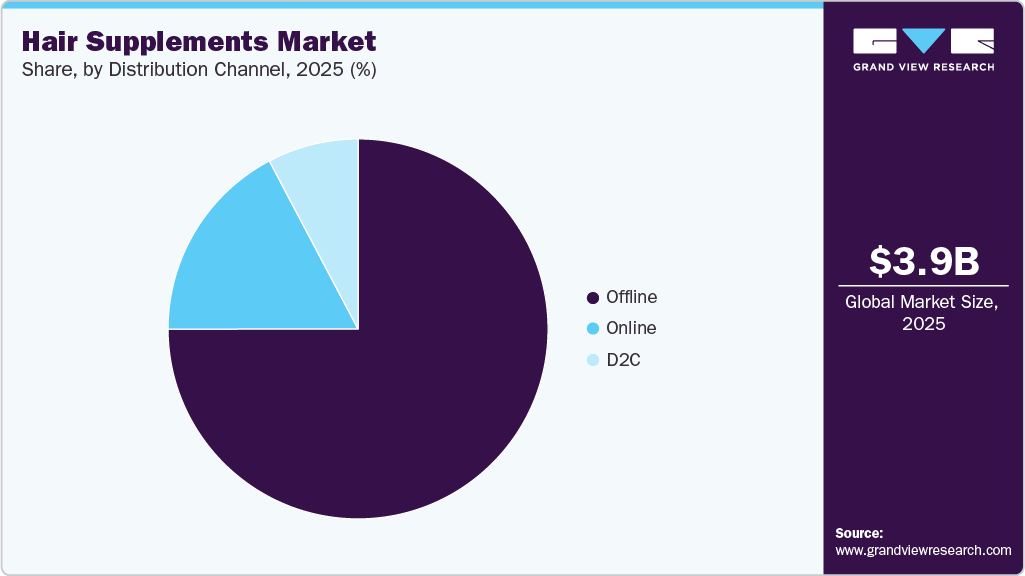
The sale of hair supplements through offline channels accounted for 75.0% share in 2025. The growth comes on the back of consumer preference for trusted, physical points of purchase. Pharmacies, dermatology clinics, salons, and specialty beauty retailers provide opportunities for consumers to verify products, seek professional guidance, and compare formulations before purchase. In-store recommendations from pharmacists, dermatologists, and beauty advisors further strengthen product credibility, while immediate product availability and retail promotions support conversion. From a strategic perspective, offline channels remain important for brands seeking to build consumer trust and reinforce credibility in a category where efficacy and product authenticity strongly influence purchasing decisions.
 To learn more about this report, Download Free Sample Report
 The online distribution channel for hair supplements is projected to grow at a CAGR of 12.9% from 2026 to 2033, supported by convenience, wider product selection, direct-to-consumer models, and digital product discovery. E-commerce also enables brands to provide detailed product information, customer reviews, and personalized recommendations while supporting repeat purchases and subscription programs. In May 2025, Sareen Hair Clinic launched its Hair Collagen Supplement through its online platform in India, featuring marine-sourced collagen peptides and pan-India delivery. The launch highlights how digital-first distribution is helping specialized hair-health brands reach consumers directly and expand beyond traditional retail networks.
Regional Insights
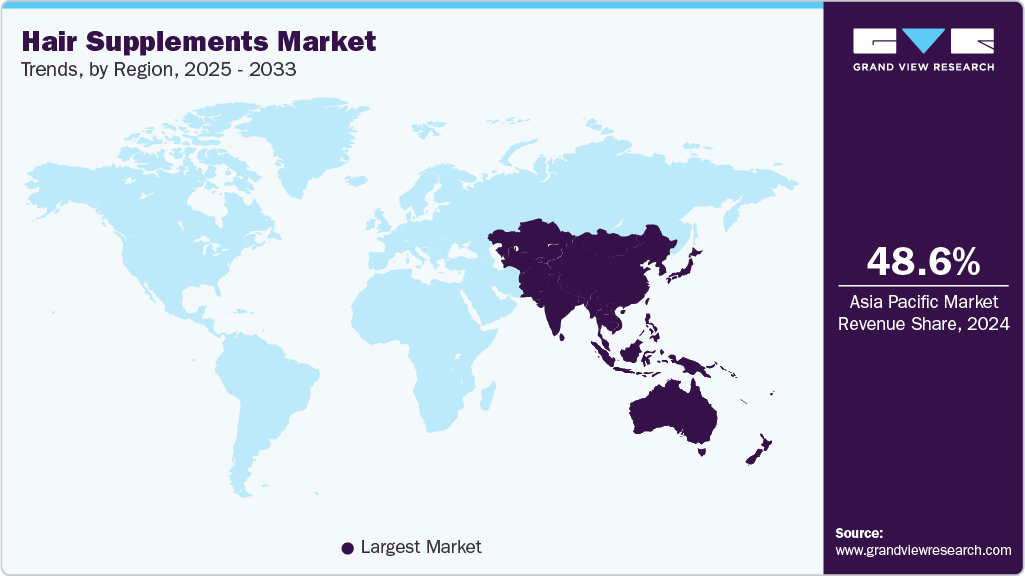
The Asia Pacific hair supplement industry accounted for the largest share of 48.6% in 2025. Asia Pacific offers significant growth potential for hair supplements, supported by the region’s expanding beauty-from-within culture, focus on preventive wellness, and preference for nutrition-based beauty solutions. Consumers are increasingly aware of the relationship between hair health, diet, stress, aging, and overall well-being, while botanical ingredients continue to influence product development. Manufacturers are also expanding beyond traditional capsules by introducing gummies, powders, functional beverages, and other convenient formats. In addition, digital commerce and social media-driven beauty trends are increasing awareness of ingredient-focused products. Rising demand for collagen, ginseng, probiotics, vitamins, and plant-based extracts is creating opportunities for brands to combine traditional wellness concepts with modern nutritional formulations and convenient products for daily use.
 To learn more about this report, Download Free Sample Report
 India Hair Supplements Market Trends
The India hair supplements market accounted for the largest share of 21.5% in 2025. The market is being driven by high consumer awareness of hair fall, the adoption of digital wellness, traditional botanical preferences, and growing acceptance of gummies and other convenient formats. Consumers increasingly combine familiar ingredients such as amla and other Ayurvedic botanicals with modern nutrients, including biotin, zinc, vitamins, and collagen. In June 2025, Dabur launched Siens, a digital-first supplement brand that included 3-in-1 Hair, Skin & Nails Gummies formulated with biotin, grape-seed extract, and vitamins. The launch illustrates how established Indian wellness companies are entering beauty-focused supplementation with convenient, multifunctional products. E-commerce and social-media-led discovery are further supporting access to these products among younger urban consumers.
North America Hair Supplements Market Trends
The hair supplements market in North America is expected to grow at a CAGR of 10.9% from 2026 to 2033. The industry is moving toward targeted, science-backed, and lifestyle-oriented solutions, supported by the growing convergence of beauty-from-within and preventive wellness. Consumers are increasingly seeking supplements that address specific concerns such as hair thinning, shedding, and hair strength, creating opportunities for formulations combining vitamins, minerals, collagen, botanicals, and other functional ingredients. Manufacturers are responding with differentiated products tailored to gender and consumer needs, while gummies and other convenient formats are broadening daily usage. In June 2025, Life Extension launched Hair Growth for Women, featuring wheat phytoceramides and saw palmetto to support hair fullness and address shedding. This product activity underscores the market’s shift toward personalized and internally focused approaches to hair health.
The hair supplements market in the U.S. accounted for the largest share of 22.0% in 2025. The region is increasingly positioned at the intersection of nutritional wellness, beauty, and preventive self-care. Consumers are moving beyond conventional single-nutrient products toward convenient, targeted solutions that support hair health as part of a broader wellness routine. This shift is encouraging brands to combine hair-focused supplementation with holistic beauty propositions, creating opportunities for differentiated formulations and integrated product portfolios. In May 2025, iHerb launched California Gold Nutrition BEAUTY in the U.S., introducing a targeted range of hair multivitamins alongside complementary hair-care products under a broader “beauty from within” positioning. The launch highlights the growing convergence of ingestible nutrition and beauty care, while strengthening opportunities for brands to position hair supplement as part of everyday self-care products.
Europe Hair Supplements Market Trends
The hair supplements market in Europe is expected to grow at a CAGR of 10.2% from 2026 to 2033, driven by rising demand for evidence-led formulations, ingredient transparency, and premium wellness products. Consumers are increasingly seeking nutritional solutions for hair strength, density, and shedding, encouraging manufacturers to move toward multi-ingredient formulations. At the same time, stringent EU requirements for health claims and product communication increase the importance of scientific substantiation and regulatory compliance. This environment favors brands with credible formulations, transparent labeling, and differentiated ingredient platforms, while premium opportunities remain in products combining vitamins, minerals, botanicals, collagen, and other beauty-from-within ingredients.
The Germany hair supplements market accounted for the largest share of 22.0% in 2025. Germany presents a promising environment for hair supplement, supported by strong consumer emphasis on product safety, nutritional quality, and evidence-based wellness. While biotin remains a widely recognized ingredient, growing regulatory attention is encouraging manufacturers to adopt more responsible dosage levels, transparent labeling, and substantiated product claims. In May 2026, Germany’s Federal Institute for Risk Assessment highlighted that high-dose biotin supplementation may interfere with certain laboratory tests, reinforcing the importance of appropriate formulation and consumer communication. This environment creates opportunities for brands to differentiate through balanced multi-nutrient formulations, clinically supported ingredients, and transparent positioning, particularly products combining vitamins and minerals such as zinc and iron with botanical ingredients.
Central & South America Hair Supplements Market Trends
The hair supplements market in Central and South America offers opportunities for hair supplement through the region’s strong connection between beauty, wellness, and nutritional supplementation. Brazil is particularly relevant because consumers increasingly associate collagen and other nutraceutical ingredients with aesthetic benefits involving skin, hair, and nails. The broader Brazilian supplement environment also shows interest in collagen, probiotics, omega-3, and natural ingredients, creating a favorable platform for multifunctional beauty supplements. Brands can capitalize on this environment through accessible pricing, trusted retail distribution, e-commerce, and convenient powder, capsule, and gummy formats.
Middle East & Africa Hair Supplements Market Trends
The hair supplements market in the Middle East and Africa is increasingly benefiting from the expansion of beauty-from-within, natural wellness, and premium supplement consumption. Consumers are showing greater interest in products that combine beauty benefits with broader nutritional support, creating opportunities for collagen, vitamins, minerals, and botanical-based formulations. Product availability is also expanding through modern retail and e-commerce. A relevant regional development occurred in February 2025, when UK-based Revive Collagen entered the UAE through more than 100 Supercare stores and its online platform, demonstrating growing availability of ingestible beauty products in the region. For hair supplement, premium positioning, trusted ingredients, convenient formats, and multifunctional beauty benefits can support adoption among wellness-oriented consumers.
Key Hair Supplements Company Insights
The global hair supplement industry features a mix of clinically positioned wellness brands, beauty-focused nutrition companies, and fast-growing regional players catering to different price points and consumer needs. Established brands such as Nutrafol, Viviscal, and Priorin lead the premium and medically oriented segment through strong scientific positioning, dermatologist recommendations, and targeted formulations addressing thinning and hair loss.
Beauty and lifestyle-driven brands, including SugarBearHair, HUM Nutrition, and OLLY, appeal to younger and appearance-focused consumers with flavored gummies, clean-label ingredients, and attractive packaging. These brands emphasize convenience, daily wellness routines, and strong digital marketing, which have helped them build high brand recall in online and specialty retail channels.
 To learn more about this report, Download Free Sample Report
 Key Hair Supplements Companies
The following key companies have been profiled for this study on the hair supplements market.
-
Nutrafol
-
Viviscal
-
Nature’s Bounty
-
Amway (Nutrilite)
-
GNC
-
HUM Nutrition
-
SugarBearHair
-
Swisse Wellness
-
InVite Health
-
Codeage
Competitive Benchmarking
Category
Operating Strategies
Competitive Edge
Weakness
Established Players (Nutrafol; Viviscal; Nature’s Bounty; Amway (Nutrilite); GNC; Swisse Wellness)
- Expand hair wellness portfolios, introduce formulations addressing specific hair concerns, strengthen retail and online distribution, and use established brand presence to reach a broader consumer base
- Strong consumer recognition, extensive distribution networks, diversified supplement portfolios, established customer relationships, and greater resources for product development and marketing.
- Larger business structures may reduce speed of response to emerging consumer preferences. Broad product portfolios and higher operating costs may also limit flexibility in targeting highly specialized market niches.
Emerging Players (HUM Nutrition; SugarBearHair; InVite Health; Codeage)
- Develop specialized hair-health formulations, emphasize distinctive ingredients and delivery formats, use digital marketing to engage targeted consumer groups, and expand through e-commerce and specialty retail channels.
- Greater flexibility in product development, focused brand positioning, differentiated formulations, and the ability to respond quickly to changing beauty, wellness, and supplementation trends.
- Comparatively limited distribution coverage, lower brand awareness, and smaller marketing and product-development budgets can constrain their ability to compete with established companies.
Recent Developments
-
In November 2025, Tru Niagen announced expanding beyond general wellness and entering the beauty category with a new supplement that leverages NAD⁺ technology. This supplement combines ingredients like Niagen, hyaluronic acid, grape-seed extract, biotin, and astaxanthin to support skin elasticity, hydration, hair strength, and nail health.
-
In October 2025, Vital Nutrients introduced a women-focused hair growth supplement designed to support hair health by addressing hormonal balance, stress, and nutritional gaps through a targeted blend of nutrients and botanicals.
-
In September 2025, Lemme officially launched in South Korea via the e-commerce platform Coupang, Inc., marking the brand’s first direct international expansion. The offering includes 13 products such as vaginal-health gummies, digestive-health gummies, and appetite-management capsules.
-
In July 2025, Vegamour launched GRO Advanced Supplements, a plant-based, biotech-driven hair supplement designed to support long-term hair density and reduce thinning. The dual capsule system targets hair longevity using botanical actives and essential nutrients.
Hair Supplements Market Report Scope
Report Attribute
Details
Market size value in 2025
USD 3.9 billion
Estimated market size in 2026
USD 4.3 billion
Projected market size by 2033
USD 9.0 billion
Growth Rate (Revenue)
CAGR of 11.1% from 2026 to 2033
Actuals
2021 - 2025
Forecast period
2025 - 2033
Quantitative units
Revenue in USD billion and CAGR from 2026 to 2033
Report coverage
Revenue forecast, company ranking, competitive landscape, growth factors, and trends
Segments covered
Ingredient type, ingredients, application, form, type, end use, distribution channel, region
Regional scope
North America; Europe; Asia Pacific; Central & South America; Middle East & Africa
Country scope
U.S.; Canada; Mexico; UK; Germany; France; Italy; Spain; China; Japan; India; Australia & New Zealand; South Korea; Brazil; South Africa
Key companies profiled
Nutrafol; Viviscal; Nature’s Bounty; Amway (Nutrilite); GNC; HUM Nutrition; SugarBearHair; Swisse Wellness; InVite Health; Codeage
Customization scope
Free report customization (equivalent up to 8 analysts working days) with purchase. Addition or alteration to country, regional & segment scope.
Pricing and purchase options
Avail customized purchase options to meet your exact research needs. Explore purchase options
Global Hair Supplements Market Report Segmentation
This report forecasts revenue growth at the global, regional, and country levels and provides an analysis of the latest industry trends and opportunities in each of the sub-segments from 2021 to 2033. For this study, Grand View Research has segmented the global hair supplements market report on the basis of ingredient type, ingredients, application, form, type, end use, distribution channel, and region.
-
Ingredient Type (Revenue, USD Million, 2021 - 2033)
-
Single Ingredient
-
Multi-Ingredients
-
-
Ingredients (Revenue, USD Million, 2021 - 2033)
-
Vitamin
-
Vitamin A
-
Vitamin C
-
Vitamin D
-
Vitamin E
-
Vitamin B12
-
Niacin
-
Biotin
-
Folic Acid
-
Multivitamin
-
-
Minerals
-
Botanical Extracts
-
Marine Extracts
-
Amino Acids & Proteins
-
Collagen
-
Keratin
-
Cysteine
-
Others
-
-
Probiotics, Prebiotics & Postbiotics
-
Resveratrol
-
Astaxanthin
-
Minoxidil
-
Finasteride
-
Dutasteride
-
Others
-
-
Application (Revenue, USD Million, 2021 - 2033)
-
Scalp Care/Health
-
Hair Growth/Thinning/Loss
-
Aging Hair
-
Hair Strength/Quality
-
Hair Thinning Prevention
-
Others
-
-
Form (Revenue, USD Million, 2021 - 2033)
-
Tablets
-
Capsules
-
Soft gels
-
Powders
-
Gummies
-
Liquids
-
Others
-
-
Type (Revenue, USD Million, 2021 - 2033)
-
OTC
-
Prescribed
-
-
End User (Revenue, USD Million, 2021 - 2033)
-
Male
-
Millennials
-
Gen X
-
Gen Z
-
-
Baby Boomers
-
-
Female
-
Pregnant Women
-
Millennials
-
Gen X
-
Gen Z
-
-
Non-Pregnant Women
-
Millennials
-
Gen X
-
Gen Z
-
Baby Boomers
-
-
-
-
Distribution Channel (Revenue, USD Million, 2021 - 2033)
-
Offline
-
Hypermarkets
-
Supermarkets/Grocery Stores
-
Discount Stores
-
Department Stores (Including Discounted)
-
Pharmacies
-
Drug Stores
-
Specialty Stores
-
Beauty & Cosmetic Stores
-
Health & Supplement Stores
-
-
Practitioner
-
Direct Sales
-
Travel Retail Stores
-
Others
-
-
D2C
-
Online
-
Amazon
-
Other Online Retail Stores
-
-
-
Regional Channel (Revenue, USD Million, 2021 - 2033)
-
North America
-
U.S.
-
Canada
-
Mexico
-
-
Europe
-
UK
-
Germany
-
France
-
Italy
-
Spain
-
-
Asia Pacific
-
China
-
Japan
-
Australia & New Zealand
-
South Korea
-
-
Central & South America
-
Brazil
-
-
Middle East & Africa
-
South Africa
-
-
Research Methodology
The hair supplements market figures in this report are based on a proven research process that combines executive interviews with secondary research from proprietary databases, company filings, and recognized regulatory and institutional sources. Market size is built through value-chain sizing-reconciling supply-side and demand-side estimates-and triangulated with bottom-up and top-down approaches. Every estimate passes multiple levels of expert validation before publication, with each hair supplements segment quantified using the revenue-capture definitions in the table below.
Segment Definition
Segment - Ingredient Type
Revenue capture definition
Single Ingredient
This segment includes the sales of hair supplement formulated with one primary active ingredient, such as biotin, collagen, zinc, iron, or other individual nutrients, designed to address specific hair health needs including hair growth, strength, thickness, or reduction of hair fall.
Multi-Ingredients
This segment includes the sales of hair supplement containing two or more active ingredients, such as combinations of vitamins, minerals, amino acids, collagen, biotin, and botanical extracts, formulated to provide broader nutritional support for hair growth, strength, scalp health, and overall hair wellness.
Estimation Model
Consumption Profile Layer
Market Reach Layer
Purchase & Retention Layer
Value Generation Layer
Who consumes hair health supplements?
Where are hair health supplements accessible?
What drives repeat purchases??
How is revenue generated
Captures consumers purchasing hair health supplements to support hair growth, reduce hair fall, improve hair strength and thickness, and address nutritional deficiencies associated with hair health.
Covers e-commerce platforms, DTC websites, pharmacies, specialty health stores, supermarkets, salons, and other consumer-facing channels.
Focuses on product quality, ingredient efficacy, formulation, clinical or scientific backing, brand reputation, consumer trust, price, and perceived results influencing initial and repeat purchases.
Captures revenue from hair vitamins, gummies, capsules, tablets, powders, functional beverages, and other supplement formats designed to support hair growth, reduce hair loss, and improve overall hair health.
Delivered Customizations
This report has been delivered with the following In-depth customizations
Client Request
Customization Delivered
Value Adds
Global Hair Supplements Market Landscape Assessment
Assessed market trends, product categories, key ingredients, consumer needs, competitive intensity, distribution channels, and growth drivers across major regions.
Helps identify high-growth segments, evaluate market attractiveness, and support informed market-entry and expansion strategies.
Global Hair Health Supplements Regulatory & Product Assessment
Reviewed regulatory considerations, product formulations, ingredient usage, health claims, labeling requirements, and market-specific compliance factors for hair health supplements.
Supports regulatory risk assessment, strengthens product development planning, and helps companies navigate market-specific compliance requirements.
Global Hair Health Supplements Channel & Retail Assessment
Assessed pharmacies, specialty health stores, supermarkets, e-commerce, direct-to-consumer platforms and other emerging distribution models.
Helps identify effective routes to market, prioritize high-potential channels, and evaluate opportunities for broader product distribution and consumer reach.
Frequently Asked Questions About This Report
The global hair supplements market size was valued at USD 3.9 billion in 2025 and is estimated at USD 4.3 billion for 2026.
The global hair supplements market is expected to grow at a CAGR of 11.1% from 2026 to 2033, reaching USD 9.0 billion by 2033.
The hair supplements market is growing because more people are experiencing hair fall and thinning due to stress, lifestyle changes, aging, and nutritional gaps, leading them to seek simple, non-invasive solutions.
Multi-ingredients segment led with a 67.9% revenue share in 2025.
Vitamin held the largest share (over 23.8%) in 2025.
Hair growth/thinning/loss segment led with a 52.7% revenue share in 2025.
Gummies held the largest share (over 35.7%) in 2025.
Asia Pacific dominated with a 48.6% revenue share in 2025.
Key players include Nutrafol, Viviscal, Nature’s Bounty, Amway (Nutrilite), GNC, HUM Nutrition, SugarBearHair, Swisse Wellness, InVite Health, Codeage
About the Author(s)
Nutraceuticals & Functional Foods Research Team
Consumer Goods · Nutraceuticals & Functional FoodsThis report was authored by the nutraceuticals & functional foods research team at Grand View Research - comprising two research analysts, one senior research analyst, and one industry expert - with specialized expertise in the nutraceuticals & functional foods segment of the consumer goods industry. All findings are based on proprietary consumer goods databases, executive interviews, and regulatory analysis, subject to internal peer review prior to publication.
Last Updated:
Speak to Analyst

Customize this report to your needs - add regions, segments, or data points, with 20% free customization.
Or view our licence options:


ISO 9001:2015 & 27001:2022 Certified
We are GDPR and CCPA compliant! Your transaction & personal information is safe and secure. For more details, please read our privacy policy.


