
- Home
- »
- Medical Devices
- »
-
Healthcare Contract Packaging Services Market Report, 2026-2033GVR Report cover

Healthcare Contract Packaging Services Market (2026 - 2033)
Size, Share & Trends Analysis Report By Service (Primary Packaging, Secondary Packaging, Tertiary Packaging), By Product Type (Blister Packs, Bottles (Plastic / Glass)), By End Use, By Region, And Segment Forecasts
Market Size, 2025
$25.9BMarket Estimate, 2026
$28.4BMarket Forecast, 2033
$61.1BCAGR, 2026–2033
11.6%Healthcare Contract Packaging Services Market Summary
The global healthcare contract packaging services market size was valued at USD 25.9 billion in 2025 and is projected to grow from USD 28.4 billion in 2026 to USD 61.1 billion by 2033, at a CAGR of 11.6% from 2026 to 2033. The market in North America dominated with a revenue share of 38.3% in 2025. The market is driven due to the increasing demand for outsourcing packaging operations by pharmaceutical, biotechnology, and medical device companies to improve efficiency, ensure regulatory compliance, and reduce operational costs.
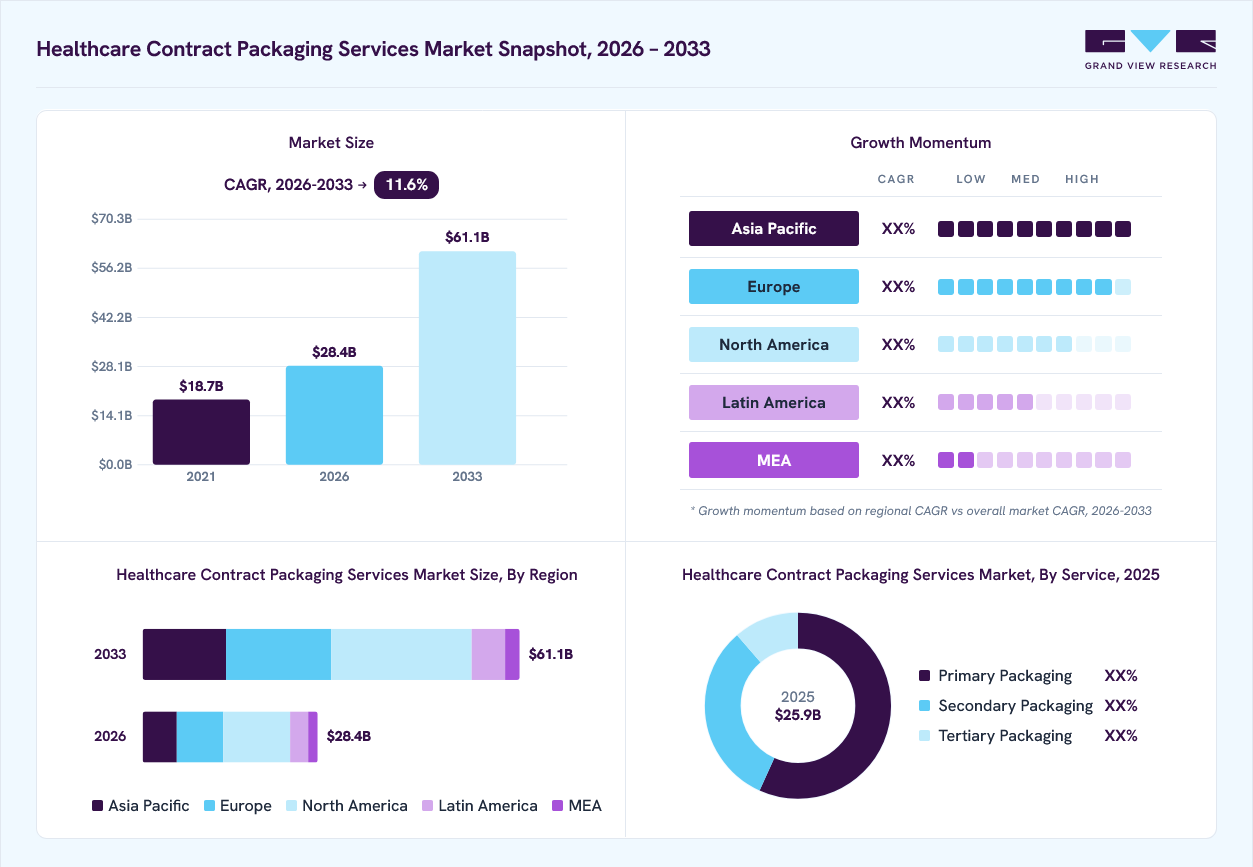 Source: Grand View Research, IR Documents, Primary Interviews, Paid DatabasesTo learn more about this report,
 Download Free Sample Report
Key Market Trends & Insights
- By service: Primary packaging segment held the largest market share of 56.6% in 2025.
- By product type: Blister packs segment held the largest market share of 30.9% in 2025.
- By end use: Pharmaceuticals and biopharmaceuticals companies segment held the largest market share of 72.5% in 2025.
Regional Highlights
- Largest regional market: North America (38.3% revenue share, 2025)
- Fastest-growing regional market: Asia Pacific (highest CAGR, 2026-2033)
- By country: The U.S. held the largest market share in 2025.
Market Size & Forecast
- Market size in 2025: USD 25.9 Billion
- Estimated market size in 2026: USD 28.4 Billion
- Projected market size by 2033: USD 61.1 Billion
- CAGR (2026-2033): 11.6%
Prism AI by Grand View Research Free to tryAsk a question about the healthcare contract packaging services marketTry asking✓Every figure cited from GVR research Prefer the report? Download free sample →
Furthermore, the market is driven by the increasing outsourcing of packaging operations by pharmaceutical, biotechnology, and medical device companies seeking to enhance operational efficiency and focus on core competencies such as R&D and commercialization. Rising regulatory complexity across regions has made compliance more demanding, prompting companies to rely on specialized contract packagers with expertise in Good Manufacturing Practices (GMP) and quality assurance. In addition, the surge in drug development, especially in biologics and specialty pharmaceuticals, has led to greater demand for sophisticated packaging formats capable of maintaining product integrity, stability, and safety. To learn more about this report, Download Free Sample Report
The growing emphasis on patient-centric and sustainable packaging solutions. With the healthcare industry shifting toward personalized medicine and self-administration drug formats, the need for convenient, tamper-evident, and easy-to-use packaging has intensified. Simultaneously, environmental concerns and regulatory pressure are encouraging the adoption of eco-friendly and recyclable packaging materials, creating new opportunities for innovation. Furthermore, advancements in automation, digital traceability, and smart packaging technologies-such as RFID, barcoding, and serialization-are enhancing supply chain visibility and security, further accelerating the market’s growth.
Market Dynamics
The healthcare contract packaging services market is experiencing steady growth driven by the outsourcing of pharmaceutical and biopharmaceutical packaging operations, the rising complexity of drug-delivery formats, and the growing demand for specialized packaging solutions across global healthcare supply chains. Pharmaceutical manufacturers are increasingly engaging contract packaging providers for primary, secondary, labeling, packaging, serialization, and regulatory-compliant packaging activities to improve operational efficiency while reducing capital investment requirements.
The growing volume of biologics, biosimilars, injectable therapies, and temperature-sensitive pharmaceuticals has increased demand for packaging partners with expertise in cold chain management, tamper-evident packaging, and patient-centric delivery systems. Expanding pharmaceutical production, rising clinical trial activity, and stricter traceability regulations across major markets are generating sustained demand for outsourced packaging services. Technological advancements in automated packaging lines, smart labeling technologies, serialization systems, and digital track-and-trace solutions are improving packaging accuracy, regulatory compliance, and supply chain visibility across the healthcare sector.
The increasing outsourcing of pharmaceutical packaging functions is a key factor driving growth in the healthcare contract packaging services market. Pharmaceutical and biotechnology companies focus their resources on drug discovery, product development, and commercialization, while outsourcing packaging operations to specialized service providers with established infrastructure and regulatory expertise. Rising demand for biologics, prefilled syringes, autoinjectors, inhalation products, and personalized medicines has created a requirement for advanced packaging capabilities that several manufacturers do not maintain in-house.
Contract packaging organizations support labeling, blister packaging, bottle filling, kitting, serialization, and cold chain packaging while helping clients manage changing regulatory requirements across multiple regions. For instance, in September 2025, Sharp Services expanded its pharmaceutical packaging capacity in Pennsylvania and invested USD 20 million to support increasing demand for clinical and commercial packaging services from biopharmaceutical companies. Growing pharmaceutical production volumes and increasing product launches continue to create long-term demand for outsourced packaging solutions worldwide.
Regulatory compliance requirements and supply chain complexities remain significant restraints for the healthcare contract packaging services market. Healthcare packaging providers must comply with stringent regulations related to serialization, product traceability, labeling accuracy, tamper evidence, and patient safety across different jurisdictions. Managing multiple packaging formats, country-specific labeling requirements, and frequent regulatory updates increases operational complexity and costs. Besides, temperature-sensitive pharmaceuticals and biologics require specialized storage, handling, and transportation systems throughout the packaging process. Shortages of packaging materials, fluctuations in raw material costs, and disruptions in global logistics networks can affect packaging schedules and delivery timelines. The need to maintain validated facilities, advanced inspection systems, and highly trained personnel adds further cost pressures, creating challenges for service providers and pharmaceutical manufacturers seeking efficient packaging operations.
The expanding pipeline of biologics, specialty pharmaceuticals, and advanced drug-delivery products presents substantial opportunities for healthcare contract packaging service providers. Increasing approvals of monoclonal antibodies, biosimilars, peptide therapeutics, cell therapies, and injectable medicines are driving demand for specialized packaging formats that maintain product stability and patient safety. Many emerging biotechnology companies lack dedicated packaging infrastructure, creating outsourcing opportunities for contract packaging organizations with expertise in cold chain packaging, device assembly, and regulatory-compliant labeling. The growing adoption of patient-centric packaging solutions, including prefilled syringes, autoinjectors, combination products, and adherence-focused packaging systems, is expected to drive demand for customized packaging services. Further, investments in pharmaceutical manufacturing facilities across the Asia Pacific and the Middle East are creating opportunities for regional packaging partnerships, capacity expansion initiatives, and integrated supply chain solutions that support global healthcare product commercialization.
Analyst Perspective
The healthcare contract packaging services market is growing due to increased outsourcing by pharmaceutical, biopharmaceutical, biotechnology, and medical device companies. Rising drug development, biologics, vaccines, specialty pharmaceuticals, and temperature-sensitive therapies are driving demand for advanced packaging solutions. Regulatory requirements and the adoption of automation, serialization, cold-chain packaging, and track-and-trace technologies are further supporting market growth. Expanding pharmaceutical production and investments in sustainable and specialized packaging solutions are expected to create long-term opportunities.
Opportunity Analysis
The global Healthcare Contract Packaging Services Market offers substantial growth opportunities driven by rising outsourcing trends, the expansion of biologics and personalized medicines, and the growing need for advanced and compliant packaging solutions. Increasing demand for sustainable and eco-friendly materials, along with the integration of smart packaging technologies such as RFID and QR code tracking, presents lucrative avenues for innovation. Moreover, the surge in biopharmaceutical production, globalization of clinical trials, and the shift toward patient-centric packaging formats create additional prospects for contract packagers to provide value-added services, streamline supply chains, and strengthen partnerships with pharmaceutical and medical device manufacturers.
Service Insights
Based on service, the primary packaging segment led the market with the largest revenue share of 56.6% in 2025. On the basis of service segment, the market is segmented into Primary Packaging, Secondary Packaging, and Tertiary Packaging. The primary packaging segment gained the largest market share of 56.57% in 2024. The segment growth is primarily attributable to the rising demand for high-quality, sterile, and protective packaging solutions that ensure the safety, efficacy, and stability of pharmaceutical and biopharmaceutical products. The increasing production of complex biologics, injectables, and single-dose formulations has driven the need for advanced primary packaging formats such as vials, prefilled syringes, blister packs, and ampoules.
The secondary packaging segment is expected to witness considerable growth owing to the increasing emphasis on product differentiation, branding, and enhanced protection during transportation and storage. As pharmaceutical and medical device companies expand their global distribution networks, the need for robust, compliant, and tamper-evident secondary packaging solutions has intensified.
Product Type Insights
Based on product type, the blister packs segment led the market with the largest revenue share of 30.9% in 2025. On the basis of the product type segment, the market is segmented into blister packs, bottles (plastic / glass), vials & ampoules, pre-filled syringes & cartridges, pouches and sachets, and others. The blister packs segment held the largest share in 2024. The market dominance is due to the widespread use of blister packs for solid oral dosage forms such as tablets and capsules, offering superior protection against moisture, contamination, and mechanical damage. Their cost-effectiveness, ease of use, and ability to provide unit-dose packaging that supports patient compliance have further strengthened their adoption among pharmaceutical manufacturers.
Moreover, pre-filled syringes & cartridges segments are anticipated to grow at the highest CAGR during the forecast period. The segments growth is due to the increasing adoption of injectable drugs, biologics, and vaccines that require precise dosing and convenient administration formats. Pre-filled syringes and cartridges offer several advantages, including reduced risk of contamination, improved patient safety, and enhanced ease of use for both healthcare professionals and patients.
End Use Insight
Based on end use, the pharmaceuticals and biopharmaceuticals companies segment led the market with the largest revenue share of 72.5% in 2025. The pharmaceuticals and biopharmaceutical companies segment held the largest market share in 2025 owing to the increasing outsourcing of packaging operations to specialized contract packaging organizations (CPOs) to enhance operational efficiency, ensure regulatory compliance, and reduce production costs. The growing demand for complex drug formulations, including biologics, injectables, and personalized medicines, has intensified the need for advanced, sterile, and high-quality packaging solutions that maintain product stability and safety.
 To learn more about this report, Download Free Sample Report
Furthermore, the biotechnology companies segment is expected to grow at a considerable CAGR during the forecast period. The segment is driven by the increasing development of complex biologics, cell and gene therapies, and other high-value biopharmaceutical products that require specialized, temperature-controlled, and contamination-free packaging solutions. Biotechnology companies often lack in-house packaging infrastructure and therefore rely on contract packaging partners with advanced capabilities in sterile filling, cryogenic storage, and customized labelling.
Regional Insights
North America dominated the healthcare contract packaging services market with the largest revenue share of 38.3% in 2025. This can be attributed to the presence of a well-established pharmaceutical and biotechnology industry, high adoption of advanced healthcare technologies, and extensive outsourcing of packaging operations to contract packaging organizations.
 To learn more about this report, Download Free Sample Report
U.S. Healthcare Contract Packaging Services Market Trends
The healthcare contract packaging services market in the U.S. held the largest share in the North America region in 2025 owing to the country’s robust pharmaceutical and biotechnology sectors, high outsourcing of packaging operations, and strict regulatory requirements for drug safety, serialization, and traceability. The increasing production of complex biologics, injectables, and personalized medicines has further driven demand for advanced, high-quality packaging solutions.
Europe Healthcare Contract Packaging Services Market Trends
The healthcare contract packaging services market in Europe is expected to grow significantly due to the stringent regulatory environment, including the EU Falsified Medicines Directive (FMD), which mandates serialization and traceability of pharmaceutical products. Additionally, the region’s strong presence of pharmaceutical and biotechnology companies, increasing production of biologics and specialty drugs, and rising demand for patient-centric and sustainable packaging solutions are driving growth.
The Germany healthcare contract packaging services market held the largest share in 2025. The market in Germany is driven by the country’s strong pharmaceutical and biotechnology industry, high regulatory standards, and widespread adoption of advanced packaging technologies. The increasing production of complex drug formulations, including biologics and specialty medicines, has heightened the demand for specialized, high-quality, and compliant packaging solutions.
The UK healthcare contract packaging services market is anticipated to grow over the forecast period. This growth is primarily due to the increasing focus on biologics, personalized medicines, and complex drug formulations that require specialized and high-quality packaging solutions. The rising trend of outsourcing packaging operations by pharmaceutical and biotechnology companies to ensure regulatory compliance, operational efficiency, and cost-effectiveness is also driving market expansion.
Asia Pacific Healthcare Contract Packaging Services Market Trends
Asia Pacific market is projected to grow at the fastest CAGR in 2025. This growth can be attributed to various factors, such as rising healthcare expenditure and the availability of several opportunities in this region, especially in Japan, China, and India.
The China healthcare contract packaging services market is driven due to the rapid expansion of its pharmaceutical and biotechnology industries, increasing production of generic and specialty drugs, and growing adoption of advanced packaging technologies. The rising trend of outsourcing packaging operations to contract service providers helps companies reduce operational costs, ensure regulatory compliance, and accelerate time-to-market.
The Japan healthcare contract packaging services market is driven due to the country’s well-established pharmaceutical and biotechnology sectors, high demand for advanced and high-quality packaging solutions, and stringent regulatory requirements for drug safety, serialization, and traceability. The growing production of biologics, injectables, and specialty medicines, along with an increasing focus on patient-centric and user-friendly packaging formats, has further fueled market demand.
Key Healthcare Contract Packaging Services Company Insights
Market players are undertaking various strategic initiatives, such as the launch of new product partnerships, collaborations, and mergers & acquisitions, to strengthen their service portfolio and provide a competitive advantage.
Key Healthcare Contract Packaging Services Companies:
The following key companies have been profiled for this study on the healthcare contract packaging services market.
-
Integer Holdings Corporation
-
Viant Technology LLC
-
FLEX LTD.
-
Celestica Inc.
-
Sanmina Corporation
-
Plexus Corp.
-
Phillips-Medisize
-
West Pharmaceutical Services, Inc.
-
Synecco Ltd
-
Catalent, Inc.
-
Thermo Fisher Scientific Inc.
Competitive Benchmarking
Category
Operating Strategies
Competitive Edge
Weakness
Established Players (IQVIA, ICON plc)
- Established players in the clinical trial management services market focus on expanding integrated clinical development capabilities covering clinical monitoring, project management, patient recruitment, medical writing, pharmacovigilance, regulatory consulting, and clinical data management. These organizations invest in decentralized trial technologies, digital health platforms, risk-based monitoring solutions, and global investigator networks to support increasingly complex multinational studies. Strategic acquisitions, technology partnerships, and expansion into high-growth therapeutic areas such as oncology, rare diseases, cell therapy, and immunology remain central growth strategies.
- Established players benefit from extensive global site networks, strong relationships with pharmaceutical and biotechnology sponsors, and decades of experience managing multi-country clinical programs. Their ability to provide end-to-end services from protocol development through regulatory submission creates significant competitive advantages. Furthermore, advanced technology infrastructure, broad therapeutic expertise, strong compliance frameworks, and access to large patient recruitment networks support efficient study execution and operational scalability across global clinical trials.
- Established organizations often face challenges associated with large operational structures, higher overhead costs, and complex internal processes. Managing extensive global workforces, technology platforms, and regulatory compliance systems requires substantial investment. Furthermore, longer decision-making timelines and dependence on large strategic contracts may reduce operational agility when responding to rapidly changing sponsor requirements or emerging clinical development trends.
Emerging Players (CTI Clinical Trial & Consulting)
- Emerging players primarily focus on niche therapeutic expertise, customized service models, and flexible clinical trial execution strategies. Many specialize in oncology, rare diseases, central nervous system disorders, and early-phase clinical development programs, where sponsors require highly personalized support. These companies frequently invest in decentralized trial capabilities, patient engagement solutions, regional site networks, and technology-enabled monitoring approaches. Strategic collaborations with biotechnology companies and targeted geographic expansion initiatives help strengthen market positioning and attract small to mid-sized sponsors.
- Emerging players benefit from lean organizational structures, greater flexibility, and closer client engagement compared with larger multinational competitors. Their specialized therapeutic knowledge, rapid study startup capabilities, and customized service delivery models enable them to efficiently address unique sponsor requirements. Furthermore, focused investments in digital trial technologies and regional expertise enable competitive positioning within selected therapeutic areas and emerging clinical research markets.
- Emerging players often face limitations related to smaller operational scale, restricted geographic coverage, and lower financial resources. Many lack extensive global investigator networks and experience managing large Phase III multinational studies. Furthermore, limited brand recognition and narrower service portfolios may restrict their ability to compete for large strategic outsourcing agreements awarded by major pharmaceutical companies.
Recent Developments
-
In February 2025, Integer Holdings Corporation announced its participation in the MD&M West 2025 conference, where it will showcase its leadership in medical device innovation. The company also highlighted its recent acquisition of Precision Coating, a move aimed at enhancing its capabilities in precision coating and expanding its portfolio in the medical device sector.
-
In October 2024, Sanmina's division, 42Q, announced the launch of a new cloud-based Manufacturing Execution System (MES). This system aims to enhance manufacturing operations by providing real-time data and analytics to improve efficiency and quality control.
Healthcare Contract Packaging Services Market Report Scope
Report Attribute
Details
Market size in 2025
USD 25.9 billion
Estimated market size in 2026
USD 28.4 billion
Projected market size by 2033
USD 61.1 billion
Growth rate
CAGR of 11.6% from 2026 to 2033
Historical data
2021 - 2025
Forecast period
2026 - 2033
Quantitative units
Revenue in USD million/billion and CAGR from 2026 to 2033
Report coverage
Revenue forecast, company ranking, competitive landscape, growth factors, and trends
Segments covered
Services, product type, end use, region
Regional scope
North America; Europe; Asia Pacific; Latin America; MEA
Country scope
U.S.; Canada; Mexico; Germany; UK; France; Italy; Spain; Norway; Denmark; Sweden; China; Japan; India; South Korea; Australia; Thailand; Brazil; Argentina; Saudi Arabia; South Africa; UAE; Kuwait; Oman; Qatar.
Key companies profiled
Integer Holdings Corporation; Viant Technology LLC; FLEX LTD.; Celestica Inc.; Sanmina Corporation; Plexus Corp.; Phillips-Medisize; West Pharmaceutical Services, Inc.; Synecco Ltd; Catalent, Inc.; Thermo Fisher Scientific Inc.
Customization scope
Free report customization (equivalent up to 8 analysts' working days) with purchase. Addition or alteration to country, regional & segment scope.
Pricing and purchase options
Avail customized purchase options to meet your exact research needs. Explore purchase options
Global Healthcare Contract Packaging Services Market Report Segmentation
This report forecasts revenue growth at global, regional, and country levels and provides an analysis of the latest industry trends in each of the sub-segments from 2021 to 2033. For this study, Grand View Research has segmented the global healthcare contract packaging services market report based on services, product type, end use, and region:
 To learn more about this report, Download Free Sample Report
-
Service Outlook (Revenue, USD Million, 2021 - 2033)
-
Primary Packaging
-
Secondary Packaging
-
Tertiary Packaging
-
-
Product Type Outlook (Revenue, USD Million, 2021 - 2033)
-
Blister Packs
-
Bottles (Plastic / Glass)
-
Vials & Ampoules
-
Pre-Filled Syringes & Cartridges
-
Pouches and Sachets
-
Others
-
-
End Use Outlook (Revenue, USD Million, 2021 - 2033)
-
Pharmaceuticals and Biopharmaceutical Companies
-
Biotechnology Companies
-
Medical Device Companies
-
Others
-
-
Regional Outlook (Revenue, USD Million, 2021 - 2033)
-
North America
-
U.S.
-
Canada
-
Mexico
-
-
Europe
-
UK
-
Germany
-
France
-
Italy
-
Spain
-
Denmark
-
Sweden
-
Norway
-
-
Asia Pacific
-
Japan
-
China
-
India
-
Thailand
-
South Korea
-
Australia
-
-
Latin America
-
Brazil
-
Argentina
-
-
Middle East & Africa
-
South Africa
-
Saudi Arabia
-
UAE
-
Kuwait
-
-
Research Methodology
The healthcare contract packaging services market figures in this report are based on a proven research process that combines executive interviews with secondary research from proprietary databases, company filings, and recognized regulatory and institutional sources. Market size is built through value-chain sizing - reconciling supply-side and demand-side estimates - and triangulated with bottom-up and top-down approaches. Every estimate passes multiple levels of expert validation before publication, with each healthcare contract packaging services segment quantified using the revenue-capture definitions in the table below.
Segment Definition
Segment - Phase
Revenue capture definition
Primary Packaging
The segment captures revenue generated from contract packaging services involving packaging components that come into direct contact with pharmaceutical, biopharmaceutical, and healthcare products. Includes bottle filling, vial and ampoule packaging, syringe and cartridge assembly, sterile packaging, sealing, labeling, and packaging validation services.
Secondary Packaging
The segment captures revenue generated from contract packaging services that provide additional protection, product identification, and regulatory compliance for primary packaged products. Includes cartoning, blister card assembly, leaflet insertion, labeling, serialization, tamper-evident packaging, overwrapping, kitting, and repackaging services.
Tertiary Packaging
The segment captures revenue generated from contract packaging services designed for the storage, handling, and transportation of healthcare products. Includes palletization, case packing, shrink wrapping, bulk shipment preparation, cold chain transport packaging, and distribution-ready packaging solutions.
Segment - Product Type
Revenue capture definition
Blister Packs
The segment captures revenue generated from contract packaging services for pharmaceutical products packaged in blister formats. Includes thermoformed blisters, cold-formed blisters, unit dose packaging, compliance packaging, calendar packs, and child-resistant blister packaging.
Bottles (Plastic / Glass)
The segment captures revenue generated from contract packaging services for healthcare products packaged in plastic and glass bottles. Includes bottle filling, capping, induction sealing, labeling, serialization, and packaging of tablets, capsules, liquids, syrups, and suspensions.
Vials & Ampoules
The segment captures revenue generated from contract packaging services for injectable pharmaceuticals packaged in vials and ampoules. Includes sterile packaging, labeling, inspection, secondary packaging, and cold chain packaging for vaccines, biologics, and injectable drugs.
Pre-Filled Syringes
& Cartridges
The segment captures revenue generated from contract packaging services for pre-filled syringes, injectable cartridges, and drug delivery systems. Includes syringe assembly, cartridge packaging, device labeling, safety packaging, tamper-evident packaging, and packaging of self-administered injectable therapies.
Pouches and Sachets
The segment captures revenue generated from contract packaging services for healthcare products packaged in pouches and sachets. Includes stick packs, powder sachets, liquid sachets, single-dose packaging, transdermal patch pouches, and moisture barrier packaging solutions.
Others
The segment captures revenue generated from contract packaging services for specialized healthcare packaging formats not included in major product categories. Includes autoinjector, inhaler, diagnostic kit, medical kit, tube, containers, and customized packaging solutions.
Segment - End Use
Revenue capture definition
Pharmaceuticals and
Biopharmaceutical Companies
The segment captures revenue generated from providing contract packaging services to pharmaceutical and biopharmaceutical manufacturers. Includes packaging of branded drugs, generic drugs, biologics, biosimilars, vaccines, specialty pharmaceuticals, and commercial drug products.
Biotechnology Companies
The segment captures revenue generated from providing contract packaging services to biotechnology companies developing innovative therapeutics and advanced healthcare products. Includes packaging support for biologics, cell and gene therapies, orphan drugs, and clinical stage products.
Medical Device Companies
The segment captures revenue generated from providing contract packaging services for medical device manufacturers. Includes sterile packaging, labeling, kitting, packaging validation, device assembly packaging, and regulatory-compliant packaging for diagnostic and therapeutic devices.
Others
The segment captures revenue generated from providing contract packaging services to other healthcare industry participants. Includes packaging services for contract manufacturing organizations, diagnostic companies, consumer healthcare companies, research organizations, and government healthcare agencies.
Estimation Model
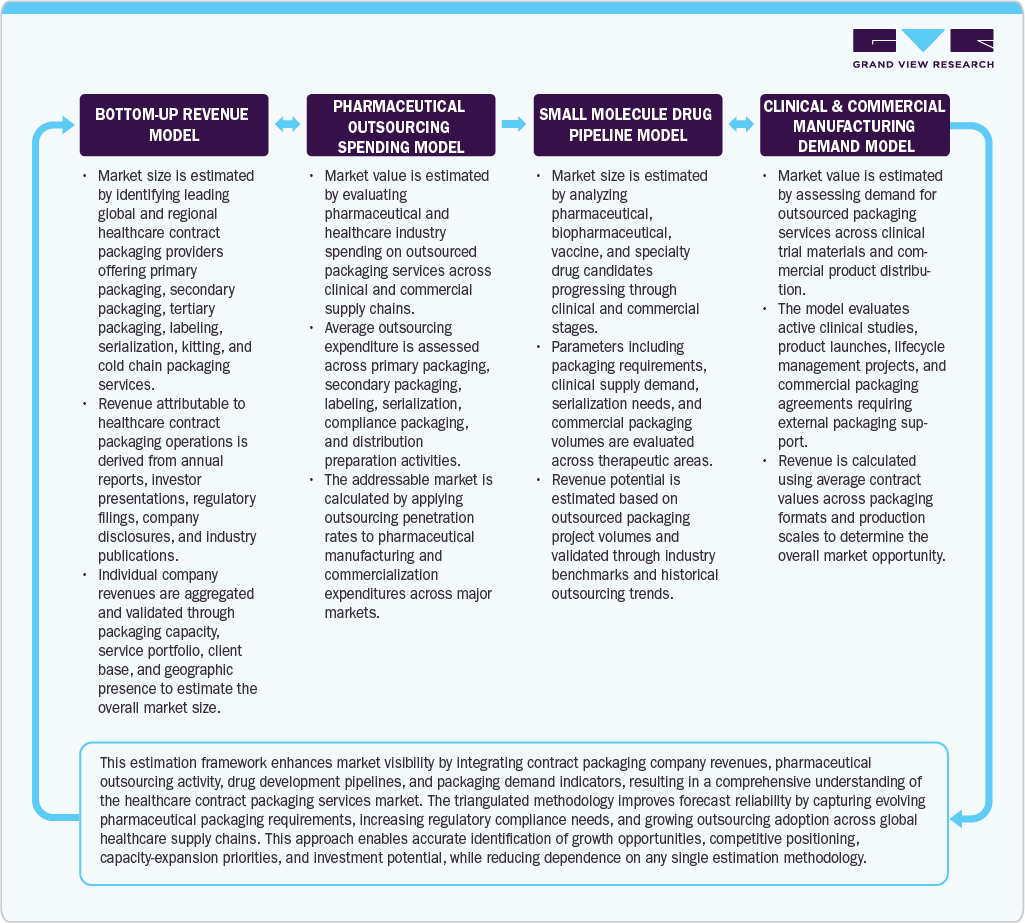 To learn more about this report, Download Free Sample Report
Delivered Customizations
This report has been delivered with the following In-depth customizations
Client Request
Customization Delivered
Value Adds
Evaluation of future outsourcing demand driven by pharmaceutical and biopharmaceutical pipelines
Built a pipeline linked outsourcing demand model by evaluating drug candidates across clinical and commercial stages, segmented by small molecules, biologics, biosimilars, vaccines, cell and gene therapies, and specialty pharmaceuticals. Assessed future demand for primary packaging, secondary packaging, labeling, serialization, cold chain packaging, and distribution support services.
Provides forward looking visibility into outsourcing opportunities and identifies therapeutic categories expected to generate the highest contract packaging demand throughout the forecast period.
Competitive benchmarking of healthcare contract packaging service providers
Conducted a comprehensive benchmark of leading contract packaging organizations based on packaging technologies, serialization capabilities, cold chain expertise, geographic footprint, regulatory compliance record, capacity utilization, automation levels, and pharmaceutical customer base. Included comparative positioning of global packaging specialists and regional service providers.
Helps clients identify competitive strengths, partnership opportunities, acquisition targets, and strategic capability gaps that may influence future market positioning.
Analysis of serialization and regulatory compliance readiness across major markets
Developed an assessment of packaging providers based on compliance with DSCSA requirements in the U.S., Falsified Medicines Directive requirements in Europe, and track and trace regulations across Asia Pacific and Latin America. Included evaluation of aggregation capabilities, digital packaging systems, and supply chain visibility solutions.
Supports strategic planning by identifying providers best positioned to address evolving regulatory requirements and increasing pharmaceutical supply chain security demands.
Frequently Asked Questions About This Report
The primary packaging segment led the market with the largest revenue share of 56.6% in 2025.
The blister packs segment led with a 30.9% revenue share in 2025, while the pre-filled syringes & cartridges segment is the fastest-growing.
Asia Pacific is the fastest-growing region over the forecast period.
The pharmaceuticals and biopharmaceuticals companies segment led the market with the largest revenue share of 72.5% in 2025.
The healthcare contract packaging services market is experiencing steady growth driven by the outsourcing of pharmaceutical and biopharmaceutical packaging operations, the rising complexity of drug-delivery formats, and the growing demand for specialized packaging solutions across global healthcare supply chains.
Key players operating in this market include Integer Holdings Corporation; Viant Technology LLC; FLEX LTD.; Celestica Inc.; Sanmina Corporation; Plexus Corp.; Phillips-Medisize; West Pharmaceutical Services, Inc.; Synecco Ltd; Catalent, Inc.; Thermo Fisher Scientific Inc.
The global healthcare contract packaging services market size was valued at USD 25.9 billion in 2025 and is estimated at USD 28.4 billion for 2026.
The global healthcare contract packaging services market is expected to grow at a CAGR of 11.6% from 2026 to 2033, reaching USD 61.1 billion by 2033.
North America dominated the healthcare contract packaging services market with the largest revenue share of 38.3% in 2025.
About the Author(s)
Medical Devices Research Team
Healthcare · Medical DevicesThis report was authored by the medical devices research team at Grand View Research - comprising two research analysts, one senior research analyst, and one industry expert - with specialized expertise in the medical devices segment of the healthcare industry. All findings are based on proprietary healthcare databases, executive interviews, and regulatory analysis, subject to internal peer review prior to publication.
Last Updated:
Speak to Analyst

Customize this report to your needs - add regions, segments, or data points, with 20% free customization.
Or view our licence options:


ISO 9001:2015 & 27001:2022 Certified
We are GDPR and CCPA compliant! Your transaction & personal information is safe and secure. For more details, please read our privacy policy.


