
- Home
- »
- Healthcare IT
- »
-
Healthcare Workforce Technology Market Report, 2026-2033GVR Report cover

Healthcare Workforce Technology Market (2026 - 2033)
Size, Share & Trends Analysis Report By Technology (Revenue Cycle Management (RCM), Patient Communication/Engagement), By Region (North America, Europe, Asia Pacific, Latin America, Middle East and Africa (MEA)), And Segment Forecasts
Market Size, 2025
$285.1BMarket Estimate, 2026
$698.2BMarket Forecast, 2033
$319.4BCAGR, 2026–2033
11.8%Healthcare Workforce Technology Market Summary
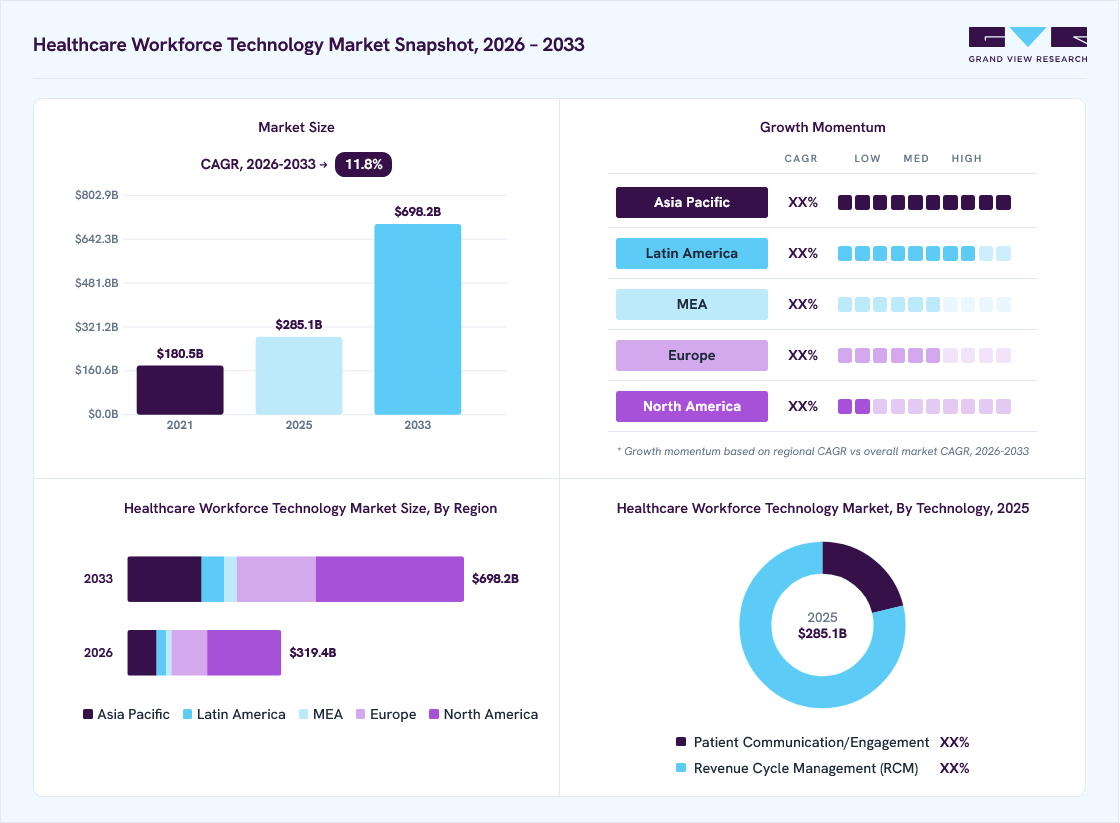
The global healthcare workforce technology market size was valued at USD 285.1 billion in 2025 and is projected to grow from USD 319.4 billion in 2026 to USD 698.2 billion by 2033, at a CAGR of 11.8% from 2026 to 2033. North America dominated the market, accounting for a revenue share of 48.7% in 2025. The market growth is attributed to the rising healthcare workforce shortages, growing demand for workforce optimization, increasing focus on employee productivity & retention, and growing adoption of data-driven workforce management.
 Source: Grand View Research, IR Documents, Primary Interviews, Paid DatabasesTo learn more about this report,
 Download Free Sample Report
Key Market Trends & Insights
- By technology: Revenue cycle management (RCM) segment held the largest market share of 43.6% in 2025.
Regional Highlights
- Largest regional market: North America (48.7% revenue share, 2025)
- Fastest-growing regional market: Asia Pacific (highest CAGR, 2026-2033)
Market Size & Forecast
- Market Size in 2025: USD 285.1 Billion
- Estimated Market Size in 2026: USD 319.4 Billion
- Projected Market Size by 2033: USD 698.2 Billion
- CAGR (2026-2033): 11.8%
Prism AI by Grand View Research Free to tryAsk a question about the healthcare workforce technology marketTry asking✓Every figure cited from GVR research Prefer the report? Download free sample →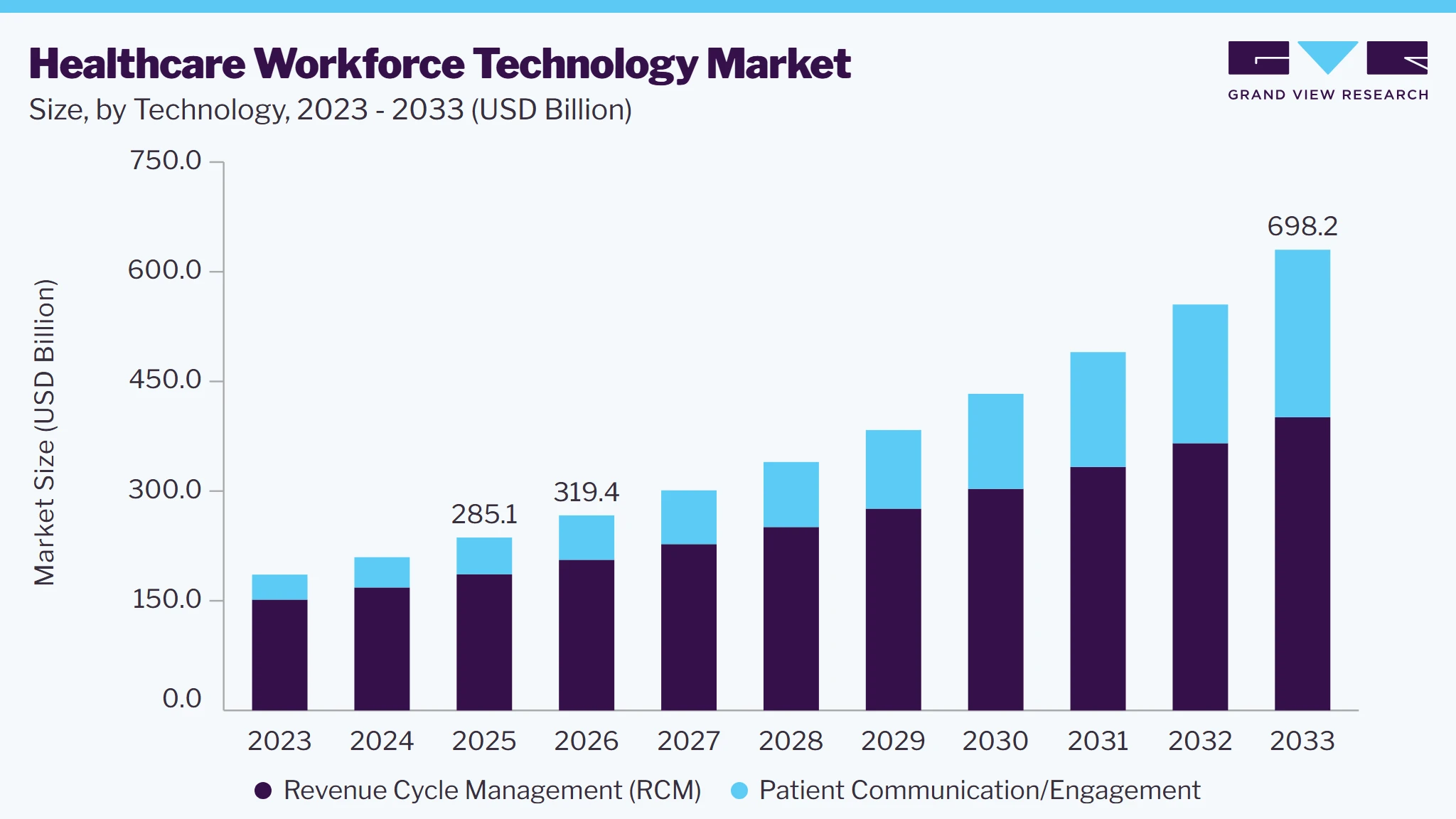 To learn more about this report, Download Free Sample Report
Market Dynamics
The market growth is driven by factors such as workforce shortages, demand for workforce optimization, employee productivity and retention, and data-driven workforce management, encouraging healthcare organizations to adopt digital solutions for staffing, scheduling, planning, and analytics. High implementation and integration costs, interoperability challenges, and data privacy concerns may restrain adoption, while AI and predictive analytics offer opportunities for intelligent scheduling, staffing forecasts, workload optimization, and real-time workforce insights.
The increasing focus on employee productivity and retention, as staffing shortages, workload pressures, burnout, and turnover affect operational efficiency and continuity of care in healthcare organizations, is driving market growth. Workforce technologies that support scheduling, workload management, employee engagement, communication, and performance tracking help organizations improve staff utilization while creating a better employee experience.
These solutions also help reduce administrative burden, improve workforce flexibility, and support long-term employee retention. For instance, in May 2026, Perceptyx reported a 2.9-percentage-point decline in healthcare employee engagement and a 3.0-percentage-point decline in employees’ intent to stay, highlighting increasing pressure on healthcare organizations to strengthen employee experience and retention.
High upfront investments in software, infrastructure, customization, training, and maintenance can restrain the adoption of healthcare workforce technologies. These costs can be particularly challenging for smaller healthcare providers with limited IT budgets. Integration with existing EHR, payroll, HCM, and scheduling systems can further increase implementation complexity and expenses. Legacy systems, data migration requirements, and the need for system customization can extend deployment timelines and increase overall costs.
The growing adoption of AI and predictive analytics is creating opportunities for technology providers in the healthcare workforce to develop solutions that forecast staffing requirements, optimize schedules, balance workloads, and provide real-time workforce insights. These technologies can help healthcare organizations respond to changing patient volumes and staffing availability while improving workforce utilization and reducing operational inefficiencies.
For instance, in February 2026, symplr introduced AI-driven predictive scheduling that anticipates staffing needs, dynamically reallocates resources, and accelerates open-shift fulfillment as part of its unified workforce management platform. This development highlights the growing opportunity for AI-enabled technologies to automate workforce planning and optimize healthcare staffing decisions.
“Operational efficiency isn’t a single initiative; it’s the sum of removing friction from dozens of everyday workflows, Platform capabilities that streamline staffing, reduce contract risk and cycle time, and strengthen real-time compliance visibility are practical improvements. They can help health systems like ours spend less time on administrative tasks and more time driving value for patients and our staff.”
- Robert Bart, MD, Chief Medical Information Officer at UPMC.
Market Concentration & Characteristics
The degree of innovation in the healthcare workforce technology industry is high, driven by AI integration, predictive analytics, intelligent automation, and integrated workforce platforms that improve scheduling, staffing, and workforce optimization. For instance, in March 2026, Worki launched an AI-powered workforce infrastructure that unifies HR and workforce systems and uses AI agents to automate workforce operations and identify optimization opportunities.
"Worki is defining a new category as one that unifies fragmented workforce systems, surfaces the friction points and waste hiding across them, charts a path forward for workforce and HR overhead roles being reshaped by AI or shifting demand, deploys intelligent agents to execute real operational workflows around HR and workforce functions, and delivers the connective, scalable AI workforce infrastructure layer that healthcare has never had."
-Craig Allan Ahrens, MHA, MBA - CEO
The level of partnerships and collaboration activities in the healthcare workforce technology market is high, as technology providers increasingly collaborate to integrate workforce management, staffing, scheduling, HR, time tracking, and payroll systems. These collaborations improve interoperability and enable healthcare organizations to manage workforce data and operations through connected platforms. For instance, in May 2026, QGenda announced a partnership with Workday to integrate its healthcare workforce management solutions with Workday Human Capital Management, connecting scheduling, HR, time tracking, and payroll data to create a unified workforce ecosystem.
“This partnership reinforces QGenda’s healthcare-specific expertise and proven ability to help health systems deploy care teams more effectively, reduce premium labor costs, and improve workforce satisfaction, “With seamless integrations, this empowers leaders with accurate, real-time demographic, scheduling, and time and attendance data to activate, deploy, and manage the entire healthcare team across the enterprise.”
Greg Benoit, CEO, QGenda
Regulations have a significant impact on the healthcare workforce technology market by requiring secure handling of employee and healthcare data, interoperability, access controls, and compliance with privacy standards such as HIPAA and GDPR. While compliance requirements increase implementation costs and complexity, they also strengthen data security, build user trust, and support the adoption of standardized technology.
The healthcare workforce technology industry is expanding as key players broaden their workforce solutions and geographic presence to serve healthcare organizations across additional markets. This expansion is supported by growing demand for staffing, workforce management, and technology-enabled workforce solutions. For instance, in May 2026, Medical Solutions highlighted its continued expansion from a three-person operation into a national healthcare workforce solutions provider, reflecting its broader geographic reach and expansion across the U.S. healthcare staffing market.
Analyst Perspective
The healthcare workforce technology market is driven by rising healthcare workforce shortages, growing demand for workforce optimization, and increasing adoption of AI-powered scheduling and analytics. High implementation and integration costs remain a key restraint, particularly for organizations integrating workforce platforms with existing EHR, HCM, payroll, and scheduling systems, while AI-powered predictive workforce analytics creates opportunities for automated staffing forecasts, intelligent scheduling, and workload optimization. Companies are focusing on AI-enabled workforce management, predictive staffing, automated scheduling, and integrated platforms to improve workforce utilization, reduce administrative workloads, and enhance operational efficiency.
Technology Insights
The revenue cycle management (RCM) segment dominated the healthcare workforce technology industry, accounting for a revenue share of 43.6% in 2025, supported by rising healthcare transaction volumes, complex reimbursement processes, and increasing pressure to improve financial performance. Healthcare organizations are adopting automated billing, claims management, payment processing, and AI-enabled RCM analytics to reduce errors, minimize revenue leakage, accelerate reimbursements, and improve collections. The growing demand for cost optimization and streamlined administrative workflows is further supporting the adoption of RCM technologies.
The patient communication/engagement segment is expected to grow at the fastest CAGR of 20.9% over the forecast period from 2026 to 2033. This is driven by the increasing digitalization of healthcare services, the rising demand for personalized communication, and a greater focus on patient experience. Healthcare organizations are increasingly adopting secure messaging, automated reminders, digital outreach, and omnichannel engagement platforms to improve communication, appointment adherence, care coordination, and patient satisfaction. The integration of AI and automation is further enabling personalized interactions and timely patient outreach.
Regional Insights
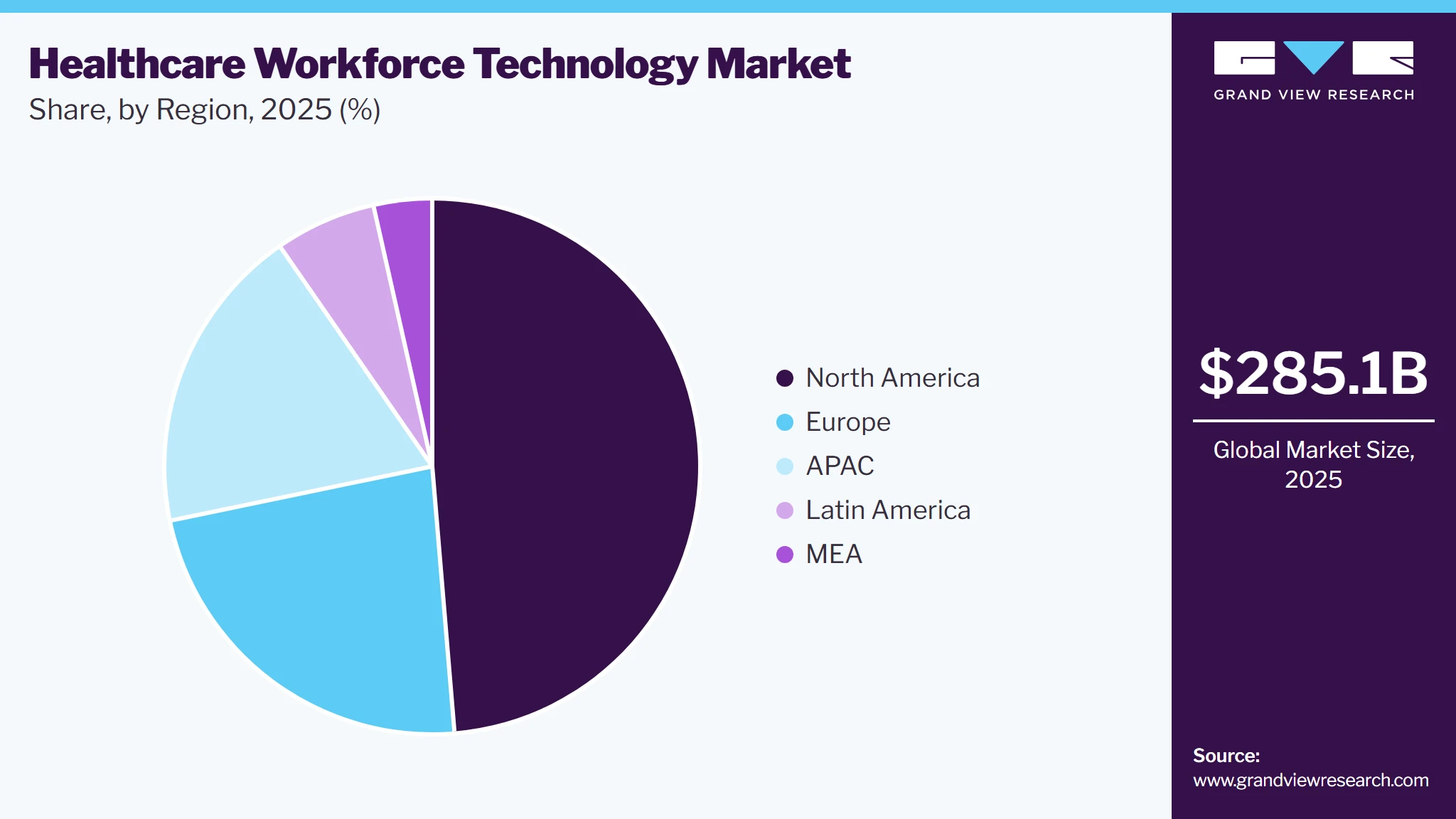
The North America healthcare workforce technology market held the largest global revenue share of 48.7% in 2025. The dominance is driven by the presence of established healthcare providers and technology companies, as well as increasing demand for workforce optimization solutions. For instance, in June 2026, AMN Healthcare and Brightfield announced a strategic collaboration to expand AMN’s healthcare workforce intelligence with broader market data, strengthening workforce decision-making capabilities in the market.
"At Brightfield, our focus is helping organizations bring greater intelligence, transparency and discipline to extended workforce decisions, Together with AMN, we have an opportunity to bring that value to healthcare in a meaningful way — helping systems better understand the market, validate decisions and build more resilient workforce strategies for the future."
- Sarah Koshiol, Chief Revenue Officer at Brightfield.
 To learn more about this report, Download Free Sample Report
U.S. Healthcare Workforce Technology Market Trends
The increasing cost of recruiting, retaining, and managing healthcare professionals is driving U.S. hospitals, health systems, and physician groups to adopt workforce management and staffing technologies. Solutions such as nurse and physician scheduling, contingent labor staffing, float pool management, labor forecasting, time and attendance, payroll, and workload management help providers allocate staff according to patient demand, reduce scheduling conflicts, and control overtime and agency staffing expenses. According to the American Hospital Association March 2026 insights, hospital workforce costs increased by 5.6% in 2025, highlighting the continuing financial pressure on healthcare employers. This supports demand for integrated workforce management platforms that connect staffing, scheduling, payroll, and productivity analytics.
Europe Healthcare Workforce Technology Market Trends
Europe is the significant region for the global healthcare workforce technology industry. Growth is driven by the digital transformation of national health systems, the growing demand for workforce planning, and the adoption of AI-enabled workforce management solutions. For instance, in October 2025, Infosys was awarded a USD 1.4 billion (£1.2 billion), 15-year contract by the NHS Business Services Authority to develop a data-driven Future NHS Workforce Solution for England and Wales, supporting approximately 1.9 million NHS employees across recruitment, payroll, career development, and workforce planning.
Asia Pacific Healthcare Workforce Technology Market Trends
The Asia Pacific healthcare workforce technology industry is expected to grow at the fastest CAGR of 10.8% over the forecast period. The growth is driven by expanding healthcare infrastructure, growing patient volumes, workforce shortages, and increasing digitalization of healthcare operations. Providers are adopting workforce management platforms to improve staff scheduling, resource allocation, time management, and workforce productivity. Increasing investments in AI, cloud-based healthcare systems, and digital health infrastructure are further supporting technology adoption across the region.
Key Healthcare Workforce Technology Company Insights
Key industry players are adopting advanced strategies to strengthen their market presence, including AI-powered workforce analytics, predictive scheduling, automation, and integrated workforce management platforms. Companies are enhancing solutions for staffing, scheduling, workforce planning, and real-time operational insights to improve workforce utilization, productivity, and cost efficiency.
Key Healthcare Workforce Technology Companies
The following key companies have been profiled for this study of the healthcare workforce technology market.
-
Oracle
-
Workday, Inc.
-
SAP SE
-
Microsoft
-
Infor
-
symplr
-
HealthStream
-
AMN Healthcare
-
QGenda, LLC
-
LeanTaaS
-
Dayforce
-
ADP, Inc.
-
ShiftMed
-
StaffDNA
-
HHAeXchange
Competitive Benchmarking
Category
Operating Strategies
Competitive Edge
Weakness
Established Players (Oracle, Workday, SAP, Microsoft, AMN Healthcare, HealthStream, symplr, Infor)
- Expand integrated workforce management platforms, strengthen AI-powered scheduling and workforce analytics, integrate HCM, payroll, staffing, and operational solutions, and pursue strategic partnerships with healthcare organizations.
- Broad healthcare and enterprise technology portfolios, large customer bases, extensive implementation capabilities, strong financial resources, and integrated workforce ecosystems.
- High implementation and integration costs, complex product portfolios, lengthy deployment cycles, and dependence on integration with existing healthcare IT systems.
Specialized Healthcare Workforce Players (QGenda, LeanTaaS, ShiftMed, symplr, AMN Healthcare, HealthStream, StaffDNA, CareRev)
- Focus on healthcare-specific scheduling, staffing, workforce optimization, contingent labor, and workforce analytics while expanding AI-enabled automation and mobile workforce capabilities.
- Deep healthcare workflow expertise, specialized workforce solutions, healthcare-specific datasets, strong provider relationships, and flexible staffing capabilities.
- Narrower product portfolios than large enterprise vendors, dependence on healthcare staffing demand, integration challenges, and comparatively smaller geographic scale.
Recent Developments
- In May 2026, Medicus Healthcare Solutions launched MedicusOne, an enterprise-grade locum tenens workforce management platform designed to provide healthcare organizations with greater control, visibility, and efficiency in managing contingent clinical workforces.
"MedicusOne was built to give healthcare leaders clarity and control when it comes to locum tenens management, By combining advanced analytics with intelligent automation, the platform simplifies staffing operations and provides leaders with the insight and tools needed to manage locum tenens staffing and ensure maximum focus on patient care."
- Tom McLain, Chief Information Officer of Medicus Healthcare Solutions.
- In August 2025, ShiftMed launched its AI-powered Workforce Suite to help healthcare organizations reduce labor costs, optimize staffing, and improve operational efficiency through AI-driven workforce management.
"Hospitals today face the dual challenge of maintaining optimal patient care while operating with leaner teams and tighter budgets, "Our AI Suite enables healthcare organizations to automate complex workforce processes, helping them spend smarter on their largest expense, labor, while driving down costs and unlocking new levels of operational efficiency. This technology is transforming workforce management so hospitals can deliver exceptional care with agility and precision well into the future."
- Todd Walrath, CEO of ShiftMed.
Healthcare Workforce Technology Market Report Scope
Report Attribute
Details
Market size in 2025
USD 285.1 billion
Estimated market size in 2026
USD 319.4 billion
Projected market size by 2033
USD 698.2 billion
Growth rate
CAGR of 11.8% from 2026 to 2033
Actual data
2021 - 2025
Forecast period
2026 - 2033
Quantitative units
Market value in USD million/billion, and CAGR from 2026 to 2033
Report coverage
Revenue forecast, company ranking, competitive landscape, growth factors, and trends
Segments covered
Technology, region
Regional scope
North America; Europe; Asia Pacific; Latin America; MEA
Country scope
Key companies profiled
Oracle; Workday, Inc.; SAP SE; Microsoft; Infor; symplr; HealthStream; AMN Healthcare; QGenda, LLC; LeanTaaS; Dayforce; ADP, Inc.; ShiftMed; StaffDNA; HHAeXchange
Customization scope
Free report customization (equivalent up to 8 analysts working days) with purchase. Addition or alteration to country, regional & segment scope.
Pricing and purchase options
Avail customized purchase options to meet your exact research needs. Explore purchase options
Global Healthcare Workforce Technology Market Report Segmentation
This report forecasts revenue growth at the global, regional & country levels and provides an analysis of the latest industry trends in each of the sub-segments from 2021 to 2033. For this study, Grand View Research has segmented the global healthcare workforce technologymarket report based on technology and region:
-
Technology Outlook (Revenue, USD Million/Billion, 2021 - 2033)
-
Access Control/Management
-
Ambulatory Scheduling
-
Analytics
-
Business Intelligence (BI)/Data Visualization
-
Capacity Planning/Optimization Management
-
Employee Communications
-
Clinical Scheduling
-
Compliance & Risk Management
-
Contingent Labor Staffing
-
Credentialing
-
Customer Relationship Management (CRM)
-
Electronic Health Records (EHR)
-
Electronic Visit Verification (EVV)
-
Employee Engagement/Feedback
-
Enterprise Resource Planning (ERP)
-
Financial Management
-
Float Pool Management
-
HCM (Human Capital Management)
-
Health Information Exchange (HIE)
-
Home Health Solution
-
Labor Forecasting/Demand Planning
-
Medical Inventory/Supply Chain Management
-
Mileage Tracking
-
Nurse Scheduling
-
Nurse Staffing
-
Patient Communication/Engagement
-
Patient Portal Solutions
-
Patient Scheduling
-
Payroll
-
Pharmacy Management Systems (PMS)
-
Physician Scheduling
-
Revenue Cycle Management (RCM)
-
Room Scheduling
-
Route Planning/Optimization
-
Spend Management
-
Staffing Platforms/Agencies
-
Talent Acquisition/Management
-
Telehealth
-
Time & Attendance
-
Vendor Management Systems (VMS)
-
Workforce Management (WFM)
-
Workload Management
-
-
Regional Outlook (Revenue, USD Million/Billion, 2021 - 2033)
-
North America
-
Europe
-
Asia Pacific
-
Latin America
-
Middle East and Africa (MEA)
-
Research Methodology
The healthcare workforce technology market figures in this report are based on a proven research process that combines executive interviews with secondary research from proprietary databases, company filings, and recognized regulatory and institutional sources. Market size is built through value-chain sizing-reconciling supply-side and demand-side estimates-and triangulated with bottom-up and top-down approaches. Every estimate passes multiple levels of expert validation before publication, with each healthcare workforce technology segment quantified using the revenue-capture definitions in the table below.
Segment Definition
Segment- Technology Type
Revenue Capture Definition
Access Control/Management
Revenue generated from software and platforms that manage workforce access, authentication, permissions, and facility or system access for healthcare employees.
Ambulatory Scheduling
Revenue generated from software that schedules ambulatory staff, appointments, resources, and clinical activities across outpatient facilities.
Analytics
Revenue generated from workforce analytics software that analyzes staffing, productivity, utilization, scheduling, and operational data to support workforce decisions.
Business Intelligence (BI)/Data Visualization
Revenue generated from BI and data visualization platforms that transform workforce and operational data into dashboards, reports, and actionable insights.
Capacity Planning/Optimization Management
Revenue generated from solutions that forecast workforce capacity and optimize staffing levels, resources, and workloads based on healthcare demand.
Employee Communications
Revenue generated from platforms that facilitate workforce communication, internal messaging, notifications, and information sharing among healthcare employees.
Clinical Scheduling
Revenue generated from software that manages schedules for clinical staff, shifts, assignments, and care activities across healthcare facilities.
Compliance & Risk Management
Revenue generated from software that manages workforce compliance, regulatory requirements, risk monitoring, policies, and related administrative processes.
Contingent Labor Staffing
Revenue generated from platforms and services that manage temporary, contract, per-diem, and other contingent healthcare workers.
Credentialing
Revenue generated from software and services that manage healthcare professional credentials, licenses, certifications, verification, and renewals.
Customer Relationship Management (CRM)
Revenue generated from CRM platforms used by healthcare organizations to manage relationships, interactions, outreach, and engagement with customers and stakeholders.
Electronic Health Records (EHR)
Revenue generated from EHR software that enables healthcare organizations to create, store, manage, and exchange electronic patient health records.
Electronic Visit Verification (EVV)
Revenue generated from EVV platforms that electronically verify caregiver visits, service delivery, time, location, and patient information, particularly in home healthcare.
Employee Engagement/Feedback
Revenue generated from platforms that measure employee engagement, collect workforce feedback, conduct surveys, and provide employee experience insights.
Enterprise Resource Planning (ERP)
Revenue generated from integrated ERP platforms that manage healthcare organizations’ financial, operational, workforce, procurement, and administrative processes.
Financial Management
Revenue generated from software that supports budgeting, accounting, financial reporting, expense management, and other financial processes within healthcare organizations.
Float Pool Management
Revenue generated from solutions that manage internal float pools by matching available healthcare staff with open shifts and workforce requirements.
Human Capital Management (HCM)
Revenue generated from HCM platforms that manage employee records, recruitment, onboarding, performance, compensation, benefits, and other workforce processes.
Health Information Exchange (HIE)
Revenue generated from platforms that enable secure electronic exchange of health information among healthcare providers, organizations, and authorized stakeholders.
Home Health Solution
Revenue generated from software platforms supporting home healthcare operations, including scheduling, care coordination, workforce management, documentation, and billing.
Labor Forecasting/Demand Planning
Revenue generated from predictive workforce solutions that forecast labor requirements based on patient volumes, historical demand, staffing availability, and operational needs.
Medical Inventory/Supply Chain Management
Revenue generated from software that manages healthcare inventory, procurement, distribution, supply planning, and medical supply utilization.
Mileage Tracking
Revenue generated from workforce software that tracks employee travel, mileage, routes, and reimbursement for mobile and home healthcare staff.
Nurse Scheduling
Revenue generated from software that automates and manages nurse schedules, shifts, assignments, availability, and staffing requirements.
Nurse Staffing
Revenue generated from platforms and services that connect healthcare organizations with nurses and manage permanent, temporary, per-diem, or contract staffing requirements.
Patient Communication/Engagement
Revenue generated from platforms that enable healthcare organizations to communicate with patients through messaging, notifications, outreach, and engagement tools.
Patient Portal Solutions
Revenue generated from digital platforms that provide patients with secure access to health information, appointments, communications, and healthcare services.
Patient Scheduling
Revenue generated from software that manages patient appointments, scheduling workflows, availability, cancellations, and related administrative processes.
Payroll
Revenue generated from payroll software and services that calculate, process, and manage employee compensation, deductions, taxes, and payroll reporting.
Pharmacy Management Systems (PMS)
Revenue generated from software that manages pharmacy operations, including prescriptions, dispensing, inventory, billing, and medication-related workflows.
Physician Scheduling
Revenue generated from software that manages physician availability, shifts, assignments, on-call schedules, and clinical coverage requirements.
Revenue Cycle Management (RCM)
Revenue generated from software and services that manage healthcare billing, claims processing, payment collection, reimbursement, and revenue optimization.
Room Scheduling
Revenue generated from software that schedules and allocates clinical rooms, operating rooms, examination rooms, and other healthcare facilities based on availability and demand.
Route Planning/Optimization
Revenue generated from software that plans and optimizes travel routes for mobile healthcare workers to improve travel efficiency, scheduling, and workforce utilization.
Spend Management
Revenue generated from software that manages organizational spending, procurement, expenses, purchasing, supplier relationships, and cost controls.
Staffing Platforms/Agencies
Revenue generated from digital staffing platforms and staffing agencies that source, match, and place healthcare professionals with healthcare organizations.
Talent Acquisition/Management
Revenue generated from software and services supporting healthcare recruitment, candidate sourcing, hiring, onboarding, career development, and talent management.
Telehealth
Revenue generated from platforms and services enabling remote healthcare consultations, virtual care delivery, remote communication, and related clinical workflows.
Time & Attendance
Revenue generated from software that records employee working hours, attendance, shifts, overtime, leave, and related workforce time data.
Vendor Management Systems (VMS)
Revenue generated from platforms that manage external workforce vendors, staffing suppliers, contracts, worker assignments, compliance, and vendor performance.
Workforce Management (WFM)
Revenue generated from integrated workforce management platforms that manage staffing, scheduling, time and attendance, workforce planning, productivity, and labor utilization.
Workload Management
Revenue generated from solutions that monitor, distribute, and optimize employee workloads based on staffing availability, patient demand, tasks, and operational requirements.
Estimation Model
Category
Description
Commodity Flow Analysis (Top Down)
Market size was estimated by analyzing revenues generated by key technology segments, including workforce management, staffing & workforce planning, HCM, scheduling, workforce analytics, workforce administration, and others, supported by company annual reports, investor presentations, industry databases, and market research.
Country-Level Segment Share Modeling
Country-level shares for workforce management, staffing, HCM, scheduling, analytics, and other workforce technology solutions were derived using healthcare workforce shortages, healthcare expenditure, digital health adoption, healthcare IT infrastructure, provider size, technology penetration, and workforce management adoption. Weighted averages were applied to determine regional and global segment distributions.
Data Triangulation & Validation Model
Market estimates were validated by triangulating secondary research, primary interviews, company-level revenue assessments, technology adoption data, healthcare workforce statistics, provider adoption, and demand-side analysis to ensure consistency across solutions, end uses, and geographies.
Forecasting & CAGR Modeling
Market forecasts were developed using healthcare workforce shortages, labor costs, healthcare employment growth, digital transformation, AI adoption, cloud technology penetration, workforce automation, healthcare expenditure, and regulatory developments. Trend and scenario-based modeling were applied to estimate future market growth and CAGR.
Delivered Customizations
This report has been delivered with the following In-depth customizations
Customization Delivered
Client Request
Value Adds
Expanded Segment-Level Market Coverage
Obtain market size data for 42 healthcare workforce technology segments across different regions.
Provided segment-level market data across 42 segments, enabling the client to assess the market size and contribution of each technology segment by region.
Technology Segment Comparison and Ranking
Compare different healthcare workforce technologies to identify the leading and revenue-generating segments.
Enabled comparative assessment and ranking of technology segments based on market size and revenue contribution, helping identify high-value segments and potential growth opportunities.
Segment-Level Competitive Landscape
Identify notable players operating within each healthcare workforce technology segment across different regions.
Provided competitive landscape coverage at the individual segment level, identifying key players across regions to help the client understand the competitive ecosystem, market positioning, and areas of competitive concentration.
About the Author(s)
Healthcare IT Research Team
Healthcare · Healthcare ITThis report was authored by the healthcare it research team at Grand View Research - comprising two research analysts, one senior research analyst, and one industry expert - with specialized expertise in the healthcare it segment of the healthcare industry. All findings are based on proprietary healthcare databases, executive interviews, and regulatory analysis, subject to internal peer review prior to publication.
Last Updated:
Speak to Analyst

Customize this report to your needs - add regions, segments, or data points, with 20% free customization.
Or view our licence options:


ISO 9001:2015 & 27001:2022 Certified
We are GDPR and CCPA compliant! Your transaction & personal information is safe and secure. For more details, please read our privacy policy.


