
- Home
- »
- Plastics, Polymers & Resins
- »
-
Heat Stabilizers Market Size And Share Report, 2026-2033GVR Report cover

Heat Stabilizers Market (2026 - 2033)
Size, Share & Trends Analysis Report Market By Application (Pipes & Fittings, Profiles & Tubing, Wires & Cables, Films & Sheets, Flooring), By End Use (Construction, Electrical & Electronics, Packaging, Automotive, Consumer Goods), By Region, And Segment
Market Size, 2025
$4.9BMarket Estimate, 2026
$5.1BMarket Forecast, 2033
$7.6BCAGR, 2026–2033
5.7%Heat Stabilizers Market Summary
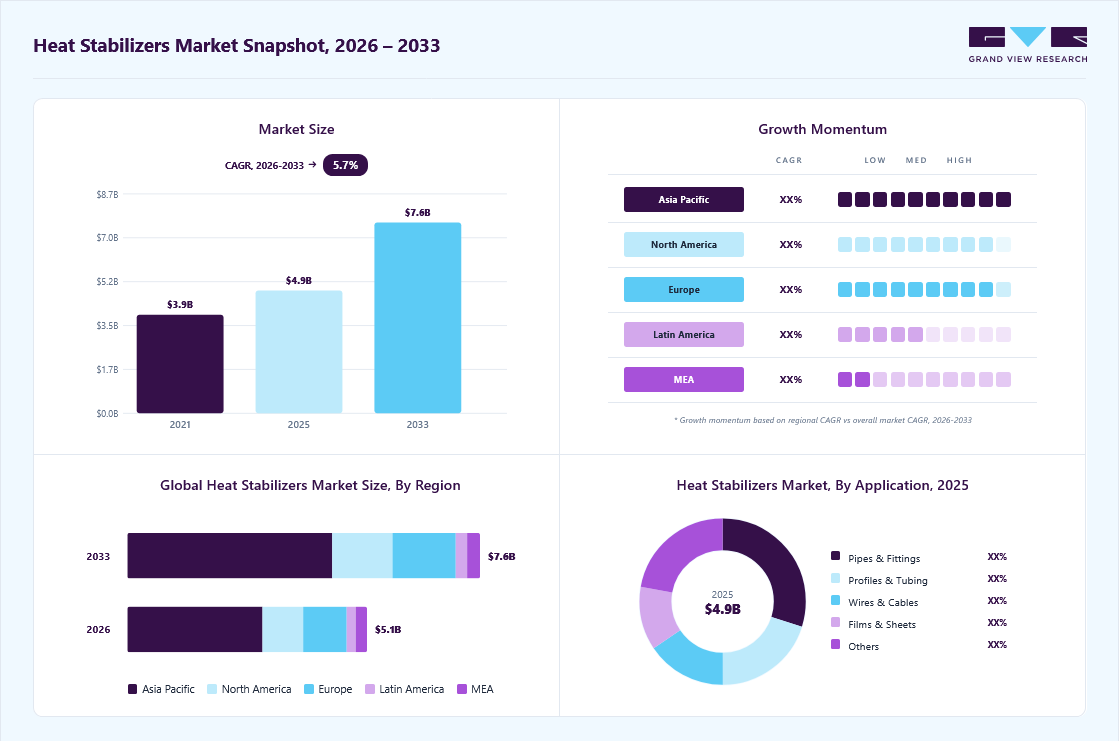
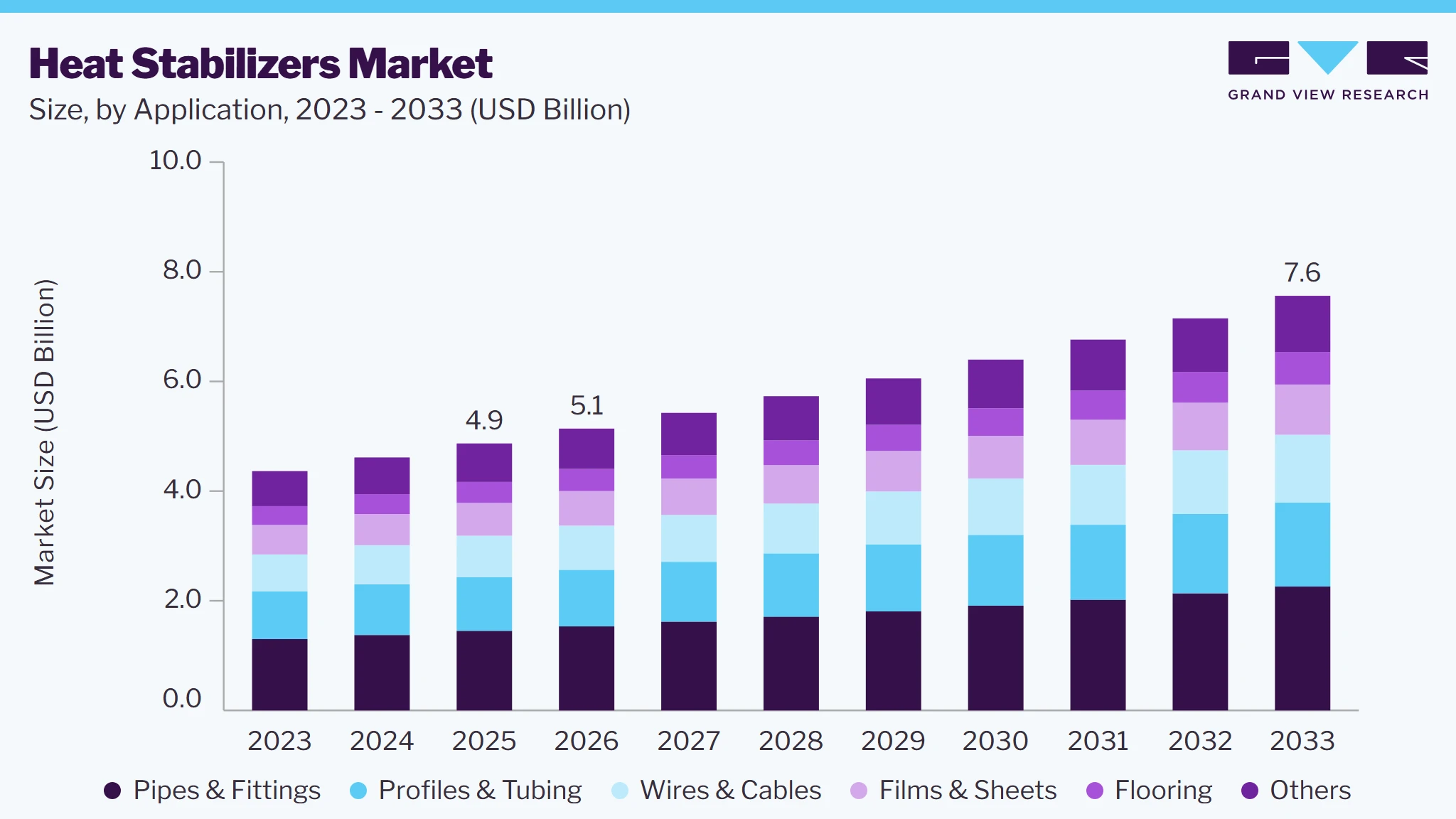
The global heat stabilizers market size was valued at USD 4.9 billion in 2025 and is projected to grow from USD 5.1 billion in 2026 to USD 7.6 billion by 2033, at a CAGR of 5.7% from 2026 to 2033. Asia Pacific dominated the global market, with a revenue share of 56.1% in 2025. Growing consumption of PVC pipes, cables, profiles, flooring, packaging, and automotive components is driving the demand for heat stabilizers.
 Source: Grand View Research, IR Documents, Primary Interviews, Paid DatabasesTo learn more about this report,
 Download Free Sample Report
Key Market Trends & Insights
- By application: Wires & cables segment is expected to grow at a CAGR of 6.3% from 2026 to 2033.
- By end use: Electrical & electronics segment is expected to grow at a 6.5% CAGR from 2026 to 2033, in terms of revenue.
Regional Highlights
- Largest regional market: Asia Pacific (56.1% revenue share, 2025)
- By country: China held the largest market share in 2025.
Market Size & Forecast
- Market size in 2025: USD 4.9 Billion
- Estimated market size in 2026: USD 5.1 Billion
- Projected market size by 2033: USD 7.6 Billion
- CAGR (2026-2033): 5.7%
GVR research-powered AIAsk Prism AI about the heat stabilizers marketGet cited answers from GVR research on market growth, segments, regulations and forecasts.Start with✓ Source-linked answers ✓ Market-specific context ✓ Traceable figuresExplore Prism AI ↗PVC requires thermal protection during high-temperature processing to prevent degradation, discoloration, and loss of mechanical properties. Infrastructure development, construction activity, automotive production, and electrical applications are expanding polymer consumption, creating sustained demand for efficient stabilizer systems that improve processing performance and long-term product durability.
 To learn more about this report, Download Free Sample Report
The heat stabilizers industry is moving toward calcium-zinc and multifunctional stabilizer packages that combine thermal protection with improved color retention and processing stability. Calcium-based systems are widely used in European PVC applications, including pipes, cables, and profiles. Formulators are also improving synergistic additive combinations to address limitations such as zinc burn and inadequate long-term stability. Research into enhanced calcium-zinc chemistries reflects this shift toward higher-efficiency formulations.
Market Dynamics
Rising investment in water supply networks, drainage systems, building infrastructure, and electrical installations is increasing PVC processing volumes across pipes, fittings, profiles, and cable insulation. PVC converters require heat stabilizers to maintain melt stability during extrusion and molding. Stabilization reduces thermal degradation, discoloration, and hydrogen chloride formation, allowing processors to achieve consistent throughput and surface quality. Growth in replacement and renovation activity further supports recurring demand for stabilized PVC products.
Demand is also expanding in window profiles, flooring, technical components, and other durable applications where PVC offers corrosion resistance, electrical insulation, and cost efficiency. Calcium-based and other stabilizer systems help maintain material performance during processing while supporting long-term product durability. Increasing conversion of PVC into rigid and flexible products, therefore directly expands stabilizer consumption, particularly where manufacturers require consistent processing performance and compliance with evolving product and environmental requirements.
Increasing restrictions on lead and other substances constrain the use of legacy heat stabilizer systems and raise reformulation requirements. European regulatory measures specifically address lead in PVC, while certain limited exemptions remain under hazardous-substance legislation. Manufacturers must therefore validate alternative formulations for thermal efficiency, color stability, durability, and application-specific performance. These technical requirements can increase development costs, qualification periods, and formulation complexity, particularly for products transitioning from established stabilizer packages.
The expansion of PVC recycling creates an opportunity for stabilizer formulations compatible with recycled feedstocks and variable additive histories. Recovered PVC can contain legacy metals and other residual substances, creating formulation and compliance challenges. The European Commission has established concentration and traceability requirements for lead in recovered PVC articles. Stabilizer suppliers can address this need through low-metal formulations, improved additive compatibility, and systems optimized for recycled PVC processing without compromising thermal performance or product quality.
Market Concentration & Characteristics
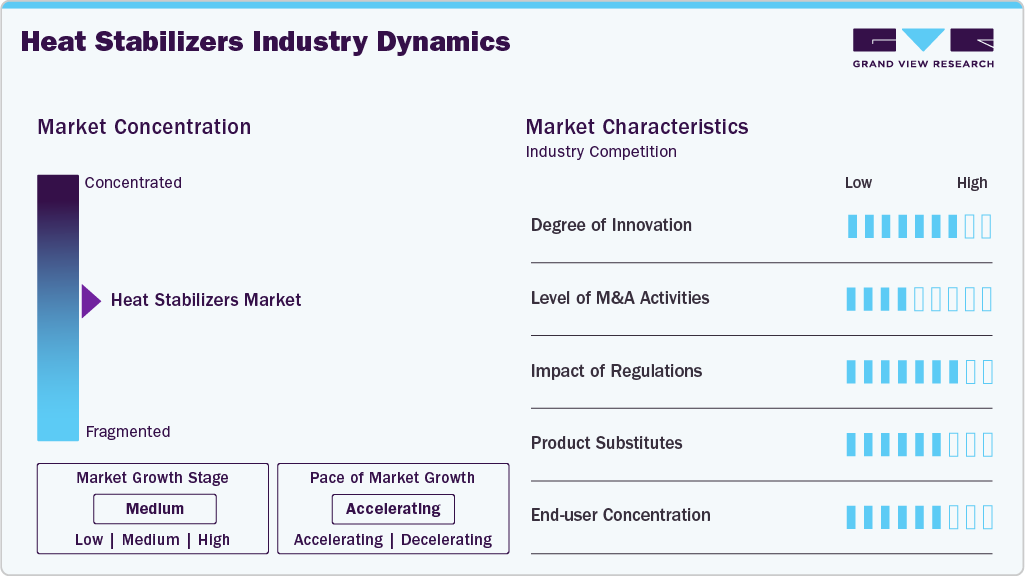
The market growth stage is medium, and growth is accelerating. The market exhibits slight consolidation, with key players dominating the industry landscape. Major companies such as Baerlocher GmbH, SONGWON Industrial Group, Akdeniz Chemson, Valtris Specialty Chemicals, Reagens Group, ADEKA Corporation, SUN ACE Group, PMC Organometallix, Kisuma Chemicals, Pau Tai Industrial Corporation, and others play a significant role in shaping the market dynamics. These leading players often drive innovation in the market by introducing new products, technologies, and materials to meet the industry's evolving demands.
Innovation in the heat stabilizers market is increasingly formulation-driven, particularly for PVC applications. Development is focused on calcium-zinc systems, tin replacement, improved one-pack formulations, and stabilizers compatible with recycled PVC. Current product development also targets better early color, processing consistency, thermal endurance, and compatibility with existing equipment. In 2025, industry developments highlighted calcium-zinc systems designed to replace tin-based technologies while supporting recycled content and meeting the needs of sensitive applications such as potable water, food packaging, and medical products.
 To learn more about this report, Download Free Sample Report
Regulations strongly influence heat stabilizer formulations, particularly by restricting lead and other substances used in PVC stabilization. Under EU Regulation 2023/923, lead concentrations in PVC articles are restricted, with specific requirements affecting recovered PVC from May 2026. In addition, ECHA added a restriction initiative in March 2026 targeting the use of lead compounds to stabilize PVC. These measures are accelerating substitution toward calcium-based and other compliant systems while increasing formulation validation and regulatory documentation requirements.
Analyst Perspective
The heat stabilizers market is expected to shift from a volume-led PVC additive segment toward a more value-led, compliance-driven, and application-specific industry. Demand will remain strong across pipes and fittings, profiles, wires and cables, flooring, construction, and electrical applications, while recycled PVC will create additional formulation requirements. Lead-free calcium-zinc and other alternatives are expected to expand as regulations accelerate substitution, particularly in Europe. Suppliers will increasingly compete through formulation efficiency, recycling compatibility, technical support, and application-specific solutions rather than price alone. Integrated production, regulatory expertise, localized supply, and global technical support will strengthen competitive positioning. However, raw-material volatility, regional overcapacity, pricing pressure, qualification cycles, and intense competition are expected to constrain margins.
Application Insights
The pipes & fittings dominated the heat stabilizers industry, accounting for a revenue share of 29.8% in 2025, and is forecast to grow at a 5.7% CAGR from 2026 to 2033. Rising investment in water supply, sanitation, drainage, and utility networks is driving demand for PVC pipes and fittings, thereby increasing the need for thermal stabilization during extrusion and molding. According to the World Bank, India’s urban water infrastructure alone requires an estimated USD 150 billion of investment over the next 15 years. PVC stabilizers are essential for maintaining processing stability and long service life in pressure, sewer, drainage, and ducting applications. This creates sustained demand for calcium-based and other compliant stabilizer systems.
The wires & cables segment is expected to grow at a 6.3% CAGR over the forecast period. Accelerating grid expansion is strengthening the wires and cables segment of the heat stabilizers market. According to the International Energy Agency, annual grid investment needs to increase by approximately 50% by 2030, from the current USD 400 billion to accommodate rising electricity demand and new generation capacity. PVC is widely used for power, data, and communication cable insulation, while stabilizers protect cable compounds during processing and long-term service. This combination of grid modernization, electrification, and cable replacement supports continued stabilizer consumption.
End Use Insights
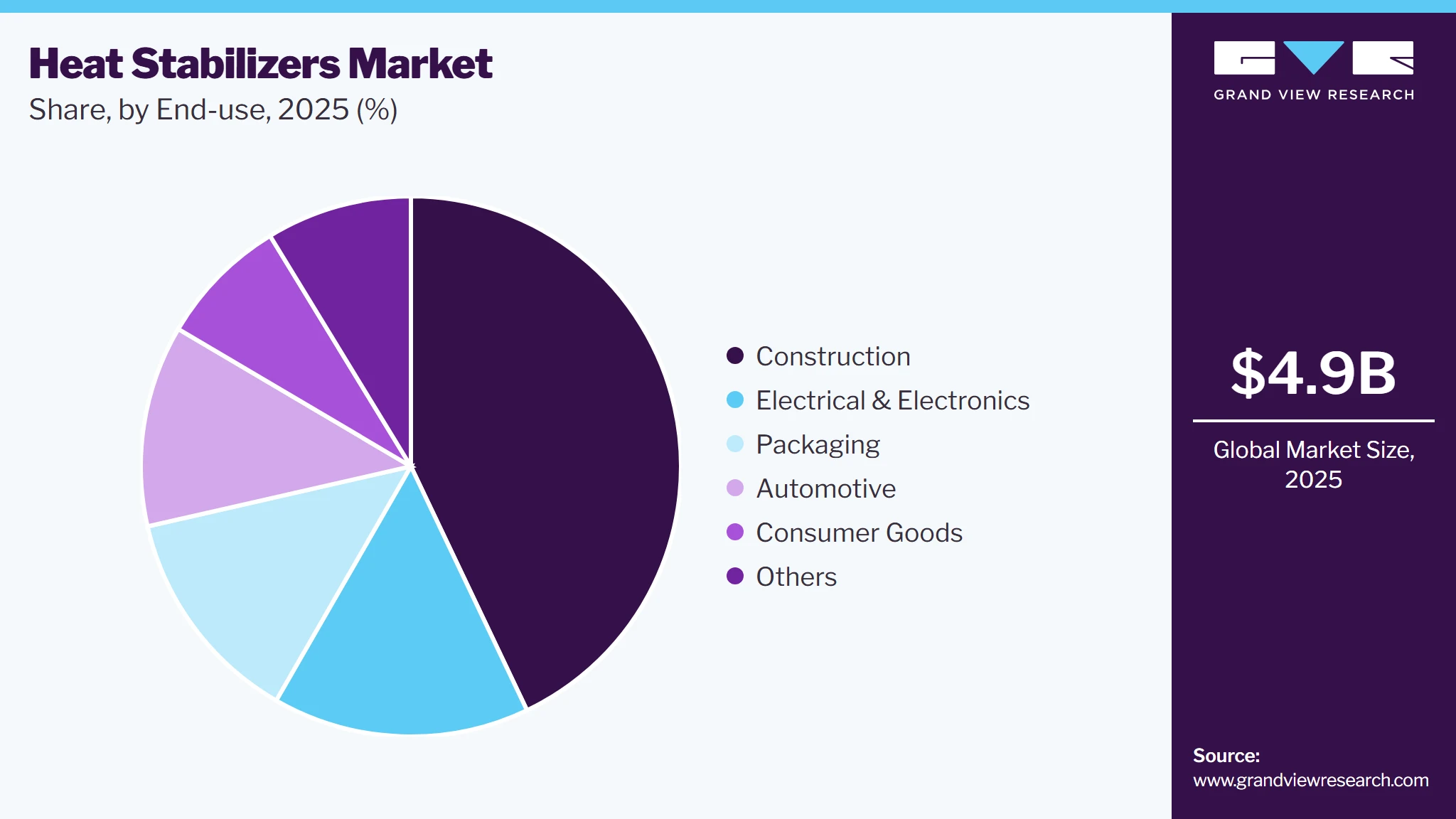
The construction segment led the heat stabilizers market, accounting for 42.9% revenue share in 2025, and is projected to grow at a 5.6% CAGR from 2026 to 2033. Construction activity is generating demand for PVC-based profiles, flooring, roofing membranes, conduits, and other building products that require thermal stabilization during manufacturing. According to the European Commission, the revised Construction Products Regulation became fully applicable on January 7, 2026, placing greater emphasis on sustainability, product performance, and environmental information. This regulatory shift is encouraging manufacturers to qualify stabilizer systems that combine thermal efficiency with lower emissions and improved environmental performance, particularly for long-life building products exposed to demanding processing and service conditions.
 To learn more about this report, Download Free Sample Report
The electrical & electronics segment is expected to grow at the fastest CAGR of 6.5% over the forecast period. Rapid electrification and the expansion of data-driven infrastructure are increasing the volume of electrical components, cable systems, insulation products, and protective polymer parts that require controlled thermal processing. According to the International Energy Agency, global electricity demand is forecast to grow at an average 3.6% annually from 2026 to 2030, supported by data centers, electric vehicles, industry, and building electrification. This expanding electrical equipment base increases demand for PVC and other stabilized polymers, where processing consistency, dielectric performance, dimensional stability, and long-term reliability are critical.
Regional Insights
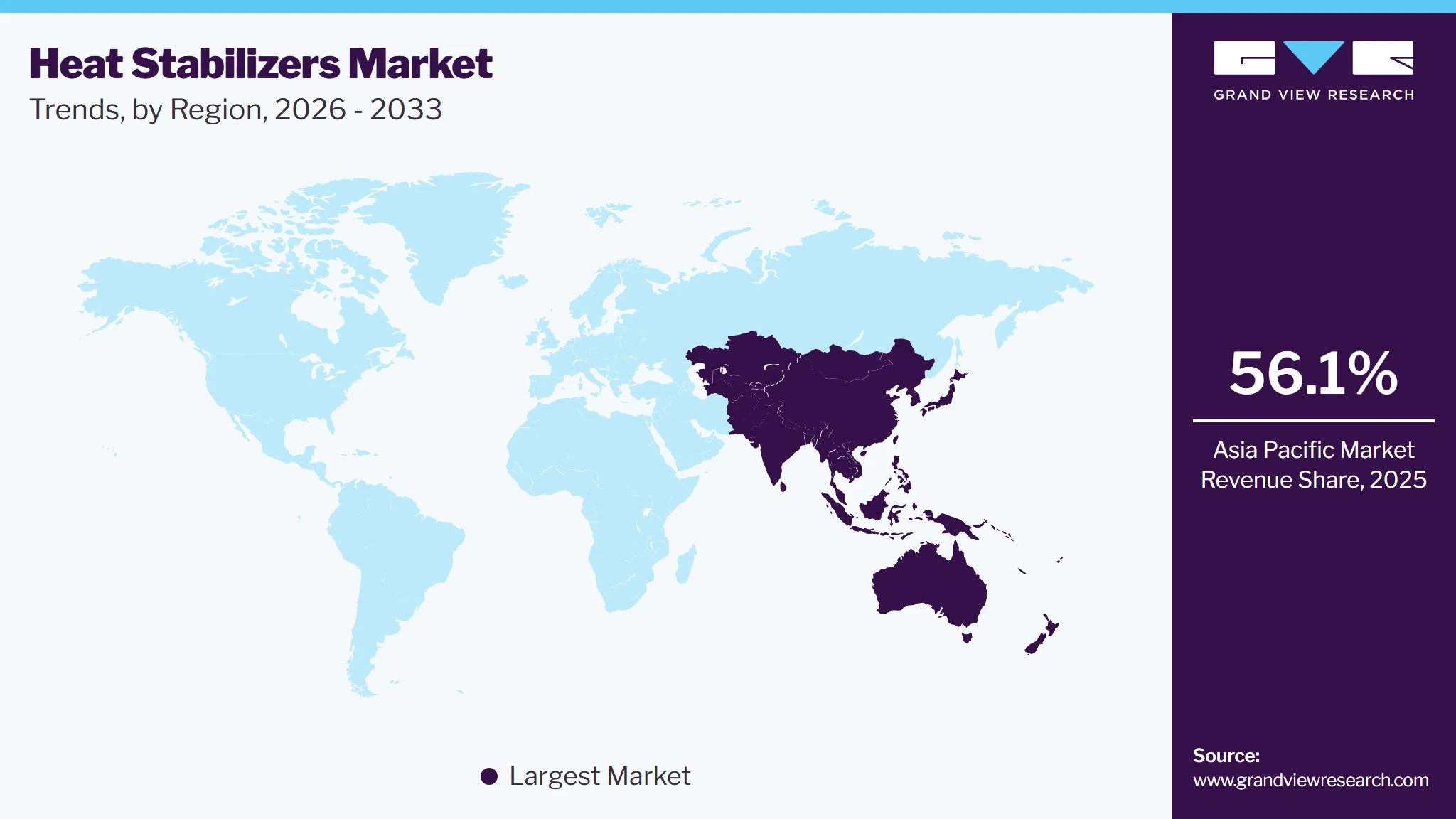
The Asia Pacific heat stabilizers market held the largest revenue share of 56.1% in 2025. The region is expected to grow at a CAGR of 6.1% over the forecast period. Asia Pacific remains a major demand center for heat stabilizers as electricity consumption, urbanization, and infrastructure investment expand across emerging economies. According to the IEA, India’s electricity demand is forecast to grow 6.4% annually through 2030, while Southeast Asia is expected to grow 5.3%. Rising grid construction, utility networks, cooling infrastructure, and building activity increase PVC usage in cables, conduits, pipes, and profiles. This supports the sustained use of thermal stabilizer systems in high-volume polymer processing.
 To learn more about this report, Download Free Sample Report
China Heat Stabilizers Market Trends
Chinaaccounted for the largest share of the heat stabilizers market in 2025, with growth increasingly driven by infrastructure-led demand for polymers rather than residential construction alone. According to the National Development and Reform Commission, more than USD 1.4 trillion is provisionally planned for the country’s major infrastructure networks in 2026, including power grids and underground pipelines. The government also expects more than USD 744.8 billion of power-grid investment during 2026-2030. These projects require significant volumes of PVC pipes, conduits, cable insulation, and profiles, sustaining demand for stabilization during extrusion and molding.
North America Heat Stabilizers Market Trends
North America is benefiting from infrastructure renewal and utility modernization, with Canada adding an important growth component to regional demand. According to the Government of Canada, the Build Communities Strong Fund will invest CAD 51 billion over 10 years from 2026-27 across housing, water, transit, and climate-resilient infrastructure. Water and wastewater upgrades require extensive polymer piping and related components, while housing-enabling infrastructure increases the use of PVC construction products. These applications create recurring requirements for reliable, compliant heat stabilizer formulations.
U.S. Heat Stabilizers Market Trends
The U.S. heat stabilizers industry is being shaped by rising electricity demand and accelerated investment in transmission, manufacturing, and water systems. According to the U.S. Department of Energy, the 2026 National Transmission Needs Study identifies pressing requirements for additional transmission infrastructure due to data centers, domestic manufacturing, and larger industrial loads. The EPA also allocated USD 7.2 billion through the FY2026 Clean Water and Drinking Water State Revolving Funds. Greater deployment of cables, conduits, pipes, and utility components supports demand for thermally stabilized polymers.
Europe Heat Stabilizers Market Trends
Europe’s heat stabilizers industry is increasingly influenced by regulatory-driven product upgrading and demand for durable construction materials. The revised Construction Products Regulation has been fully applied since January 7, 2026, with greater emphasis on sustainability, environmental information, and digital product documentation. PVC remains important in European building, electrical, and infrastructure applications. This regulatory environment encourages processors to qualify stabilizer systems that support compliant formulations while maintaining thermal performance, color retention, and product durability in pipes, profiles, cables, flooring, and other long-life applications.
Latin America Heat Stabilizers Market Trends
Latin America offers growth potential through the expansion of water, sanitation, and energy infrastructure. Brazil is a key contributor, with the federal government directing USD 4.2 billion through the New PAC toward sanitation projects in 2025, while total sanitation investment since 2023 reached BRL 11.7 billion. Mexico is also accelerating infrastructure development, with BRL-equivalent investments across energy, water, transport, and other sectors through its 2026-2030 infrastructure plan. These projects increase the consumption of PVC piping, conduits, and construction products requiring thermal stabilization.
Middle East and Africa Heat Stabilizers Market Trends
The demand in the Middle East & Africa heat stabilizers industry is being supported by electrification, cooling requirements, and infrastructure expansion, although market dynamics differ across countries. According to the IEA, electricity demand in the Middle East grew by nearly 4% in 2025, supported by economic expansion and rising air-conditioning use. In Africa, the African Development Bank’s Mission 300 initiative aims to connect an additional 300 million people to electricity by 2030. Grid expansion, utility construction, cables, conduits, and building systems, therefore, provide a growing application base for stabilized PVC products.
Key Heat Stabilizers Company Insights
Some of the key players operating in the market include Baerlocher GmbH and SONGWON Industrial Group.
-
Baerlocher maintains a broad heat stabilizer portfolio covering calcium-based, organotin, liquid mixed-metal, and customized one-pack systems for PVC processing. Its solutions target pipes, fittings, wires and cables, profiles, sheets, flooring, and other rigid and flexible applications. Recent developments emphasize calcium-zinc systems and tin-replacement technologies, strengthening its position in regulatory-driven PVC formulation transitions.
-
SONGWON has an extensive PVC stabilizer portfolio spanning calcium-zinc, mixed-metal, metal soap, organotin, auxiliary stabilizers, lubricants, and application-specific one-pack systems. Its offerings address extrusion, calendering, injection molding, pipes, fittings, cables, and flexible PVC. The company combines organotin expertise with lead-free stabilization technologies, supporting processors seeking thermal performance, weatherability, transparency, and regulatory compliance.
Kisuma Chemicals and Pau Tai Industrial Corporation are some of the emerging participants in the heat stabilizers market.
-
Kisuma Chemicals specializes in hydrotalcite-based additives for PVC stabilization through its ALCAMIZER portfolio. These products function as acid scavengers in heavy-metal-free systems and support lead-free and tin-replacement formulations. Its portfolio includes grades optimized for improved thermal stability, early color, weatherability, window profiles, and higher processing temperatures. The company’s three global production facilities support its position as a specialized technology supplier.
-
Pau Tai Industrial Corporation has a specialized PVC additive portfolio covering stabilizers, organotin systems, plasticizers, lubricants, processing aids, and other additives. Its heat stabilizer solutions address calendering, injection molding, flexible extrusion, rigid films, pipes, and profiles. Manufacturing operations in Taiwan and China, supported by application laboratories and technical services, enable customized formulations focused on lower-toxicity and non-toxic PVC stabilization.
Key Heat Stabilizers Companies
The following key companies have been profiled for this study on the heat stabilizers market.
-
Baerlocher GmbH
-
SONGWON Industrial Group
-
Akdeniz Chemson
-
Valtris Specialty Chemicals
-
Reagens Group
-
ADEKA Corporation
-
SUN ACE Group
-
PMC Organometallix
-
Kisuma Chemicals
-
Pau Tai Industrial Corporation
Competitive Benchmarking
Operating Strategies
Competitive Edge
Weakness
Mature Players: Baerlocher GmbH; SONGWON Industrial Group; Akdeniz Chemson; Valtris Specialty Chemicals; Reagens Group; ADEKA Corporation; SUN ACE Group
- Maintain broad PVC heat-stabilizer portfolios covering calcium-zinc, mixed-metal, organotin, barium-zinc, co-stabilizers, and application-specific one-pack systems for pipes, profiles, wires and cables, flooring, films, sheets, medical products, automotive components, and flexible PVC.
- Invest in lead-free and heavy-metal-free technologies, improved initial color, long-term heat stability, weatherability, transparency, processing efficiency, and compatibility with demanding PVC formulations.
- Expand through global manufacturing, regional technical centers, application laboratories, customer formulation support, and localized production to support regulatory-driven conversion across major PVC processing markets.
- Extensive stabilization expertise supports development of systems with controlled acid scavenging, heat resistance, color retention, processability, and long-term durability across rigid and flexible PVC.
- Diverse technology portfolios allow suppliers to address multiple processing routes, including extrusion, injection molding, calendering, plastisol processing, and wire and cable compounding.
- Global production and technical-service networks support formulation conversion, regulatory compliance, customer qualification, and supply continuity across Europe, North America, and Asia Pacific.
- Broad product portfolios require continuous investment in formulation development, testing, regulatory compliance, and management of different stabilizer chemistries across regions.
- Mature suppliers face competition from specialized regional manufacturers offering cost-focused calcium-zinc and mixed-metal systems, particularly in price-sensitive PVC applications.
- Replacing established lead, barium, or tin systems can require extensive formulation testing, processing adjustments, and customer qualification, which can lengthen commercialization cycles.
Emerging Players: PMC Organometallix; Kisuma Chemicals; Pau Tai Industrial Corporation
- Focus on specialized organometallic, hydrotalcite-based, calcium-zinc, mixed-metal, and application-specific stabilization technologies for PVC processors seeking compliant and technically optimized alternatives.
- Develop products targeting heavy-metal reduction, acid scavenging, thermal stability, initial color, transparency, weatherability, and compatibility with existing PVC processing systems.
- Expand through specialty product development, regional manufacturing, technical collaboration, customer-specific formulation support, and greater penetration of applications transitioning toward lead-free and tin-replacement stabilization.
- Specialized chemistry capabilities can support targeted solutions for specific stabilization requirements rather than broad commodity positioning.
- Focused technologies can enable customization around acid scavenging, heat stability, color retention, transparency, and PVC formulation compatibility. Kisuma, for example, has developed hydrotalcite products specifically for heavy-metal-free systems and supports calcium-zinc, calcium-organic, and tin stabilization systems.
- Regional manufacturing and technical capabilities provide opportunities to respond quickly to localized formulation requirements and regulatory transitions.
- Comparatively narrower product portfolios can limit the ability to provide complete stabilization packages across all PVC chemistries and processing applications.
- Smaller geographic manufacturing and distribution networks may provide less supply redundancy than established multinational suppliers.
- Limited coverage across organotin, mixed-metal, calcium-zinc, co-stabilizer, and one-pack technologies can constrain participation in applications requiring integrated stabilization systems and extensive regulatory qualification.
Recent Developments
-
In October 2025, Baerlocher showcased its Tin Replacement initiative at K 2025, including BAEROSTAB and BAEROPAN calcium-zinc systems designed to replace tin-based stabilizers in rigid PVC. The solutions target potable water, food packaging, medical applications, and recycled PVC processing while supporting regulatory and sustainability requirements.
-
In July 2025, SONGWON highlighted its new SONGSTAB Calcium Organic stabilizer family as part of its PVC portfolio at K 2025. The technology expands its calcium-based stabilization offerings for processors seeking alternatives to conventional systems while maintaining thermal stability, processing performance, and regulatory compliance.
Heat Stabilizers Market Report Scope
Report Attribute
Details
Market size in 2025
USD 4.9 billion
Estimated market size in 2026
USD 5.1 billion
Projected market size by 2033
USD 7.6 billion
Growth rate
CAGR of 5.7% from 2026 to 2033
Historical data
2021 - 2025
Forecast period
2026 - 2033
Quantitative units
Revenue in USD million/billion, volume in Kilotons, and CAGR from 2026 to 2033
Report coverage
Revenue & volume forecast, competitive landscape, growth factors, and trends
Segments covered
Application, end use, region
Regional scope
North America; Europe; Asia Pacific; Latin America; Middle East & Africa
Country Scope
U.S.; Canada; Mexico; Germany; UK; France; Italy; Spain; China; India; Japan; South Korea; Australia; Brazil; Argentina; Saudi Arabia; UAE; South Africa
Key companies profiled
Baerlocher GmbH; SONGWON Industrial Group; Akdeniz Chemson; Valtris Specialty Chemicals; Reagens Group; ADEKA Corporation; SUN ACE Group; PMC Organometallix; Kisuma Chemicals; Pau Tai Industrial Corporation
Customization scope
Free report customization (equivalent to up to 8 analyst working days) with purchase. Addition or alteration to country, regional & segment scope
Pricing and purchase options
Avail customized purchase options to meet your exact research needs. Explore purchase options
Global Heat Stabilizers Market Report Segmentation
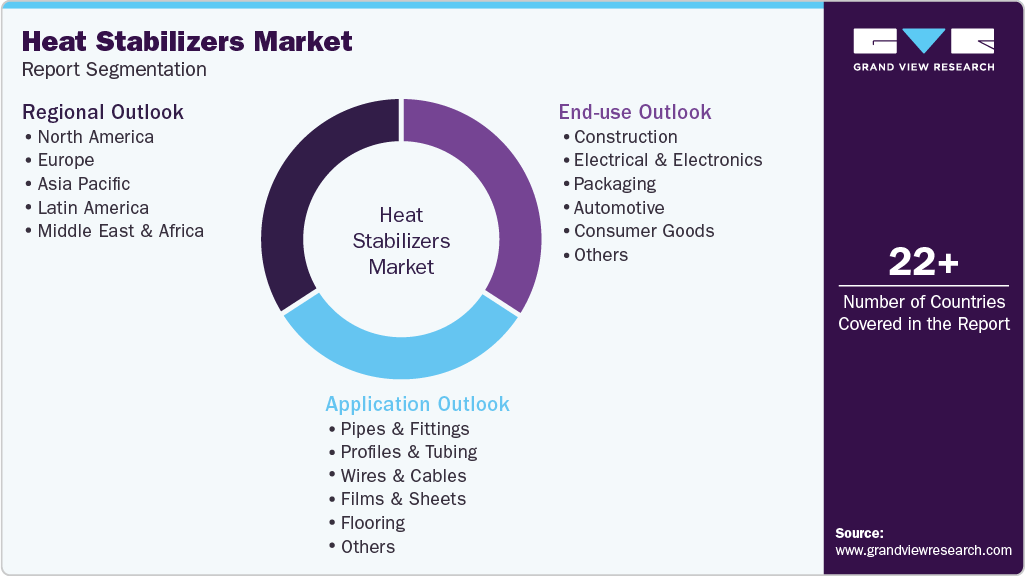
This report forecasts revenue & volume growth at the global, regional & country levels and provides an analysis of the latest industry trends across sub-segments from 2021 to 2033. For this study, Grand View Research has segmented the global heat stabilizers market report based on application, end use, and region:
 To learn more about this report, Download Free Sample Report
-
Application Outlook (Volume, Kilotons; Revenue, USD Million/Billion, 2021 - 2033)
-
Pipes & Fittings
-
Profiles & Tubing
-
Wires & Cables
-
Films & Sheets
-
Flooring
-
Others
-
-
End Use Outlook (Volume, Kilotons; Revenue, USD Million/Billion, 2021 - 2033)
-
Construction
-
Electrical & Electronics
-
Packaging
-
Automotive
-
Consumer Goods
-
Others
-
-
Regional Outlook (Volume, Kilotons; Revenue, USD Million/Billion, 2021 - 2033)
-
North America
-
U.S.
-
Canada
-
Mexico
-
-
Europe
-
Germany
-
UK
-
France
-
Italy
-
Spain
-
-
Asia Pacific
-
China
-
India
-
Japan
-
South Korea
-
Australia
-
-
Latin America
-
Brazil
-
Argentina
-
-
Middle East & Africa
-
Saudi Arabia
-
UAE
-
South Africa
-
-
Research Methodology
The heat stabilizers market figures in this report are based on a proven research process that combines executive interviews with secondary research from proprietary databases, company filings, and recognized regulatory and institutional sources. Market size is built through value-chain sizing-reconciling supply-side and demand-side estimates-and triangulated with bottom-up and top-down approaches. Every estimate passes multiple levels of expert validation before publication, with each heat stabilizerssegment quantified using the revenue-capture definitions in the table below.
Segment Definition
Application
Revenue capture definition
Pipes & Fittings
Revenue is captured through heat stabilizers used in PVC pipes and fittings requiring thermal protection during extrusion, dimensional stability, color retention, and long service life. Demand comes from water distribution, wastewater, drainage, irrigation, gas infrastructure, and industrial piping. Calcium-zinc and other lead-free systems are increasingly important as regulations restrict legacy stabilizer chemistries. Stabilizer selection depends on processing temperature, residence time, pressure rating, impact performance, weatherability, formulation compatibility, and requirements for potable water or other sensitive applications.
Profiles & Tubing
Revenue is generated through heat stabilizers used in PVC window profiles, door frames, technical profiles, medical tubing, hoses, and other extruded products requiring consistent processing and long-term thermal stability. Demand is supported by construction, healthcare, industrial equipment, and infrastructure applications. Stabilizer systems must provide strong initial color, weatherability, dimensional stability, and resistance to prolonged thermal exposure. Manufacturers select formulations based on extrusion conditions, profile thickness, outdoor exposure, flexibility requirements, surface appearance, regulatory compliance, and compatibility with calcium-based or other stabilizer technologies.
Wires & Cables
Revenue is captured through heat stabilizers used in PVC cable insulation, sheathing, conduits, and electrical wiring compounds requiring thermal stability during extrusion and reliable performance during service. Demand is linked to grid expansion, building electrification, telecommunications, renewable-energy installations, and industrial electrical systems. Stabilizers support processing consistency, electrical insulation properties, heat resistance, and long-term durability. Selection depends on processing temperature, cable formulation, flexibility, electrical performance, color requirements, flame-retardant systems, aging resistance, and restrictions on heavy-metal-based stabilization technologies.
Films & Sheets
Revenue is generated through heat stabilizers incorporated into PVC films and sheets used for packaging, construction membranes, industrial covers, flooring layers, medical products, and flexible applications. These materials require thermal protection during calendering, extrusion, and related processing operations. Demand is supported by flexible PVC consumption across packaging, healthcare, construction, and industrial products. Stabilizer selection focuses on processing stability, transparency, color retention, surface quality, flexibility, migration behavior, and compatibility with plasticizers and other additives. Lead-free and low-toxicity systems are gaining importance in sensitive applications.
Flooring
Revenue is captured through heat stabilizers used in PVC flooring products, including resilient flooring, vinyl tiles, sheets, and multilayer flooring systems. Stabilizers protect PVC during high-temperature processing and help maintain color, dimensional stability, and long-term durability. Demand is supported by commercial construction, healthcare facilities, hospitality, retail spaces, and residential renovation. Formulations are selected according to calendering or extrusion conditions, plasticizer compatibility, wear requirements, color stability, surface appearance, indoor-use requirements, and regulatory restrictions affecting heavy-metal-containing stabilizer systems.
Others
Revenue is generated through heat stabilizers used in additional PVC and polymer applications, including automotive components, artificial leather, coated fabrics, medical products, toys, stationery, hoses, and technical molded products. These applications require different combinations of thermal resistance, color retention, flexibility, weatherability, and surface quality. Demand depends on polymer formulation, processing method, and end use specifications. Manufacturers select stabilizers according to processing temperature, residence time, plasticizer system, mechanical requirements, regulatory conditions, and the need for lead-free, calcium-based, or application-specific stabilization technologies.
End Use
Revenue capture definition
Construction
Revenue is captured through heat stabilizers used in PVC pipes, fittings, window profiles, doors, flooring, roofing membranes, wall coverings, conduits, and other construction products. PVC processing requires effective stabilization to prevent discoloration and degradation during extrusion and molding. Demand is supported by infrastructure development, renovation, water networks, and energy-efficient building systems. Stabilizer selection emphasizes long-term weatherability, thermal stability, dimensional retention, and regulatory compliance. Increasing adoption of lead-free formulations is reshaping product requirements across construction-grade PVC applications.
Electrical & Electronics
Revenue is generated through heat stabilizers used in PVC cable insulation, wire sheathing, conduits, electrical profiles, and selected electronic components. Electrical applications require consistent polymer processing and stable insulation performance under thermal and electrical stress. Demand is supported by grid modernization, data infrastructure, industrial electrification, renewable-energy installations, and building electrical systems. Stabilizer systems are selected based on processing temperature, electrical properties, flexibility, flame-retardant compatibility, thermal aging, color requirements, and restrictions on hazardous substances used in electrical and electronic products.
Packaging
Revenue is captured through heat stabilizers used in PVC films, sheets, containers, closures, labels, and other packaging-related products requiring controlled thermal processing. Stabilizers help maintain color, surface quality, dimensional stability, and processing consistency during extrusion and calendering. Demand is influenced by flexible packaging, specialty packaging, and applications requiring transparent or durable polymer films. Product selection depends on transparency, migration characteristics, plasticizer compatibility, thermal history, food-contact requirements where applicable, and increasing preference for stabilization systems with improved regulatory and environmental profiles.
Automotive
Revenue is generated through heat stabilizers used in PVC instrument panels, wire and cable insulation, profiles, underbody components, artificial leather, floor coverings, seals, and interior trim. Automotive processors require stable materials that withstand elevated processing temperatures and prolonged exposure to heat, sunlight, and mechanical stress. Demand is supported by vehicle production, increased electrical content, and greater use of polymer components for weight and cost optimization. Stabilizer selection focuses on heat aging, fogging behavior, weatherability, surface appearance, flexibility, and compatibility with automotive-grade formulations.
Consumer Goods
Revenue is captured through heat stabilizers used in consumer products such as flooring, footwear, artificial leather, toys, stationery, household products, hoses, and flexible PVC articles. These applications require reliable thermal processing while maintaining color, flexibility, surface finish, and product durability. Demand is influenced by consumer-product manufacturing and replacement cycles. Stabilizer selection varies according to processing method, plasticizer content, required transparency, mechanical performance, exposure conditions, and restrictions on lead and other regulated substances in consumer-facing products.
Others
Revenue is generated through heat stabilizers used across healthcare, industrial equipment, agriculture, marine products, and specialty polymer applications. Medical tubing, agricultural films, industrial hoses, coated fabrics, and technical components require stabilization tailored to different thermal and performance conditions. Demand depends on product specifications, polymer type, processing technology, and regulatory requirements. Manufacturers select stabilizer systems based on thermal endurance, color retention, flexibility, weatherability, chemical compatibility, extractables, and application-specific safety requirements, creating demand for customized and high-performance stabilization packages.
Estimation Model
Layer Name
Key Question
Description
Top-Down Heat Stabilizers Demand Assessment Layer
What defines overall market demand?
Establishes overall global demand for heat stabilizers across PVC processing applications, including pipes & fittings, profiles & tubing, wires & cables, films & sheets, flooring, and other products. The layer assesses consumption across construction, electrical & electronics, packaging, automotive, consumer goods, and other end uses. It considers calcium-zinc, organotin, mixed-metal, barium-zinc, lead-based, and other stabilization technologies based on thermal stability, processing conditions, color retention, weatherability, product durability, and regulatory requirements.
End Use Demand Validation Layer
Where is demand concentrated?
Maps heat stabilizer demand across construction, electrical & electronics, packaging, automotive, consumer goods, and other end uses. The assessment considers requirements such as thermal resistance, processing stability, initial color, long-term heat aging, weatherability, dimensional stability, flexibility, transparency, and electrical performance. It validates end use demand through PVC pipe production, profile extrusion, cable manufacturing, flooring output, automotive component production, packaging conversion, construction activity, and electrical infrastructure development.
Consumption-to-Revenue Conversion Layer
How is demand monetized?
Converts heat stabilizer consumption into market revenue using stabilizer chemistry, application, PVC formulation, dosage requirements, product grade, purity, performance specifications, production scale, manufacturing costs, supplier positioning, and prevailing pricing structures. The layer evaluates price differences between calcium-zinc, organotin, mixed-metal, and specialty stabilization systems. Premiums associated with lead-free formulations, high-performance stabilization, application-specific one-packs, regulatory compliance, improved color retention, and enhanced thermal performance are also assessed.
Regional Demand Verification Layer
Where is demand validated?
Validates heat stabilizer demand across Asia Pacific, China, North America, the U.S., Europe, Latin America, and Middle East & Africa. The assessment considers PVC production and processing capacity, construction activity, infrastructure investment, electrical and cable manufacturing, automotive production, packaging output, and regional stabilizer manufacturing. It also examines restrictions on lead and other regulated substances, adoption of calcium-zinc and alternative technologies, import and export patterns, raw material availability, manufacturing investments, recycling activity, and supplier localization strategies influencing regional consumption.
Delivered Customizations
This report has been delivered with the following In-depth customizations
Client Request
Customization Delivered
Value Adds
Regional segmentation
Heat stabilizer demand was segmented across Asia Pacific, China, North America, the U.S., Europe, Latin America, and Middle East & Africa, with regional drivers linked to PVC processing, infrastructure investment, electrical networks, construction activity, and regulatory developments.
Identifies regional demand concentration, application maturity, regulatory exposure, and geographic growth pockets. Helps assess differences in stabilization technology adoption across developed and emerging PVC markets.
Competitive benchmarking
Key manufacturers were benchmarked based on revenue scale, geographic presence, heat stabilizer portfolio breadth, stabilization technologies, application coverage, operating strategies, competitive edge, and weaknesses. Companies were further categorized into mature and emerging players.
Provides a structured view of competitive positioning and technology coverage. Helps identify portfolio gaps, specialization areas, geographic strengths, and competitive differentiation across calcium-zinc, organotin, mixed-metal, and other stabilization systems.
Trade assessment
Trade dynamics were assessed through regional manufacturing capacity, import dependence, export availability, supplier concentration, logistics exposure, and cross-border availability of stabilizer grades. Particular attention was given to Asia-based supply and its role in supplying price-sensitive PVC processing markets, alongside regional qualification requirements for specialized applications.
Helps evaluate supply-chain resilience, sourcing alternatives, regional cost differences, import exposure, and potential supply risks. Supports the identification of markets where local production or alternative sourcing can create competitive advantages.
Frequently Asked Questions About This Report
The heat stabilizers market is expected to grow at a CAGR of 5.7% from 2026 to 2033, reaching USD 7.6 billion by 2033.
The pipes & fittings in the heat stabilizers industry led the plastics in the application market in 2025 with a 29.8% share. Rising PVC pipe demand for water supply, drainage, irrigation, and industrial infrastructure is increasing the use of heat stabilizers to improve thermal stability, color retention, and long-term durability.
Key players in the heat stabilizers market are Baerlocher GmbH, SONGWON Industrial Group, Akdeniz Chemson, Valtris Specialty Chemicals, Reagens Group, ADEKA Corporation, SUN ACE Group, PMC Organometallix, Kisuma Chemicals, and Pau Tai Industrial Corporation.
The heat stabilizers market size was valued at USD 4.9 billion in the year 2025 and is estimated at USD 5.1 billion in 2026.
Rising PVC consumption across pipes, cables, profiles, flooring, packaging, and automotive components is driving heat stabilizer demand. Stabilizers prevent thermal degradation and discoloration during processing while supporting mechanical performance, product durability, and consistent manufacturing quality.
The Asia Pacific heat stabilizers market accounted for the largest share of 56.1% market size in 2025.
The construction segment accounted for the largest share of 42.9% market size in 2025 while electrical & electronics segment is second fastest growing market
About the Author(s)
Plastics, Polymers & Resins Research Team
Bulk Chemicals · Plastics, Polymers & ResinsThis report was authored by the plastics, polymers & resins research team at Grand View Research - comprising two research analysts, one senior research analyst, and one industry expert - with specialized expertise in the plastics, polymers & resins segment of the bulk chemicals industry. All findings are based on proprietary bulk chemicals databases, executive interviews, and regulatory analysis, subject to internal peer review prior to publication.
Last Updated:
Speak to Analyst

Customize this report to your needs - add regions, segments, or data points, with 20% free customization.
Or view our licence options:


ISO 9001:2015 & 27001:2022 Certified
We are GDPR and CCPA compliant! Your transaction & personal information is safe and secure. For more details, please read our privacy policy.


