
- Home
- »
- Next Generation Technologies
- »
-
High-altitude Pseudo Satellites Market, Industry Report, 2033GVR Report cover
![High-altitude Pseudo Satellites Market Size, Share & Trends Report]()
High-altitude Pseudo Satellites Market (2025 - 2033) Size, Share & Trends Analysis Report By Platform (Airships, Balloons), By Application (Connectivity & Communication, Navigation & Remote Sensing), By End-use, By Region, And Segment Forecasts
- Report ID: GVR-4-68040-721-4
- Number of Report Pages: 150
- Format: PDF
- Historical Range: 2021 - 2024
- Forecast Period: 2025 - 2033
- Industry: Technology
- Report Summary
- Table of Contents
- Interactive Charts
- Methodology
- Download FREE Sample
-
 Download Sample Report
High-altitude Pseudo Satellites Market Summary
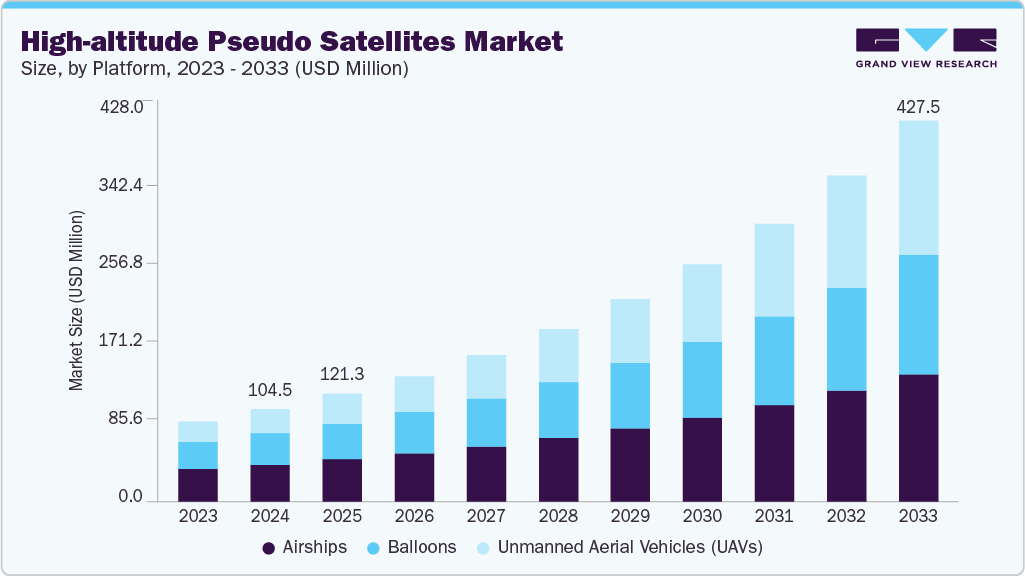
The global high-altitude pseudo satellites market size was estimated at USD 104.5 million in 2024 and is projected to reach USD 427.5 million by 2033, growing at a CAGR of 17.0% from 2025 to 2033. The market growth is primarily driven by the adoption of smart lighting systems integrated with cabin management, the expansion of retrofit programs for older aircraft, the increasing use of lightweight materials to reduce fuel consumption, and the regulatory push for sustainable aviation technologies.
Key Market Trends & Insights
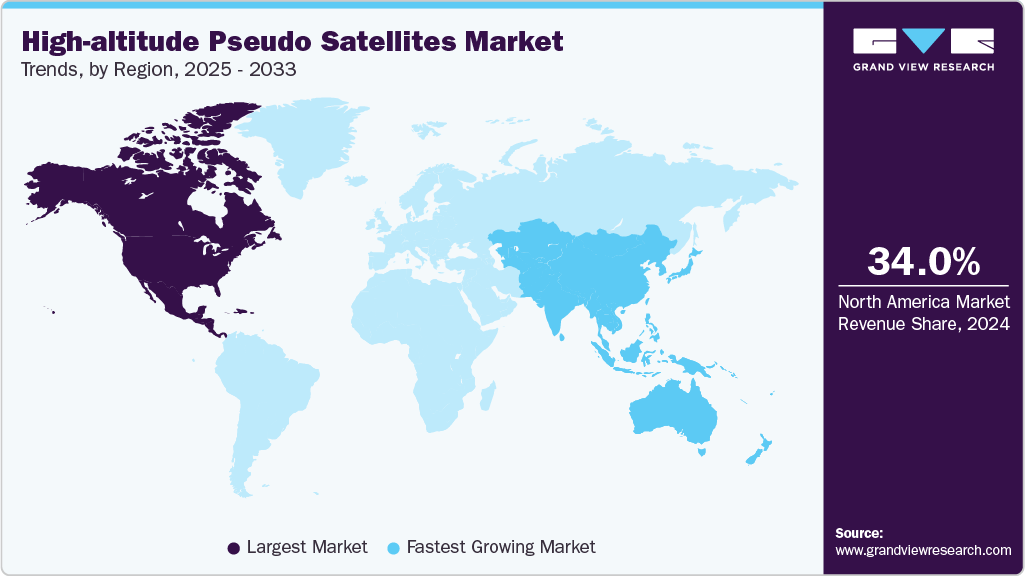
- North America dominated the global high-altitude pseudo satellites industry with the largest revenue share of over 34% in 2024.
- The U.S. high-altitude pseudo satellites industry dominated the market with a share of over 77% in 2024.
- By platform, the airships segment led the market, holding the largest revenue share of over 39% in 2024.
- By application, the intelligence, surveillance, and reconnaissance (ISR) segment held the dominant position in the market and accounted for the leading revenue share of over 34% in 2024.
- By end-use, the commercial segment is expected to grow at the fastest CAGR of around 20% from 2025 to 2033.
Market Size & Forecast
- 2024 Market Size: USD 104.5 Million
- 2033 Projected Market Size: USD 427.5 Million
- CAGR (2025-2033): 17.0%
- North America: Largest market in 2024
- Asia Pacific: Fastest growing market
The high-altitude pseudo satellites industry is experiencing robust growth as defense and security agencies increasingly demand persistent surveillance solutions. HAPS can remain airborne for weeks or even months, providing continuous intelligence, surveillance, and reconnaissance (ISR) coverage over critical regions. This persistent presence reduces operational costs compared to traditional satellite or manned aircraft missions. As security threats evolve, the adoption of HAPS for long-endurance monitoring is becoming a strategic priority worldwide.The integration of HAPS into next-generation communication networks is a major growth catalyst for the high-altitude pseudo satellites industry. Operating in the stratosphere, these platforms can provide broadband connectivity to underserved and remote areas. Telecom operators view HAPS as an efficient complement to terrestrial and satellite networks, especially for disaster recovery and emergency communication. The convergence of 5G and HAPS technology is further amplifying this opportunity.
The integration of artificial intelligence and autonomous navigation is revolutionizing the high-altitude pseudo satellites industry. AI-powered systems enable autonomous decision-making for flight adjustments, threat detection, and data collection optimization. This reduces reliance on ground operators and improves mission efficiency. Autonomous HAPS can handle complex, multi-objective tasks with minimal human intervention, unlocking new operational possibilities.
The demand for advanced disaster management tools is propelling growth in the high-altitude pseudo satellites industry. High-altitude Pseudo Satellites (HAPS) can be rapidly deployed over affected areas to provide real-time imagery, communication links, and situational awareness. This capability is critical in coordinating rescue operations and assessing damage in inaccessible regions. As climate-related disasters become more frequent, governments and humanitarian organizations are increasingly investing in HAPS-based emergency response solutions.
The increasing growth in the need for cost-effective space replacement solutions is fueling the high-altitude pseudo satellites industry. HAPS can act as gap-fillers when satellites fail, face delays, or require maintenance, ensuring uninterrupted service. This flexibility is particularly valuable for communication, navigation, and observation networks. Industries reliant on satellite infrastructure are recognizing HAPS as a practical and quick-deployment alternative.
Platform Insights
The airships segment dominated the market with a share of over 39% in 2024, driven by their ability to provide long-endurance surveillance, communication, and environmental monitoring at a fraction of the operational cost of satellites. Their large payload capacity, coupled with the ability to remain airborne for weeks or even months, makes them highly attractive for defense, disaster management, and commercial applications. The reduced infrastructure requirements compared to traditional satellites further strengthen their adoption in emerging markets. In addition, continuous technological advancements in lightweight materials and hybrid propulsion systems are enhancing airship performance, fueling stronger demand in the high-altitude pseudo satellites industry.
The unmanned aerial vehicles (UAVs) segment is expected to register a significant CAGR of over 20% from 2025 to 2033, driven by their versatility in executing high-altitude missions with greater maneuverability and lower operational costs. These platforms are increasingly being deployed for intelligence, surveillance, and reconnaissance (ISR) operations, as well as for communication relay in remote and disaster-affected areas. Advancements in autonomous navigation, AI-driven analytics, and solar-powered propulsion are further extending UAV endurance, making them a competitive alternative within the High-Altitude Pseudo Satellites industry. Moreover, growing defense modernization programs and expanding commercial applications such as precision agriculture and environmental monitoring are amplifying their adoption globally.
Application Insights
The intelligence, surveillance, and reconnaissance (ISR) segment dominated the market in 2024and accounted for the leading revenue share of over 34%, driven by the growing demand for persistent, real-time situational awareness across defense, border security, and critical infrastructure protection. High-Altitude Pseudo Satellites (HAPS) are equipped with advanced imaging, radar, and communication payloads that enable continuous monitoring over vast areas without the high costs of traditional satellites. Governments and defense agencies are increasingly investing in ISR-focused HAPS to strengthen national security, enhance threat detection, and improve decision-making speed. In addition, the integration of AI-powered data analytics and autonomous mission management is further enhancing the efficiency and strategic value of ISR operations.
The connectivity and communication segment is expected to grow at the fastest CAGR in the coming years, owing to the rising demand for high-speed, reliable broadband services in remote, rural, and underserved regions. High-altitude pseudo satellites offer a cost-effective and flexible alternative to terrestrial networks and traditional satellites, enabling rapid deployment and scalable coverage. Telecom operators are increasingly partnering with HAPS providers to expand 5G backhaul, disaster recovery communications, and emergency response networks. Furthermore, advancements in high-capacity transceivers and lightweight solar-powered systems are enhancing operational efficiency, fueling broader adoption of HAPS for global connectivity solutions.
End-use Insights
The government & defense segment dominated the market in 2024, owing to the growing reliance on high-altitude pseudo satellites for persistent surveillance, secure communications, and strategic intelligence gathering. These platforms enable extended operational endurance, allowing defense forces to monitor borders, track potential threats, and support tactical missions without the high costs of traditional satellite systems. Governments worldwide are increasingly investing in HAPS to enhance national security, disaster response, and critical infrastructure protection. In addition, advancements in AI-driven analytics, autonomous mission control, and advanced sensor payloads are further boosting the segment’s adoption across defense and security applications.
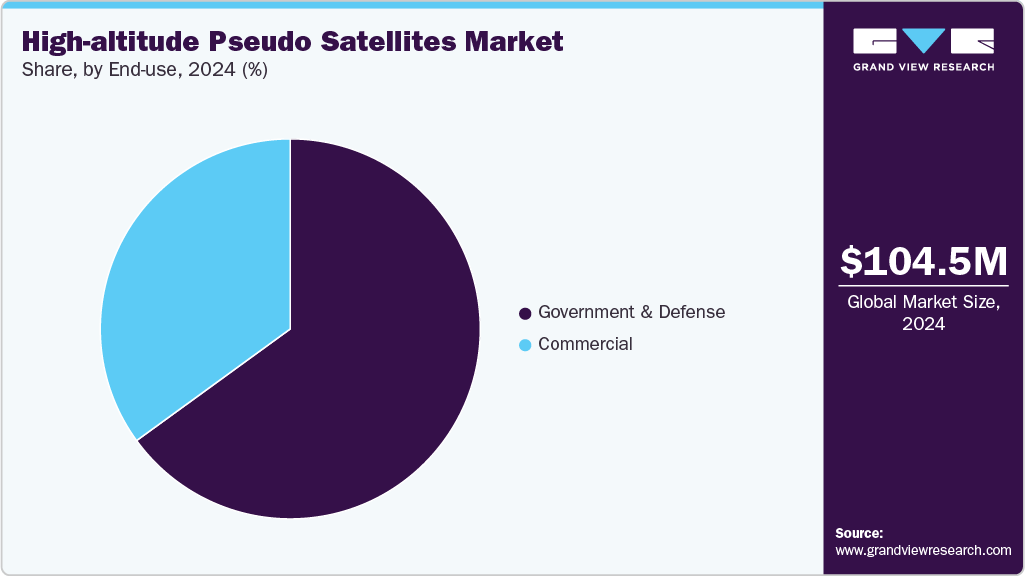
The commercial segment is expected to grow at the fastest CAGR of around 20% in the coming years, owing to the expanding use of HAPS in telecommunications, environmental monitoring, and precision agriculture. Businesses are turning to HAPS to deliver affordable broadband access, capture high-resolution climate data, and enable industrial inspections in remote or hard-to-reach locations. Their long-endurance capabilities and lower operational costs compared to traditional satellite systems make them highly attractive for commercial operators. In addition, rising partnerships between technology providers, telecom firms, and service integrators are accelerating innovation and adoption across multiple commercial applications.
Regional Insights
North America high-altitude pseudo satellites industry dominated the market with a share of over 34% in 2024, driven by strong defense spending and advanced aerospace capabilities across the region. Growing adoption of telecommunications for rural broadband expansion and emergency response communications is fueling further investments. In addition, rising collaborations between defense contractors, telecom operators, and government agencies are enhancing innovation and operational deployment of HAPS.
U.S. High-altitude Pseudo Satellites Market Trends
The U.S. high-altitude pseudo satellites industry dominated the market with a share of over 77% in 2024, supported by large-scale defense modernization programs and advanced aerospace R&D facilities. The increasing integration of AI-driven analytics and autonomous navigation in HAPS is boosting mission efficiency for ISR and connectivity applications. Furthermore, significant funding from NASA, the Department of Defense, and private aerospace firms is accelerating the commercialization of HAPS technologies.
Europe High-altitude Pseudo Satellites Market Trends
The Europe high-altitude pseudo satellites industry is expected to grow at a CAGR of over 16.0% from 2025 to 2033, primarily driven by rising investments in sustainable and low-emission aerial platforms. Growing use cases in environmental monitoring and disaster management are prompting European nations to deploy HAPS as part of climate resilience strategies. In addition, advancements in solar-powered airship and UAV designs are boosting long-endurance operations across the region.
The Germany high-altitude pseudo satellites industry is expected to grow at a significant rate in the coming years, owing to strong aerospace manufacturing capabilities and a focus on high-precision engineering. German companies are increasingly developing advanced payload systems for ISR, navigation, and environmental analysis. The integration of renewable energy sources into HAPS platforms aligns with the country’s commitment to green technology adoption.
The UK high-altitude pseudo satellites industry is expected to grow at a significant rate in the coming years, driven by government-backed space and defense programs. The UK’s strategic focus on global connectivity solutions is fostering HAPS adoption for rural broadband and maritime communications. In addition, its strong private aerospace sector is accelerating innovation in lightweight materials and endurance capabilities.
Asia Pacific High-altitude Pseudo Satellites Market Trends
The Asia Pacific high-altitude pseudo satellites industry is expected to grow at the fastest CAGR of over 19% from 2025 to 2033. driven by rapid defense modernization and large-scale telecom expansion. Countries in the region are investing in HAPS to bridge connectivity gaps in remote islands and rural areas. Furthermore, growing collaborations between local aerospace firms and global technology providers are accelerating market maturity.
The China high-altitude pseudo satellites industry is primarily driven by state-led defense initiatives and ambitious space technology programs. The government is deploying HAPS for border surveillance, disaster management, and rural internet coverage under national connectivity strategies. In addition, heavy investments in solar-powered UAVs and autonomous flight systems are strengthening China’s technological capabilities.
The Japan high-altitude pseudo satellites industry is fueled by its advanced robotics expertise, precision engineering, and disaster resilience priorities. HAPS are being integrated into Japan’s early warning systems for earthquakes, tsunamis, and extreme weather monitoring. Furthermore, collaborations between government agencies, universities, and aerospace companies are driving innovation in solar-powered and lightweight platforms.
Key High-altitude Pseudo Satellites Company Insights
Some of the key players operating in the market include AeroVironment, Inc., Airbus SE, among others.
-
AeroVironment, Inc., the prominent aerospace and defense company, specializes in unmanned aircraft systems and solar-powered aerial platforms. The company has developed the Sunglider, a solar-powered fixed-wing HAPS UAV designed for long-endurance ISR, communications, and scientific missions. Its expertise lies in integrating lightweight materials, AI capabilities, and energy-efficient propulsion for persistent stratospheric operations. AeroVironment serves defense, environmental, and connectivity markets worldwide, earning a reputation for reliability and innovation in HAPS solutions.
-
Airbus SE, headquartered in Europe, is one of the world’s largest aerospace manufacturers and a pioneer in HAPS innovation. Its flagship Zephyr platform is a solar-electric stratospheric UAV capable of months-long flights for defense surveillance, border monitoring, and broadband connectivity. Airbus specializes in ultra-lightweight designs and renewable power integration, pushing the limits of endurance and payload efficiency. The company’s HAPS technologies are deployed globally, serving both government and commercial missions.
Stratospheric Platforms Ltd. and Kea Aerospace Limited are some of the emerging market participants in the high-altitude pseudo satellites industry.
-
Stratospheric Platforms Ltd., based in the UK, is developing hydrogen-powered HAPS UAVs to deliver 5G network coverage from the stratosphere. Its technology enables wide-area, high-capacity telecom services with significantly lower deployment costs than terrestrial infrastructure. The company partners with mobile network operators to expand connectivity into remote and underserved regions. Stratospheric Platforms’ innovative propulsion and payload integration make it a disruptive force in telecom-focused HAPS applications.
-
Kea Aerospace Limited, from New Zealand, specializes in solar-powered UAVs for environmental monitoring, mapping, and aerial data services. Its Kea Atmos platform is designed for persistent stratospheric missions that collect climate, agricultural, and geospatial data. The company emphasizes sustainability, precision engineering, and collaboration with research institutions. Kea Aerospace is positioning itself as a leader in using HAPS for environmental intelligence and resource management.
Key High-altitude Pseudo Satellites Companies:
The following are the leading companies in the High-altitude pseudo satellites market. These companies collectively hold the largest market share and dictate industry trends.
- AeroVironment, Inc.
- Airbus SE
- BAE Systems plc
- Thales Group
- Aerostar LLC
- Mira Aerospace Ltd.
- Sceye Inc.
- HAPSMobile Inc. (SoftBank Corp.)
- Aurora Flight Sciences (The Boeing Company)
- Stratospheric Platforms Ltd.
- Kea Aerospace Limited
- Sierra Nevada Company, LLC.
Recent Developments
-
In May 2025, AALTO HAPS’ Zephyr set a new world record with a 67-day, 6-hour, and 52-minute continuous stratospheric flight. The solar-powered system launched from Kenya and navigated multiple regions and weather conditions before concluding over the Indian Ocean. This milestone reinforces Zephyr’s commercial viability ahead of its 2026 market launch.
-
In March 2025, Airbus U.S. Space & Defense and Aerostar expanded their research partnership to integrate Persistent Systems’ networking technologies. The IRAD Flight HBAL717, launched via an Aerostar Thunderhead balloon, tested satcom, MANET, and Cloud Relay systems in stratospheric conditions. The mission aims to advance encrypted ISR, cloud data routing, and future AI/ML-driven stratospheric operations.
-
In January 2025, AALTO launched its first Zephyr flight from the new AALTOport in Kenya. Using the ELVIS platform, the solar-powered aircraft ascended to 60,000 feet, improving efficiency compared to earlier hand-launch methods. This milestone highlights regulatory support in Kenya and AALTO’s plans to expand HAPS-based connectivity and Earth observation.
High-altitude Pseudo Satellites Market Report Scope
Report Attribute
Details
Market size value in 2025
USD 104.5 million
Revenue forecast in 2033
USD 427.5 million
Growth Rate
CAGR of 17.0% from 2025 to 2033
Base Year of Estimation
2024
Actual Data
2021 - 2024
Forecast period
2025 - 2033
Quantitative units
Revenue in USD million and CAGR from 2025 to 2030
Report coverage
Revenue forecast, company ranking, competitive landscape, growth factors, and trends
Segments covered
Platform, application, end-use, region
Regional scope
North America; Europe; Asia Pacific; Latin America; Middle East and Africa
Country scope
U.S.; Canada; Mexico; Germany; UK; France; China; Japan; India; South Korea; Australia; Brazil; UAE; Saudi Arabia; South Africa
Key companies profiled
AeroVironment, Inc.; Airbus SE; BAE Systems plc; Thales Group; Aerostar LLC; Mira Aerospace Ltd.; Sceye Inc.; HAPSMobile Inc. (SoftBank Corp.); Aurora Flight Sciences (The Boeing Company); Stratospheric Platforms Ltd.; Kea Aerospace Limited; Sierra Nevada Company, LLC
Customization scope
Free report customization (equivalent up to 8 analysts working days) with purchase. Addition or alteration to country, regional & segment scope.
Pricing and purchase options
Avail customized purchase options to meet your exact research needs. Explore purchase options
Global High-altitude Pseudo Satellites Market Report Segmentation
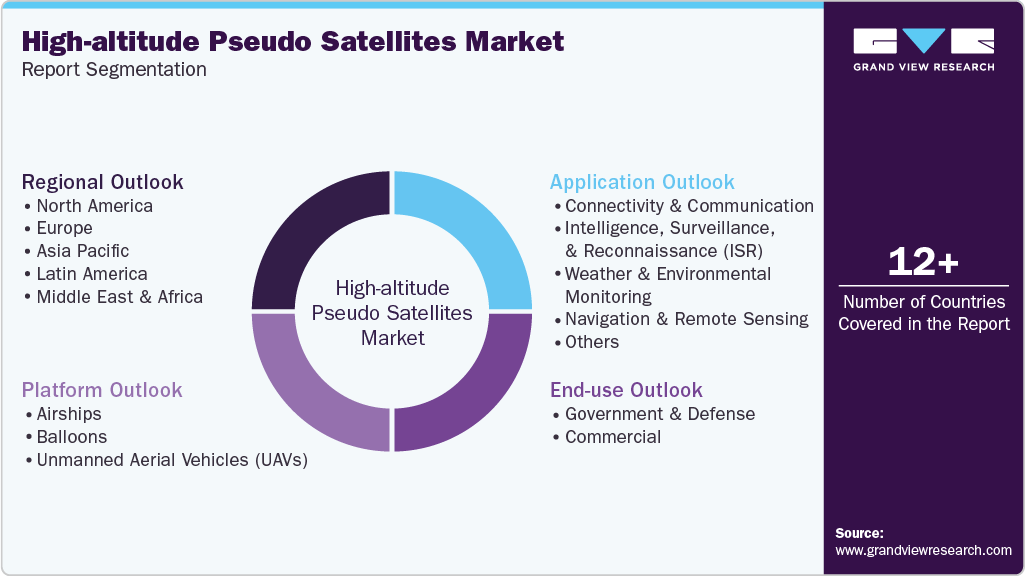
This report forecasts revenue growth at global, regional, and country levels and provides an analysis of the latest industry trends in each of the sub-segments from 2021 to 2033. For this study, Grand View Research has segmented the global High-Altitude Pseudo Satellites (HAPS) market report based on platform, application, end-use, and region:
-
Platform Outlook (Revenue, USD Million, 2021 - 2033)
-
Airships
-
Balloons
-
Unmanned Aerial Vehicles (UAVs)
-
-
Application Outlook (Revenue, USD Million, 2021 - 2033)
-
Connectivity and Communication
-
Intelligence, Surveillance, and Reconnaissance (ISR)
-
Weather and Environmental Monitoring
-
Navigation and Remote Sensing
-
Others
-
-
End-use Outlook (Revenue, USD Million, 2021 - 2033)
-
Government & Defense
-
Commercial
-
-
Regional Outlook (Revenue, USD Million, 2021 - 2033)
-
North America
-
U.S.
-
Canada
-
Mexico
-
-
Europe
-
Germany
-
UK
-
France
-
-
Asia Pacific
-
China
-
Japan
-
India
-
South Korea
-
Australia
-
-
Latin America
-
Brazil
-
-
Middle East and Africa (MEA)
-
UAE
-
Saudi Arabia
-
South Africa
-
-
Frequently Asked Questions About This Report
b. The global high-altitude pseudo satellites market size was estimated at USD 104.5 million in 2024 and is expected to reach USD 121.3 million in 2025.
b. The global high-altitude pseudo satellites market is expected to grow at a compound annual growth rate of 17.0% from 2025 to 2033 to reach USD 427.5 million by 2033.
b. North America dominated the high-altitude pseudo satellites market with a share of over 34.0% in 2024, owing to strong defense investments, robust aerospace infrastructure, and growing demand for persistent surveillance and communication solutions across military and commercial sectors.
b. Some key players operating in the high-altitude pseudo satellites market include AeroVironment, Inc., Airbus SE, BAE Systems plc, Thales Group, Aerostar LLC, Mira Aerospace Ltd., Sceye Inc., HAPSMobile Inc. (SoftBank Corp.), Aurora Flight Sciences (The Boeing Company), Stratospheric Platforms Ltd., Kea Aerospace Limited, Sierra Nevada Company, LLC.
b. Key factors that are driving the market growth include increasing demand for persistent surveillance and communication, rising investments in defense and aerospace technologies, and advancements in solar-powered and autonomous flight systems.


Share this report with your colleague or friend.
Need a Tailored Report?
Customize this report to your needs — add regions, segments, or data points, with 20% free customization.


ISO 9001:2015 & 27001:2022 Certified
We are GDPR and CCPA compliant! Your transaction & personal information is safe and secure. For more details, please read our privacy policy.
Trusted market insights - try a free sample
See how our reports are structured and why industry leaders rely on Grand View Research. Get a free sample or ask us to tailor this report to your needs.













