
- Home
- »
- Advanced Interior Materials
- »
-
High Visibility Clothing Market Size, Share Report, 2026-2033GVR Report cover

High Visibility Clothing Market (2026 - 2033)
Size, Share & Trends Analysis Report, By Product (Vest, Jacket, Shirt, Pant), By Type (Type O, Type R, Type P), By Distributions Channel (Online, Offline), By End Use (Construction, Manufacturing), By Region, And Segment Forecasts
Market Size, 2025
$1.9BMarket Estimate, 2026
$2.0BMarket Forecast, 2033
$3.3BCAGR, 2026–2033
7.1%High Visibility Clothing Market Summary
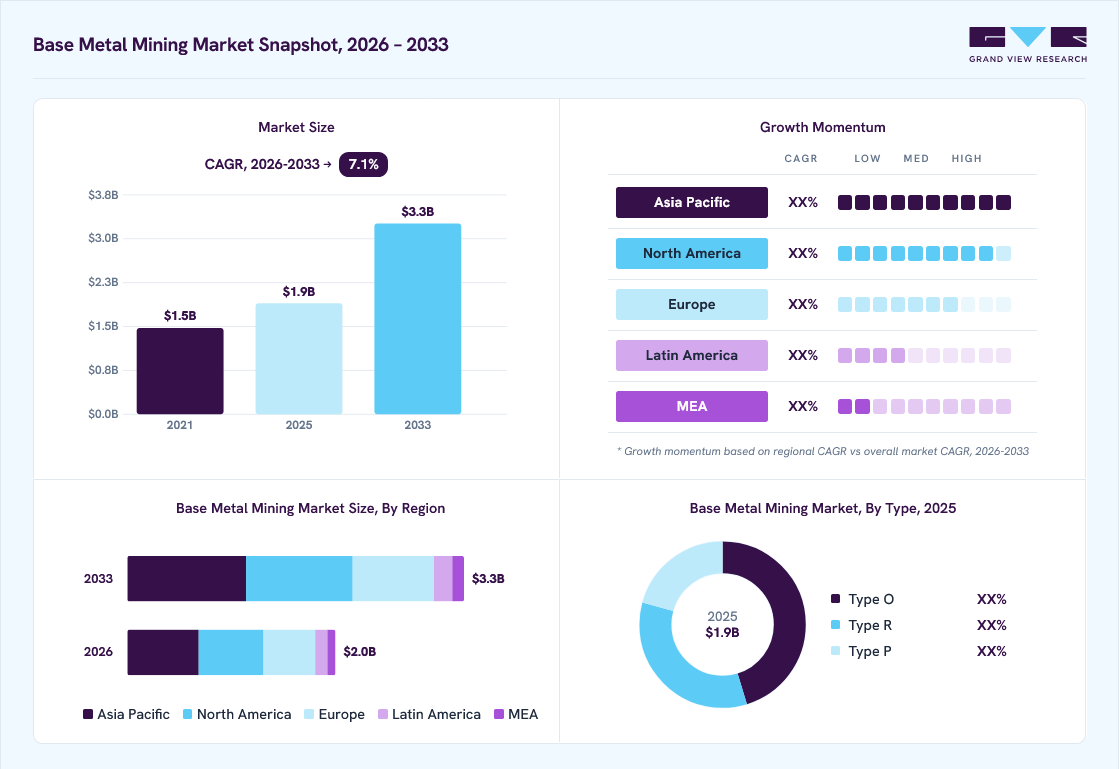
The global high visibility clothing market size was valued at USD 1.9 billion in 2025 and is projected to grow from USD 2.0 billion in 2026 to USD 3.3 billion by 2033, at a CAGR of 7.1% from 2026 to 2033. North America dominated the market, accounting for a revenue share of 31.1% in 2025. The market is growing due to increasing awareness about workplace safety regulations, particularly in industries like construction, transportation, and mining, where visibility is crucial.
 Source: Grand View Research, IR Documents, Primary Interviews, Paid DatabasesTo learn more about this report,
 Download Free Sample Report
Key Market Trends & Insights
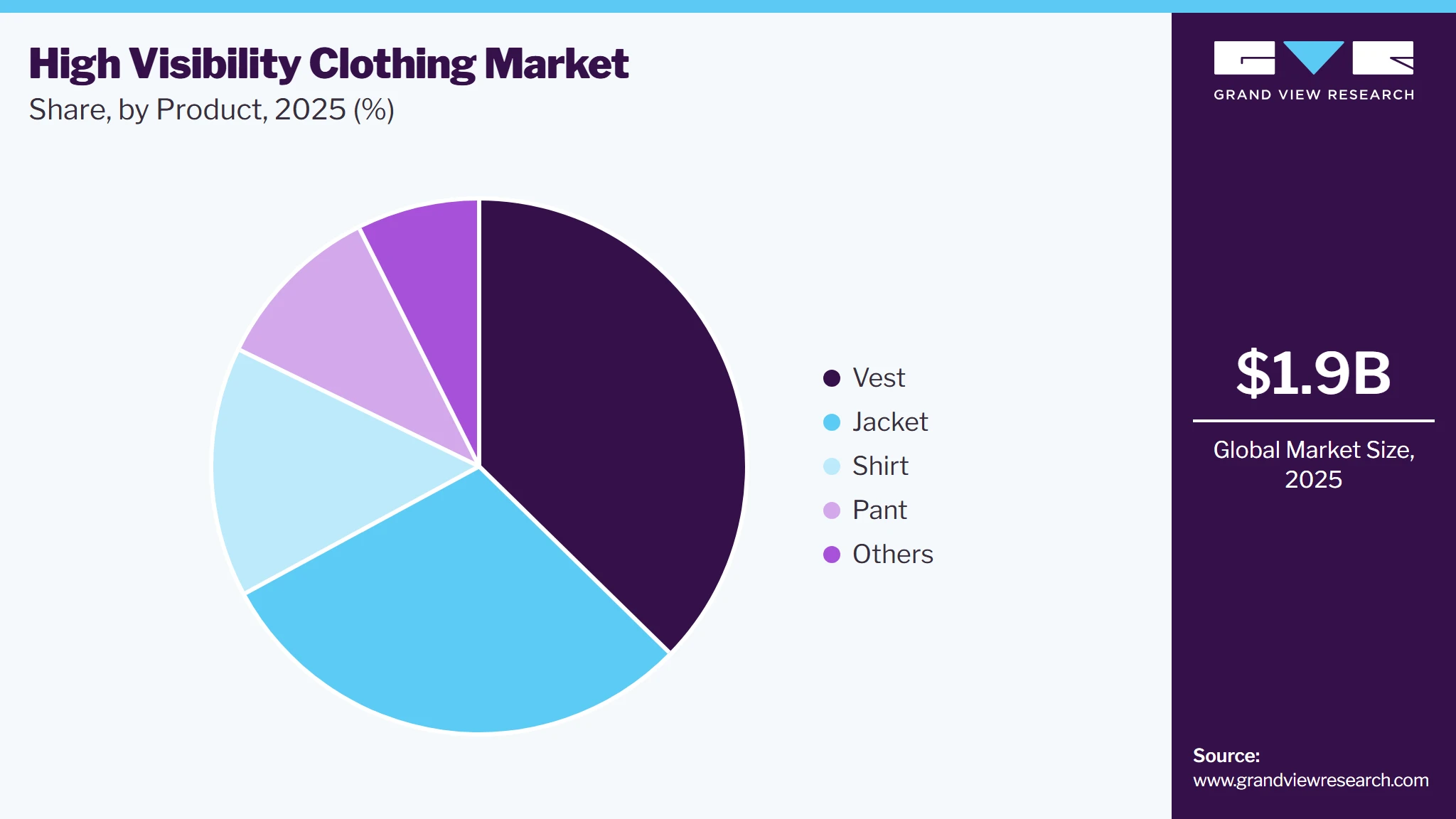
- By product: Vest segment led the market with the largest revenue share of 37.3% in 2025.
- By type: Type O segment led the market with the largest revenue share of 45.2% in 2025.
- By distribution channel: Offline segment led the market with the largest revenue share of 59.9% in 2025.
- By end use: Construction segment led the market with the largest revenue share of 35.9% in 2025.
Regional Highlights
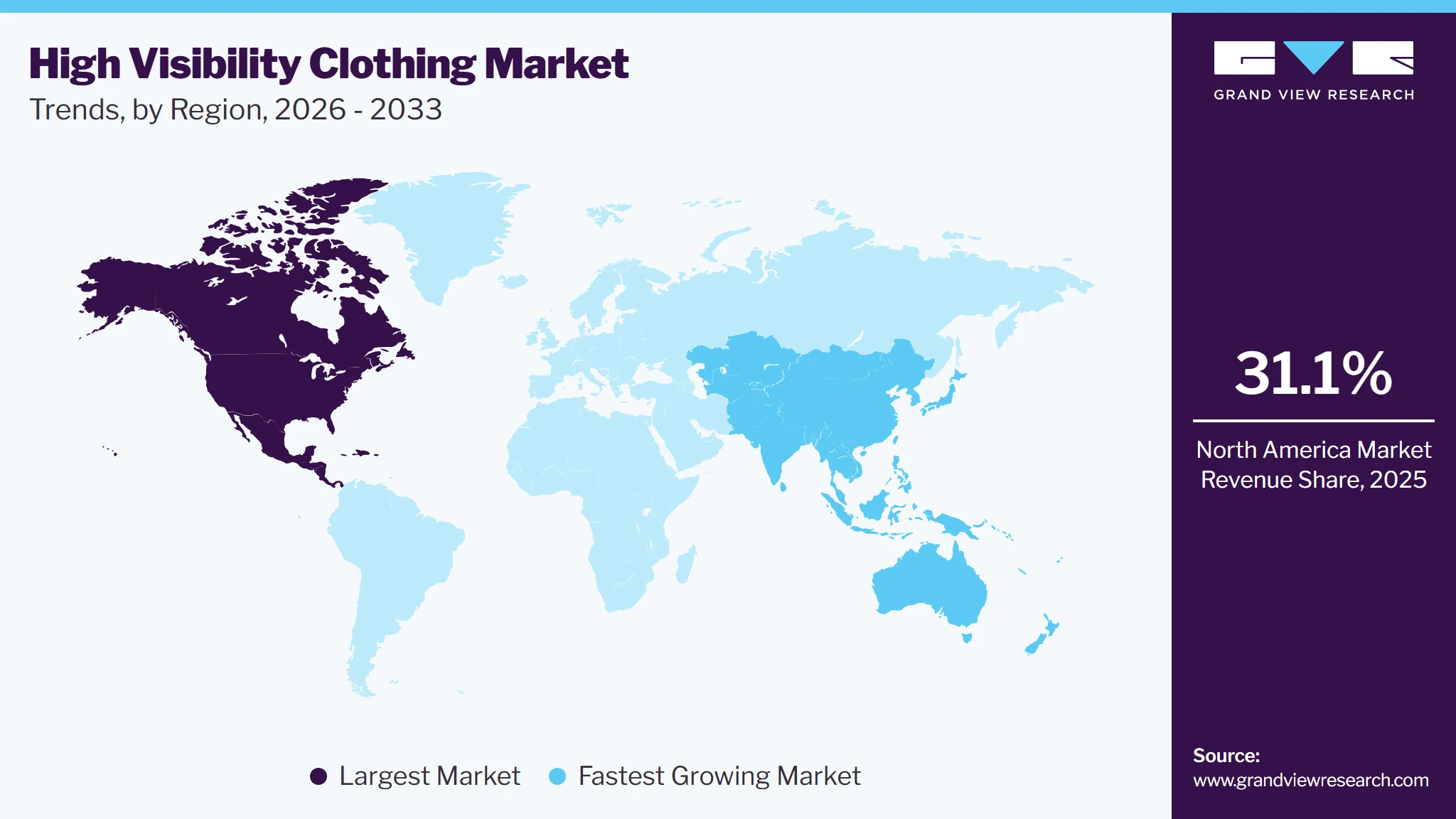
- Largest regional market: North America (31.1% revenue share, 2025)
- Fastest-growing regional market: Asia Pacific (highest CAGR, 2026-2033)
- By country: The U.S. held the largest market share in 2025.
Market Size & Forecast
- Market size in 2025: USD 1.9 Billion
- Estimated market size in 2026: USD 2.0 Billion
- Projected market size by 2033: USD 3.3 Billion
- CAGR (2026-2033): 7.1%
Three ways to get this report
Buy it, customize it, or ask a question.Ask an Analyst
Analyst response in 1 business day
- AccessReport author, directly
- Reply timeWithin 1 working day
- No sales callDirect answer only
- FormatEmail reply
- CostFree, no cost
Get the Full Report
What the study covers
- FormatsPDF · Excel · Dashboard
- Timeline2026–2033 annual, 2025 base
- Coverage20+ countries, 5 regions
- Companies10+ key players profiled
Customize the Report
20% free customization
- IncludeCountries, segments, points
- TailorTo your product definition
- ExtendDeeper competitor detail
- OrA fully bespoke study
- Turnaround5–10 working days
Additionally, the rising awareness of personal safety, especially among workers in hazardous environments, and the growth of infrastructure projects globally are key contributors. Increased adoption of high visibility clothing in outdoor activities, such as cycling and running, is also expanding the market.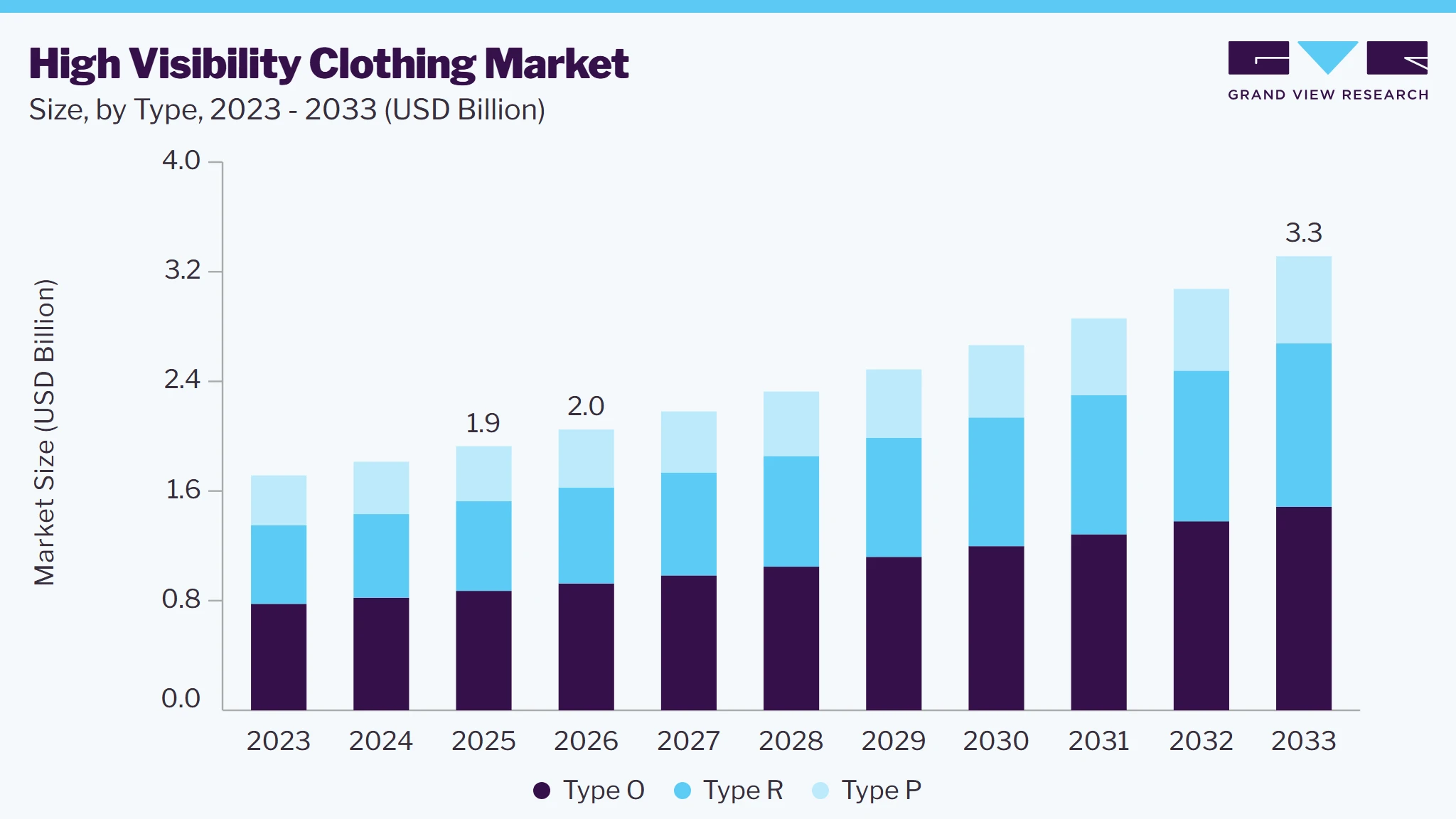 To learn more about this report, Download Free Sample Report
Market Dynamics
The high visibility clothing market is expanding steadily as industries place greater importance on worker safety and compliance with occupational safety standards. Demand is increasing across construction, transportation, manufacturing, mining, utilities, and oil & gas sectors where employees work around vehicles, heavy equipment, or in low-light conditions. Companies are also adopting more comfortable and durable safety garments featuring breathable fabrics and long-lasting reflective materials, helping improve employee compliance. Continued investments in infrastructure and industrial development, particularly in emerging economies, are expected to support market growth over the coming years.
Governments across the world continue to strengthen workplace safety requirements, making high visibility clothing an essential part of personal protective equipment for many industries. Workers involved in road construction, utilities, logistics, mining, and industrial operations are often required to wear certified reflective apparel to improve visibility and reduce the likelihood of workplace accidents. These regulations are encouraging employers to invest in quality safety clothing that meets recognized performance standards.
Beyond meeting legal requirements, many organizations are making workplace safety a core business priority. Businesses recognize that better visibility helps reduce accidents, minimize downtime, and improve operational efficiency. As industrial activities expand and worksites become more complex, employers are increasingly equipping their workforce with high visibility garments to create safer working environments.
High visibility garments do not maintain their protective performance indefinitely. Repeated washing, exposure to sunlight, harsh weather, and everyday use gradually reduce the effectiveness of fluorescent fabrics and reflective strips, requiring regular replacement. For organizations with large workforces, these recurring expenses can be significant. Cost-conscious businesses may extend replacement intervals or purchase lower-priced products, which can slow demand for premium high visibility clothing.
Manufacturers have an opportunity to strengthen their market position by developing high visibility clothing that combines safety, comfort, and sustainability. Products made with recycled or eco-friendly materials are attracting interest from companies pursuing environmental goals, while smart garments equipped with features such as LED lighting, location tracking, or wearable sensors are gaining attention in high-risk industries. These innovations are expected to create new revenue opportunities as employers seek advanced safety solutions that improve both worker protection and operational performance.
Market Concentration & Characteristics
The global high visibility clothing market is moderately fragmented, with a mix of large multinational companies and regional players competing for market share. Key manufacturers focus on developing high-quality, durable, and comfortable high visibility garments that meet safety standards and offer superior visibility in various working environments such as construction, transportation, and emergency services. Innovation in the market is largely driven by increasing awareness about worker safety, the growing demand for lightweight and weather-resistant materials, and adherence to safety regulations in different industries.
 To learn more about this report, Download Free Sample Report
Regulatory pressures from organizations such as OSHA in the U.S., the European Union, and other global regulatory bodies play a significant role in shaping the market. These regulations mandate the use of high-visibility clothing in specific industries to improve worker safety and reduce accidents, especially in low-visibility conditions. Compliance with these regulations is essential for manufacturers to remain competitive, as companies are required to meet specific safety standards and certifications for their products. With the rise in infrastructure development and industrial activities globally, demand for high visibility clothing that complies with strict safety standards continues to increase.
While opportunities are abundant, the high visibility clothing market also faces competition from alternative safety apparel solutions, such as those incorporating smart textiles or wearable technologies that offer additional features like temperature control or communication integration. To maintain market leadership, manufacturers must focus on innovation, offering products that not only meet safety requirements but also enhance comfort, performance, and durability. Emphasizing eco-friendly materials, sustainable production practices, and technological integration will be crucial in capturing the expanding market for high-visibility clothing tailored to the needs of modern industries.
Analyst Perspective
The high visibility clothing market is expected to witness steady growth over the forecast period, driven by increasingly stringent workplace safety regulations, expanding infrastructure and industrial activities, and greater awareness of employee safety across high-risk industries. While construction, transportation, manufacturing, and utilities remain the primary demand generators, adoption is also rising in sectors such as logistics, mining, public safety, and energy. Manufacturers are differentiating their offerings through lightweight fabrics, improved comfort, durable reflective materials, and sustainable designs to enhance worker acceptance and regulatory compliance. Looking ahead, innovations in smart PPE, increasing demand for eco-friendly workwear, and continued investments in industrial development are expected to create new growth opportunities, making high visibility clothing an essential component of modern workplace safety programs.
Product Insights
Based on product, vest segment led the market with the largest revenue share of 37.3% in 2025. Vests represent the largest product segment in the high visibility clothing market due to their versatility, affordability, and ease of use across a wide range of industries. Typically worn over regular clothing, high visibility vests provide a quick and effective way to ensure worker compliance with visibility standards. They are especially prevalent in construction, event management, traffic control, and maintenance services. Their lightweight design and universal sizing make them ideal for temporary workers and short-term projects. Continued emphasis on workplace safety is expected to drive consistent demand for this product type globally.
 To learn more about this report, Download Free Sample Report
High visibility shirts are widely used across industries where continuous visibility is essential, especially in indoor environments or warmer climates. These garments are typically made from lightweight, breathable materials, providing both comfort and compliance with safety standards. The demand for high visibility shirts is growing in manufacturing, warehousing, and logistics sectors, where workers require full-day wear without bulk. Additionally, innovations in fabric technologies, such as moisture-wicking and anti-microbial features, are enhancing product appeal. The segment is expected to witness steady growth as companies prioritize worker comfort and visibility compliance.
Type Insights
Based on type, type O segment led the market with the largest revenue share of 45.2% in 2025, driven by the growing need for visibility in environments with minimal traffic or low-risk conditions. It is often used by workers in areas with lower safety hazards where basic visibility is required. The demand for Type O garments is increasing in sectors like agriculture and general outdoor work, where workers need to be seen but don't face high-level risks.
Type R high visibility clothing is gaining traction due to stricter safety regulations in high-risk industries, such as construction, transportation, and roadwork. These garments are designed for high visibility in environments where workers are exposed to vehicular traffic or other dangers. As workplace safety standards become more stringent globally, demand for Type R apparel continues to rise, especially in urban and industrial settings.
Distribution Channel Insights
Based on distribution channel, offline segment led the market with the largest revenue share of 59.9% in 2025, driven by the hands-on experience of physically inspecting and trying on garments for fit and comfort, which is particularly important for safety gear. Distribution through retail stores, industrial supply outlets, and direct sales ensures that workers can immediately access the necessary clothing for their jobs. Many industries also continue to rely on offline channels for bulk purchases and company-wide uniform programs.
The online distribution channel for high visibility clothing is growing due to the convenience and accessibility it offers to customers. The ability to browse various product options, compare prices, and make bulk purchases from the comfort of one's home or office is a key factor driving online sales. Additionally, the rise of e-commerce platforms and targeted marketing strategies are helping to expand reach and increase consumer awareness.
End Use Insights
Based on end use, construction segment led the market with the largest revenue share of 35.9% in 2025, driven by stringent safety regulations and the high-risk environment that construction workers face. With workers exposed to heavy machinery, moving vehicles, and potential falling debris, ensuring maximum visibility is crucial for accident prevention. Ongoing infrastructure projects globally and a heightened focus on worker safety continue to boost the market for high-visibility apparel in construction.
The oil & gas sector sees a strong demand for high visibility clothing due to the hazardous nature of the work environment, which includes exposure to heavy machinery, volatile chemicals, and potentially dangerous conditions. High-visibility garments are essential for ensuring worker safety, especially in offshore rigs and remote drilling sites. As the industry grows and safety standards tighten, the demand for protective and visible workwear continues to rise.
Regional Insights
The market in Asia Pacific dominated the global revenue share in 2024 accounting for 34.0% share driven by rapid industrialization, particularly in countries like China and India, is driving the demand for high visibility clothing as worker safety standards improve. The growing construction, manufacturing, and transportation sectors, coupled with rising awareness about safety, are key factors in this region’s market expansion.
China High Visibility Clothing Market Trends
The high visibility clothing market in China is projected to grow at a CAGR of 8.0% over the forecast period. In China, rapid urbanization and industrialization are driving the high visibility clothing market, particularly in construction, manufacturing, and transportation sectors. As safety standards improve and awareness of worker protection rises, demand for high-visibility apparel continues to grow.
India high visibility clothing market is projected to grow at a CAGR of 8.4% over the forecast period. In India, the high visibility clothing market is growing due to the rapid expansion of infrastructure projects, increased industrial activity, and growing awareness about workplace safety. With an improving regulatory environment, the demand for high-visibility apparel is expected to rise in sectors like construction and manufacturing.
North America High Visibility Clothing Market Trends
North America dominated the high visibility clothing market with the largest revenue share of 31.1% in 2025. In North America, the growth of the high visibility clothing market is driven by strict safety regulations in industries like construction, transportation, and roadwork, which mandate the use of high-visibility apparel. Rising awareness of workplace safety and government initiatives to enforce safety standards further boost the demand for these products.
 To learn more about this report, Download Free Sample Report
The high visibility clothing market in the U.S. held the largest share in the North America region in 2025, driven by strict safety regulations across industries like construction, transportation, and roadwork, along with growing concerns about worker safety and compliance with OSHA standards. The ongoing infrastructure development and focus on road safety also support the demand for high-visibility apparel.
Europe High Visibility Clothing Market Trends
In Europe, the demand for high visibility clothing is propelled by stringent regulations, especially in construction, mining, and transportation industries. The region’s focus on worker safety and continued investment in infrastructure projects ensures steady market growth.
The high visibility clothing market in France is expected to grow at a rapid CAGR of 7.5% over the forecast period, driven by stringent safety regulations, particularly in the construction and transportation sectors, where worker visibility is crucial. The government's focus on workplace safety and growing infrastructure projects further supports demand. Manufacturers are increasingly focusing on comfort and eco-friendly materials to meet both regulatory requirements and consumer preferences.
Italy high visibility clothing market is expected to grow at a rapid CAGR of 7.1% over the forecast period fueled by regulatory safety standards, especially in industries like construction, roadwork, and logistics. As the country continues to invest in infrastructure and public safety, the market is expanding. Additionally, Italian manufacturers are innovating with sustainable fabrics and advanced design features to address both safety and environmental concerns.
Latin America High Visibility Clothing Market Trends
In Latin America, the high visibility clothing market is growing due to increasing infrastructure projects and the expansion of the manufacturing sector. As safety awareness rises and regulatory frameworks improve, demand for high-visibility clothing is increasing, particularly in countries like Brazil and Mexico.
The high visibility clothing market in Argentina is projected to grow at a CAGR of 7.5% over the forecast period due to increasing infrastructure development and rising awareness of workplace safety, particularly in construction and transportation. Government regulations promoting safety standards and worker protection further boost demand for high-visibility apparel.
Middle East & Africa High Visibility Clothing Market Trends
In the Middle East and Africa, market growth is driven by expanding infrastructure development, especially in construction and transportation sectors. The rising focus on worker safety and increasing adoption of safety regulations further contribute to the demand for high visibility clothing in this region.
Saudi Arabiahigh visibility clothing market is projected to grow at a CAGR of 5.9% over the forecast period due to large-scale infrastructure projects, including construction and transportation initiatives, which require strict safety measures. The country’s increasing focus on worker safety and regulatory enforcement further supports the demand for high-visibility clothing.
Key High Visibility Clothing Company Insights
Some of the key players operating in the market include 3M, and Lakeland Industries, Inc. among others.
-
3Moperates through four business segments including safety & industrial, healthcare, consumer, and transportation & electronics. It has a robust distribution network and its products are distributed globally through a wide distribution network that includes retailers, wholesalers, dealers, distributors, and jobbers.
-
Lakeland Industries, Inc. caters to its products to various end-use industries such as biotechnology, chemical manufacturing, construction, metallurgy, healthcare, electric utilities, and pharmaceutical manufacturing. Its renowned brands include Arc X Rainwear, ChemMax, Interceptor Plus, Lakeland FR, MicroMax, Pyrolon, and SafeGard.
Key High Visibility Clothing Companies
The following key companies have been profiled for this study on the high visibility clothing market
-
3M
-
Bulwark Protection (Workwear Outfitters, LLC)
-
Carhartt, Inc.
-
Cintas Corporation
-
Radians, Inc.
-
Honeywell International Inc.
-
Jiangsu Tianshi New Material Co., Ltd.
-
Lakeland Industries, Inc.
-
Portwest Ltd.
-
Pyramex
Competitive Benchmarking
Category
Operating Strategies
Competitive Edge
Weakness
Established Players (e.g., 3M; Pyramex; Portwest Ltd.; PIP; Lakeland Industries, Inc.; Carhartt, Inc.)
- Expand certified high visibility clothing portfolios across multiple industries and applications.
- Invest in advanced reflective materials, lightweight fabrics, and sustainable product development.
- Strengthen global distribution through direct sales, industrial distributors, and e-commerce platforms.
- Strong global brand recognition and customer trust.
- Comprehensive product portfolio meeting international safety standards.
- Extensive manufacturing capabilities and well-established global distribution networks.
- Premium pricing compared to regional manufacturers.
- Higher operational and compliance costs.
- Slower adaptation to niche regional requirements due to large organizational structures.
Emerging & Regional Players (e.g., : Bulwark Protection; Cintas Corporation; Radians, Inc.; Jiangsu Tianshi New Material Co., Ltd.; Ballyclare International; ASATEX AG; Ergodyne; National Safety Apparel.)
- Focus on region-specific demand and industry-specific high visibility apparel.
- Offer customized products and flexible manufacturing to meet customer requirements.
- Expand market presence through partnerships, distributors, and competitive pricing.
- Strong understanding of local regulations and customer preferences.
- Greater flexibility in product customization and faster product launches.
- Competitive pricing for regional and mid-sized industrial customers.
- Limited global market presence compared to leading multinational companies.
- Smaller product portfolios and distribution networks.
- Lower investment capacity for large-scale innovation, branding, and international expansion.
Recent Developments
-
In October 2023, Arco collaborated with Stuff4Life, a polyester recycling start-up, and introduced a new line of high visibility clothing. The range includes eight garment types, such as t-shirts, polo shirts, waistcoats, sweatshirts, fleeces, softshells, and overcoats, all made from 100% Global Recycled Standard (GRS) certified polyester.
-
In March 2024, F.A.S.T., a British Columbia-based company specializing in safety clothing, launched a new line of high-visibility personal protective equipment (PPE) tailored specifically for women. The new line includes items such as vests, coveralls, bomber-style jackets, and hoodies, designed to fit women's bodies rather than downsizing men's patterns. Features like two-piece coveralls aim to improve functionality, such as easier access for washroom breaks
High Visibility Clothing Market Report Scope
Report Attribute
Details
Market size in 2025
USD 1.9 billion
Estimated market size in 2026
USD 2.0 billion
Projected market size by 2033
USD 3.3 billion
Growth rate
CAGR of 7.1% from 2026 to 2033
Base year for estimation
2025
Historical data
2021 - 2024
Forecast period
2026 - 2033
Quantitative units
Revenue in USD billion and CAGR from 2026 to 2033
Report coverage
Revenue forecast, company ranking, competitive landscape, growth factors, and trends
Segments covered
Product, type, distribution channel, end use, region.
Regional scope
North America; Europe; Asia Pacific; Latin America; Middle East & Africa
Country scope
U.S.; Canada; Mexico; UK; Germany; France; Spain; Italy; China; India; Japan; Australia; South Korea; Brazil; Argentina; Saudi Arabia; South Africa; UAE
Key companies profiled
3M; Bulwark Protection; Carhartt, Inc.; Cintas Corporation; Radians, Inc.; Jiangsu Tianshi New Material Co., Ltd.; Lakeland Industries, Inc.; Portwest Ltd.; Pyramex
Customization scope
Free report customization (equivalent up to 8 analysts' working days) with purchase. Addition or alteration to country, regional & segment scope.
Pricing and purchase options
Avail customized purchase options to meet your exact research needs. Explore purchase options
Global High Visibility Clothing Market Report Segmentation
This report forecasts revenue growth at global, regional & country levels and provides an analysis on the industry trends in each of the sub-segments from 2021 to 2033. For this study, Grand View Research has segmented the global high visibility clothing market based on product, distribution channel, type, end use, and region:
-
Product Outlook (Revenue, USD Million, 2021 - 2033)
-
Vest
-
Jacket
-
Shirt
-
Pant
-
Others
-
-
Type Outlook (Revenue, USD Million, 2021 - 2033)
-
Type O
-
Type R
-
Type P
-
-
Distribution Channel Outlook (Revenue, USD Million, 2021 - 2033)
-
Online
-
Offline
-
-
End Use Outlook (Revenue, USD Million, 2021 - 2033)
-
Construction
-
Manufacturing
-
Oil & Gas
-
Utility
-
Public Safety
-
Transportation & Warehousing
-
Mining
-
Others
-
-
Regional Outlook (Revenue, USD Million, 2021 - 2033)
-
North America
-
U.S.
-
Canada
-
Mexico
-
-
Europe
-
UK
-
Germany
-
France
-
Spain
-
Italy
-
-
Asia Pacific
-
China
-
India
-
Japan
-
South Korea
-
Australia
-
-
Latin America
-
Brazil
-
Argentina
-
-
Middle East & Africa
-
Saudi Arabia
-
South Africa
-
UAE
-
-
Research Methodology
The high visibility clothing market figures in this report are based on a proven research process that combines executive interviews with secondary research from proprietary databases, company filings, and recognized regulatory and institutional sources. Market size is built through value-chain sizing - reconciling supply-side and demand-side estimates - and triangulated with bottom-up and top-down approaches. Every estimate passes multiple levels of expert validation before publication, with each high visibility clothing segment quantified using the revenue-capture definitions in the table below.
Segment Definition
Product
Revenue Capture Definition
Vest
Revenue generated from the sale of high visibility safety vests featuring fluorescent fabrics and reflective strips used to improve worker visibility in construction, logistics, roadwork, warehousing, and industrial environments.
Jacket
Revenue captured from the sales of high visibility jackets designed to provide enhanced visibility and weather protection for workers operating in outdoor and hazardous environments.
Shirt
Revenue captured from the sales of high visibility shirts, including T-shirts, polo shirts, and long-sleeve shirts, used across construction, manufacturing, utilities, and transportation sectors.
Pant
Revenue captured from the sales of high visibility work pants and trousers designed to improve worker visibility and durability in demanding industrial applications.
Others
Revenue captured from the sales of specialized high visibility garments, including coveralls, overalls, rainwear, aprons, and bibs, used in industrial and hazardous work environments.
Type
Revenue Capture Definition
Type O
Revenue captured from the sales of Type O high visibility clothing intended for off-road occupational workplaces such as factories, warehouses, and manufacturing facilities.
Type R
Revenue captured from the sales of Type R high visibility clothing designed for workers exposed to roadway traffic, including construction, transportation, and utility personnel.
Type P
Revenue captured from the sales of Type P high visibility clothing developed for public safety professionals, including emergency responders, firefighters, and law enforcement personnel.
Distribution Channel
Revenue Capture Definition
Online
Revenue captured from the sales of high visibility clothing through online channels, including manufacturer websites, e-commerce platforms, and industrial procurement portals.
Offline
Revenue captured from the sales of high visibility clothing through offline channels, including industrial distributors, safety equipment suppliers, workwear retailers, and authorized dealers.
End Use
Revenue Capture Definition
Construction
Revenue generated from the sale of high visibility clothing for construction workers engaged in residential, commercial, infrastructure, and civil engineering projects where worker visibility is essential.
Manufacturing
Revenue captured from the sales of high visibility clothing to manufacturing companies for use in factories, production plants, and industrial processing facilities.
Oil & Gas
Revenue captured from the sales of high visibility clothing to oil & gas companies operating across upstream, midstream, and downstream facilities.
Utility
Revenue captured from the sales of high visibility clothing to utility companies, including electricity, water, gas, renewable energy, and telecommunications service providers.
Public Safety
Revenue captured from the sales of high visibility clothing to public safety organizations, including police departments, fire services, emergency medical services, and rescue agencies.
Transportation & Warehousing
Revenue captured from the sales of high visibility clothing to transportation, logistics, warehousing, airport, and port operations requiring enhanced worker visibility.
Mining
Revenue captured from the sales of high visibility clothing to mining companies operating in surface and underground mining environments.
Others
Revenue captured from the sales of high visibility clothing to agriculture, forestry, aviation ground operations, marine, defense, and other specialized industries requiring enhanced worker visibility.
Estimation Model
Layer Name
Key Question
Description
End-use Industry Assessment
What is the potential demand across key end-use industries?
Estimate the workforce and demand potential across construction, manufacturing, oil & gas, utilities, public safety, transportation & warehousing, mining, and other industries where high visibility clothing is commonly used.
Product Demand Analysis
Which product categories contribute to overall market demand?
Analyze demand by product type, including vests, jackets, shirts, pants, coveralls, rainwear, and other high visibility garments, considering purchase frequency and application across different industries.
Market Penetration & Distribution Analysis
How is demand distributed across product types, standards, and sales channels?
Evaluate market penetration by Type O, Type R, and Type P clothing along with sales through online and offline distribution channels to determine overall market coverage and product adoption.
Revenue Estimation
What is the total revenue generated from high visibility clothing sales?
Estimate total market revenue by consolidating product sales across all categories, end-use industries, distribution channels, and regions, supported by company sales analysis, industry demand, and market share assessment.
Delivered Customizations
This report has been delivered with the following In-depth customizations
Client Request
Customization Delivered
Value Adds
Regional Segmentation
The report was customized with detailed regional analysis covering North America, Europe, Asia Pacific, Latin America, and the Middle East & Africa. Each region includes market size estimates, growth trends, regulatory landscape, demand patterns, and country-level insights for major markets. The analysis also highlights the impact of industrialization, workplace safety regulations, and infrastructure investments on the adoption of high visibility clothing across regions.
Enables stakeholders to identify high-growth regions, compare market maturity across geographies, prioritize regional expansion strategies, and support investment decisions with region-specific demand analysis.
Competitive Benchmarking
A comprehensive competitive assessment was delivered covering leading manufacturers, including company profiles, product portfolios, strategic initiatives, recent developments, market positioning, distribution capabilities, and competitive categorization. The report also evaluates operating strategies, competitive strengths, weaknesses, and the presence of established and emerging players to provide a complete view of the competitive landscape.
Helps clients benchmark competitors, identify market gaps, understand competitive positioning, evaluate strategic opportunities, and support product development, partnership, and market entry decisions.
Opportunity Assessment
The report includes an in-depth assessment of current and future market opportunities by evaluating high-growth end-use industries, product innovations, sustainability trends, smart PPE adoption, regulatory developments, and emerging regional demand. It also identifies key investment areas, evolving customer requirements, and untapped market segments expected to drive future revenue growth.
Assists clients in identifying new revenue opportunities, prioritizing high-growth applications and regions, aligning product development with market trends, and formulating long-term business expansion and investment strategies.
Frequently Asked Questions About This Report
Asia Pacific is projected to be the fastest-growing regional market, during the forecast period, supported by continued industrial expansion and increasing adoption of workplace safety standards.
The construction segment led the market with a 35.9% revenue share in 2025, supported by increasing infrastructure development and stringent workplace safety requirements.
The global high visibility clothing market size was estimated at USD 1.9 billion in 2025 and is projected to grow from USD 2.0 billion in 2026.
The global high visibility clothing market, in terms of revenue, is expected to grow at a compound annual growth rate of 7.1% from 2026 to 2033 to reach USD 3.3 billion by 2033.
North America dominated the global high visibility clothing market with the largest revenue share of 31.1% in 2025, driven by rapid industrialization, infrastructure investments, and expanding manufacturing activities.
Some of the key players operating in the market are 3M; Bulwark Protection; Carhartt, Inc.; Cintas Corporation; Radians, Inc.; Jiangsu Tianshi New Material Co., Ltd.; Lakeland Industries, Inc.; Portwest Ltd.; Pyramex; PIP; Ballyclare International; ASATEX AG; Ergodyne; National Safety Apparel.
The primary factor driving the high visibility clothing market is the growing emphasis on workplace safety and increasingly stringent occupational safety regulations across industries such as construction, manufacturing, transportation, mining, and utilities. Employers are increasingly investing in certified high visibility apparel to improve worker visibility, reduce workplace accidents, and comply with national and international safety standards, thereby supporting sustained market growth.
The vest segment accounted for the largest market share, representing 37.3% of the global high visibility clothing market revenue in 2025, owing to its widespread use across construction, transportation, logistics, and industrial applications.
The Type O segment dominated the market with a 45.2% revenue share in 2025, driven by its extensive adoption in off-road workplaces such as warehouses, manufacturing facilities, and industrial sites.
About the Author(s)
Advanced Interior Materials Research Team
Advanced Materials · Advanced Interior MaterialsThis report was authored by the advanced interior materials research team at Grand View Research - comprising two research analysts, one senior research analyst, and one industry expert - with specialized expertise in the advanced interior materials segment of the advanced materials industry. All findings are based on proprietary advanced materials databases, executive interviews, and regulatory analysis, subject to internal peer review prior to publication.
Last Updated:
Speak to Analyst

Customize this report to your needs - add regions, segments, or data points, with 20% free customization.
Or view our licence options:


ISO 9001:2015 & 27001:2022 Certified
We are GDPR and CCPA compliant! Your transaction & personal information is safe and secure. For more details, please read our privacy policy.


