
- Home
- »
- Organic Chemicals
- »
-
Higher Alpha Olefins Market Size & Share Report, 2026-2033GVR Report cover

Higher Alpha Olefins Market (2026 - 2033)
Size, Share & Trends Analysis Report By Type (C6-C8, C10-C14, C16), By Application (Polyethylene Comonomers, Lubricants & Synthetic Oils, Detergents & Surfactants), By Region, And Segment Forecasts
Market Size, 2025
$10.8BMarket Estimate, 2026
$11.5BMarket Forecast, 2033
$19.3BCAGR, 2026–2033
7.6%Higher Alpha Olefins Market Summary
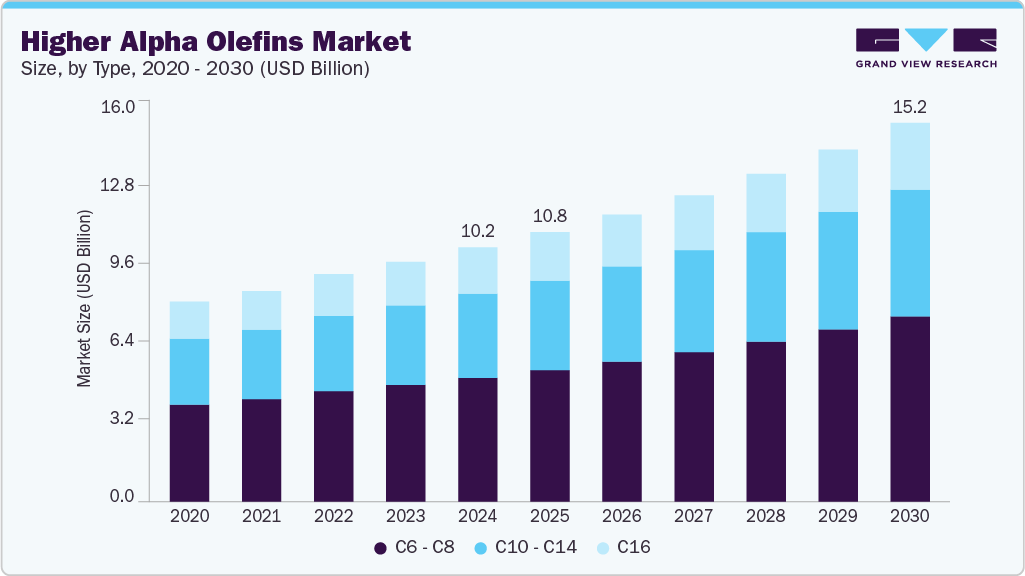
The global higher alpha olefins market size was valued at USD 10.8 billion in 2025 and is projected to grow from USD 11.5 billion in 2026 to USD 19.3 billion by 2033, at a CAGR of 7.6% from 2026 to 2033. North America dominated the higher alpha olefins market with the highest revenue share of 35.8% in 2025. Higher alpha olefins (HAOs) are linear, terminal olefins characterized by a double bond located at the first carbon atom, primarily synthesized via the oligomerization of ethylene.
 Source: Grand View Research, IR Documents, Primary Interviews, Paid DatabasesTo learn more about this report,
 Download Free Sample Report
 Key Market Trends & Insights
- By type: C6-C8 segment held the largest market share of 48.9% in 2025.
- By application: Polyethylene comonomers segment held the largest market share of 52.2% in 2025.
Regional Highlights
- Largest regional market: North America (35.8% revenue share, 2025)
- Fastest-growing regional market: Asia Pacific (highest CAGR, 2026-2033)
- By country: The US held the largest market share in 2025.
Market Size & Forecast
- Market size in 2025: USD 10.8 Billion
- Estimated market size in 2026: USD 11.5 Billion
- Projected market size by 2033: USD 19.3 Billion
- CAGR (2026-2033): 7.6%
Three ways to get this report
Buy it, customize it, or ask a question.Ask an Analyst
A direct answer, usually in 1 working day
- AccessReport author, directly
- Reply timeWithin 1 working day
- No sales callDirect answer only
- FormatEmail reply
- CostFree, no cost
Get the Full Report
What the study covers
- FormatsPDF · Excel · Dashboard
- Timeline2026–2033 annual, 2025 base
- Coverage20+ countries, 5 regions
- Companies10+ key players profiled
Customize the Report
20% free customization
- IncludeCountries, segments, points
- TailorTo your product definition
- ExtendDeeper competitor detail
- OrA fully bespoke study
- Turnaround5–10 working days
These versatile hydrocarbons are foundational building blocks in the production of a wide range of downstream chemical products. Their most significant role lies in the manufacture of polyethylene comonomers, where HAOs enhance polymer flexibility, impact strength, and processability key properties required in packaging films, containers, and plastic products. In addition, HAOs serve as essential intermediates in the formulation of synthetic lubricants, surfactants, detergent alcohols, and oilfield chemicals, driven by their favorable physical properties such as low volatility, thermal stability, and biodegradability.The higher alpha olefins industry is benefiting from a confluence of industrial and regulatory shifts. There is an increasing emphasis on environmentally sustainable materials and formulations, with downstream manufacturers seeking raw materials that comply with stringent environmental standards. In particular, regulations such as REACH in Europe and FDA guidelines in the U.S. are encouraging innovation in the design of low-toxicity, high-purity HAO products. This is prompting producers to invest in cleaner processes, enhanced catalytic systems, and high-efficiency downstream integration.
 To learn more about this report, Download Free Sample Report
 Moreover, growing demand for high-performance plastics, energy-efficient lubricants, and bio-based surfactants is expanding the application base of HAOs. Innovations in polymer chemistry and customized olefin chain lengths are also helping manufacturers tailor products to meet specific functional requirements in fast-evolving industries such as automotive, consumer packaging, and personal care. As a result, the global HAO market is evolving from a commodity-focused sector to a value-added, application-specific industry with increasing demand for performance-oriented grades.
Market Dynamics
Higher alpha olefins (HAOs) are linear olefins produced primarily through ethylene oligomerization and serve as important intermediates in the manufacture of polyethylene, synthetic lubricants, surfactants, plasticizers, oilfield chemicals, and specialty chemicals. Their versatility, favorable chemical properties, and expanding industrial applications have positioned HAOs as critical building blocks within the petrochemical value chain. Growing demand for performance polymers, specialty chemicals, and industrial lubricants continues to support market expansion globally.
The increasing consumption of polyethylene across packaging, consumer goods, construction, automotive, and industrial applications is a major factor driving growth in the higher alpha olefins market. Higher alpha olefins, particularly C4, C6, and C8 grades, are widely utilized as co-monomers in polyethylene manufacturing to enhance product strength, flexibility, durability, and processing characteristics.
Rising demand for high-performance polyethylene grades such as linear low-density polyethylene (LLDPE) and high-density polyethylene (HDPE) is further supporting HAO consumption. Continued investments in petrochemical capacity expansions and packaging industry growth across emerging economies are expected to sustain long-term demand.
Fluctuations in ethylene prices remain a key challenge for higher alpha olefin manufacturers. Since ethylene serves as the primary feedstock for HAO production, changes in crude oil and natural gas markets can significantly impact production economics and profitability across the value chain.
Growing consumption of synthetic lubricants and specialty chemical formulations presents significant opportunities for higher alpha olefin producers. HAOs are extensively used in the production of poly-alphaolefin (PAO) synthetic lubricants, which offer superior thermal stability, oxidation resistance, and performance characteristics compared to conventional lubricants.
Market Concentration & Characteristics
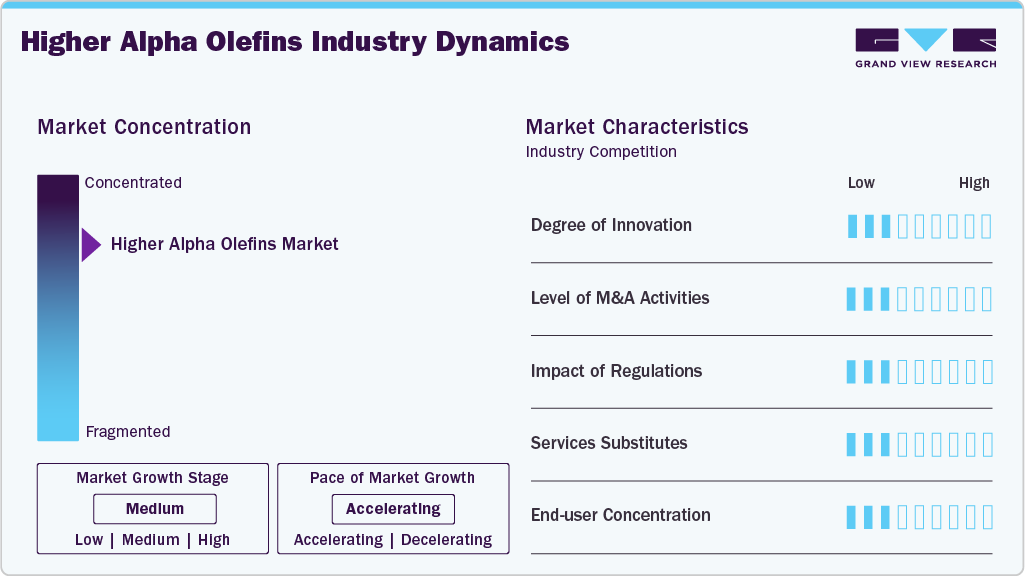
The higher alpha olefins industry exhibits a consolidated structure, characterized by the dominance of several vertically integrated multinational corporations. Players such as Shell Chemicals, INEOS Oligomers, Chevron Phillips Chemical (CP Chem), ExxonMobil Chemical, and Sasol Ltd. occupy significant market shares by virtue of their well-established production capacities, global supply networks, and proprietary technologies in olefin oligomerization.
These industry leaders benefit from access to captive ethylene feedstock, enabling cost-effective, large-scale production of HAO through processes like the Shell Higher Olefin Process (SHOP) or metallocene-catalyzed technologies. Their integration across the petrochemical value chain from raw material extraction and ethylene production to alpha olefin synthesis and end-use product development provides them with greater pricing control, logistical efficiencies, and flexibility in catering to diverse customer segments.
 To learn more about this report, Download Free Sample Report
 Meanwhile, emerging regional players, particularly in Asia-Pacific and the Middle East, are entering the higher alpha olefins industry with cost-competitive and bulk-grade offerings, targeting high-volume applications such as detergent alcohols and polyethylene comonomers. These new entrants are supported by access to abundant natural gas-based ethylene and investment in downstream infrastructure within special economic zones or petrochemical parks.
Despite competition on volume and pricing, product innovation, regulatory compliance, and technical support services remain key differentiators. Global producers are increasingly focused on delivering value-added olefins that conform to evolving regulations especially for applications in medical, food-grade packaging, and cosmetics, which require high levels of purity, non-toxicity, and low migration rates.
Analyst Perspective
The higher alpha olefins market occupies a strategically important position within the petrochemical value chain, as demand is driven not only by overall industrial activity but also by the increasing shift toward higher-performance polymer and specialty chemical formulations. While polyethylene comonomers continue to account for the majority of consumption, particularly within LLDPE and HDPE production, the market's long-term value creation is increasingly supported by higher-margin applications such as synthetic lubricants, specialty surfactants, and oilfield chemicals. This creates a dual growth dynamic whereby producers benefit from both volume-driven demand linked to packaging and infrastructure development, and value-driven demand associated with performance-oriented specialty products. Given that ethylene feedstock economics remain a critical determinant of competitiveness, companies with integrated olefin production assets and advanced oligomerization technologies are expected to maintain structural cost advantages. Looking ahead, the industry's competitive landscape is likely to be shaped by the ability to balance large-scale polyethylene demand with growing participation in specialty applications, where product differentiation, formulation performance, and downstream integration offer greater opportunities for margin expansion.
Type Insights
Based on type, the C6-C8 segment led the market with the largest revenue share of 48.9% in 2025. Their dominance is attributed to their compatibility with linear low-density polyethylene (LLDPE) and other polymer systems used in film and packaging applications. C10-C14 olefins, on the other hand, are gaining traction in the formulation of high-end synthetic lubricants and surfactants due to their favorable flow characteristics and low volatility.
The C16 segment is expected to grow at the fastest CAGR during the forecast period, driven by niche uses in specialty waxes, personal care bases, and high-viscosity lubricants. Advancements in catalyst systems and process optimization are supporting type diversification and performance customization.
Application Insights
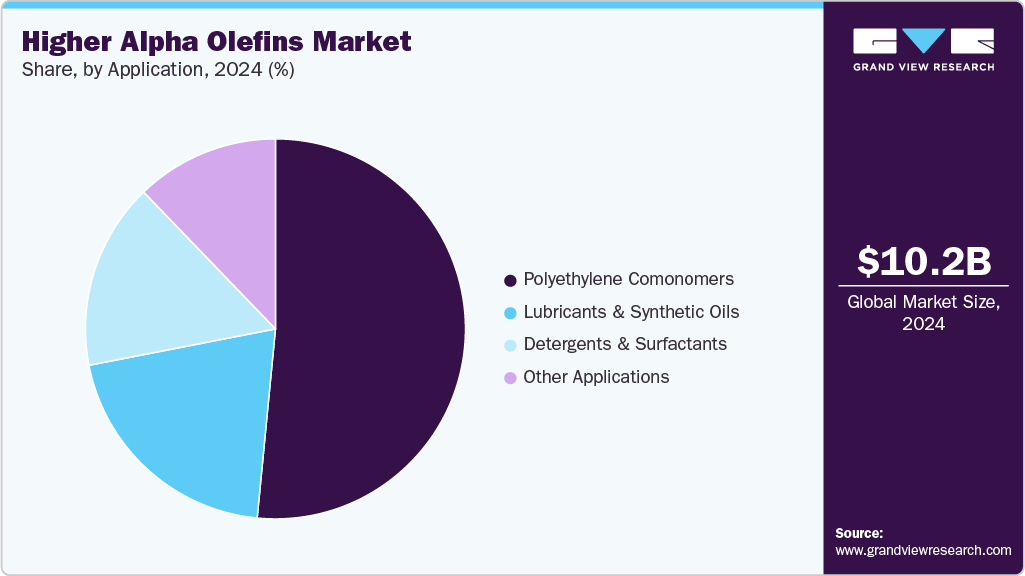
In 2025, the polyethylene comonomers segment accounted for the dominating revenue share of 52.2%. These olefins are critical for enhancing the flexibility, clarity, and strength of polyethylene grades used in packaging films and containers. Lubricants and synthetic oils represent another significant share, particularly in automotive and industrial sectors where thermal stability and wear resistance are crucial.
The detergents and surfactants segment continues to expand, backed by consumer demand for high-performance, low-foaming cleaning agents. Other applications including adhesives, specialty polymers, and drag-reducing agents are benefiting from the development of tailored olefins with optimized chain lengths and functional properties.
 To learn more about this report, Download Free Sample Report
 The lubricants and synthetic oils segment is anticipated to grow at the fastest CAGR during the forecast period, driven by the increasing need for high-performance base oils and viscosity modifiers in the automotive, aerospace, and industrial machinery sectors. Higher alpha olefins serve as key feedstocks for the synthesis of polyalphaolefins (PAOs), which are widely regarded for their excellent oxidative stability, low volatility, and high-temperature performance. These attributes are especially valuable in synthetic engine oils, gear oils, hydraulic fluids, and transmission fluids. As original equipment manufacturers (OEMs) push for energy-efficient, long-life lubricants, demand for olefin-based synthetic oils continues to grow, particularly in electric vehicles, aviation, and heavy-duty equipment.
The detergents and surfactants segment is another key application area, benefiting from rising consumer awareness around clean-label and biodegradable formulations. Higher alpha olefins are used in the production of olefin sulfonates and alkylbenzene sulfonates, which are key ingredients in laundry detergents, dishwashing liquids, and personal care products. Their low-foaming properties, compatibility with hard water, and ability to remove oil-based stains efficiently make them ideal for both domestic and institutional cleaning products. As regulations increasingly favor non-phosphate, eco-friendly formulations, olefin-derived surfactants are expected to play a growing role in the household and industrial cleaning sectors.
Regional Insights
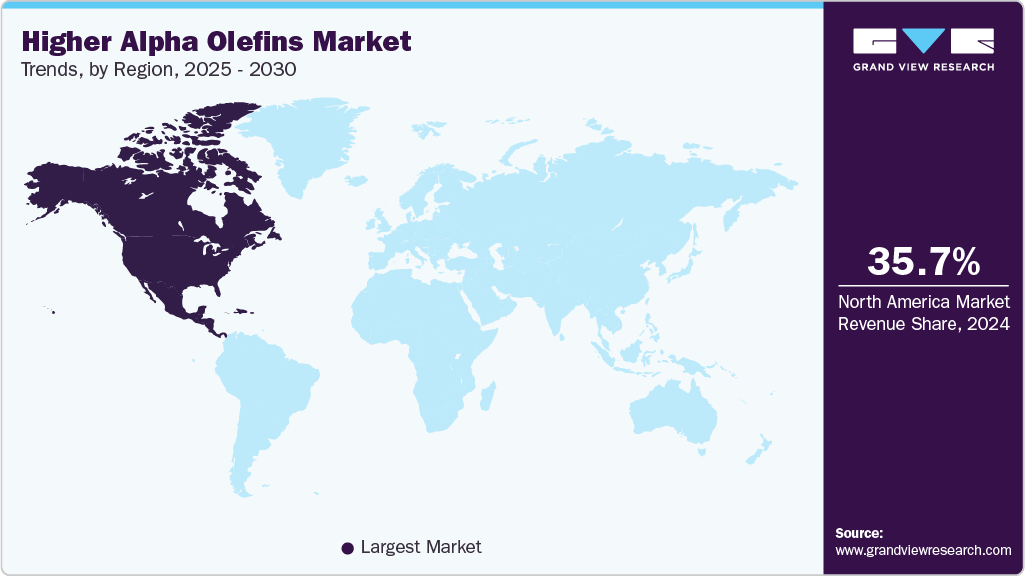
North America dominated the higher alpha olefins market with the highest revenue share of 35.8% in 2025, with the U.S. leading due to its mature petrochemical infrastructure, advanced regulatory frameworks, and extensive R&D activities. The U.S. market is well-established in sectors such as medical adhesives, polyethylene production, and industrial lubricants.
 To learn more about this report, Download Free Sample Report
 U.S. Higher Alpha Olefins Market Trends
The U.S. accounted for 92.2% of the North American higher alpha olefins market in 2025. The country’s industrial infrastructure, access to low-cost ethylene, and emphasis on energy-efficient formulations have accelerated the use of alpha olefins in LLDPE, detergent alcohols, and lubricants. In addition, regulatory pressure to reduce volatile organic compounds (VOCs) is boosting the role of alpha olefins in clean, low-emission applications.
Asia Pacific Higher Alpha Olefins Market Trends
The higher alpha olefins market in Asia Pacific is witnessing increased investment in alpha olefin capacity, particularly in China, where domestic consumption of polyethylene and synthetic lubricants is rapidly expanding. Japan and South Korea contribute specialty applications in electronics and the medical fields, supported by strong technology and innovation ecosystems. Regional governments are also promoting local production of olefin-based intermediates to reduce import dependency.
Europe Higher Alpha Olefins Market Trends
The higher alpha olefins market in Europe is anticipated to grow at a significant CAGR during the forecast period. Stringent environmental and health safety regulations characterize Europe. This has encouraged local producers and users to shift toward olefins with high purity and lower toxicity. Industrial coatings, packaging, and automotive lubricants remain primary applications. Furthermore, the transition toward circular plastics and low-carbon chemistry is encouraging new investment in sustainable olefin production routes.
Middle East & Africa Higher Alpha Olefins Market Trends
The higher alpha olefins market in the Middle East & Africa region is emerging both as a production base and a growing market for alpha olefins. GCC countries are leveraging their abundant hydrocarbon resources to develop integrated olefin complexes. Local demand is modest but rising, particularly in sectors like construction coatings, lubricants, and packaging.
Key Higher Alpha Olefins Company Insights
Some of the key players operating in the market include Shell Chemicals, INEOS Oligomers, Chevron Phillips Chemical (CP Chem), ExxonMobil Chemical, Sasol Ltd., SABIC, QatarEnergy, Idemitsu Kosan Co., Ltd., Godrej Industries, and Linde plc.
-
Shell Chemicals, a division of Shell plc (formerly Royal Dutch Shell), is one of the world’s largest producers of petrochemicals, including higher alpha olefins. Shell’s chemical division is deeply integrated with its upstream oil and gas operations, allowing for a consistent supply of feedstock like ethylene, a critical input in alpha olefin production.
-
INEOS Oligomers is a key business unit within INEOS Group, one of the largest privately held chemical companies globally. INEOS Oligomers is a leading manufacturer of a wide range of linear alpha olefins, including short-chain and long-chain variants, used across polymers, lubricants, and surfactants.
Key Higher Alpha Olefins Companies:
The following key companies have been profiled for this study on the higher alpha olefins market.
-
Shell Chemicals
-
INEOS Oligomers
-
Chevron Phillips Chemical (CP Chem)
-
ExxonMobil Chemical
-
Sasol Ltd.
-
SABIC
-
QatarEnergy
-
Idemitsu Kosan Co., Ltd.
-
Godrej Industries
-
Linde plc.
Competitive Benchmarking
Category
Operating Strategies
Competitive Edge
Weakness
Established Players (Shell Chemicals, INEOS Oligomers, Chevron Phillips Chemical (CP Chem), ExxonMobil Chemical, Sasol Ltd., SABIC, and QatarEnergy)
Expanding integrated petrochemical production facilities to improve feedstock security and manufacturing efficiency globally.
Investing in advanced olefin technologies and capacity expansions to support growing polymer industry demand.
Strong vertical integration provides reliable raw material access and cost advantages across operations.
Large-scale production infrastructure supports consistent supply to major polyethylene and specialty chemical manufacturers.
High dependence on petrochemical feedstocks exposes operations to crude oil and ethylene price volatility.
Capital-intensive production assets require substantial investments for expansion, maintenance, and process optimization.
Emerging Players (Idemitsu Kosan Co., Ltd., Godrej Industries, and Linde plc)
Strengthening regional production capabilities and expanding participation within specialty olefin and derivative markets.
Pursuing strategic collaborations and technology improvements to enhance product quality and market competitiveness.
Strong regional presence enables efficient customer engagement and targeted market development initiatives.
Diversified business operations provide flexibility to address evolving industrial and petrochemical market requirements.
Comparatively lower influence within the global higher alpha olefins market may limit market share expansion.
Smaller production footprint than leading players can reduce economies of scale and cost competitiveness.
Recent Development
-
In 2024, INEOS Oligomers significantly enhanced its production capabilities at the Chocolate Bayou facility in Alvin, Texas, by expanding its linear alpha olefins (LAO) plant. This expansion increased the plant's capacity to 420,000 metric tons per year, making it one of the largest LAO production units globally. The LAO plant is fully integrated with INEOS's adjacent polyalphaolefins (PAO) production facilities, ensuring a seamless supply chain for the production of synthetic lubricants and other applications
Higher Alpha Olefins Market Report Scope
Report Attribute
Details
Market size in 2025
USD 10.8 billion
Estimated Market size in 2026
USD 11.5 billion
Projected Market size by 2033
USD 19.3 billion
Growth rate
CAGR of 7.6% from 2026 to 2033
Base year for estimation
2025
Historical data
2021 - 2024
Forecast period
2026 - 2033
Quantitative units
Revenue in USD million/billion, Volume in Kilotons and CAGR from 2026 to 2033
Report coverage
Revenue forecast, company ranking, competitive landscape, growth factors, and trends
Segments covered
Type, Application, region
Regional scope
North America; Europe; Asia Pacific; Latin America; MEA
Country scope
U.S.; Canada; Mexico; Germany; UK; France; Italy; Spain; China; Japan; India; South Korea;
Key companies profiled
Shell Chemicals; INEOS Oligomers; Chevron Phillips Chemical (CP Chem); ExxonMobil Chemical; Sasol Ltd.; SABIC; QatarEnergy; Idemitsu Kosan Co., Ltd.; Godrej Industries; Linde plc.
Customization scope
Free report customization (equivalent up to 8 analysts' working days) with purchase. Addition or alteration to country, regional & segment scope.
Pricing and purchase options
Avail customized purchase options to meet your exact research needs. Explore purchase options
Global Higher Alpha Olefins Market Report Segmentation
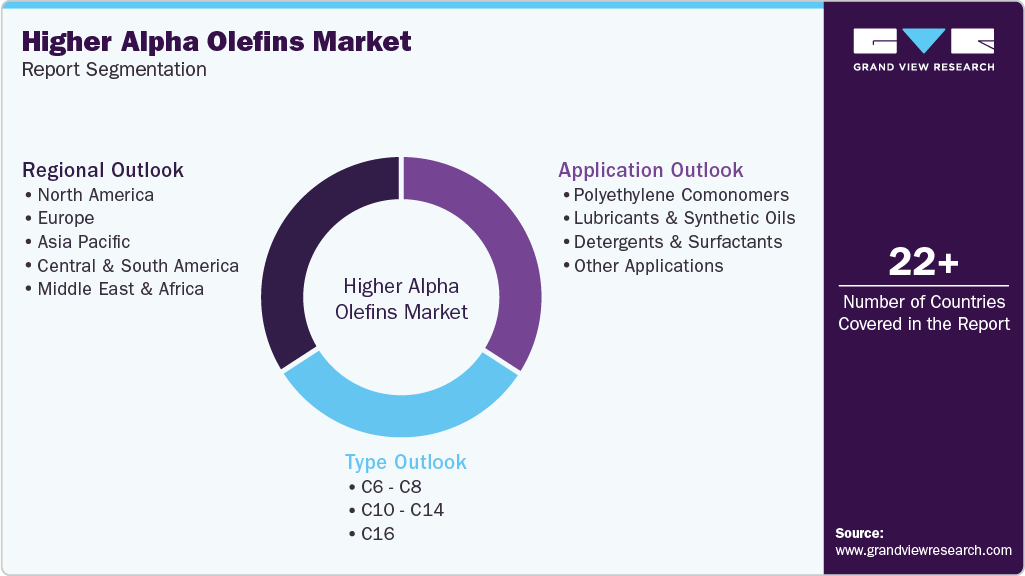
This report forecasts revenue growth at global, regional, and country levels and provides an analysis of the latest industry trends in each of the sub-segments from 2021 to 2033. For this study, Grand View Research has segmented the global higher alpha olefins market report based on type, application and region:
 To learn more about this report, Download Free Sample Report
 -
Type Outlook (Volume, Kilotons; Revenue, USD Billion, 2021 - 2033)
-
C6-C8
-
C10-C14
-
C16
-
-
Application Outlook (Volume, Kilotons; Revenue, USD Billion, 2021 - 2033)
-
Polyethylene Comonomers
-
Lubricants & Synthetic Oils
-
Detergents & Surfactants
-
Other Applications
-
-
Regional Outlook (Volume, Kilotons; Revenue, USD Billion, 2021 - 2033)
-
North America
-
U.S.
-
Canada
-
Mexico
-
-
Europe
-
Germany
-
UK
-
France
-
Italy
-
Spain
-
-
Asia Pacific
-
China
-
India
-
Japan
-
South Korea
-
-
Central & South America
-
Middle East & Africa
-
Research Methodology
The higher alpha olefins market figures in this report are based on a proven research process that combines executive interviews with secondary research from proprietary databases, company filings, and recognized regulatory and institutional sources. Market size is built through value-chain sizing - reconciling supply-side and demand-side estimates - and triangulated with bottom-up and top-down approaches. Every estimate passes multiple levels of expert validation before publication, with each higher alpha olefins segment quantified using the revenue-capture definitions in the table below.
Segment Definition
Segment - Type
Revenue capture definition
C6-C8
As the dominant type segment, revenue capture is primarily driven by large-volume consumption as polyethylene comonomers in LLDPE and HDPE production. Expanding polymer manufacturing capacity and increasing demand for high-performance plastics significantly support market value generation.
C10-C14
Market revenue is generated through applications in synthetic lubricants, surfactants, detergent alcohols, and specialty chemicals. Growing industrial demand for performance formulations and chemical intermediates continues to support commercial adoption within this segment.
C16
Revenue contribution stems from utilization in lubricant additives, specialty surfactants, waxes, and personal care ingredients. Demand is supported by increasing consumption of high-value specialty chemical products requiring specific performance characteristics.
Segment - Application
Revenue capture definition
Polyethylene Comonomers
As the largest end-use segment, revenue is generated through the incorporation of higher alpha olefins into polyethylene production processes. Global demand for LLDPE and HDPE across packaging, construction, automotive, and consumer applications remains the primary growth driver.
Lubricants & Synthetic Oils
Revenue is supported by the use of higher alpha olefins in polyalphaolefin production for automotive, industrial, and specialty lubricant applications. Growing demand for high-performance lubricants with enhanced thermal and oxidation stability contributes to segment expansion.
Detergents & Surfactants
Market value is driven by consumption in detergent alcohol production and surfactant manufacturing. Expanding household cleaning, industrial cleaning, and personal care product markets continue to support steady demand for alpha olefin-derived ingredients.
Other Application
This segment derives revenue from specialty chemicals, oilfield chemicals, plasticizers, and various industrial applications. Product innovation and diversification of downstream uses continue to create additional market opportunities.
Estimation Model
Layer Name
Key Question
Description
Ethylene Feedstock Layer
What forms the production base?
Identify global ethylene production capacity and oligomerization infrastructure used to manufacture higher alpha olefins. This establishes the foundational supply base available for downstream chemical and polymer applications.
Application Adoption Layer
Where are higher alpha olefins consumed?
Estimate the proportion of higher alpha olefins utilized across polyethylene comonomers, synthetic lubricants, surfactants, detergents, oilfield chemicals, plasticizers, and specialty chemical applications.
Consumption Intensity Layer
How much product is used?
Analyze application-specific inclusion rates, polymer production volumes, lubricant manufacturing activity, and specialty chemical demand to determine annual consumption levels across major end-use sectors.
Revenue Layer
How is market revenue generated?
Market revenue is quantified through the sale of higher alpha olefins supplied to polymer manufacturers, lubricant producers, surfactant manufacturers, oilfield service companies, and specialty chemical producers worldwide.
Delivered Customizations
This report has been delivered with the following In-depth customizations
Client Request
Customization Delivered
Value Adds
Regional Segmentation
The study delivers detailed regional and country-level analysis across North America, Europe, Asia Pacific, the Middle East, and key countries including China, the U.S., India, Saudi Arabia, and Japan, covering production, consumption, and demand trends.
Provides comprehensive visibility into regional growth opportunities, supply-demand balances, and petrochemical investment trends, enabling stakeholders to prioritize expansion strategies and allocate resources more effectively.
Pricing Analysis
The report delivers detailed pricing assessment covering historical higher alpha olefin prices, feedstock cost movements, regional pricing variations, and key factors influencing market pricing dynamics across major producing and consuming regions.
Supports procurement planning, margin optimization, and cost management strategies by providing deeper insights into pricing volatility and the impact of feedstock fluctuations on market profitability.
Competitive Benchmarking
The study delivers comprehensive benchmarking of leading and emerging manufacturers based on production capacity, technology capabilities, integration levels, geographic presence, product portfolio strength, and strategic developments within the higher alpha olefins value chain.
Enables companies to evaluate competitive positioning, identify market gaps, benchmark operational performance, and support strategic decisions related to partnerships, investments, and future growth initiatives.
Frequently Asked Questions About This Report
Some key players operating in the higher alpha olefins market include Shell Chemicals, INEOS Oligomers, Chevron Phillips Chemical (CP Chem), ExxonMobil Chemical, Sasol Ltd., SABIC, QatarEnergy, Idemitsu Kosan Co., Ltd., Godrej Industries, and Linde plc
Key factors that are driving the market growth include growing demand for high-performance plastics, energy-efficient lubricants, and bio-based surfactants which is expanding the application base of HAOs.
North America dominated the higher alpha olefins market with a share of 35.8% in 2025. This is attributable to well-established in sectors such as medical adhesives, polyethylene production, and industrial lubricants driving the product demand in the region.
Asia Pacific is projected to be the fastest-growing regional market during the forecast period, registering a CAGR of 8.3% from 2026 to 2033
The polyethylene comonomers segment led the higher alpha olefins market in 2025, accounting for 52.2% of market revenue
The C10–C14 segment is projected to witness the fastest growth during the forecast period, registering a CAGR of 7.8% from 2026 to 2033
The C6–C8 segment dominated the higher alpha olefins market in 2025, capturing 48.9% of market revenue, due to its widespread utilization in polyethylene production and other large-volume petrochemical applications.
The global higher alpha olefins market size was estimated at USD 10.8 billion in 2025 and is expected to reach USD 11.5 billion in 2026.
The global higher alpha olefins market is expected to grow at a compound annual growth rate of 7.6% from 2026 to 2033 to reach USD 19.3 billion by 2033.
About the Author(s)
Organic Chemicals Research Team
Bulk Chemicals · Organic ChemicalsThis report was authored by the organic chemicals research team at Grand View Research - comprising two research analysts, one senior research analyst, and one industry expert - with specialized expertise in the organic chemicals segment of the bulk chemicals industry. All findings are based on proprietary bulk chemicals databases, executive interviews, and regulatory analysis, subject to internal peer review prior to publication.
Last Updated:
Speak to Analyst

Customize this report to your needs - add regions, segments, or data points, with 20% free customization.
Or view our licence options:


ISO 9001:2015 & 27001:2022 Certified
We are GDPR and CCPA compliant! Your transaction & personal information is safe and secure. For more details, please read our privacy policy.


