
- Home
- »
- Homecare & Decor
- »
-
Home Fragrance Market Size, Share & Trends Report, 2033GVR Report cover

Home Fragrance Market (2026 - 2033)
Size, Share & Trends Report By Product (Scented Candles, Reed Diffuser & Incense Sticks), By Fragrance (Floral, Fruity, Citrus), By Price Tier (Economy/Mass, Luxury/Super-Premium), By Distribution Channel, By Region, And Segment Forecasts
Market Size, 2025
$24.2BMarket Estimate, 2026
$25.3BMarket Forecast, 2033
$39.0BCAGR, 2026–2033
6.3%Home Fragrance Market Summary
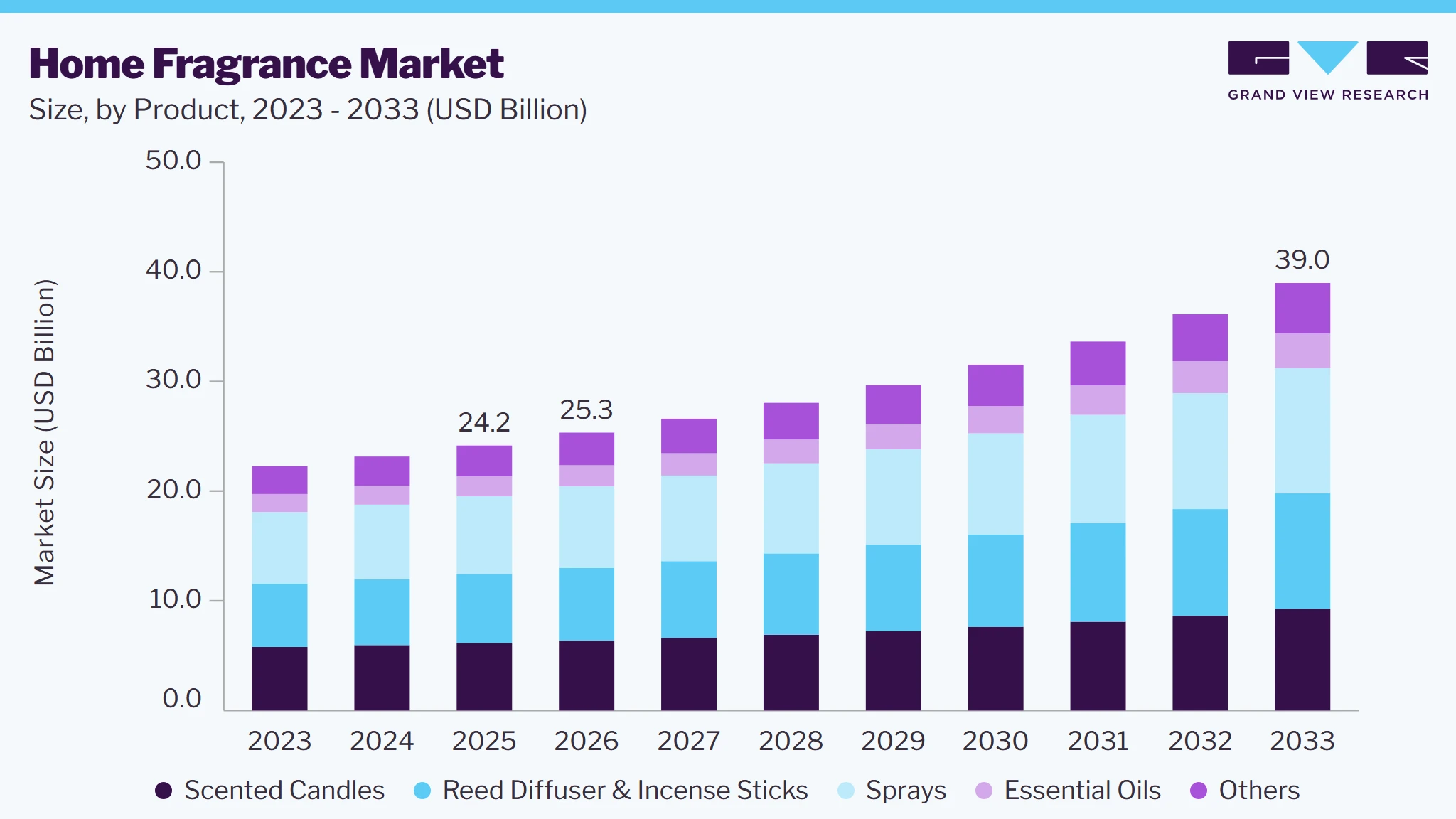
The global home fragrance market size was valued at USD 24.2 billion in 2025 and is expected to grow from USD 25.3 billion in 2026 to USD 39.0 billion by 2033, at a CAGR of 6.3% from 2026 to 2033. Europe dominated the market, accounting for a revenue share of 32.4% in 2025. The market is driven by rising consumer interest in home ambiance, increasing demand for scented candles, sprays, and essential oils, and a growing emphasis on wellness and relaxation.
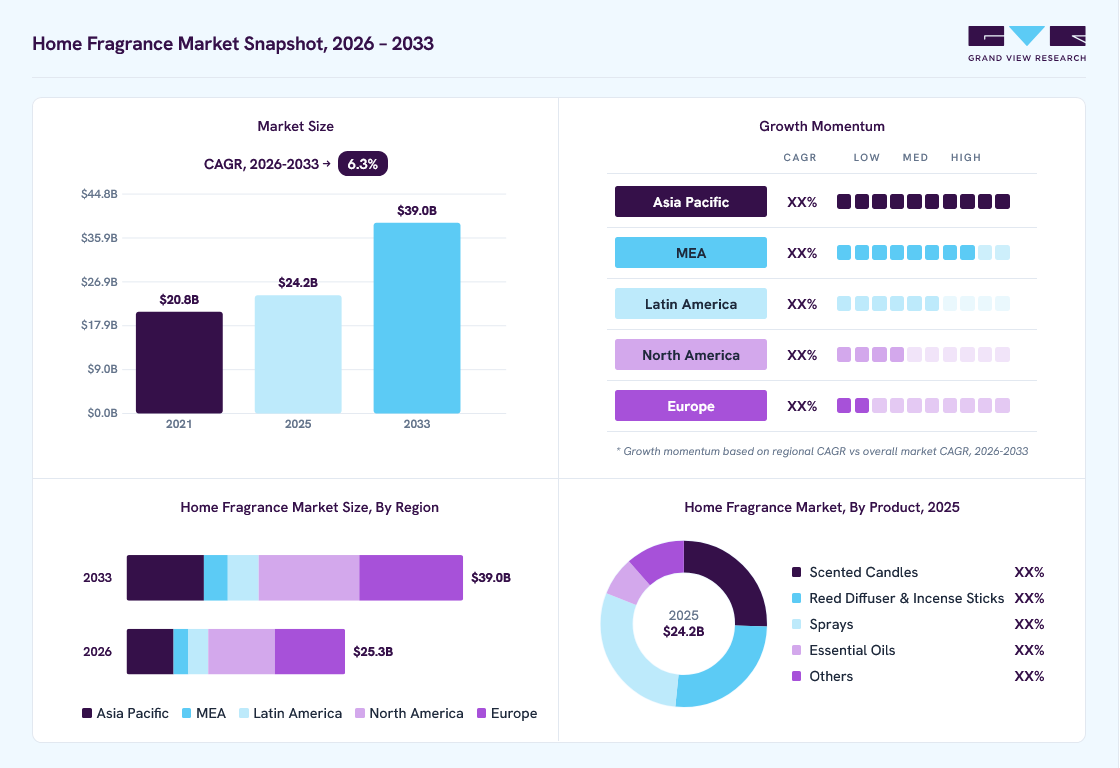 Source: Grand View Research, IR Documents, Primary Interviews, Paid DatabasesTo learn more about this report,
 Download Free Sample Report
Key Market Trends & Insights
- By product: Sprays segment held the largest share of 29.3% in 2025.
- By fragrance: Floral home fragrance accounted for the largest share of 24.2% in 2025.
- By price tier: Economy/mass home fragrance led the market with a share of 35.2% in 2025.
- By distribution channel: Supermarkets & hypermarkets held the largest share of 34.9% in 2025.
Regional Highlights
- Largest regional market: Europe (32.4% revenue share, 2025)
- Fastest-growing regional market: Asia Pacific (highest CAGR, 2026-2033)
- By country: The Germany held the largest market share in 2025.
Market Size & Forecast
- Market size in 2025: USD 24.2 Billion
- Estimated market size in 2026: USD 25.3 Billion
- Projected market size by 2033: USD 39.0 Billion
- CAGR (2026-2033): 6.3%
Three ways to get this report
Buy it, customize it, or ask a question.Ask an Analyst
Analyst response in 1 business day
- AccessReport author, directly
- Reply timeWithin 1 working day
- No sales callDirect answer only
- FormatEmail reply
- CostFree, no cost
Get the Full Report
What the study covers
- FormatsPDF · Excel · Dashboard
- Timeline2026–2033 annual, 2025 base
- Coverage20+ countries, 5 regions
- Companies10+ key players profiled
Customize the Report
20% free customization
- IncludeCountries, segments, points
- TailorTo your product definition
- ExtendDeeper competitor detail
- OrA fully bespoke study
- Turnaround5–10 working days
The home fragrance market growth is also supported by the adoption of premium and natural fragrance products, the expansion of e-commerce channels, and product innovations featuring diverse fragrances, sustainable packaging, and long-lasting scent formulations across residential and commercial applications.
 To learn more about this report, Download Free Sample Report
Consumers are increasingly using home fragrance to shape the sensory identity of their living spaces, moving the category beyond basic odor control toward ambiance, comfort, and personal expression. This shift is supported by consumer research from DSM-Firmenich cited in 2025, which found that 92% of consumers considered fragrance important, while 79% wanted their homes to smell good, and 78% actively sought long-lasting freshness. In addition, the company's NewNextNow consumer research, covering 21 countries, found that 70% of consumers appreciated scents more than before. Together, these findings indicate that fragrance is becoming a more consciously valued component of the home environment, creating greater scope for products that allow consumers to choose scents according to their individual preferences and the atmosphere they want to create.
The growing use of scented candles as decorative and gifting products is supporting the home fragrance market, particularly within the scented candles segment. According to the U.S. National Candle Association, approximately 90% of candle users report using candles to make a room feel comfortable or cozy, while 76% of candle purchasers consider candles suitable holiday gifts. These findings indicate that fragrance products serve both functional and ambient purposes, as well as gifting, creating opportunities for manufacturers to offer floral, fruity, woody, and fresh/clean fragrances in decorative formats.
The rising personalization trend is also encouraging brands to combine fragrance differentiation with visual design and multisensory attributes. For instance, in April 2025, Newell Brands' WoodWick introduced its Precious Metals Collection, comprising eight fragrances, including Sparkling Pomelo, Marine Amber, Volcanic Orris, and Shimmering Spice. The collection paired differentiated scent profiles with metallic vessel designs and WoodWick's signature crackling Pluswick technology, allowing the product to contribute simultaneously to the sensory and visual character of a room.
Market Dynamics
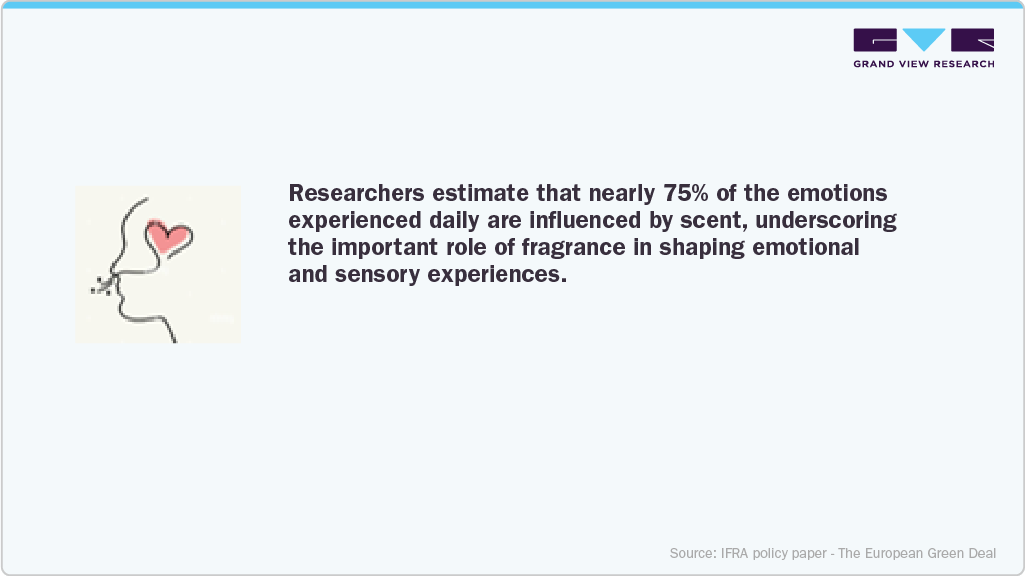
Home fragrance is increasingly shifting from a primarily functional air-care purchase to a sensory, experiential product that shapes the home's atmosphere. Consumers are using fragrance to support moments such as relaxation, unwinding, entertaining, and creating a sense of comfort, thereby expanding its relevance beyond situations where odor removal is the primary objective. Consumer attitudes increasingly support the shift toward experiential fragrance, with the International Fragrance Association (IFRA) reporting that 89% of consumers believe fragrances can improve their well-being and provide a positive influence in their lives. This reinforces the expanding role of home fragrance as a tool for creating desired emotional and sensory environments, rather than serving solely as an odor-management product. This evolution is significant because it gives home fragrance a role within everyday lifestyle routines rather than limiting demand to functional odor-management occasions.
 To learn more about this report, Download Free Sample Report
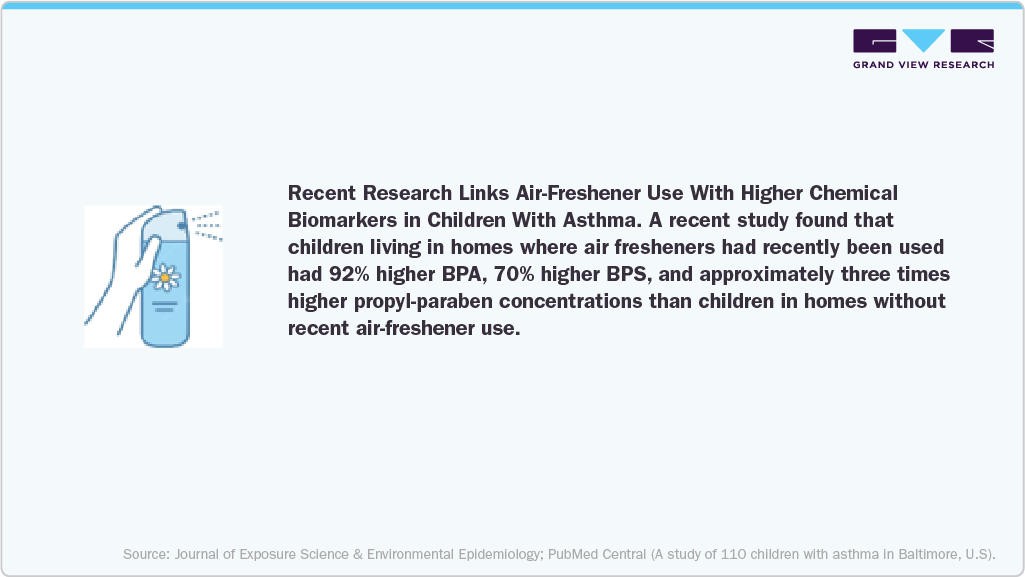
Growing consumer and regulatory attention toward indoor air quality is creating a structural restraint for home fragrance products, particularly those designed for continuous or high-frequency fragrance delivery. Air fresheners, sprays, plug-ins, and diffusers intentionally release volatile compounds into indoor environments, creating a potential trade-off between fragrance performance and perceptions of indoor environmental quality. The U.S. Environmental Protection Agency (EPA) notes that concentrations of many VOCs can be up to 10 times higher indoors than outdoors, although the agency also emphasizes that VOC levels and health effects vary considerably by individual compound and exposure conditions. This growing awareness can make consumers more selective about the duration, intensity, and frequency of their use of fragranced products, particularly in enclosed spaces such as bedrooms, nurseries, and other poorly ventilated areas.
 To learn more about this report, Download Free Sample Report
Growing awareness of indoor air quality (IAQ) is creating an opportunity for home fragrance manufacturers to differentiate their products by emphasizing natural, responsibly sourced, and transparent ingredients, rather than competing solely on fragrance intensity or longevity. The U.S. Environmental Protection Agency (EPA) reports that concentrations of many volatile organic compounds (VOCs) can be up to 10 times higher indoors than outdoors, while its Total Exposure Assessment Methodology studies have found concentrations of several common organic pollutants to average 2-5 times higher indoors. Household products such as aerosol sprays, air fresheners, and other fragranced products are among the identified sources of VOCs. This provides a structural opportunity for home-fragrance brands to position lower-emission formats, carefully selected ingredients, and controlled fragrance delivery as part of a broader “cleaner home environment” proposition.
Consumer Insights
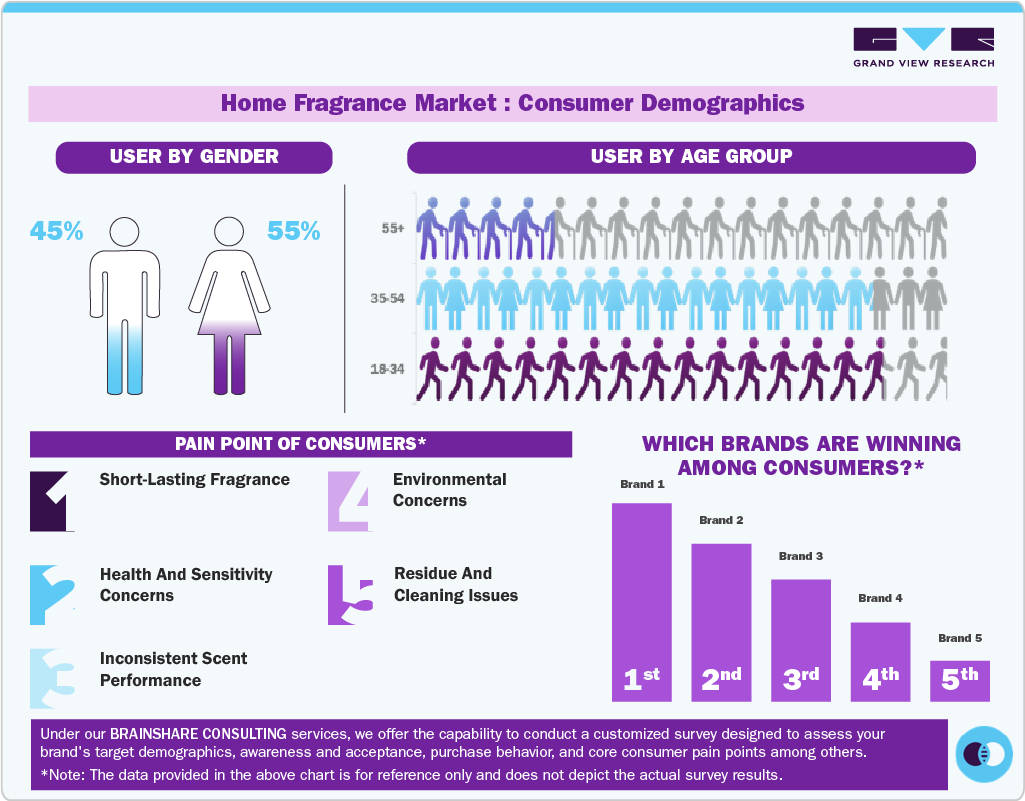
Consumer demand in the home fragrance market is influenced by gender, age, lifestyle preferences, household ambiance, and interest in relaxation, décor, and personal well-being. Purchasing decisions are also shaped by fragrance preferences, product affordability, scent longevity, and the convenience of using candles, sprays, essential oils, and incense sticks in residential environments.
 To learn more about this report, Download Free Sample Report
Users by gender
-
Female consumers account for the larger share of home fragrance users at approximately 55.0%, supported by scented candles, room sprays, and other fragrance products for home décor, relaxation, gifting, and creating pleasant indoor environments.
-
Male consumers account for approximately 45.0%, with demand associated with personal fragrance preferences, household ambiance, and interest in convenient home scent solutions.
Users by age group
Consumers aged 18-34 represent a substantial user group in the home fragrance market, supported by interest in home décor, lifestyle products, self-care routines, and experimenting with different fragrance profiles. Consumers aged 35-54 represent another important user group, with demand associated with household maintenance, interior ambiance, relaxation, entertaining guests, and purchasing fragrance products for family homes. Consumers aged 55 and above contribute to demand through preferences for comfortable indoor environments, familiar fragrances, relaxation, and decorative or gifting products.
Pain points of consumers
Consumers in the home fragrance market commonly encounter several challenges when selecting, purchasing, and using fragrance products.
-
Short-lasting fragrance: Some scented candles, sprays, and other home fragrance products may lose their scent quickly, requiring frequent replacement or reapplication and reducing perceived value for money.
-
Health and sensitivity concerns: Fragrance ingredients may cause discomfort for sensitive individuals, including headaches or irritation, creating concerns about product suitability and indoor air quality.
-
Inconsistent scent performance: Variations in fragrance intensity, diffusion, and longevity can make it difficult for consumers to achieve their preferred level of scent in different rooms.
-
Environmental concerns: Disposable packaging, excessive plastic use, and concerns about ingredient sourcing may discourage environmentally conscious consumers from purchasing certain home fragrance products.
-
Residue and cleaning issues: Wax residue, fragrance oils, and deposits from some sprays or incense products may create additional cleaning requirements, affecting consumer convenience.
The global home fragrance market is shifting from basic freshness to a broader lifestyle and sensory experience, with scented candles, sprays, essential oils, and incense used for ambiance, relaxation, aromatherapy, decoration, and gifting. Growing interest in wellness, personalized environments, and premium fragrances fuels demand in residential and commercial spaces. Brands are diversifying fragrance profiles, product formats, and price points, introducing innovative, sustainable, refillable, and omnichannel solutions to attract various consumers, boost loyalty, and grow in this expanding home fragrance industry.
Analyst Perspective
The global home fragrance market is shifting from basic freshness to a broader lifestyle and sensory experience, with scented candles, sprays, essential oils, and incense used for ambiance, relaxation, aromatherapy, decoration, and gifting. Growing interest in wellness, personalized environments, and premium fragrances fuels demand in residential and commercial spaces. Brands are diversifying fragrance profiles, product formats, and price points, introducing innovative, sustainable, refillable, and omnichannel solutions to attract various consumers, boost loyalty, and grow in this expanding home fragrance industry.
Product Insights
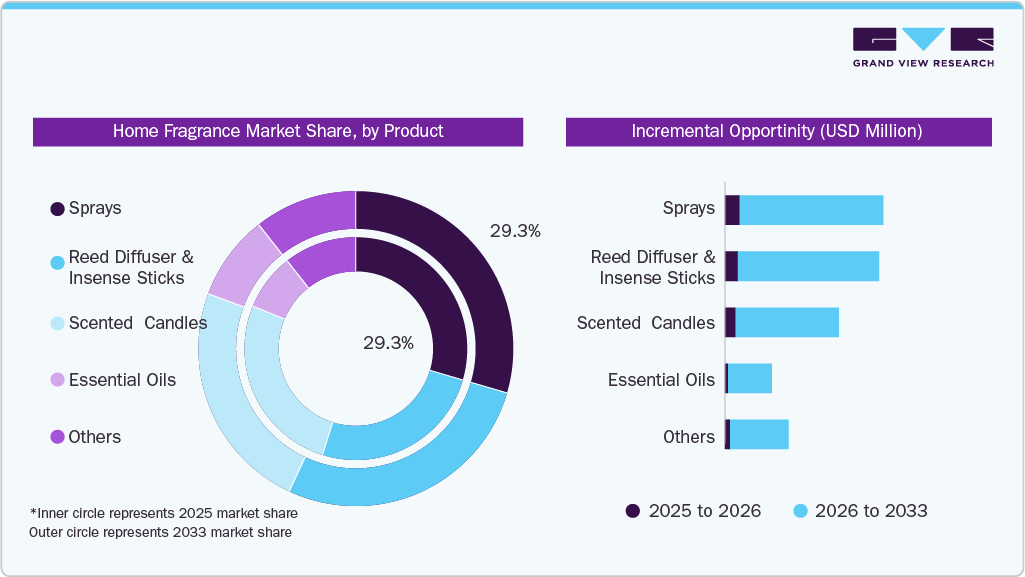
The sprays segment accounted for 29.3% of the global revenue in 2025, driven by demand for convenient, instant home fragrance solutions that refresh spaces, mask unwanted odors, and create desired atmospheres. Their on-demand application and diverse fragrance options are also supporting the positioning of sprays as premium lifestyle products.
For instance, in September 2025, Victoria’s Secret launched its first home fragrance collection, which included scented room sprays alongside candles, diffuser reeds, and liquid hand soaps. The room sprays were offered in fragrances such as Whipped Dream, Rose Bohemia, Midnight Vanilla, and Santal Amour, with prices starting at USD 19.95. The launch demonstrates the extension of established fine-fragrance identities into convenient home-scenting formats, supporting product diversification and premiumization within the sprays segment and contributing to innovation in the broader home fragrance industry.
 To learn more about this report, Download Free Sample Report
The essential oils segment is projected to grow at the fastest CAGR of 7.3% from 2026 to 2033. Essential oils are being incorporated into home-fragrance products to create refreshing, calming, or uplifting environments, while brands are emphasizing cleaner formulations and plant-derived ingredients to differentiate these products from conventional synthetic fragrances. This trend is also broadening the role of essential oils from traditional aromatherapy toward everyday home ambiance and lifestyle applications.
For instance, on March 5, 2025, TAJA Collection introduced Limoni Di Capri, a 100% pure lemon essential oil scent inspired by the fresh atmosphere of the Italian coastline. The product was positioned around a zesty, uplifting, and refreshing aroma and was described as helping to purify the air, eliminate unwanted scents, and promote mental clarity. TAJA also emphasized its focus on safe, non-toxic home products and wellness-oriented sensory experiences, demonstrating how essential-oil-based fragrance is increasingly being connected with natural formulations, home freshness, and personal well-being.
Fragrance Insights
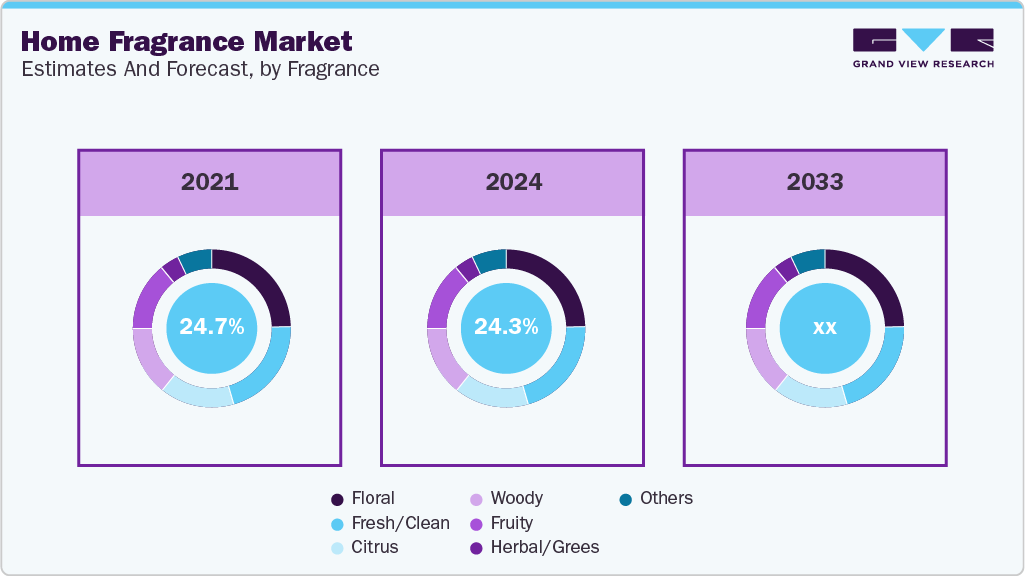
Floral home fragrance accounted for 24.2% of the global revenue in 2025 and is gaining attention as consumers seek familiar, nature-inspired scents for everyday home ambiance and relaxation. Floral fragrances such as rose, jasmine, and lavender are used in scented candles, room sprays, essential oils, and incense sticks, creating opportunities for manufacturers to develop differentiated home-fragrance products around recognizable botanical notes. In India, floral scents also benefit from their cultural association with rituals, hospitality, and festive celebrations, supporting their use in both traditional incense products and modern home-scenting formats.
According to a Talker Research survey commissioned by Air Wick, conducted among 2,000 U.S. adults between March 25 and March 31, 2025, 36% of respondents preferred floral scents when preparing their homes for guests during spring and summer 2025. The survey also found that 82% of respondents considered how their home smells before inviting guests, while 78% said a pleasant scent can make a home feel more inviting. This indicates that floral fragrances continue to play an important role in creating an inviting and aesthetically pleasing home atmosphere, supporting their incorporation across scented candles, sprays, diffusers, incense sticks, and other home-fragrance formats.
 To learn more about this report, Download Free Sample Report
Woody home fragrance is projected to grow at a CAGR of 7.5% from 2026 to 2033, driven by fragrance profiles that combine earthy, warm, and sophisticated notes, including sandalwood, cedarwood, oud, and patchouli. These scents are particularly relevant to premium home-fragrance products, where consumers seek distinctive fragrance experiences that complement interior décor and create an elevated ambiance. The use of woody notes in candles, room sprays, essential oils, and incense sticks enables brands to target consumers who prefer deeper, sweeter profiles.
For instance, Diptyque offers its Santal (Sandalwood) Classic Candle, featuring a creamy and woody sandalwood fragrance. The brand also offers other wood-focused home fragrances, including Feu de Bois, characterized by a smoky wood-fire scent, and Oud, which draws on precious wood notes.
Price Tier Insights
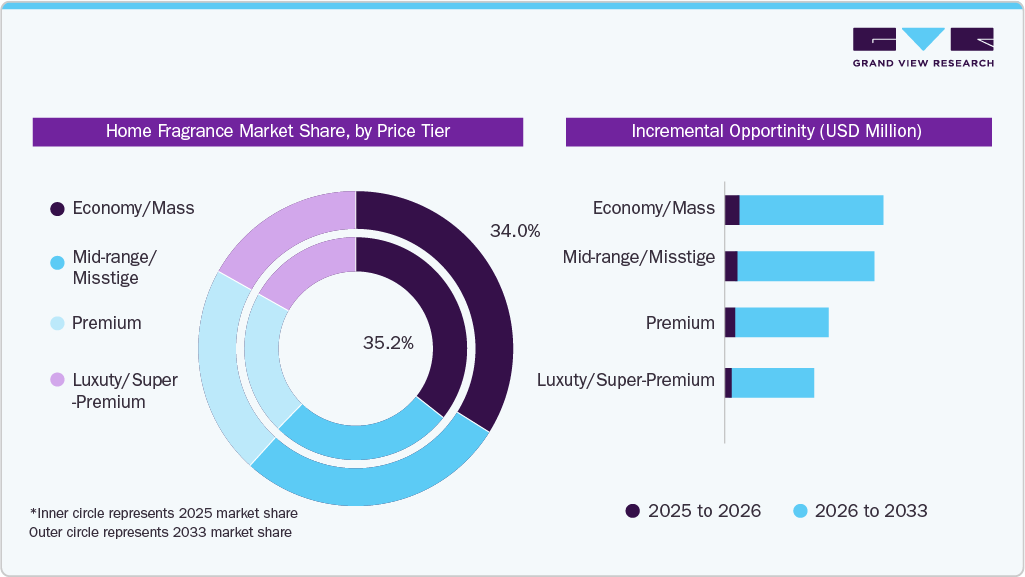
The economy/mass home fragrance segment accounted for 35.2% of the global revenue in 2025. Its scale reflects strong consumer preference for affordable, frequently replenished products, supported by broad availability across mass retail, supermarkets, convenience stores, and online channels. Companies such as Air Wick, Glade, Renuzit, Febreze, Mainstays, and Better Homes & Gardens have extensive offerings in the Economy/Mass price range. For instance, Air Wick offers room sprays, scented oils, and automatic spray formats at approximately USD 5-15, while Glade provides sprays, plug-in refills, and solid air fresheners generally priced at around USD 3-USD 12.
 To learn more about this report, Download Free Sample Report
The mid-range/masstige home fragrance segment is projected to grow at a CAGR of 6.8 from 2026 to 2033, driven by consumer demand for affordable premium home-fragrance products that combine improved fragrance quality, sophisticated packaging, and greater product variety. These offerings include scented candles, reed diffusers, room sprays, diffuser oils, and decorative fragrance products, positioning the segment between mass-market and premium categories.
For instance, The White Company's Autumn Signature Candle is priced at USD 40 and features pear, quince, apricot, amber, and musk, while its Glen Isla two-wick candle is priced at USD 53 and combines leather, sandalwood, cedarwood, and myrrh. These products illustrate how the home fragrance industry is addressing demand for enhanced sensory experiences and premium aesthetics at relatively accessible price points, supporting the development of the mid-range/masstige segment.
Distribution Channel Insights
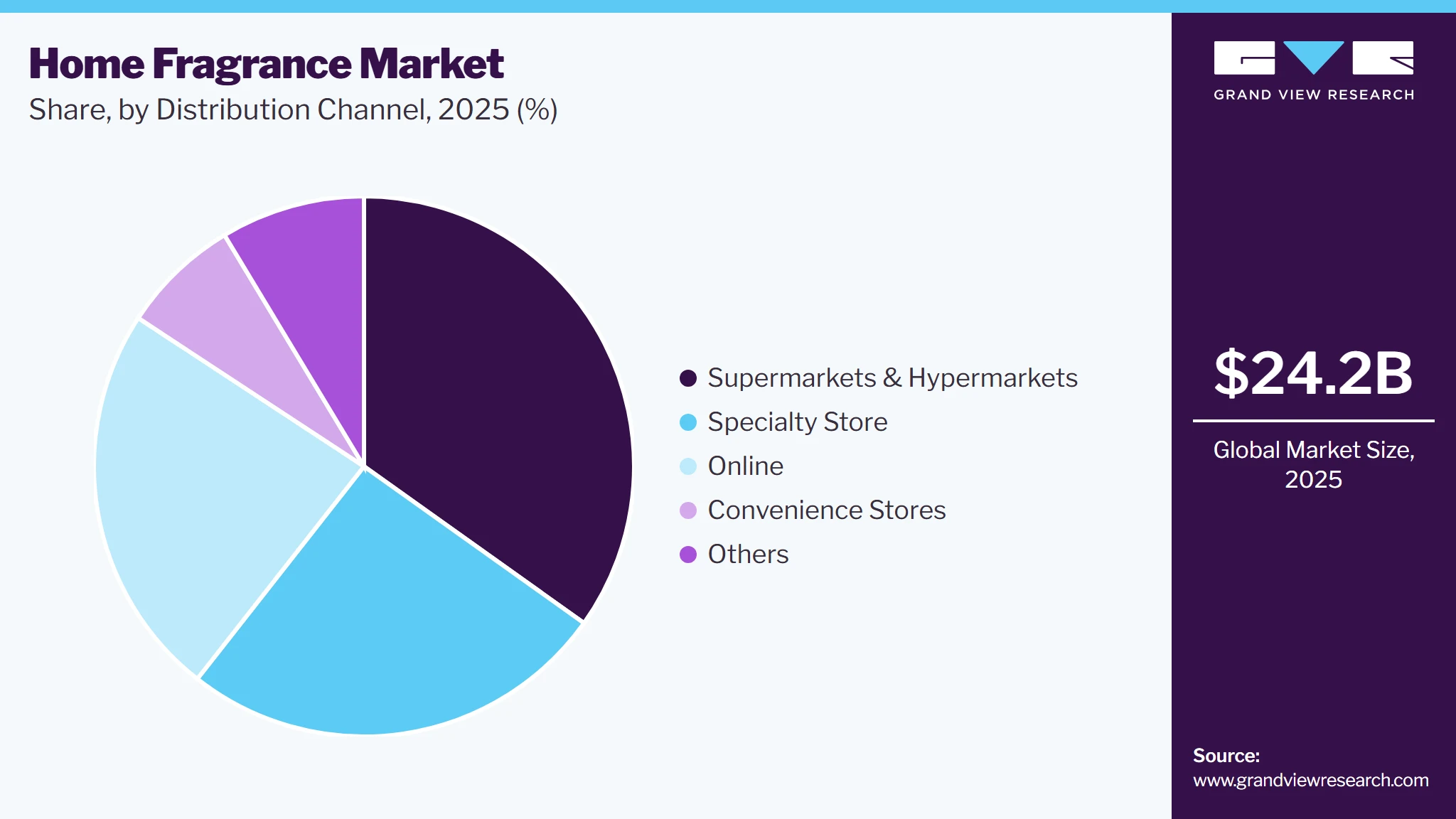
The supermarkets & hypermarkets distribution channel accounted for 34.9% of global revenue in 2025, supported by extensive retail networks, high consumer footfall, competitive pricing, and convenient access to a broad range of home-fragrance products.
 To learn more about this report, Download Free Sample Report
For instance, Walmart and Target in the U.S., Tesco in the UK, and D-Mart in India represent key retail formats through which consumers can purchase everyday fragrance products. Product offerings generally include room sprays, plug-in air fresheners, scented candles, diffusers, wax melts, gels, and incense, with brands such as Febreze, Glade, Air Wick, Godrej Aer, and Odonil available across different markets. This extensive product availability and retail accessibility support the growth of the home fragrance market and strengthen the role of supermarkets and hypermarkets within the broader home fragrance industry.
Online distribution channel projected to grow at a CAGR of 6.9% from 2026 to 2033, driven by broad product availability, shopping convenience, direct-to-consumer engagement, and access to seasonal and exclusive home-fragrance products. Home fragrance companies are increasingly introducing new products through their own e-commerce platforms to strengthen direct-to-consumer distribution and expand their digital presence.
For instance, in June 2026, Goose Creek, a home-fragrance company known for its scented candles, entered the plug-in diffuser category with the launch of its Signature Home Diffuser. Priced at USD 29.99, the product was made exclusively available through GooseCreek.com, providing consumers with direct online access to the company's new fragrance format.
Regional Insights
The home fragrance market in North America accounted for a revenue share of 30.5% in 2025, supported by increasing consumer focus on home ambiance, premiumization, product diversification, and wider omnichannel accessibility. Seasonal and mood-oriented fragrance collections are encouraging consumers to use products as part of home experiences, while premium offerings are expanding the category's value proposition. Meanwhile, price sensitivity is supporting demand for affordable alternatives. E-commerce and broader retail distribution are further improving product accessibility, where brands are expanding across major retailers and online platforms.
For instance, in September 2025, Yankee Candle launched its Fantastical Fall Collection, alongside Halloween-inspired candles and seasonal classics such as Spiced Pumpkin, with fragrances designed to capture different autumn moods. The collection translates seasonal experiences such as autumn harvests, forest walks, and cozy evenings into fragrance, demonstrating how home fragrance is increasingly positioned as a tool for creating specific moods and experiences within the home.
U.S. Home Fragrance Market Trends
The U.S. accounted for approximately 79.7% of the North American home fragrance market in 2025. The growing consumer interest in convenient, versatile fragrance formats, particularly room mists and sprays, allows consumers to refresh indoor spaces quickly and easily. This growing interest is reflected in increasing engagement with these products across major digital platforms. According to Happi, room mists and sprays recorded a 52.9% year-over-year increase in interest, with search interest rising 39.8%, TikTok engagement increasing 76.7%, and Instagram interest growing 38.1%. The trend recorded a 49.2% Popularity Share on Google, with approximately 49.6 thousand average monthly Google searches and 3.3 million average weekly TikTok views. The rising visibility and engagement across digital platforms indicate growing consumer interest in convenient spray-based home-fragrance formats, underscoring the growing relevance of room mists and sprays in the U.S. home-fragrance market.
Europe Home Fragrance Market Trends
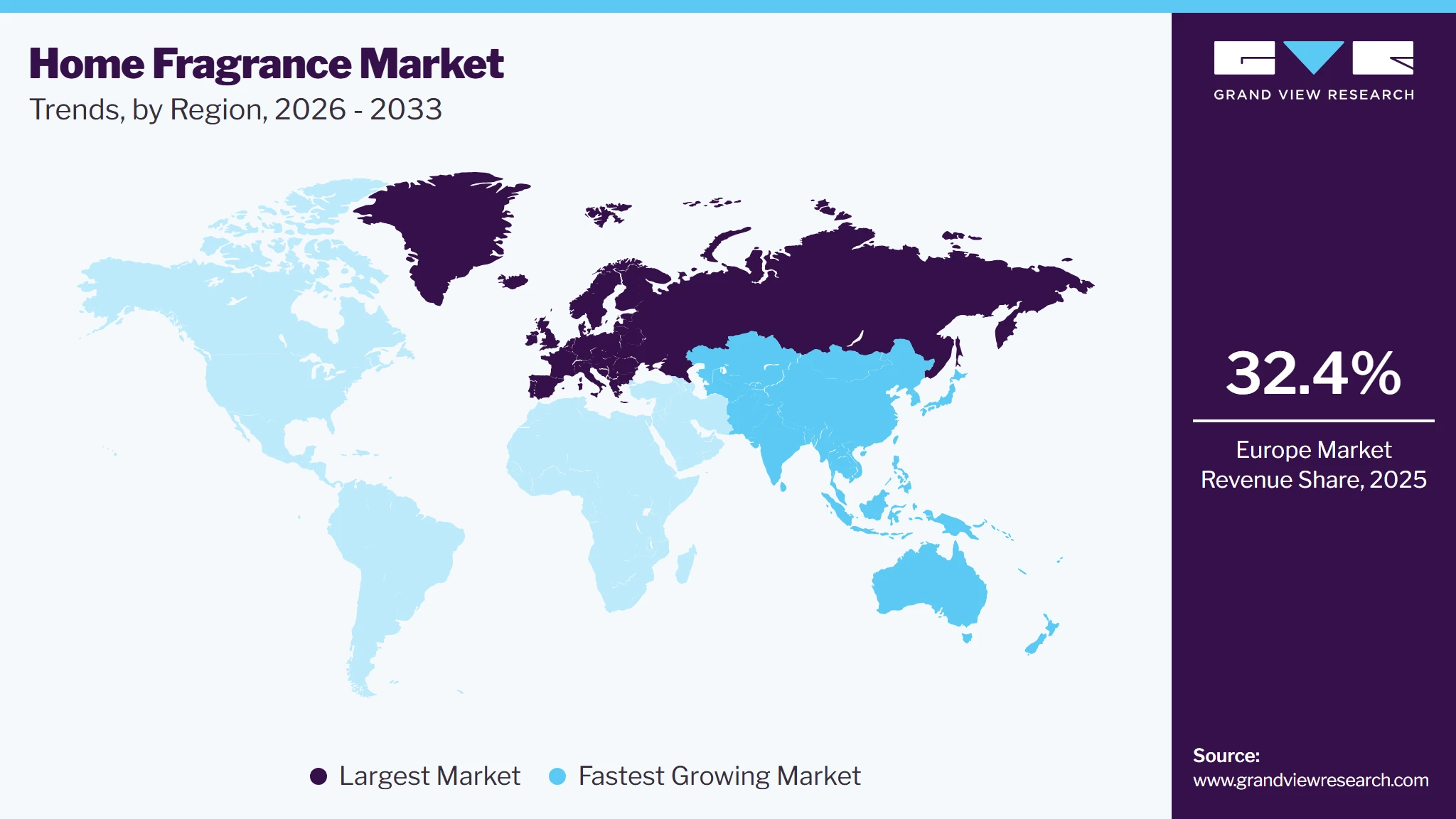
The home fragrance market in Europe accounted for 32.4% of the global market in 2025. The market is increasingly influenced by nature-inspired and well-being-oriented fragrance concepts, as consumers seek products that enhance the atmosphere and emotional experience of their living spaces. Bell Flavors & Fragrances' 2025/26 fragrance trends highlight this shift through its “Bringing Inside” concept, which emphasizes fragrances designed to create calm, inspiration, and a stronger connection with nature. The trends incorporate floral, fruity, herbal, green, and woody fragrance directions and identify applications including candles and reed diffusers. This indicates growing opportunities for European home-fragrance brands to differentiate their products through nature-inspired, mood-enhancing fragrance profiles.
 To learn more about this report, Download Free Sample Report
The home fragrance market in Germany accounted for a revenue share of 16.8% in 2025. The market is witnessing increasing integration of fragrance with interior design, craftsmanship, and decorative functionality.
In January 2026, German design company Rosenthal launched its Design Lights scented candle collection, comprising eight models inspired by the designs of Finnish designer Tapio Wirkkala. The collection combines white and black porcelain vessels with fragrances featuring notes of citrus, jasmine, roses, lily of the valley, musk, vanilla, and patchouli. The vessels can also be reused as decorative storage objects after the wax has been consumed, demonstrating the growing role of scented candles as both fragrance products and interior design accessories.
The home fragrance market in the UK is projected to grow at a CAGR of 5.3% from 2026 to 2033, driven by increasing consumer interest in nature-inspired and destination-oriented fragrance concepts that create a relaxing ambiance at home.
In May 2026, Aldi UK launched a Mediterranean home-fragrance collection featuring scented candles and diffusers priced at USD 5.33. The range included Citrus & Sea Salt, Olive Leaf & Cypress, and Pistachio & Fig fragrances, combining citrus, sea salt, herbal, woody, and fruity notes. The launch demonstrates retailers incorporating fresh, coastal, and nature-inspired fragrance profiles into affordable home-fragrance products, supporting greater diversification of fragrance offerings in the UK home fragrance industry.
France Home Fragrance Market Trends
The home fragrance market in France is projected to grow at a CAGR of 6.0% from 2026 to 2033. The market is experiencing a shift toward botanical and wellness-inspired scent concepts, as manufacturers introduce products that combine natural fragrance profiles with premium presentation and sustainable design.
In November 2025, French fragrance house Maison Monravel launched a collection of six scented candles inspired by the wellness benefits of plants. The collection included Citrus Maxima, featuring mandora, orange blossom, neroli, and blood orange notes, and Jardin d’Embruns, blending algae, peppermint, sage, and lavender inspired by Brittany’s Emerald Coast. The candles were poured in France’s Grasse region using paraffin-free rapeseed wax and featured refillable glass vessels.
Asia Pacific Home Fragrance Market Trends
The Asia Pacific home fragrance market is projected to grow at the fastest CAGR of 7.4% from 2026 to 2033. The market is characterized by a blend of traditional fragrance practices and increasingly modern, lifestyle-oriented home fragrance applications. Fragrance has long been incorporated into homes, religious and cultural practices across countries such as India, China, and Japan, while contemporary consumers are increasingly using scented candles, diffusers, room sprays, essential oils, and incense to enhance home ambiance, relaxation, and personal well-being. The region also demonstrates considerable variation in fragrance preferences, with floral, woody, fruity, fresh, and culturally distinctive scent profiles being incorporated into modern home-fragrance products.
Home fragrance market in China led the Asia Pacific home fragrance industry and accounted for 29.3% of the market in 2025. The fragrance market is increasingly moving toward fragrance experiences that combine floral, fruity, woody, fresh, and culturally distinctive scent profiles. Floral fragrances remain particularly relevant, while lighter fruity and nature-inspired profiles are gaining attention alongside traditional Chinese fragrance references such as osmanthus, tea, agarwood, and incense. The growing emphasis on scent and mood is also encouraging brands to develop fragrances around relaxation, everyday ambiance, and specific occasions, creating opportunities for both contemporary and culturally inspired home-fragrance products.
The India home fragrance market is projected to grow at a CAGR of 8.0% from 2026 to 2033, influenced by scents associated with cultural traditions, childhood memories, and every day experiences. A 2026 editorial by SOSA Home & Body identifies ylang-ylang, sandalwood, jasmine, vanilla, vetiver (khus), fresh cotton, warm milk, and mitti (petrichor) as comforting scent profiles for Indian consumers. Traditional fragrances such as sandalwood, jasmine, vetiver, and mitti are particularly associated with rituals, monsoon experiences, summer cooling, and family memories, while contemporary notes such as vanilla and fresh cotton evoke familiar, calming associations. This highlights opportunities for brands to combine culturally familiar Indian fragrance notes with modern home-fragrance formats such as candles, reed diffusers, room sprays, and incense.
Central & South America Home Fragrance Market Trends
The Central & South America home fragrance industry is projected to grow at a CAGR of 6.5% from 2026 to 2033, driven by growing consumer interest in premium fragrance products, tropical scent profiles, and culturally relevant fragrance concepts. In July 2026, Bath & Body Works entered Brazil by opening its first store at Morumbi Shopping in São Paulo and launching a dedicated Brazilian digital platform. The company's Brazilian assortment includes 3-wick and single-wick candles, diffusers, and other home-fragrance products. The brand identified strong demand for fruity and tropical scents in Brazil and offered fragrances such as Waikiki Beach Coconut, Pink Pineapple Sunrise, Mango Papaya Paradise, Rainforest Falls, and Sea Salt Coast. In addition, its Brazil-inspired Viva collection features notes of guava, maracujá, coconut water, banana, gardenia, cedarwood, amber, and sandalwood. The expansion highlights opportunities for home-fragrance brands to combine fruity, tropical, floral, and woody fragrance profiles with premium formats and locally relevant scent concepts across the Central & South America home fragrance market.
Middle East & Africa Home Fragrance Market Trends
The Middle East & Africa home fragrance market is projected to grow at a CAGR of 7.0% from 2026 to 2033, growing interest in fragrance products that enhance home ambiance, complement personal rituals, and support premium lifestyle experiences. In September 2026, South African fragrance house Zayya Fragrance introduced its Home Fragrance Collection, expanding from personal fragrance into home scenting through candles, reed diffusers, and room mists. The collection includes Oak & Amber, Bois de Kyōto, and Sacred Ground, covering warm, aromatic, earthy, and resinous fragrance profiles. Zayya positions its home collection around slow living, atmosphere, and intentional everyday rituals, while its products are handcrafted on the KwaZulu-Natal coast using internationally sourced fragrance materials. The launch highlights opportunities for home-fragrance brands to combine premium formats, distinctive scent profiles, and lifestyle-oriented positioning to cater to evolving consumer preferences across the Middle East & Africa home fragrance market.
Key Home Fragrance Company Insights
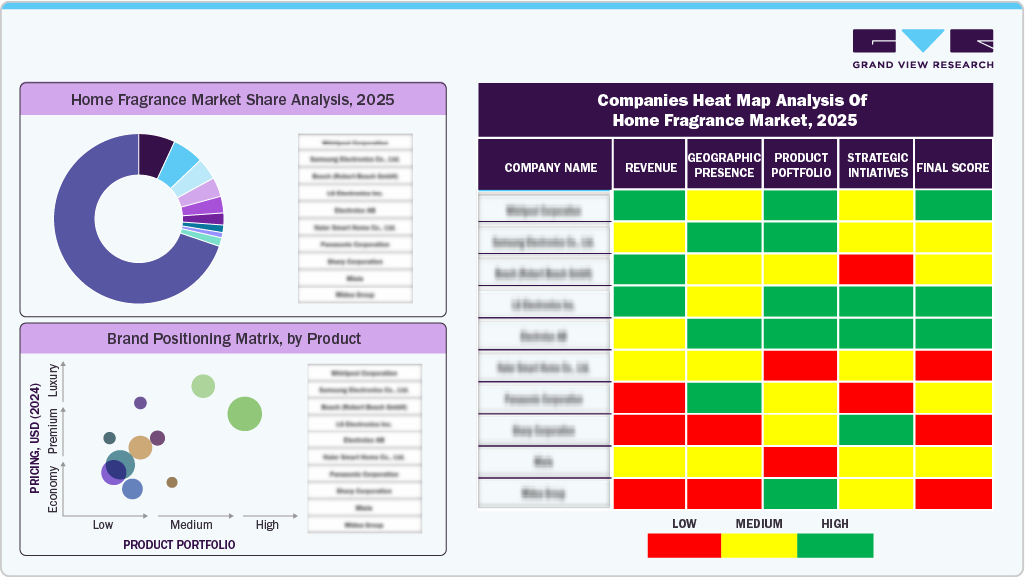
The home fragrance market is characterized by competition among mass-market fragrance manufacturers, premium home-scenting brands, luxury fragrance houses, and specialized scenting solution providers. Competitive positioning varies by product category, brand positioning, distribution reach, and customer segment. Established companies benefit from extensive retail networks, brand recognition, and diversified home-fragrance portfolios, while premium and luxury brands differentiate through fragrance craftsmanship, exclusive formulations, product design, and experiential retail.
-
Mass-Market & Lifestyle Fragrance Brands: Bath & Body Works, Inc. and Newell Brands Inc. compete through broad product portfolios, established retail distribution, and strong consumer brand recognition. Bath & Body Works focuses on scented candles, home fragrance, and seasonal scent collections, while Newell Brands participates through brands such as Yankee Candle and Chesapeake Bay Candle. Their competitive positioning is supported by product variety, promotional activity, and access to both physical and online retail channels.
-
Premium & Luxury Home Fragrance Brands: NEST New York, Diptyque S.A.S., Jo Malone London, Trudon, and VOLUSPA compete in premium and luxury segments through distinctive fragrances, refined packaging, and elevated home ambiance experiences. These companies emphasize scented candles, diffusers, and other home-scenting products, with differentiation based on fragrance development, brand heritage, craftsmanship, and premium retail presentation. Their market presence is particularly associated with consumers seeking decorative, gifting-oriented, and luxury home fragrance products.
-
Diversified Consumer Goods & Home Fragrance Companies: The Procter & Gamble Company participates in the Home Fragrance Market through products such as Febreze, which focuses on odor elimination and home freshness. Its competitive advantages include established consumer-goods distribution, extensive brand awareness, and product innovation across household fragrance applications. Portmeirion Group PLC participates through its Wax Lyrical home fragrance brand, offering scented candles, diffusers, and related products that leverage its heritage in home and lifestyle goods.
-
Commercial & Professional Scenting Solutions: ScentAir Technologies, LLC competes through commercial scenting systems, fragrance delivery technologies, and customized scent experiences for businesses and hospitality environments. Its positioning differs from conventional retail fragrance brands because it emphasizes scent marketing, managed fragrance solutions, and recurring business-to-business customer relationships. This segment supports the broader Home Fragrance Industry by connecting fragrance with customer experience, commercial interiors, and brand identity.
 To learn more about this report, Download Free Sample Report
Key Home Fragrance Companies
The following key companies have been profiled for this study on the home fragrance market.
-
Bath & Body Works, Inc.
-
Diptyque S.A.S.
-
Jo Malone London
-
NEST New York
-
Newell Brands Inc.
-
Portmeirion Group PLC
-
ScentAir Technologies, LLC
-
The Procter & Gamble Company
-
Trudon
-
VOLUSPA
Competitive Benchmarking
Category
Operating Strategies
Competitive Edge
Weakness
Established Players
Bath & Body Works, Inc.; The Procter & Gamble Company; S.C. Johnson & Son, Inc.; Newell Brands Inc.; NEST New York; Diptyque S.A.S.
- Expand product portfolios across scented candles, sprays, essential oils, incense sticks, and other fragrance formats. Focus on seasonal collections, premium offerings, brand extensions, and omnichannel distribution.
- Strong brand recognition, extensive retail networks, established customer relationships, broad product portfolios, and fragrance expertise.
- High competition across fragrance formats, changing consumer preferences, and pressure to maintain product differentiation. Key challenges also include managing ingredient and packaging costs, responding to sustainability expectations, maintaining fragrance quality, and balancing premium positioning with affordability.
Emerging & Regional Players
P.F. Candle Co.; Brooklyn Candle Studio; Homesick; Boy Smells; regional independent candle, incense, and home-scenting brands
- Focus on niche fragrance profiles, artisanal formulations, distinctive packaging, and specialized product concepts. These companies often use direct-to-consumer websites, social media, specialty retailers, and selected regional distribution channels. Emerging brands also target specific lifestyle preferences through personalized fragrances, limited-edition collections, and products designed around local or cultural scent preferences.
- Greater flexibility in product development, differentiated brand identities, specialized fragrance offerings, and closer engagement with niche consumer groups. Their competitive strengths include distinctive scent concepts, design-led home-fragrance products, direct customer feedback, and the ability to respond quickly to emerging trends within the home fragrance industry.
- Limited production capacity, lower brand awareness, and restricted access to large retail networks. Additional challenges include customer acquisition costs, maintaining consistent product quality during expansion, competing with established brands, managing inventory, and securing reliable supplies of fragrance ingredients and packaging materials.
Recent Developments
-
In September 2026, The Procter & Gamble Company partnered its Febreze brand with Dunkin’ to launch a limited-edition scent collection inspired by coffee and bakery favorites. The collection introduced Strawberry Frosted Donut, Cinnamon Roll, and Vanilla Latte fragrances across Febreze AIR, PLUG, and BATHROOM formats, bringing food-inspired scents into everyday home fragrance products and expanding the use of brand collaborations to create differentiated fragrance experiences.
-
In August 2026, Bath & Body Works, Inc. introduced the Reserve Collection, a new home fragrance franchise featuring fragrance-infused liquid less reed diffusers, four-wick ceramic candles, room mists, and Wallflowers. The launch expands the company's home fragrance portfolio beyond traditional formats and strengthens its presence in the décor-oriented and flameless home fragrance segments.
-
In May 2026, Diptyque S.A.S. introduced its summer 2026 “Garden of Waters” collection, featuring the limited-edition Pinède scented candle, outdoor incense spirals, and decorative accessories. Developed around a seasonal outdoor-living theme and incorporating mosaic-inspired artwork, the collection reflects Diptyque's strategy of combining fragrance, design, and artistic collaborations to create differentiated luxury home fragrance experiences.
-
In March 2026, ScentAir Technologies, LLC introduced its Garden Party Collection, featuring three spring-inspired fragrances developed around floral, fruity, and green scent profiles. The seasonal collection was designed to bring the atmosphere of a garden into indoor environments, reflecting the company's focus on using nature-inspired fragrances to create distinctive sensory experiences.
Home Fragrance Market Report Scope
Report Attribute
Details
Market size in 2025
USD 24.2 billion
Estimated market size in 2026
USD 25.3 billion
Projected market size by 2033
USD 39.0 billion
Growth rate
CAGR of 6.3% from 2026 to 2033
Base Year
2025
Historical data
2021 - 2024
Forecast period
2026 - 2033
Quantitative units
Revenue in USD million/billion and CAGR from 2026 to 2033
Report coverage
Revenue forecast, company ranking, competitive landscape, growth factors, and trends
Segments covered
Product, fragrance, price tier, distribution channel, region
Regional scope
North America, Europe, Asia Pacific, Central & South America, Middle East & Africa
Country scope
U.S.; Canada; Mexico; Germany; UK; France; Italy; Spain; China; Japan; India; South Korea; Australia & New Zealand; Brazil; Argentina; Colombia; South Africa; UAE; Saudi Arabia
Key companies profiled
Bath & Body Works, Inc.; Newell Brands Inc.; NEST New York; Diptyque S.A.S.; The Procter & Gamble Company; Portmeirion Group PLC; ScentAir Technologies, LLC; Jo Malone London; Trudon; VOLUSPA.
Customization scope
Free report customization (equivalent up to 8 analysts’ working days) with purchase. Addition or alteration to country, regional & segment scope.
Pricing and purchase options
Avail customized purchase options to meet your exact research needs. Explore purchase options
Global Home Fragrance Market Report Segmentation
This report forecasts revenue growth at the global, regional & country levels and provides an analysis of the latest trends and opportunities in each sub-segment from 2026 to 2033. For this study, Grand View Research has segmented the global home fragrance market based on product, fragrance, price tier, distribution channel, and region:
-
Product Outlook (Revenue, USD Billion, 2021 - 2033)
-
Scented Candles
-
Reed Diffuser & Incense Sticks
-
Sprays
-
Essential Oils
-
Others
-
-
Fragrance Outlook (Revenue, USD Billion, 2021 - 2033)
-
Floral
-
Fruity
-
Woody
-
Fresh/Clean
-
Citrus
-
Herbal/Green
-
Others
-
-
Price Tier Outlook (Revenue, USD Billion, 2021 - 2033)
-
Economy/Mass
-
Mid-range/Masstige
-
Premium
-
Luxury/Super-Premium
-
-
Distribution Channel Outlook (Revenue, USD Billion, 2021 - 2033)
-
Supermarkets & Hypermarkets
-
Specialty Store
-
Convenience Stores
-
Online
-
Others
-
-
Regional Outlook (Revenue, USD Billion, 2021 - 2033)
-
North America
-
U.S.
-
Canada
-
Mexico
-
-
Europe
-
Germany
-
UK
-
France
-
Italy
-
Spain
-
-
Asia Pacific
-
China
-
Japan
-
India
-
South Korea
-
Australia & New Zealand
-
-
Central & South America
-
Brazil
-
Argentina
-
Colombia
-
-
Middle East & Africa
-
South Africa
-
UAE
-
Saudi Arabia
-
-
Research Methodology
The home fragrance market figures in this report are based on a proven research process that combines executive interviews with secondary research from proprietary databases, company filings, and recognized regulatory and institutional sources. Market size is built through value-chain sizing - reconciling supply-side and demand-side estimates - and triangulated with bottom-up and top-down approaches. Every estimate passes multiple levels of expert validation before publication, with each home fragrance segment quantified using the revenue-capture definitions in the table below.
Segment Definition
Segment - Price Tier
Revenue capture definition
Economy/Mass
Revenue from home fragrance products positioned at accessible price points and targeted toward price-sensitive and mass-market consumers. Includes scented candles, sprays, essential oils, incense sticks, and other home fragrance products sold through supermarkets, mass merchandisers, discount stores, and online marketplaces. Products typically emphasize affordability, everyday household use, standardized fragrances, and high-volume distribution.
Mid-range/Masstige
Revenue from home fragrance products positioned between mass-market and premium offerings, combining accessible pricing with enhanced fragrance quality, packaging, and design. Includes scented candles, sprays, essential oils, incense sticks, and other home fragrance products marketed to consumers seeking an elevated home ambiance experience without luxury-level prices. Sales are captured through specialty retailers, department stores, lifestyle stores, brand websites, and online platforms.
Premium
Revenue from home fragrance products positioned above mid-range offerings through higher-quality fragrance formulations, refined packaging, distinctive scent profiles, and enhanced product presentation. Includes premium scented candles, sprays, essential oils, incense sticks, and other home fragrance products targeted toward consumers willing to pay more for product quality, brand differentiation, and home ambiance. Revenue is captured through specialty fragrance retailers, department stores, premium lifestyle stores, and direct-to-consumer channels.
Luxury/Super-Premium
Revenue from high-priced home fragrance products associated with luxury branding, exclusive fragrance compositions, artisanal craftsmanship, premium ingredients, and sophisticated packaging. Includes luxury scented candles, sprays, essential oils, incense sticks, and other high-end home fragrance products marketed for exclusivity, gifting, interior ambiance, and sensory experiences. Revenue is captured through luxury boutiques, exclusive department stores, brand-owned stores, premium hospitality channels, and official online brand platforms.
Estimation Model
No.
Layer
Key Question
Description
01
Household & Consumer Base Layer
Who forms the addressable consumer base?
Households and individual consumers occupying residential properties and having access to disposable income for household ambiance, odor management, personal rituals, and decorative home fragrance products.
02
Home Fragrance Demand Layer
Which consumers purchase home fragrance products?
Consumers with sufficient discretionary spending and an interest in home ambiance, freshness, relaxation, aromatherapy, decorative accessories, gifting, or premium sensory experiences who are potential purchasers of home fragrance products.
03
Product, Price Tier & Purchase Layer
What type of home fragrance product do they purchase?
Consumers selecting scented candles, sprays, essential oils, incense sticks, and other home fragrance products, differentiated by price tier-Economy/Mass, Mid-range/Masstige, Premium, and Luxury/Super-Premium-and by purchase channel, fragrance preference, and product usage.
04
Monetization Layer
How much revenue is generated?
The estimated number of home fragrance purchasing households and consumers is converted into market revenue by applying product purchase frequency, units purchased, average selling prices, product-specific revenue assumptions, and price-tier and channel mix.
Delivered Customizations
This report has been delivered with the following In-depth customizations
Client Request
Customization Delivered
Value Adds
Market Entry & Distribution Prioritization
Developed a three-dimensional assessment of the home fragrance market by evaluating product categories, including scented candles, sprays, essential oils, incense sticks, and others; fragrance preferences; consumer demand; retail channels; and regional market opportunities.
Helps identify high-potential product categories, consumer segments, and distribution channels, enabling companies to prioritize market entry, retail expansion, and product launch opportunities.
Product Portfolio & Format Assessment
Assessed product portfolio opportunities by analyzing scented candles, sprays, essential oils, incense sticks, and other fragrance formats, along with floral, fruity, woody, fresh/clean, citrus, and herbal/green fragrance profiles. Evaluated product pricing, packaging, fragrance longevity, and consumer preferences.
Helps identify attractive product categories, fragrance profiles, and format opportunities, supporting portfolio expansion, product development, and pricing decisions.
Premiumization & Revenue Diversification Strategy
Compared economy/mass, mid-range/masstige, and premium product offerings across scented candles, room sprays, diffusers, essential oils, and other home fragrance formats. Assessed pricing, packaging, product quality, brand positioning, and consumer demand to identify premiumization opportunities.
Helps identify opportunities for premium product development, revenue diversification, and brand differentiation, enabling companies to strengthen product positioning, expand consumer reach, and reduce reliance on standardized fragrance offerings.
Frequently Asked Questions About This Report
Key players in the home fragrance market include Procter & Gamble, Reckitt Benckiser, Newell Brands, S.C. Johnson & Son, Bath & Body Works, The Estée Lauder Companies (NEST New York), Diptyque, Jo Malone London, ScentAir, and VOLUSPA.
Supermarkets & hypermarkets accounted for the largest distribution channel share of 34.9% of the global revenue in 2025, while online the fastest-growing segment.
Key players in the Home Fragrance Market include Procter & Gamble, Reckitt Benckiser, Newell Brands, S.C. Johnson & Son, Bath & Body Works, The Estée Lauder Companies (NEST New York), Diptyque, Jo Malone London, ScentAir, and VOLUSPA.
Floral home fragrance accounted for the largest share of 24.2% of the global revenue in 2025, while woody home fragrance is the fastest-growing fragrance.
The sprays accounted for the largest share of 29.3% of the global revenue in 2025, while essential oils segment is the fastest-growing product.
Economy/mass home fragrance accounted for the largest share of 35.2% of the global revenue in 2025, while mid-range/masstige home fragrance the fastest-growing segment.
The global home fragrance market was valued at USD 24.2 billion in 2025 and is estimated at USD 25.3 billion in 2026.
The global home fragrance market is expected to grow at a CAGR of 6.3% from 2025 to 2033, reaching USD 39.0 billion by 2033.
Europe dominated the market, accounting for a revenue share of 32.4% in 2025.
About the Author(s)
Homecare & Decor Research Team
Consumer Goods · Homecare & DecorThis report was authored by the homecare & decor research team at Grand View Research - comprising two research analysts, one senior research analyst, and one industry expert - with specialized expertise in the homecare & decor segment of the consumer goods industry. All findings are based on proprietary consumer goods databases, executive interviews, and regulatory analysis, subject to internal peer review prior to publication.
Last Updated:
Speak to Analyst

Customize this report to your needs - add regions, segments, or data points, with 20% free customization.
Or view our licence options:


ISO 9001:2015 & 27001:2022 Certified
We are GDPR and CCPA compliant! Your transaction & personal information is safe and secure. For more details, please read our privacy policy.


