
- Home
- »
- Advanced Interior Materials
- »
-
HVAC Pump Market Size, Growth Report, 2026-2033GVR Report cover

HVAC Pump Market (2026 - 2033)
Size, Share & Trends Analysis Report By Stage (Single-Stage Pumps, Multi-Stage Pumps), By Pump Type (Centrifugal Pumps, Circulator/Circulating Pumps, Positive Displacement Pumps), By End-use, By Region, And Segment Forecasts
Market Size, 2025
$36.2BMarket Estimate, 2026
$37.5BMarket Forecast, 2033
$53.7BCAGR, 2026–2033
5.3%HVAC Pump Market Summary
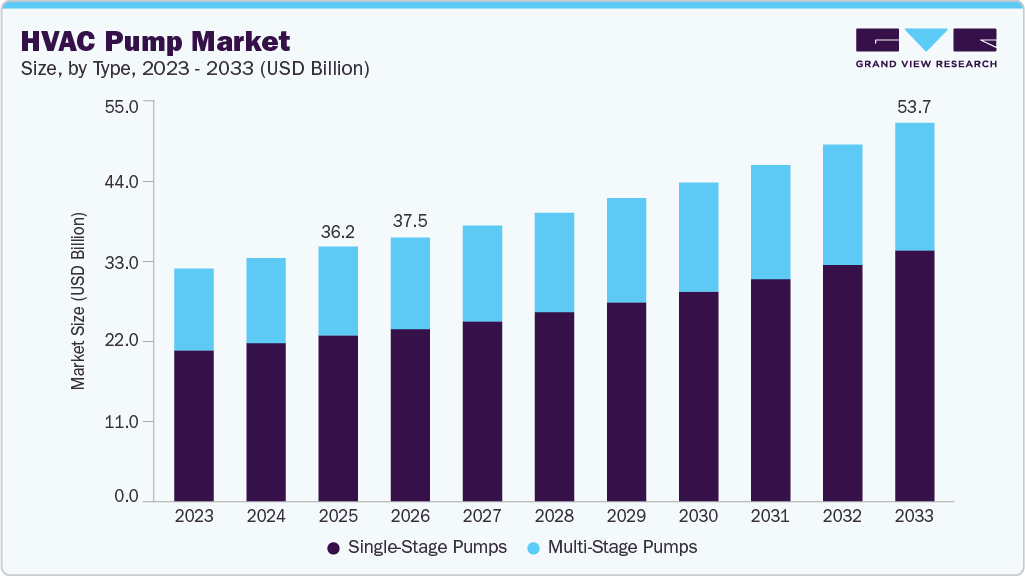
The global HVAC pump market size was valued at USD 36.2 billion in 2025 and is projected to grow from USD 37.5 billion in 2026 to USD 53.7 billion by 2033, at a CAGR of 5.3% from 2026 to 2033. Asia Pacific dominated the global market, accounting for the largest revenue share of 47.0% in 2025. The industry is expected to grow significantly due to increasing demand for energy-efficient heating, ventilation, and air conditioning (HVAC) systems across residential, commercial, and industrial buildings.
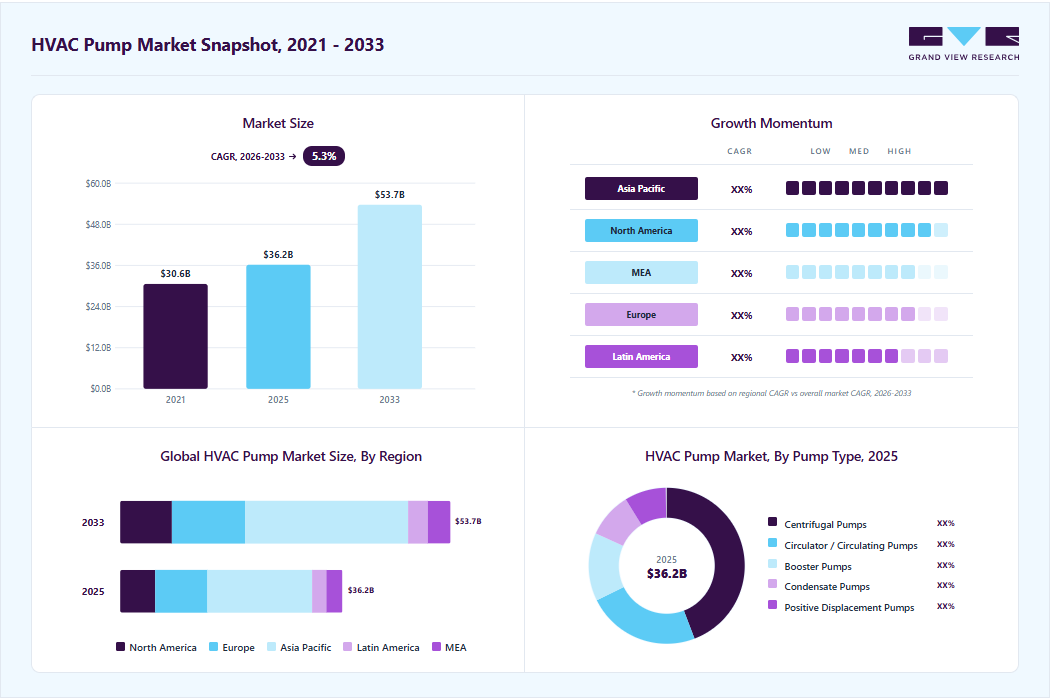 Source: Grand View Research, IR Documents, Primary Interviews, Paid DatabasesTo learn more about this report,
 Download Free Sample Report
 Key Market Trends & Insights
- By stage: Multi-stage pumps segment is projected to grow at 4.8% CAGR during the forecast period.
- By pump type: Booster pumps segment is projected to expand at a CAGR of 5.5% from 2026 to 2033 in terms of revenue.
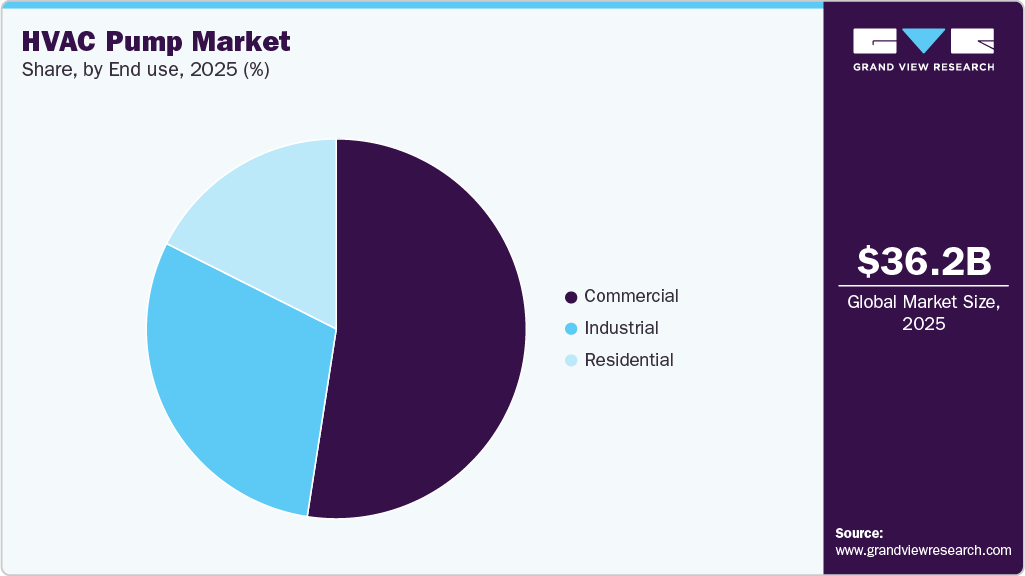
- Based on end use: Commercial segment dominated the market in 2025, accounting for 52.5% market share.
Regional Highlights
- Largest regional market: Asia Pacific (47.0% revenue share, 2025)
- By country: The China HVAC pump industry is a major contributor to the global market.
Market Size & Forecast
- Market size in 2025: USD 36.2 Billion
- Estimated market size in 2026: USD 37.5 Billion
- Projected market size by 2033: USD 53.7 Billion
- CAGR (2026-2033): 5.3%
Three ways to get this report
Buy it, customize it, or ask a question.Ask an Analyst
A direct answer, usually in 1 working day
- AccessReport author, directly
- Reply timeWithin 1 working day
- No sales callDirect answer only
- FormatEmail reply
- CostFree, no cost
Get the Full Report
What the study covers
- FormatsPDF · Excel · Dashboard
- Timeline2026–2033 annual, 2025 base
- Coverage20+ countries, 5 regions
- Companies10+ key players profiled
Customize the Report
20% free customization
- IncludeCountries, segments, points
- TailorTo your product definition
- ExtendDeeper competitor detail
- OrA fully bespoke study
- Turnaround5–10 working days
Rapid urbanization and expansion of commercial infrastructure, including offices, hospitals, and shopping complexes, are driving the installation of modern HVAC systems. In addition, government regulations promoting efficient building systems and reduced carbon emissions are encouraging the adoption of advanced HVAC pump technologies. Growth in district heating and cooling projects and increasing investments in green building construction are expected to further support long-term market expansion.
 To learn more about this report, Download Free Sample Report
 Market Dynamics
The expansion of commercial construction activities worldwide is creating strong demand for HVAC pumps across office complexes, hotels, educational institutions, healthcare facilities, and mixed-use developments. Modern commercial buildings require efficient heating and cooling systems capable of maintaining indoor comfort while minimizing energy consumption. HVAC pumps play a vital role in circulating chilled and hot water across centralized HVAC networks in these large facilities.
The adoption of smart building technologies is further supporting market growth. Building management systems increasingly integrate IoT-enabled HVAC pumps for automated monitoring, pressure balancing, and energy optimization. Smart pumps improve operational efficiency by dynamically adjusting flow rates according to occupancy and environmental conditions. Additionally, increasing investments in metro cities, airports, data centers, and commercial real estate projects across emerging economies are contributing to long-term demand for high-capacity HVAC pump systems.
Although advanced HVAC pumps offer significant energy savings and operational benefits, their installation and maintenance processes can be complex and costly, particularly in large commercial and industrial facilities. Integration with existing HVAC infrastructure often requires specialized engineering, advanced control systems, and skilled technicians, increasing initial project costs. Small and medium-sized building owners may hesitate to invest in high-end smart pump systems due to budget limitations and concerns about return on investment.
Market Concentration & Characteristics
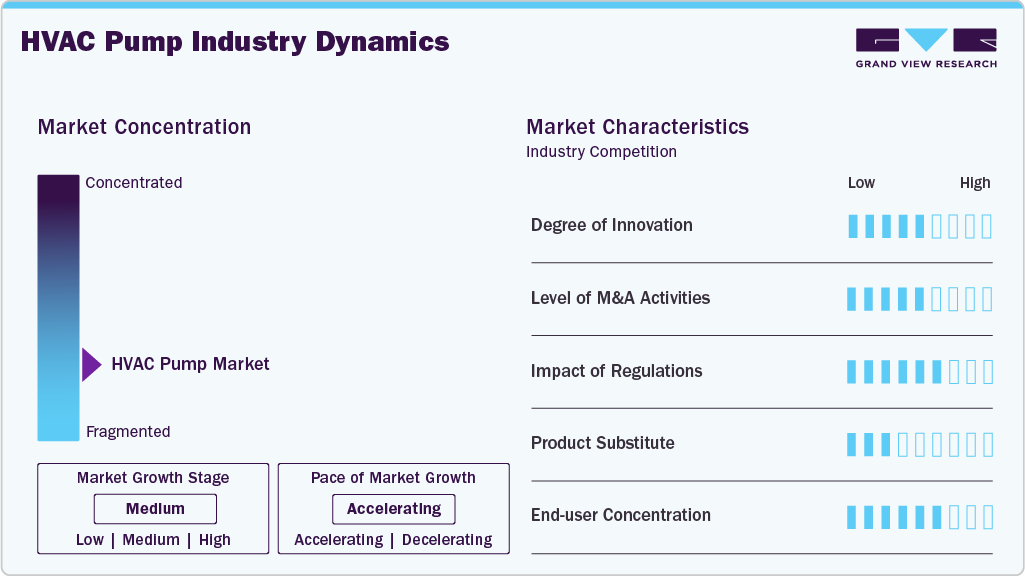
The HVAC pump industry is fragmented, with the presence of numerous global manufacturers, regional suppliers, and specialized component providers. Large companies maintain strong positions through established distribution networks and broad product portfolios, while smaller firms compete by offering customized and cost-effective solutions. Differences in regional demand, building standards, and project-specific requirements contribute to market diversity.
Innovation in the industry is high, driven by demand for energy efficiency and system optimization. Manufacturers are developing variable-speed pumps, smart monitoring systems, and IoT-enabled controls to improve performance and reduce energy use. Advances in materials and motor technologies are enhancing durability and efficiency. Integration with building management systems is also improving operational control and supporting predictive maintenance across commercial and industrial facilities.
 To learn more about this report, Download Free Sample Report
 Merger and acquisition activity in the industry is increasing as companies seek to expand product portfolios and strengthen market presence. Manufacturers are acquiring regional firms and technology providers to enhance distribution networks and gain access to advanced pump technologies. Strategic partnerships are also common, enabling companies to improve manufacturing capabilities and enter new geographic markets while responding to growing demand for energy-efficient solutions.
Regulations play an important role in shaping the industry by promoting energy efficiency and environmental compliance. Governments are implementing standards related to energy consumption, emissions, and building performance, encouraging the use of high-efficiency pumps. Compliance with energy labeling and efficiency requirements is driving technological upgrades.
Stage Insights
Single-stage pumps led the market and accounted for 65.2% of the global revenue share in 2025, due to their simple design and suitability for low to moderate pressure applications. These pumps are commonly used in residential and small commercial HVAC systems where operational requirements are less complex. Lower installation and maintenance costs support adoption, while increasing residential construction activities are further contributing to steady demand for single-stage pump solutions.
The multi-stage pumps segment is expected to grow significantly due to its ability to handle higher pressure and large-scale applications. These pumps are widely used in commercial buildings, industrial facilities, and district cooling systems. Increasing demand for efficient water circulation in large HVAC networks is supporting adoption. Their capability to deliver consistent performance and energy efficiency further contributes to segment growth.
Pump Type Insights
The centrifugal pumps segment dominated the market in 2025, accounting for 44.3% of the market share due to its widespread use in water circulation and cooling applications. These pumps are preferred for their simple design, reliability, and ability to handle large flow volumes. Increasing installation of HVAC systems in residential and commercial buildings is supporting demand, while the ongoing development of energy-efficient centrifugal pump models is further contributing to segment growth.
The booster pumps segment is expected to grow steadily in the market due to rising demand for maintaining consistent water pressure in multi-story buildings and large facilities. These pumps are widely used in commercial complexes, hospitals, and industrial plants where reliable water flow is required. Growing urbanization and construction of high-rise buildings are supporting adoption, along with increasing focus on improving system efficiency.
End Use Insights
The commercial segment led the market in 2025 due to the increasing construction of office buildings, shopping centers, hospitals, and hotels. These facilities require efficient heating and cooling systems to maintain indoor comfort and operational efficiency. Rising investments in commercial infrastructure and the adoption of energy-efficient HVAC systems are supporting demand. Retrofitting of existing buildings is also contributing to steady growth in this segment.
 To learn more about this report, Download Free Sample Report
 The industrial segment is expected to grow at 5.0% CAGR during the forecast period, due to rising demand for temperature control and ventilation in manufacturing and processing facilities. Industries such as chemicals, pharmaceuticals, and food processing require reliable HVAC systems to maintain operational conditions. Increasing industrial expansion and focus on energy efficiency are driving adoption, while integration of advanced pump technologies is further supporting growth in large-scale industrial environments.
Regional Insights
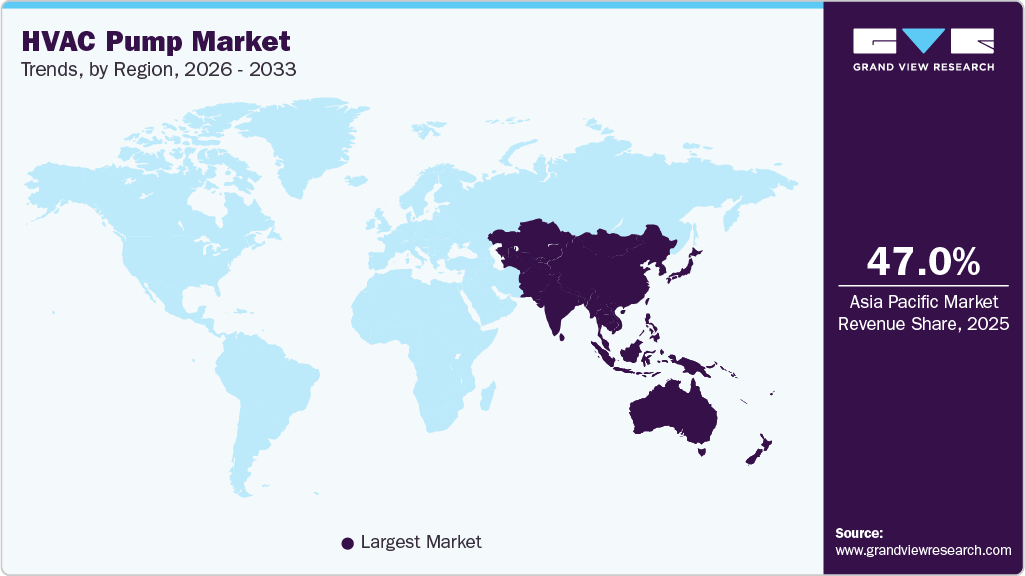
Asia Pacific HVAC pump market led in 2025 with a revenue share of 47.0%, due to rapid urbanization and infrastructure development. Increasing construction of residential complexes, commercial buildings, and industrial facilities is driving demand. Rising population and growing middle-class income levels are supporting the adoption of modern HVAC systems.
 To learn more about this report, Download Free Sample Report
 China HVAC Pump Market Trends
The HVAC pump market in China is growing rapidly due to large-scale urban development and industrial expansion. Increasing construction of commercial complexes and manufacturing facilities is driving the installation of advanced HVAC systems. Government policies promoting energy efficiency and environmental sustainability are supporting demand for high-performance pumps. The country’s strong manufacturing sector and continuous infrastructure development are further contributing to market growth.
India HVAC pump market is expanding steadily, driven by rapid urbanization and rising demand for climate-controlled environments in commercial and residential buildings. Increasing development of malls, offices, and healthcare facilities is supporting demand. Government initiatives promoting energy-efficient buildings and infrastructure development are encouraging adoption. Growth in industrial manufacturing and data center construction is also contributing to increased installation of HVAC pump systems.
North America HVAC Pump Market Trends
The HVAC pump market in North America is projected to grow at a 5.2% CAGR over the forecast period, driven by rising demand for energy-efficient heating and cooling systems. The region benefits from strong construction activity, particularly in commercial and institutional buildings. Retrofitting of aging HVAC infrastructure and adoption of smart building technologies are supporting demand.
The U.S. HVAC pump market is growing steadily, supported by rising investments in commercial construction, healthcare facilities, and data centers. Increasing focus on energy conservation and modernization of older buildings is driving the replacement of outdated pump systems. Adoption of smart HVAC technologies and building automation systems is also supporting market expansion.
The HVAC pump market in Mexico is growing gradually, supported by expanding industrial and commercial construction activities. Rising urbanization and increasing demand for temperature-controlled environments in manufacturing facilities are driving adoption. Growth in retail and hospitality infrastructure is also contributing to demand.
Europe HVAC Pump Market Trends
The HVAC pump market in Europe is witnessing steady growth due to strict energy efficiency regulations and a strong focus on sustainable building practices. Increasing renovation of existing buildings and adoption of advanced heating and cooling technologies are driving demand. Growth in district heating and cooling systems is also contributing to market expansion.
Germany HVAC pump market is growing due to its strong industrial base and commitment to energy-efficient building solutions. Increasing investments in modernizing heating and cooling systems in commercial and residential buildings are supporting demand. The country’s focus on sustainability and strict energy performance standards is encouraging the adoption of advanced pump technologies.
The HVAC pump market in the UK is expanding steadily due to rising demand for energy-efficient building systems and the modernization of existing infrastructure. The increasing construction of residential and commercial properties is supporting the installation of new HVAC systems. Government initiatives promoting energy-efficient technologies and sustainable building practices are encouraging the adoption of high-performance pumps.
Middle East & Africa HVAC Pump Market Trends
The HVAC pump market in the Middle East and Africa is witnessing steady growth due to rising demand for cooling systems in hot climate conditions. Increasing construction of commercial complexes, airports, and residential developments is driving adoption. Growth in hospitality and tourism infrastructure is also contributing to demand. Investments in district cooling projects and the modernization of building systems are further supporting market expansion across the region.
The Saudi Arabia HVAC pump market is growing significantly due to the increasing construction of commercial and residential projects. Rising demand for efficient cooling systems in hot climate conditions is supporting the adoption of advanced HVAC technologies. Expansion of large infrastructure developments, including airports and commercial centers, is driving demand. Government initiatives focused on energy efficiency and modernization of building systems are further contributing to market growth.
Latin America HVAC Pump Market Trends
The HVAC pump market in Latin America is experiencing gradual growth due to increasing urbanization and the expansion of commercial infrastructure. Rising demand for air conditioning systems in residential and commercial buildings is supporting adoption. Growth in the retail and hospitality sectors is also contributing to demand. Although economic fluctuations may impact investment levels, ongoing infrastructure development is expected to support steady market growth.
Brazil HVAC pump market is growing steadily due to expanding construction activities and rising demand for cooling systems in commercial and residential buildings. The increasing development of shopping centers, hospitals, and office complexes is supporting the installation of HVAC systems. Growth in industrial manufacturing facilities is also contributing to demand. Efforts to improve energy efficiency and modernization of building infrastructure are further supporting market expansion.
Key HVAC Pump Company Insights
Some of the key players operating in the market include Daikin Industries, Ltd., Xylem Inc., among others.
-
Daikin Industries, Ltd. is a Japan-based manufacturer engaged in heating, ventilation, air conditioning, and refrigeration equipment. Daikin Industries, Ltd. develops heating, ventilation, and air conditioning systems that incorporate fluid circulation components used in HVAC applications. The company provides pumps and related equipment designed to support chilled and hot water circulation in residential, commercial, and industrial buildings. Its HVAC-focused portfolio includes integrated system solutions used in offices, hospitals, and industrial facilities, supported by global manufacturing and distribution operations.
-
Xylem Inc. manufactures a range of pumps used in HVAC systems, including circulation and booster pumps designed for heating and cooling water movement. Its HVAC-related solutions are applied in commercial buildings, industrial plants, and district energy systems. The company focuses on improving water flow efficiency and supporting system reliability. Xylem supplies HVAC pump solutions through multiple regional operations serving building and infrastructure sectors.
Key HVAC Pump Companies:
The following key companies have been profiled for this study on the HVAC pump market.
- Daikin Industries, Ltd.
- Kirloskar Brothers Limited
- Xylem Inc.
- EBARA Corporation
- Pentair plc
- Lubi Industries LLP
- Grundfos Holding A/S
- Welch Vacuum
- Global Power Systems
- WILO SE
- Hayes Pump, Inc.
- C.R.I. Pumps Private Limited
- CNP Pumps
- KSB SE & Co. KGaA
- Armstrong Fluid Technology
Competitive Benchmarking
Operating Strategies
Competitive Edge
Weaknesses
Mature Players: Grundfos Holding A/S; WILO SE; Xylem Inc.; KSB SE & Co. KGaA; EBARA Corporation; Pentair plc
- Focus on development of energy-efficient and smart HVAC pump systems integrated with IoT and building automation technologies.
- Expand global distribution networks and strengthen partnerships with commercial infrastructure, industrial, and data center projects.
- Invest heavily in R&D activities to enhance pump efficiency, sustainability, and predictive maintenance capabilities.
- Strong global brand recognition with diversified HVAC and fluid management product portfolios across residential, commercial, and industrial sectors.
- Advanced technological expertise in intelligent circulation systems, variable-speed pumps, and high-capacity HVAC applications.
- Established after-sales service networks and long-term relationships with EPC contractors, facility managers, and OEMs.
- High operational and manufacturing costs compared to regional and low-cost competitors.
- Strong dependence on mature infrastructure markets in North America and Europe can limit rapid growth potential.
Emerging Players: Lubi Industries LLP; C.R.I. Pumps Private Limited; CNP Pumps; Lubi Industries LLP; Hayes Pump, Inc.; Global Power Systems.
- Focus on expanding regional presence through cost-effective HVAC pumping solutions for residential and mid-scale commercial projects.
- Increase investments in localized manufacturing and distribution channels to improve pricing competitiveness.
- Target developing economies with affordable circulation, booster, and multistage pump solutions.
- Competitive pricing strategies help attract cost-sensitive customers in emerging markets.
- Greater operational flexibility enables faster adaptation to local infrastructure and customer requirements.
- Growing product portfolios and improving manufacturing capabilities support increasing market penetration.
- Limited global brand visibility and smaller international distribution networks compared to established market leaders.
- Lower R&D budgets may restrict adoption of advanced smart pumping and automation technologies.
Recent Developments
-
In March 2025, Danfoss introduced seven new HVACR products at ACREX India 2025, focusing on improving energy efficiency and sustainability in heating and cooling systems. The launch reflects the ongoing development of advanced components designed to support environmentally responsible and efficient HVAC operations.
-
In June 2023, Kirloskar Brothers Limited introduced a vertical inline long-coupled pump designed for HVAC applications. The pump is intended to support efficient fluid circulation in heating and cooling systems used in commercial and industrial buildings.
HVAC Pump Market Report Scope
Report Attribute
Details
Market size in 2025
USD 36.2 billion
Estimated Market size in 2026
USD 37.5 billion
Projected Market size by 2033
USD 53.7 billion
Growth rate
CAGR of 5.3% from 2026 to 2033
Base year for estimation
2025
Historical data
2021 - 2024
Forecast period
2026 - 2033
Quantitative units
Revenue in USD million/billion and CAGR from 2026 to 2033
Report coverage
Revenue forecast, company market position analysis, competitive landscape, growth factors, and trends
Segments covered
Pump type, stage, end use, region
Regional scope
North America; Europe; Asia Pacific; Latin America; Middle East & Africa
Country Scope
U.S.; Canada; Mexico; Germany; UK; Italy; Spain; France; China; Japan; India; Australia; South Korea; Brazil; Argentina; Saudi Arabia; UAE; South Africa
Key companies profiled
Daikin Industries, Ltd.; Kirloskar Brothers Limited; Xylem Inc.; EBARA Corporation; Pentair plc; Lubi Industries LLP; Grundfos Holding A/S; Welch Vacuum; Global Power Systems; WILO SE; Hayes Pump, Inc.; C.R.I. Pumps Private Limited; CNP Pumps; KSB SE & Co. KGaA; Armstrong Fluid Technology
Customization scope
Free report customization (equivalent up to 8 analysts working days) with purchase. Addition or alteration to country, regional & segment scope.
Pricing and purchase options
Avail customized purchase options to meet your exact research needs. Explore purchase options
Global HVAC Pump Market Report Segmentation
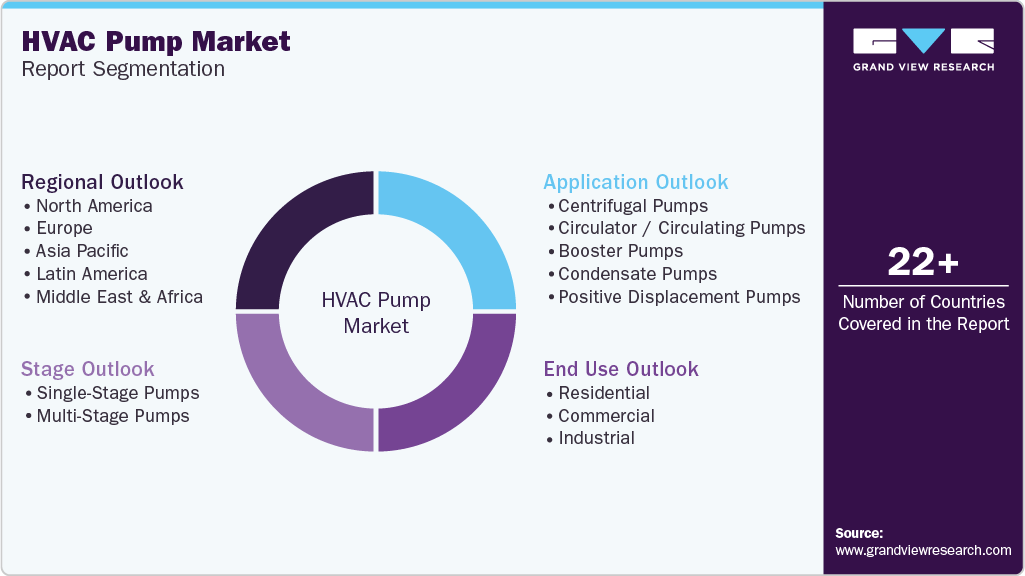
This report forecasts revenue growth at global, regional & country levels and provides an analysis of the industry trends in each of the sub-segments from 2021 to 2033. For this study, Grand View Research has segmented the global HVAC pump market report on the basis of pump type, stage, end use, and region:
 To learn more about this report, Download Free Sample Report
 -
Stage Outlook (Revenue, USD Billion, 2021 - 2033)
-
Single-Stage Pumps
-
Multi-Stage Pumps
-
-
Pump Type Outlook (Revenue, USD Billion, 2021 - 2033)
-
Centrifugal Pumps
-
Circulator / Circulating Pumps
-
Booster Pumps
-
Condensate Pumps
-
Positive Displacement Pumps
-
-
End Use Outlook (Revenue, USD Billion, 2021 - 2033)
-
Residential
-
Commercial
-
Industrial
-
-
Regional Outlook (Revenue, USD Billion, 2021 - 2033)
-
North America
-
U.S.
-
Canada
-
Mexico
-
-
Europe
-
Germany
-
France
-
UK
-
Spain
-
Italy
-
-
Asia Pacific
-
China
-
India
-
Japan
-
South Korea
-
Australia
-
-
Latin America
-
Brazil
-
Argentina
-
-
Middle East & Africa
-
Saudi Arabia
-
UAE
-
South Africa
-
-
Delivered Customizations
This report has been delivered with the following In-depth customizations
Client Request
Customization Delivered
Value Adds
Opportunity assessment
A detailed evaluation of HVAC pump market growth potential was conducted by analyzing demand trends across residential, commercial, and industrial sectors. The assessment included identification of high-growth applications such as smart buildings, data centers, and energy-efficient infrastructure projects to support strategic market entry decisions.
Helped identify profitable growth areas, emerging investment opportunities, and demand hotspots across regions and end-use industries. Enabled better strategic planning and resource allocation for long-term business expansion.
Competitive benchmarking
Comprehensive benchmarking of major HVAC pump manufacturers was performed based on product portfolio strength, technological capabilities, regional presence, and innovation focus. The study also compared mature and emerging players to evaluate competitive positioning and market differentiation.
Provided clear insights into competitor strengths, market gaps, and strategic positioning. Supported decision-making related to product development, partnership opportunities, and competitive strategy enhancement.
Regional segmentation
Regional analysis was conducted across North America, Europe, Asia-Pacific, Middle East & Africa, and Latin America to evaluate market demand, infrastructure growth, regulatory trends, and industrial expansion. The customization highlighted region-specific opportunities for HVAC circulation, booster, and smart pump systems.
Enabled identification of high-growth regional markets and customer demand variations. Assisted in developing region-specific expansion strategies, distribution planning, and localized product offerings.
Frequently Asked Questions About This Report
The global HVAC pump market size was valued at USD 36.2 billion in 2025 and is estimated at USD 37.5 billion for 2026.
The global HVAC pump market is expected to grow at a CAGR of 5.3% from 2026 to 2033, reaching USD 53.7 billion by 2033.
The centrifugal pumps segment led the market and accounted for 44.3% of the global market revenue share in 2025 due to its widespread use in water circulation and cooling applications. These pumps are preferred for their simple design, reliability, and ability to handle large flow volumes.
Key players include Daikin Industries, Ltd.; Kirloskar Brothers Limited; Xylem Inc.; EBARA Corporation; Pentair plc; Lubi Industries LLP; Grundfos Holding A/S; Welch Vacuum; Global Power Systems; WILO SE; Hayes Pump, Inc.; C.R.I. Pumps Private Limited; CNP Pumps; KSB SE & Co. KGaA; Armstrong Fluid Technology.
Key factors driving the HVAC pump market include increasing installation of heating and cooling systems in residential, commercial, and industrial buildings. Rising urbanization, growing demand for energy-efficient infrastructure, and expansion of commercial facilities such as hospitals and offices are supporting growth.
Asia Pacific dominated with a 47.0% revenue share in 2025.
The single-stage pumps segment led with a 65.2% revenue share in 2025.
Commercial segment held the largest share (over 52.0%) in 2025.
About the Author(s)
Advanced Interior Materials Research Team
Advanced Materials · Advanced Interior MaterialsThis report was authored by the advanced interior materials research team at Grand View Research - comprising two research analysts, one senior research analyst, and one industry expert - with specialized expertise in the advanced interior materials segment of the advanced materials industry. All findings are based on proprietary advanced materials databases, executive interviews, and regulatory analysis, subject to internal peer review prior to publication.
Last Updated:
Speak to Analyst

Customize this report to your needs - add regions, segments, or data points, with 20% free customization.
Or view our licence options:


ISO 9001:2015 & 27001:2022 Certified
We are GDPR and CCPA compliant! Your transaction & personal information is safe and secure. For more details, please read our privacy policy.


