
- Home
- »
- Renewable Energy
- »
-
Hybrid Solar Wind Systems Market Size Report, 2026-2033GVR Report cover

Hybrid Solar Wind Systems Market (2026 - 2033)
Size, Share & Trends Analysis Report By Connectivity (On-grid Systems, Stand-alone Systems), By End-use (Residential, Commercial, Industrial), By Region (North America, Europe, Asia Pacific, MEA), And Segment Forecasts
Market Size, 2025
$1.4BMarket Estimate, 2026
$1.5BMarket Forecast, 2033
$2.9BCAGR, 2026–2033
10.2%Hybrid Solar Wind Systems Market Trends
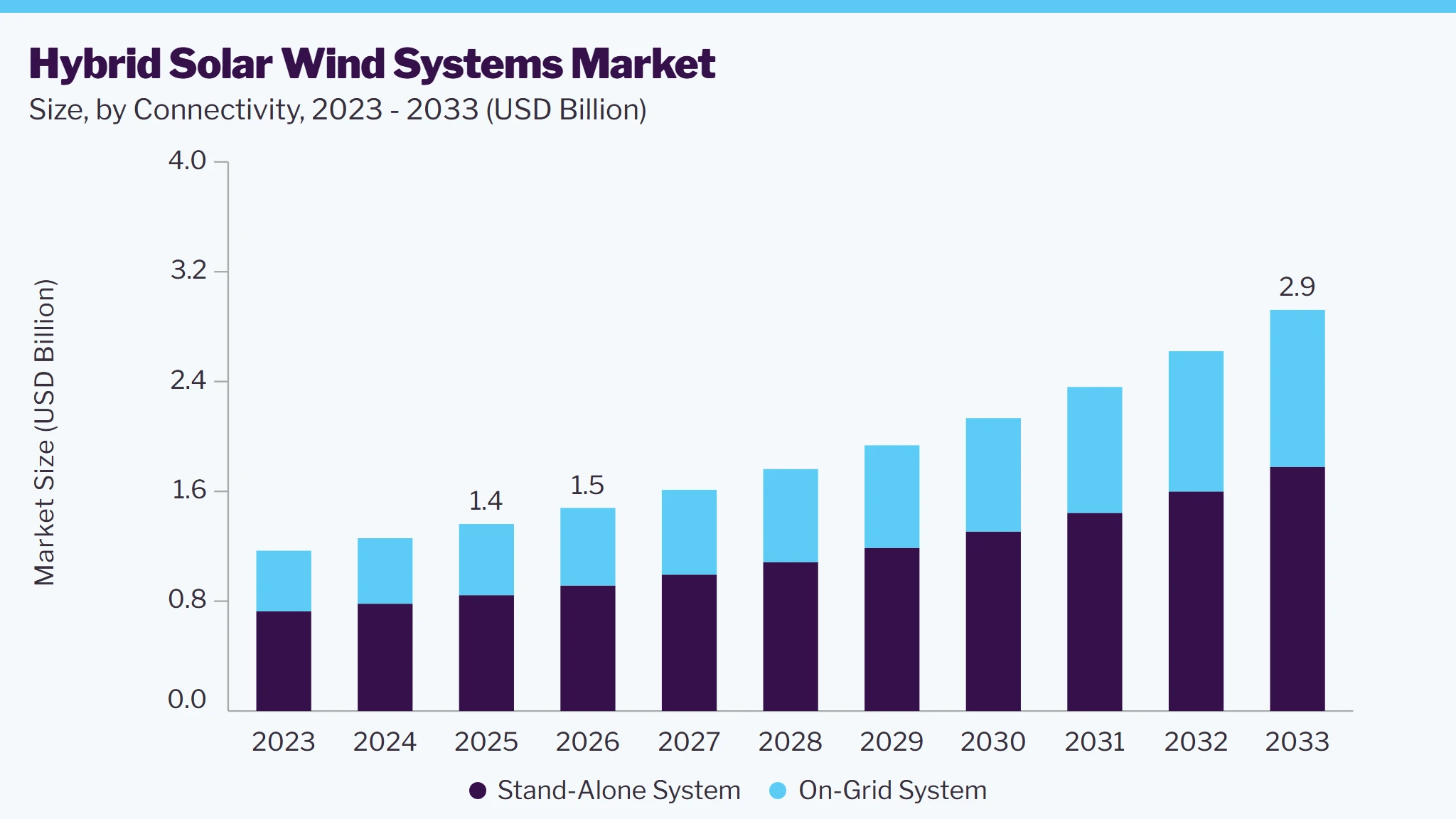
The global hybrid solar wind systems market size was valued at USD 1.4 billion in 2025 and is projected to grow from USD 1.5 billion in 2026 to USD 2.9 billion by 2033, at a CAGR of 10.2% from 2026 to 2033. Asia Pacific market dominated, with a revenue share of 40.5% in 2025. This growth is attributed to the increasing environmental concerns and the push for renewable energy targets are prompting governments and businesses to invest in hybrid systems for energy security and decentralization of power generation.
 Source: Grand View Research, IR Documents, Primary Interviews, Paid DatabasesTo learn more about this report,
 Download Free Sample Report
Key Market Trends & Insights
- By connectivity: Stand-alone system segment led the market with the largest revenue share of 61.9% in 2025.
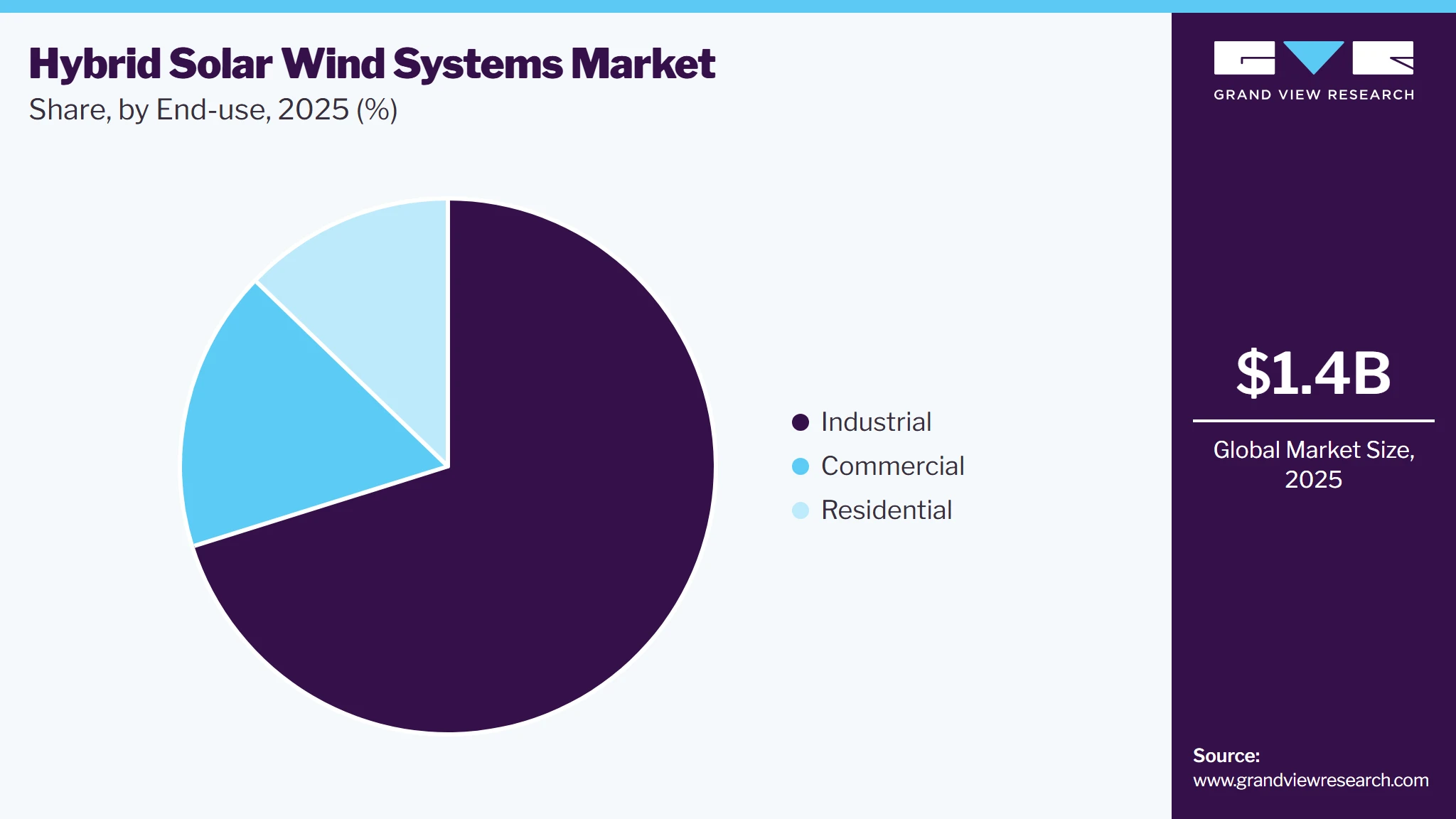
- By end-use: Industrial segment led the market with the largest revenue share of 70.2% in 2025.
Regional Highlights
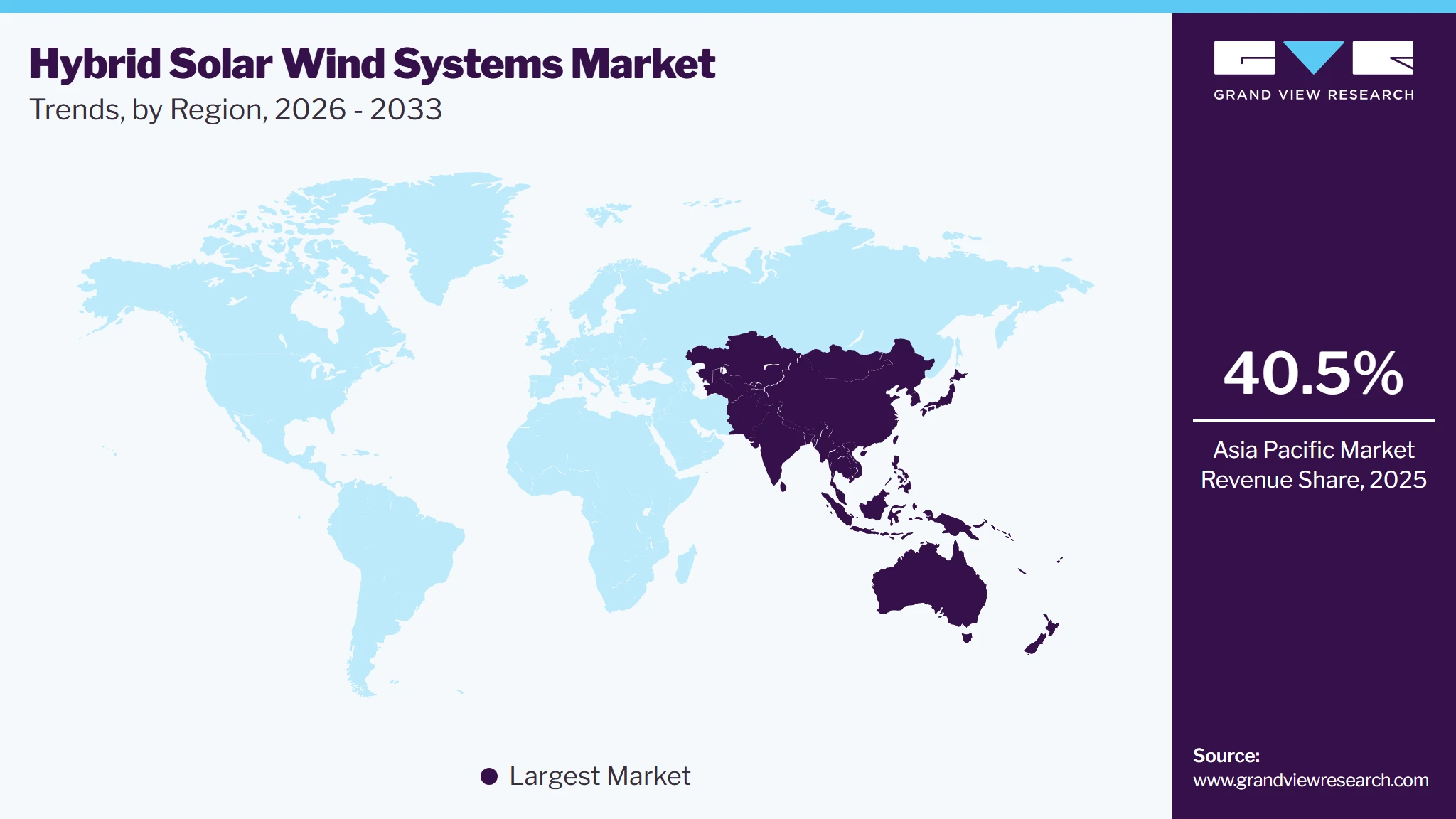
- Largest regional market: Asia Pacific (40.5% revenue share, 2025)
- By country: China held the largest market share in 2025.
Market Size & Forecasts
- Market size in 2025: USD 1.4 Billion
- Estimated market size in 2026: USD 1.5 Billion
- Projected market size by 2033: USD 2.9 Billion
- CAGR (2026-2033): 10.5%
Prism AI by Grand View Research Free to tryAsk a question about the hybrid solar wind systems marketTry asking✓Every figure cited from GVR research Prefer the report? Download free sample →
Furthermore, technological advancements have reduced costs, making these systems more accessible. Moreover, the demand for reliable, continuous power supply, especially in off-grid areas, further propels market expansion. A Hybrid Solar Wind System integrates solar panels and wind turbines to generate electricity, leveraging both renewable energy sources for enhanced reliability. The surge in demand for renewable energy is a primary catalyst for the growth of the global hybrid solar wind system market. Governments worldwide are reassessing their strategies to reduce greenhouse gas emissions and increase the proportion of renewables in their energy portfolios, leading to heightened investments in this sector. This technology offers numerous advantages over traditional fossil fuel systems, including lower operational costs, reduced environmental impact, and improved reliability, making it a preferred choice for utilities and consumers alike.In addition, technological advancements are also propelling market growth. The declining costs of solar panels and wind turbines, coupled with innovations in energy storage solutions, have made hybrid systems more economically viable. Furthermore, improvements in grid integration technologies facilitate easier connections between these systems and the existing power grid, enhancing their appeal.
 To learn more about this report, Download Free Sample Report
Moreover, government incentives play a crucial role in this expansion as well. Many governments provide financial support such as rebates and tax incentives to encourage the adoption of renewable energy systems. These initiatives help lower the initial investment required for hybrid solar wind systems, thereby accelerating market growth.
Market Dynamics
The hybrid solar wind systems market is growing as governments, businesses, and utilities increasingly invest in renewable energy solutions to improve energy security and reduce carbon emissions. Rising electricity demand, expanding rural electrification programs, and the need for reliable off-grid and microgrid power are driving the adoption of hybrid systems. Advances in battery energy storage, digital energy management, and smart grid technologies are further improving system efficiency and project viability. While high initial installation costs and project integration challenges remain key restraints, supportive renewable energy policies and growing investments in clean energy infrastructure continue to create significant opportunities for market expansion.
The growing need for uninterrupted and reliable electricity is a major driver for the hybrid solar wind systems market. Standalone solar and wind systems are inherently intermittent, as their power generation depends on weather conditions. By combining both energy sources, hybrid systems ensure a more stable and continuous power supply, making them well-suited for critical applications such as telecom towers, healthcare facilities, industrial operations, remote communities, and microgrids. The integration of battery energy storage further enhances system reliability by delivering power during periods of low solar irradiance or weak wind conditions.
In 2025, India's renewable energy expansion continued to emphasize hybrid renewable projects to improve grid reliability and ensure round-the-clock power availability. According to the Ministry of New and Renewable Energy (MNRE), more than 70 GW of hybrid, round-the-clock (RTC), and firm dispatchable renewable energy projects were under implementation or tendered by November 2025. India's wind-solar hybrid policy supports the integration of battery storage to deliver more reliable and balanced power output, highlighting the growing preference for hybrid systems that provide uninterrupted electricity.
The market faces challenges due to the complexity of integrating multiple power generation technologies into a single system. Combining solar panels, wind turbines, battery storage, inverters, and advanced energy management systems requires careful site assessment, system design, and skilled installation, increasing project costs and implementation time. In addition, maintaining two different renewable technologies demands specialized technical expertise and regular servicing, particularly in remote or harsh environments. These factors can discourage adoption among cost-sensitive customers and small-scale project developers, limiting market growth in certain regions.
The integration of hybrid solar wind systems with pumped hydro energy storage presents a significant growth opportunity, particularly for utility-scale renewable energy projects. While hybrid systems improve renewable power generation, pumped hydro storage enables excess electricity to be stored and discharged over extended periods, ensuring reliable power during peak demand or low renewable generation. This combination enhances grid stability, supports higher renewable energy penetration, and reduces dependence on fossil fuel-based backup generation. As countries invest in long-duration energy storage and resilient power infrastructure, the deployment of hybrid solar-wind projects alongside pumped hydro facilities is expected to accelerate.
Analyst Perspective
The hybrid solar wind systems market is growing as businesses, industries, and communities look for a more reliable source of clean energy. Using both solar and wind helps provide a more stable power supply than relying on a single renewable source. While the higher upfront cost is still a challenge, falling technology costs and government support are encouraging wider adoption. Demand is also increasing in remote locations and areas with unreliable grid access, where continuous power is essential. The market is expected to benefit further as countries continue investing in renewable energy and resilient power infrastructure.
Connectivity Insights
Based on connectivity, the stand-alone system segment led the market with the largest revenue share of 61.9% in 2025. This growth is attributed to their cost-effectiveness, especially in remote areas where extending grid power lines is impractical. In addition, these systems provide a reliable energy solution for off-grid industries such as manufacturing and healthcare, which often operate in isolated locations. Furthermore, the increasing demand for clean energy sources further supports the adoption of stand-alone systems, as they offer a sustainable alternative to traditional fossil fuel power generation.
The on-grid systems are expected to grow at a CAGR of 8.1% over the forecast period, driven by the rising energy demands and the need for continuous electricity supply to local grids. In addition, these systems enable users to harness solar and wind energy efficiently, contributing to grid stability and sustainability. Furthermore, government incentives and policies promoting renewable energy integration also play a significant role in driving the growth of on-grid systems. Moreover, as public awareness of environmental issues increases, these systems are becoming essential for achieving energy security and reducing carbon footprints.
End Use Insights
Based on end-use, the industrial segment led the market with the largest revenue share of 70.2% in 2025. Primarily driven by the increasing energy demands of various sectors, including manufacturing and processing. Industries are seeking reliable and cost-effective energy solutions to minimize operational disruptions caused by power outages. In addition, corporate sustainability initiatives are driving the adoption of hybrid systems, as they help reduce carbon footprints and align with environmental goals. Furthermore, the integration of advanced energy storage technologies further enhances the efficiency and reliability of these systems in industrial applications.
 To learn more about this report, Download Free Sample Report
The residential segment is expected to grow at a CAGR of 8.8% from 2025 to 2030, owing to the rising awareness of renewable energy benefits among homeowners. Many individuals are looking for sustainable energy solutions to lower their electricity bills and reduce reliance on traditional energy sources. In addition, hybrid solar wind systems provide a cleaner, more reliable power supply, particularly in remote areas where grid access may be limited. Furthermore, government incentives and subsidies also encourage residential adoption, making these systems more accessible and appealing for homeowners aiming to contribute to environmental conservation.
Regional Insights
Asia Pacific dominated the hybrid solar wind systems market with the largest revenue share of 40.5% in 2025. This growth is attributed to the rapid industrialization and urbanization, particularly in emerging economies such as India and China. In addition, these countries are increasingly investing in renewable energy to meet their growing energy demands and reduce carbon emissions. Furthermore, government policies favoring the installation of hybrid systems, coupled with advancements in technology, are further propelling market expansion.
 To learn more about this report, Download Free Sample Report
China Hybrid Solar Wind Systems Market Trends
The hybrid solar wind systems market in China held the largest share in the Asia Pacific region in 2025, primarily driven by substantial government support for renewable energy initiatives. The country's ambitious targets for clean energy generation and investments in innovative technologies are fostering market development. In addition, the decreasing costs of solar and wind components enhance the feasibility of hybrid systems, making them an attractive option for both industrial and residential applications. Furthermore, China's commitment to reducing its carbon footprint is also a significant factor contributing to market growth.
Latin America Hybrid Solar Wind Systems Market Trends
Latin America hybrid solar wind systems is expected to grow at a CAGR of 9.7% over the forecast period, owing to an increasing focus on energy independence and sustainability. Countries in this region are actively seeking alternatives to fossil fuels to combat climate change and enhance energy security. The availability of abundant natural resources, such as sunlight and wind, makes hybrid systems particularly viable. Government incentives aimed at promoting renewable energy adoption further stimulate growth in this sector.
North America Hybrid Solar Wind Systems Market Trends
The hybrid solar wind systems industry in the North America held significant revenue share of 20.3% in 2024, driven by a strong emphasis on sustainability and energy efficiency among businesses and consumers. In addition, the presence of advanced infrastructure for electricity transmission supports the integration of hybrid systems into existing grids. Furthermore, public awareness regarding environmental issues is driving demand for cleaner energy solutions. Government policies that promote renewable energy investments also play a crucial role in fostering market growth in this region.
U.S. hybrid solar wind systems market led the North American market with largest revue share in 2024, owing to significant investments in renewable energy technologies and infrastructure development. The country’s commitment to reducing greenhouse gas emissions has led to increased adoption of hybrid systems, particularly in remote areas where traditional power sources are less reliable. Furthermore, state-level incentives and federal tax credits encourage both residential and commercial users to transition towards sustainable energy solutions.
Europe Hybrid Solar Wind Systems Market Trends
The growth of hybrid solar wind systems market in Europe is expected to be driven by stringent environmental regulations and ambitious renewable energy targets set by various governments. In addition, the European Union's commitment to achieving carbon neutrality by 2050 has spurred investments in clean energy technologies. Furthermore, public awareness of climate change impacts encourages both individuals and businesses to adopt hybrid systems as part of their sustainability strategies.
Key Hybrid Solar Wind Systems Company Insights
Key companies in the global hybrid solar wind systems market include Alpha Windmills, UNITRON Energy System Pvt. Ltd., Supernova Technologies Pvt. Ltd., and others. These players are investing in research and development to innovate and improve system efficiency. In addition, they are forming strategic partnerships with technology providers for better integration, and expanding their product portfolios to cater to diverse customer needs. Furthermore, companies are also focusing on sustainability initiatives and enhancing customer engagement through education and support services, thereby fostering long-term relationships and driving market growth.
-
Alpha Windmills manufactures and provides hybrid solar wind systems, focusing on integrating wind and solar energy technologies. The company operates primarily in the renewable energy sector, offering solutions that combine solar panels and wind turbines to generate electricity. Their product range includes various configurations of hybrid systems designed for both residential and industrial applications.
-
ReGen Powertech is engaged in the development and production of hybrid solar wind systems, emphasizing innovative renewable energy solutions. The company operates within the renewable energy industry, providing advanced technologies that combine solar and wind energy generation. Their offerings include a variety of hybrid systems tailored for different applications, including commercial and residential sectors.
Key Hybrid Solar Wind Systems Companies
The following key companies have been profiled for this study on the hybrid solar wind systems market.
-
Blue Pacific Solar Product, Inc.
-
Schneider Electric
-
Alpha Windmills
-
ReGen Powertech
-
Gamesa
-
UNITRON Energy System Pvt. Ltd.
-
Supernova Technologies Pvt. Ltd.
-
Alternate Energy Company
-
Grupo Dragon
-
Polar Power, Inc.
Competitive Benchmarking
Category
Operating Strategies
Competitive Edge
Weakness
Established Players (Vestas, Siemens Gamesa, GE Vernova, ACCIONA Energía, Suzlon Energy Ltd., ReGen Powertech, Ginlong Technologies)
- Expand utility-scale hybrid solar-wind project development and strengthen global manufacturing and service capabilities to meet growing renewable energy demand.
- Invest in advanced hybrid technologies, battery energy storage integration, and digital energy management platforms to improve system efficiency and reliability.
- Form long-term partnerships with utilities, EPC contractors, and government agencies to secure large-scale hybrid renewable energy projects.
- Extensive global project portfolio and strong brand recognition across the wind and renewable energy industry.
- Broad technology portfolio combining wind turbines, solar integration, energy storage, and grid solutions.
- Strong financial resources, R&D capabilities, and established after-sales service and maintenance networks.
- High capital investment requirements and dependence on large infrastructure and utility projects.
- Longer project development cycles due to complex regulatory approvals and project execution.
- Greater exposure to policy changes, supply chain disruptions, and fluctuations in raw material prices.
Emerging Players (UNITRON Energy System Pvt. Ltd., Ryse Energy, Polar Power, Inc.)
- Develop customized hybrid solar-wind systems for telecom, rural electrification, industrial, and remote off-grid applications.
- Expand regional distribution networks and collaborate with EPC firms and local renewable energy developers to increase market presence.
- Focus on integrated hybrid solutions with battery storage and smart energy management systems for reliable decentralized power.
- Strong flexibility in delivering customized solutions for niche and off-grid energy applications.
- Faster product development and quicker response to changing customer requirements than larger competitors.
- Specialized expertise in distributed renewable energy systems and remote power applications.
- Limited manufacturing capacity and geographic presence compared to multinational competitors.
- Lower investment capacity for large-scale R&D, product innovation, and international expansion.
- Limited experience in executing utility-scale hybrid renewable energy projects and competing for large public tenders.
Recent Developments
-
In March 2024, Schneider Electric and Mainspring Energy announced a partnership to introduce a hybrid-energy technology that integrates Schneider's EcoStruxure Microgrid Solution with Mainspring's Linear Generator. This collaboration aims to enhance energy resilience and decarbonization for commercial and industrial customers. The innovative solution allows facilities to generate electricity on-site while dynamically switching between various fuel options, including low- and zero-carbon fuels. This development is crucial for organizations striving to meet sustainability goals amid increasing energy demands and extreme weather events.
Hybrid Solar Wind Systems Market Report Scope
Report Attribute
Details
Market Definition
The hybrid solar wind systems market measures the revenue generated from the sale of hybrid solar-wind power systems across on-grid and stand-alone connectivity for residential, commercial, and industrial end users.
Market size value in 2025
USD 1.4 billion
Estimated market size in 2026
USD 1.5 billion
Projected market size by 2033
USD 2.9 billion
Growth rate
CAGR of 10.2% from 2026 to 2033
Base year for estimation
2025
Historical data
2021 - 2024
Forecast period
2026 - 2033
Quantitative units
Revenue in USD million and CAGR from 2026 to 2033
Report coverage
Revenue forecast, company ranking, competitive landscape, growth factors, and trends
Segments covered
Connectivity, end-use, region
Regional scope
North America, Europe, Asia Pacific, Latin America, Middle East & Africa
Country scope
U.S., Canada, Mexico, China, India, Japan, Australia, Germany, Spain, France, UK, Brazil, Argentina, Saudi Arabia, and UAE
Key companies profiled
Vestas, Siemens Gamesa, GE Vernova, ACCIONA Energía, Suzlon Energy Ltd., ReGen Powertech, Ginlong Technologies, UNITRON Energy System Pvt. Ltd., Ryse Energy, Polar Power, Inc.
Customization scope
Free report customization (equivalent up to 8 analysts' working days) with purchase. Addition or alteration to country, regional & segment scope.
Pricing and purchase options
Avail customized purchase options to meet your exact research needs. Explore purchase options
Global Hybrid Solar Wind Systems Market Report Segmentation
This report forecasts revenue growth at global, regional, and country levels and analyzes the latest industry trends in each sub-segment from 2021 to 2033. For this study, Grand View Research has segmented the global hybrid solar wind systems market report based on connectivity, end use, and region:
 To learn more about this report, Download Free Sample Report
-
Connectivity Outlook (Revenue, USD Million, 2021 - 2033)
-
On-Grid System
-
Stand-Alone System
-
-
End Use Outlook (Revenue, USD Million, 2021 - 2033)
-
Residential
-
Commercial
-
Industrial
-
-
Regional Outlook (Revenue, USD Million, 2021 - 2033)
-
North America
-
U.S.
-
Canada
-
Mexico
-
-
Europe
-
Germany
-
Spain
-
France
-
UK
-
-
Asia Pacific
-
China
-
India
-
Japan
-
Australia
-
-
Latin America
-
Brazil
-
Argentina
-
-
Middle East and Africa
-
Saudi Arabia
-
UAE
-
-
Research Methodology
The hybrid solar wind systems market figures in this report are based on a proven research process that combines executive interviews with secondary research from proprietary databases, company filings, and recognized regulatory and institutional sources. Market size is built through value-chain sizing-reconciling supply-side and demand-side estimates-and triangulated with bottom-up and top-down approaches. Every estimate passes multiple levels of expert validation before publication, with each hybrid solar wind systems segment quantified using the revenue-capture definitions in the table below.
Segment Definition
Segment - Connectivity
Revenue capture definition
On-Grid System
Hybrid solar wind systems are connected to the utility grid to supply renewable electricity while enabling surplus power export and grid support. Revenue is generated from the sale of on-grid hybrid solar wind systems.
Stand-Alone System
Hybrid solar wind systems are deployed independently of the utility grid to provide reliable electricity in remote and off-grid locations, typically with battery storage. Revenue is generated from the sale of stand-alone hybrid solar wind systems.
Segment - End Use
Revenue capture definition
Residential
Hybrid solar wind systems are deployed in homes and residential communities to provide clean and reliable electricity. Revenue is generated from the sale of hybrid solar wind systems for residential applications.
Commercial
Hybrid solar wind systems are deployed across commercial facilities such as offices, hospitals, educational institutions, hotels, telecom sites, and retail buildings. Revenue is generated from the sale of hybrid solar wind systems for commercial applications.
Industrial
Hybrid solar wind systems are deployed in manufacturing plants, mining operations, warehouses, and other industrial facilities to support continuous power requirements. Revenue is generated from the sale of hybrid solar wind systems for industrial applications.
Estimation Model
Layer Name
Key Question
Description
Renewable Energy Demand & Electrification Layer
What forms the demand base for hybrid solar wind systems?
Assess demand for hybrid solar wind systems driven by renewable energy adoption, rural electrification, rising electricity demand, energy security goals, and the need for reliable power in grid-connected and off-grid areas. Evaluate government incentives, renewable energy targets, grid expansion, microgrid development, and investments in clean energy infrastructure to determine the underlying demand for hybrid systems.
Connectivity Layer
Which connectivity systems are being adopted?
Analyze the adoption of on-grid and stand-alone hybrid solar wind systems across different regions and project types. Assess deployment based on grid accessibility, energy reliability requirements, battery storage integration, installation costs, and application suitability to determine connectivity-wise market demand.
End-use Deployment Layer
Where are hybrid solar wind systems being deployed?
Evaluate the deployment of hybrid solar wind systems across residential, commercial, and industrial sectors. Analyze installations based on energy consumption patterns, electricity cost savings, backup power requirements, sustainability initiatives, and renewable energy adoption to estimate end-use-wise market contribution.
Revenue Layer
How is market revenue generated?
Market revenue is quantified through the sale of hybrid solar wind systems across different connectivity types and end-use sectors. The overall market value is determined by system sales, power generation capacity, component configuration (solar PV, wind turbine, and battery storage), project scale, pricing, and demand from residential, commercial, and industrial customers.
Delivered Customizations
This report has been delivered with the following In-depth customizations
Client Request
Customization Delivered
Value Adds
Connectivity-Based Adoption Assessment
Evaluated the adoption of on-grid and stand-alone hybrid solar wind systems across different regions and end-use industries. Assessed deployment trends, power reliability requirements, battery storage integration, and project economics.
Helped identify the most suitable connectivity option based on application needs and regional infrastructure.
Cross-Segmentation Analysis
Evaluated the adoption of on-grid and stand-alone hybrid solar wind systems within the industrial end-use segment. Assessed connectivity preference based on grid availability, energy reliability requirements, power demand, operating costs, and project economics across different industrial facilities.
Helped identify the most suitable connectivity type for industrial applications, understand deployment patterns, and support investment and infrastructure planning decisions.
Competitive Landscape Assessment
Evaluated major hybrid solar wind system companies based on product portfolio, regional presence, project experience, technology capabilities, strategic partnerships, and recent developments. Assessed competitive positioning across established and emerging players.
Helped benchmark key competitors, identify market leaders, and understand competitive differentiation.
Frequently Asked Questions About This Report
Stand-alone system segment led the market with the largest revenue share of 61.9% in 2025.
Industrial segment led the market with the largest revenue share of 70.2% in 2025.
The key players operating in the hybrid solar wind systems market are Vestas, Siemens Gamesa, GE Vernova, ACCIONA Energía, Suzlon Energy Ltd., ReGen Powertech, Ginlong Technologies, UNITRON Energy System Pvt. Ltd., Ryse Energy, Polar Power, Inc., and others.
Latin America is the fastest-growing region over the forecast period.
The hybrid solar wind systems market size was valued at USD 1.4 billion in 2025 and is estimated at USD 1.5 billion in 2026.
The hybrid solar wind systems market is expected to grow at a CAGR of 10.2% from 2026 to 2033, reaching USD 2.9 billion by 2033.
Asia Pacific market dominated, with a revenue share of 40.5% in 2025.
The hybrid solar wind systems market is primarily driven by the growing need for uninterrupted, reliable power and the increasing adoption of renewable energy solutions across on-grid and off-grid applications.
About the Author(s)
Renewable Energy Research Team
Energy & Power · Renewable EnergyThis report was authored by the renewable energy research team at Grand View Research - comprising two research analysts, one senior research analyst, and one industry expert - with specialized expertise in the renewable energy segment of the energy & power industry. All findings are based on proprietary energy & power databases, executive interviews, and regulatory analysis, subject to internal peer review prior to publication.
Last Updated:
Speak to Analyst

Customize this report to your needs - add regions, segments, or data points, with 20% free customization.
Or view our licence options:


ISO 9001:2015 & 27001:2022 Certified
We are GDPR and CCPA compliant! Your transaction & personal information is safe and secure. For more details, please read our privacy policy.


