
- Home
- »
- Advanced Interior Materials
- »
-
Hydraulic Pumps Market Size & Share Report, 2026-2033GVR Report cover

Hydraulic Pumps Market (2026 - 2033)
Size, Share & Trends Analysis Report By Type (Gear Pump, Vane Pump), By Operating Pressure (3001 To 6000 PSI, Up To 3000 PSI), By End Use (Construction, Automotive, Agriculture), By Region, And Segment Forecasts
Market Size, 2025
$11.3BMarket Estimate, 2026
$11.6BMarket Forecast, 2033
$15.5BCAGR, 2026–2033
4.2%Hydraulic Pumps Market Summary
The global hydraulic pumps market size was valued at USD 11.3 billion in 2025 and is projected to grow from USD 11.6 billion in 2026 to USD 15.5 billion by 2033, at a CAGR of 4.2% from 2026 to 2033. The market in Asia Pacific dominated with a revenue share of 45.4% in 2025. The hydraulic pumps industry is witnessing steady growth driven by the increasing demand for fluid power systems across various industries, including construction, agriculture, automotive, and manufacturing.
 Source: Grand View Research, IR Documents, Primary Interviews, Paid DatabasesTo learn more about this report,
 Download Free Sample Report
 Key Market Trends & Insights
- By operating pressure: Up to 3000 PSI segment held the largest market share of 50.8% in 2025.
- By type: Gear pump segment held the largest market share of 39.7% in 2025.
- By end use: Construction segment held the largest market share of 29.3% in 2025.
Regional Highlights
- Largest regional market: Asia Pacific (45.4% revenue share, 2025)
- By country: China held the largest market share in 2025
Market Size & Forecast
- Market size in 2025: USD 11.3 Billion
- Estimated market size in 2026: USD 11.6 Billion
- Projected market size by 2033: USD 15.5 Billion
- CAGR (2026-2033): 4.2%
Three ways to get this report
Buy it, customize it, or ask a question.Ask an Analyst
Analyst response in 1 business day
- AccessReport author, directly
- Reply timeWithin 1 working day
- No sales callDirect answer only
- FormatEmail reply
- CostFree, no cost
Get the Full Report
What the study covers
- FormatsPDF · Excel · Dashboard
- Timeline2026–2033 annual, 2025 base
- Coverage20+ countries, 5 regions
- Companies10+ key players profiled
Customize the Report
20% free customization
- IncludeCountries, segments, points
- TailorTo your product definition
- ExtendDeeper competitor detail
- OrA fully bespoke study
- Turnaround5–10 working days
As industries seek more efficient and durable machinery, there is a rise in the adoption of high-performance hydraulic pumps that offer enhanced energy efficiency, reduced maintenance costs, and improved productivity. Technological advancements in pump design, such as the development of smart pumps and variable displacement pumps, are further pushing market growth by offering better control and adaptability in diverse applications. To learn more about this report, Download Free Sample Report
 Furthermore, the shift toward automation and digitalization in industrial processes is significantly influencing the hydraulic pumps industry. With growing investments in smart factories and advanced manufacturing technologies, hydraulic pumps are becoming an integral part of automation systems, enabling more precise and reliable operations. In addition, the rising focus on sustainability and energy-efficient solutions is prompting manufacturers to develop eco-friendly pumps with lower energy consumption and reduced carbon footprints, aligning with global environmental goals.
Market Dynamics
The utilization of hydraulic power systems across mobile and industrial equipment remains a key determinant of market demand, while equipment production volumes and replacement cycles influence procurement activity. Performance requirements related to pressure output, flow control, energy efficiency, and system reliability drive product selection and technological development. Advancements in pump design, variable displacement technologies, electronic controls, and condition monitoring capabilities continue to enhance operational efficiency and system performance. Raw material costs, manufacturing expenditures, and supply chain dynamics affect production economics, while industrial investment levels and infrastructure development activities influence equipment deployment.
The increasing deployment of hydraulic systems in construction machinery, agricultural equipment, mining vehicles, and industrial machinery remains a primary factor supporting hydraulic pump demand. Hydraulic pumps serve as critical components in power transmission systems, enabling efficient operation of equipment that requires high force output, precise control, and reliable performance under demanding operating conditions. Growth in infrastructure development projects, mechanized farming practices, and industrial production activities continues to strengthen equipment manufacturing and replacement demand worldwide.
Additionally, fleet modernization initiatives and investments in high-performance machinery are encouraging the adoption of advanced hydraulic pump technologies. Equipment manufacturers are increasingly incorporating pumps with enhanced efficiency, improved pressure capabilities, and greater operational reliability to meet productivity requirements and reduce maintenance-related downtime. These developments are contributing to sustained demand across both mobile and stationary hydraulic applications.
The increasing use of electric and electromechanical actuation systems in selected applications presents a challenge to hydraulic pump demand. Technological improvements in electric drives have expanded their suitability for applications requiring precise motion control, lower maintenance requirements, and improved energy efficiency. As industries pursue automation and electrification strategies, some equipment categories are gradually shifting away from traditional hydraulic systems.
Large-scale infrastructure investments across emerging economies are generating substantial demand for construction, mining, and material handling equipment that relies on hydraulic power systems. Expanding transportation networks, urban development projects, energy infrastructure construction, and industrial facility expansion are supporting equipment deployment and creating opportunities for hydraulic pump manufacturers.
Market Concentration & Characteristics
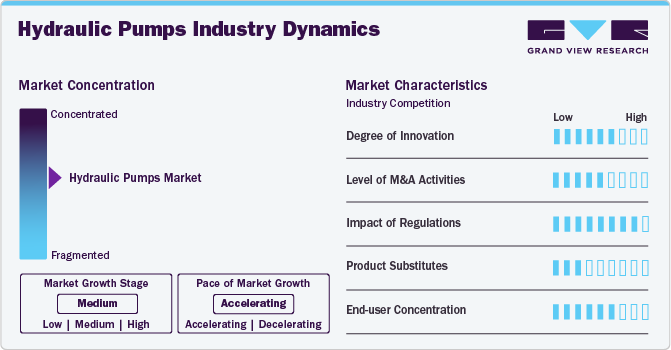
The hydraulic pumps industry exhibits moderate concentration, with a few major global players dominating the industry while numerous regional and niche companies serve specific segments. Large manufacturers, such as Bosch Rexroth, Eaton, and Parker Hannifin, hold a significant share of the market due to their extensive product portfolios, strong distribution networks, and technological capabilities. However, regional players are also growing in prominence, catering to specific market needs by offering customized solutions at competitive prices. The market concentration is expected to increase as companies merge or form strategic partnerships to enhance their product offerings and expand their reach in emerging markets.
A key characteristic of the hydraulic pumps industry is its reliance on continuous technological innovation. Manufacturers are focusing on enhancing pump efficiency, durability, and performance through advances in materials and design. The trend toward variable displacement pumps, which offer better control and energy efficiency, is becoming increasingly popular. In addition, digital and smart hydraulic pumps, which integrate sensors and automation, are gaining traction in industries that demand higher precision and adaptability. As a result, the industry is seeing significant investments in research and development to meet the evolving demands of various applications.
 To learn more about this report, Download Free Sample Report
 The hydraulic pumps industry is heavily influenced by the rapid industrialization of emerging economies, especially in regions like Asia-Pacific and Latin America. These markets are witnessing a surge in infrastructure projects, such as construction, energy, and manufacturing plants, which in turn drive the demand for hydraulic pumps. The construction industry relies on hydraulic pumps for machinery like excavators, bulldozers, and cranes. As the demand for heavy-duty equipment and advanced machinery grows, manufacturers are increasingly focusing on developing products that meet the specific needs of these markets, including high-pressure, durable, and cost-effective hydraulic pump solutions.
Another defining characteristic of the hydraulic pumps industry is the growing emphasis on sustainability and energy efficiency. With rising energy costs and increasing environmental awareness, industries are under pressure to adopt more energy-efficient hydraulic pump systems. This has led to the development of pumps with improved energy-saving features, such as variable-speed motors and optimized flow rates. Furthermore, the market is witnessing an increased focus on reducing maintenance costs and extending the lifecycle of hydraulic pumps, which not only enhances operational efficiency but also contributes to the overall sustainability goals of industries across the globe.
Analyst Perspective
The hydraulic pumps market reflects steady structural demand supported by its deep integration across construction, mining, agriculture, and industrial machinery ecosystems. Market dynamics are largely influenced by capital equipment production cycles and the installed base of hydraulic-driven systems, which sustains recurring replacement and retrofit activity across end-use industries. The transition toward energy-efficient and electronically controlled hydraulic architectures is gradually reshaping product development priorities, with increasing emphasis on variable displacement and system-level optimization. Competitive conditions remain shaped by technologically advanced global manufacturers alongside regionally focused suppliers operating in cost-sensitive segments.
Type Insights
Based on type, the gear pump segment led the market with the largest revenue share of 39.7% in 2025. Gear pump's popularity is driven by its simplicity, reliability, and cost-effectiveness, making it a preferred choice for low to medium-pressure applications. Its compact design and ability to handle a wide range of fluids, including viscous ones, contribute to its widespread use in industries such as automotive, construction, and manufacturing.
Piston pumps are driven by their ability to deliver high-pressure output and superior efficiency, making them ideal for heavy-duty and high-performance applications. Their versatility in handling varying flow rates and pressures gives them an edge in industries such as automotive, oil & gas, and agriculture. The rising demand for precision and the increasing need for high-efficiency hydraulic systems also contribute to the growing adoption of piston pumps.
End-use Insights
Based on end use, the construction segment led the market with the largest revenue share of 29.3% in 2025. In the construction industry, hydraulic pumps are crucial for powering heavy machinery such as excavators, cranes, bulldozers, and concrete pumps. They provide the high pressure and flow required for tasks such as lifting, digging, and material handling. Hydraulic pumps are favored for their reliability, efficiency, and ability to operate in tough conditions. The growing demand for infrastructure projects worldwide continues to drive the adoption of advanced hydraulic systems in construction equipment.
 To learn more about this report, Download Free Sample Report
 In the automotive industry, hydraulic pumps are used in various applications, including power steering systems, braking systems, and suspension systems. They provide the necessary pressure to ensure the smooth, responsive performance of vehicles. With the increasing demand for electric vehicles (EVs) and advanced driver-assistance systems, hydraulic pumps are also evolving to meet the needs of more energy-efficient and precise systems.
Operating Pressure Insights
Based on operating pressure, the up to 3000 PSI segment led the market with the largest revenue share of 50.8% in 2025. Hydraulic pumps with up to 3000 PSI operating pressure are in high demand across industries such as construction, agriculture, and manufacturing, where medium-pressure applications are common. Their affordability, durability, and reliability make them the go-to solution for many standard hydraulic systems, such as loaders, excavators, and material-handling equipment.
The demand for hydraulic pumps with operating pressures between 3001 and 6000 PSI is growing in heavy-duty industries such as mining, oil & gas, and large-scale manufacturing. These pumps are essential for high-pressure applications, offering the power required for complex machinery and systems. As industries push for higher performance, precision, and reliability in extreme conditions, the need for higher-pressure pumps continues to rise.
Regional Insights
The North America hydraulic pumps industry growth is driven by the region's robust industrial base, coupled with the increasing demand for automation and energy-efficient systems. The need for high-performance equipment in heavy-duty industries and infrastructure development are contributing to the consistent growth of the market in North America.
U.S. Hydraulic Pumps Market Trends
The hydraulic pumps industry in the U.S. is expected to grow at a CAGR of 3.0% from 2026 to 2033. The U.S. market for hydraulic pumps is characterized by significant demand in the construction, automotive, and agriculture industries. With a growing focus on automation, energy efficiency, and sustainability, the U.S. is investing in advanced hydraulic pump technologies.
The hydraulic pumps industry in Canada is expected to grow at a CAGR of 2.2% from 2026 to 2033. Canada’s vast natural resources and infrastructure projects require hydraulic pumps that can withstand tough environments and provide reliable power for heavy machinery. In addition, the demand for hydraulic pumps in agriculture and renewable energy projects is contributing to market growth in the region.
Europe Hydraulic Pumps Market Trends
Europe’s hydraulic pump industry is fueled by diverse industries, including automotive, manufacturing, agriculture, and construction. The region’s strong focus on energy efficiency, environmental sustainability, and industrial automation is driving innovations in hydraulic pump technology. Europe’s infrastructure projects and the automotive industry’s shift toward electric vehicles are also increasing the demand for more efficient hydraulic systems.
Germany's hydraulic pumps industry held a 22.4% share in the European market. Germany is a key player in the European region, with significant demand in industries such as automotive, industrial machinery, and renewable energy. The country’s advanced manufacturing capabilities and emphasis on technological innovation drive the development of high-performance, energy-efficient hydraulic pumps.
The hydraulic pumps industry in the UK is driven by growing demand for machinery and equipment used in infrastructure development and maintenance. The UK’s focus on improving energy efficiency and sustainability, as well as its growth in renewable energy projects, is contributing to the adoption of more advanced hydraulic pumps.
Asia Pacific Hydraulic Pumps Market Trends
Asia Pacific dominated the hydraulic pumps market with the largest revenue share of 45.4% in 2025. The Asia Pacific region is experiencing rapid growth driven by the increasing industrialization and infrastructure development in countries like China and India. The demand for hydraulic pumps is rising in sectors such as construction, agriculture, mining, and manufacturing.
 To learn more about this report, Download Free Sample Report
 The hydraulic pumps market in China held the largest share in the Asia Pacific region in 2025. As the largest global consumer of hydraulic systems, China is focusing on upgrading its infrastructure, including urban development and transportation projects that are expected to increase the demand for high-performance hydraulic pumps.
The hydraulic pumps market in India is expected to grow at a CAGR of 6.0% from 2026 to 2033. The demand is particularly high in the construction, agriculture, and mining industries. As India continues to invest in urbanization, transportation, and industrial sectors, the need for robust and efficient hydraulic systems is expected to grow.
Middle East & Africa Hydraulic Pumps Market Trends
The hydraulic pumps industry in the Middle East and Africa is expanding due to increased investments in infrastructure, construction, and oil & gas industries. Countries like the UAE, Qatar, and South Africa are driving demand for high-performance hydraulic systems in heavy machinery and equipment. The region’s focus on large-scale development projects, such as smart cities and energy infrastructure, is propelling the need for durable and energy-efficient hydraulic pumps.
Saudi Arabia’s hydraulic pumps market is primarily driven by the construction, oil & gas, and petrochemical industries, which require high-pressure systems for heavy-duty machinery. As the country invests heavily in infrastructure projects, such as NEOM and other mega-development initiatives, the demand for hydraulic pumps continues to rise.
Latin America Hydraulic Pumps Market Trends
The hydraulic pumps industry in Latin America is witnessing steady demand for hydraulic pumps, especially in sectors like agriculture, construction, and mining, which is fueling the market growth. Countries such as Brazil, Mexico, and Argentina are investing heavily in infrastructure and energy projects, driving the need for hydraulic systems in heavy machinery. With the growing adoption of automation and renewable energy technologies, hydraulic pumps are becoming essential for industries that require efficient and reliable power systems.
Brazil’s hydraulic pumps market is growing due to the country’s significant investment in sectors such as agriculture, mining, and construction. As the largest economy in Latin America, Brazil's infrastructure and industrial development projects are boosting the demand for efficient and reliable hydraulic systems. The country’s agricultural sector, which heavily relies on hydraulic pumps for irrigation and machinery, is a key driver in this market.
Key Hydraulic Pumps Company Insights
Some of the key players operating in the market include Parker Hannifin Corp, Bosch Rexroth Corporation, among others.
-
Parker Hannifin Corp is a global leader in motion and control technologies, offering a wide range of hydraulic pumps, filters, valves, and other fluid power components. With over 100 years of experience, the company serves various industries, including aerospace, automotive, industrial, and construction. Parker Hannifin focuses on innovation, providing advanced, energy-efficient solutions to enhance performance across multiple applications.
-
Bosch Rexroth is a leading supplier of industrial automation, motion control, and hydraulic systems, providing innovative solutions for diverse industries such as manufacturing, automotive, and renewable energy. With a strong global presence, the company designs and manufactures hydraulic pumps, valves, and power units tailored to meet high-performance standards.
Key Hydraulic Pumps Companies:
The following are the leading companies in the hydraulic pumps market.
-
Parker Hannifin Corp
-
Bosch Rexroth Corporation
-
Eaton
-
Danfoss
-
LHY Powertrain GmbH & Co. KG
-
HYDAC International GmbH
-
Bucher Hydraulics GmbH
-
Shimadzu Corporation
-
Kawasaki Heavy Industries, Ltd.
-
DAIKIN INDUSTRIES, Ltd
Competitive Benchmarking
Category
Operating Strategies
Competitive Edge
Weakness
Established Players (e.g., Parker Hannifin Corporation; Bosch Rexroth Corporation; Eaton; Danfoss.)
- Focus on advanced hydraulic pump systems, including variable displacement, electro-hydraulic integration, and energy-efficient architectures.
- Strengthen long-term OEM partnerships across construction, agriculture, mining, and industrial machinery sectors.
- Expand integrated hydraulic portfolios combining pumps, motors, valves, and digital control systems.
- Strong global manufacturing and distribution networks with deep OEM integration.
- High R&D intensity enabling continuous innovation in high-pressure and energy-efficient hydraulic technologies.
- Broad system-level product offerings covering mobile and industrial applications.
- Exposure to cyclical demand from capital-intensive end-use industries.
- Premium pricing limits penetration in cost-sensitive markets.
- Raw material price volatility impacts margins.
Emerging & Regional Players (e.g., Shimadzu Corporation, Bucher Hydraulics GmbH, regional players)
- Focus on application-specific and mid-range hydraulic pump solutions for mobile and industrial equipment.
- Emphasis on regional manufacturing presence and cost-efficient production models to enhance competitiveness.
- Strengthen OEM collaboration in niche industrial segments to expand targeted application reach.
- High adaptability in product customization and faster engineering response cycles.
- Competitive cost positioning in mid-tier hydraulic pump applications.
- Strong specialization in selected hydraulic sub-systems and compact hydraulic solutions.
- Limited global scale compared to tier-1 hydraulic OEMs.
- Lower R&D investment capacity restricts rapid technological advancement.
- Dependence on regional demand cycles and narrower geographic diversification.
Recent Developments
-
In March 2024, Poclain expanded its high-power industrial motor portfolio with the launch of the MI330, which boasts the highest hydraulic power densities on the market. Offering 30% more displacement, it can achieve up to 600 kW and features an extended lifetime.
-
In December 2024, RCHC introduced a new range of hydraulic pumps designed to transform the industry, addressing the growing demand for high-performance and long-lasting hydraulic systems across various sectors.
Hydraulic Pumps Market Report Scope
Report Attribute
Details
Market size in 2025
USD 11.3 billion
Estimated market size in 2026
USD 11.6 billion
Projected market size by 2033
USD 15.5 billion
Growth rate
CAGR of 4.2% from 2026 to 2033
Base year for estimation
2025
Historical data
2021 - 2024
Forecast period
2026 - 2033
Quantitative units
Revenue in USD billion and CAGR from 2026 to 2033
Report coverage
Revenue forecast, company ranking, competitive landscape, growth factors, and trends
Segments covered
Type, operating pressure, end use, region
Regional scope
North America; Europe; Asia Pacific; Latin America; Middle East & Africa
Country scope
U.S.; Canada; Mexico; Germany; UK; France; Italy; Spain; Japan; China; India; Australia; South Korea; Brazil; Argentina; Saudi Arabia; South Africa; UAE
Key companies profiled
Parker Hannifin Corp, Bosch Rexroth Corporation, Eaton, Danfoss, LHY Powertrain GmbH & Co. KG, HYDAC International GmbH, Bucher Hydraulics GmbH, Shimadzu Corporation, Kawasaki Heavy Industries, Ltd., DAIKIN INDUSTRIES, Ltd
Customization scope
Free report customization (equivalent up to 8 analysts' working days) with purchase. Addition or alteration to country, regional & segment scope.
Pricing and purchase options
Avail customized purchase options to meet your exact research needs. Explore purchase options
Global Hydraulic Pumps Market Report Segmentation
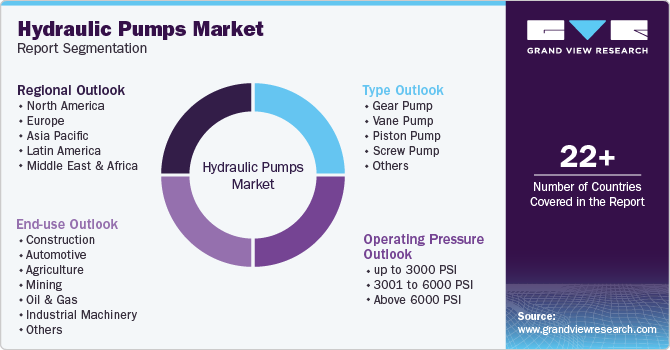
This report forecasts revenue growth at global, regional & country levels and provides an analysis of the industry trends in each of the sub-segments from 2021 to 2033. For this study, Grand View Research has segmented the global hydraulic pumps market report based on type, operating pressure, end-use, and region:
 To learn more about this report, Download Free Sample Report
 -
Type Outlook (Revenue, USD Billion, 2021 - 2033)
-
Gear Pump
-
Vane Pump
-
Piston Pump
-
Screw Pump
-
Others
-
-
Operating Pressure Outlook (Revenue, USD Billion, 2021 - 2033)
-
up to 3000 PSI
-
3001 to 6000 PSI
-
Above 6000 PSI
-
-
End-use Outlook (Revenue, USD Billion, 2021 - 2033)
-
Construction
-
Automotive
-
Agriculture
-
Mining
-
Oil & Gas
-
Industrial Machinery
-
Others
-
-
Regional Outlook (Revenue, USD Billion, 2021 - 2033)
-
North America
-
U.S.
-
Canada
-
Mexico
-
-
Europe
-
Germany
-
UK
-
France
-
Italy
-
Spain
-
-
Asia Pacific
-
China
-
India
-
Japan
-
Australia
-
South Korea
-
-
Latin America
-
Brazil
-
Argentina
-
-
Middle East & Africa
-
Saudi Arabia
-
UAE
-
South Africa
-
-
Research Methodology
The hydraulic pumps market figures in this report are based on a proven research process that combines executive interviews with secondary research from proprietary databases, company filings, and recognized regulatory and institutional sources. Market size is built through value-chain sizing - reconciling supply-side and demand-side estimates - and triangulated with bottom-up and top-down approaches. Every estimate passes multiple levels of expert validation before publication, with each hydraulic pumps segment quantified using the revenue-capture definitions in the table below.
Segment Definition
Segment - Type
Revenue Capture Definition
Gear Pump
Revenue generated from the sale of external gear, internal gear, and gerotor hydraulic pumps
Vane Pump
Revenue generated from the sale of fixed and variable displacement vane hydraulic pumps.
Piston Pump
Revenue is primarily driven by high-pressure hydraulic solutions based on reciprocating piston mechanisms, enabling precise flow control and superior power density.
Screw Pump
This category accounts for revenue from hydraulic pumping systems engineered with screw-based rotors that ensure continuous, low-pulsation fluid movement.
Others
Revenue generated from the sale of other hydraulic pump technologies, including diaphragm, lobe, and specialty hydraulic pumps used in niche hydraulic applications.
Segment - Operating Pressure
Revenue Capture Definition
Up to 3000 PSI
Revenue generated from the sale of hydraulic pumps designed to operate at pressures up to 3,000 PSI for light- and medium-duty hydraulic applications.
3001 to 6000 PSI
Revenue generated from the sale of hydraulic pumps operating between 3,001 and 6,000 PSI for medium- to heavy-duty mobile and industrial hydraulic systems.
Above 6000 PSI
Revenue generated from the sale of hydraulic pumps designed for operating pressures above 6,000 PSI for high-performance hydraulic applications.
Segment -End use
Revenue Capture Definition
Construction
Revenue is generated from hydraulic pumps used in excavators, loaders, cranes, and other heavy construction equipment. Demand is driven by infrastructure development, urban expansion, and continuous fleet upgrades requiring high-power hydraulic systems.
Automotive
This segment captures revenue from hydraulic applications in vehicle systems such as steering, braking, and manufacturing equipment. Growth is supported by automotive production volumes and the increasing use of hydraulics in precision assembly processes.
Agriculture
Revenue is derived from hydraulic pumps used in tractors, harvesters, and irrigation machinery. Adoption is driven by farm mechanization, productivity improvements, and growing reliance on hydraulically operated equipment.
Mining
This segment includes revenue from hydraulic pumps in drilling rigs, loaders, and excavation equipment. Demand is supported by intensive mining activities and the need for durable, high-pressure hydraulic systems.
Oil & Gas
Revenue is generated from hydraulic pumps used in drilling, well servicing, and offshore operations. Growth is driven by high-pressure operational requirements and critical performance needs in extreme environments.
Industrial Machinery
This segment captures revenue from hydraulic pumps used in machine tools, production lines, and automated systems. Demand is supported by industrial automation and the need for efficient and precise fluid power control.
Others
Revenue is derived from specialized applications such as aerospace, marine, and defense equipment. This segment is driven by customized hydraulic solutions for niche and high-performance use cases.
Estimation Model
Layer Name
Key Question
Description
Industrial Equipment Base Layer
Where are hydraulic pumps required?
Analyze demand across key end-use industries including construction, agriculture, mining, oil & gas, automotive, industrial machinery, and material handling.
Hydraulic Integration & Application Layer
Which systems require hydraulic pump functionality?
Evaluate production of hydraulic machinery, capital investments across end-use industries, and equipment manufacturing activity. Assess procurement of hydraulic pumps by OEMs and industrial equipment manufacturers driven by new equipment production and fleet expansion.
Pump Technology & Adoption Layer
What type of hydraulic pumps are deployed across applications?
Maps adoption across gear, vane, piston, screw, and specialty pump types based on pressure range, efficiency, cost, and application suitability. Also evaluates penetration of advanced solutions such as variable displacement and electro-hydraulic integrated systems.
Revenue Conversion Layer
How much revenue is generated?
Estimate annual hydraulic pump shipments by pump type, operating pressure, and end-use industry. Quantify revenues generated exclusively from the sale of new hydraulic pumps supplied to OEMs and industrial customers.
Delivered Customizations
This report has been delivered with the following In-depth customizations
CLIENT REQUEST
CUSTOMIZATION DELIVERED
VALUE ADDS
Competitive Benchmarking
Benchmarked hydraulic pump manufacturers based on pump portfolio strength (gear, vane, piston, screw), pressure range capability, displacement technologies, OEM integration strength, geographic presence, and competitive positioning, while distinguishing established global OEMs and regional participants.
Provided a clear assessment of competitive structure within the hydraulic pumps market, enabling evaluation of technology leadership, pricing positioning, and product differentiation across pump types and applications.
Regional Segmentation
Refined regional analysis by evaluating demand for hydraulic pumps across construction equipment, mining machinery, agricultural systems, industrial machinery, and oil & gas applications across North America, Europe, Asia Pacific, Middle East & Africa, and Latin America.
Enabled identification of region-specific demand concentration for hydraulic pump technologies, supporting strategic prioritization of high-growth industrial and equipment-driven markets.
Opportunity assessment
Assessed growth opportunities across high-pressure hydraulic pumps, variable displacement technologies, and electro-hydraulic integrated pumps across mobile and industrial equipment.
Helped prioritize revenue opportunities driven by equipment pump efficiency upgrades, and increasing demand for durable high-performance hydraulic pump systems across end-use industries.
Frequently Asked Questions About This Report
Asia Pacific dominated the hydraulic pumps market with the largest revenue share of 45.4% in 2025.
Some of the key players operating in the hydraulic pumps market include Parker Hannifin Corp, Bosch Rexroth Corporation, Eaton, Danfoss, LHY Powertrain GmbH & Co. KG, HYDAC International GmbH, Bucher Hydraulics GmbH, Shimadzu Corporation, Kawasaki Heavy Industries, Ltd., DAIKIN INDUSTRIES, Ltd.
The hydraulic pumps market is witnessing steady growth driven by the increasing demand for fluid power systems across various industries, including construction, agriculture, automotive, and manufacturing.
Asia Pacific is anticipated to be one of the fastest-growing regional markets over the forecast period, driven by rapid industrialization, expanding infrastructure projects, and increasing production of construction and agricultural machinery.
The gear pump segment led the market with the largest revenue share of 39.7% in 2025.
The up to 3000 PSI segment accounted for the largest revenue share of 50.8% in 2025.
The construction segment led the market with the largest revenue share of 29.3% in 2025.
The global hydraulic pumps market size was valued at USD 11.3 billion in 2025 and is estimated at USD 11.6 billion for 2026.
The global hydraulic pumps market is expected to grow at a CAGR of 4.2% from 2026 to 2033, reaching USD 15.5 billion by 2033.
About the Author(s)
Advanced Interior Materials Research Team
Advanced Materials · Advanced Interior MaterialsThis report was authored by the advanced interior materials research team at Grand View Research - comprising two research analysts, one senior research analyst, and one industry expert - with specialized expertise in the advanced interior materials segment of the advanced materials industry. All findings are based on proprietary advanced materials databases, executive interviews, and regulatory analysis, subject to internal peer review prior to publication.
Last Updated:
Speak to Analyst

Customize this report to your needs - add regions, segments, or data points, with 20% free customization.
Or view our licence options:


ISO 9001:2015 & 27001:2022 Certified
We are GDPR and CCPA compliant! Your transaction & personal information is safe and secure. For more details, please read our privacy policy.


