
- Home
- »
- IT Services & Applications
- »
-
Identity Analytics Market Size And Share Report, 2026-2033GVR Report cover

Identity Analytics Market (2026 - 2033)
Size, Share, & Trends Analysis Report By Component (Solutions, Services), By Deployment (Cloud, On-premises), By Enterprise Size, By Application, By End Use, By Region, And Segment Forecasts
Market Size, 2025
$1.9BMarket Estimate, 2026
$2.3BMarket Forecast, 2033
$12.7BCAGR, 2026–2033
27.4%Identity Analytics Market Summary
The global identity analytics market size was valued at USD 1.9 billion in 2025 and is projected to grow from USD 2.3 billion in 2026 to USD 12.7 billion by 2033, at a CAGR of 27.4% from 2026 to 2033. North America dominated the market, accounting for a revenue share of 38.5% in 2025. The market is driven by rising identity-based cyberattacks, increasing adoption of cloud and digital services, and growing demand for real-time user behavior, access-risk, and fraud detection.
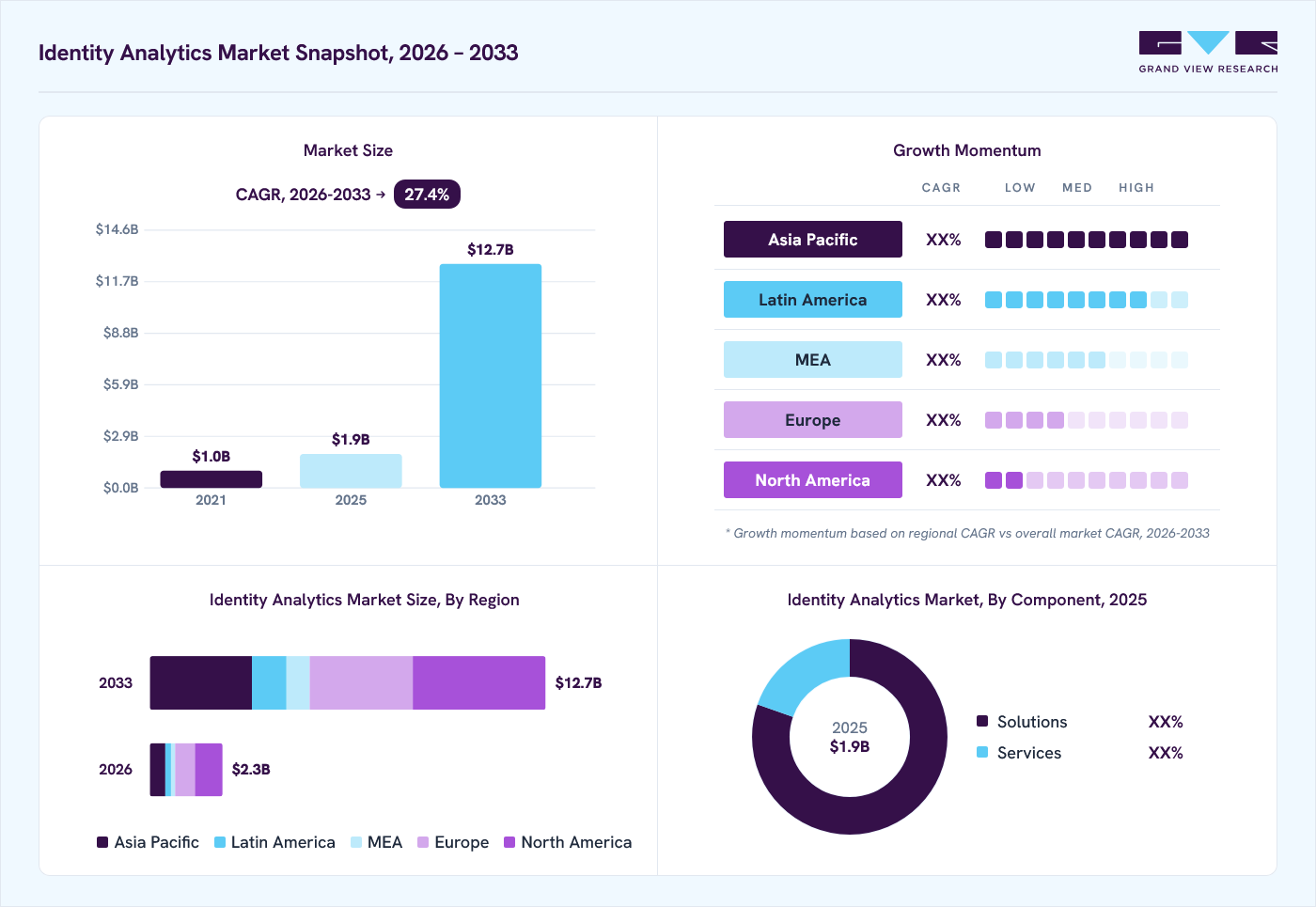 Source: Grand View Research, IR Documents, Primary Interviews, Paid DatabasesTo learn more about this report,
 Download Free Sample Report
 Key Market Trends & Insights
- By component: Solutions segment dominated the market, with a revenue share of 80.3% in 2025
- By deployment: Cloud led the market and accounted for a share of 66.6% in 2025
- By enterprise size: Large enterprises segment dominated the market, with a revenue share of 73.3% in 2025
- By application: Account & access analytics segment dominated the market, with a revenue share of 23.9% in 2025
- By end use: BFSI segment held the largest revenue share in 2025
Regional Highlights
- Largest regional market: North America (38.5% revenue share, 2025)
- Fastest-growing regional market: Asia Pacific (highest CAGR, 2026-2033)
- By country: The U.S. held the largest market share in 2025.
Market Size & Forecast
- Market size in 2025: USD 1.9 Billion
- Estimated market size in 2026: USD 2.3 Billion
- Projected market size by 2033: USD 12.7 Billion
- CAGR (2026-2033): 27.4%
Three ways to get this report
Buy it, customize it, or ask a question.Ask an Analyst
Analyst response in 1 business day
- AccessReport author, directly
- Reply timeWithin 1 working day
- No sales callDirect answer only
- FormatEmail reply
- CostFree, no cost
Get the Full Report
What the study covers
- FormatsPDF · Excel · Dashboard
- Timeline2026–2033 annual, 2025 base
- Coverage20+ countries, 5 regions
- Companies10+ key players profiled
Customize the Report
20% free customization
- IncludeCountries, segments, points
- TailorTo your product definition
- ExtendDeeper competitor detail
- OrA fully bespoke study
- Turnaround5–10 working days
The growing sophistication of identity-based cyberattacks and account takeover threats is a significant driver of the identity analytics market. Organizations are increasingly using identity analytics to analyze authentication patterns, access privileges, entitlement usage, and user behavior to identify anomalous activities and potential threats. The increasing adoption of cloud applications, hybrid IT environments, remote work models, and digital services has also expanded the number of identities and access points that organizations must monitor. Consequently, enterprises are moving beyond conventional identity and access management toward analytics-driven approaches that provide continuous visibility into identity risk, suspicious behavior, excessive privileges, and compromised credentials.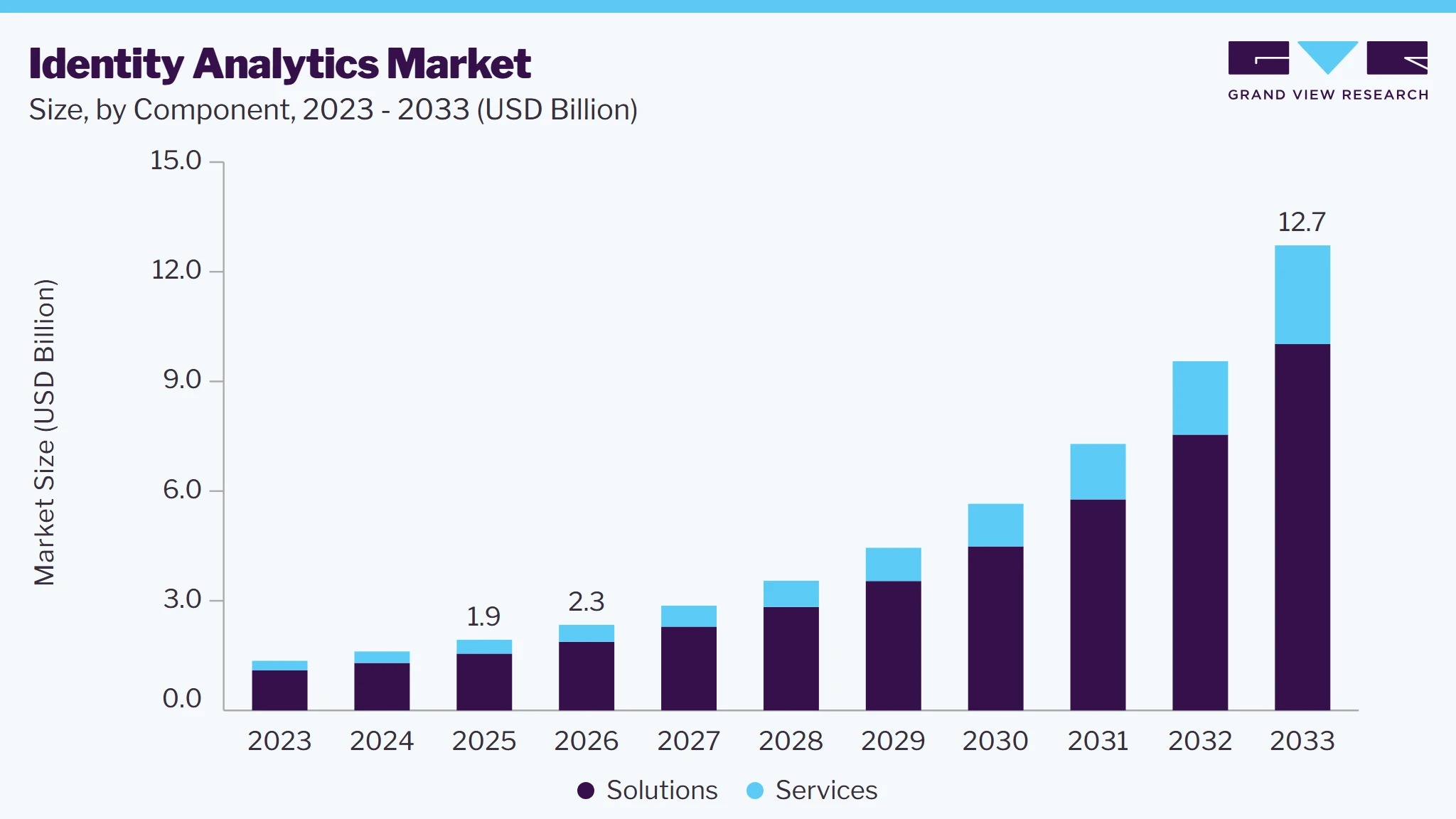 To learn more about this report, Download Free Sample Report
 Stringent regulatory requirements and the growing need for identity governance and risk management are further accelerating market adoption. Regulations and frameworks governing data privacy, cybersecurity, financial services, and critical infrastructure increasingly require organizations to demonstrate stronger access controls, auditability, segregation of duties, and protection of sensitive information. Identity analytics helps organizations continuously assess access risks, detect policy violations, support compliance reporting, and prioritize remediation. At the same time, the integration of AI and machine learning into identity-security platforms is improving behavioral anomaly detection and enabling more proactive identification of identity threats, encouraging organizations to invest in advanced identity analytics capabilities.
Market Dynamics
The identity analytics market is driven by the increasing complexity of enterprise identity environments and the need to continuously identify, assess, and mitigate risks associated with users, accounts, privileges, and access activities. The expansion of hybrid workforces, multi-cloud infrastructures, SaaS applications, machine identities, and third-party access has significantly increased the number of digital identities organizations must monitor. Traditional IAM tools primarily focus on authentication and authorization, whereas identity analytics adds behavioral, contextual, and risk-based intelligence to identify unusual access patterns, excessive privileges, dormant accounts, and potentially compromised identities. The convergence of identity security with Zero Trust, privileged access management, identity governance, and security operations is further expanding demand for analytics-driven identity protection.
The growing adoption of Zero Trust security architectures is driving the Identity Analytics Market as organizations increasingly require continuous assessment of identity and access risk rather than relying on static authentication decisions. Zero Trust frameworks require organizations to continuously evaluate who is requesting access, what resources are being accessed, from which environment, and whether the activity is consistent with established behavior. Identity analytics strengthens this approach by correlating identity attributes, authentication events, access privileges, device context, and behavioral signals to identify anomalous or high-risk activities. As enterprises transition from perimeter-based security toward identity-centric security models, identity analytics is becoming increasingly important for risk-based access decisions, continuous verification, privilege monitoring, and identity threat detection. In February 2026, Omada’s State of Identity Governance 2026 research, based on 577 identity and cybersecurity leaders, highlighted growing adoption of Zero Trust principles and the need for greater executive visibility into identity risk, supporting demand for identity analytics.
Inconsistent identity data and difficulties in correlating identities across heterogeneous systems can restrain market growth. Large enterprises commonly maintain fragmented identity information across directories, HR systems, IAM platforms, cloud applications, privileged-access environments, SaaS platforms, and legacy infrastructure. Incomplete identity attributes, duplicate accounts, orphaned credentials, inconsistent naming conventions, and disconnected data sources can reduce the accuracy of analytics and risk scoring. Organizations may therefore need substantial data normalization, identity resolution, integration, and governance efforts before obtaining reliable analytical insights. These challenges can increase implementation complexity and limit adoption among organizations with highly fragmented IT environments.
The rapid growth of machine identities and non-human identities (NHIs) represents a significant opportunity for the identity analytics market. APIs, service accounts, workloads, bots, containers, applications, IoT devices, and AI agents increasingly require credentials and access privileges, creating identity populations that can exceed the number of human users in large digital environments. These identities can accumulate excessive privileges, remain active without adequate ownership, or be exploited when credentials are compromised. Identity analytics platforms can provide organizations with visibility into ownership, access patterns, privilege levels, lifecycle status, and anomalous behavior associated with non-human identities. The increasing deployment of AI agents and autonomous workloads is expected to further expand the need to continuously monitor and analyze machine-to-machine access and identity risk.
Analyst Perspective
The convergence of identity security and security operations is expected to increasingly shape the identity analytics market (IAM). Identity-related signals are becoming an important component of broader threat detection as compromised credentials, privilege misuse, session hijacking, and anomalous authentication can serve as early indicators of attacks. Identity analytics can bridge IAM and cybersecurity operations by transforming authentication, authorization, entitlement, and behavioral data into actionable risk intelligence. The integration of identity analytics with SIEM, SOAR, XDR, IGA, PAM, and ITDR platforms is consequently creating a more unified approach to detecting and responding to identity-centric threats. As enterprises seek to reduce identity attack surfaces while managing increasingly complex digital and machine identities, analytics capabilities are likely to become a more integral layer of enterprise security architecture.
Component Insights
The solutions segment dominated the market and accounted for the revenue share of 80.3% in 2025, driven by the growing need for continuous, analytics-based visibility into identity and access risks across increasingly complex IT environments. Enterprises are deploying identity analytics solutions to monitor authentication activity, user behavior, access privileges, entitlement usage, and anomalous identity patterns across cloud, hybrid, and on-premises systems.
The services segment is anticipated to grow at the highest CAGR during the forecast period, driven by the increasing complexity of deploying and integrating identity analytics across fragmented IAM, cloud, security, and enterprise environments. Organizations increasingly require consulting, implementation, integration, customization, managed services, and ongoing support to configure analytics platforms, normalize identity data, develop risk models, and maintain continuous monitoring.
Deployment Insights
The cloud segment dominated the market and accounted for the revenue share of 66.6% in 2025 as enterprises prioritize scalable, flexible, and rapidly deployable identity analytics without significant investments in on-premises infrastructure. Growing adoption of SaaS applications, multi-cloud environments, remote workforces, and cloud-native IAM is increasing demand for cloud-based analytics that can centrally monitor identities and access activities across distributed environments.
The on-premises segment is anticipated to grow at significant CAGR during the forecast period, supported by organizations with stringent data sovereignty, security, compliance, and infrastructure-control requirements. BFSI, government, defense, and other highly regulated sectors often retain on-premises identity analytics to maintain greater control over sensitive identity data, integrate with legacy systems, and comply with internal security policies.
Enterprise Size Insights
The large enterprises segment dominated the market and accounted for the revenue share of 73.3% in 2025 due to their extensive identity populations, complex access structures, multiple business applications, and geographically distributed IT environments. The need to manage excessive privileges, third-party access, dormant accounts, and identity risks across hybrid infrastructures encourages investment in advanced identity analytics capabilities.
The small & medium enterprises (SMEs) segment is expected to grow at a significant CAGR during the forecast period as cloud-based identity analytics, managed security services, and subscription-based platforms reduce the infrastructure, expertise, and upfront-cost barriers associated with enterprise-grade identity security. Rising cyberattacks and growing awareness of credential theft, account compromise, and access risks are encouraging SMEs to adopt more proactive identity monitoring.
Application Insights
The account & access analytics segment dominated the market and accounted for the revenue share of 23.9% in 2025, driven by the need to continuously analyze authentication events, access requests, entitlement usage, privilege levels, and unusual access patterns. As organizations implement Zero Trust and strengthen identity governance, analytics capabilities that identify excessive privileges, anomalous access, dormant accounts, and policy violations are becoming increasingly important.
The fraud & account takeover detection segment is expected to grow at a significant CAGR during the forecast period. Increasing credential theft, phishing, bot activity, synthetic identities, and account takeover attacks are driving demand for identity analytics capable of detecting suspicious login behavior and abnormal account activity. Behavioral analytics and risk-based detection enable organizations to identify potentially compromised identities and fraudulent activity earlier while protecting digital accounts and transactions.
End Use Insights
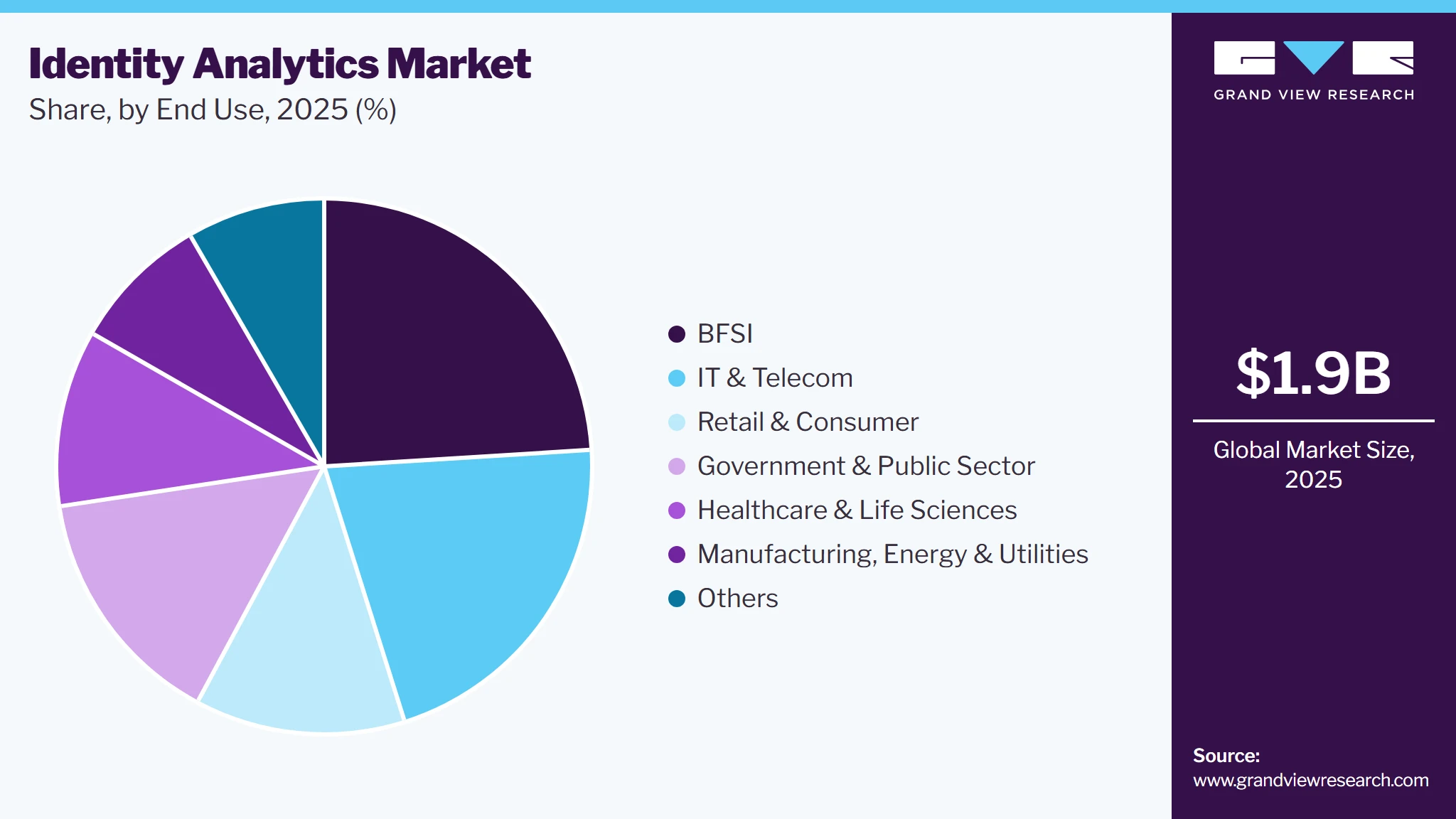
The BFSI segment dominated the market and accounted for the revenue share of 24.0% in 2025, driven by the sector's high exposure to identity fraud, credential compromise, unauthorized access, and increasingly sophisticated digital attacks. Banks, insurers, and financial institutions are investing in identity analytics to strengthen authentication monitoring, detect anomalous behavior, manage privileged access, support regulatory compliance, and protect increasingly digital customer and employee ecosystems.
 To learn more about this report, Download Free Sample Report
 The retail and consumer segment is expected to grow at a significant CAGR over the forecast period, driven by rapid e-commerce adoption, digital wallets, loyalty platforms, mobile applications, and large-scale customer identity databases that increase exposure to account takeover and identity fraud. Retailers are using identity analytics to analyze customer and employee access behavior, detect suspicious activity, protect digital accounts, and reduce fraud-related losses while maintaining frictionless customer experiences.
Regional Insights
North America dominated the global market with the largest revenue share of 38.5% in 2025, driven by the increasing convergence of identity security with enterprise cybersecurity operations, as organizations seek to use identity signals alongside endpoint, network, and cloud telemetry to detect threats. The region's mature cybersecurity ecosystem and widespread adoption of SIEM, XDR, PAM, and identity threat detection technologies are encouraging enterprises to correlate authentication, privilege, and behavioral data for faster identification of compromised identities and lateral movement.
 To learn more about this report, Download Free Sample Report
 U.S. Identity Analytics Market Trends
The identity analytics market in the U.S. is expected to grow significantly at a CAGR of 24.9% from 2026 to 2033, due to the rapid expansion of non-human identities, including service accounts, APIs, cloud workloads, bots, and AI agents. As enterprises deploy increasingly autonomous applications and AI-driven workflows, the number of machine identities requiring credentials and permissions is growing, creating demand for analytics that can establish ownership, monitor privilege usage, identify anomalous activity, and detect identity-related attack paths.
Europe Identity Analytics Market Trends
The identity analytics market in Europe is anticipated to register considerable growth from 2026 to 2033 due to the increasing need for identity-centric compliance and auditability as organizations adapt to stringent digital-security and data-protection requirements. Enterprises are strengthening capabilities to demonstrate appropriate access controls, segregation of duties, identity lifecycle governance, and traceability of privileged activities, encouraging the use of analytics to continuously identify policy deviations and access risks.
The UK identity analytics market is expected to grow rapidly in the coming years, owing to the growing adoption of identity-based cyber-risk quantification within enterprise security programs. Organizations are increasingly seeking to translate identity events and access anomalies into measurable risk indicators that security teams can prioritize, helping them focus remediation efforts on high-risk accounts, excessive privileges, unusual authentication behavior, and vulnerable access pathways.
The Germany identity analytics market held a substantial market share in 2025 due to the increasing protection requirements for industrial and operational technology environments, where manufacturing organizations must manage identities across IT systems, production networks, connected equipment, and third-party maintenance ecosystems. Identity analytics enables enterprises to identify unusual access to sensitive operational resources and strengthen control over privileged and remote access without disrupting critical production processes.
Asia Pacific Identity Analytics Market Trends
Asia Pacific identity analytics held a significant share in the global market in 2025, due to the rapid digitization of financial services and super-app ecosystems, which are generating large volumes of identity, authentication, and behavioral data. Banks, fintech companies, digital platforms, and mobile-service providers increasingly require analytics to distinguish legitimate users from suspicious activity across high-volume digital interactions, supporting demand for real-time identity-risk assessment.
The Japan identity analytics market is expected to grow rapidly in the coming years, driven by the increasing modernization of legacy identity infrastructure as enterprises transition toward cloud-based applications and hybrid IT architectures. Identity analytics helps organizations bridge traditional directory and access-control environments with newer cloud identities, providing greater visibility into account activity, privileges, and access anomalies during modernization initiatives.
The China identity analytics market held a substantial market share in 2025, due to the growing need for identity security across extensive digital ecosystems and large-scale cloud deployments. Enterprises and digital platforms are managing enormous volumes of user accounts, application identities, and access events, creating demand for analytics capable of detecting abnormal authentication behavior, unauthorized access, and identity-related risks across highly distributed digital environments.
Key Identity Analytics Company Insights
Key players operating in the identity analytics industry are SailPoint Technologies Holdings Inc., CyberArk Software Ltd., Microsoft, Oracle, IBM Corporation, and Okta Inc. The companies are focusing on various strategic initiatives, including new product development, partnerships & collaborations, and agreements to gain a competitive advantage over their rivals. The following are some instances of such initiatives.
- In May 2026, SailPoint introduced Agentic Fabric, a new solution designed to help enterprises secure and govern AI agents and other non-human identities. The platform connects identities, access permissions, and activity across enterprise environments, using identity-graph capabilities to map AI agents and machine identities to their owners, applications, systems, and critical data. It also provides governance, authorization controls, threat detection, and automated response capabilities to help organizations manage emerging identity risks as AI adoption expands.
- In February 2026, Palo Alto Networks completed its acquisition of CyberArk Software Ltd., making identity security a core component of its cybersecurity platform. The transaction adds CyberArk’s capabilities for securing human, machine, and AI identities, with the companies focusing on reducing excessive privileges, limiting lateral movement, and detecting identity-driven threats across hybrid cloud environments. CyberArk’s Identity Security Platform will remain available as a standalone offering while its capabilities are progressively integrated into Palo Alto Networks’ broader security ecosystem.
Key Identity Analytics Companies
The following key companies have been profiled for this study on the identity analytics market:
-
CyberArk Software Ltd.
-
Eviden
-
HID Global Corporation
-
IBM Corporation
-
Microsoft Corporation
-
Okta Inc.
-
One Identity LLC
-
Oracle
-
Ping Identity Holding Corp.
-
SailPoint Technologies Holdings Inc.
-
Saviynt Inc.
-
Securonix Inc.
-
Thales Group
-
Transmit Security Ltd.
-
Verint Systems Inc.
Competitive Benchmarking
Category
Operating Strategies
Competitive Edge
Weakness
Established Players (SailPoint Technologies Holdings Inc., CyberArk Software Ltd., Microsoft, Oracle, IBM Corporation, and Okta Inc.)
- Invest in identity analytics, identity governance and administration (IGA), identity threat detection and response (ITDR), behavioral analytics, risk-based access controls, and AI/ML-driven identity risk assessment.
- Expand strategic partnerships, acquisitions, and technology ecosystems to strengthen identity-security capabilities and enterprise deployments.
- Strong global brand recognition and extensive enterprise customer bases. Broad cybersecurity and identity portfolios spanning IAM, IGA, PAM, cloud security, threat detection, and analytics.
- High R&D investment and substantial financial resources support development of AI-powered identity intelligence, behavioral monitoring, risk scoring, and automated remediation.
- Higher licensing, implementation, and integration costs for complex enterprise environments. Longer procurement and deployment cycles, particularly for large regulated organizations.
- Integration challenges can arise across legacy IAM infrastructure, heterogeneous directories, cloud environments, and multiple security platforms.
Emerging Players (Saviynt Inc., Securonix Inc., Transmit Security Ltd., One Identity LLC)
- Focus on cloud-native identity security, identity analytics, behavioral intelligence, identity governance, fraud detection, and risk-based authentication.
- Expand AI/ML capabilities to identify anomalous identity behavior, excessive privileges, compromised credentials, and identity-related threats.
- Faster innovation cycles and greater flexibility in addressing emerging identity-security use cases. Strong specialization in areas such as cloud IGA, UEBA, identity threat detection, customer identity, fraud prevention, and identity risk analytics.
- Flexible architectures and specialized functionality can provide competitive advantages in specific enterprise and industry applications.
- Smaller global customer bases and comparatively lower brand recognition than the largest technology vendors. Lower financial capacity for global expansion and large-scale R&D investments.
- More limited distribution, implementation, and support networks in some markets. Greater concentration in specific identity-security segments can also increase exposure to changes in enterprise technology preferences and competitive offerings.
Identity Analytics Market Report Scope
Report Attribute
Details
Market size in 2025
USD 1.9 billion
Estimated market size in 2026
USD 2.3 billion
Projected market size by 2033
USD 12.7 billion
Growth rate
CAGR of 27.4% from 2026 to 2033
Actual data
2021 - 2025
Forecast period
2026 - 2033
Quantitative units
Revenue in USD billion and CAGR from 2026 to 2033
Report coverage
Revenue forecast, company share, competitive landscape, growth factors, and trends
Segments covered
Component, deployment, enterprise size, application, end use, region
Regional scope
North America; Europe; Asia Pacific; Latin America; MEA
Country scope
U.S.; Canada; Mexico; UK; Germany; France; China; India; Japan; Australia; South Korea; Brazil; UAE; Kingdom of Saudi Arabia; South Africa
Key companies profiled
CyberArk Software Ltd.; Eviden; HID Global Corporation; IBM Corporation; Microsoft; Okta Inc.; One Identity LLC; Oracle; Ping Identity Holding Corp.; SailPoint Technologies Holdings Inc.; Saviynt Inc.; Securonix Inc.; Thales Group; Transmit Security Ltd.; Verint Systems Inc.
Customization scope
Free report customization (equivalent to 8 analysts working days) with purchase. Addition or alteration to country, regional & segment scope.
Pricing and purchase options
Avail customized purchase options to meet your exact research needs. Explore purchase options
Global Identity Analytics Market Report Segmentation
This report forecasts revenue growth at the global, regional, and country levels and provides an analysis of the latest industry trends in each of the sub-segments from 2021 to 2033. For this study, Grand View Research has segmented the identity analytics market report based on component, deployment, enterprise size, application, end use, and region.
-
Component Outlook (Revenue, USD Billion, 2021 - 2033)
-
Solutions
-
Services
-
-
Deployment Outlook (Revenue, USD Billion, 2021 - 2033)
-
Cloud
-
On-premises
-
-
Enterprise Size Outlook (Revenue, USD Billion, 2021 - 2033)
-
Large Enterprises
-
Small & Medium Enterprises (SMEs)
-
-
Application Outlook (Revenue, USD Billion, 2021 - 2033)
-
Account & Access Analytics
-
Customer Identity Analytics
-
Fraud & Account Takeover Detection
-
GRC Analytics
-
User & Entity Behavior Analytics (UEBA)
-
Others
-
-
End Use Outlook (Revenue, USD Billion, 2021 - 2033)
-
IT and Telecom
-
BFSI
-
Government and Public Sector
-
Retail and Consumer
-
Healthcare and Life Sciences
-
Manufacturing, Energy and Utilities
-
Others
-
-
Regional Outlook (Revenue, USD Billion, 2021 - 2033)
-
North America
-
U.S.
-
Canada
-
Mexico
-
-
Europe
-
UK
-
Germany
-
France
-
-
Asia Pacific
-
China
-
India
-
Japan
-
South Korea
-
Australia
-
-
Latin America
-
Brazil
-
-
Middle East & Africa
-
UAE
-
Saudi Arabia
-
South Africa
-
-
Research Methodology
The identity analytics market figures in this report are based on a proven research process that combines executive interviews with secondary research from proprietary databases, company filings, and recognized regulatory and institutional sources. Market size is built through value-chain sizing-reconciling supply-side and demand-side estimates-and triangulated with bottom-up and top-down approaches. Every estimate passes multiple levels of expert validation before publication, with each identity analytics segment quantified using the revenue-capture definitions in the table below.
Segment Definition
Component
Revenue capture definition
Solutions
Market value is captured through identity analytics software platforms and tools used to collect, correlate, monitor, analyze, and visualize identity and access data. This includes identity risk analytics, identity behavior analytics, access intelligence, entitlement analytics, identity threat detection, anomaly detection, risk scoring, and AI/ML-enabled identity analytics capabilities. Revenue includes software licenses, subscriptions, SaaS fees, and usage-based charges attributable to these capabilities.
Services
Market value is captured through professional and managed services directly associated with the deployment, integration, customization, operation, and maintenance of identity analytics solutions. This includes consulting, implementation, integration, configuration, training, technical support, managed identity analytics, monitoring, and related optimization services. Revenue from standalone cybersecurity, general IT consulting, or unrelated IAM services is excluded.
Deployment
Revenue capture definition
Cloud
Market value is captured from identity analytics solutions deployed and delivered through cloud infrastructure, including SaaS, public cloud, private cloud, and hybrid-cloud environments where the analytics application is hosted or operated using cloud resources. Revenue includes recurring subscriptions and usage-based fees attributable to cloud-based identity analytics capabilities.
On-premises
Market value is captured from identity analytics software installed, hosted, and operated within the customer's own data center or IT infrastructure. Revenue includes software licenses, maintenance, and related fees attributable to on-premises identity analytics deployments.
Enterprise Size
Revenue capture definition
Large Enterprises
The large enterprises segment, with respect to the number of employees, typically comprises organizations employing more than 1,000 employees for multinational corporations.
Small & Medium Enterprises (SMEs)
The SMEs segment, with respect to the number of employees, generally includes organizations employing between 10 and 999 employees.
Application
Revenue capture definition
Account & Access Analytics
Market value is captured from identity analytics capabilities used to analyze account activity, authentication events, access requests, permissions, entitlements, privilege usage, dormant accounts, and anomalous access patterns to identify and manage identity and access risks.
Customer Identity Analytics
Market value is captured from analytics capabilities focused specifically on customer and consumer identities, including analysis of customer authentication, login behavior, identity journeys, access patterns, and identity-related risks across digital services, applications, and customer portals.
Fraud & Account Takeover Detection
Market value is captured from identity analytics capabilities used to identify fraudulent identity activity, credential compromise, account takeover, suspicious login behavior, unusual transaction-related identity signals, and other identity-based fraud patterns. General transaction fraud analytics without an identity or account-access component is excluded.
GRC Analytics
Market value is captured from analytics capabilities used to assess identity-related governance, risk, and compliance requirements, including access-policy violations, segregation-of-duties conflicts, entitlement risks, audit requirements, access certifications, and compliance-related identity reporting.
User & Entity Behavior Analytics (UEBA)
Market value is captured from analytics capabilities that establish behavioral baselines for users and entities and identify deviations or anomalies in identity, authentication, access, and activity patterns. This includes behavioral risk scoring and detection of potentially compromised or malicious identities.
Others
Market value is captured from identity analytics applications not covered by the above categories, including specialized identity intelligence, identity lifecycle analytics, niche identity-risk use cases, and other application-specific analytics capabilities.
End Use
Revenue capture definition
IT and Telecom
Market value is captured from identity analytics solutions and services deployed by IT service providers, software companies, telecommunications operators, data infrastructure providers, and related technology organizations to monitor and manage workforce, privileged, customer, and machine identity risks.
BFSI
Market value is captured from identity analytics solutions and services deployed by banks, insurance companies, financial institutions, fintech organizations, payment providers, and other financial-services entities to monitor identity risks, access behavior, fraud, account takeover, and compliance requirements.
Government and Public Sector
Market value is captured from identity analytics solutions and services deployed by national, regional, and local government agencies, public institutions, defense-related organizations, and other public-sector bodies to monitor citizen, employee, contractor, and privileged identities and strengthen access governance and security.
Retail and Consumer
Market value is captured from identity analytics solutions and services deployed by retailers, e-commerce companies, consumer platforms, marketplaces, and related businesses to analyze customer and workforce identity activity, account access, authentication behavior, and account takeover or fraud risks.
Healthcare and Life Sciences
Market value is captured from identity analytics solutions and services deployed by hospitals, healthcare providers, pharmaceutical companies, biotechnology organizations, laboratories, and other life-sciences entities to monitor workforce, patient, privileged, and third-party identities and protect access to sensitive health and research data.
Manufacturing, Energy and Utilities
Market value is captured from identity analytics solutions and services deployed by manufacturers, energy companies, utilities, and industrial organizations to monitor workforce, contractor, privileged, machine, and operational technology identities and identify anomalous access to enterprise and industrial environments.
Other
Market value is captured from identity analytics deployments across end-use sectors not specifically covered above, including transportation and logistics, media and entertainment, education, hospitality, real estate, and professional services.
Estimation Model
Layer
Question
Analysis
Identity Data & Risk Intelligence Layer
Where is identity analytics required?
Identify enterprise and digital environments where organizations generate large volumes of identity, authentication, access, entitlement, and behavioral data requiring continuous analysis. This layer evaluates workforce identities, customer identities, privileged accounts, machine identities, AI agents, applications, cloud workloads, and third-party users across cloud, on-premises, hybrid, and distributed IT environments where analytics are required to establish identity context, detect anomalies, assess risk, and improve visibility into access activity.
Identity Analytics Technology & Data Layer
What enables identity analytics implementation?
Assess the technologies and data infrastructure supporting identity analytics, including identity graphs, behavioral analytics, machine learning, AI-based anomaly detection, risk scoring, identity correlation, access intelligence, entitlement analysis, and identity threat detection. The effectiveness and scalability of an identity analytics environment depend on its ability to ingest and correlate data from IAM, IGA, PAM, directories, HR systems, cloud platforms, applications, SIEM, endpoint, and security systems while maintaining accurate identity context.
Identity Analytics Application & Deployment Layer
How are identity analytics capabilities delivered to users and security teams?
Analyze delivery models and applications through which identity analytics are operationalized, including cloud and on-premises deployments supporting account and access analytics, customer identity analytics, fraud and account takeover detection, GRC analytics, and UEBA. Providers deliver capabilities through software platforms, APIs, dashboards, risk scoring, alerts, automated workflows, integration, customization, professional services, and managed services to enable continuous identity-risk monitoring and response.
Identity Solutions & Enterprise Economics Layer
How is value generated within the identity analytics ecosystem?
Evaluate revenue generated through identity analytics software licenses, subscriptions, SaaS platforms, usage-based models, implementation and integration services, consulting, managed services, maintenance, and technical support. Additional enterprise value is generated through reduced identity-related security incidents, improved access governance, faster threat detection, compliance support, reduced excessive privileges, and improved security operations. Adoption is influenced by identity-data quality, integration complexity, deployment costs, regulatory requirements, cybersecurity maturity, and the measurable reduction of identity-related risk.
Delivered Customization
This report has been delivered with the following In-depth customizations:
Client Request
Customization Delivered
Value Adds
Identity Data Integration & Risk Intelligence Trends
Conducted a focused analysis of Semantic Web adoption for integrating heterogeneous enterprise data sources, including databases, cloud applications, APIs, legacy systems, and distributed data repositories.
Evaluated the role of RDF, ontologies, linked data, and semantic data models in improving data interoperability and information accessibility.
Helps stakeholders identify high-potential semantic data integration opportunities, assess interoperability requirements, and understand how organizations are addressing fragmented data environments.
Identity Threat Detection & Behavioral Analytics Adoption Trends
Evaluated adoption trends for UEBA, identity threat detection and response (ITDR), anomalous authentication detection, account takeover detection, identity-risk scoring, and behavioral analytics across enterprise security environments.
Assessed how organizations are using AI/ML and identity intelligence to identify compromised credentials, excessive privileges, anomalous access, and identity-driven attack patterns.
Provides insights into emerging identity-security technologies, behavioral analytics adoption patterns, and commercially attractive opportunities for identity analytics and cybersecurity solution providers.
Helps stakeholders understand the convergence of IAM, security analytics, and identity threat detection.
Identity Analytics Application & Enterprise Opportunity Assessment
Assessed demand for account and access analytics, customer identity analytics, fraud and account takeover detection, GRC analytics, and UEBA across major end-use industries.
Evaluated cloud versus on-premises deployment trends, large-enterprise versus SME adoption, integration requirements, identity-data complexity, and enterprise implementation considerations.
Supports investment and expansion strategies by identifying high-growth application areas, evaluating enterprise adoption readiness, and highlighting opportunities for identity analytics software, professional services, and managed service providers.
Enables stakeholders to prioritize attractive industry verticals and deployment models for future growth.
Frequently Asked Questions About This Report
The account & access analytics segment held the largest share (over 23.9%) in 2025, while the fraud & account takeover detection segment is the fastest-growing segment.
The global identity analytics market size was estimated at USD 1.9 billion in 2025 and is expected to reach USD 2.3 billion in 2026.
The global identity analytics market is expected to grow at a compound annual growth rate of 27.4% from 2026 to 2033 to reach USD 12.7 billion by 2033.
Key factors include rising identity-based cyberattacks, increasing adoption of cloud and digital services, and growing demand for real-time user behavior, access-risk, and fraud detection.
North America dominated with 38.5% revenue share in 2025.
Asia Pacific is the fastest-growing region over the forecast period.
Key players operating in the identity analytics market include CyberArk Software Ltd., Eviden, HID Global Corporation, IBM Corporation, Microsoft, Okta Inc., One Identity LLC, Oracle, Ping Identity Holding Corp., SailPoint Technologies Holdings Inc., Saviynt Inc., Securonix Inc., Thales Group, Transmit Security Ltd., Verint Systems Inc.
The solutions segment led with a 80.3% revenue share in 2025, while the services segment is the fastest-growing segment.
The cloud segment led with a 66.6% revenue share in 2025, while the on-premises segment is the fastest-growing segment.
About the Author(s)
IT Services & Applications Research Team
Technology · IT Services & ApplicationsThis report was authored by the it services & applications research team at Grand View Research - comprising two research analysts, one senior research analyst, and one industry expert - with specialized expertise in the it services & applications segment of the technology industry. All findings are based on proprietary technology databases, executive interviews, and regulatory analysis, subject to internal peer review prior to publication.
Last Updated:
Speak to Analyst

Customize this report to your needs - add regions, segments, or data points, with 20% free customization.
Or view our licence options:


ISO 9001:2015 & 27001:2022 Certified
We are GDPR and CCPA compliant! Your transaction & personal information is safe and secure. For more details, please read our privacy policy.


