
- Home
- »
- Advanced Interior Materials
- »
-
Immersion Cooling Market Size & Share Report, 2026-2033GVR Report cover

Immersion Cooling Market (2026 - 2033)
Size, Share & Trends Analysis Report By Product (Single-phase, Two-phase), By Cooling Liquid (Mineral Oil, Fluorocarbon-based Fluids), By Application (High-performance Computing, Edge Computing, Cryptocurrency Mining), By Region, And Segment Forecasts
Market Size, 2025
$348.9MMarket Estimate, 2026
$425.8MMarket Forecast, 2033
$2,017.3MCAGR, 2026–2033
24.9%Immersion Cooling Market Summary
The global immersion cooling market size was valued at USD 348.9 million in 2025 and is projected to grow from USD 425.8 million in 2026 to USD 2,017.3 million by 2033, at a CAGR of 24.9% from 2026 to 2033. The market in North America dominated with a revenue share of 34.9% in 2025. The market is primarily driven by the rapid growth of artificial intelligence, high-performance computing (HPC), and hyperscale data centers.
 Source: Grand View Research, IR Documents, Primary Interviews, Paid DatabasesTo learn more about this report,
 Download Free Sample Report
 Key Market Trends & Insights
- By product: Single-phase immersion cooling segment held the largest market share of 70.4% in 2025.
- By cooling liquid: Mineral oil segment held the largest market share of 43.5% in 2025.
- By application: High-performance computing segment held the largest market share in 2025.
Regional Highlights
- Largest regional market: North America (34.9% revenue share, 2025)
- Fastest-growing regional market: Asia Pacific (highest CAGR, 2026-2033)
- By country: U.S. held the largest market share in 2025
Market Size & Forecast
- Market size in 2025: USD 348.9 Million
- Estimated market size in 2026: USD 425.8 Million
- Projected market size by 2033: USD 2,017.3 Million
- CAGR (2026-2033): 24.9%
Three ways to get this report
Buy it, customize it, or ask a question.Ask an Analyst
Analyst response in 1 business day
- AccessReport author, directly
- Reply timeWithin 1 working day
- No sales callDirect answer only
- FormatEmail reply
- CostFree, no cost
Get the Full Report
What the study covers
- FormatsPDF · Excel · Dashboard
- Timeline2026–2033 annual, 2025 base
- Coverage20+ countries, 5 regions
- Companies10+ key players profiled
Customize the Report
20% free customization
- IncludeCountries, segments, points
- TailorTo your product definition
- ExtendDeeper competitor detail
- OrA fully bespoke study
- Turnaround5–10 working days
AI training models and GPU-intensive workloads generate extremely high heat densities that traditional air-cooling systems struggle to manage efficiently. Immersion cooling offers superior thermal management, higher energy efficiency, and improved processing performance by directly submerging servers in dielectric fluids. To learn more about this report, Download Free Sample Report
 Another driver is the growing focus on sustainable, energy-efficient data center operations. Data centers consume significant amounts of electricity, with cooling accounting for a large share of operational energy usage. Immersion cooling helps reduce power consumption, reduce dependence on conventional HVAC systems, minimize water usage, and support lower carbon emissions. Governments, cloud service providers, and enterprise operators are investing heavily in green data center technologies to meet environmental targets and reduce operational costs.
Market Dynamics
The growing adoption of artificial intelligence (AI), machine learning, and high-performance computing is a major driver for the market growth. AI training and inference workloads require powerful GPUs and processors that generate substantial amounts of heat during continuous operation. Traditional air-cooling systems are becoming less effective at meeting the thermal demands of high-density server environments, driving strong demand for advanced cooling technologies such as immersion cooling. The technology enables efficient heat dissipation, improves hardware performance, and supports higher computing densities within limited data center space.
In addition, hyperscale cloud providers and enterprise data center operators are increasingly focusing on reducing energy consumption and operational costs. Immersion cooling significantly reduces cooling-related electricity consumption and minimizes reliance on conventional HVAC infrastructure. The technology also helps improve server lifespan, reduce maintenance requirements, and support sustainable data center operations. As investments in AI infrastructure continue to grow globally, demand for immersion-cooling solutions is expected to accelerate further.
The high upfront investment required for immersion-cooling infrastructure remains a key restraint on market growth. Deployment involves specialized immersion tanks, dielectric-cooling fluids, modified server configurations, and supporting thermal management systems, which can increase capital expenditures compared to conventional cooling methods. In addition, retrofitting existing data centers with immersion cooling technology can be complex and costly, particularly for operators with large legacy infrastructure. These factors may limit adoption among small- and medium-sized data center operators despite the long-term energy-saving benefits of immersion cooling systems.
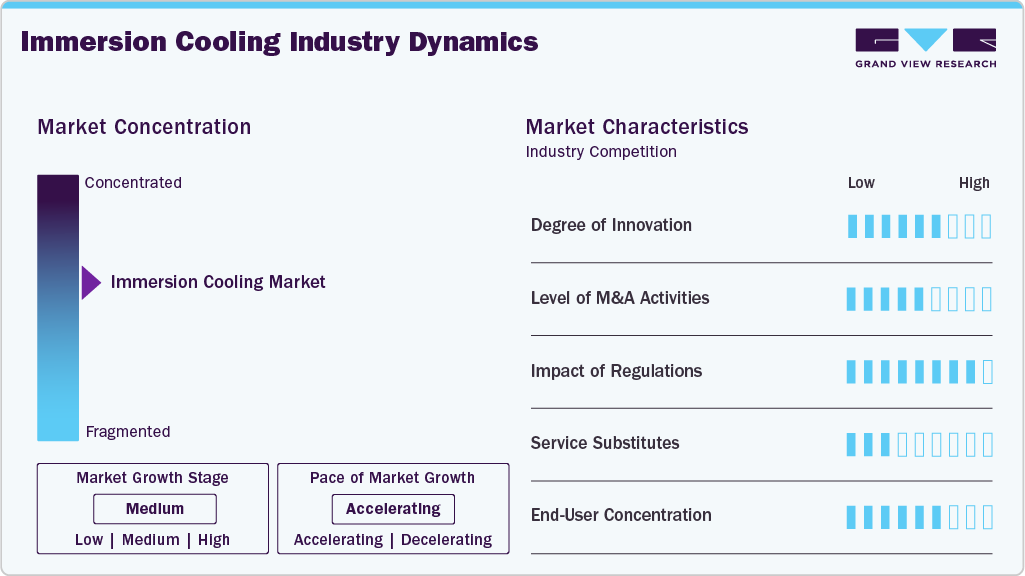
Market Concentration & Characteristics
The immersion cooling industry is concentrated, with a combination of large data center infrastructure providers and specialized thermal management companies competing within the industry. Market participants are focusing on technological innovation, strategic partnerships, and the expansion of AI-ready cooling solutions to strengthen their market position. The industry is also witnessing increased collaboration among cooling system manufacturers, dielectric fluid suppliers, and server hardware providers to develop integrated, energy-efficient cooling ecosystems.
The immersion cooling industry is highly innovation-driven due to rising demand for AI, HPC, and high-density data center infrastructure. Companies are developing advanced dielectric fluids, compact immersion systems, and energy-efficient cooling technologies to improve thermal performance and reduce operational costs. Recent industry developments also focus on sustainable cooling solutions and lower carbon emissions. For instance, in April 2026, Keppel and Shell introduced an advanced immersion liquid-cooling testbed to improve efficiency and sustainability in AI-focused data centers.
 To learn more about this report, Download Free Sample Report
 Environmental and energy-efficiency regulations are playing an important role in shaping the immersion cooling industry. Governments and regulatory bodies are promoting sustainable data center operations through policies that focus on reducing carbon emissions, energy consumption, and water use. In addition, increasing restrictions on certain fluorinated cooling fluids are encouraging the adoption of environmentally safer and energy-efficient cooling technologies.
The market shows moderate to high end-user concentration, with demand mainly coming from hyperscale data centers, AI infrastructure providers, cryptocurrency mining operators, and large cloud companies. These organizations require efficient cooling systems to support high-density computing workloads and continuous operations. At the same time, adoption is gradually expanding across telecom, research, defense, and edge computing sectors as immersion cooling becomes more commercially viable.
Product Insights
The single-phase immersion cooling segment led the market with the largest revenue share of 70.4% in 2025, due to its cost-effectiveness, operational simplicity, and efficient thermal management capabilities. In this system, electronic components are submerged in a dielectric fluid that remains in liquid form during the cooling cycle, making it easier to maintain and deploy than in two-phase systems. The technology is widely used across data centers, AI infrastructure, and cryptocurrency mining facilities owing to its lower infrastructure costs, high dielectric strength, reduced environmental impact, and ability to improve Power Usage Effectiveness (PUE).
The two-phase immersion cooling segment is projected to register at the fastest CAGR during the forecast period, driven by its superior heat dissipation efficiency and suitability for high-density computing environments. In this system, the dielectric fluid evaporates after absorbing heat, then condenses back into liquid form, enabling highly effective thermal management for AI workloads, hyperscale data centers, and high-performance computing (HPC) systems. Rising investments in advanced data center cooling technologies and increasing demand for efficient GPU cooling solutions are accelerating adoption. In November 2024, Opteon introduced its developmental two-phase immersion cooling liquid at the SC24 event, highlighting significant reductions in cooling energy consumption and space requirements, further supporting market growth.
Cooling Liquid Insights
The mineral oil segment led the market with the largest revenue share of 43.5% in 2025, owing to its cost-effectiveness, easy availability, and strong thermal management capabilities. Mineral oil is widely used as a single-phase dielectric cooling fluid due to its high boiling point, electrical insulation properties, and operational simplicity compared to conventional air-cooling systems. The fluid effectively absorbs and transfers heat away from electronic components, helping maintain stable operating temperatures in data centers, cryptocurrency mining facilities, and high-performance computing environments.
The fluorocarbon-based fluids segment is expected to witness at the fastest CAGR during the forecast period, due to increasing demand for advanced cooling solutions in AI, hyperscale data centers, and high-density computing applications. These synthetic dielectric fluids offer excellent electrical insulation and heat transfer capabilities, making them highly suitable for safely cooling sensitive electronic components without the risk of short circuits or equipment damage. Their superior dielectric performance, reliability, and efficiency in managing high thermal loads are driving adoption among data center operators seeking next-generation cooling technologies.
Application Insights
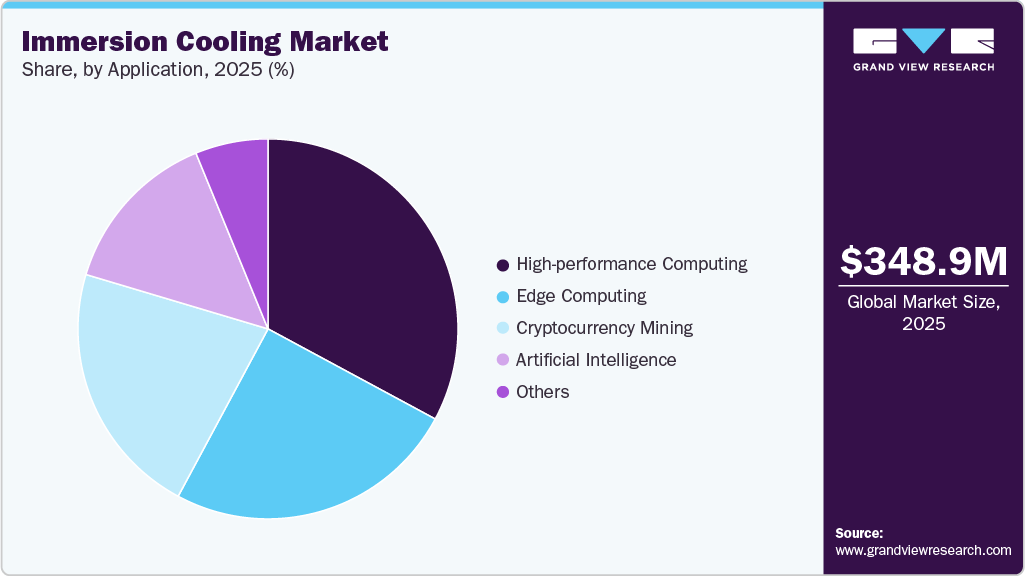
The high-performance computing (HPC) segment accounted for the largest market share in 2025, driven by the increasing need for efficient thermal management in data-intensive computing environments. HPC applications such as scientific simulations, machine learning, engineering analysis, and big data processing require substantial computational power, generating substantial heat that traditional air-cooling systems often struggle to manage effectively. Immersion cooling offers superior heat dissipation, improved energy efficiency, lower latency, and support for high chip-density configurations, making it highly suitable for HPC infrastructure.
 To learn more about this report, Download Free Sample Report
 The artificial intelligence (AI) segment is projected to witness at the fastest CAGR during the forecast period, owing to the rapid expansion of AI training, inference workloads, and generative AI applications. AI systems rely heavily on GPUs, TPUs, and other high-performance accelerators that generate significant amounts of heat during continuous processing of large datasets and complex algorithms. This has increased the demand for advanced cooling technologies capable of maintaining performance and energy efficiency in high-density computing environments. Growing investments in AI-focused data centers and increasing adoption of generative AI technologies across industries are expected to further accelerate the deployment of immersion cooling systems globally.
Regional Insights
North America dominated the global immersion cooling market with the largest revenue share of 34.9% in 2025, supported by the region’s large concentration of hyperscale data centers, cloud computing companies, and AI-driven infrastructure. Strong demand for high-density computing and growing investments in advanced thermal management technologies have encouraged widespread adoption of immersion cooling systems. The presence of established technology providers and increasing focus on reducing data center energy consumption are further contributing to market growth across the region.
 To learn more about this report, Download Free Sample Report
 U.S. Immersion Cooling Market Trends
The immersion cooling market in the U.S. accounted for the largest market revenue share in North America in 2025, due to the strong presence of hyperscale data centers, cloud computing infrastructure, and growing investments in artificial intelligence (AI) and high-performance computing (HPC). The increasing deployment of GPU-intensive workloads and the rising demand for energy-efficient thermal management solutions are accelerating the adoption of immersion cooling technologies across the country. According to Data Center Map, the U.S. has 4,283 listed data centers across all 50 states, reflecting its extensive digital infrastructure network. In addition, increasing focus on reducing energy consumption, improving Power Usage Effectiveness (PUE), and supporting sustainable data center operations is further driving market growth in the country.
Europe Immersion Cooling Market Trends
The immersion cooling market in Europe is experiencing notable growth, driven by the increasing emphasis on sustainable, energy-efficient data center operations. Regional policies focused on lowering carbon emissions and improving energy efficiency are encouraging operators to adopt advanced cooling technologies. Growing AI adoption, the expansion of cloud infrastructure, and rising investments in environmentally responsible digital facilities are driving demand for immersion cooling systems across the region.
The UK immersion cooling market held a significant share in Europe in 2025, supported by rising investments in AI infrastructure, cloud computing, and high-density data center expansion. The increasing deployment of GPU-based computing systems is driving strong demand for advanced cooling technologies that improve energy efficiency and thermal performance. In September 2025, NVIDIA announced a USD 2.6 billion investment initiative alongside partners to expand the UK AI ecosystem, including the deployment of 120,000 NVIDIA Blackwell GPUs. The company further stated that up to 60,000 GPUs are expected to support new AI factories by 2026 through collaborations with Microsoft, Nscale, OpenAI, and CoreWeave, underscoring significant future demand for immersion-cooling solutions.
The immersion cooling market in Germany is emerging as a key growth market in Europe, driven by expanding digital infrastructure, increasing enterprise cloud adoption, and the rising deployment of AI and industrial automation technologies. The growing need for efficient cooling systems in high-performance computing environments is encouraging investments in advanced thermal management solutions. In addition, a strong national focus on energy efficiency, sustainable infrastructure, and lower carbon emissions is supporting the adoption of immersion cooling technologies across modern data center facilities.
Asia Pacific Immersion Cooling Market Trends
The immersion cooling market in the Asia Pacific is projected to witness at the fastest CAGR during the forecast period, due to the rapid expansion of digital infrastructure and increasing deployment of data centers across emerging economies. The rising adoption of artificial intelligence, cloud services, and 5G technologies is driving greater demand for efficient cooling solutions in countries such as China, India, Japan, and Australia. In addition, increasing government initiatives supporting digital transformation and smart infrastructure development are accelerating regional market expansion.
The China immersion cooling market is supported by rapid growth in AI infrastructure, cloud computing capacity, and large-scale data center development. The increasing adoption of high-density computing systems and GPU-intensive workloads is accelerating demand for advanced cooling technologies that improve energy efficiency and operational reliability. In November 2025, Goldman Sachs indicated that Chinese AI companies are projected to invest nearly USD 70 billion in data center infrastructure as they expand both domestic and international operations, creating significant growth opportunities for immersion cooling solutions.
The immersion cooling market in India is emerging as a high-growth market, driven by rising investments in AI infrastructure, expanding digital transformation initiatives, and increasing data center development across the country. The growing adoption of cloud computing, artificial intelligence, and high-performance computing is driving strong demand for advanced, energy-efficient cooling technologies. As part of the IndiaAI Mission, the Government of India introduced IndiaAIKosh in 2025 to provide a centralized repository for AI datasets, models, and tools. By December 2025, the platform had integrated 5,722 datasets and 251 AI models from 54 organizations spanning 20 sectors. Furthermore, the IndiaAI Compute Portal currently supports more than 38,000 GPUs and 1,050 TPUs, reflecting the rapid expansion of India’s AI computing capabilities and underscoring the need for efficient immersion-cooling solutions.
Latin America Immersion Cooling Market Trends
The immersion cooling market in Latin America is developing steadily, driven by increasing investments in cloud infrastructure, enterprise data storage, and regional data center construction. Businesses across the region are gradually adopting advanced cooling technologies to improve operational efficiency and manage rising computing workloads. Expanding digital connectivity and growing demand for reliable data processing infrastructure are expected to create long-term opportunities for immersion cooling providers.
The Brazil immersion cooling market is emerging as a key market in Latin America, due to increasing investments in data center infrastructure, cloud computing services, and digital transformation initiatives. Rising internet penetration, growth in enterprise data storage requirements, and expanding adoption of artificial intelligence and high-performance computing applications are driving demand for advanced thermal management solutions in the country.
Middle East & Africa Immersion Cooling Market Trends
The immersion cooling market in the Middle East & Africa is gaining traction as countries continue investing in digital infrastructure modernization and large-scale technology projects. The rising deployment of data centers, increasing cloud adoption, and growth in AI-based applications are driving demand for advanced cooling systems in the region. The need for energy-efficient cooling technologies that operate effectively in warm climates is also driving the adoption of immersion cooling solutions.
The Saudi Arabia immersion cooling market is witnessing growing adoption due to rising investments in digital infrastructure, hyperscale data centers, and artificial intelligence initiatives under the country’s economic diversification programs. The increasing deployment of cloud computing services, smart city projects, and high-performance computing applications is driving demand for advanced cooling systems that operate efficiently in high-temperature environments.
Key Immersion Cooling Company Insights
Some of the key players operating in the market include Fujitsu, DUG Technology, and GRC, Green Revolution Cooling.
-
Fujitsu offers digital infrastructure, data center, and advanced cooling solutions for enterprise and high-performance computing environments. The company is strengthening its position in the immersion cooling industry through energy-efficient thermal management technologies designed for AI, GPU-intensive workloads, and hyperscale data centers. Fujitsu focuses on improving cooling efficiency, reducing power consumption, and supporting sustainable data center operations through advanced liquid and immersion cooling systems tailored for next-generation computing infrastructure.
-
DUG Technology is an Australia-based technology company specializing in high-performance computing (HPC) and immersion cooling solutions for data centers and AI infrastructure. The company developed DUG Cool, a patented single-phase immersion cooling technology designed to improve energy efficiency, reduce water consumption, and support high-density GPU and CPU workloads. DUG’s cooling systems are widely recognized for lowering power usage and improving data center sustainability, making them suitable for AI, edge computing, and hyperscale HPC applications.
Key Immersion Cooling Companies:
The following key companies have been profiled for this study on the immersion cooling market.
- Fujitsu
- DUG Technology
- GRC, Green Revolution Cooling
- Submer
- LiquidStack Holding B.V.
- Midas Immersion Cooling
- Aecorsis BV
- DCX POLSKA SP. Z O.O.
- LiquidCool Solutions
- STULZ GMBH
- Vertiv Group Corp.
- Schneider Electric
- Exxon Mobil Corporation
- Lubrizol
- nVent
Competitive Benchmarking
Operating Strategies
Competitive Edge
Weaknesses
Mature Players: Fujitsu; Vertiv Group Corp.; Schneider Electric; STULZ GMBH; Exxon Mobil Corporation
- Mature companies focus on expanding AI-ready cooling infrastructure through partnerships, acquisitions, and integrated data center solutions.
- These players invest heavily in R&D to improve energy efficiency, scalability, and compatibility with hyperscale and enterprise computing environments.
- Strong global presence, established customer base, and extensive service networks provide long-term competitive advantages.
- Broad product portfolios covering cooling systems, fluids, power management, and digital infrastructure strengthen market positioning.
- Higher operational and infrastructure costs can reduce flexibility in rapidly changing market conditions.
Emerging Players: Submer; LiquidStack Holding B.V.; Midas Immersion Cooling Liquid Solutions; Accelsius BV
- Emerging companies focus on specialized immersion cooling technologies targeting AI, HPC, cryptocurrency mining, and edge computing applications.
- Many startups emphasize modular system designs, customized cooling platforms, and sustainability-focused solutions to gain market traction.
- Faster innovation capabilities and niche technology expertise help these companies respond quickly to evolving market demands.
- Strong focus on high-density computing and advanced thermal efficiency supports differentiation in competitive AI infrastructure markets.
- Limited global presence and smaller financial resources can restrict large-scale deployment capabilities.
Recent Developments
-
In March 2026, GRC partnered with UNICOM Engineering to introduce integrated immersion-cooled AI infrastructure solutions for high-density computing applications. The collaboration combines immersion cooling technology with optimized hardware platforms to support easier deployment of AI and HPC systems. The solutions aim to improve cooling efficiency, scalability, and energy performance across modern data center environments.
-
In November 2025, DUG Technology launched the DUG Nomad 40, a 1MW immersion-cooled modular data center container designed for AI and HPC workloads. The system uses single-phase immersion cooling technology and supports over 850 NVIDIA H200 GPUs, highlighting growing demand for scalable and energy-efficient cooling infrastructure in high-density computing environments.
Immersion Cooling Market Report Scope
Report Attribute
Details
Market size in 2025
USD 348.9 million
Estimated Market size in 2026
USD 425.8 million
Projected Market size by 2033
USD 2,017.3 million
Growth rate
CAGR of 24.9% from 2026 to 2033
Base year for estimation
2025
Historical data
2021 - 2024
Forecast period
2026 - 2033
Quantitative units
Revenue in USD million/billion, and CAGR from 2026 to 2033
Report coverage
Revenue forecast, company market position analysis, competitive landscape, growth factors, and trends
Segments covered
Product, cooling liquid, application, region
Regional scope
North America; Europe; Asia Pacific; Latin America; Middle East & Africa
Country Scope
U.S.; Canada; Mexico; Netherlands; France; Germany; Russia; Italy; UK; China; India; Japan; Australia; South Korea; Brazil; Argentina; Saudi Arabia; South Africa
Key companies profiled
Fujitsu; DUG Technology; GRC (Green Revolution Cooling); Submer; LiquidStack Holding B.V.; Midas Immersion Cooling; Aecorsis BV; DCX POLSKA SP. Z O.O.; LiquidCool Solutions; STULZ GMBH; Vertiv Group Corp.; Schneider Electric; Exxon Mobil Corporation; Lubrizol; nVent
Customization scope
Free report customization (equivalent up to 8 analysts working days) with purchase. Addition or alteration to country, regional & segment scope.
Pricing and purchase options
Avail customized purchase options to meet your exact research needs. Explore purchase options
Global Immersion Cooling Market Report Segmentation
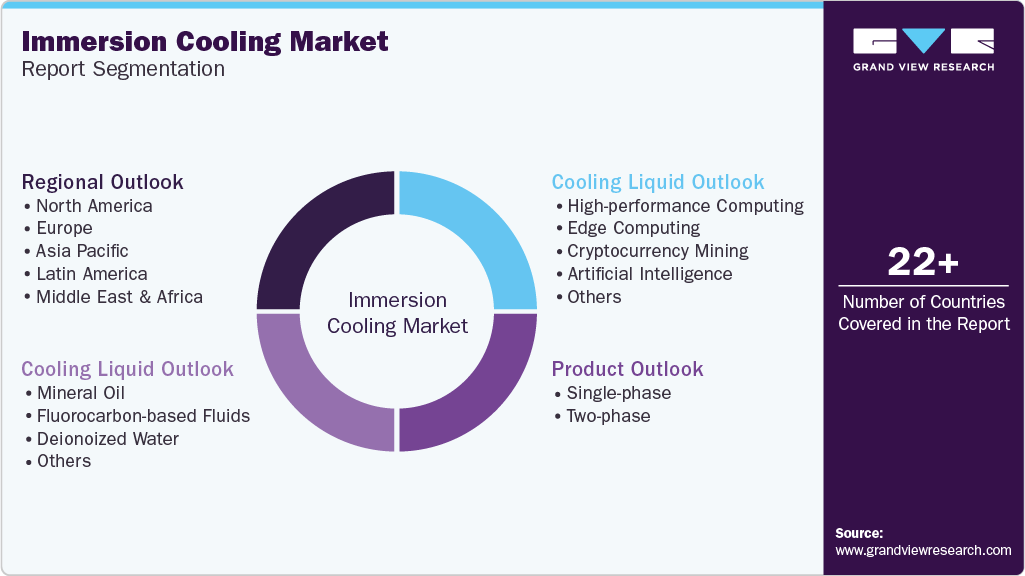
This report forecasts revenue growth at global, regional & country levels, and provides an analysis on the latest trends and opportunities in each of the sub-segments from 2021 to 2033. For this study, Grand View Research has segmented the global immersion cooling market report based on the product, cooling liquid, application, and region:
 To learn more about this report, Download Free Sample Report
 -
Product Outlook (Revenue, USD Million, 2021 - 2033)
-
Single-phase
-
Two-phase
-
-
Cooling Liquid Outlook (Revenue, USD Million, 2021 - 2033)
-
Mineral Oil
-
Fluorocarbon-based Fluids
-
Deionoized Water
-
Others
-
-
Application Outlook (Revenue, USD Million, 2021 - 2033)
-
High-performance Computing
-
Edge Computing
-
Cryptocurrency Mining
-
Artificial Intelligence
-
Others
-
-
Regional Outlook (Revenue, USD Million, 2021 - 2033)
-
North America
-
U.S.
-
Canada
-
Mexico
-
-
Europe
-
Netherlands
-
Germany
-
Italy
-
France
-
UK
-
Russia
-
-
Asia Pacific
-
China
-
India
-
Japan
-
Australia
-
South Korea
-
-
Latin America
-
Brazil
-
Argentina
-
-
Middle East & Africa
-
Saudi Arabia
-
South Africa
-
-
Delivered Customizations
This report has been delivered with the following In-depth customizations
Client Request
Customization Delivered
Value Adds
Regional Segmentation
Detailed regional market analysis was provided covering North America, Europe, Asia Pacific, Latin America, and Middle East & Africa, along with country-level insights for key markets such as the U.S., UK, Germany, China, India, Brazil, and Saudi Arabia. The assessment included market trends, infrastructure investments, AI adoption levels, and regional demand drivers influencing immersion cooling adoption.
The analysis helps stakeholders identify high-growth markets, understand regional technology adoption patterns, and evaluate country-specific investment opportunities. It also supports strategic expansion planning by highlighting regions with strong hyperscale data center growth, AI infrastructure development, and increasing demand for energy-efficient cooling solutions.
Trade assessment
A comprehensive trade and supply chain assessment was conducted covering immersion cooling systems, dielectric cooling fluids, and related thermal management technologies. The study evaluated supply chain structure, manufacturing capabilities, technology partnerships, and the role of major cooling system providers and fluid manufacturers in the global market ecosystem.
The assessment enables companies to understand supply chain dependencies, evaluate sourcing strategies, and identify potential technology and distribution partners. It also provides insights into competitive manufacturing capabilities and helps businesses mitigate operational and procurement risks associated with rapidly evolving cooling technologies.
Opportunity assessment
An in-depth opportunity analysis was provided focusing on emerging applications such as artificial intelligence, hyperscale computing, edge data centers, cryptocurrency mining, and high-performance computing infrastructure. The study also evaluated growth potential associated with sustainable data center development and next-generation cooling technologies.
The analysis assists market participants in identifying future revenue opportunities, prioritizing high-growth application areas, and developing long-term investment strategies. It further supports product development and business expansion initiatives by highlighting sectors expected to witness accelerated adoption of immersion cooling solutions over the forecast period.
Frequently Asked Questions About This Report
The immersion cooling market is primarily driven by the rapid growth of artificial intelligence (AI), high-performance computing (HPC), and hyperscale data centers, which generate significant heat and require advanced thermal management solutions. Increasing focus on energy-efficient and sustainable data center operations, along with rising deployment of GPU-intensive workloads, is further accelerating adoption of immersion cooling technologies globally
The single-phase immersion cooling segment led with a 70.4% revenue share in 2025, while the two-phase immersion cooling segment is the fastest-growing.
The mineral oil segment led with a 43.5% revenue share in 2025, while the fluorocarbon-based fluids segment is the fastest-growing.
The high-performance computing segment held the largest revenue share in 2025, while the artificial intelligence segment is the fastest-growing.
The global immersion cooling market size was valued at USD 348.9 million in 2025 and is estimated at USD 425.8 million for 2026.
The global immersion cooling market is expected to grow at a CAGR of 24.9% from 2026 to 2033, reaching USD 2,017.3 million by 2033.
North America dominated with a 34.9% revenue share in 2025.
Which is the fastest-growing regional market?
Key players include Fujitsu; DUG Technology; GRC (Green Revolution Cooling); Submer; LiquidStack Holding B.V.; Midas Immersion Cooling; Aecorsis BV; DCX POLSKA SP. Z O.O.; LiquidCool Solutions; STULZ GMBH; Vertiv Group Corp.; Schneider Electric; Exxon Mobil Corporation; Lubrizol; nVent
About the Author(s)
Advanced Interior Materials Research Team
Advanced Materials · Advanced Interior MaterialsThis report was authored by the advanced interior materials research team at Grand View Research - comprising two research analysts, one senior research analyst, and one industry expert - with specialized expertise in the advanced interior materials segment of the advanced materials industry. All findings are based on proprietary advanced materials databases, executive interviews, and regulatory analysis, subject to internal peer review prior to publication.
Last Updated:
Speak to Analyst

Customize this report to your needs - add regions, segments, or data points, with 20% free customization.
Or view our licence options:


ISO 9001:2015 & 27001:2022 Certified
We are GDPR and CCPA compliant! Your transaction & personal information is safe and secure. For more details, please read our privacy policy.


